ChatGPT
 Google AI
 Grok
Grok Claude
Sheet music looks like a secret code, and honestly, that's exactly what it is. The good news? Musical notation is a code anyone can crack in a few focused weeks. This guide walks you through the staff, every clef, note values, rests, and the dynamics markings that tell players how loud to be. You'll also see how Western symbols compare with Indian sargam, a perspective most guides never offer. Each section builds on the last, with tables you can bookmark and drills you can start tonight. By the end, those mysterious dots become plain instructions. Let's crack the code together.
What Is Musical Notation, Really?
 Strip away the mystique and musical notation is simply instructions frozen on paper: which pitch, how long, how loud, in what mood. It lets a melody written in Vienna in 1791 sound identical in Dallas tonight. Writing preserves what memory alone loses.
Think of it as a two-axis map. The vertical axis of the staff shows pitch, higher symbols meaning higher sounds. The horizontal axis shows time, reading left to right like English text. Every symbol you'll ever meet lives somewhere on that grid.
The Staff: Music's Five-Line Home
Everything starts with five horizontal lines and four spaces, together called the staff. Each line and space holds one letter-named pitch. Notes sit on, between, or beyond these lines, and bar lines slice the staff into equal time boxes called measures.
Here's the beginner's relief: the staff never changes. Five lines in a children's piano book, five lines in a symphony score. Complexity comes from what composers place on it, never from the grid itself. Learn the grid once, read forever.
Clefs: The Keys That Unlock the Staff
A clef sits at every line's start and assigns letter names to the staff. Change the clef and every line means a different note. That's why identical-looking dots sound different for a violinist and a cellist. The clef is the decoder ring.
Most music uses just two clefs, with two rarer cousins for special jobs. Master treble first, add bass second, and greet the others when repertoire demands. The four clefs below cover essentially all sheet music you'll ever encounter in life.
Treble Clef
The elegant swirl curls around the second line, naming it G. Right-hand piano, violin, flute, guitar, and higher voices live here. Remember lines EGBDF with Every Good Boy Does Fine and spaces spelling FACE. Two mnemonics, whole clef conquered.
Bass Clef
The bass clef's two dots hug the fourth line, naming it F. Left-hand piano, cello, and bass guitar read it. Lines run GBDFA: Good Boys Do Fine Always. Our complete bass clef guide drills it thoroughly with keyboard diagrams.
Alto and Tenor Clefs
The C clefs point their center at middle C, sitting on the third line for alto and fourth for tenor. Violists live in alto; cellists visit tenor. Explore our dedicated alto clef guide when orchestral reading calls you.
The Grand Staff
Stack treble above bass, join them with a brace, and you've built the grand staff pianists read, with middle C floating between the two on its own tiny line. Our grand staff guide maps the full eleven-line picture clearly.
The Seven Note Names and the Musical Alphabet
 Western music recycles just seven letters: A, B, C, D, E, F, G, then back to A an octave higher. That's the entire alphabet. Every melody ever written in this system, from lullabies to symphonies, spells itself with those seven characters.
On the staff, moving up one position, line to space or space to line, moves one letter forward. Moving down reverses it. Count positions and you can name any note mechanically. Speed comes later; the counting logic never fails you.
Finding Middle C
Middle C anchors everything: the note between the two staves, sitting on the piano nearest the maker's name. Locate it first in every practice session. From that single landmark you can count your way to any note in either clef confidently.
Note Values: How Long Each Note Lasts
A note's shape declares its duration. Hollow heads last long, filled heads move quicker, and each added flag halves the length again. The system is beautifully mathematical: every value splits neatly into two of the next, like measuring cups for time.
Say durations aloud while clapping: ta-a-a-a for whole notes, ta for quarters, ti-ti for eighths. Voice plus movement cements note values faster than staring ever will. Our rhythm guide expands these drills into complete workouts.
Dotted Notes
A small dot after any note adds half its value again. A dotted half lasts three beats; a dotted quarter, one and a half. Composers love dots for lilting, swinging feels. Waltzes and lullabies practically run on dotted note values alone.
Ties
A curved line joining two same-pitch notes ties them into one longer sound. Tie a whole note across the bar lines to another and it rings eight beats. Ties let notes outlive measures, something no single symbol could notate alone.
Rests: The Sound of Silence
Silence gets written too. Every note value owns a matching rest symbol, telling players exactly how long to stay quiet. Musicians joke that rests are the hardest notes to play well, because counting nothing takes more discipline than playing something.
Treat rests as active events, not gaps. Keep counting through them, hands ready, breath steady. Great performers make silence feel intentional and charged. In sheet music, the whole rest hangs below a line while the half rest sits on top: hat off, hat on.
Time Signatures: Organizing the Beat
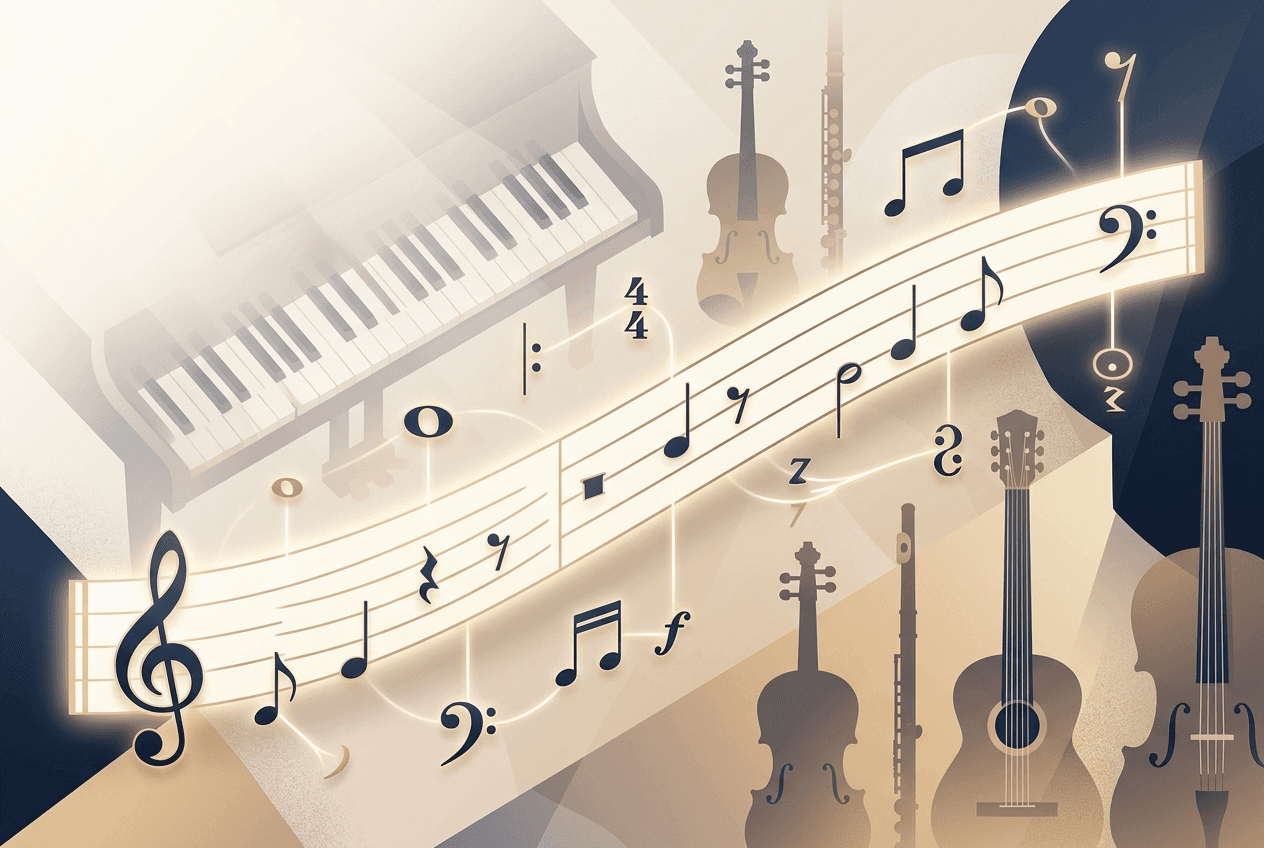 Those stacked numbers after the clef set the rhythmic ground rules. The top number counts beats per measure; the bottom names which note value gets one beat. Four-four means four quarter-note beats, the heartbeat of most popular sheet music worldwide.
Three-four waltzes, six-eight lilts, five-four surprises: each time signature creates a distinct groove before a single melody appears. We unpack every common meter, with counting drills, in our full time signatures guide. Bookmark it beside this page.
How to Count Any Meter
Number the beats aloud, stressing beat one: ONE two three four. Add the word and for eighth-note subdivisions: one-and-two-and. Tap your foot on numbers, clap the melody above it. Two layers, one brain, and suddenly rhythm reads itself.
Pickup Measures
Some pieces start mid-thought, with a partial measure called an anacrusis or pickup. Happy Birthday begins on one: the word happy arrives before beat one lands. Count the missing beats silently, breathe, and enter. The final measure usually repays the borrowed time.
Beams, Flags, and Note Groups
Single eighth notes wear flags; neighbors hold hands instead, joined by horizontal beams into readable clusters. Beams group notes by beat, letting your eye grab a whole rhythmic word at once rather than spelling letter by letter. Reading speed lives here.
Beam patterns also reveal the meter visually. Four-four groups eighths in twos and fours; six-eight bundles them in threes. Before playing anything, scan the beaming and the time signature together. The page literally diagrams its own groove for you.
Triplets and Tuplets
Sometimes three notes squeeze into two notes' time, marked with a small 3 above the beam. That's a triplet, the gateway tuplet. Swing, jazz, and countless film themes ride triplet feel. Count trip-a-let evenly and the squeeze becomes second nature.
Bar Lines and Measure Types
Vertical bar lines slice music into equal time parcels, keeping performers synchronized like commas keep readers breathing. A thin double bar marks a section's end; a thin-thick final bar closes the piece entirely. Small marks, big structural announcements. Measures also number themselves in printed scores, usually at each line's start. Rehearsal letters or boxed numbers mark landmarks for ensembles. When a conductor says letter B, everyone teleports instantly. Navigation systems this old still outperform most modern meetings, honestly.
Reading a Full Score: Putting It All Together
Open any piece and run this scan before playing: clef first, then key signature, then time signature, then tempo word, then a quick hunt for repeats and surprises. Thirty seconds of scouting prevents ninety percent of trainwrecks.
Then read rhythm and pitch as one unit, beat by beat, letting beams and bar lines chunk the work. Whisper counts while naming notes. Clunky at first, automatic within weeks. Every fluent reader you admire built exactly this scanning ritual first.
Try It on Happy Birthday
Find free sheet music for Happy Birthday and run the full checklist: three-four time, pickup measure, dotted rhythms, one octave leap. Everything this guide taught hides inside those eight friendly measures. Decode it completely and celebrate. You're officially reading music.
Sharps, Flats, and Key Signatures
A sharp raises a note one half step; a flat lowers it one. A natural cancels either. These accidentals appear beside individual notes and last through the measure. They're the seasoning that turns seven plain letters into twelve usable pitches.
Write the same sharps at every line's start and you've made a key signature: a standing instruction covering the whole piece. One sharp means G major territory; three flats, E flat major. Reading keys becomes instant with familiarity, promise.
The Order of Sharps and Flats
Sharps always arrive in order: F, C, G, D, A, E, B. Father Charles Goes Down And Ends Battle. Flats reverse it exactly: B, E, A, D, G, C, F. One sentence forward, one backward, every key signature decoded forever.
A First Look at the Circle of Fifths
Arrange all keys in a clock where each step adds one sharp clockwise or one flat counterclockwise, and you've drawn the circle of fifths, music theory's favorite diagram. Don't memorize it today. Just know the map exists; navigation comes naturally with repertoire.
Enharmonic Twins
F sharp and G flat name the identical piano key, a pairing called enharmonic equivalence. Context picks the spelling: sharps climb, flats descend, and the key signature votes too. Same sound, two passports. Don't let the double identity rattle you.
Dynamics: How Loud, How Soft
Italian letters under the staff control volume. The letter p means piano, soft; f means forte, loud; m softens either to medium. Stack letters for extremes: pp whispers, ff roars. These dynamics markings carry the emotional weather of every piece.
Then come the wedges. A hairpin opening rightward means crescendo, growing louder; closing means diminuendo, fading. Composers sculpt entire storms with these little angles. Play any melody twice, once flat and once with dynamics, and hear interpretation being born.
Tempo Markings: Setting the Speed
Above the first measure sits the speed limit, usually in Italian. Adagio strolls, andante walks, allegro jogs, presto sprints. Modern scores often add exact numbers: a quarter note equals 120 beats per minute, settable on any metronome instantly.
Speed words also carry character, not just velocity. Allegro means cheerful, literally. Grave means solemn weight. Composers chose these tempo marks as mood instructions wrapped inside speed instructions. Read them as both and performances gain personality immediately.
Articulation: Shaping Each Note
Articulation symbols decide how notes begin and end. A dot above a note means staccato, short and detached. A horizontal dash means tenuto, full value with weight. A curved slur connects different pitches smoothly, legato, no gaps between sounds.
Accents, marked with a small wedge, punch individual notes forward. These tiny marks transform identical pitches into completely different sentences. Our detailed articulation guide demonstrates each symbol at the piano, with practice patterns worth stealing for any instrument.
Ornaments and Grace Notes
Ornaments decorate melodies the way jewelry decorates outfits: small, shiny, optional yet transformative. A tiny crushed note before a main note is a grace note, played quickly and lightly. Baroque composers scattered them everywhere; Bollywood melodies still sparkle with them.
The classical trio deserves names. A trill rapidly alternates two neighboring pitches. A mordent bites once to the neighbor and back. A turn circles the main note above and below. Indian gamakas achieve similar magic, taught by ear rather than symbol.
How to Practice Ornaments
Learn the plain melody first, completely solid. Then add one ornament at a time at half speed, keeping the main beats immovable. Ornaments decorate rhythm; they never rob it. If the pulse wobbles, drop the jewelry and rebuild the outfit.
Chord Symbols and Lead Sheets
Pop, jazz, and worship musicians often read a leaner dialect: a single melody line with letters like C, Am, or G7 floating above. Those chord symbols compress whole harmonies into shorthand, trusting players to voice them freely. Welcome to lead sheets.
The letters follow simple grammar. A lone C means C major; a small m adds minor; a 7 stacks an extra note of tension. Guitarists and keyboardists worldwide jam from this shorthand nightly. Full sheet music precision, traded for improvisational speed.
When You'll Meet Each Format
Classical lessons and exams use fully notated scores. Band rehearsals, songwriter demos, and jazz gigs hand you lead sheets. Fluent musicians switch between dialects effortlessly, so sample both early. Each format strengthens the other's weaknesses in your training.
Expression Symbols You'll Meet Along the Way
Beyond the core system floats a constellation of specialty marks. A fermata, the bird's eye, holds a note until the conductor releases it. An ottava line shifts a passage one octave. A glissando slides gloriously between two pitches.
None of these need memorizing today. Meet them in the table below, greet them politely in repertoire later. Recognition beats memorization for rare symbols: know where to look things up and sheet music can never truly ambush you again.
Notation for Singers Vocal scores add a lyric layer beneath the notes, with syllables aligned under their pitches and hyphens splitting words across notes. When one syllable stretches over several notes, a slur marks the melisma, the vocal run every playback singer loves.
Breath marks, the small commas above the staff, plan your oxygen like punctuation plans speech. Pencil extra ones wherever phrases run long. Choir directors judge sight-singers largely on honoring lyrics, slurs, and breaths together. Train all three as one habit.
How Notation Changes Across Instruments
The core system stays universal, but instruments add dialects. Guitarists often read tablature, six lines mirroring six strings with fret numbers replacing pitches. Drummers read a percussion clef where line position means which drum, not which pitch. Same grammar, local accents.
Guitar Tab vs Staff
Tablature tells fingers exactly where to press but hides rhythm and theory. Staff notation reveals the music's logic but demands fretboard knowledge. Serious guitarists read both, using tab for speed and staff for depth. Neither replaces the other honestly.
Drum and Percussion Notation
On a percussion staff, the middle line usually carries the snare, spaces below hold toms and kick, and x-shaped heads mark cymbals. Duration symbols work identically to melodic music. Rhythm readers transfer to drums within days, delightfully.
Notation Software and Free Tools
Composers once needed ink and rulers; you need a browser. MuseScore offers professional engraving free, Flat.io runs in any browser, and NoteFlight suits classrooms. Type notes, press play, and hear your homework instantly. Instant feedback accelerates every note values lesson.
Apps also drill reading itself. Flashcard tools quiz note names against a clock, and sight-reading generators print endless fresh exercises. Ten software minutes daily, alongside real repertoire, roughly doubles beginner reading speed within a month. Free tools, real results.
A Word of Balance
Software plays back perfectly, which tempts beginners to let machines do the counting. Resist. Clap, count aloud, and internalize the pulse yourself, then verify with playback. Tools should check your reading of the clef and rhythm, never replace it.
Repeats and Navigation Signs
Composers hate copying passages twice, so sheet music evolved traffic signs. Double dots facing a double bar mean repeat the enclosed section. First and second endings bracket alternate exits. The system saves paper and tests your attention simultaneously.
Italian abbreviations handle bigger jumps. D.C. al Fine means return to the beginning and play until the word Fine. D.S. al Coda means jump back to the fancy S sign, then leap ahead at the coda symbol. Musical GPS, basically.
Reading a Roadmap Before Playing
Professionals scan every repeat, ending, and coda before playing note one, penciling arrows where jumps occur. Copy the habit. Thirty seconds of route planning prevents the classic trainwreck of half the ensemble looping while half sprints ahead.
Ledger Lines: Beyond the Staff
When melodies climb past the fifth line or dive below the first, short private rails called ledger lines extend the grid. Middle C between the staves rides the most famous one. Counting logic stays identical: lines and spaces keep alternating letters.
Beginners fear ledger territory unnecessarily. Anchor on landmarks instead: two ledger lines above treble is C, two below bass is E. Learn four landmarks and count short distances from them. High and low notes stop being scary within a week.
Sargam vs Staff: How Indian Notation Compares
Here's the perspective Western guides skip. India developed its own musical notation centuries ago: swara syllables Sa Re Ga Ma Pa Dha Ni written in scripts like Bhatkhande's system, with dots marking octaves and symbols marking time signature-like tala cycles.
The philosophies differ beautifully. Staff notation fixes absolute pitches; sargam floats relative to your chosen Sa, making every song portable to any voice. Explore the seven swaras fully in our swaras guide and become bilingual in music.
Why Learning Both Pays Off
Bilingual readers own both worlds: staff precision for ensembles and film sessions, sargam freedom for ragas and improvisation. Many Art Gharana students map Sa onto middle C during practice, letting each system explain the other. Double vocabulary, double opportunity.
A Short History of Written Music
 Ancient Greeks scratched letter systems above lyrics, and ninth-century monks drew squiggly neumes to jog chant memory. Then Guido of Arezzo added horizontal lines around 1025, inventing the staff and, incidentally, the do-re-mi syllables singers still use.
Printing presses standardized everything after 1400, and today notation software renders scores instantly. A thousand years of refinement sits inside every PDF your teacher emails. This written system remains a thousand-year open-source project, still updating, still free to learn.
India's Parallel Story
India's written tradition runs equally deep. Ancient texts described swara systems, and Vishnu Narayan Bhatkhande standardized modern Hindustani notation around 1910, publishing thousands of compositions. Two civilizations, two scripts, one shared instinct: great music deserves to outlive its makers.
Your First Week Reading Music: A Practice Plan
Day one and two: name treble staff notes with flashcards, five minutes each. Day three: clap note values from the table above. Day four: count rests aloud. Day five: read a four-measure melody slowly, naming before playing.
Days six and seven: combine everything on one children's song, checking dynamics and tempo marks too. Ten minutes daily, no marathons. Reading music is a language, and languages grow through small daily conversations, never through weekend cramming binges.
The Golden Rule of Sight-Reading
Never stop, never go back. Keep the pulse moving even through mistakes, exactly as you'd keep talking through a stumbled word. Momentum trains reading ahead, the single skill separating fluent readers from note-by-note decoders. Slow tempo, unbroken flow, always.
Track Your Progress Honestly
Keep a tiny log: date, minutes practiced, and one thing that clicked. Weekly, sight-read one saved exercise from day one and feel the difference physically. Documented progress fuels motivation better than willpower ever will, and reading fluency arrives measurably sooner.
Common Beginner Mistakes to Avoid
Mistake one: writing letter names under every note. The crutch feels kind and quietly prevents reading. Mistake two: ignoring rests, treating silence as optional. Mistake three: practicing fast and sloppy instead of slow and accurate. Speed is a byproduct, never a goal.
Mistake four: skipping the key signature and hitting wrong sharps all piece long. Glance left before playing, always. Mistake five: learning pitch but not rhythm, or the reverse. The two axes only make music together, so train them together from day one.
Frequently Asked Questions
1. What do music symbols mean?
Each symbol answers one question. Notes give pitch and duration, rests measure silence, clefs assign letter names, time signature numbers organize beats, dynamics letters set volume, and tempo words set speed. Together they form complete performance instructions on paper.
2. How do I read musical notation as a total beginner?
Start with the treble staff: learn line and space names using mnemonics, then note shapes for duration, then simple rhythms in four-four. Add the bass clef in week two. Ten minutes daily reads simple melodies within a month, genuinely.
3. What are the 7 musical notes?
Western music uses letters A through G, repeating each octave. Indian music uses the swaras Sa, Re, Ga, Ma, Pa, Dha, Ni. Both systems describe the same sonic staircase with different labels, and mapping one onto the other takes minutes.
4. What is a time signature in music?
The stacked numbers after the clef. The top number counts beats per measure, the bottom identifies which note value carries one beat. Four-four gives four quarter-note beats; three-four gives waltz time. It's rhythm's ground rule, set before bar one.
5. What do p and f mean in music?
They're Italian volume instructions: p for piano, meaning soft, and f for forte, meaning loud. Additions scale them: mp and mf sit in the middle, pp and ff push the extremes. These dynamics markings shape a piece's emotional contour.
6. Is Indian sargam a form of music notation?
Absolutely. Sargam syllables, octave dots, and tala markings form a complete written system, standardized by Bhatkhande in the early 1900s. It prioritizes relative pitch and improvisation where staff notation prioritizes absolute precision. Serious musicians benefit from reading both fluently.
Final Thoughts
The secret code turns out to be wonderfully logical: one grid, seven letters, a handful of shapes, and some Italian seasoning. Give musical notation ten patient minutes a day and the fluency compounds faster than any skill you've learned lately.
Reading opens every door: choirs, bands, exams, film sessions, and centuries of sheet music waiting silently in libraries. When you want a guide beside you, Art Gharana's instructors teach notation inside live music lessons, from first staff to first recital.