ChatGPT
 Google AI
 Grok
Grok Claude
Most beginners approach guitar scales the same way and it does not work. They find a diagram, memorise the shape, run up and down it for a fortnight, get bored, and conclude that scales are a chore unrelated to actually playing. The problem is not the scale, it is that nobody explained what it is for or how to practise it so that it changes anything. This guide fixes both. If you are still at the stage of forming chords, the beginner guitar chords guide comes first.
What follows covers which scale to start with and why, the four that actually matter early, how to practise them so they improve your playing rather than only your patience, and how to turn a memorised pattern into something musical. There is also a section on the Indian equivalent, because the concept of a scale works differently there in a way worth understanding.
What Is a Guitar Scale?
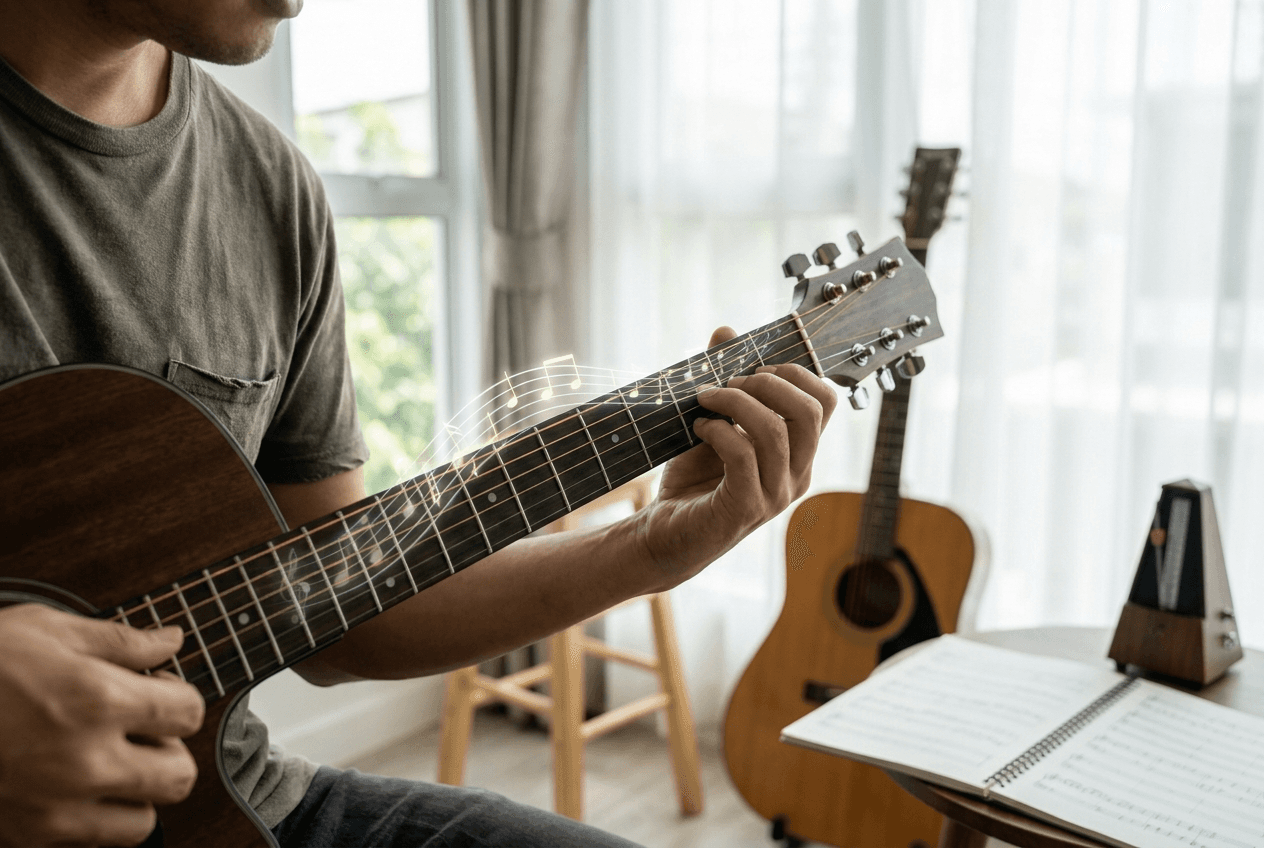 A scale is a set of notes arranged in order of pitch, played one at a time, which forms the raw material for melodies and solos. Guitar scales are usually learned as repeatable fretboard shapes rather than as note names, because the instrument's tuning means the same shape can be moved to a different position to play the same scale in a different key. A beginner typically starts with the minor pentatonic, a five-note scale used across blues, rock and pop.
Scales, chords and the relationship between them
A chord is several notes played together; a scale is the same material played one at a time. They come from the same source, which is why a solo built from the right scale fits over the chords underneath it and a solo built from the wrong one does not. Understanding that connection is the single thing that turns scale practice from an abstract exercise into something obviously useful.
Which Scale Should You Learn First?
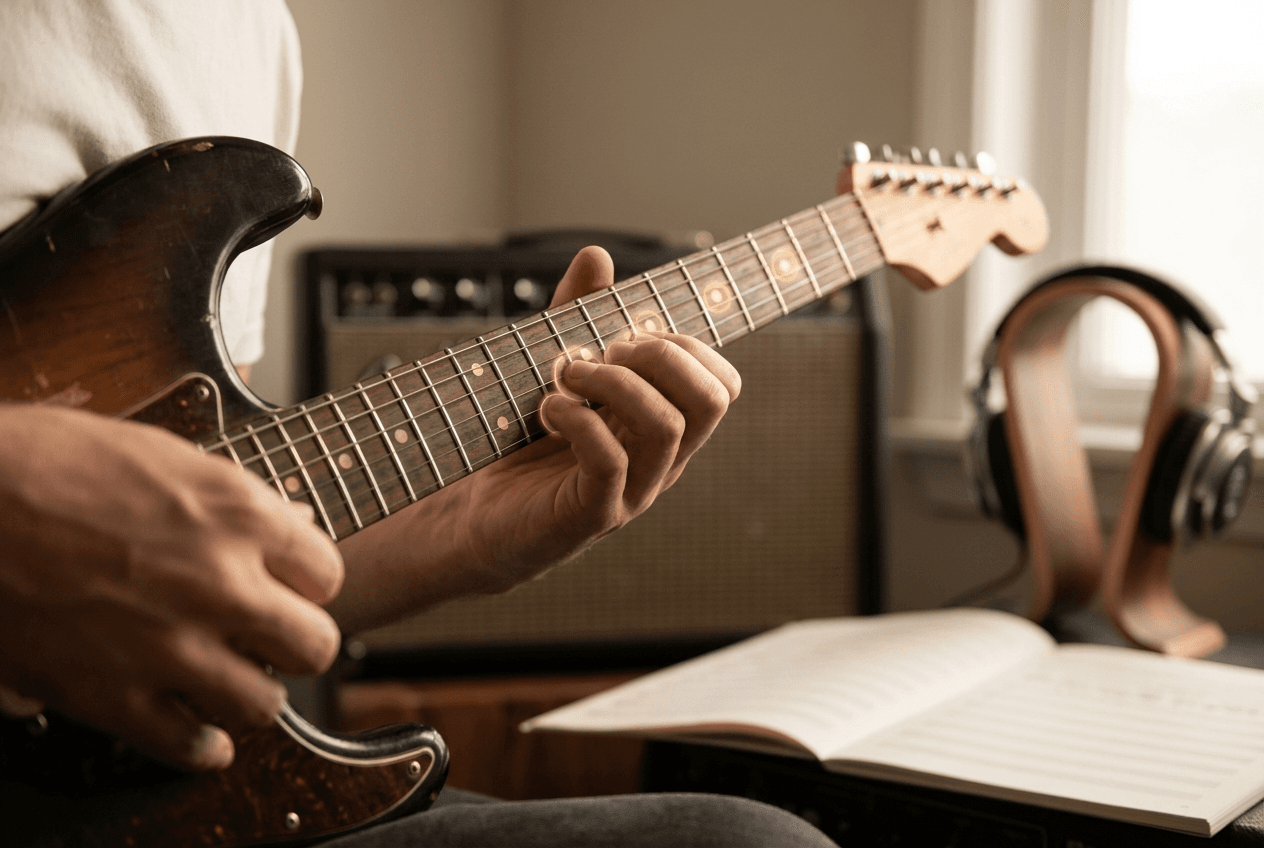 Of all the guitar scales available, the minor pentatonic, and there is no serious argument against it.
Five notes rather than seven, which means fewer to remember. Two notes per string in the standard shape, which makes it physically simple and symmetrical. It fits over an enormous amount of popular music without modification. And a very large share of the guitar solos you already know are built almost entirely from it, which means learning it gives you immediate access to music you recognise.
The other argument for it is psychological. Because it contains no notes that clash badly against common chord progressions, a beginner improvising with it will produce something that sounds acceptable almost immediately. That early success is what keeps people practising, and a scale that sounds wrong until you use it perfectly does not.
Why the blues scale is the natural second step
Because it is not really a new scale. It is the minor pentatonic with one extra note added between two existing ones, which means the shape you already know remains intact and you simply add a single finger position. That one note is responsible for most of what people mean when they describe a phrase as bluesy, and adding it costs almost nothing in learning time while changing the sound considerably.
Why the major scale matters even if you never solo with it
It is the reference against which everything else in Western music theory is described. Intervals, chord construction, key signatures and the relationships between chords all get explained in terms of it. A guitarist who knows the major scale can understand why a chord progression works, which is a different and more useful thing than being able to play fast over it.
How to Practise Scales Properly
How you practise guitar scales determines whether any of this helps, and where most beginners go wrong.
Slowly, and slower than feels necessary
Speed is the last thing to add and the first thing beginners chase. A scale played evenly and cleanly at a slow tempo builds accurate muscle memory. The same scale rushed builds inaccurate muscle memory, which then has to be unlearned. If any note is buzzing, muted or uneven, you are playing too fast.
With a metronome, from the start
Not as a refinement to add later. Practising without a fixed pulse means practising uneven timing, and uneven timing is the most common problem in self-taught guitarists. Set a slow tempo, play one note per click until it is completely secure, then two per click, and raise the tempo in small increments only when the current one is genuinely clean. The guide to using a metronome properly covers the method.
Alternate picking
Down, up, down, up, consistently, rather than picking whichever direction feels convenient. This feels awkward for a few weeks and it is what makes speed possible later. A player who picks inconsistently hits a ceiling around the point where the picking hand becomes the limiting factor, and correcting it afterwards is considerably harder than establishing it now.
Watch the picking hand rather than the fretting hand while practising this, since most players concentrate entirely on the left hand and never notice what the right is doing. Beginners commonly discover they have been picking downward twice in a row at string changes without realising, which is exactly the habit that limits speed later.
Know where the root is
The single most neglected instruction in scale practice. Every scale shape has a root note, the note the scale is named after, and knowing which notes in the pattern are roots is what lets you move the shape to a different key and what makes your playing sound anchored rather than aimless. Practise saying or thinking the root as you play it.
Ten minutes, not an hour
Scale practice is warm-up and skill-building rather than the main event. Ten focused minutes at the start of a session, daily, produces far more than a long weekly session, and it leaves the rest of your practice time for playing music, which is the reason you picked up the instrument.
Vary the pattern
Running straight up and down is the least useful way to practise a scale, because music does not move that way. Play it in groups of three, in fours, skipping notes, starting from different points in the pattern, and descending from the top. This is what makes a scale usable rather than merely memorised.
From Scale to Music
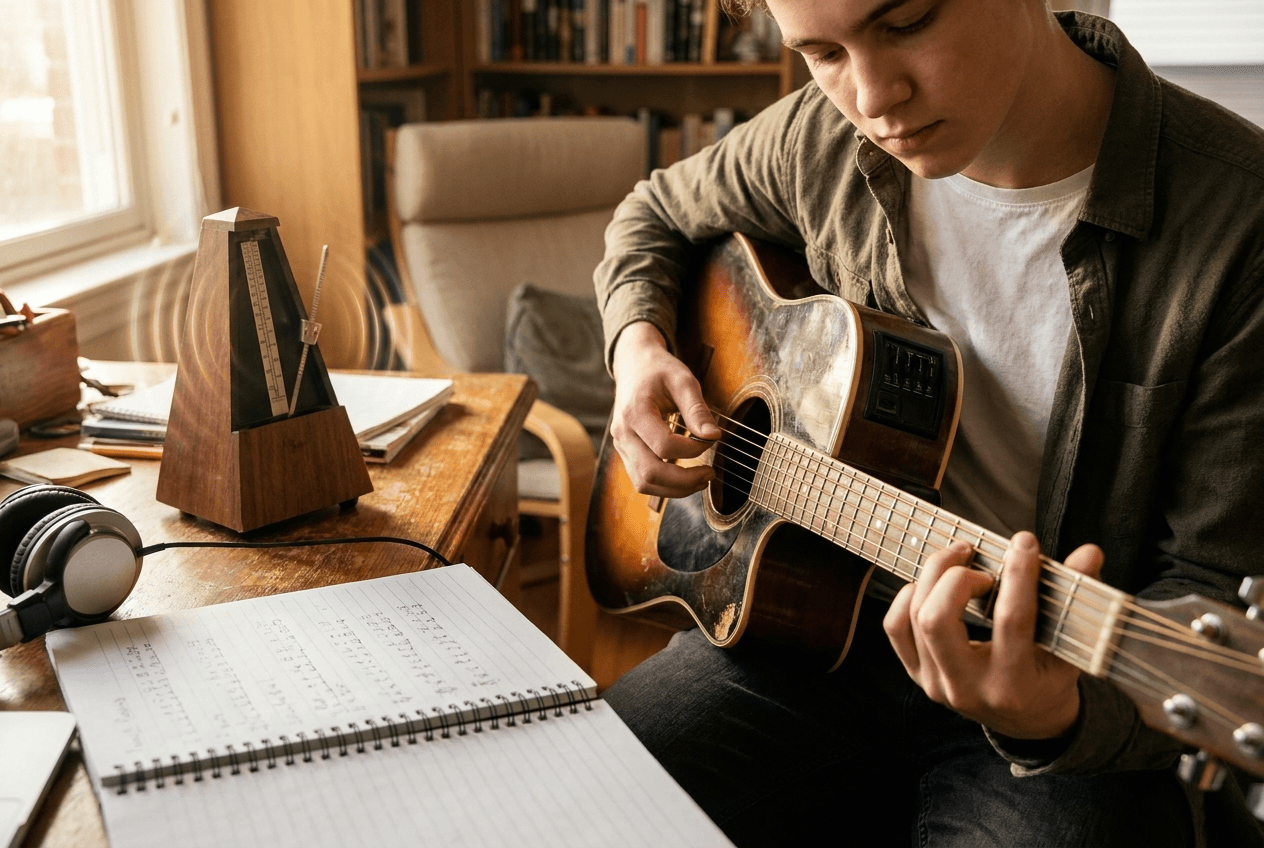 Turning guitar scales into music is the step almost nobody is taught, and the reason so many players know scales and cannot use them.
Play over something
A scale practised in silence stays an exercise. Play it against a backing track or a recorded chord progression in the same key, and it immediately becomes obvious which notes sound settled and which sound tense. That information is not available when practising alone and it is the whole point.
Free backing tracks in every key and style are widely available, and there is no reason to practise without one. Choose something slow to begin with, since fast tempos encourage running the pattern rather than making choices, and stay on one track long enough to get past the obvious ideas. Most players change track when they run out of things to say, and staying put is precisely when the more interesting ideas arrive. Ten minutes over one progression will teach you more than ten tracks in ten minutes.
Use fewer notes
Beginners improvise by running up and down the pattern, which sounds like a scale rather than a solo. Restrict yourself to three notes and make something musical from them. This forces phrasing, rhythm and repetition, which are what actually make a solo work, and it is a considerably harder and more useful exercise than playing all five notes quickly.
Leave gaps
Silence is a musical choice and beginners do not use it. Play a phrase, stop, listen, play another. The most memorable guitar solos in popular music contain far more space than a beginner expects, and filling every beat is the clearest marker of an inexperienced player.
Steal phrases
Learn short passages from solos you like, by ear where possible, and work out where they sit in the scale shape. This is how nearly every guitarist has learned to improvise, and a vocabulary of borrowed phrases recombined in your own way is not cheating, it is the tradition. Working these out by ear rather than from tablature builds the ear at the same time, though the guide to reading guitar sheet music and tabs is useful when a passage defeats you.
Sing what you play
An unexpectedly effective exercise. Sing a short phrase, then find it on the guitar. This connects your ear to the fretboard directly, and it is the difference between a player who executes patterns and one who plays what they actually hear in their head. Nearly every guitarist who improvises well can do this, and nearly every guitarist who cannot improvise has never tried it.
Understanding the Fretboard
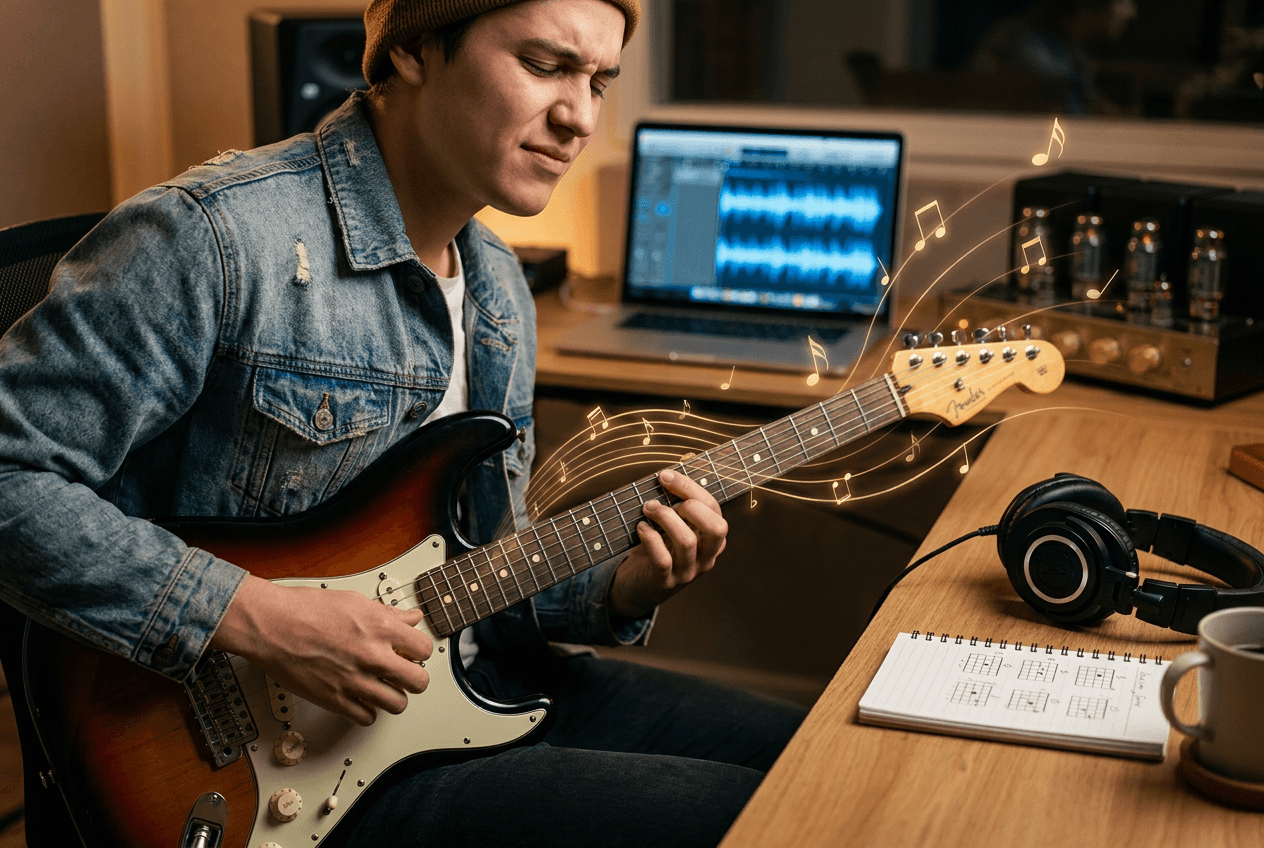 Scales are the route into fretboard knowledge, which is the thing that separates a guitarist who can play songs from one who can play music.
Why shapes move
Standard guitar tuning means an interval between two frets is the same distance wherever you are on the neck, with one small adjustment across the second and third strings. That is why a scale shape learned in one position plays the same scale a few frets higher, just in a different key. Nothing else about the shape changes.
This is the guitar's great advantage over instruments where every key demands different fingering, and it is also the source of a common trap. A player can learn one shape and move it around for years without ever knowing what notes they are playing, which works until they need to communicate with other musicians or read anything.
Learn the notes on two strings
The efficient shortcut. Learn the note names along the sixth and fifth strings only, which is far less work than the whole neck, and you can locate the root of any moveable shape immediately. Almost every scale and barre chord shape has its root on one of those two strings, so this small piece of memorisation unlocks a disproportionate amount.
Connect it to what you already know
If you have learned open chords, you already know several scale notes without realising, since a chord is built from notes of its parent scale. Playing a chord and then finding those same notes one at a time around the shape is a genuinely useful exercise and it makes the connection concrete rather than theoretical. The guide to guitar anatomy and parts covers the physical layout this all sits on.
Common Mistakes
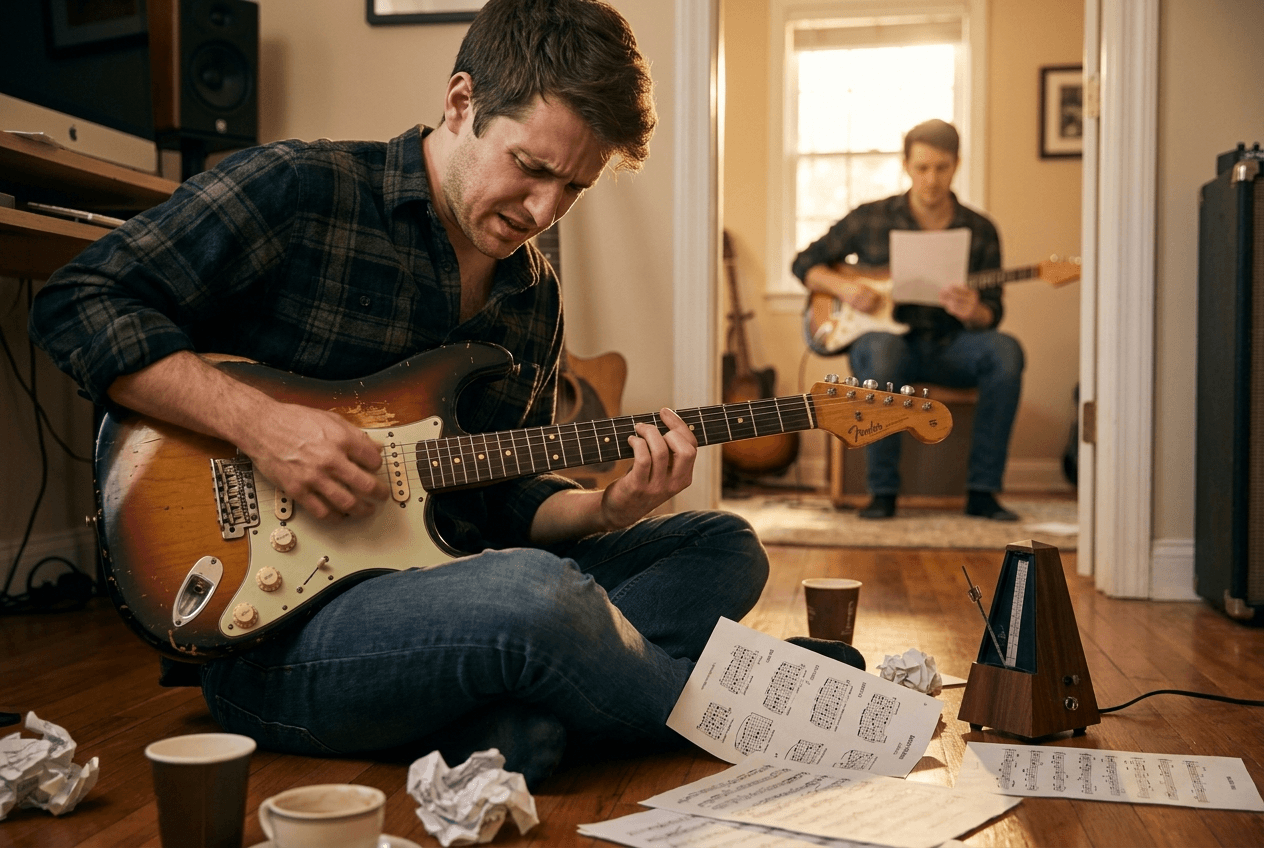
Learning too many scales
The most common error by a distance. A player who knows one scale thoroughly, in every position, and can make music with it, is far ahead of one who has memorised seven and can use none. Depth first, breadth much later, and most players never need the breadth at all.
Practising only the shape
Memorising a pattern without knowing the root, the key, or what it fits over produces a player who can execute something they cannot deploy. Always connect the shape to a key and to the chords it works against.
Practising fast
Speed is a by-product of accuracy repeated many times, not something to be attempted directly. Every teacher says this and every beginner ignores it, and the ones who ignore it plateau.
Skipping the metronome
Playing along to recordings is enjoyable and it is not the same as building internal time. A metronome exposes exactly where your timing drifts, which is uncomfortable and necessary.
Never using them
Practising scales in one part of your session and then never applying them in another is how scale practice becomes a ritual disconnected from playing. Every session should include some attempt to use what you are drilling.
Scales Beyond the First Year
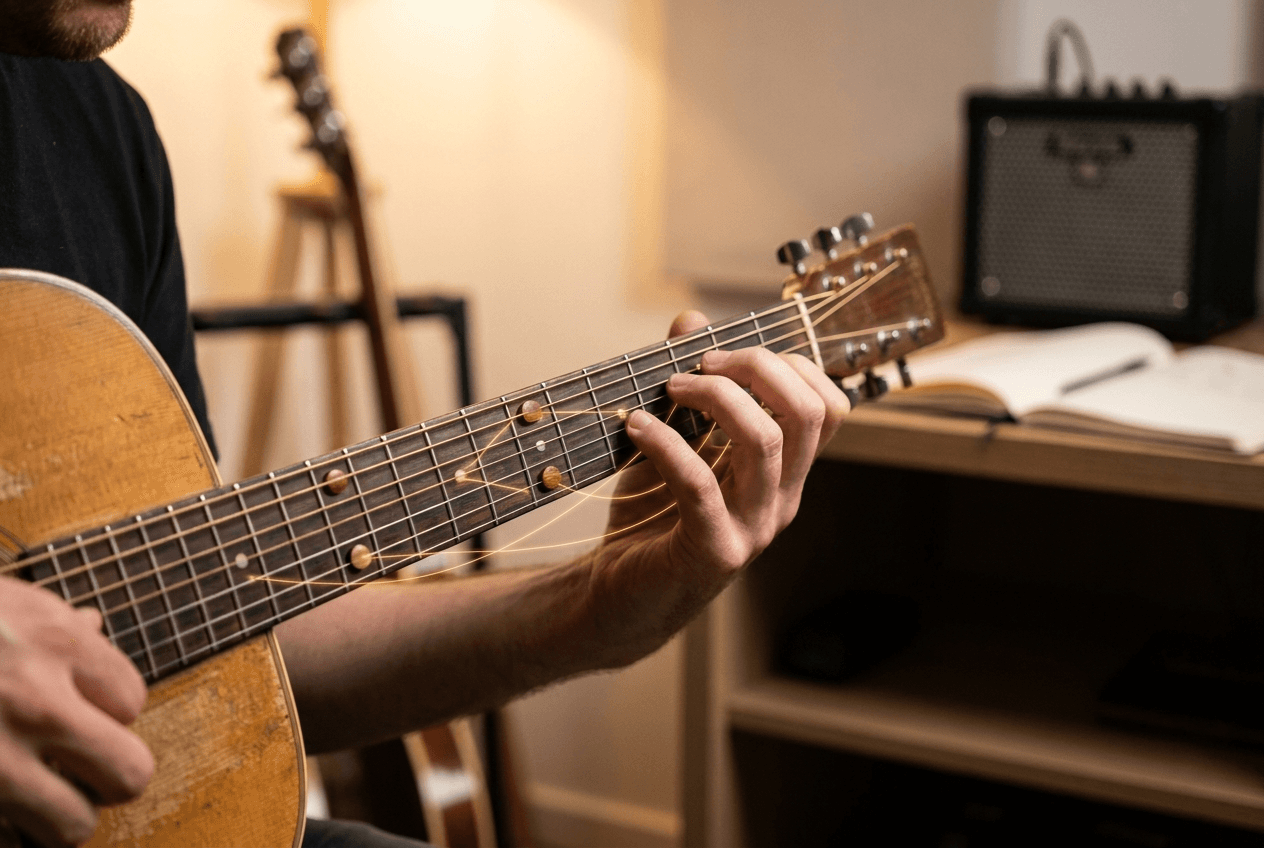 The advanced guitar scales are covered briefly here, so you know what is coming and do not attempt it prematurely.
Once the minor pentatonic is automatic in one position, the next step is learning it in all five positions across the neck, which connects the fretboard into a single map rather than a set of isolated boxes. That is a substantial project and it transforms a player's freedom.
The useful way to approach that project is one position at a time, learning each until it is as secure as the first, and specifically practising the joins between them rather than each box in isolation. Players who learn five separate shapes end up with five separate shapes; players who practise moving across the boundaries end up with a fretboard.
Beyond that sit the modes, which are the major scale started from different points and which produce different characters, and the harmonic and melodic minor scales, which supply the sound of a great deal of jazz, metal and classical-influenced playing. None of these are urgent, and attempting them before the pentatonic is secure is the standard way to waste a year.
Scales in Indian Music
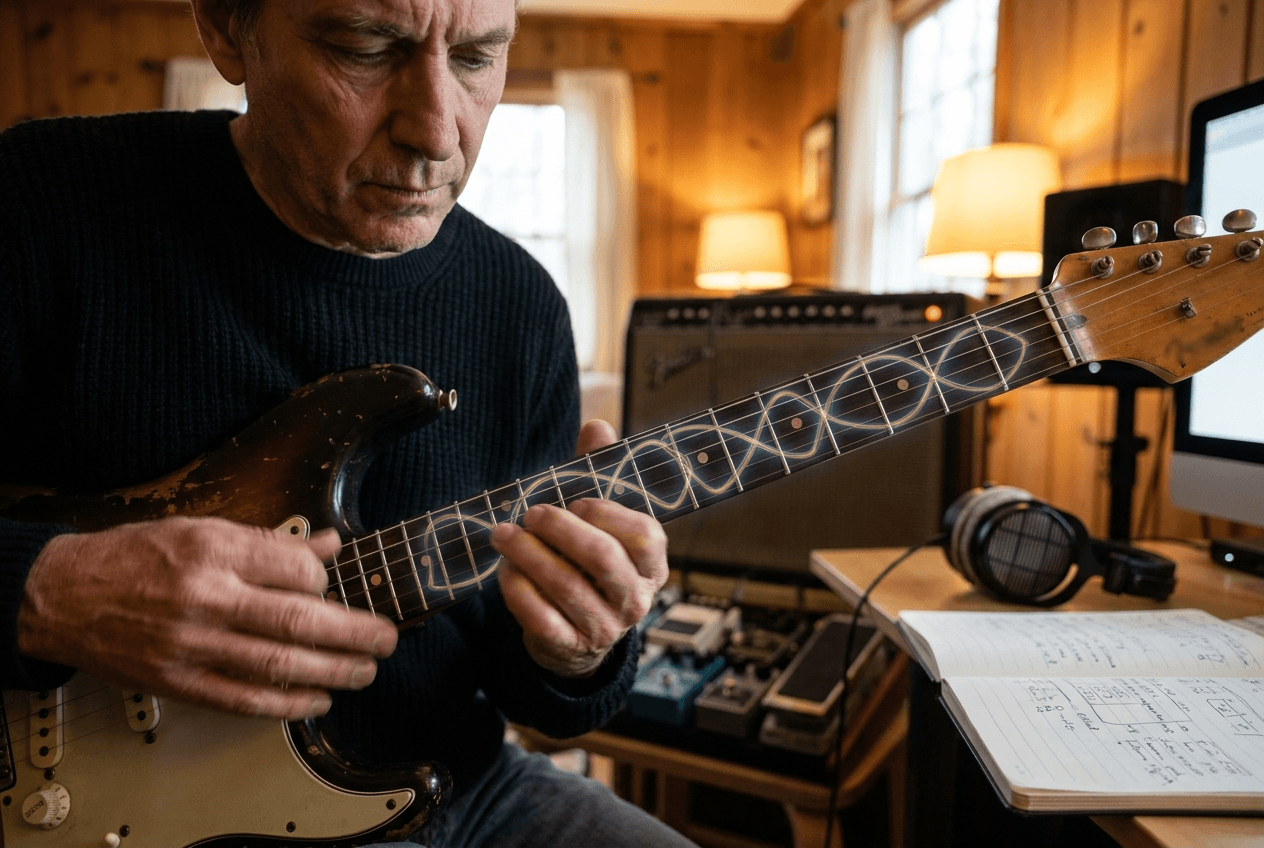 Worth a section, because the concept exists there in a form that is related and genuinely different, and any guitarist interested in Indian music will hit this immediately.
Indian classical music organises melody through raga, which contains a scale and is not reducible to one. A raga specifies which notes are used, and also how they are approached, which are emphasised, which are ornamented, which ascending and descending patterns are permitted, and what character the whole thing carries. Two ragas can use identical notes and be entirely different pieces of music.
The practical consequence for a guitarist is that playing the notes of a raga does not produce that raga. The ornaments, principally meend, the continuous glide between notes, and the various oscillations, are the substance rather than decoration, and a fretted instrument produces fixed pitches with nothing in between. This is the reason Pandit Vishwa Mohan Bhatt rebuilt a guitar as the Mohan veena and played it with a slide.
For a guitarist wanting to explore this, the useful starting points are bending and slide technique, which get you closer to continuous pitch movement than fretted playing does, and simply listening extensively before attempting to play anything. The framework is set out in the guide to Indian raga music and the note system in the complete guide to swaras.
What transfers back
Two things, and both improve Western playing. Indian training places enormous emphasis on singing what you play, which builds the ear connection described earlier. And it treats a small amount of material explored deeply as more valuable than a large amount covered superficially, which is exactly the correction most guitar students need.
There is a third worth mentioning. Indian classical training works constantly against a drone, which builds an unusually accurate sense of pitch relationships because every note is heard in relation to a fixed reference. A guitarist who practises scales against a sustained root note rather than in silence develops something similar, and it is a small change that noticeably improves intonation on bends.
How Long Until It Sounds Like Something
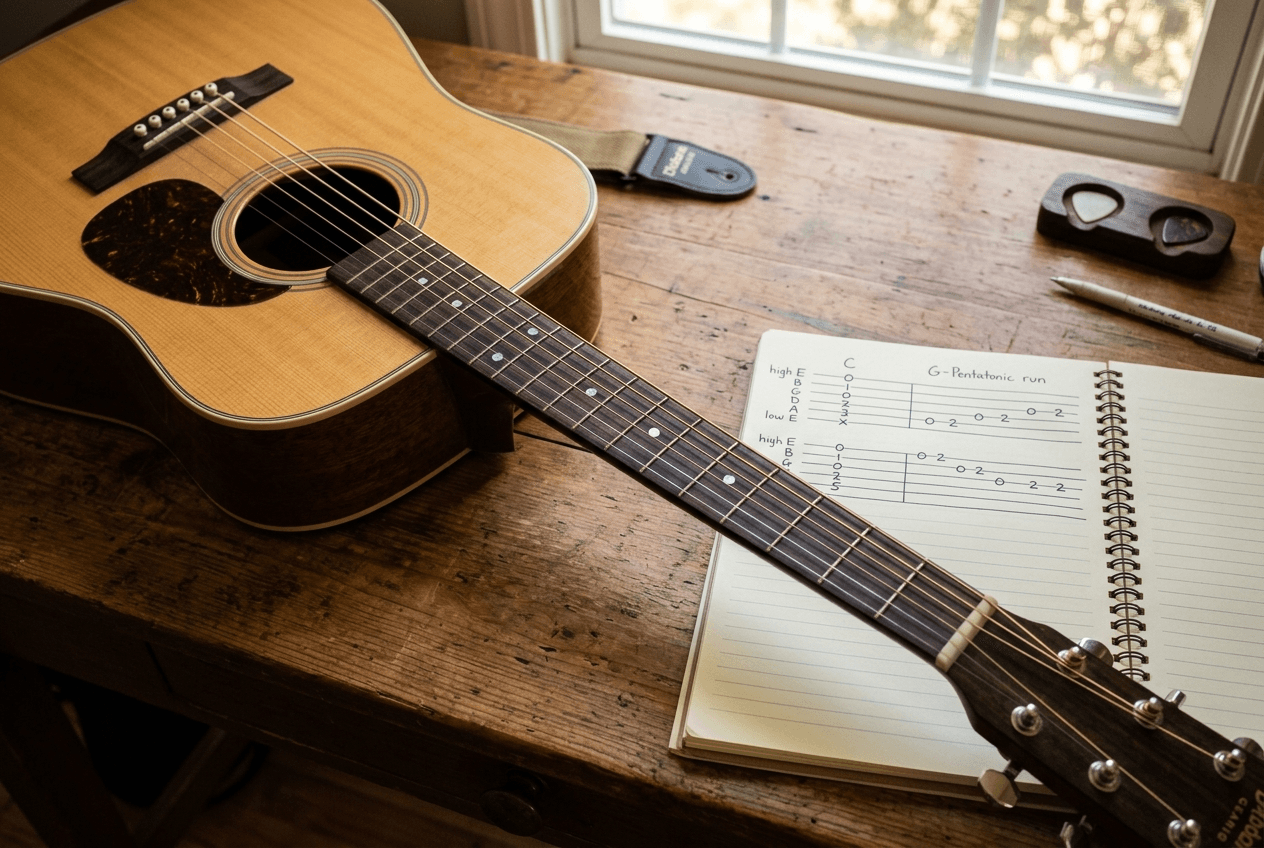 Realistic expectations, since vague promises are why beginners give up at the point where they were about to improve.
Two to four weeks to have one pentatonic shape memorised and playable slowly without looking. Two to three months to play it cleanly at a moderate tempo with a metronome and to know where the roots are. Around three to six months before improvising over a backing track produces something you would be willing to play to someone else.
A year to know the scale in more than one position and to have a small vocabulary of phrases that are recognisably yours. And several years before improvisation feels like speaking rather than assembling, which is the stage every player is aiming at and which arrives gradually rather than suddenly. Those figures assume ten focused minutes on scales most days alongside other practice. They stretch considerably with irregular practice and they do not shorten much with longer sessions, because the limiting factor is the number of days rather than the number of hours.
The plateau, and why it happens
Almost every guitarist hits a stretch around three to six months where the pentatonic feels exhausted and everything they play sounds the same. This is not a ceiling, it is the point at which pattern knowledge has outrun musical vocabulary, and the fix is not another scale. It is learning phrases from records, restricting yourself to fewer notes, and working on rhythm rather than pitch.
Players who respond to this by learning a new scale usually arrive at the same plateau with a different shape a few months later. Players who respond by working on phrasing get past it.
A Practice Routine That Works
Twenty to thirty minutes, most days, structured rather than improvised.
Five minutes of scale work with a metronome, slowly, one scale, varying the pattern rather than running it straight. Five minutes on a specific technical problem, whether a chord change, a passage that keeps failing, or picking accuracy. Ten minutes on actual music, meaning a song or a piece you are learning. And five minutes of playing freely over a backing track, applying whatever you have been drilling.
The last of those is the one people cut when short of time and it is the one that connects everything else to music. Cut the technical work instead if you must, because a session with no music in it is how practice becomes a chore.
Scales on Acoustic and Electric
 A practical difference that affects how scale practice feels and which nobody warns beginners about.
Acoustic
Heavier strings, higher action and a wider neck make scale runs physically harder, and bending notes takes real finger strength. That is not a disadvantage for practice, since a player who can execute cleanly on an acoustic finds an electric considerably easier, and the strength built transfers directly.
Acoustic playing also tends toward chord and melody work rather than sustained lead lines, because the instrument does not sustain long notes the way an amplified electric does. Scale knowledge on acoustic is therefore more often used for melody, fills between chords and fingerstyle arrangement than for soloing.
Electric
Lighter strings, lower action and a narrower neck make fast runs and bends far more achievable, which is why lead playing developed on the instrument. Sustain from amplification means a single held note remains musically interesting, which changes what a solo can be built from.
The complication is that amplification and distortion expose sloppiness rather than hiding it. Unwanted string noise, notes not fully fretted and inconsistent picking all become audible, so an electric player needs muting technique, which is a whole skill acoustic players largely avoid. The comparison between the two instruments is covered in the guide to buying a first guitar.
Which to practise on
Whichever you own. The scale shapes are identical and everything transfers. If you have both, alternating is useful, since acoustic builds strength and electric builds speed and each exposes different weaknesses.
Frequently Asked Questions
Which guitar scale should I learn first?
The minor pentatonic. Five notes rather than seven, two notes per string in a symmetrical shape, and it fits over an enormous amount of popular music. A very large share of well-known guitar solos are built almost entirely from it, and it produces acceptable-sounding results almost immediately, which keeps beginners practising.
How do I practise guitar scales?
Slowly, with a metronome from the start, using consistent alternate picking, and knowing where the root notes are. Ten focused minutes daily beats an hour once a week. Vary the pattern rather than running straight up and down, and always spend part of the session applying the scale over a backing track.
What is the easiest guitar scale?
The minor pentatonic, because it has only five notes and the standard shape uses two notes per string, making it physically symmetrical and simple to remember. The blues scale is the natural next step since it adds only one note to a shape you already know.
Why should I learn scales at all?
Because scales are the raw material of melody and soloing, and because they connect to chords, which is what lets you understand why music works rather than only reproducing it. They also build finger independence, picking accuracy and fretboard knowledge, all of which improve everything else you play.
How long should I practise scales each day?
Ten minutes is enough and more is usually counterproductive at beginner level. Scale practice is warm-up and skill-building, not the main event, and a session spent entirely on scales leaves no time for the music that made you want to play. Frequency matters far more than duration.
How many scales do I need to know?
Far fewer than most beginners assume. One scale known thoroughly, in multiple positions, and usable over a backing track, is worth more than seven memorised and unused. The minor pentatonic alone will carry you through several years of blues, rock and pop playing.
What is the difference between the pentatonic and the blues scale?
One note. The blues scale is the minor pentatonic with a single additional note inserted between two existing ones, and that note produces most of what people recognise as the blues sound. The shape you already know stays intact, which is why it is the natural second scale to learn.
Do I need to know music theory to use scales?
Not to start. You can learn a shape, find the root, and play over a backing track in that key without any theoretical knowledge. Theory becomes valuable once you want to understand why certain notes work and to move between keys deliberately, and the major scale is where that understanding begins.
How do I stop my solos sounding like scales?
Restrict yourself to three notes and make music from them, which forces phrasing and rhythm rather than pattern-running. Leave gaps, since beginners fill every beat and memorable solos contain far more space. And learn short phrases from solos you like by ear, then recombine them in your own way.
Can I use guitar scales for Indian music?
Partly. Indian classical music uses ragas, which specify not only which notes are used but how they are approached, ornamented and emphasised, so playing the notes does not produce the raga. The continuous glides central to the tradition are difficult on a fretted instrument, which is why slide technique and instruments like the Mohan veena exist.
Final Thoughts
The reason most people give up on guitar scales is that they were taught the shape and not the purpose. A scale is not a test of memory, it is the material your melodies and solos are made from, and it only becomes interesting when you play it over something and start choosing between the notes rather than running through all of them.
So learn one scale, the minor pentatonic, properly. Ten minutes daily with a metronome, know where the roots are, and spend part of every session using it over a backing track with only three notes at a time. That single scale, used well, will take you further than five learned badly. Art Gharana teaches guitar live and one-to-one across acoustic, electric and Indian approaches, with a free first lesson.