ChatGPT
 Google AI
 Grok
Grok Claude
Learning to read guitar sheet music and tabs is essential for any beginner aiming to play songs quickly and accurately. While some musicians rely solely on playing by ear, understanding guitar notation gives a significant advantage. Reading music for guitar allows you to learn guitar notes and chords, understand timing, and follow complex melodies effortlessly. Beginners who master notation can play songs without relying on memory alone, leading to faster improvement and deeper comprehension of music. To strengthen your skills with expert guidance, you can explore online guitar classes.
Playing by ear can be fun, but it often limits learning to familiar songs. Guitar notation, including both guitar sheet music and guitar tablature, provides a structured roadmap for learning. It teaches rhythm, pitch, and musical theory simultaneously. By learning both, beginners develop versatile skills, enabling them to tackle solos, riffs, and chord progressions in any style. Combining ear training with notation reading produces well-rounded musicianship.
Guitar Sheet Music vs Guitar Tabs

Understanding Guitar Sheet Music
Guitar sheet music uses a staff with five lines and four spaces to represent notes. Each note corresponds to a pitch, and the treble clef shows which notes correspond to which guitar strings. Learning sheet music trains you to read rhythm, timing, and pitch simultaneously. Notes include whole, half, quarter, eighth, and sixteenth durations, making it easier to play songs with accurate timing. Understanding key signatures further helps you play in the correct scale and tune, essential for performing with others. For a practical reference while learning, you can check out this guitar chord chart for beginners.
Sheet music is ideal for classical guitar, fingerstyle, and any genre requiring precise note accuracy. It can also enhance your ability to play guitar exercises for beginners, such as scales and arpeggios, effectively improving dexterity. While it may seem intimidating at first, consistent practice enables beginners to identify notes quickly and sight-read songs with ease.
Understanding Guitar Tabs
Guitar tabs, or guitar tablature, display music on six horizontal lines representing strings, with numbers indicating frets to press. Tabs show where to place your fingers and allow beginners to play chords and single notes without learning standard notation. This method is particularly helpful for learning rock, pop, and electric guitar songs quickly.
Reading guitar tabs left to right ensures you play the notes in chronological order. Chords are indicated by stacked numbers, while riffs are displayed linearly. Guitar tabs for beginners are easier to understand because the visual layout mirrors the guitar fretboard. Learning tabs allows students to play familiar songs and solos early, boosting confidence and motivation.
Key Differences Between Sheet Music and Tabs
While sheet music emphasizes timing and musical structure, tabs focus on finger placement. Sheet music is ideal for learning rhythm, melodies, and theory, whereas tabs are faster for learning beginner guitar songs. Both methods complement each other, and skilled guitarists often use a combination for practice. Understanding when to use each depends on your goals: tabs for immediate playing and sheet music for developing long-term musicianship.
Learning How to Read Guitar Sheet Music
Memorizing Notes on the Staff
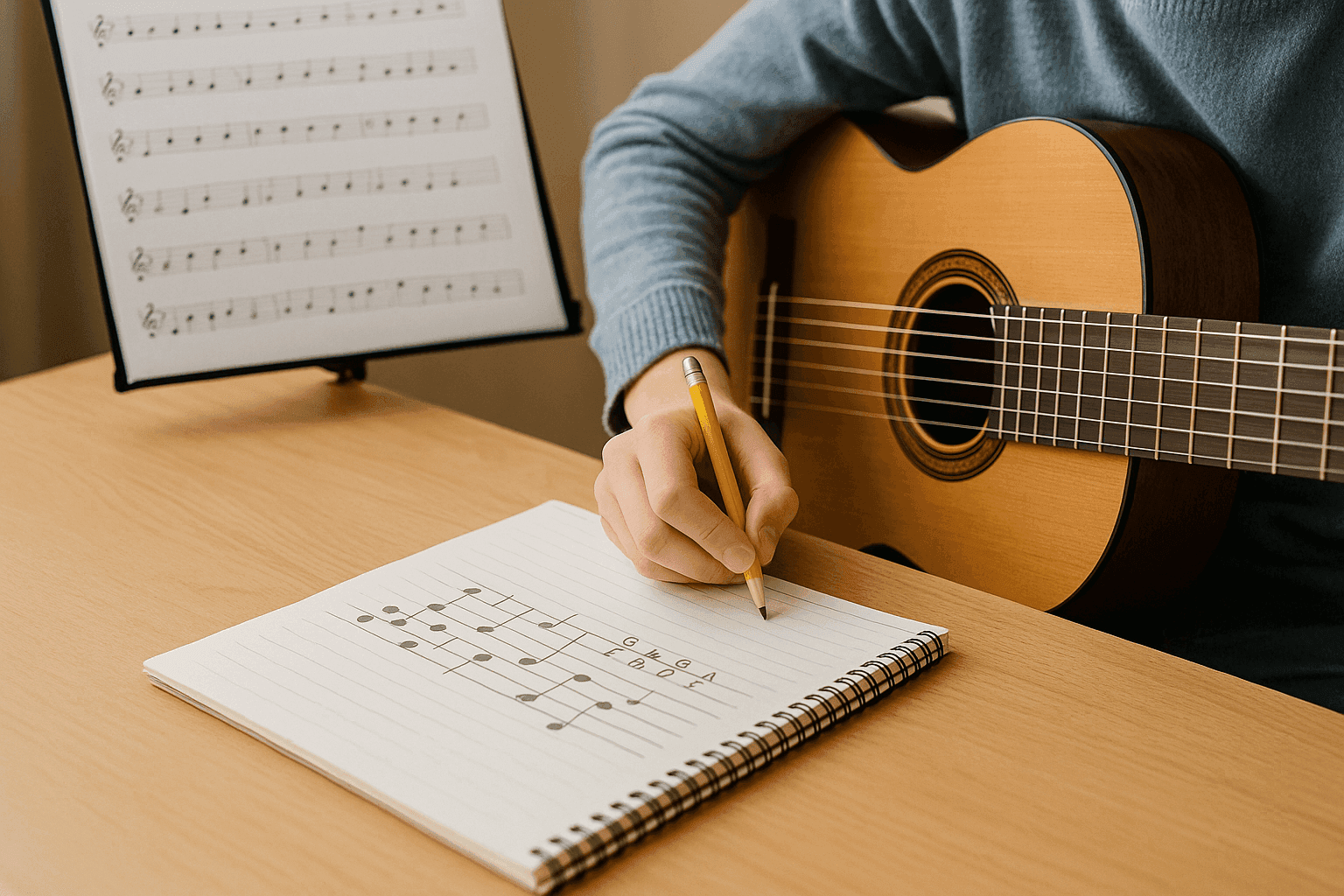
Memorizing notes on the staff is crucial for sight-reading. Each line and space represents a specific pitch, and consistent practice allows beginners to recognise guitar notes to play instantly. Using mnemonic devices, such as "Every Good Boy Deserves Favour" for lines, can simplify learning. Repetition and exercises help solidify this knowledge, making playing smoother and more confident.
Understanding Key Signatures
Key signatures indicate which notes are sharp or flat throughout a piece. Knowing key signatures helps beginners avoid wrong notes and maintain musical coherence. For instance, a piece in the key of G major has one sharp, F#. Learning this allows guitarists to play scales, chords, and melodies accurately.
Reading Rhythm
Rhythm guides the timing and duration of each note. Beginners learn note duration, including whole, half, quarter, eighth, and sixteenth notes, and combine them with musical rests to maintain proper timing. Understanding dotted notes and syncopation enhances the musicality of playing, creating dynamic and expressive performances.
Note Duration
Each note type lasts a specific length, such as a whole note spanning four beats and a quarter note lasting one beat. Correctly interpreting durations ensures songs sound like the original composition.
Musical Rests
Rests indicate silence for a certain duration. Beginners must count rests accurately to maintain rhythm, which is vital when playing with other musicians or backing tracks.
Dotted Notes
A dot increases a note's duration by half. For example, a dotted quarter note lasts for one and a half beats. This subtle change enhances rhythm complexity and musical expression.
16th Notes
Sixteenth notes divide beats further, requiring precise timing and dexterity. Practicing 16th notes improves finger speed and coordination, essential for fast guitar riffs and solos.
Practical Exercises for Sheet Music
Exercise #1: Reading Simple Notes
Start with open strings and single fretted notes. Play slowly and match each note to the staff visually.
Exercise #2: Completing Measures
Use simple measures with quarter and half notes to practice counting beats and combining different note durations.
Exercise #3: Playing Dotted Notes
Introduce dotted notes to your exercises. Play along with a metronome to maintain consistent timing.
Exercise #4: 16th Notes Practice
Gradually incorporate sixteenth notes into exercises. Focus on smooth transitions between fretted notes and open strings.
How to Read Guitar Tabs
Understanding the Guitar Tab Staff
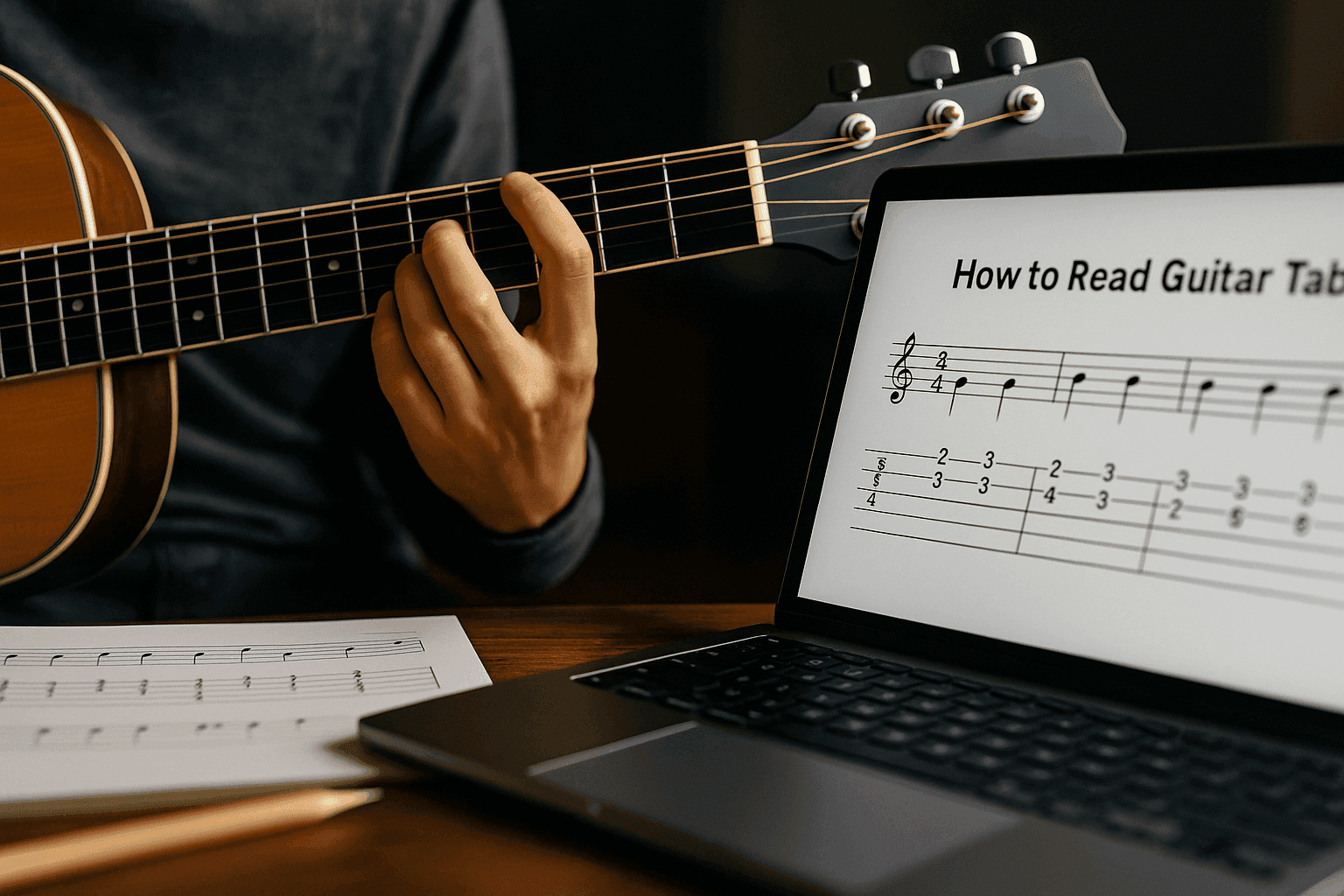
Guitar tabs display six horizontal lines representing strings, with the top line as high E and the bottom as low E. Numbers show which fret to press, while the spacing indicates timing. This method simplifies learning playing chords and single notes without memorising standard notation.
Understanding Guitar Frets
Frets divide the guitar neck into semitones. Numbers on the tab correspond to frets, guiding your fingers precisely. Open strings are marked as 0, while fretted notes are indicated with numbers. Learning guitar frets and strings helps beginners navigate the fretboard confidently. For a detailed guide on strings and frets, you can check out this complete guitar strings guide.
Reading Guitar Chords in Tabs
Chords are shown as stacked numbers on multiple strings. Tabs make chord transitions visible, showing which strings to press simultaneously. For more chord guidance, see Guitar Chord Chart for Beginners.
Reading Guitar Riffs in Tabs
Riffs combine single notes and partial chords, forming memorable hooks in songs. Tabs indicate the order and timing of notes for accurate playing.
Guitar Tabs vs Chord Charts
Chord charts show finger positions without timing, while tabs show exact notes and rhythm. Combining both methods helps beginners play songs accurately and understand guitar strumming patterns.
Fingering and Number Notation
Guitar tabs display fret numbers, while finger numbers guide hand placement. Understanding the finger numbering system ensures proper technique for chords, scales, and riffs.
Reading Guitar Tab Symbols
Learning guitar tab symbols is essential for playing expressive techniques. Below is a detailed table summarising common symbols and their usage:
| Guitar Tab Symbol | Technique | Description | Example |
|---|---|---|---|
| 0 | Open String | Play the string without pressing any fret | 0 on high E = play open E string |
| 1, 2, 3… | Fretted Note | Press the string on the numbered fret | 3 on B string = play B string at 3rd fret |
| h | Hammer-On | Strike a note and hammer onto a higher note | 5h7 = play 5th fret, hammer onto 7th fret |
| p | Pull-Off | Pull off a fretted note to a lower note | 7p5 = play 7th fret, pull off to 5th fret |
| / | Slide Up | Slide finger up to a higher fret | 5/7 = slide from 5th fret to 7th fret |
| |Slide Down | Slide finger down to a lower fret | 7\5 = slide from 7th fret to 5th fret | |
| b | Bend | Push string to raise pitch | 7b9 = bend 7th fret to sound like 9th fret |
| r | Release Bend | Release a bent note back to original pitch | 9r7 = release bend from 9th fret back to 7 |
| PM | Palm Muting | Lightly mute strings with picking hand | PM— = strum while muting |
| x | Muted Note | Notes muted by fretting hand | x = string hit but muted |
| ~ | Vibrato | Rapid pitch fluctuation on a note | 7~ = vibrato on 7th fret |
| T | Finger Tapping | Tap string with picking hand | T12 = tap 12th fret with picking hand |
| ^ | Pre-Bend | Bend note before picking | 7^9 = pre-bend to 9th fret before picking |
| + or ^ | Harmonic | Play natural harmonic | 12^ = harmonic on 12th fret |
This table provides a quick reference for beginners learning how to read guitar tabs and apply expressive guitar techniques.
Essential Guitar Techniques Through Tabs
Muting Guitar Notes
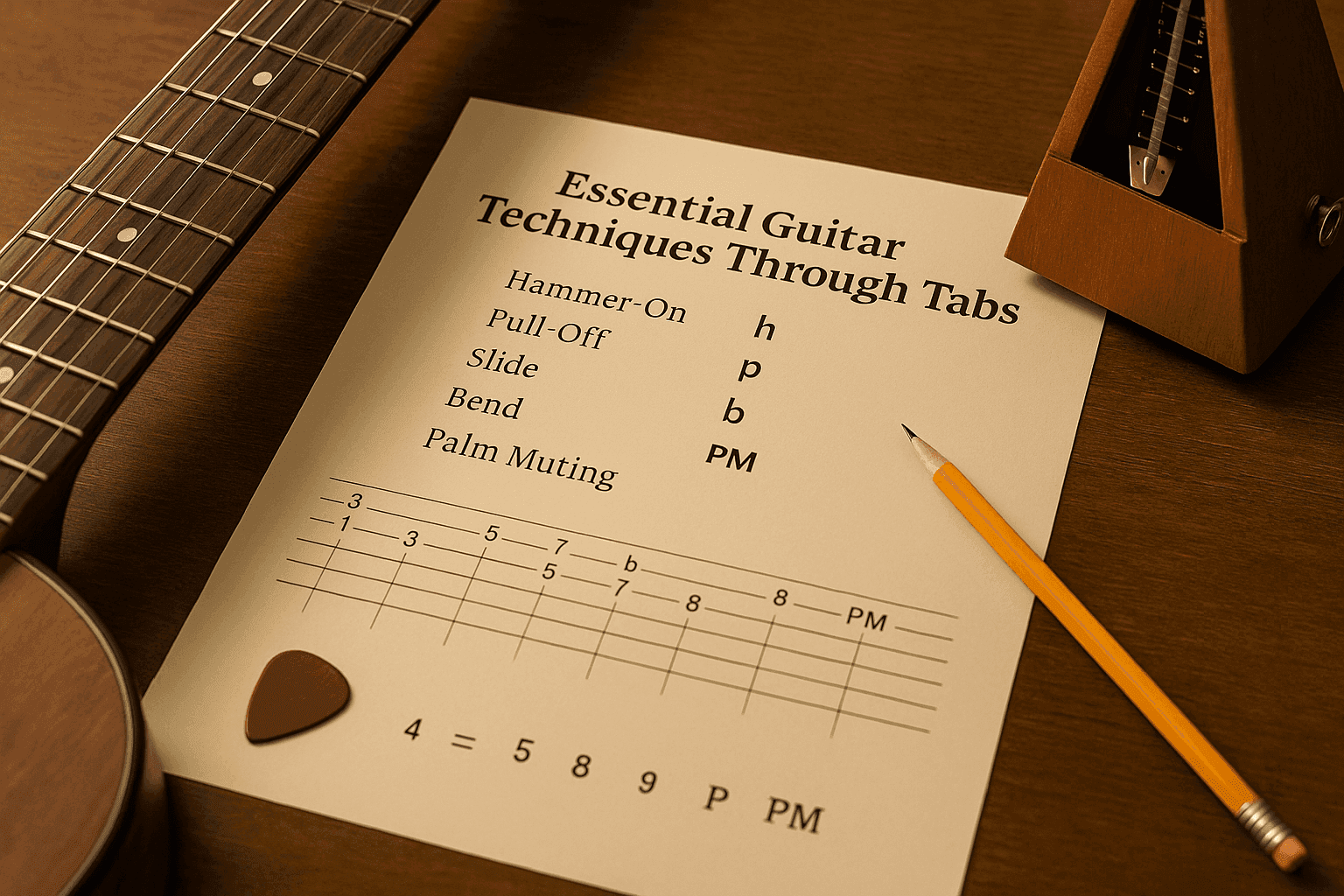
Muting improves clarity and rhythm. Palm muting and fretting hand muting create dynamic sound textures. For detailed guidance, beginners can check Guitar Tuning Beginners Guide.
Palm Muting
Palm muting uses the picking hand to dampen strings, producing a tight, percussive sound. It is especially effective in rock and metal riffs.
Muted Notes
Muted notes use the fretting hand to lightly touch strings without pressing, producing a percussive effect.
Bending Guitar Strings
Bends add expressive quality. Standard bends and pre-bends change the pitch smoothly for solos and riffs.
Standard Bend
Push a string up or down to reach the target note, typically using multiple fingers for control.
Pre-Bending
Pre-bend a string before picking to achieve precise pitch changes and expressive phrasing.
Sliding Guitar Notes
Slides transition notes smoothly along the fretboard.
Slide Up
Slide from a lower to higher fret to reach the target note.
Slide Down
Slide from a higher to lower fret for descending phrases.
Hammer-Ons and Pull-Offs
Hammer-ons and pull-offs enable fluid playing without picking every note.
How to Play Hammer-Ons
Strike a string and hammer onto a higher fret, creating smooth note transitions.
How to Play Pull-Offs
Pull-off a fretted note to a lower pitch, allowing legato playing.
Vibrato Technique
Vibrato adds a vocal quality by oscillating pitch slightly, enhancing musical expression.
Tapping Guitar
Finger tapping allows rapid note sequences using both hands.
Finger Tapping
Tap a string with the picking hand, similar to a hammer-on.
Two-Handed Tapping
Use both hands independently to play simultaneous notes for advanced solos.
Strumming Techniques
Strumming involves both downstrokes and upstrokes to create rhythm.
Downstrokes and Upstrokes
Downstrokes move from low to high strings; upstrokes move high to low. Combining these produces varied guitar strumming patterns.
Putting It All Together: Practice Tips for Beginners
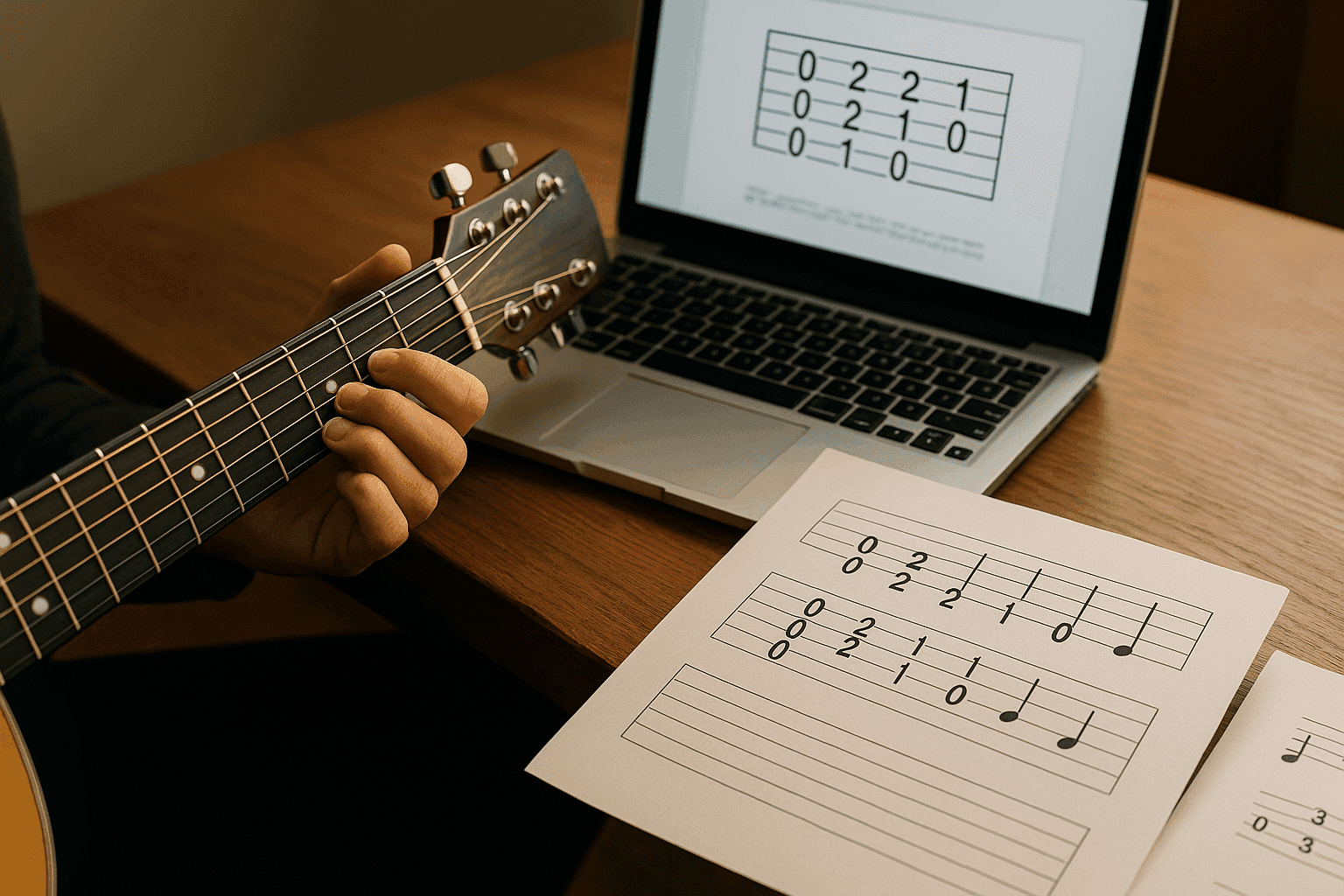
Combining sheet music and guitar tabs in practice enhances speed and accuracy. Start with slow exercises, gradually increasing tempo. Focus on guitar exercises for beginners, including riffs, chords, and scales. Practicing consistently improves note recognition, timing, and coordination, bridging the gap between beginner and intermediate skill levels. Incorporating beginner-friendly songs like easy piano songs adapted to guitar can make practice fun and motivating.
Frequently Asked Questions (FAQs)
1. What is the easiest way to learn guitar for beginners?
Start with basic chords, simple TABs, and gradually add guitar sheet music practice for rhythm and timing.
2. Do I need to learn sheet music if I can read tabs?
Tabs are faster, but sheet music teaches rhythm, timing, and music theory, essential for long-term musicianship.
3. How long does it take to read guitar sheet music fluently?
With consistent practice, most beginners improve within three to six months.
4. Can I learn guitar on my own with online resources?
Yes, combining online lessons, exercises, and learning guitar online with tabs and sheet music is effective.
5. What are the most important guitar techniques for beginners?
- Muting
- Bending
- Sliding
- Hammer-ons
- Pull-offs
- Vibrato
- Tapping
- Strumming
These are essential guitar techniques for beginners.
6. Are TABs better for learning solos or chords?
Tabs work for both; solos show exact finger placement, while chord diagrams help with rhythm. See Guitar Chord Chart for Beginners for chord guidance.
Conclusion
Mastering both guitar sheet music and guitar tabs equips beginners with versatile skills. Practice consistently, focus on guitar exercises for beginners, and gradually incorporate expressive techniques like bending, vibrato, and tapping. Explore online lessons, follow structured exercises, and play beginner guitar songs to reinforce learning. With dedication, reading music for guitar becomes second nature, paving the way for confident, expressive performances. To get personalized guidance and structured practice, you can book a trial class today.