ChatGPT
 Google AI
 Grok
Grok Claude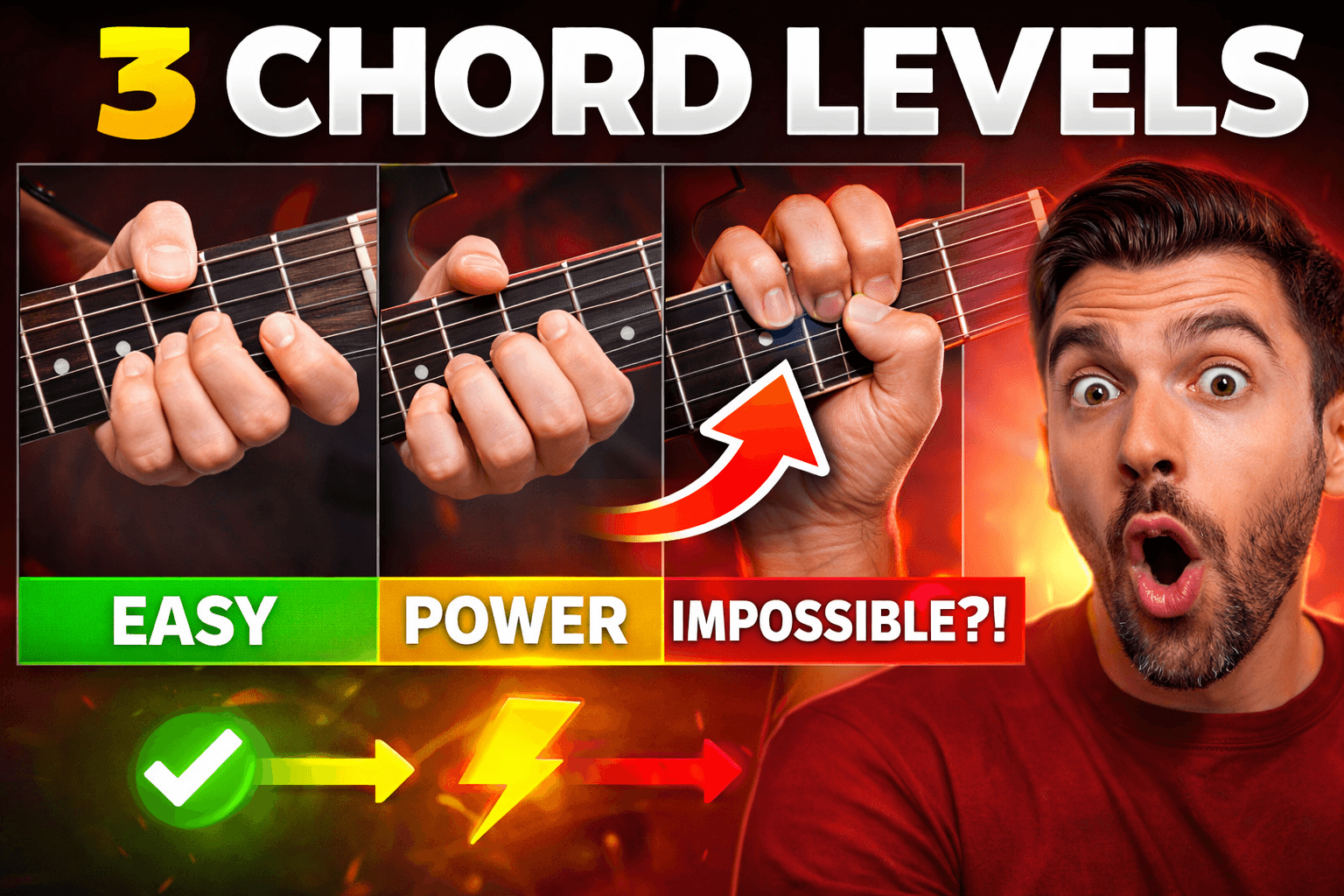
Learning guitar is an exciting journey, and understanding chords is your first major milestone. Whether you're picking up a guitar for the first time or looking to solidify your foundation, mastering power chords, open chords, and barre chords is essential.
Understanding the Basics of Guitar Chords
 A chord is a combination of three or more notes played simultaneously to create harmony. Chords form the backbone of most songs across all genres—from rock and pop to blues and classical.
The 3 Types of Chords Every Beginner Should Know
- Power Chords: Simple two-note chords perfect for rock music
- Open Chords: Chords that use open strings, ideal for beginners
- Barre Chords: Advanced chords that require pressing multiple strings with one finger
Power Chords — The Ultimate Beginner's Tool
What Are Power Chords?
Power chords are simplified two-note chords that create a bold, powerful sound. They're commonly used in rock, punk, and metal music.
How to Play Power Chords
Basic E5 Power Chord:
- Place your index finger on the 7th fret of the 6th string
- Place your ring finger on the 9th fret of the 5th string
- Strum only these two strings
Basic A5 Power Chord:
- Place your index finger on the 5th fret of the 5th string
- Place your ring finger on the 7th fret of the 4th string
Moveable Power Chord Patterns
The beauty of power chords is that they're moveable—once you learn the shape, you can move it up and down the fretboard to play different chords.
Open Chords — The Foundation of Rhythm Guitar

Essential Open Chords for Beginners
E Major (E)
- Index finger: 1st fret, 3rd string
- Middle finger: 2nd fret, 5th string
- Ring finger: 2nd fret, 4th string
- Strum all six strings
A Major (A)
- Index finger: 2nd fret, 4th string
- Middle finger: 2nd fret, 3rd string
- Ring finger: 2nd fret, 2nd string
- Strum from the 5th string down
D Major (D)
- Index finger: 2nd fret, 3rd string
- Middle finger: 2nd fret, 1st string
- Ring finger: 3rd fret, 2nd string
- Strum from the 4th string down
C Major (C)
- Index finger: 1st fret, 2nd string
- Middle finger: 2nd fret, 4th string
- Ring finger: 3rd fret, 5th string
- Strum from the 5th string down
G Major (G)
- Index finger: 2nd fret, 5th string
- Middle finger: 3rd fret, 6th string
- Ring finger: 3rd fret, 1st string
- Strum all six strings
E Minor (Em)
- Middle finger: 2nd fret, 5th string
- Ring finger: 2nd fret, 4th string
- Strum all six strings
A Minor (Am)
- Index finger: 1st fret, 2nd string
- Middle finger: 2nd fret, 4th string
- Ring finger: 2nd fret, 3rd string
- Strum from the 5th string down
Tips for Playing Open Chords
- Finger Placement: Press down close to the fret for clearer notes
- Arched Fingers: Keep your fingers arched to avoid muting adjacent strings
- Practice Transitions: Focus on smooth transitions between chords
Barre Chords — Level Up Your Playing

What Are Barre Chords?
Barre chords involve using one finger—usually your index finger—to press down multiple strings across the fretboard. While more challenging, they're incredibly versatile.
Basic Barre Chord Shapes
F Major (E-Shape Barre Chord)
- Barre all strings at the 1st fret with your index finger
- Middle finger: 2nd fret, 3rd string
- Ring finger: 3rd fret, 5th string
- Pinky: 3rd fret, 4th string
B Minor (A-Shape Barre Chord)
- Barre all strings at the 2nd fret with your index finger
- Ring finger: 4th fret, 4th string
- Pinky: 4th fret, 3rd string
- Middle finger: 3rd fret, 2nd string
Tips for Mastering Barre Chords
- Build finger strength: Practice regularly
- Proper thumb placement: Position behind the neck for maximum leverage
- Start small: Begin in the middle of the neck where frets are closer
- Be patient: Barre chords take time to master
Popular Songs to Practice
 Using Power Chords:
- "Smells Like Teen Spirit" by Nirvana
- "Iron Man" by Black Sabbath
- "Basket Case" by Green Day
Using Open Chords:
- "Wonderwall" by Oasis
- "Knockin' on Heaven's Door" by Bob Dylan
- "Let It Be" by The Beatles
Common Questions (FAQ)
How long does it take to learn guitar chords?
With consistent practice (15-30 minutes daily), most beginners can learn basic open chords in 2-4 weeks. Barre chords typically take 2-3 months to master.
Why do my fingers hurt?
Finger pain is normal for beginners. Your fingertips need to develop calluses, which typically form after 2-3 weeks of regular practice.
What's the easiest chord to learn?
E minor (Em) is often considered the easiest chord because it only requires two fingers.
Should I skip barre chords?
While you can delay learning barre chords, they significantly expand your playing capabilities and should be a goal as you progress.
Practice Routine for Beginners
5-Minute Warm-Up: Finger stretches and exercises 15 Minutes Chord Practice: Individual chords and transitions 15 Minutes Song Practice: Apply chords to actual songs 5-Minute Cool Down: Review difficult transitions
Strumming Patterns
Knowing chords is only half the battle—you need rhythm too.
Pattern 1: Down, Down, Up, Up, Down, Up
Pattern 2: Down, Down, Up, Down, Up
Pattern 3: Down, Up, Down, Up, Down, Up, Down, Up
Conclusion
Mastering guitar chords for beginners—whether power chords, open chords, or barre chords—is a journey that requires patience, practice, and persistence. Start with power chords and open chords to build confidence, then gradually work toward barre chords as your finger strength improves.
Remember:
- Practice consistently, even if only for 15 minutes a day
- Focus on clean technique over speed
- Be patient with yourself—everyone learns at their own pace
- Make practice fun by learning songs you love
- Don't skip the basics—they're the foundation for everything else
Every professional guitarist started exactly where you are now. With dedication and the right approach, you'll be playing your favorite songs before you know it. Happy strumming!