ChatGPT
 Google AI
 Grok
Grok Claude
Bought a guitar and dreaming of playing your favorite film songs at the next gathering? Perfect timing. The best easy Bollywood songs on guitar need just three or four open chords, one friendly strumming pattern, and a capo position to match your voice. This guide hands you sixteen songs arranged as a ladder, from two-week starters to satisfying challenges, each with its chord progression, capo advice, and the reason it's beginner-friendly. You'll also get a master table, a thirty-day plan, and tips for smooth chord transitions. No music theory degree required. Tune up, and let's make your living room sound like a film set.
Why Bollywood Songs Are Perfect for Beginner Guitarists
 Film composers write for singing crowds, not soloists. That means slow-to-medium tempos, repeating chord progression loops, and melodies everyone already knows. When your audience hums along from note one, small guitar mistakes vanish under collective joy. Built-in forgiveness, every performance.
There's a motivation science angle too. Practicing songs you love releases the persistence that scales and drills never spark. Beginners who start with familiar Hindi melodies practice measurably longer per session. Emotion is fuel, and Bollywood supplies it in tankers.
The Five Chords That Unlock Almost Everything
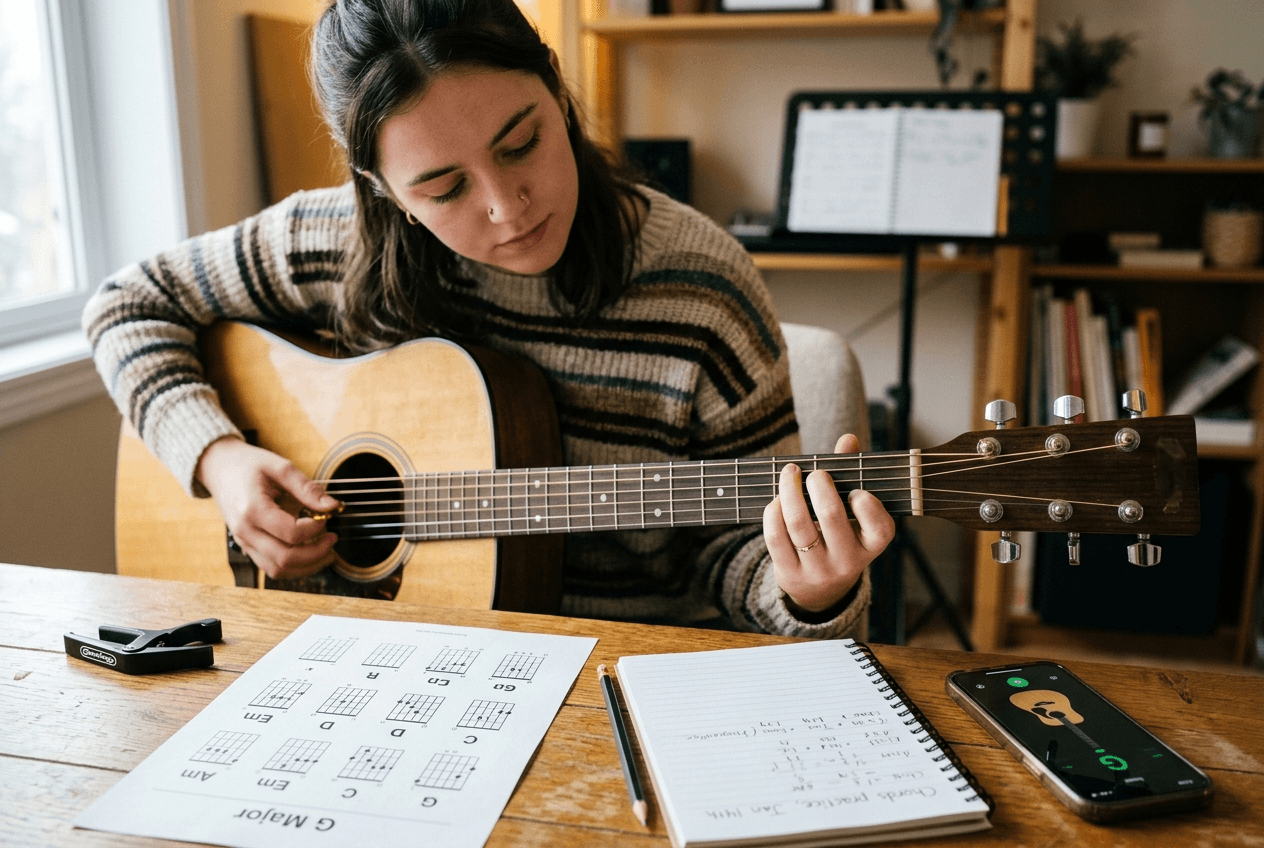 Here's the beautiful secret: five open chords cover most beginner Hindi repertoire. Learn G, C, D, Em, and Am, and doors swing open everywhere. Our guitar chord chart for beginners diagrams each shape with finger numbers and photos.
Drill them in pairs before attempting songs: G to C forty times, C to D forty times, everything to Em because Em is home base for emotional Hindi ballads. Master the C major chord cleanly first; it anchors half this list.
Your Best Friend: The Capo
A capo clamps across a fret and raises every chord together, letting you keep easy shapes while matching the original key or your own voice. Most Hindi songs online list a capo position beside the chords. Five dollars, infinite convenience. Buy one today.
Reading Chord Sheets
Song sheets place chord names above the moment they change. Strum the named chord until the next name appears, keeping the pulse steady. That's the entire system. Combine it with steady down-up strumming pattern work and any sheet becomes playable.
Strumming Patterns: Learn Two, Play Everything
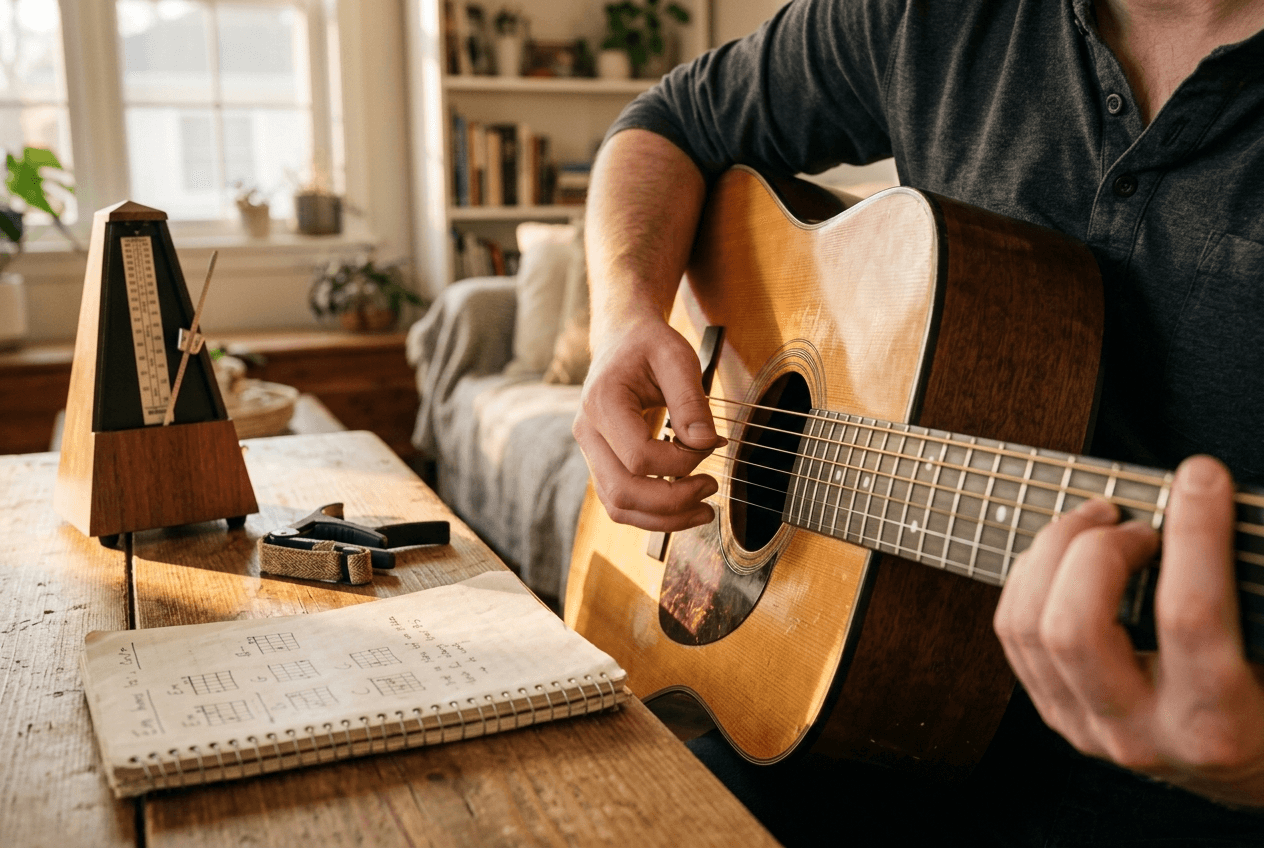 Beginners imagine every song needs its own pattern. Wonderful news: two patterns cover this whole list. Pattern one, all downstrokes on the beat, works for any song at any speed. Pattern two, the universal D-DU-UDU, adds instant professionalism.
Count it as one, two-and, and-four-and while your wrist stays loose like shaking water off your hand. Practice the pattern on a muted Em chord until it runs on autopilot. Rhythm lives in the wrist, never the elbow. Loose wins, always.
Matching Patterns to Songs
Slow ballads like Tum Hi Ho love gentle down, down-up strums with space between. Upbeat tracks like Ilahi want the full D-DU-UDU rolling continuously. When unsure, listen for the drummer's hi-hat and let your wrist shadow it quietly.
Understanding Keys: Why G, C, Am, and Em Rule Hindi Music
 Spardha's whole guide organizes songs by key, and there's wisdom there worth borrowing. A key is a song's home neighborhood, and Hindi acoustic music overwhelmingly lives in G, C, Em, and Am because those homes suit both open chords and typical vocal ranges.
Practical takeaway: when you find a song's key, you can predict its chords before reading anything. Key of G usually invites C, D, and Em over. Key of Am invites F, C, and G. Neighborhoods have regulars; learn the guest lists.
Major and Minor: The Mood Switch
Major keys smile; minor keys ache. Every major key hides a relative minor sharing identical chords: G major and E minor are roommates, C major and A minor likewise. That's why Hindi ballads drift between them so smoothly mid-song. Same rooms, different lighting.
What About Songs in Harder Keys?
Original film recordings often sit in keys full of barre chords, chosen for a singer's voice rather than your fingers. That's precisely the capo position's job: clamp until the hard key becomes G or C shapes. Every table entry above already applies this trick.
Level 1: Three-Chord Starters (Week One Songs)
 Start here even if you're impatient. These songs use three shapes and forgiving tempos, so victory arrives within days. Early wins build the habit loop that carries you through the whole ladder. Our 3-chord songs guide adds Western options too.
Play each song daily for one week before judging yourself. First days sound clunky for every guitarist who ever lived. By day five, chord transitions smooth out mysteriously overnight. Trust the process; your hands are learning while you sleep, literally.
1. Tum Hi Ho (Aashiqui 2)
The modern anthem of beginner guitar across India and the diaspora. A popular simplified version loops Am, C, and G with an occasional F swap, at a slow, forgiving tempo. Gentle down and down-up strums carry its entire aching mood beautifully.
2. Raabta (Agent Vinod)
Raabta floats on a soft loop commonly played as Em, C, G, and D, and its dreamy tempo hides hesitant changes kindly. Strum lightly, almost brushing the strings. This song teaches dynamics, playing softly, better than any exercise sheet ever printed.
3. Pani Da Rang (Vicky Donor)
A famously friendly progression of G, C, D, and Em in a repeating cycle makes this the classic first campfire song. The relaxed groove suits all-downstroke strumming while you build confidence. Ayushmann made it charming; you'll make it yours.
Level 2: Four-Chord Wonders (Weeks Two and Three)
 The famous four-chord family powers global pop and modern Bollywood alike. Once G, C, D, Em, and Am rotate freely under your fingers, this tier opens completely. Suddenly your repertoire jumps from three songs to thirty without learning anything new.
Focus now on transition speed. Set a timer for one minute and count clean chord changes; beginners average twenty, and forty means ready. This single drill, sixty seconds daily, upgrades every song on this page simultaneously. Efficiency disguised as a game.
4. Kabira (Yeh Jawaani Hai Deewani)
The unofficial anthem of road trips and rooftop jams. A widely played version sits on capo two with Em, C, G, and D cycling hypnotically. Keep strums sparse and let chords ring. Simplicity is the entire point of Kabira's magic.
5. Kal Ho Naa Ho (Kal Ho Naa Ho)
Shankar-Ehsaan-Loy's classic flows in a warm G, D, Em, C neighborhood when simplified with a capo. Its walking tempo suits down, down-up patterns perfectly. Two decades old and still the most requested song at every diaspora gathering, guaranteed.
6. Khairiyat (Chhichhore)
Arijit's modern favorite runs a friendly capo-based loop of G, D, Em, and C variants at a singable tempo. The chorus lands on satisfying changes that reward clean chord transitions. Perfect for testing your one-minute-changes progress in real music.
7. Ilahi (Yeh Jawaani Hai Deewani)
The wanderlust song. A common arrangement rolls Em, G, D, and C under a bouncing full D-DU-UDU strumming pattern. Ilahi teaches rhythm stamina: keeping the wrist rolling for four minutes builds the endurance every uptempo song later demands.
Level 3: Evergreen 90s and Classics
The golden era gives you songs every generation at the party knows. Uncles harmonize, kids Shazam, and you hold the room. Simplified capo versions keep old film keys friendly for open chords, so vintage prestige comes at beginner prices.
Classics also train musicality. Their melodies breathe with rubato pauses and gentle swells, teaching you to follow a song rather than march through it. Play along with original recordings and steal the singers' phrasing with your strumming hand.
8. Tujhe Dekha To (DDLJ)
The mustard-fields anthem itself. A beginner-friendly arrangement moves through D, A, Em-family shapes with a capo taming the original key. Slow, iconic, and instantly recognized from the first chord. Expect the whole room to sing before you reach the chorus.
9. Pehla Nasha (Jo Jeeta Wohi Sikandar)
The slow-motion first-love classic. Capo-based versions using G, D, Em, and C neighborhoods make it accessible, while the original's smooth flow teaches patience between changes. Spardha's own FAQ names it among the easiest starters, and the crowd response justifies every practice minute.
10. Purani Jeans (Ali Haider)
Technically Pakistani pop, spiritually every Indian hostel's anthem. Simple simplified shapes around G, C, and D power its nostalgic singalong. This is the song that turns acquaintances into friends around a fire. College reunions legally require it, practically speaking.
Level 4: Modern Hits Your Audience Requests
 Post-2015 Bollywood leans acoustic, which is a gift to guitarists. Producers often build tracks around real open chords, so your living-room version sounds legitimately close to the record. Streaming-era hits also skew slower, favoring clean, ringing changes.
These songs keep your set current. Pair one classic with one modern hit per performance and every generation feels seen. That programming trick, stolen from wedding bands, works flawlessly at birthday parties and open mics alike. Balance wins rooms.
11. Kesariya (Brahmastra)
Arijit's mega-hit rides a warm capo-based loop in the C, G, Am, F family at an easy swaying tempo. The progression repeats generously, giving thinking time between changes. Learn it once and expect requests forever. Resistance is genuinely futile.
12. Dil Diyan Gallan (Tiger Zinda Hai)
A commonly shared version sits at capo four with G, Em, C, and D rotating gently. The romantic swing suits soft down, down-up strums. Wedding sangeet gold: learn this and cousins will book you before dessert arrives.
13. Jeena Jeena (Badlapur)
Atif's tender ballad works beautifully with capo-friendly Em, G, D, and A-family shapes played sparsely. Its slow pulse forgives everything while teaching emotional restraint. Fingerpick the verse once comfortable, and watch the room lean in noticeably closer.
14. Shayad (Love Aaj Kal)
Pritam's gentle earworm uses C, G, Bm, and touches of F in popular versions, making it your friendly introduction to one barre-ish shape. Play Bm as a two-finger mini-barre initially. The song's patience gives your fingers room to grow.
Level 5: Step-Up Challenges Worth Chasing
Two final songs stretch you deliberately: one toward riffs and power, one toward fingerstyle serenity. Neither is hard forever; both feel impossible for exactly two weeks. Schedule them for month two and enjoy how far the ladder has carried you.
Approach challenges in slices: intro riff only, then verse loop, then full run-through at seventy percent speed. Slice practice beats heroic full-song attempts every time. Our E major chord guide preps the shapes these songs lean on.
15. Sadda Haq (Rockstar)
Bollywood's great guitar anthem is riff-driven and traditionally electric, built on gritty power-chord energy. Acoustic players can still own a simplified rhythm version. It teaches palm muting and attitude, two skills no ballad on this list touches. Channel your inner Jordan.
16. Kun Faya Kun (Rockstar)
Rahman's Sufi masterpiece floats on a meditative minor-key loop, commonly played around Am with gentle neighboring shapes. The challenge is texture: soft fingerpicking, patience, and space. Artium's guide calls it a Sufi introduction; treat it as guitar meditation.
Master Table: All 16 Songs at a Glance
Bookmark this table for practice sessions and party requests alike. Chord listings show popular simplified versions; capo positions vary by voice, so nudge until singing feels comfortable. Difficulty stars assume you've drilled the five core open chords first.
Print it, tape it inside your guitar case, and tick songs off as they go performance-ready. Sixteen ticks equals a full hour-long set of Bollywood songs on guitar, which quietly makes you the most valuable guest at any gathering this year.
Your 30-Day Bollywood Guitar Plan
 Week one: tune daily, drill the five chords, and land Tum Hi Ho plus Pani Da Rang. Week two: add the D-DU-UDU strumming pattern and two Level 2 songs. Small daily sessions, twenty minutes, phone in another room entirely.
Week three: one classic and one modern hit, plus the one-minute changes drill each morning. Week four: polish four favorites to performance level and film yourself. Thirty days, six songs stage-ready. That pace beats ninety percent of self-taught beginners comfortably.
The Daily 20-Minute Split
Five minutes: chord changes with a timer. Five minutes: strumming on muted strings with a metronome. Ten minutes: actual songs, always ending on the one you love most. Ending with joy tricks your brain into craving tomorrow's session. Use it.
Quick Setup: Tuning and Gear Basics
Nothing sabotages beginners like an out-of-tune guitar; even perfect chords sound wrong. Tune every single session using a clip-on tuner or app. Our guitar tuning guide walks standard EADGBE tuning step by step with troubleshooting.
Know your instrument too. Understanding frets, the nut, and where the capo position sits saves confusion when reading song sheets. Ten minutes with our guitar anatomy guide covers every part name you'll ever need at practice.
Singing While Playing: The Real Party Trick
Strumming and singing together feels like patting your head while solving math, initially. The fix: automate the guitar first. When the strumming pattern runs without thought, your voice slots on top naturally. Hum before adding words; humming bridges beautifully.
Pick songs sitting comfortably in your vocal range, moving the capo until the chorus feels easy. Pair this guide with our easy songs for beginner singers list to build vocal confidence in parallel. Guitarists who sing get double the requests.
The Slow-Motion Method
Play the song at half speed and speak the words rhythmically instead of singing. Once speech locks onto strums, add pitch. This unglamorous drill assembles the two skills within days, while brave full-speed attempts usually collapse for weeks. Slow is fast.
Common Mistakes That Stall Beginners
Mistake one: learning six songs at two percent each instead of two songs at ninety. Depth beats breadth early. Mistake two: ignoring the capo position and wrestling original keys with barre chords. Use the clamp; pride sounds worse than it feels.
Mistake three: strumming from the elbow, which exhausts and stiffens everything. Wrist only. Mistake four: practicing standing before mastering seated posture. Mistake five: skipping tuning. Every mistake above costs weeks; every fix above costs minutes. Choose accordingly, cheerfully.
Small Spices: Techniques That Upgrade Every Song
Once chords ring clean, tiny techniques add restaurant-quality garnish. None require new theory; each needs five minutes of daily play. Sprinkle them gradually and listeners will swear you've been playing for years. Guitarists call these spices; audiences call them magic.
The rule with spices: one per song, maximum two. Overseasoned playing distracts from the melody everyone came to sing. Bollywood accompaniment is service work, supporting voices rather than competing. The tastiest chord progression is the one nobody notices holding everything up.
Palm Muting
Rest the strumming hand's edge lightly on the strings near the bridge and strum: instant intimate, percussive chug. Verses love it; choruses love its release. Sadda Haq runs on it. Practice muted verse, open chorus, and feel arrangements appear.
Hammer-Ons and Pull-Offs
Fret a note, then snap another finger down on a higher fret without picking again: hammer-on. Reverse it for a pull-off. Add one inside your Em chord and Kabira's intro suddenly sounds like the record. Tiny motion, huge authenticity.
Fingerpicking Your First Pattern
Ballads bloom when strumming gives way to fingerpicking. Start with the universal pattern: thumb plays the lowest chord note, then fingers pluck strings three, two, one, and back. Count one-two-three-four evenly. That single pattern carries Jeena Jeena and Kun Faya Kun.
Assign fingers permanently: thumb takes the bottom two strings, index takes string three, middle takes two, ring takes one. Fixed addresses build speed. Practice the pattern on one chord for two minutes daily before applying it to songs. Patience here pays doubly.
When to Pick, When to Strum
Simple rule of thumb: verses whisper, choruses soar. Fingerpick the quiet verse, switch to strumming as the chorus lifts, and the arrangement breathes exactly like the original track. One song, two textures, standing ovation from the aunties. Every single time.
Practice With the Original Track
Your best free teacher streams on every platform: the original recording. Play along from day one, even badly. The track enforces steady tempo, cues every change, and buries your mistakes generously. Solo practice lies about timing; records never do.
Use the capo to match the recording's key first, or slow the track with an app until your chord transitions keep up. Increase speed weekly. Playing along also trains your ear to hear changes coming, the skill that eventually lets you learn songs without sheets.
The Mute-Test Game
Every thirty seconds, mute the track briefly and keep playing, then unmute. Still aligned? You're internalizing the song, not shadowing it. Drifted? Note where and drill that section. This little game builds performance-proof timing faster than any metronome session.
Building Your First 30-Minute Set List
 Six songs make a half-hour set with chatter between. Order matters more than beginners expect: open familiar, dip emotional mid-set, and close on a singalong everyone owns. The sample set below sequences songs from this guide into a crowd-tested arc.
Notice the energy wave: warm, up, tender, nostalgic, current, anthem. Audiences ride waves, not playlists. Steal this shape, swap songs freely, and always keep one backup ballad ready for when someone inevitably requests something slow for a dedication.
Playing for Sangeet and Family Functions
Weddings and festivals are your natural stage. Acoustic guitar plus familiar film songs equals instant sangeet entertainment with zero equipment drama. Coordinate keys with whoever sings, keep the capo position flexible, and rehearse smooth starts since intros get filmed.
Practical wisdom from countless functions: prepare eight songs but expect to play four, print chord sheets in large font for dim lighting, and clip a tuner to your headstock permanently. Uncles will request Kishore Kumar; smile and redirect to Pehla Nasha.
Handling Requests You Don't Know
Someone will request a song outside your list, always. The graceful move: ask them to sing the hook, find the feel on Em or C, and strum supportively while they lead. Accompaniment forgiveness is enormous. Confidence plus two chords beats panic plus apologies.
What Each Song Secretly Teaches You
This ladder was engineered, not assembled. Each level installs a specific skill that the next level assumes. Seeing the hidden curriculum keeps practice purposeful and explains why skipping ahead feels harder than it should. Trust the sequence; it compounds.
Scan the map below whenever motivation dips. You're never just repeating a song; you're upgrading a transferable skill that every future song inherits. Guitar progress hides inside repertoire, which is exactly why song-first learning beats drill-first learning for most beginners.
Care for Your Fingers and Your Guitar
Fingertips hurt for the first two weeks; that's calluses under construction, not damage. Practice daily but briefly, avoid pressing harder than notes require, and never quit during the sore phase. Every guitarist alive crossed this exact bridge. The toll expires permanently.
Guitar care is equally simple: wipe strings after playing, store away from radiators, and change strings every few months for brighter tone. A well-kept instrument stays in tune longer, making every strumming pattern sound instantly better. Five minutes monthly, big returns.
When Chords Buzz
Buzzing usually means fingertips too far from the fret wire or pressing at an angle. Move fingers snug behind the fret, arch knuckles, and check thumb position behind the neck. Ninety percent of beginner buzz vanishes with those three adjustments alone.
Record Yourself Weekly
Your phone is a brutal, brilliant coach. Record one full song every Sunday and listen back once, noting a single fix for the week. Cameras catch rushed changes and uneven strumming pattern habits that mirrors and memory politely hide from you.
Keep every recording in one folder and revisit month-old takes when motivation wobbles. Nothing fuels practice like hearing your own before-and-after. Bonus: by month three you'll have shareable clips, and family group chats make surprisingly enthusiastic first audiences. Applause emojis count as applause.
Frequently Asked Questions
Which Bollywood songs are easiest on guitar?
Tum Hi Ho, Pani Da Rang, Raabta, and Kabira top most teachers' lists, using three or four open chords at slow tempos. Pehla Nasha and Jeene Laga Hoon follow closely. Any Level 1 song above suits your very first week.
What Hindi songs can I play with 4 chords?
With G, C, D, and Em you can play Pani Da Rang, Kal Ho Naa Ho, Khairiyat, Ilahi, and simplified Kesariya among many others. That single four-chord family covers most modern acoustic Bollywood songs on guitar, genuinely.
How do I play Bollywood songs on guitar as a total beginner?
Learn five open chords, one down-up strumming pattern, and how to read chord names above lyrics. Add a capo for key matching. Start with Tum Hi Ho at half speed, and expect your first recognizable performance within two focused weeks.
Do I need a capo for Hindi songs?
Not strictly, but a capo turns hard keys into easy shapes and matches songs to your voice instantly. Most online chord sheets assume one. For five dollars it converts dozens of intermediate songs into beginner songs overnight. Essential, honestly.
How long does it take to learn one song?
With daily twenty-minute practice, a Level 1 song reaches singalong quality in five to seven days. Four-chord songs take two weeks. The first song is the slowest; every chord progression afterward reuses shapes you already own, so speed compounds.
Acoustic or electric for Bollywood songs?
Acoustic suits ninety percent of this list and needs zero extra gear. Electric shines for riff-driven tracks like Sadda Haq. Start acoustic, add electric later if rock Bollywood calls you. The chords transfer perfectly between both instruments anyway.
Final Thoughts
Sixteen songs, five chords, two strumming patterns, one thirty-day plan. That's the entire distance between your guitar gathering dust and you soundtracking the next family evening with Bollywood songs on guitar everyone sings along to. The ladder works; climb it.
When you want faster progress, Art Gharana's guitar instructors teach these exact songs in live one-on-one classes, correcting your chord transitions in real time from anywhere in the USA. First song in week one, first applause soon after. Pick up the guitar tonight.