ChatGPT
 Google AI
 Grok
Grok Claude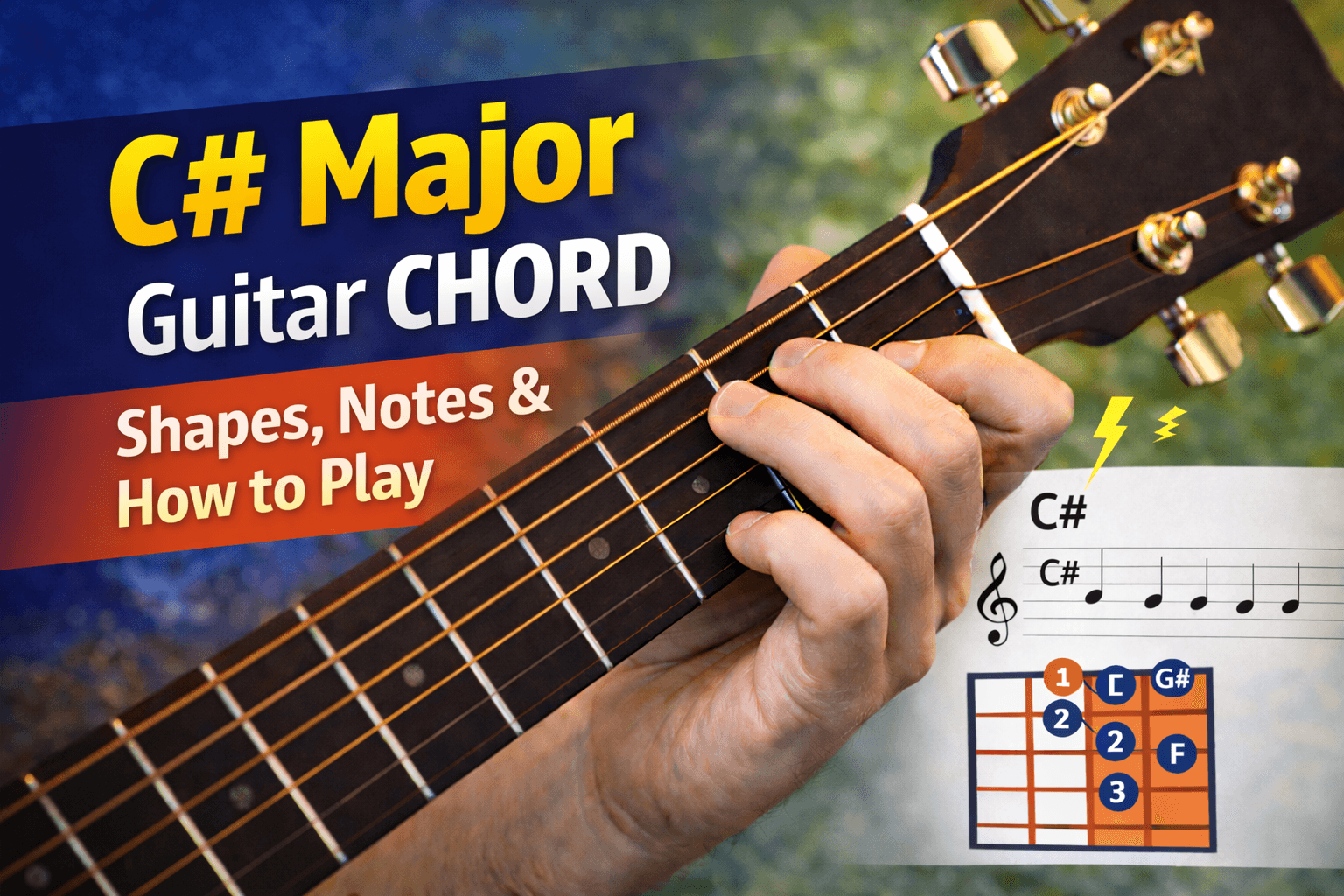
The C# major chord on guitar is a bright, rich, and harmonically powerful major chord widely used across genres like pop, rock, R&B, gospel, and jazz. Built from the notes C#–E#–G#, this chord forms a classic major triad using the formula 1–3–5. While many guitarists initially struggle with C# major because it rarely has an easy open position, mastering its barre chord shapes leads to tremendous fretboard freedom.
C# major appears frequently in keys with sharps, especially when playing pop or contemporary music where transposing with a capo or using barre chords is common. Learning the C# major chord diagram, understanding finger positioning, and exploring multiple voicings helps guitarists create smooth transitions, build chord vocabulary, and understand the relationships between keys, intervals, and chord patterns.
Since the C# note does not appear naturally in most open tunings, the chord is played almost entirely using movable shapes, making it one of the best chords for learning fretboard mapping and triad visualization. Whether you're creating rhythm sections, layering chord voicings, or developing lead lines, mastering the C# major chord unlocks new musical colors and creative options across the guitar.
What Makes the C# Major Chord Special?
 The C# major chord is harmonically bright, stable, and expressive. Like all major chords, it is built using the pattern root–major third–perfect fifth, giving it a confident and uplifting sound. What makes C# major especially unique is its role in sharp-heavy keys and progressions where smooth voice leading and consistent fretboard movement matter.
Another reason C# major stands out is its position between commonly used chords such as B major, F# major, A major, and G# minor. Many pop and R&B progressions revolve around these chords, making C# major an essential building block for modern guitar accompaniment. Its barre-shape form also helps intermediate players strengthen finger pressure and develop clean chord transitions along the neck.
Because the C# note lies outside most easy open chord shapes, players are encouraged to rely on movable barre shapes, triads, inversions, and CAGED positions, which improves fretboard knowledge. Its sound is bright, resonant, and harmonically rich, making it a powerful chord for songwriting, improvisation, and rhythm playing.
C# Major Chord Notes and Formula
The C# major chord consists of:
Note Interval C# Root E# Major Third G# Perfect Fifth
Although E# looks unusual, it is theoretically correct because major chords require the third scale degree, and the C# major scale uses E# rather than F. This distinction becomes important when studying theory, inversions, scales, and chord construction across the neck.
How the Major Chord Is Built
The C# major chord is formed by selecting scale degrees 1, 3, and 5 from the C# major scale:
C# major scale: C# – D# – E# – F# – G# – A# – B#
Picking the 1st (C#), 3rd (E#), and 5th (G#) notes forms the C# major triad. This major chord formula, also known as stacking thirds, applies to every major chord and is essential for understanding chord construction, variation, and chord-tone targeting while improvising.
By visualizing these intervals across the neck, players can create triads, chord inversions, and expanded voicings such as C#maj7, C#6, C#sus2, and C#sus4.
C# Major Chord on Guitar
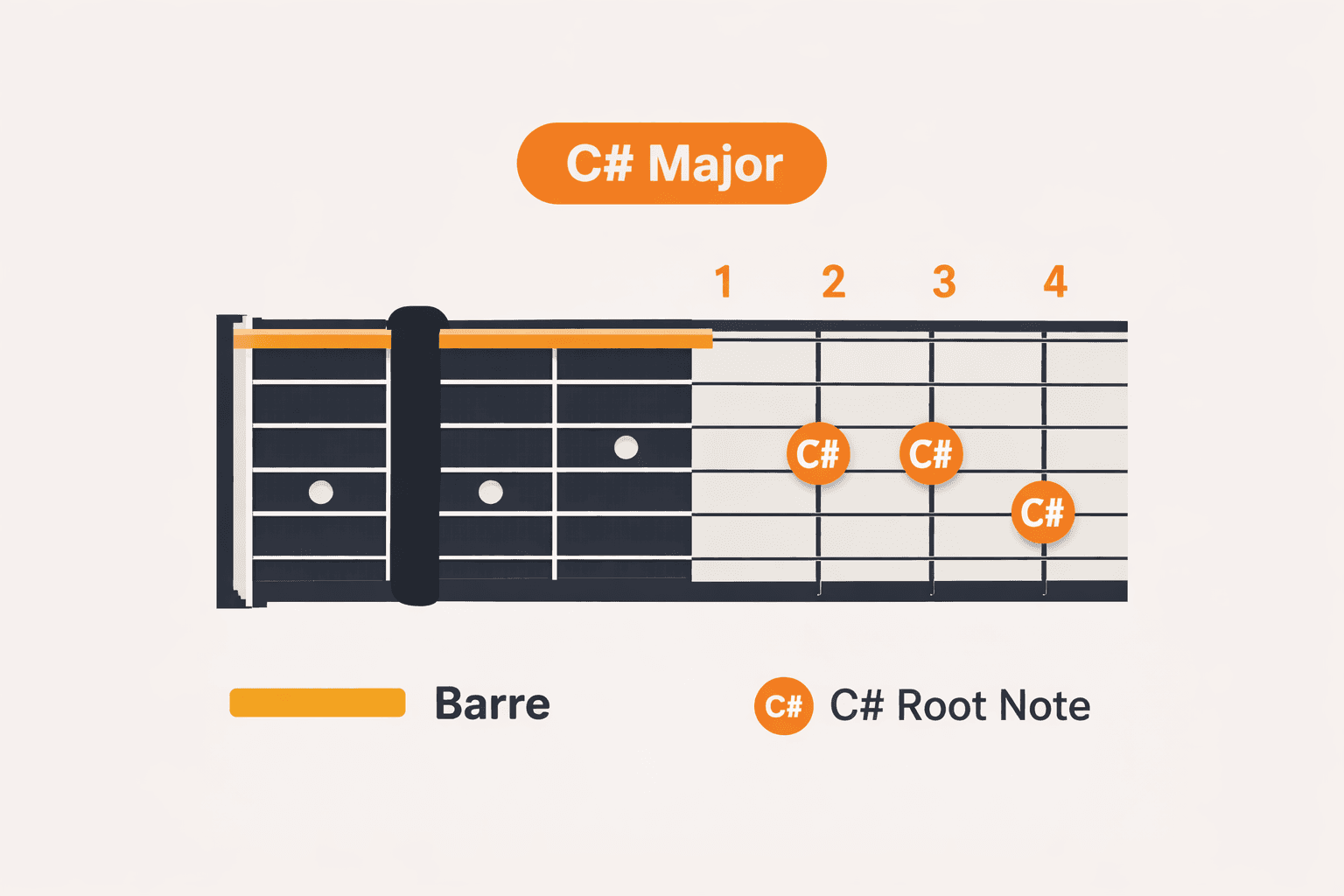
 Unlike chords like G major or A major, C# major does not contain open-string voicings in standard tuning. Therefore, the chord is played primarily using barre chords, movable shapes, and CAGED-system positions. These voicings offer consistent tone and powerful projection, making them suitable for rhythm guitar and live performance.
Mastering the C# major guitar chord empowers players to confidently navigate sharp keys and express harmonic ideas more fluently.
The Basic Barre C# Major Shape
The most common way to play C# major is the E-shape barre chord on the 4th fret. This form creates a full, rich sound while maintaining comfortable finger placement.
Common beginner challenges include finger fatigue, muted string buzz, and improper barre pressure. Practicing proper thumb placement, wrist angle, and finger curvature helps achieve a clean and resonant tone.
Keys Where You’ll Find the C# Major Chord
C# major frequently appears in sharp-heavy keys and is commonly used in genres requiring transposition or capo use. Studying its position within specific key signatures improves improvisation, songwriting, and chord progression fluency.
Key I ii iii IV V vi vii° C# Major C# D#m E#m F# G# A#m B#dim A Major A Bm C#m D E F#m G#dim E Major E F#m G#m A B C#m D#dim F# Major F# G#m A#m B C# D#m E#dim G# Minor G#m A#dim B C#m D#m E F#
Understanding these relationships helps guitarists identify when and where the chord appears, making it easier to integrate into chord progressions, melodies, and harmonic contexts.
Common Chord Progressions With C# Major
C# major participates in several popular progressions, especially in modern pop, R&B, rock, gospel, and K-pop styles. These progressions offer bright harmonic movement and expressive emotional flow.
Popular Progressions
-
I–V–vi–IV (C# – G# – A#m – F#) One of the most widely used emotional progressions in contemporary pop.
-
I–IV–V (C# – F# – G#) Common for bright, energetic songs.
-
vi–IV–I–V (A#m – F# – C# – G#) Used extensively in commercial music.
-
ii–V–I (D#m – G# – C#) A jazz-inspired movement found in modern R&B.
These chord progressions using C# major help players understand harmonic flow and how this chord interacts with others in musical contexts.
Scales to Play Over a C# Major Chord
 Improvising over the C# major chord becomes easier when you target chord tones and choose compatible scales. These scales allow players to craft melodic lines that blend seamlessly with harmony.
Scale Notes ** Mood** C# Major Scale C# D# E# F# G# A# B# Bright, uplifting A# Minor Scale A# B# C# D# E# F# G# Emotional, smooth C# Major Pentatonic C# D# E# G# A# Simple, melodic C# Lydian C# D# E# F## G# A# B# Airy, dreamy C# Mixolydian C# D# E# F# G# A# B Relaxed, bluesy
Practicing these scales improves improvisational control, helps identify landing notes, and enhances melodic creativity.
Popular Songs That Use the C# Major Chord
While many songs use C# major, it often appears due to transposition, modulations, or capo usage. Songs may also contain the C# chord in place of its enharmonic equivalent, Db, since they represent the same pitch.
Examples include:
- Songs written in **C# major, A major**, and **E major keys**.
- Modern pop songs that revolve around I–V–vi–IV progressions.
- Contemporary worship and gospel tracks requiring transposed chords.
These compositions demonstrate how C# major chord voicings support harmonic structure and melodic storytelling.
How to Play the C# Major Chord: Guitar Shapes & Positions
 The C# major chord can be played using several shapes within the CAGED system. These include E-shape, A-shape, D-shape, C-shape, and G-shape mappings.
Position **Root Note ** Shape Type Position 1 4th fret A string Barre A-shape Position 2 9th fret E string Barre E-shape Position 3 11th fret D string Movable Triad Position 4 13th fret A string Movable Inversion Position 5 16th fret E string Movable High Voicing
Learning these C# chord voicings and movable chord shapes ensures fretboard mastery and supports advanced harmonic expression.
Alternate Voicings and Extensions
Advanced players can use extended forms of the C# major chord to add expressive color:
- C#maj7
- C#6
- C#sus2
- C#sus4
- C#add9
- C#maj9
Each variation slightly modifies the chord’s overall tension, brightness, or emotional tone, allowing players to create unique progressions and harmonic textures.
Play This Chord With Other Roots
Once you master the C# major shape, you can transpose the chord anywhere on the neck to play other major chords. This is fundamental to the CAGED method and teaches you how movable shapes work across the fretboard.
Using the same shape, you can instantly play:
D major, E major, F major, F# major, G major, A major, B major, and more—simply by shifting the root note.
How to Build the C# Major Chord on Guitar
The C# major triad is built by identifying every C#, E#, and G# on the guitar neck and mapping them across strings. This helps players form:
- Chord inversions
- Movable shapes
- Triads on upper strings
- Melodic arpeggios
Fretboard mapping deepens theoretical understanding and unlocks creative playing techniques.
Tips to Master the C# Major Chord
Technique Exercises
Exercise Duration Goal C# Barre Finger Pressure 5 mins Build barre strength Transition C# – F# 10 mins Clean chord changes C# – G# – A#m progression 10 mins Improve rhythm flow
Additional Tips
- Keep your wrist relaxed and angled outward.
- Use your fingertip arch to avoid muting adjacent strings.
- Press from the arm, not just the finger, to achieve clean barre pressure.
- Practice chord transitions slowly before increasing tempo.
- String buzzing due to weak barre pressure
- Fatigue in the index finger
- Muted high strings
- Incorrect thumb placement
- Lead improvisation using arpeggios and triads
- Smooth voice leading in jazz and R&B
- Pop progressions requiring bright major tonal centers
- Composing emotional or atmospheric chord movements
Troubleshooting Common Problems####
Common challenges include:
Adjusting hand posture, thumb alignment, and pressure distribution solves these issues over time.
Advanced Applications of the C# Major Chord
C# major becomes especially powerful in:
Mastering C# major improves harmonic fluency and compositional creativity.
FAQ About the C# Major Guitar Chord
1. Is C# major difficult to play on guitar?
Yes, it can be challenging for beginners because it requires barre chord shapes. However, with practice and proper technique, it becomes easier.
2. What notes make up the C# major chord?
The C# major chord consists of C# (root), E# (major third), and G# (perfect fifth).
3. Which chords pair well with C# major?
C# major pairs well with F#, G#, A#m, D#m, and E#dim depending on the key.
4. How do I make the C# major chord easier?
Try playing a simplified triad on the top three strings or move higher up the neck for reduced finger tension.
5.What is the difference between C# major and C# minor?
C# major uses C#–E#–G#, while C# minor lowers the third to E, creating a darker tone.