ChatGPT
 Google AI
 Grok
Grok Claude
What Is the E Major Guitar Chord?

The Emaj guitar chord is one of the most essential major chords for guitarists. It consists of three notes: E (root), G# (major third), and B (perfect fifth). Together, these notes create a bright and resonant sound that works across many styles, from rock to folk to blues. Understanding this chord provides a strong foundation for learning other major chord shapes and mastering guitar chord construction.
In music theory, the E major chord follows the major chord formula of root, third, and fifth. Knowing these major chord intervals helps you recognize the chord's role in progressions and how it interacts with scales. Learning E major chord notes also allows beginners to experiment with chord tone mapping, triads on guitar, and stacking thirds, essential skills for creating clean E chord finger positions across the fretboard. For step-by-step guidance in mastering these concepts, you can explore online guitar classes that simplify learning for beginners.
What Makes the E Chord Special
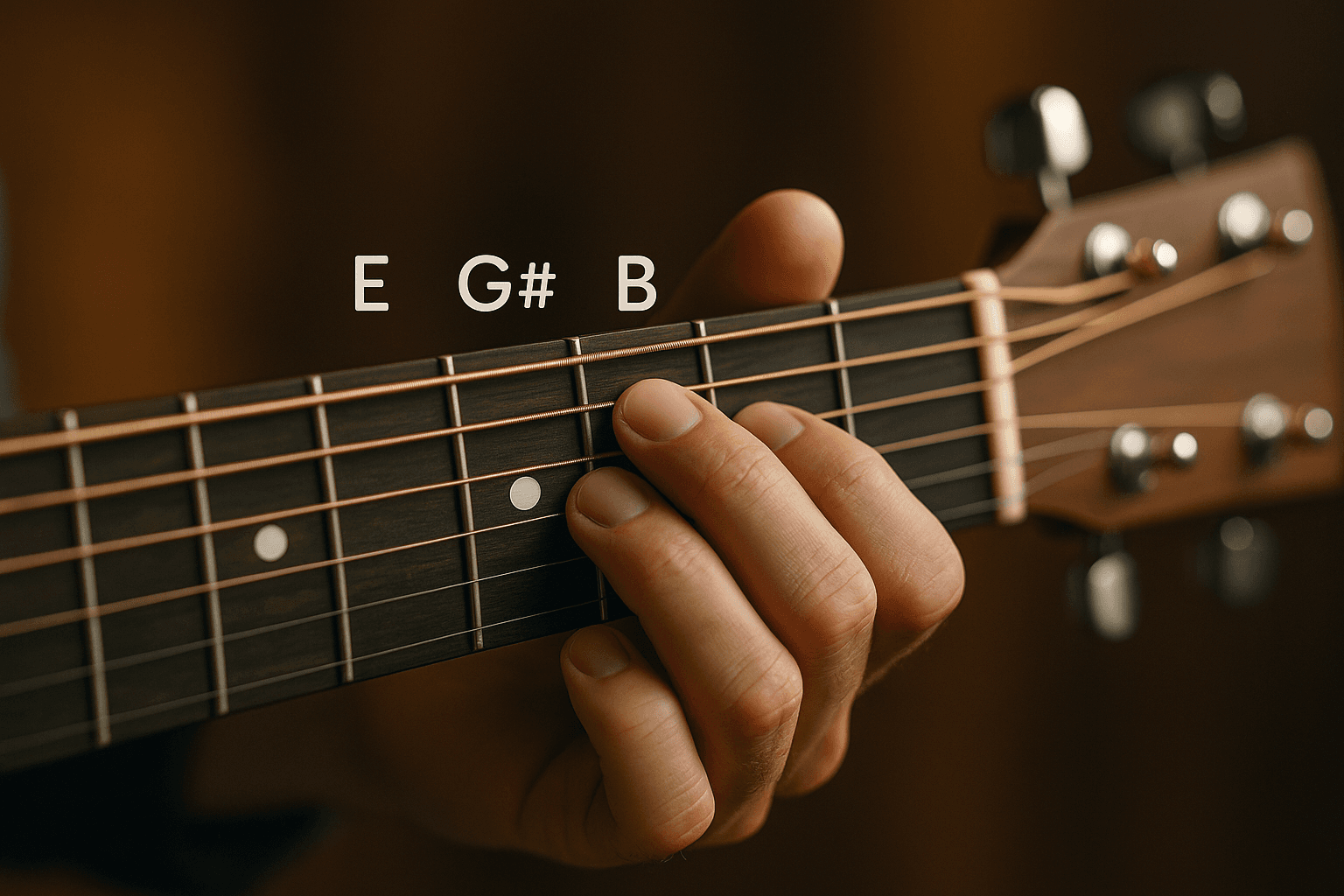
The E major chord stands out because of its bright and full tone. Unlike minor chords, which sound darker or more emotional, the E major chord sound has clarity and stability, making it perfect for rhythm and lead playing. Its resonance comes partly from the open strings, allowing vibrations to travel freely across the guitar body.
This chord is extremely versatile. It appears in countless songs using E major chord, including rock classics, pop hits, and blues standards. Its harmonic function can be tonic, dominant, or even mediant depending on the key. This flexibility also makes it a core part of beginner guitar chords, open chords, and barre chords.
E Major Chord Notes and Formula
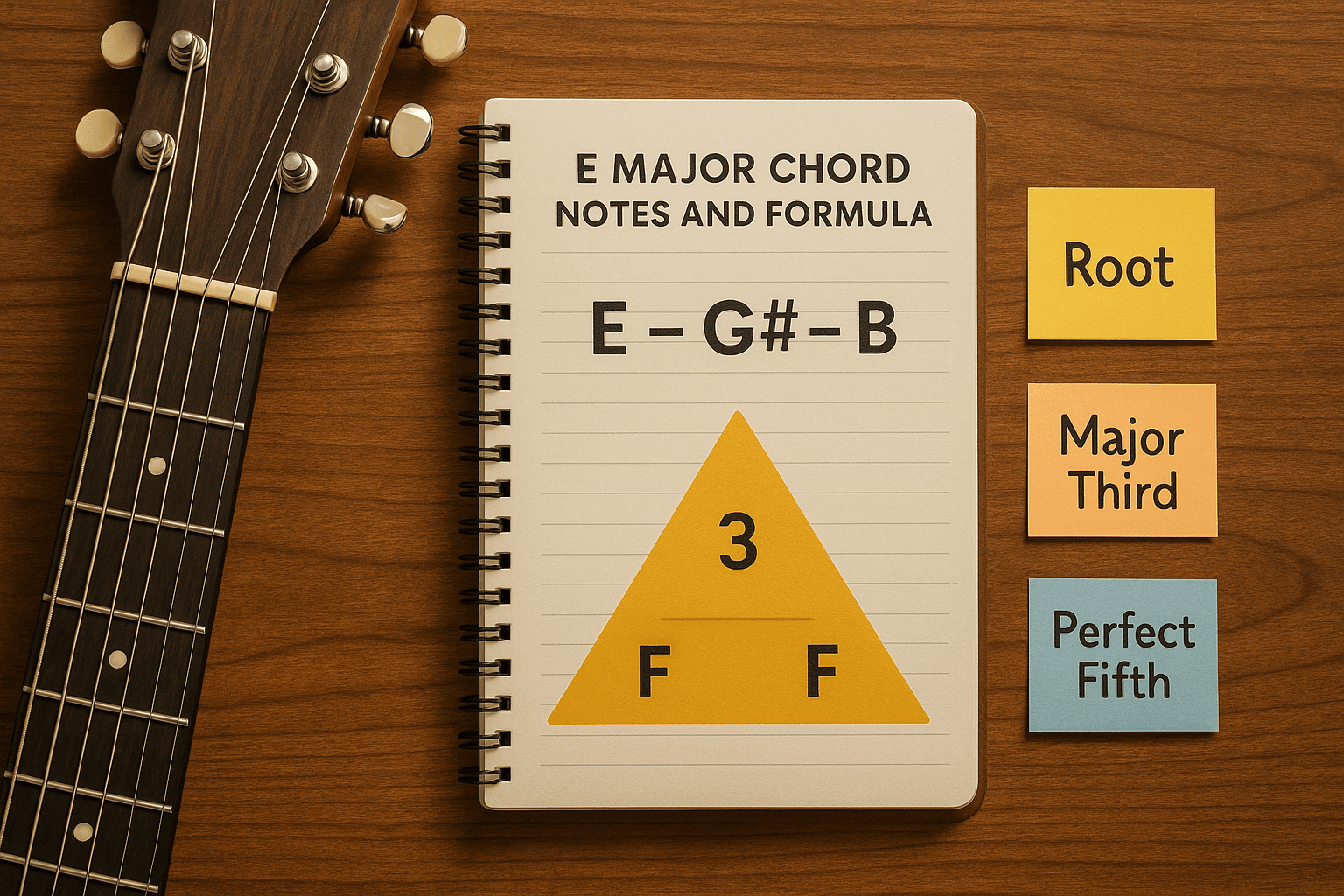
Understanding the E major chord structure starts with identifying the chord tones. These are E, G#, and B, corresponding to the root–major third–perfect fifth formula. On the fretboard, these notes can appear in multiple positions, giving you flexibility to play E major chord anywhere on the fretboard.
| Note | Interval | Function |
|---|---|---|
| E | 1 | Root |
| G# | 3 | Major Third |
| B | 5 | Perfect Fifth |
Learning these E major chord notes lets you apply chord tone visualization techniques. Mapping these tones across the strings improves fretboard theory, helps with improvising on E major, and lays the foundation for exploring chord inversions and E major chord variations.
How the Major Chord Is Built
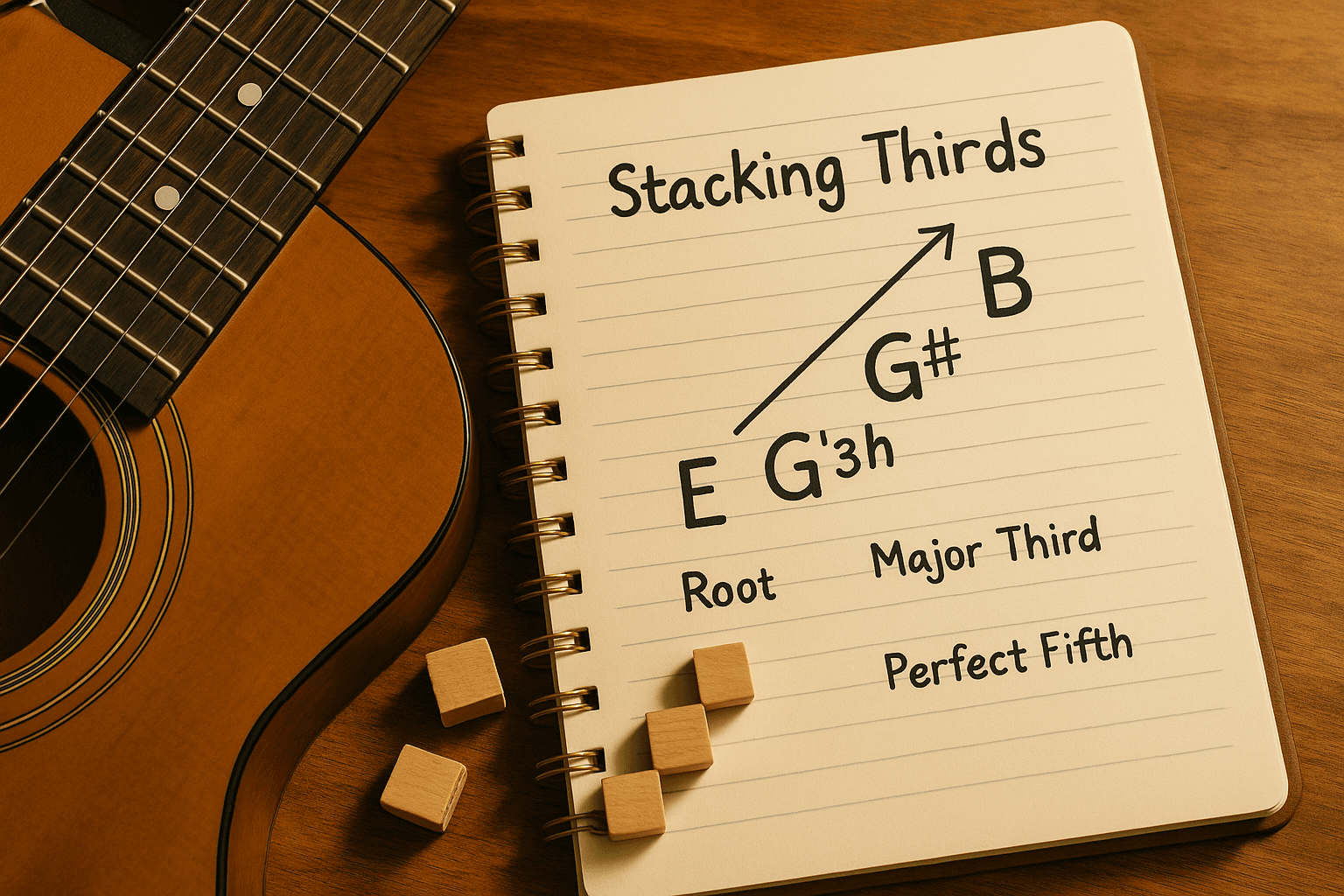
The E major chord is constructed by stacking thirds. Starting from the root E, adding the major third G#, and then the perfect fifth B creates the classic major triad. This is the same principle used for all major chords on guitar and is explained in CAGED system guitar methods for easier visualization.
This structure produces a bright, stable, and consonant sound, ideal for rhythm playing. By understanding major chord formula and music intervals on guitar, you can also create alternate E chord voicings, build triads on guitar, and explore chord tone mapping for advanced applications. For example, the E major formula (E–G#–B) can be applied anywhere on the fretboard using movable E chord shapes.
E Major Chord on Guitar
The basic open E major chord is simple yet powerful. Place your index finger on the G# note (1st fret, third string), your middle finger on the B note (2nd fret, fifth string), and your ring finger on the E note (2nd fret, fourth string). Strumming all six strings produces the iconic E major chord sound.
Beginners often struggle with muted strings or buzzing. Ensuring proper guitar finger placement, curved fingertips, and wrist alignment reduces mistakes. Practicing open E guitar chord shapes helps develop hand strength and finger independence, essential for smooth C–E chord transitions and barre chord tips.
Keys Where You'll Find the E Major Chord
The E major chord is common in several keys. Understanding which keys include E major helps when creating chord progressions using E major and improvising over scales that fit E major.
| Key | Chords in Key (I, ii, iii, IV, V, vi, vii°) |
|---|---|
| E Major | E, F#m, G#m, A, B, C#m, D#dim |
| A Major | A, Bm, C#m, D, E, F#m, G#dim |
| B Major | B, C#m, D#m, E, F#, G#m, A#dim |
| C# Minor | C#m, D#dim, E, F#m, G#m, A, B |
| G# Minor | G#m, A#dim, B, C#m, D#m, E, F# |
Knowing keys containing E major chord helps you play E major chord in context, combine it with related chords, and experiment with chord voicings across the fretboard.
Common Chord Progressions With E Major
- I–IV–V progression (E–A–B): Common in rock, blues, and pop.
- vi–IV–I–V progression (C#m–A–E–B): Widely used in modern pop songs.
Practicing these progressions improves your understanding of E major chord relationships and smooths chord transitions. These patterns are a foundation for improvisation and are compatible with scales to play over an E major chord, such as E major scale or E major pentatonic.
Scales to Play Over an E Major Chord
- E major scale (E F# G# A B C# D#): Bright, uplifting.
- C# minor scale: More emotional, compatible with E major.
- E major pentatonic (E F# G# B C#): Simple, catchy.
- E lydian scale (E F# G# A# B C# D#): Dreamy, ethereal.
- E mixolydian scale (E F# G# A B C# D): Bluesy, funky.
These scales are perfect for improvising on E major, creating solos, and exploring different melodic colors over the chord.
| Scale Name | Notes | Mood / Feel |
|---|---|---|
| E Major Scale | E F# G# A B C# D# | Bright, uplifting |
| E Major Pentatonic | E F# G# B C# | Simple, catchy |
| E Lydian Scale | E F# G# A# B C# D# | Dreamy, ethereal |
| E Mixolydian Scale | E F# G# A B C# D | Bluesy, funky |
FAQ About the E Major Guitar Chord
Q1: Is E major easy to play on guitar?
Yes, the open E chord is beginner-friendly, though it requires finger stretching.
Q2: What notes are in the E major chord?
E (root), G# (major third), B (perfect fifth).
Q3: Which chords go well with E major?
A, B, C#m, and F#m form common E major chord progressions.
Q4: How do I play E major without finger strain?
Use open E shape or movable E chord shapes higher up the neck.
Q5: Difference between E major and E minor?
E major uses G#. E minor lowers it to G, producing a darker sound.
Conclusion
The E major guitar chord is essential for all guitarists. Its bright sound, adaptability across open, barre, and movable positions, and compatibility with numerous scales make it a core chord in rock, blues, pop, and folk music. Mastering E major chord positions, chord voicings, and fretboard mapping improves transitions, improvisation, and musical creativity. With practice, understanding E major chord theory, and exploring CAGED system guitar, guitarists can unlock endless possibilities on the fretboard.