ChatGPT
 Google AI
 Grok
Grok Claude
Have you just picked up a guitar and found yourself wondering, “What should I play first?” You’re not alone. Every beginner reaches that exciting — and slightly overwhelming — stage where you know a few shapes, but you’re not sure how to turn them into real music.
The truth is, you don’t need complicated riffs or advanced techniques to start sounding good. Some of the easiest guitar songs ever written use just two or three chords. That means you can move from memorizing shapes to playing full songs faster than you think.
Learning easy guitar songs for beginners helps you apply your guitar chords for beginners in a musical way. Your transitions get smoother. Your rhythm improves. And most importantly — you start enjoying the process. If you’ve been searching for easy songs to play on guitar or looking for the easiest beginner guitar songs, this guide walks you through 10 iconic tracks you can start practicing today.
And if you’d like structured guidance while learning these songs, you can always explore our Online Guitar Classes to get step-by-step support from experienced mentors.
Let’s turn those basic chords into real music.
Essential Open Chords You’ll Use in These Songs
 Before you jump into playing full tracks, let’s make sure your foundation is solid.
If you’re serious about learning easy guitar songs for beginners, everything starts with mastering a handful of core shapes. These are the guitar chords for beginners that appear again and again in the world’s most popular songs.
And the best part? Once you’re comfortable with them, dozens of easy guitar songs to play instantly become accessible.
So which chords should you focus on first?
The Core Beginner Chords
Start with these essential open chords:
- A major
- D major
- E major
- G major
- C major
- E minor (Em)
- A minor (Am)
These chords form the backbone of countless easy guitar chords songs and some of the easiest beginner guitar songs you’ll ever learn.
If you can switch smoothly between G–C–D or A–D–E, you already have the building blocks for multiple classic hits.
Why These Chords Matter So Much
You might be wondering — why these specific shapes?
Because they:
In other words, they’re practical. Not flashy. Not complicated. Just effective.
How to Practice Beginner Guitar Chords the Smart Way
If you want these chords to feel natural (not forced), try this structured approach:
-
Perfect One Chord at a Time
Strum slowly and make sure every string rings clearly. 2) #### Practice Common Transitions Focus on pairs like: G → C
A → D
C → Am
These appear in many easy songs to play on guitar, so the smoother your transitions, the easier your songs will feel. 3) #### Use a 60-Second Switch Drill Set a timer. Switch between two chords as many times as possible in one minute while keeping clean sound. 4) #### Keep Your Fingers Close to the Fretboard The less distance your fingers travel, the faster you’ll improve.
A Small Shift That Makes a Big Difference
Here’s something many beginners overlook:
Don’t just memorize shapes. Understand how they sound.
Play a G major. Notice its brightness. Play an Em. Hear the mood change?
This awareness helps you connect emotionally with the music — and makes learning simple songs on guitar far more rewarding.
Struggling With Clean Chord Changes?
That’s completely normal.
If your fingers feel stiff or transitions seem slow, structured guidance can dramatically speed things up. Many beginners find that following a clear progression inside professional online guitar classes helps them move from frustration to fluency much faster.
Because here’s the truth:
Once these beginner guitar chords feel comfortable, the world of easy guitar songs opens up instantly. And in the next section, you’ll see exactly how these chords come together in real, playable songs you can start practicing today.
How to Read Chord Diagrams & Strumming Patterns (So Your Songs Actually Sound Right)
 You’ve learned the chords. Good.
But here’s the real question: do you know how to read them correctly on paper?
Many beginners struggle with easy guitar songs not because the chords are difficult, but because chord diagrams and strumming patterns feel confusing at first. Once you understand how to read them, playing easy songs to play on guitar becomes far more intuitive.
Let’s simplify this.
Understanding Chord Diagrams Without Overcomplicating Them
A chord diagram is simply a visual representation of your fretboard. Think of it as a blueprint for your fingers.
Here’s how it works:
- Vertical lines represent the strings (low E to high E)
- Horizontal lines represent the frets
- Dots show where your fingers go
- Numbers indicate which finger to use
- “X” above a string means don’t play it
- “O” above a string means play it open
That’s it.
Once you can interpret these diagrams confidently, you unlock access to countless easy guitar songs and chords and many simple guitar songs to play without feeling stuck.
If you’re practicing guitar chords for beginners, focus on placing all fingers at once instead of one at a time. This small shift improves muscle memory and speeds up your transitions.
Making Sense of Strumming Patterns
Now let’s talk about rhythm — the element that makes or breaks your sound.
Most beginner guitar songs easy are written in 4/4 time. That means you count:
1 – 2 – 3 – 4
Each number represents a beat in the measure.
A beginner-friendly pattern might look like:
Down – Down – Down – Down
Once comfortable, you might move to:
Down – Down – Up – Up – Down – Up
Here’s what many tutorials overlook:
Your strumming hand should always keep moving.
Even when you’re not hitting the strings, your hand continues the up-and-down motion. That consistency is what makes even the easiest guitar songs sound natural instead of mechanical.
Why This Matters More Than You Think
Have you ever experienced this?
- Your chord shapes are correct, but the song feels awkward.
- You lose timing halfway through.
- The rhythm sounds stiff.
In most cases, it’s not your chords. It’s your timing and strumming control.
When you combine steady rhythm with clean beginner guitar chords, even the most simple guitar song can sound polished and confident.
A Simple Rhythm Drill That Works
If you want to strengthen your timing quickly, try this:
-
Lightly mute the strings with your fretting hand.
-
Strum in steady 4/4 time.
-
Count out loud as you play.
-
Keep your arm relaxed and loose.
Practice this for just two minutes a day.
You’ll notice that your basic guitar songs start sounding tighter and more controlled without adding complexity.
Keep It Simple at First
It’s tempting to copy complex rhythms from recordings. But when you’re learning easy guitar songs for beginners, simplicity wins.
Steady downstrums can make simple songs on guitar sound strong and musical. Precision always matters more than flash.
Once you understand chord diagrams and strumming patterns, something shifts.
You’re no longer guessing. You’re reading, interpreting, and controlling the music.
And that’s when learning easy guitar songs to play starts feeling less like practice — and more like progress.
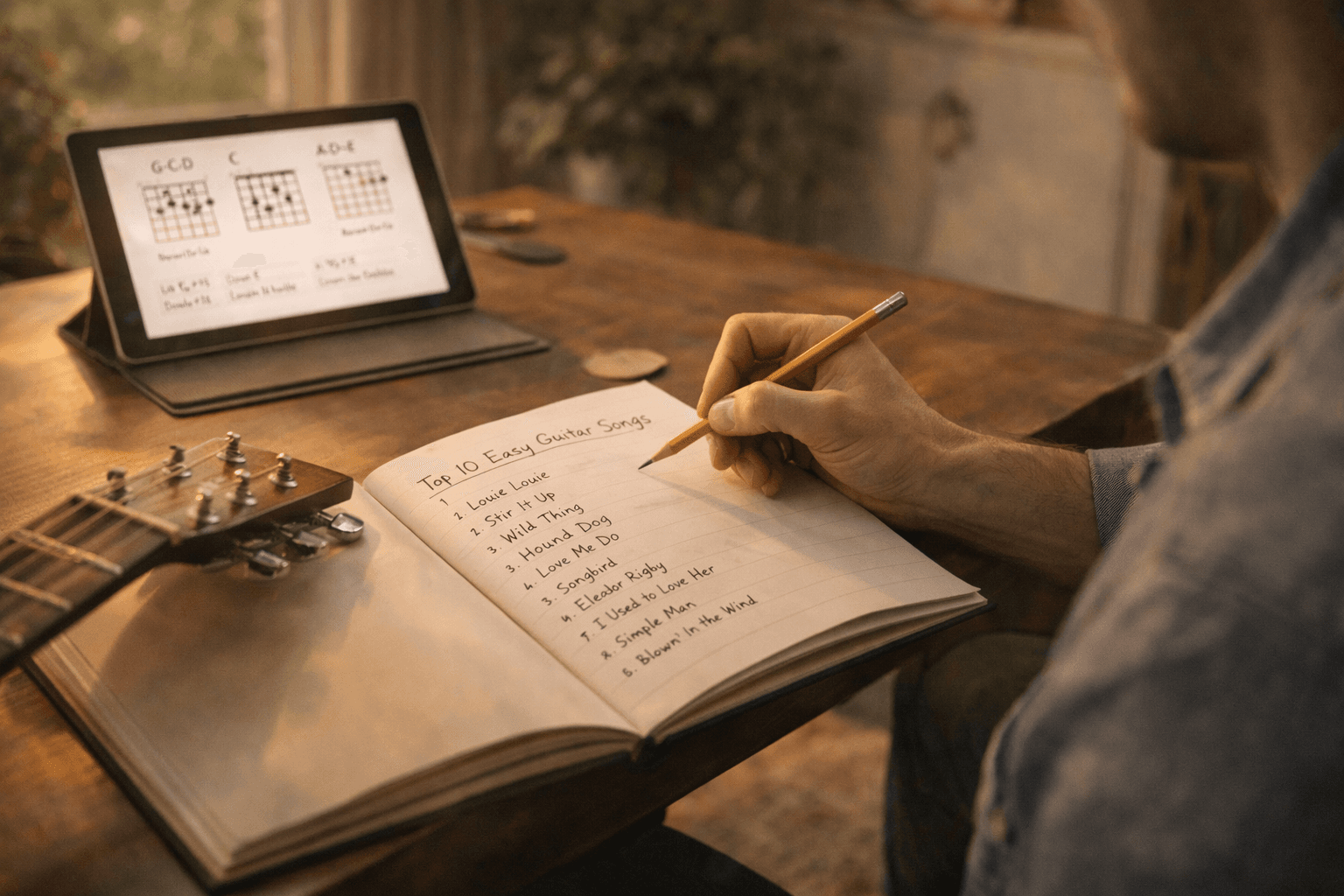
Top 10 Easy Guitar Songs With 3 Chords or Less
 Now comes the exciting part — turning your chords into real music.
If you’ve been searching for easy guitar songs, easy songs to play on guitar, or even the easiest beginner guitar songs, this list is designed to give you quick wins while strengthening your fundamentals.
Each song below uses simple progressions, making them perfect beginner guitar songs easy enough to build confidence — but structured enough to improve your rhythm and chord control.
Let’s break them down.
1. Louie Louie – The Kingsmen
Why start here?
- Slow chord changes
- Space between transitions
- Works well with steady downstrums
Progression: A - D / Em - D
Strumming Pattern:
This is one of the easiest guitar songs to play because it gives you time to think while switching chords. If you’re still mastering guitar chords for beginners, this song won’t overwhelm you.
2. Stir It Up – Bob Marley & The Wailers
This track is excellent for:
- Practicing consistent rhythm
- Learning relaxed strumming
- Developing groove awareness
Progression: A / D - E
Strumming Pattern:
Among easy guitar songs for beginners, this one teaches you control rather than speed — a crucial early skill.
3. Wild Thing – The Troggs
Chords: A – D – E
Progression: A - D / E - D
Strumming Pattern:
Two chords per bar make this a great transition trainer. If you’re working through simple guitar songs to play, this one sharpens timing while keeping the structure predictable.
4. Hound Dog – Elvis Presley
Chords: A – D – E
Progression: A / A / A / A / D / D / A / A / E / D / A / A
Strumming Pattern:
This song introduces you to the 12-bar blues format — something every guitarist should understand early on.
Why it’s valuable:
- Strengthens chord stamina
- Improves rhythm discipline
- Expands your understanding of basic guitar songs
5. Love Me Do – The Beatles
Chords: G – C – D
Progression:
Chorus: G / C / G / C / G / C / C / C / C / G / C / G / C Bridge: D / D / C / G / D / D / C / G
Strumming Pattern:
This classic progression appears in countless easy guitar songs and chords combinations.
If you can transition smoothly between G, C, and D, you unlock a large category of easy songs to learn on guitar.
6. Songbird – Oasis
Chords: G – Em7 – G/F#
Progression: G / G / G / G-G/F# / Em7 / Em7 / Em7 / Em7-G/F#
Strumming Pattern:
What makes this powerful for beginners?
- Minimal finger movement
- Repetitive structure
- Clear chord progression
- Practicing chord flow
- Strengthening timing
- Playing with steady confidence
- Which chord progression feels smoothest in your hands?
- Do you prefer slower tempos or upbeat rhythms?
- Are you more comfortable with G–C–D or A–D–E shapes?
-
Loop just those two chords.
-
Switch back and forth for 60 seconds.
-
Focus on minimizing finger movement.
-
Keep your strumming hand steady.
- Can I switch chords without pausing?
- Are all strings ringing clearly?
- Is my rhythm consistent?
- Play the verse twice.
- Pause and fix mistakes.
- Play the chorus twice.
- Practice only the toughest transition.
- Then play the full song once.
- Practicing muted strums in 4/4 time
- Counting out loud while playing
- Keeping your wrist relaxed
- Maintaining continuous motion, even on rests
- One slow song
- One mid-tempo song
- One rhythm-focused song
-
2 minutes – Warm up with basic chord switches
-
3 minutes – Practice a difficult transition
-
3 minutes – Work on strumming patterns
-
2 minutes – Play one full song confidently
- One-on-one instruction tailored to your level
- Real-time feedback on your chord transitions and strumming
- A structured learning path beyond just “easy songs to learn on guitar”
- Clear goals to help you progress faster
- G major
- C major
- D major
- A major
- E minor (Em)
- Practice switching between two chords repeatedly for 60 seconds
- Keep your fingers close to the fretboard
- Move all fingers at the same time
- Practice slowly before increasing speed
It’s one of the more modern easy guitar songs to play, and it reinforces smooth transitions without dramatic shifts.
7. Eleanor Rigby – The Beatles
Chords: Em – C
Progression:
Intro/Bridge: C / C / Em / Em
Verse: Em / Em / Em / C / C
Chorus: Em7 / Em6 / Em aug / Em
Strumming Pattern:
Only two main chords.
That simplicity makes it one of the most simple guitar songs structurally. Yet musically, it sounds rich and expressive.
If you’re looking for a song with simple chords that still feels impressive, this is a strong choice.
8. I Used to Love Her – Guns N' Roses
Chords: D – A – G
Progression: Intro/Verse: D / A / G / A Chorus: G / A / G / A / G / A / D / D
Strumming Pattern:
This song introduces a slightly more energetic progression while remaining firmly within the category of easy guitar songs for beginners.
It’s ideal for:
9. Simple Man – Lynyrd Skynyrd
Chords: C – G – Am
Progression: C / G / Am / Am
Strumming Pattern:
Adding a minor chord gives emotional depth. If you’ve been practicing beginner guitar chords, this progression reinforces clean switching between major and minor shapes.
It’s also one of the easiest songs to learn on guitar that sounds more advanced than it actually is.
10. Blowin' in the Wind – Bob Dylan
Chords: G – C – D
Progression:
Verse: G / C / D / G / G / C / G / G G / C / D / G / G / C / D / D G / C / D / G / G / C / G / G
Chorus: C / D / G / C / C / D / G / G
Strumming Pattern:
This song’s repeating structure makes memorization easier than it looks on paper.
It’s a timeless example of how simple songs on guitar can still carry powerful musical impact.
How to Choose Which Song to Start With
 Feeling unsure where to begin? Ask yourself:
Start with the one that feels easiest physically — not necessarily the one you like most musically. Confidence builds consistency.
And once you can comfortably play even two or three of these easy guitar songs, something shifts.
You stop practicing shapes. You start playing music.
That’s the moment every beginner is working toward — and it’s closer than you think.
How to Practice Easy Guitar Songs So You Improve Faster
 Learning easy guitar songs is exciting.
But here’s the truth most beginners overlook: playing a song from start to finish isn’t the same as practicing it effectively.
If you want real progress — cleaner chord transitions, smoother rhythm, and stronger timing — you need a simple, repeatable strategy.
Let’s break that down.
Step 1: Isolate the Difficult Transition
Every “easy” song has a weak spot. Maybe it’s switching from G to C.
Maybe it’s moving between A and D quickly.
Instead of replaying the entire song, isolate the exact chord change that feels unstable.
Try this:
This micro-practice method dramatically improves guitar chords for beginners and makes your easy songs to play on guitar feel smoother within days.
Step 2: Slow Down More Than You Think You Need To
Most beginners rush.
But slowing down is one of the fastest ways to improve your beginner guitar songs performance.
Ask yourself:
If the answer is no, reduce the tempo.
When practicing easy guitar songs for beginners, clarity beats speed every time.
Step 3: Use Structured Repetition (Not Random Replays)
Instead of playing a song five times casually, structure it like this:
This approach turns simple guitar songs to play into powerful training tools rather than passive entertainment.
Step 4: Strengthen Your Strumming Hand
Many players obsess over chord shapes but ignore rhythm.
Yet rhythm is what makes basic guitar songs sound musical.
Improve your strumming control by:
The better your rhythm, the more confident your easy chord songs will sound — even with simple progressions.
Step 5: Rotate Songs to Avoid Plateaus
Once you’ve mastered one of your easy songs to learn on guitar, don’t stay there too long.
Rotate between:
This variation strengthens your adaptability and keeps motivation high.
Plus, learning multiple easy guitar songs and chords expands your musical vocabulary faster than repeating a single track.
The 10-Minute Daily Routine That Works
 If you’re short on time, try this simple structure:
That’s it.
Consistency matters more than duration. Ten focused minutes daily will outperform one random hour per week.
Final Thoughts: Your First Songs Are Just the Beginning
 Learning your first few easy guitar songs isn’t just about playing familiar melodies. It’s about building coordination, rhythm, and confidence — one clean chord transition at a time.
When you practice intentionally, those beginner guitar songs stop feeling like exercises and start sounding like real music. Your strumming becomes steadier. Your timing improves. Your hands move with less hesitation.
And here’s something worth asking yourself:
How much faster would you improve with structured guidance?
Because while practicing easy guitar songs for beginners on your own works, having expert feedback can shorten your learning curve dramatically. A teacher can correct subtle mistakes, refine your rhythm, and help you move beyond basic easy guitar songs and chords with clarity and confidence.
You don’t have to figure everything out alone.
Ready to Accelerate Your Progress?
 If you’re serious about improving and want personalized guidance, this is your next step.
Book a free trial guitar class and experience:
Whether you’re just starting with your first easy guitar songs or ready to level up, a trial class gives you clarity, direction, and momentum.
Stop guessing. Start progressing.
Book your free trial class today and take the next confident step in your guitar journey.
Frequently Asked Questions (FAQ)
1. What are the easiest guitar songs for absolute beginners?
The easiest guitar songs for beginners typically use 2–3 open chords like G, C, D, A, or Em. Songs built around simple progressions (such as G–C–D or A–D–E) are ideal because they allow you to focus on rhythm and clean transitions rather than complex finger placements.
2. How long does it take to learn easy guitar songs?
Most beginners can play basic easy guitar songs within 1–2 weeks of consistent daily practice. If you practice 10–15 minutes a day focusing on chord transitions and strumming patterns, you’ll notice steady improvement quickly.
3. What chords should I learn first?
Start with these beginner guitar chords:
These chords unlock dozens of easy songs to play on guitar and form the foundation for many popular progressions.
4. How can I switch chords faster?
To improve chord transitions:
Clean transitions are the key to making easy guitar songs sound smooth and professional.
5. What is the best strumming pattern for beginners?
A simple down-down-down-down pattern in 4/4 time works perfectly for most easy guitar songs for beginners. Once comfortable, try:
Down – Down – Up – Up – Down – Up
Consistency in rhythm is more important than complexity.
6. Can I learn guitar by only playing easy songs?
Yes — especially at the beginning. Simple songs on guitar help you build coordination, timing, and muscle memory. As your confidence grows, you can gradually move to more advanced techniques.
7. Do I need a teacher to learn beginner guitar songs?
You can learn on your own, but structured guidance accelerates progress. A teacher can correct technique, improve rhythm accuracy, and help you move beyond basic easy guitar songs more efficiently.