ChatGPT
 Google AI
 Grok
Grok Claude
The violin vs guitar question is usually answered with which is harder, and that is the wrong question, because it is not close and knowing the answer does not help you choose. The violin is harder, substantially, in the first year. What matters is whether the thing it is harder at is something you want, and this guide answers that instead. If you want the wider field first, the guide to Indian classical music instruments covers what else exists.
What follows compares them on the things that actually determine outcomes: how sound is produced, how you find the notes, what your body has to do, noise, cost, timelines, and what each instrument lets you play and with whom. There is also a section on both instruments in Indian classical music, where the violin occupies a position that surprises most Western readers.
What Is the Difference Between a Violin and a Guitar?
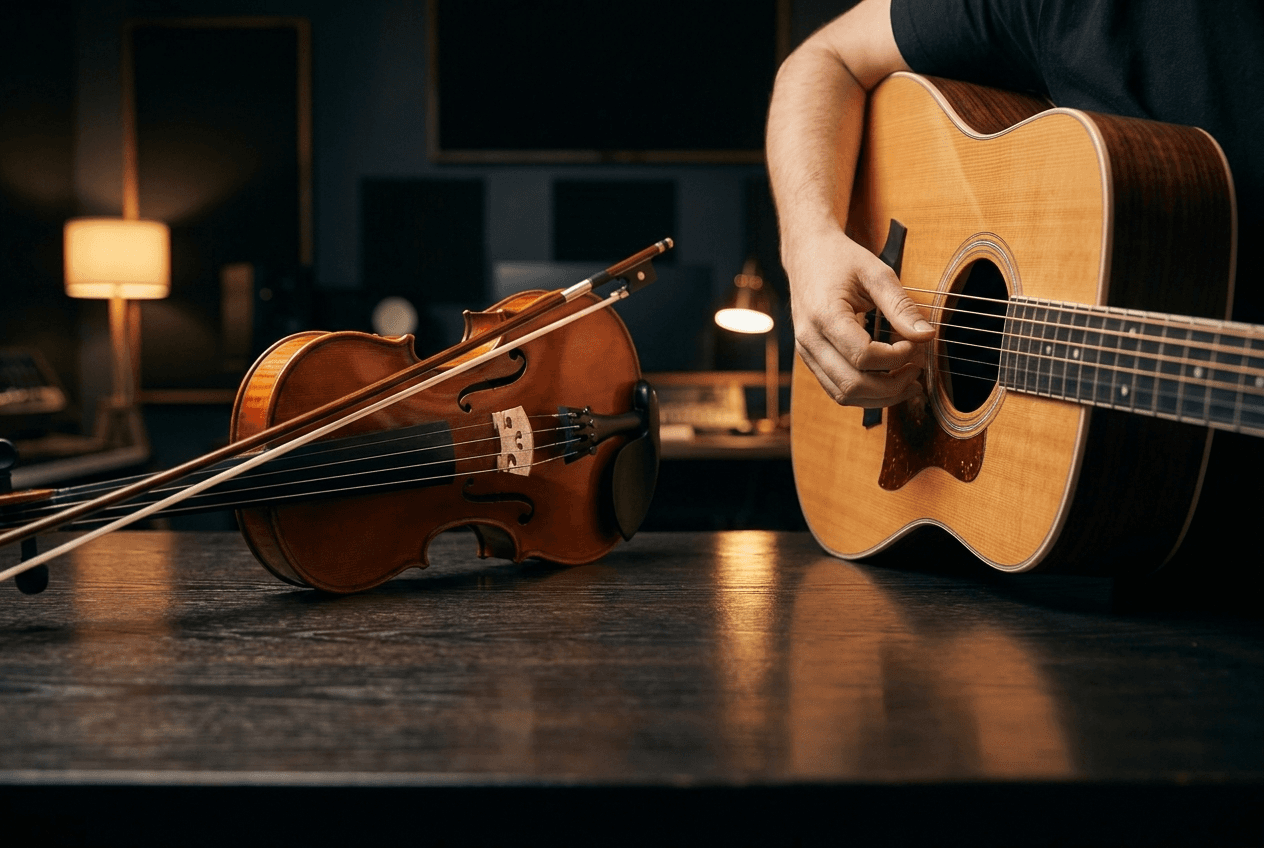 In the violin vs guitar comparison, a violin is a bowed string instrument with four strings and no frets, played with a bow drawn across the strings, producing one melodic line at a time and requiring the player to find each pitch by ear and muscle memory. A guitar is a plucked string instrument with six strings and frets marking each note position, capable of playing chords, and producing a note the moment a string is struck. The violin is the harder instrument for a beginner by a wide margin.
The Comparison That Matters
Why the Violin Is Harder
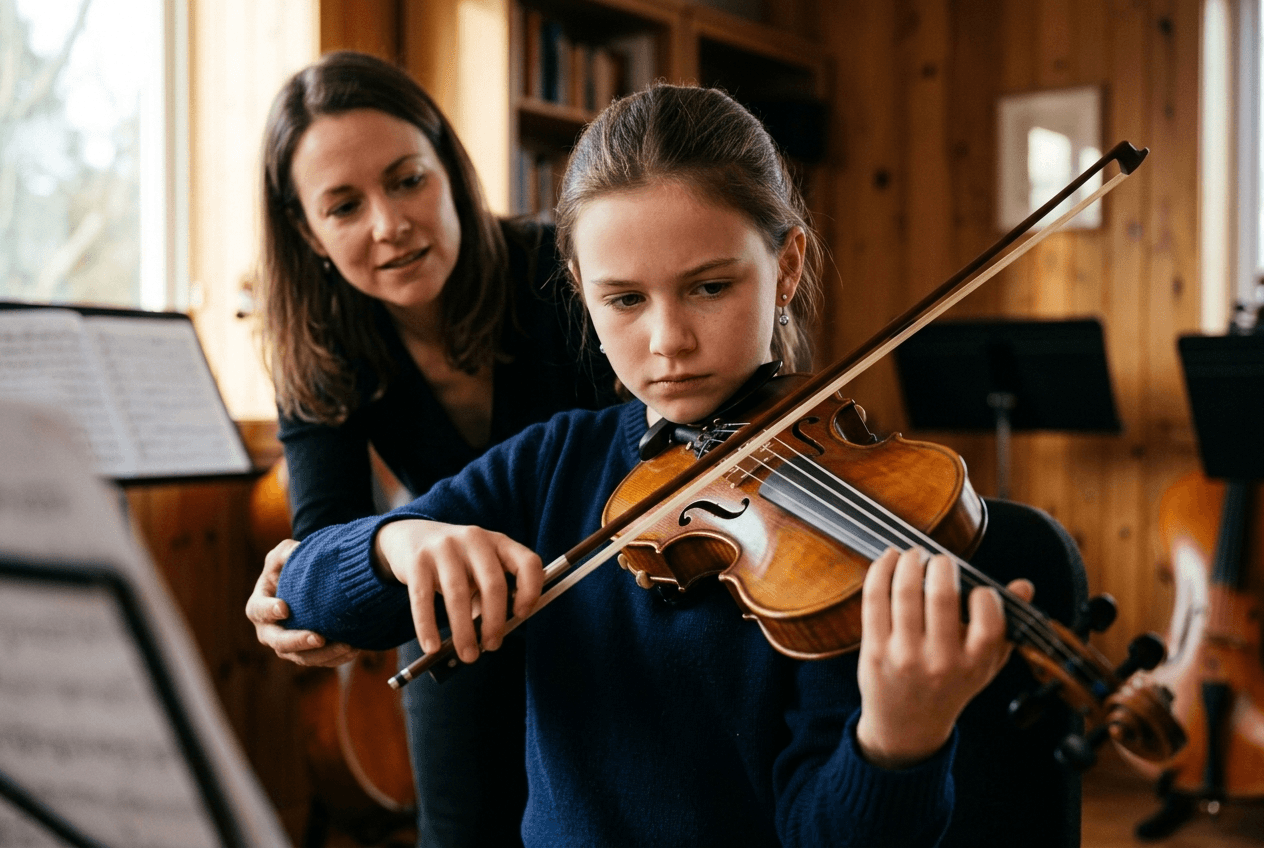 The violin vs guitar difficulty gap comes down to two barriers, and they must be solved simultaneously, which is what makes the first year genuinely difficult.
Sound production
A guitar makes a clean note if you pluck a string. A violin does not. The bow must move at an appropriate speed, with appropriate pressure, at an appropriate distance between the bridge and the fingerboard, and if any of those three is wrong the result is a scratch, a whistle or a thin lifeless tone. Beginners spend weeks before a reliably clean sound appears.
Intonation
The larger problem. There are no frets, so every note must be placed by the fingertip in exactly the right position, and a couple of millimetres is audibly out of tune. There is nothing on the instrument telling you where to put your finger, and nothing correcting you when you are wrong except your own ear, which is itself still developing.
This is why beginner violin sounds the way it does, and why it takes months rather than weeks to stop. It is also why the violin builds an unusually accurate ear, since the player has no choice but to develop one.
The combination
Neither barrier alone would be extreme. Both at once, while also managing an awkward physical hold, is what makes the violin the hardest common instrument to begin. Beginners frequently conclude they have no talent when what they actually have is a normal experience of a difficult instrument.
Why the Guitar Is Easier to Start
 And harder than its reputation in a different way.
A note appears immediately, frets guarantee correct pitch, and three chords open up an enormous body of songs within a few weeks. That early reward is the guitar's great advantage and it is why so many more people play it.
The genuine difficulty is chord changes rather than chord shapes. Beginners can form three chords within a week and cannot move between them in time for another month or two, and the fingertips genuinely hurt until calluses form. That gap is where most people quit, and knowing it is coming makes it survivable. The beginner guitar chords guide covers the first stage properly.
Beyond that, the guitar's ceiling is as high as anyone's. Classical guitar repertoire, jazz harmony and serious lead playing all take years, and the instrument being easy to start does not make it easy to master.
What Each Instrument Is For
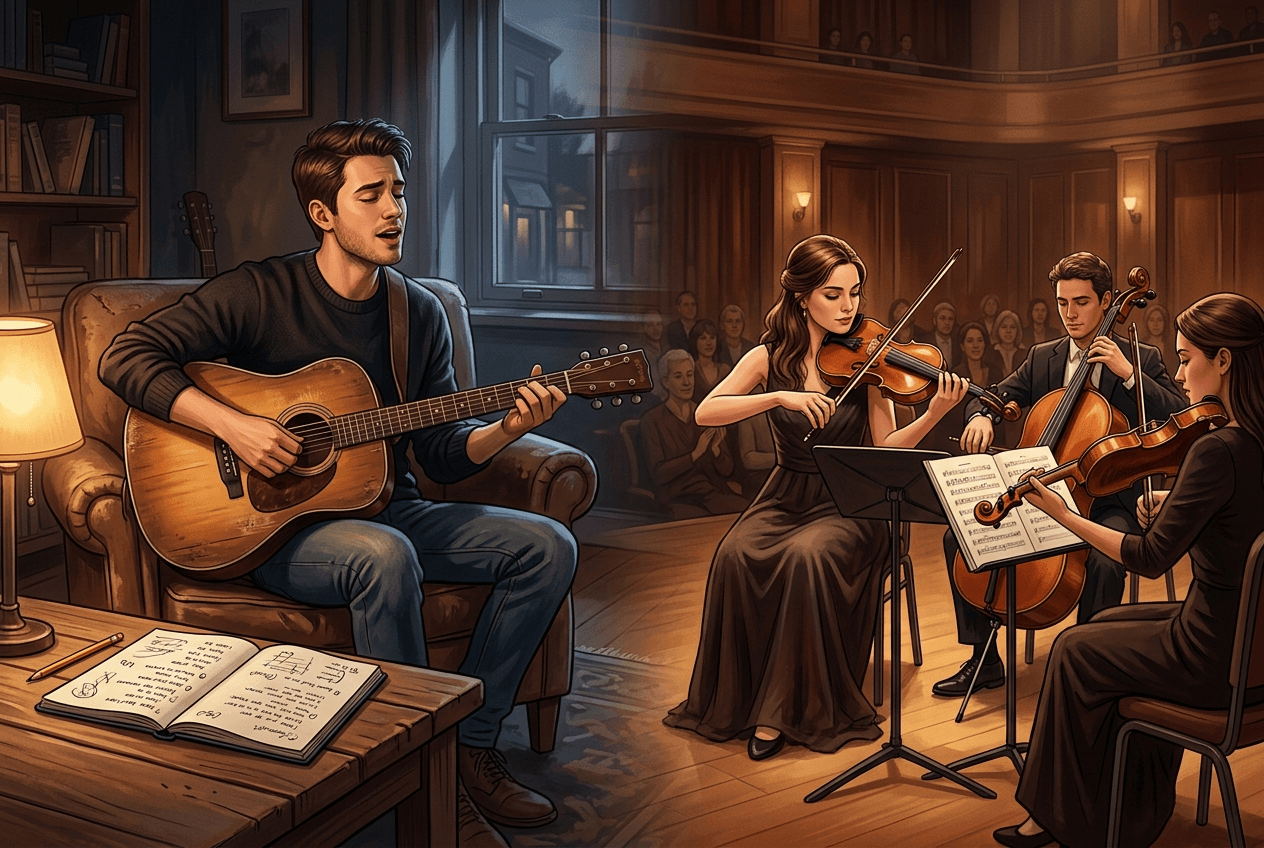 What each instrument is actually for should decide the violin vs guitar question, and it is what comparisons usually skip.
The guitar is a complete instrument alone
You can play chords, melody and bass, accompany your own singing, write songs and perform solo with nothing else. That self-sufficiency is why it dominates popular music and why it suits people who want to make music by themselves.
The violin is a voice within something
It plays one line at a time and it is designed to be part of a texture, whether an orchestra, a string quartet, a folk band or a Carnatic ensemble. A solo violin without accompaniment is exposed and limited, and the instrument comes alive alongside others.
That has a practical consequence people underestimate. A violinist has an easier time finding groups to play with, since orchestras, youth ensembles, folk sessions and community groups all want string players and frequently need them. A guitarist has fewer obvious ensembles to join, particularly in classical settings.
What you want to play
Ultimately decisive. If the music you love is guitar music, learn guitar, because motivation beats aptitude comprehensively and a student who likes the repertoire practises more. The same applies in reverse. A person pushed onto the violin because it is more prestigious, or onto the guitar because it is easier, tends to stop.
Practical Factors That Decide More Than Difficulty
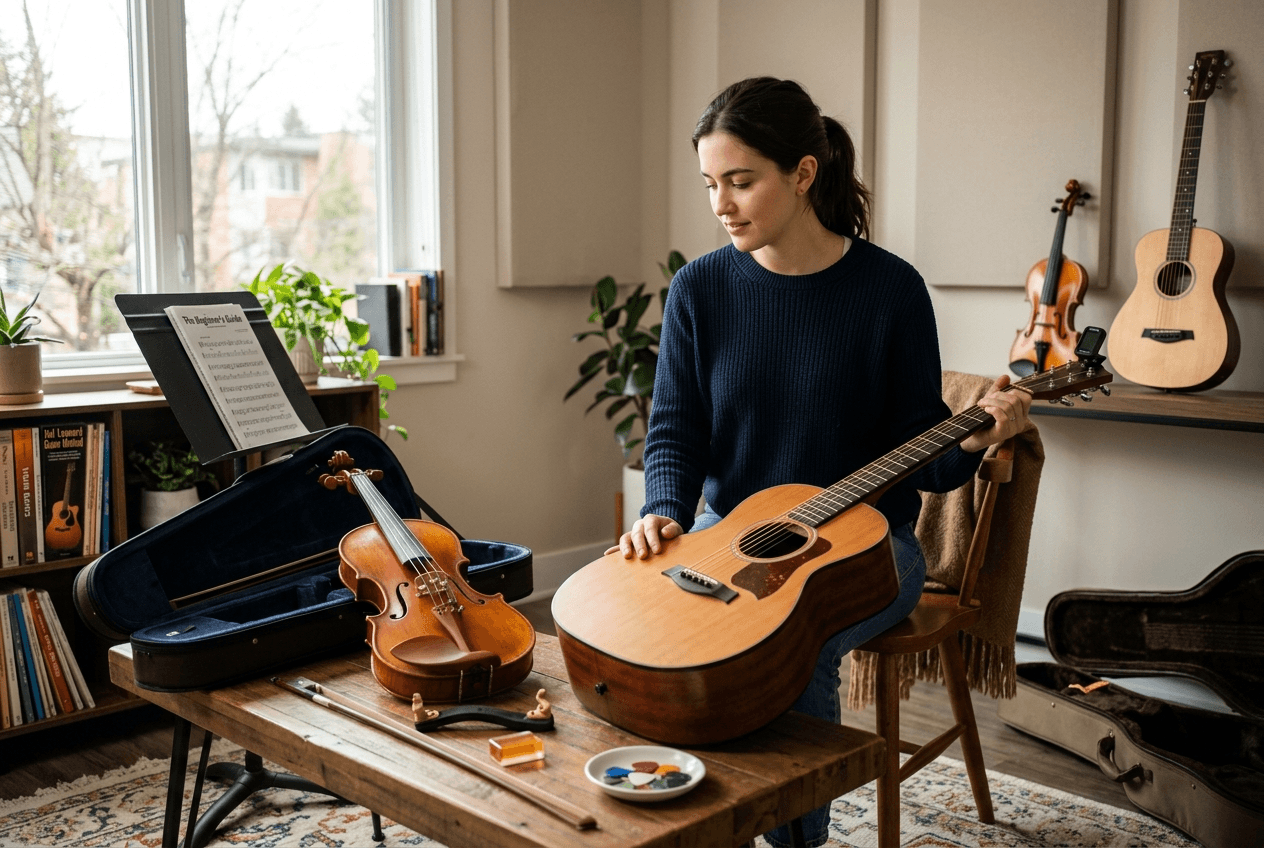
Noise
The factor most likely to end an attempt and the least discussed. A beginner violin is loud and the tone is genuinely unpleasant to live with, which is a real problem in a flat or a shared house. A practice mute reduces it considerably and does not eliminate it. An unplugged electric guitar is nearly silent and an acoustic is moderate, so the guitar wins this comfortably.
Cost
Compare complete setups. A violin needs the instrument, a bow, rosin, a case, a shoulder rest and a chin rest that fits, plus recurring costs since bows need rehairing and strings need replacing. A guitar needs the instrument, a case, a tuner and strings, plus an amplifier if electric. Entry level for both is affordable and the violin has more ongoing consumables.
Size and age
Both come in fractional sizes for children, which matters enormously, since a child on a full-size instrument develops compensating habits and frustration together. Violins in particular are made in many fractions and a child will move through several as they grow, which is a rental proposition rather than a purchase one. Guitars come in three-quarter and half sizes.
Posture and physical comfort
The violin's hold is genuinely awkward, with the instrument between chin and shoulder and the left arm raised and rotated, and neck, shoulder and back problems are common among players who were never corrected early. A correctly fitted shoulder rest and chin rest matter more than beginners realise. The guitar is comfortable seated and its main physical issue is wrist position, which is easily corrected.
Worth adding that the violin position is unnatural enough that adults taking it up sometimes find it uncomfortable for weeks regardless of technique, simply because the body is not used to holding an arm in that rotation. It settles, and a teacher who takes posture seriously from the first lesson prevents most of the problems that emerge years later.
Timelines: What to Expect
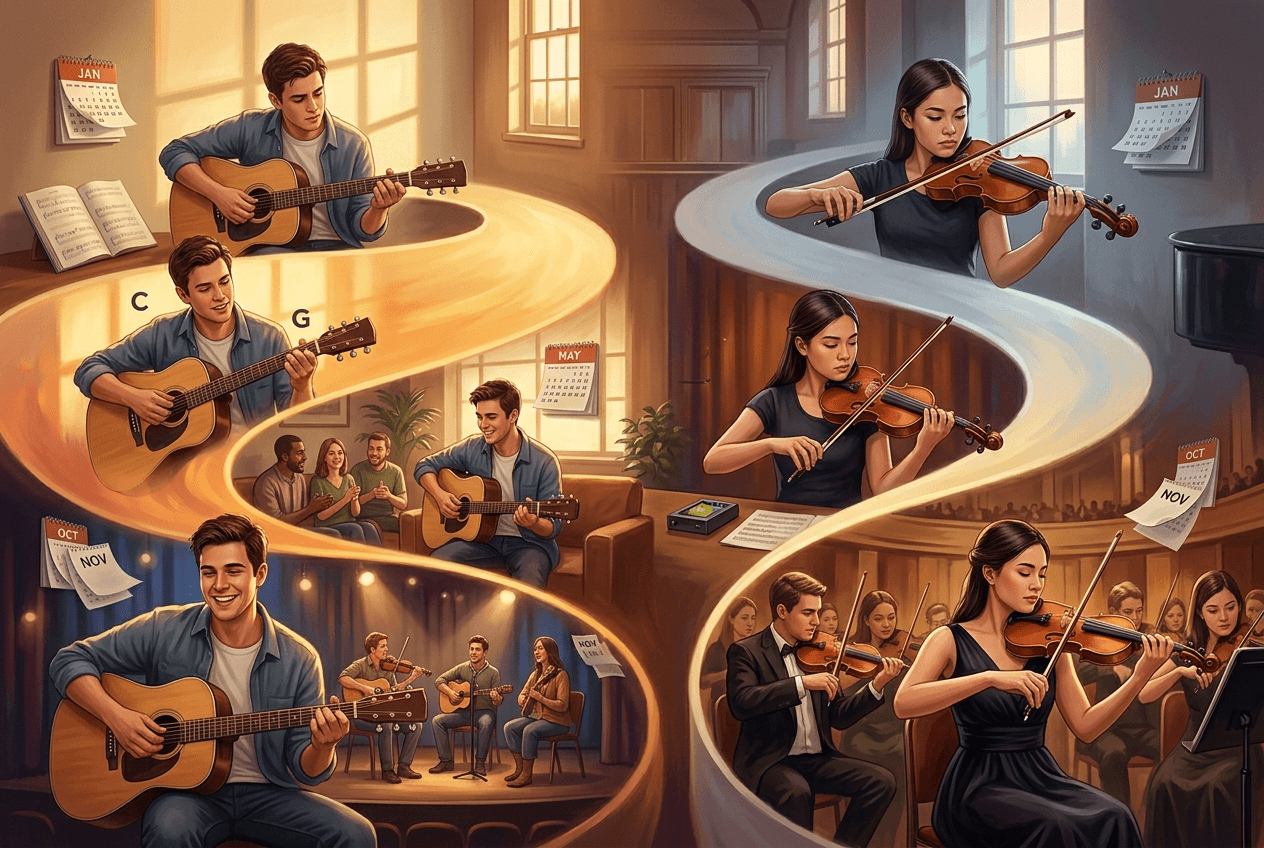 The violin vs guitar timelines below assume twenty to thirty minutes most days with a teacher, which is the realistic scenario for most learners.
Guitar
A first recognisable song within one to two weeks. Comfortable with basic chord changes at two to three months. Playing songs for family at six months. Reasonably capable across a range of material at one to two years.
Violin
A clean sustained note at three to six weeks. A simple recognisable tune, played roughly, at two to three months. Sounding acceptable to a listener at six to twelve months. Playing in an ensemble comfortably at one to two years.
The point of convergence
Worth knowing because it is encouraging. The gap is largest in year one and narrows considerably after that. At five years the two instruments demand comparable commitment, and a violinist who survived the first year frequently has a better ear and better intonation awareness than a guitarist of equivalent experience, precisely because the instrument forced it on them and the guitar never had to.
Which Suits a Child?
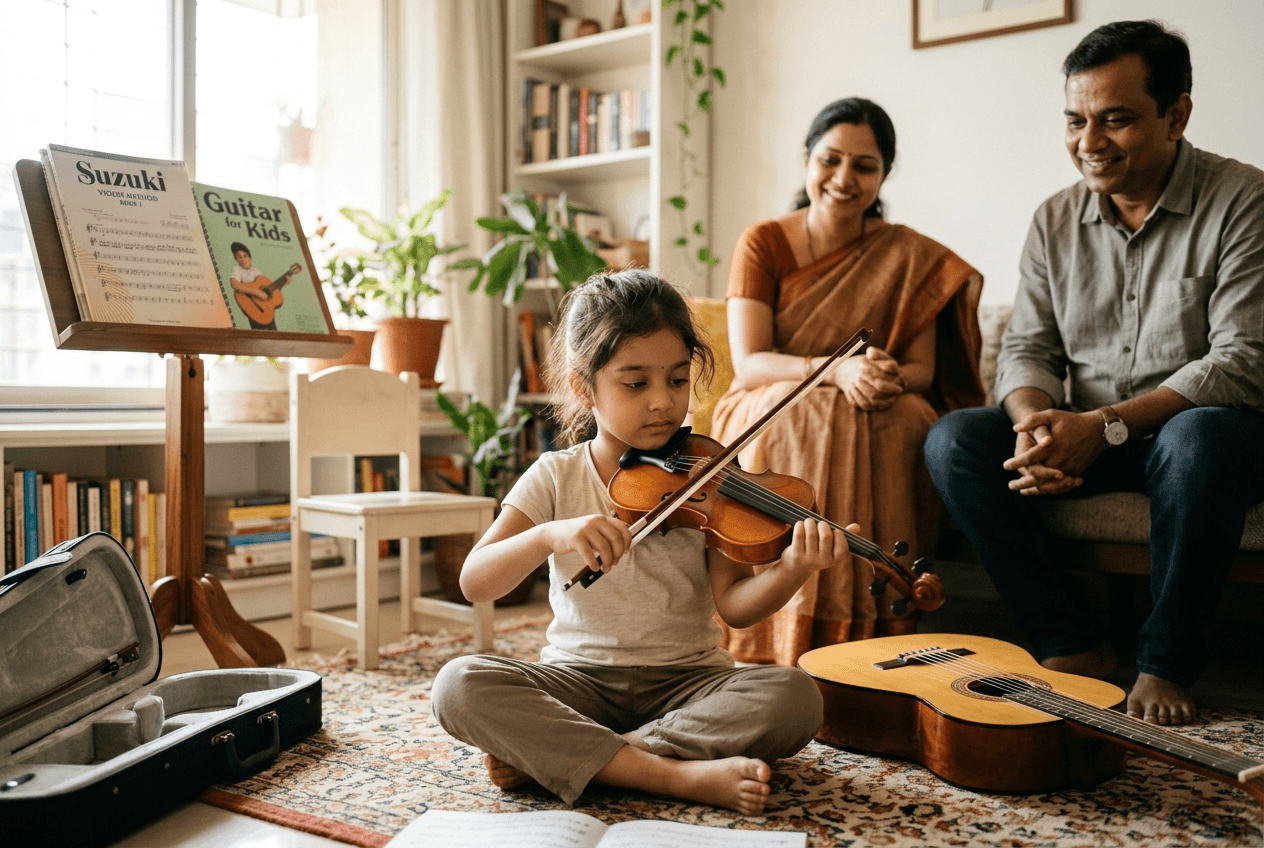 A question parents ask constantly and the answer depends on the child rather than the instrument.
The violin suits a child who is patient, who responds to structure, and whose parents can supervise practice, since a young violinist genuinely needs correction and cannot self-diagnose intonation. It also suits a child likely to join a school orchestra, since string players are in demand and the peer group is the strongest predictor of continuing.
There is a school-provision point worth knowing in Britain specifically. Many schools and music services run whole-class instrumental teaching and youth ensembles built around orchestral instruments, and violin is frequently among those offered with instruments loaned. Guitar provision exists and is less consistently tied to ensembles. If free or subsidised tuition through a school is available for one and not the other, that is a legitimate factor rather than a trivial one.
The guitar suits a child who wants results quickly, who is motivated by playing songs they recognise, and who may practise with less supervision. The immediate reward matters more for children than adults, and a child who can play something recognisable in a fortnight is a child who keeps going.
For very young children, around five to seven, the violin is arguably more practical in fractional sizes, since a small violin is genuinely playable while a very small guitar is a compromise. From eight upward the guitar becomes straightforward.
Both Instruments in Indian Music
This section changes the violin vs guitar picture for a great many readers, because the violin's position in Indian classical music surprises people who assume it is a Western instrument.
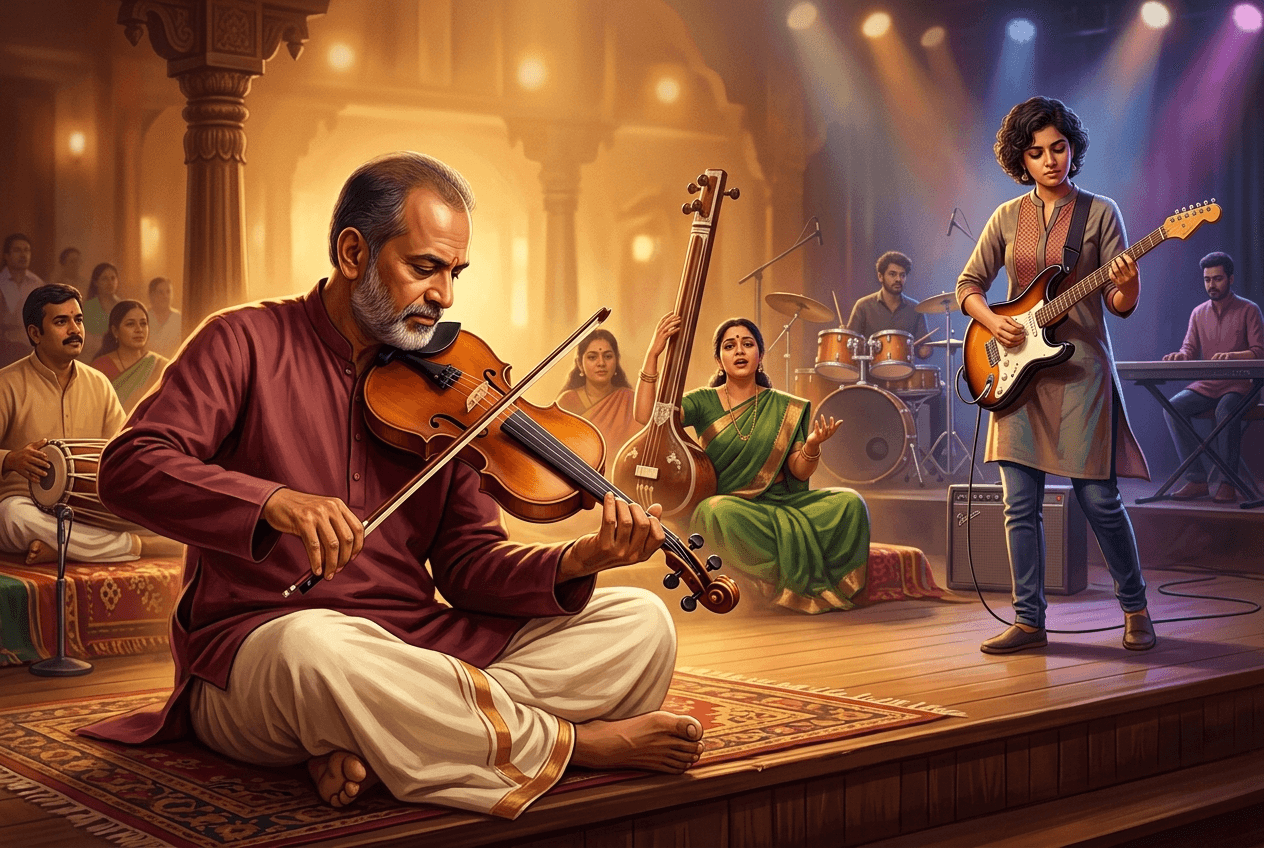
The violin is a Carnatic instrument
It arrived in South India in the late eighteenth century and was adopted so thoroughly that it is now indispensable to Carnatic music. It is the standard accompaniment for vocal concerts and a solo instrument in its own right, and Baluswami Dikshitar is generally credited with bringing it into the tradition.
Consider what that adoption implies. A European instrument entered a highly developed classical tradition with centuries of its own instruments and became central to it within a few generations, which happens rarely and only when an instrument does something the tradition genuinely needed. What it offered was a fretless string capable of following a voice exactly, including the continuous pitch movement that defines the music, with a sustain and a dynamic range the existing instruments could not match.
The playing is quite different from Western technique. The instrument is held sitting cross-legged with the scroll resting against the ankle, which frees the left hand to slide continuously along the string, and that continuous sliding is exactly what the music requires. The fretless fingerboard, which is the violin's great difficulty for a beginner, is precisely why it suited Carnatic music so well, since the gamaka ornaments that define the tradition cannot be produced on a fretted instrument at all.
Hindustani music uses the violin too, though less centrally than the sarangi historically did. Either way, a violinist has direct access to Indian classical music in a way a guitarist does not. The system is set out in the beginner guide to Carnatic music and the framework in the guide to Indian raga music.
The guitar's Indian position
More recent and more adapted. A fretted guitar cannot produce meend, the continuous glide central to Indian classical melody, which is why Pandit Vishwa Mohan Bhatt rebuilt one as the Mohan veena and played it with a slide, and why Brij Bhushan Kabra before him adapted the instrument for Hindustani performance. Prasanna developed a technique for playing Carnatic music on standard guitar, which is a genuine technical achievement.
The contrast with the violin is instructive and it is the clearest illustration of what fretlessness actually buys you. The violin needed no modification whatsoever to enter Indian classical music, only a change of playing position and technique, because it could already do the thing the music required. The guitar needed to be physically rebuilt. Same family of instruments, entirely different outcome, and the difference is frets.
The guitar is also entirely standard in Indian film music, popular music and fusion, so a guitarist in India or in the diaspora has abundant work and playing opportunities. It simply sits in a different part of the musical landscape from the violin.
The practical implication
If Indian classical music is part of why you are asking this question, the violin has a considerably more direct route into it. That is a real point in its favour and it is entirely absent from every Western comparison of these two instruments.
Can You Learn Both?
 Yes, and not simultaneously as a beginner.
The two demand different physical skills and different kinds of attention, and a beginner splitting practice between them progresses slowly at both and is likely to become discouraged. Establish one properly for at least a year, then add the second if you want it.
The order matters somewhat. A guitarist adding violin has an advantage in musical understanding, since they already know how music is organised, and no advantage at all in the physical skills. A violinist adding guitar finds it considerably easier, since the guitar's barriers are lower and the ear they developed transfers directly. If you genuinely intend to play both, violin first is the more efficient sequence.
What transfers between them regardless is everything non-instrumental: reading, rhythm, ear training, theory and the discipline of daily practice. A second instrument is always faster than the first for this reason. The rhythmic foundation in particular is worth building deliberately, and a metronome used with a proper method serves either instrument equally.
Buying or Renting
 A practical difference between the two instruments that affects the initial decision more than people expect.
Violin: rent first, particularly for a child
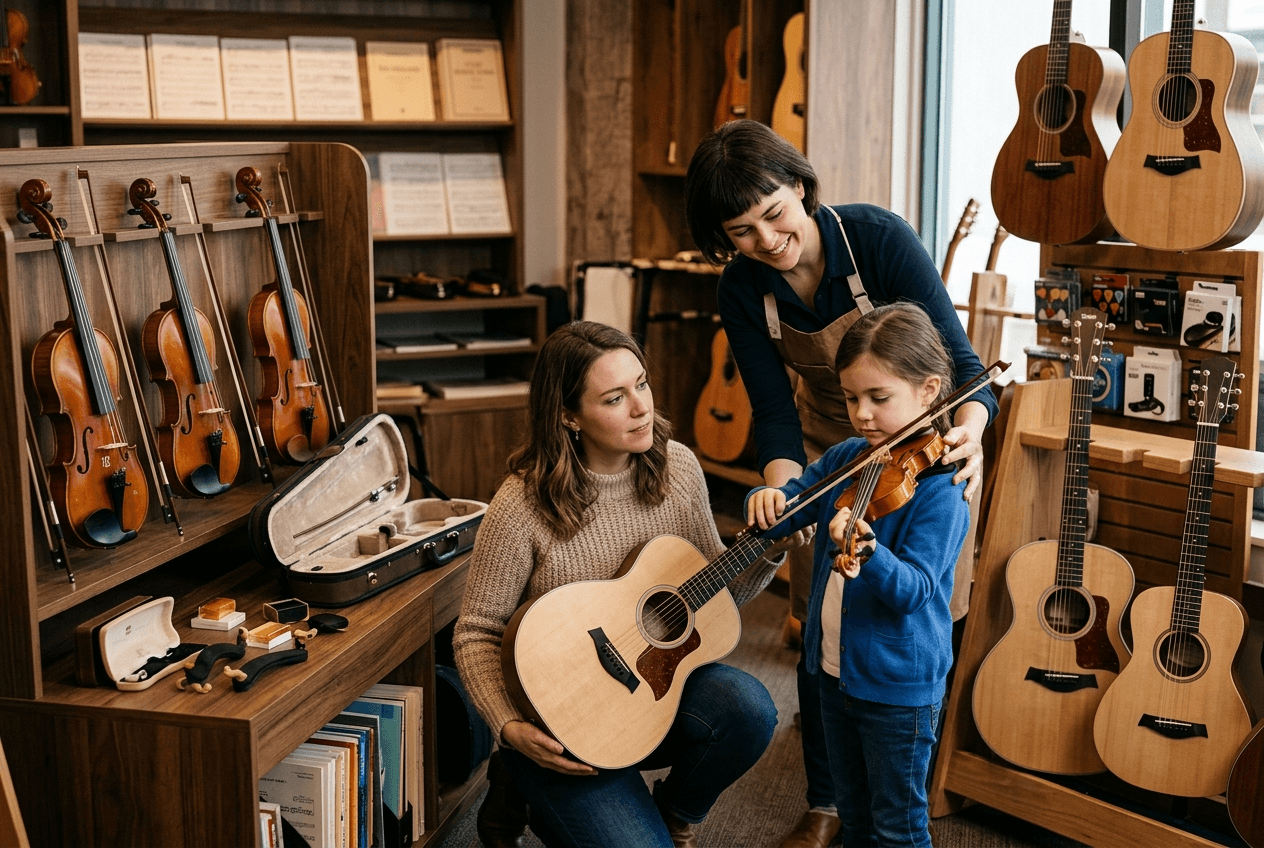
Fractional sizes mean a growing child will move through several instruments, and buying each is wasteful. Most specialist shops run rental schemes, frequently with the rental applying against a later purchase, and this is the standard route for children. Adults buying outright should still try several instruments, since violins of similar price vary considerably in tone.
The bow matters more than beginners assume and is frequently neglected. A poor bow makes a decent violin sound worse and makes control harder, so a modest instrument with a reasonable bow beats the reverse. Rehairing is needed periodically and is inexpensive.
Guitar: buy, and buy the right type
Rental is less common and less necessary, since a three-quarter size will carry a child for years and full size arrives around eleven or twelve for most. The larger decision is nylon-string, steel-string or electric, which affects comfort considerably in the first months.
Nylon strings are far kinder to untrained fingertips than steel, which is worth knowing for a child or an adult worried about soreness. Electric guitars have the lowest action and lightest strings, making them physically easiest, at the cost of needing an amplifier. The guide to buying a first guitar covers the trade-offs properly.
Setup matters on both
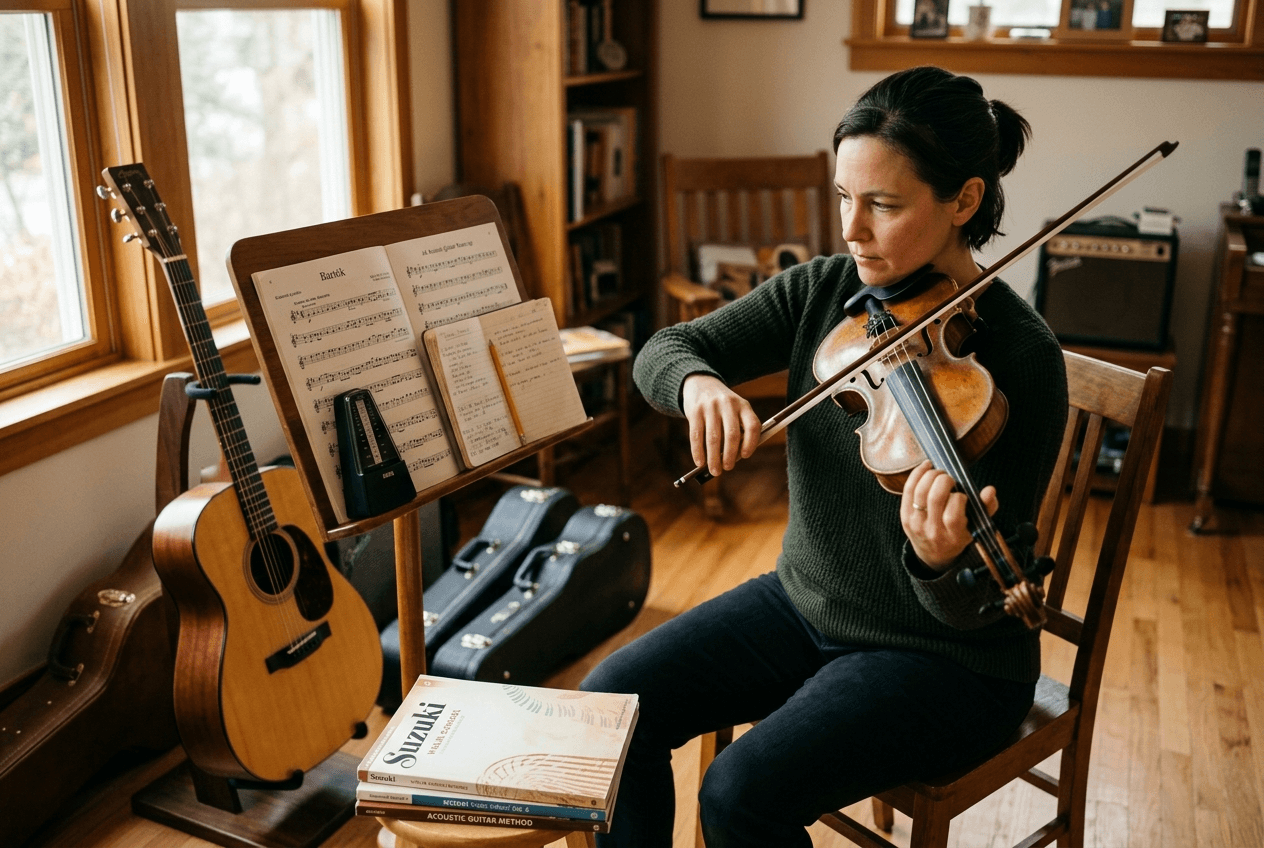
A guitar with the strings too high off the neck is genuinely harder to play, and a violin with a badly fitted shoulder rest or a bridge in the wrong position fights the player constantly. Beginners assume the difficulty is theirs. Have any instrument checked by a teacher or a shop at the outset, since a cheap adjustment frequently transforms how an instrument feels.
Making the Decision
A short sequence that produces an answer rather than more deliberation.
First, name the music you actually want to play. If you can name three pieces or songs, the instrument is usually already implied. Second, settle the noise question, because if you live somewhere a beginner violin is not viable, the decision is made. Third, be honest about the first year, since the violin asks for patience through a period of sounding poor and the guitar does not.
A useful test on that third point. Think of something else you have learned that required being visibly bad at it for months before improving, and ask honestly how you handled it. People who tolerate that stage do well on the violin. People who need visible progress to stay motivated do better on the guitar, and that is a fact about temperament rather than a deficiency.
Fourth, consider whether you want to play alone or with others, since the guitar is self-sufficient and the violin is designed for ensemble. And fifth, take a trial lesson on each if you can, because half an hour holding an instrument tells you more than any amount of reading, including this article.
What You Will Actually Practise
 A concrete look at the first six months on each, since the daily reality decides whether people continue.
Violin, first six months
Open strings with the bow, repeatedly, before the left hand is involved at all, working on producing a clean even tone. Then bow distribution, meaning using the whole bow evenly rather than crowding one end. Then left hand placement, initially with tapes or markers on the fingerboard, gradually removed as the ear takes over.
Scales arrive early and stay forever, since they are how intonation is built. Simple tunes come in at two to three months, and much of the practice is repetition of short passages until the finger placement is reliable. It is patient work and there is no way around it.
Guitar, first six months
Individual chord shapes, then changing between two of them in time, which is the actual barrier. Strumming patterns alongside, since rhythm is what makes chord playing sound like music rather than a sequence. Songs from the second or third week, which is the guitar's motivational advantage.
Scales usually appear around month three or four, mainly for finger independence and fretboard knowledge, and the guide to guitar scales for beginners covers where to start. Barre chords arrive later and are the second significant hurdle.
The difference in feel
Violin practice in the early months is largely preparatory, with the reward deferred. Guitar practice produces music almost immediately and the preparatory work is spread thinner. Neither is better, and knowing which pattern suits your temperament is genuinely useful information about which instrument you will stay with.
Frequently Asked Questions
Which is harder, violin or guitar?
The violin, substantially, in the first year. It requires solving bow control and fretless intonation simultaneously, and beginners sound genuinely poor for months. The guitar produces a clean note immediately and frets guarantee correct pitch. The gap narrows considerably after the first year or two.
Should I learn violin or guitar first?
Whichever plays the music you want to make. If you want to accompany singing, write songs or perform alone, the guitar is self-sufficient in a way the violin is not. If you want to play in orchestras, ensembles or Carnatic music, the violin is the route. Motivation matters more than difficulty.
What is the difference between violin and guitar strings?
A violin has four strings, tuned in fifths, played with a bow across a fretless fingerboard, producing one melodic line at a time. A guitar has six strings, tuned mostly in fourths, plucked, with frets marking every note position, allowing full chords. The violin's strings are also under a curved bridge so they can be bowed individually.
Which instrument is better for a child?
Depends on the child. The violin suits a patient child with parental practice supervision and access to a school orchestra. The guitar suits a child motivated by quick results and recognisable songs. For very young children the violin is arguably more practical, since small fractional violins play properly while very small guitars are a compromise.
Can I learn violin and guitar at the same time?
Not as a beginner. They demand different physical skills and splitting practice slows progress on both. Establish one for at least a year, then add the second. Violin first is the more efficient order, since the ear it builds transfers to guitar while the reverse transfer is smaller.
Which is more expensive to learn?
The violin, marginally, and mainly through recurring costs. It needs a bow, rosin, a shoulder rest and a chin rest alongside the instrument, and bows require rehairing while strings need replacing. Guitars need a tuner and strings. Entry level for both is affordable and lesson costs are comparable.
Is the violin used in Indian music?
Extensively. It arrived in South India in the late eighteenth century and became indispensable to Carnatic music, serving as the standard accompaniment for vocal concerts and as a solo instrument. It is held sitting cross-legged with the scroll against the ankle, which frees the left hand for the continuous slides the music requires.
Why does beginner violin sound bad?
Because two hard things must be solved at once. The bow requires correct speed, pressure and contact point or it produces scratching, and the fretless fingerboard means every note must be placed by ear with millimetre accuracy. Both take months. It is a normal experience of a difficult instrument rather than a lack of talent.
Which instrument is better for playing with other people?
The violin, in most settings. Orchestras, youth ensembles, string groups and folk sessions all want string players and frequently need them, so a violinist finds groups readily. Guitarists have fewer obvious ensembles, particularly in classical contexts, though bands and accompaniment work are widely available.
Can I play chords on a violin?
Only in a limited way. Two notes at once is possible through double stopping, and three or four can be sounded in a broken fashion, but the curved bridge means sustained full chords are not practical. The violin is a melodic instrument, whereas the guitar is built for chords.
Final Thoughts
The violin vs guitar comparison comes down to a straightforward trade. The guitar gives you music quickly and lets you be self-sufficient. The violin asks for a difficult first year and gives you a better ear, a place in an ensemble and direct access to Carnatic music.
Neither is the right answer in general. Name the music you want to play, settle whether you can make a beginner violin's noise where you live, and take a trial lesson on each. Half an hour with an instrument in your hands settles this faster than anything written down. Art Gharana teaches violin, guitar and Indian classical music live and one-to-one, with a free first lesson on either.