ChatGPT
 Google AI
 Grok
Grok Claude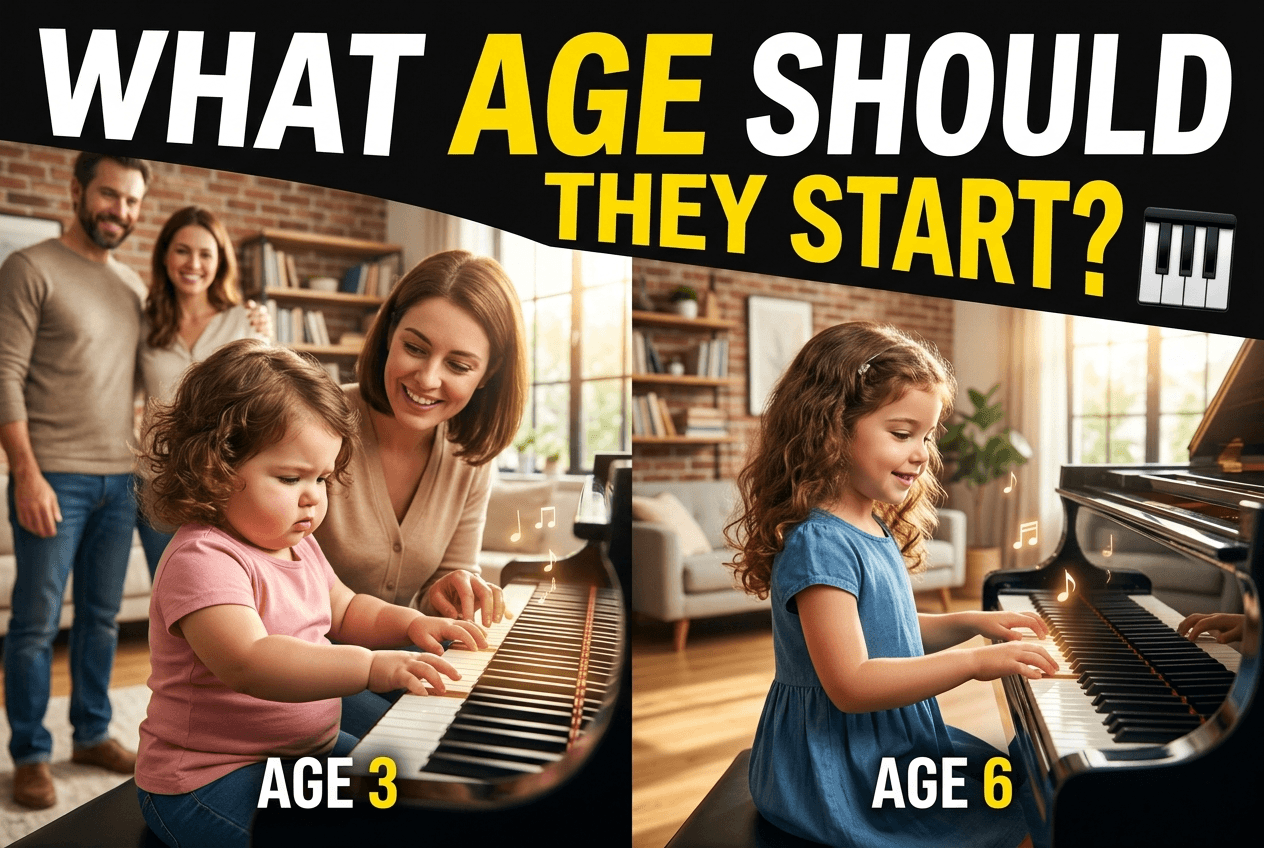
Most answers to this question give a number and stop, which is why parents keep asking it. The number itself is not very useful, because two six-year-olds can differ enormously in the things that actually determine whether lessons will work. The best age to start piano lessons is better understood as a set of readiness signs than as a birthday, and this guide sets out what those signs are and what to do at every age around them. If you are still deciding between instruments, the guide to Indian classical music instruments covers the wider field.
What follows gives the honest range, the four readiness indicators that matter more than age, what to do if your child is younger than the window, what changes for older children and teenagers, how much practice is realistic at each stage, and the parental role, which is the variable most parents underestimate.
One thing worth saying before anything else. Starting later is not a disadvantage in any way that matters. A child who begins at nine and enjoys it will overtake a child who began at four and resented it, usually within two years. The urgency parents feel about this is almost entirely unwarranted.
What Is the Best Age to Start Piano Lessons?
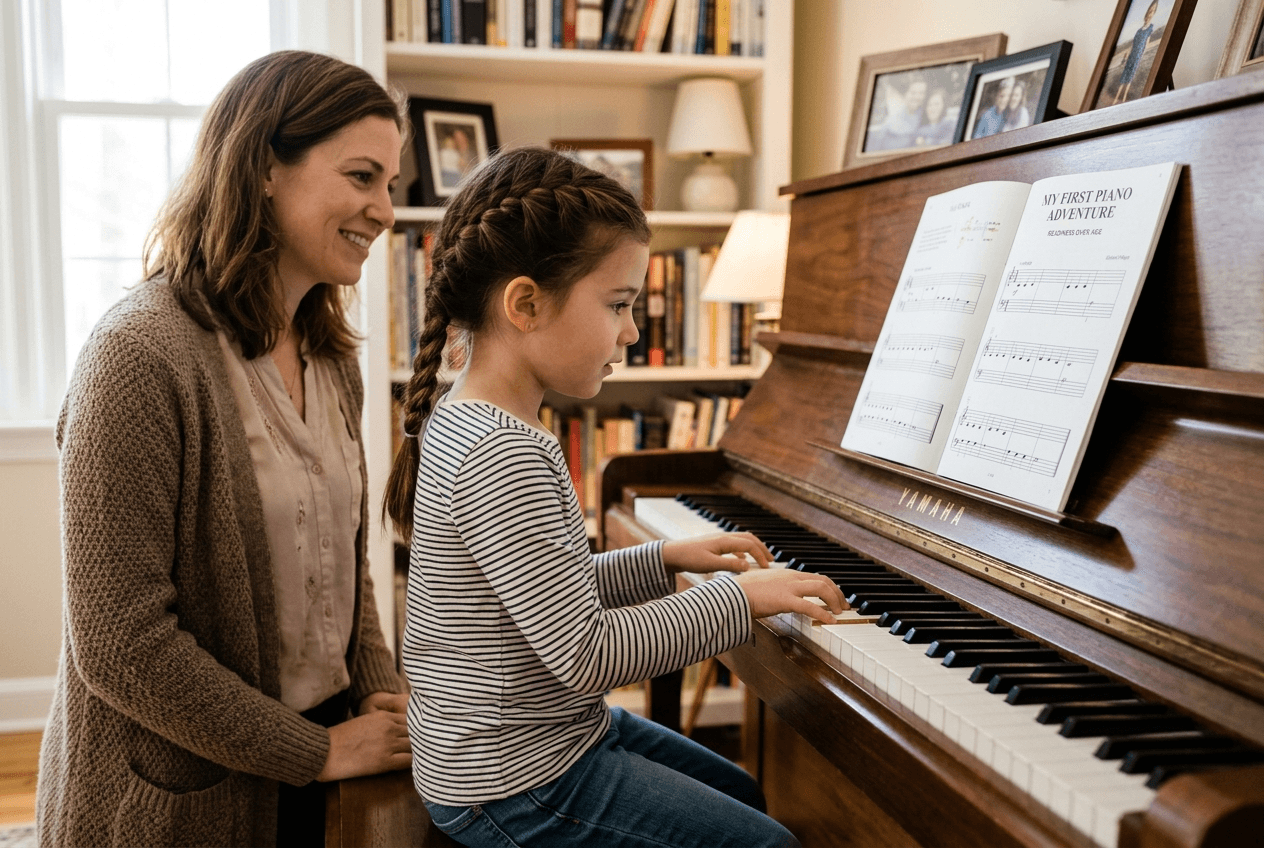 Most teachers put the best age to start piano lessons at six to eight years old, when a child can usually sit and concentrate for twenty to thirty minutes, recognise letters and numbers, follow multi-step instructions and manage the fine motor control that finger independence requires. Children as young as four can start in play-based or group settings, and children of any age up to adulthood can begin successfully. Readiness varies enough between individuals that the signs matter more than the number.
The Four Readiness Signs
These predict success considerably better than any view about the best age to start piano lessons, and a parent can assess all four in a week of ordinary observation.
Attention span
Can the child stay with a single activity for fifteen to twenty minutes without needing to be redirected? This is the single strongest predictor, because a lesson requires sustained focus and practice requires it again at home. A child who cannot yet manage this is not behind; they are simply not ready for a format that demands it, and six months makes a substantial difference at this age.
Fine motor control
Can they hold a pencil with reasonable control, use scissors, do up buttons, and move individual fingers with some independence? Piano requires each finger to work separately, which is a coordination that develops on its own schedule. A useful informal test is asking a child to tap each finger in turn against their thumb.
Letter and number recognition
Music notation uses letters A to G and counting, so a child who recognises letters and can count reliably has the foundation for reading music. A child who is not there yet can still learn plenty by ear and imitation, which is exactly what good early teaching does, and formal notation will wait.
Interest, meaning theirs rather than yours
The one that decides everything and the one parents assess least honestly. A child who asks about the piano, presses the keys unprompted, or shows curiosity when they hear one is bringing something no amount of scheduling can manufacture. A child being enrolled because a parent wants them to play is starting from a considerably harder position.
Age by Age
Is Four Too Young?
For formal lessons, usually yes. The best age to start piano lessons is rarely four, and that is not the same as saying four is too young for music.
A four-year-old typically lacks the attention span for a structured lesson, the finger independence for proper technique, and the reading readiness for notation. Attempting formal instruction at this age frequently produces a frustrated child, a frustrated teacher and a parent who concludes their child is not musical.
What works instead is genuine musical activity without the constraints of an instrument. Singing, clapping rhythms, moving to music, playing simple percussion, listening actively and identifying sounds. All of these build the ear, the sense of pulse and the enjoyment that formal lessons will later draw on, and a child who has done two years of this arrives at their first piano lesson substantially ahead of one who has not.
Group music classes designed for this age exist widely and are a better investment than early individual piano lessons. If a four-year-old is genuinely fascinated by the piano specifically, short informal sessions of ten minutes with a parent, exploring rather than instructing, are far more productive than a formal lesson.
The exception
Some children are ready earlier, and the Suzuki method in particular is designed for early starters, beginning by ear rather than by reading and requiring substantial parental participation in every lesson and practice session. It works genuinely well for the right family, and it depends on a parent able to commit that time, which is a real requirement rather than a nominal one.
Is Ten Too Late? Is Fifteen?
No. The idea that there is a narrow best age to start piano lessons after which the opportunity closes is the most persistent misconception in children's music education.
Older children learn faster. A ten-year-old can understand an explanation, retain a concept without endless repetition, practise independently, and recognise their own errors. Where a five-year-old might take a year to reach a certain standard, a ten-year-old frequently reaches it in a few months, and the gap closes far more quickly than parents expect.
Teenagers have the additional advantage of choosing for themselves. A fourteen-year-old who decides they want to play, and picks the music they want to play, will practise with a motivation that no parental encouragement produces in a younger child. The commonest reason teenagers do not progress is not late starting; it is being made to play repertoire they have no interest in.
The one genuine advantage of early starting is that habits form more readily and certain physical skills embed more deeply, which matters for a child heading toward professional performance. For everyone else, which is the overwhelming majority, the effect is small and easily outweighed by enthusiasm.
How Much Practice at Each Age
Once past the best age to start piano lessons question, parents ask about practice, and the realistic numbers are lower than most assume.
At five to six, five to ten minutes daily is plenty and more is counterproductive. At seven to nine, ten to twenty minutes. At ten to twelve, twenty to thirty minutes. Teenagers working seriously might do thirty to sixty minutes, and that is their choice rather than a requirement.
Frequency matters enormously more than duration. Ten minutes daily produces far more progress than seventy minutes on a Saturday, because physical skill develops through repetition spaced over time rather than through total hours. A parent enforcing a long weekend session is working against the biology.
Making practice happen
Same time each day, attached to an existing routine such as after breakfast or before dinner, so it does not require a decision. Keep the piano somewhere central rather than in a spare room, since an instrument in a cold unused space gets played considerably less. And keep sessions short enough that the child stops while still willing, rather than continuing until they are fed up, which teaches them that practice ends badly.
The Parent's Role
The variable that predicts outcomes more reliably than the child's aptitude, and the one least discussed.
For younger children, sit in
Children under about seven benefit enormously from a parent attending lessons and helping at home, because they cannot yet remember what the teacher said or organise their own practice. This does not require the parent to play. It requires them to know what was set and to help the child do it.
Praise effort rather than talent
Telling a child they are talented sets up a fragile self-image that difficulty threatens. Telling them they worked hard on a passage, and that it improved, describes something they control. This distinction is well established in educational research and it matters particularly in music, where progress is slow and visible failure is constant.
Do not turn it into a battle
The fastest way to end a child's interest in music is to make practice the site of a daily conflict. If it has become one, reduce the requirement rather than escalating. Five minutes willingly is worth more than twenty enforced, and a child who associates the piano with arguments will stop as soon as they are able to.
Play music at home
Children who hear music regularly develop ears faster and connect lessons to something they enjoy. This costs nothing and it is the most underrated thing a parent can do. Playing a range including whatever traditions the family carries matters too, and the guide to easy songs for beginner singers is a useful starting point for material a child can join in with.
Choosing an Instrument to Learn On
 A practical question that affects progress more than parents realise.
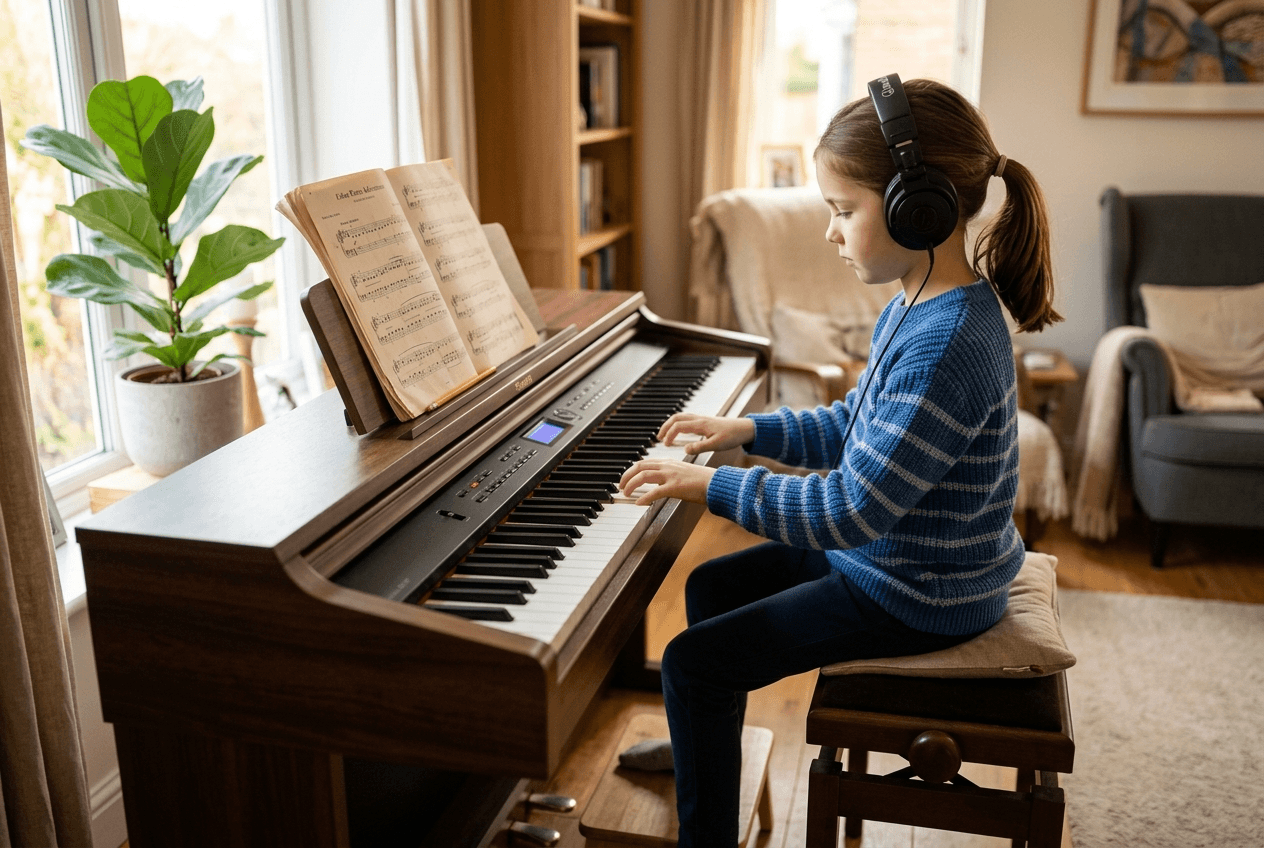
A full acoustic piano is ideal and is not necessary. An eighty-eight key digital piano with weighted keys is entirely adequate for learning and has real advantages, being silent through headphones and never needing tuning.
A practical question that affects progress more than parents realise.
A full acoustic piano is ideal and is not necessary. An eighty-eight key digital piano with weighted keys is entirely adequate for learning and has real advantages, being silent through headphones and never needing tuning.
What does matter is weighted keys. A light unweighted keyboard does not build the finger strength and dynamic control that piano playing requires, and a child who learns on one finds a real piano genuinely difficult when they encounter it at a lesson or an exam. If the budget forces a compromise, compromise on the number of sounds and features rather than on the action.
Sixty-one keys is workable for the first year or two and will run out. Bench height matters more than people expect, since a child sitting too low or too high develops wrist problems, and an adjustable bench is worth the small extra cost.
Individual or Group Lessons?
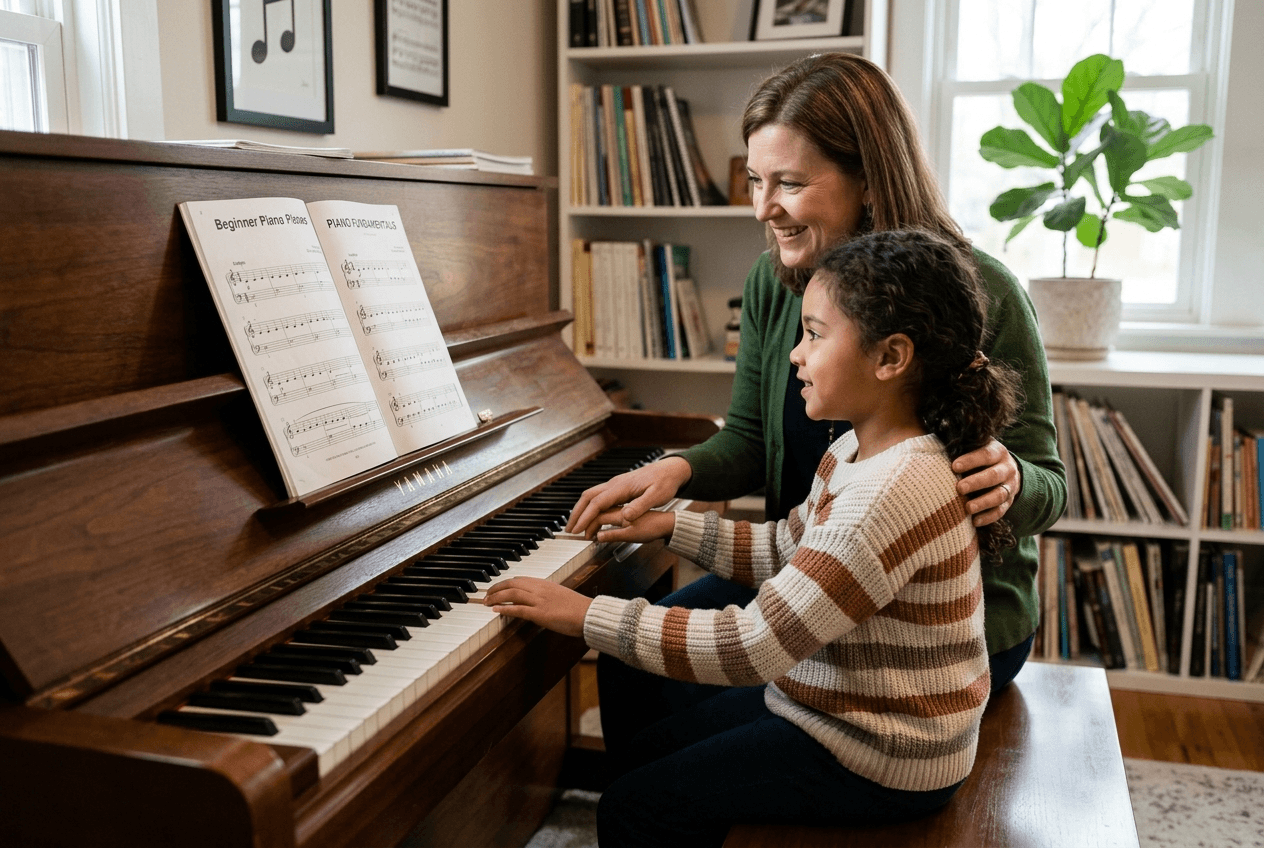 Both work and they suit different children.
Individual lessons give focused attention, allow the pace to match the child, and produce faster technical progress. They also put a young child alone with an adult for half an hour, which some children find intense.
Group lessons cost less, provide peers, and turn practice into something social. For younger children in particular the motivational effect of other children doing the same thing is substantial. The trade-off is less individual correction, so technical errors persist longer.
A common and sensible pattern is group classes at five or six, moving to individual lessons at seven or eight once the child can sustain focus and the technical work becomes more demanding.
There is a third option that suits some families, which is a short individual lesson combined with an occasional group session or informal concert. The individual lesson supplies correction and the group setting supplies the motivation and the low-stakes performance experience, which is the thing children most lack when learning at home. Teachers who run termly informal concerts for their students are providing something genuinely valuable, and it is worth asking whether they do.
Online or In Person?
A real question for parents now, and the answer depends more on the child's age than on the instrument. Piano adapts well to online teaching. The playing position is stable, both hands are visible from a single camera angle above or to the side, and a teacher can see hand shape, posture and finger use clearly. Many families find it works better than expected.
The complication is age. Younger children need more physical presence and more help staying engaged, and a five-year-old on a screen is a harder proposition than a ten-year-old. Where online lessons are used with young children, a parent sitting alongside is close to essential rather than optional.
Setup matters more than most families realise. A camera showing the keyboard and the hands, decent audio rather than a laptop microphone, and a stable connection make the difference between a teacher who can correct and one who is guessing.
Signs It Is Working, and Signs It Is Not
Working
The child plays outside of practice time, even briefly and even badly. They mention the piano unprompted. They want to show someone something. They ask to learn a specific song. And across three months, comparing a recording to one from the start, there is audible progress even if week to week there seemed to be none.
Not working
Practice has become a daily argument. The child expresses relief when a lesson is cancelled. There is no progress across several months despite regular practice, which usually indicates a teaching or setup problem rather than a child problem. Or the child is anxious rather than merely reluctant, which is worth taking seriously.
What to do about it
Change something before stopping. A different teacher, a different format, different repertoire, or a break of a few months are all interventions worth trying, and any of them may solve it. Many children who quit lessons entirely would have continued happily with a teacher who suited them better or with music they had chosen themselves.
Piano and Indian Classical Music
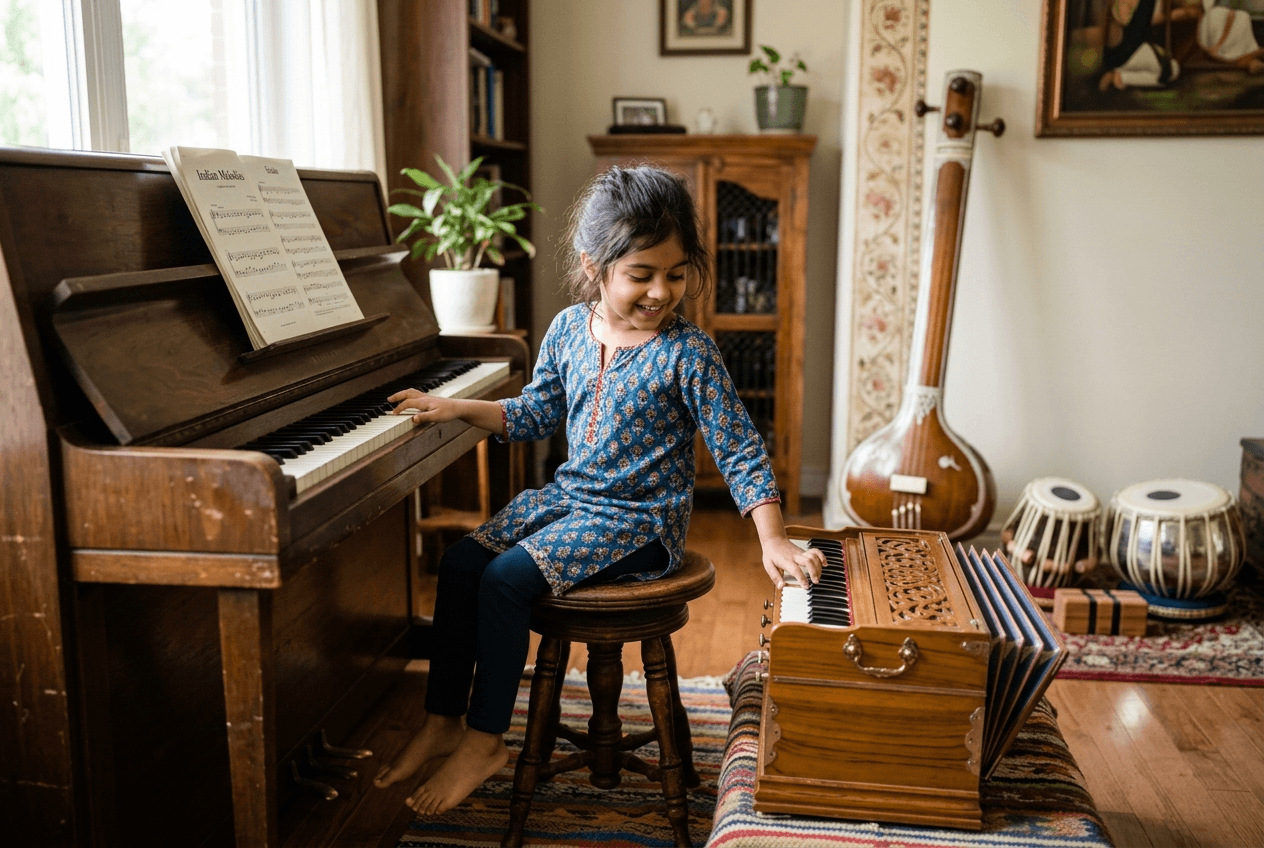 Worth addressing for families pursuing both, which is common in British Indian households.
The two are complementary rather than competing. Piano builds notation reading, theory understanding and hand independence, all of which transfer to any musical activity. Indian classical training builds ear, microtonal accuracy, raga knowledge and improvisation, which the Western system does not develop and which piano study cannot supply.
A child doing both is not overloaded provided the total time is reasonable, and many families run piano lessons alongside vocal or harmonium study successfully. The harmonium in particular sits close to the piano in interface while belonging to an entirely different tradition, and a child who plays one finds the other physically familiar.
For a child learning Indian vocal music, some keyboard ability is genuinely useful, since it allows them to check pitch, find their tonic and accompany their own practice. The foundations are set out in the beginner guide to Hindustani classical music and the complete guide to swaras.
One difference worth explaining to a child doing both, because it confuses them otherwise. The piano has fixed tuning, with twelve equal steps in an octave, and Indian classical music uses finer intervals than that, called shrutis. A note that is correct on the piano can be audibly not quite right in a raga, and this is not the child getting it wrong. Understanding that the two systems tune differently prevents a great deal of unnecessary confusion, and the guide to Indian raga music explains why.
What Piano Actually Gives a Child
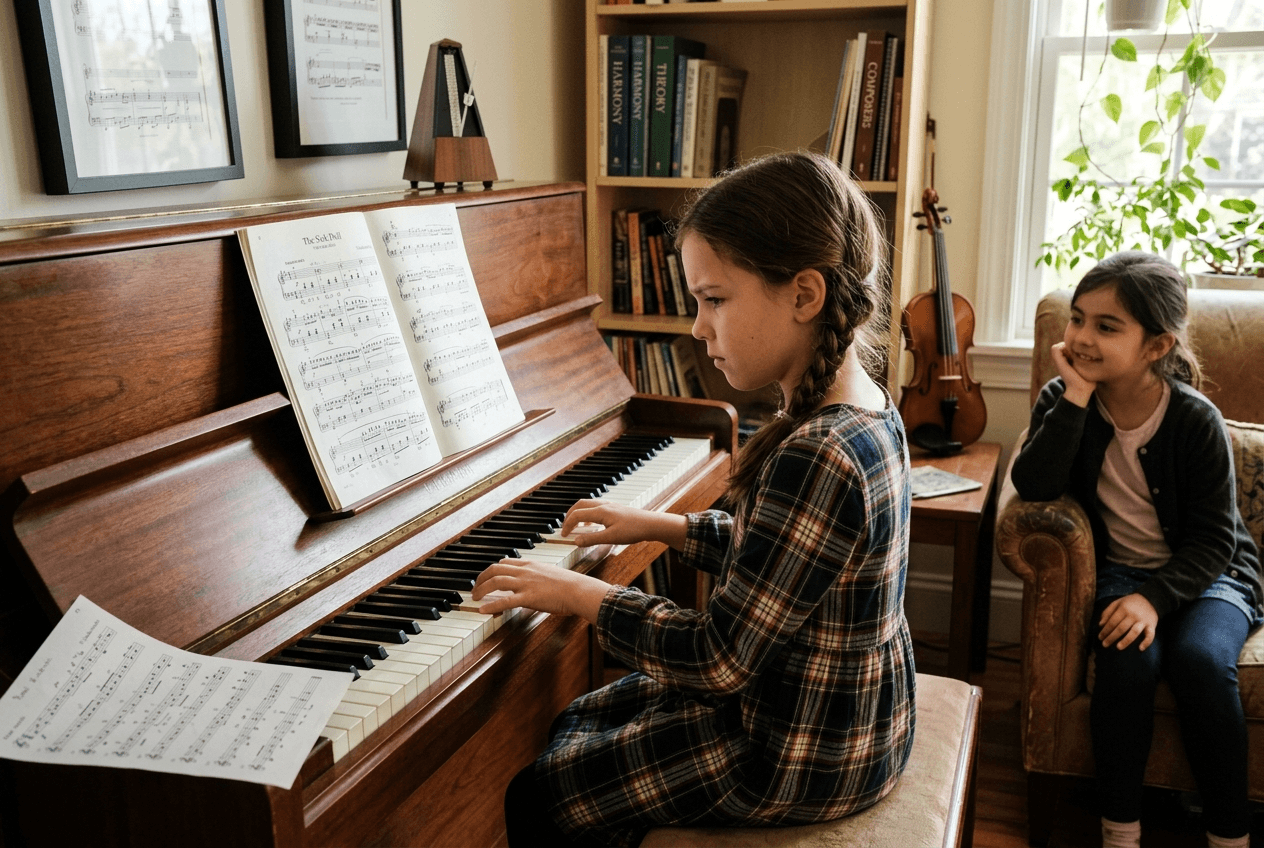 Worth setting out, because parents frequently enrol a child without articulating what they hope for, and the honest answer is broader than performance ability.
A visual map of how music works
The piano lays out the entire structure of Western music theory in front of you. Intervals are distances you can see, chords are shapes, and scales are patterns. A child who learns theory at a keyboard learns it once and carries it to every other instrument and to singing, which is why so many musicians who play something else entirely have basic piano.
Two hands doing different things
A genuine cognitive skill and one piano develops more than almost any other instrument. Coordinating independent movements while reading two lines of notation is demanding, and children who acquire it find other coordinated tasks easier. It is also the reason piano progress feels slow around the six month mark, since this is the point where the two hands must separate.
The habit of working at something difficult
The least musical benefit and arguably the most useful. Learning an instrument involves being visibly bad at something for a sustained period, working at it daily without dramatic results, and eventually finding that it works. A child who has experienced that once has learned something that transfers well beyond music.
Something to do with other people
Often overlooked with piano specifically, since it is a solo instrument by default. Accompanying a singer, playing duets, joining a band or working with other musicians are all available to a pianist and all considerably more enjoyable than practising alone. Parents who arrange even occasional playing with others usually find motivation improves noticeably.
What to Look for in a Teacher
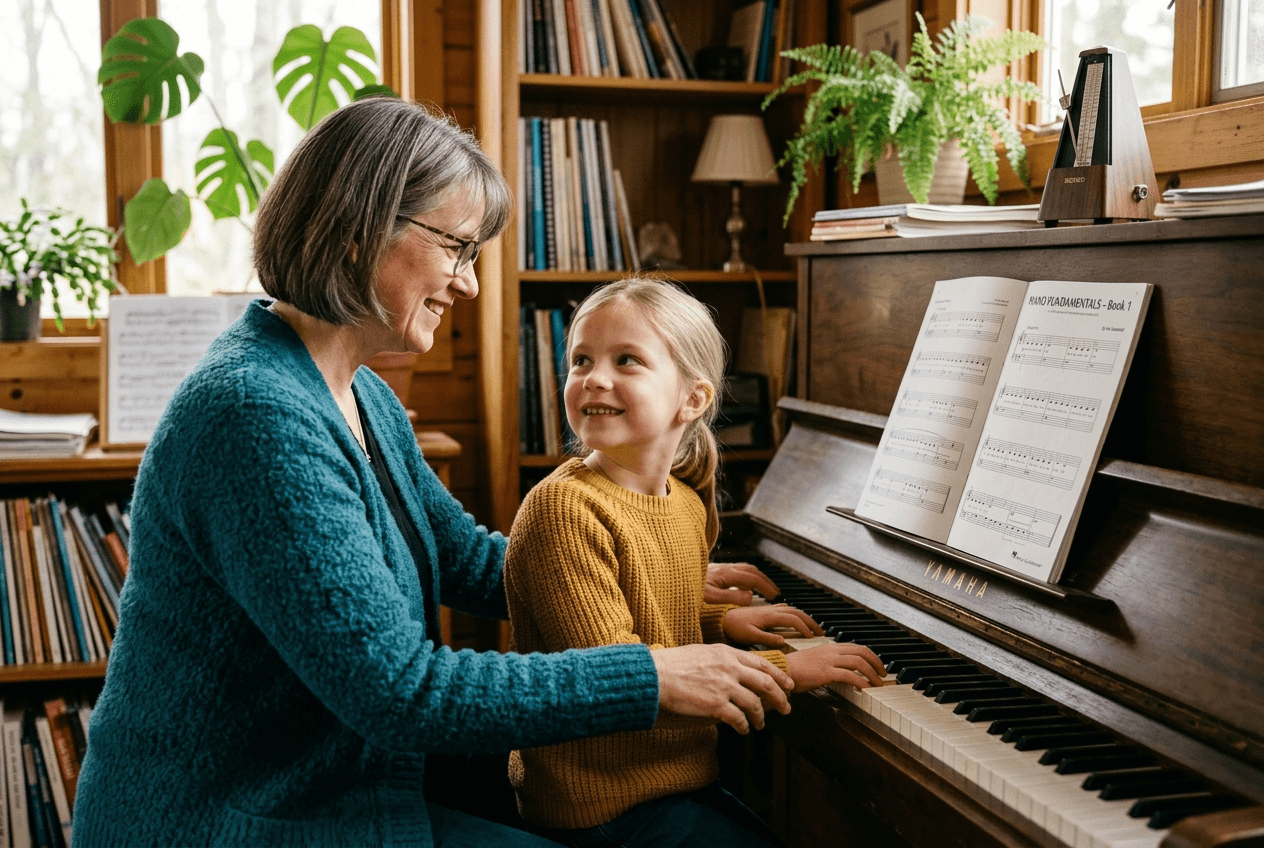 The single most consequential decision in this whole process, more than age, format or instrument.
Experience with children specifically, since teaching a six-year-old is a different skill from playing well. Ask how long they have taught children of your child's age, and be wary of an excellent performer with no teaching background.
The single most consequential decision in this whole process, more than age, format or instrument.
Experience with children specifically, since teaching a six-year-old is a different skill from playing well. Ask how long they have taught children of your child's age, and be wary of an excellent performer with no teaching background.
A trial lesson, which is standard and which you should use properly. Watch how the teacher speaks to your child, whether they explain or merely demonstrate, and whether your child is engaged or enduring it. Personality fit matters more here than in almost any other subject.
Clarity about what is set for practice. A child who leaves a lesson without knowing what to do at home will not practise usefully, and a teacher who writes it down or records it is doing something valuable.
And a willingness to include music the child likes. A teacher who only assigns from a graded syllabus, with no room for a song the child asked for, is optimising for exams rather than for a musician.
Ask also how they handle a child who has not practised, since it will happen regularly. A teacher who treats it as a failure of character sets up a dynamic that damages the relationship; one who adjusts the week's work and moves on keeps the child coming back. This single question tells you a great deal about how the next few years will go. The wider considerations around choosing a provider are covered in the guide to general singing and music tips for beginners.
Common Mistakes Parents Make
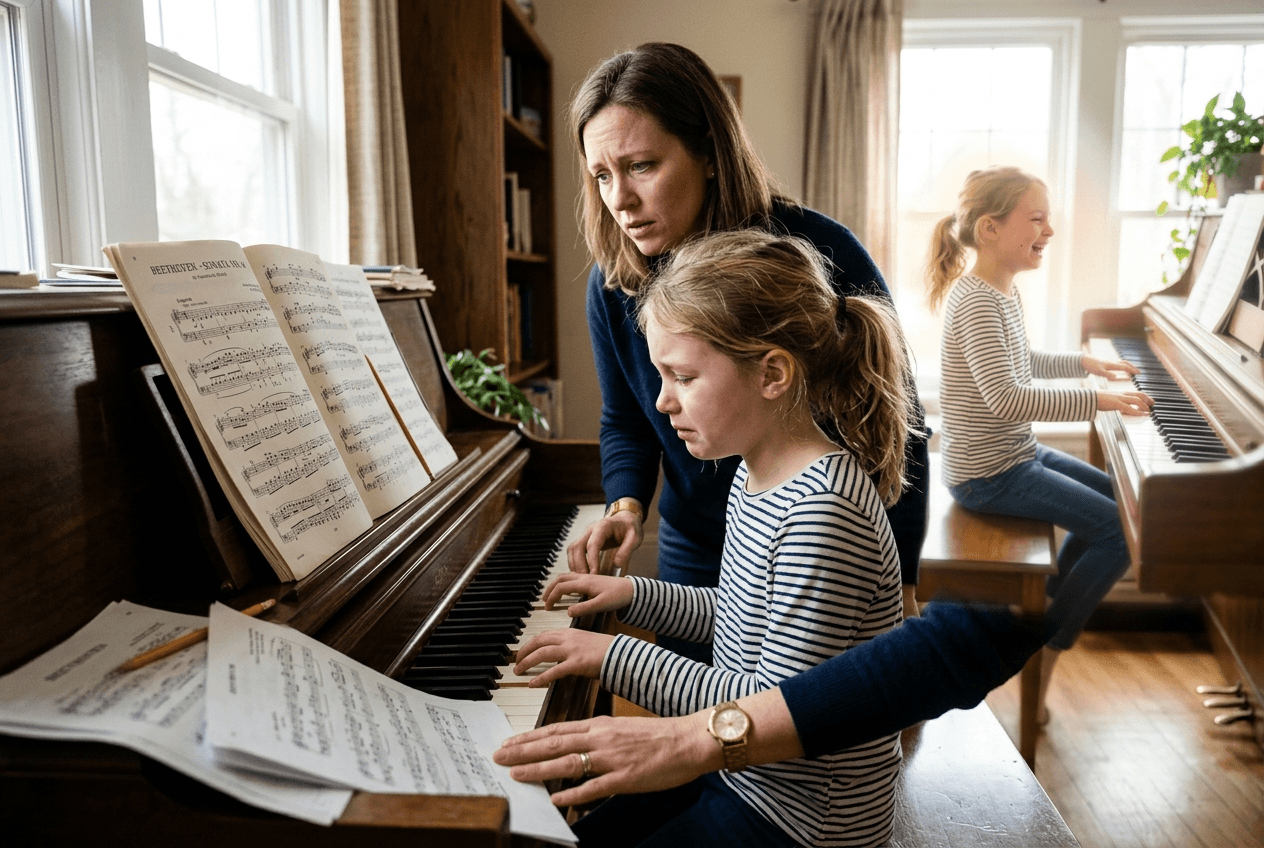
Starting too early because a friend's child did
Children develop at genuinely different rates and comparison between them is close to useless at this age. A child who is not ready at five will frequently be ready at six and a half, and waiting costs nothing while starting too early can produce an aversion that lasts.
Buying an instrument that fights the child
An unweighted keyboard, a badly out-of-tune acoustic or a bench at the wrong height all make playing harder in ways a child cannot diagnose. They will simply find it frustrating and conclude that the difficulty is theirs. Get the setup checked by the teacher at the first lesson.
Measuring progress in months rather than years
Music progresses slowly and invisibly. Recording the child playing the same short piece once a month, and comparing across a term, gives you an honest picture and gives the child evidence of their own improvement, which is worth more to them than any amount of encouragement.
Treating the exam as the point
Graded exams are a useful structure and a poor purpose. A child who plays only exam repertoire, working toward the next certificate, frequently stops the moment the certificates end. Alongside whatever the syllabus requires there should be music the child chose.
Giving up at the first plateau
Every learner hits a stretch where nothing seems to improve, and on piano it commonly arrives around the point where the hands must work independently. It is a normal stage rather than a ceiling, it passes, and children who are allowed to push through it emerge considerably more capable than before.
Doing it for the wrong person
The hardest one to hear. A parent who wanted to play as a child and did not, or who values music highly, may be enrolling a child in something the child has no interest in. That is worth being honest with yourself about, because a child can tell, and the resentment it produces outlasts the lessons.
Frequently Asked Questions
What is the best age for a child to start piano?
Six to eight is the typical window, when most children can concentrate for twenty to thirty minutes, recognise letters and numbers, and manage the finger independence piano requires. Readiness varies enough between children that the signs matter more than the number, and starting later carries no meaningful disadvantage.
Is 4 too young for piano lessons?
For formal lessons, usually yes, since most four-year-olds lack the attention span, finger independence and reading readiness. For music generally, no. Singing, rhythm work, movement and play-based group music classes build the ear and enjoyment that formal lessons later draw on, and a child who has done that arrives ahead.
How do I know my child is ready for piano?
Four signs. Can they focus on one activity for fifteen to twenty minutes? Do they have fine motor control, meaning pencil grip, scissors, buttons and independent finger movement? Do they recognise letters and count reliably? And are they interested, meaning genuinely curious rather than being enrolled because a parent wants it?
Is 10 too late to start piano?
No, and older children frequently progress faster. A ten-year-old understands explanations, retains concepts, practises independently and recognises their own errors, so they reach in months what a five-year-old takes a year to achieve. The gap closes far more quickly than parents expect.
How long should a child practise piano?
Five to ten minutes daily at ages five to six, ten to twenty minutes at seven to nine, and twenty to thirty at ten to twelve. Frequency matters far more than duration, since ten minutes daily produces more progress than seventy minutes once a week.
Do I need a real piano for my child to learn?
No. An eighty-eight key digital piano with weighted keys is entirely adequate and has advantages, being silent through headphones and never needing tuning. Weighted keys are the specification that matters, since a light unweighted keyboard does not build the control real piano playing requires.
Should my child have individual or group lessons?
Both work. Individual lessons give focused attention and faster technical progress. Group lessons cost less and provide peers, which is a substantial motivator for younger children. A common pattern is group classes at five or six, moving to individual lessons at seven or eight.
Can young children learn piano online?
Yes, and piano adapts to online teaching better than most instruments, since the playing position is stable and the hands are visible from one camera angle. Younger children need a parent sitting alongside to help with engagement, and camera position and audio quality make a substantial difference.
What if my child wants to stop?
Change something before stopping. A different teacher, a different format, repertoire the child chose, or a break of a few months may all solve it. A great many children who quit entirely would have continued happily with a teacher who suited them or with music they had chosen themselves.
Should my child take graded exams?
Only if they help. Exams provide structure, deadlines and external validation, which suits many children. They also measure a narrow thing and can turn playing into an obligation. Taking a grade every other year, with the intervening time on music the child chose, is a reasonable middle path.
Final Thoughts
The best age to start piano lessons is whenever the four readiness signs are present, which for most children falls somewhere between six and eight and for plenty of others does not. A child who starts later and wants to play will pass a child who started earlier and did not, and usually quite quickly. So watch for the signs rather than the birthday, find a teacher your child actually likes, keep practice short and daily rather than long and enforced, and let them play some music they chose. That combination produces a child who is still playing at fifteen, which is the only outcome that really matters. Art Gharana teaches piano, keyboard and Indian classical music for children live and one-to-one, with a free trial class.