ChatGPT
 Google AI
 Grok
Grok Claude
Two facts explain almost everything about bagpipes. They cannot be played quietly, and they cannot stop. A reed driven by constant air pressure from a bag has no volume control and no silence between notes, which means every musical decision the instrument makes has to be made without either of the two tools most instruments rely on. Understanding that turns the bagpipe from a curiosity into something genuinely interesting. For the wider wind family, the guide to Indian classical music instruments places reed instruments in context.
What follows covers the mechanism in detail, why the Scottish association is stronger than the history warrants, the varieties across Europe and Asia including India's own bagpipe, the repertoire including the classical form most people have never heard, and what learning actually involves, which is not what most people expect.
How Do Bagpipes Work?
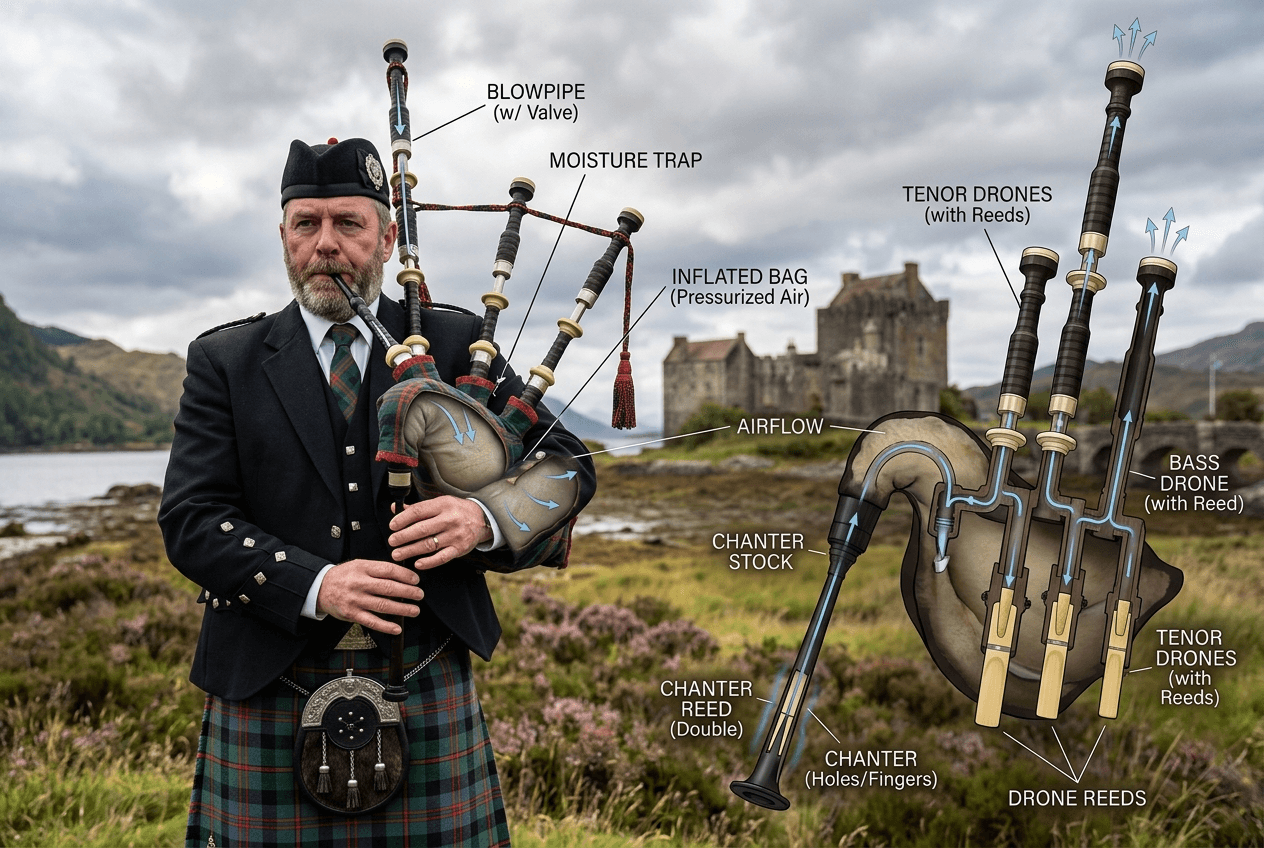 Bagpipes are reed instruments in which the player fills an airtight bag with air, then squeezes the bag with the arm to force a steady stream of air through several reeds simultaneously. The melody is played on a pipe called the chanter, which has finger holes, while separate pipes called drones sound single fixed notes continuously. Because the bag holds a reserve of air, the sound never stops, even while the player takes a breath.
The bag as air reservoir
The whole idea. A player blows into the bag through the blowpipe, which has a valve preventing the air escaping back out, and simultaneously squeezes the bag with their arm. When they need to breathe in, the arm keeps the pressure constant, so the reeds keep sounding. That is why bagpipe music is continuous and why no other wind instrument sounds like it.
Maintaining even pressure while alternating between blowing and squeezing is the fundamental skill, and it is harder than it sounds. Uneven pressure makes the pitch waver audibly, which is the single most common fault in a beginner and the reason so much early practice is about breath and arm rather than about fingers.
The chanter
The melody pipe, with finger holes and a double reed. On the Great Highland bagpipe it has a range of just nine notes, which is a genuine constraint, and there are no keys, no octave changes and nothing resembling a chromatic scale. Everything the instrument plays must fit inside those nine notes.
The drones
Separate pipes, each with a single reed, sounding one fixed note continuously. The Great Highland bagpipe has three, typically two tenor drones and one bass. They provide the constant harmonic backdrop that makes the sound instantly recognisable, and they are tuned by sliding sections of the pipe in and out.
Why it cannot play quietly or stop
Volume on a wind instrument comes from varying air pressure, and a bagpipe requires constant pressure to keep the reeds sounding correctly. Reduce the pressure and the pitch drops and the reeds falter. So the instrument has effectively one volume, and it is loud.
Silence is equally unavailable, since stopping the airflow stops the reeds entirely and restarting them is neither instant nor clean. There is no way to play a rest.
How the Instrument Solved Those Problems
 This is where bagpipes become genuinely interesting rather than merely loud.
With no dynamics and no rests, the bagpipe developed an elaborate system of grace notes and ornaments to do the work that volume and silence do elsewhere. A rapid grace note inserted between two identical pitches creates the impression of a separated, articulated note where otherwise there would be one continuous sound. That is how a piper plays the same note twice.
These ornaments have names and are learned as specific finger movements: doublings, grips, taorluaths, birls and crunluaths among them, ascending in complexity. A skilled piper executes them at speed and they are not decoration, they are the instrument's punctuation, phrasing and accent system all at once.
The scale of this is worth grasping. A single note in a written tune may carry an ornament of five or six grace notes executed in a fraction of a second, and a bar of music can contain dozens of individual finger movements that a listener perceives as articulation rather than as separate notes. Learning them is not a refinement added after the tunes; it is the majority of what a piper practises, and a tune played without them is not a simplified version of the music so much as a different and incorrect thing.
There is a genuine parallel here with Indian classical music, where ornaments like meend and gamak are not embellishments added to a melody but the substance of how a raga is expressed. In both traditions a technically correct sequence of pitches played without ornamentation is simply wrong rather than plain, and the guide to Indian raga music explains the same principle in that context.
Why Scotland?
 The association between bagpipes and Scotland is overwhelming, and the history is broader than it suggests.
Bagpipes are ancient and widespread, with forms appearing across Europe, North Africa, the Middle East, the Caucasus and South Asia. They were common in medieval Europe and were played across England, Ireland, Spain, France, Italy and the Balkans, and many of those traditions survive.
What happened in Scotland was that the Great Highland bagpipe became attached to a specific set of institutions, principally the military. British Army Highland regiments carried pipers, and as those regiments served across the empire the instrument travelled with them, which is why pipe bands exist today in India, Pakistan, Canada, Australia, New Zealand, South Africa and beyond.
The nineteenth century Highland revival, with its romanticised construction of Scottish identity, consolidated the association further, and by the twentieth century the bagpipe was Scottish in the popular imagination in a way it had never been exclusively in fact. Other European traditions continued and simply lost the branding contest.
The Northumbrian exception
Worth singling out because it does something no other bagpipe does. Its chanter is closed at the end, which means that with all holes covered the sound genuinely stops. That gives it true staccato and rests, which no other bagpipe has, and it produces a completely different musical character, precise and clipped rather than continuous.
The uilleann pipes
The most mechanically sophisticated of the family. Bellows strapped to the elbow supply the air rather than the mouth, which means the player can sing while playing and the reeds receive dry air, extending their life considerably. The instrument has a wider range than the Highland pipe, a chanter that can be stopped against the knee for staccato, and regulators, which are keyed pipes allowing the player to sound chords with the wrist while playing melody.
India's Bagpipe
 Indian bagpipes are the section nobody else writing about this instrument includes, and it is genuinely interesting.
India has an indigenous bagpipe tradition alongside an imported one, and the two have merged in practice. The mashak is a traditional mouth-blown bagpipe of North India, particularly associated with Rajasthan, Uttar Pradesh and neighbouring regions, played at weddings and festivals. It has a straightforward construction, historically with a bag made from animal skin, and it plays folk melodies rather than a codified classical repertoire.
Separately, the Great Highland bagpipe arrived through the British Indian Army, and it took root thoroughly. Indian and Pakistani military and police pipe bands exist in substantial numbers, playing Highland repertoire alongside local material, and India became a significant manufacturer of bagpipes, supplying instruments internationally.
The result is that a bagpipe at an Indian wedding may be either instrument, or a hybrid, and the sound is entirely familiar to millions of people who have never associated it with Scotland at all. For a British Indian reader, this is worth knowing, since it means the instrument sits in both halves of a shared heritage rather than in one.
Pakistan in particular became a major centre of bagpipe manufacture, with Sialkot producing instruments in quantity for export, and pipe bands there and in India perform at military ceremonies, weddings, school events and public occasions. Some Indian bands have competed internationally. This is a genuine musical tradition several generations deep rather than a colonial residue nobody plays.
There is a further layer worth mentioning. Pipers in these bands frequently play Indian film songs and folk melodies on the Highland chanter alongside the Scottish repertoire, which is a real feat given that the chanter has nine notes and no accidentals, and it requires arranging melodies to fit a scale they were never written for. Hearing a familiar Hindi tune emerge from a Highland bagpipe is a distinctly Indian musical experience with no equivalent anywhere else.
Why bagpipes suit Indian weddings
The same reason they suited Highland gatherings and military parades. They are loud, they carry outdoors over crowds, they cannot be drowned out, and they play continuously without pause. An Indian wedding procession has exactly the acoustic requirements a bagpipe was built for, which is also why the shehnai occupies the same role in the same processions. The comparison is instructive, since both are loud double-reed instruments doing an identical ceremonial job in the same country, arriving from completely different directions.
The Repertoire
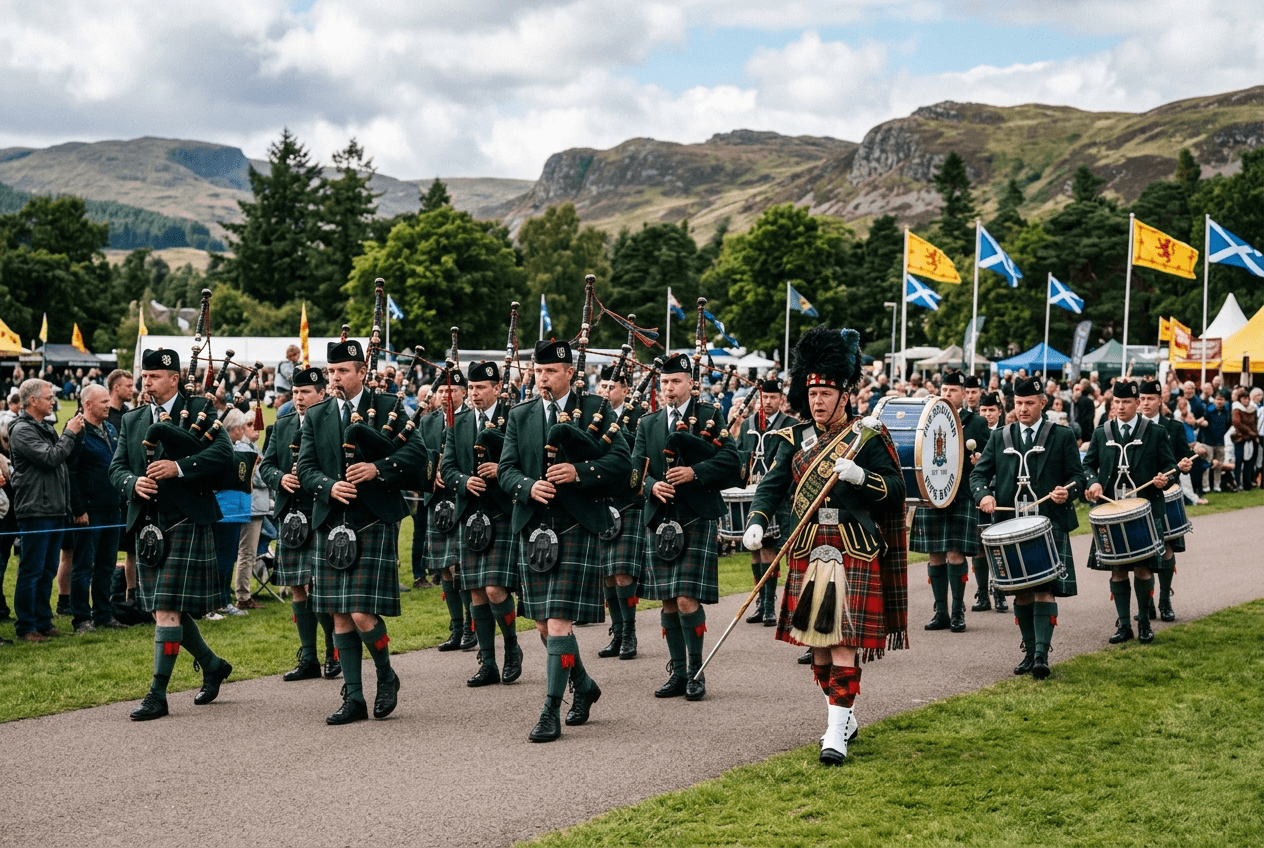 Ceol beag, the light music
Marches, strathspeys, reels, jigs and hornpipes. This is what most people have heard, it is what pipe bands play, and it is the accessible end of the repertoire. Rhythmically driven, generally in regular time, and designed for marching, dancing or listening without prior knowledge.
Each of these forms has a specific rhythmic character rather than being interchangeable. Marches are in regular time and built for walking. Strathspeys have a distinctive dotted and snapped rhythm particular to Scottish music. Reels are fast and even. Jigs are in compound time with a lilting swing. A piper learns them as distinct rhythmic idioms rather than as tunes at different speeds, which is closer to how an Indian musician thinks about taal than most Western folk traditions get.
Ceol mor, or piobaireachd
The classical music of the Highland bagpipe, and the thing almost nobody outside piping knows exists. A piobaireachd begins with a slow theme called the urlar, then presents a series of increasingly ornamented variations on it, building in complexity before returning to the theme at the end. A single piece can run fifteen or twenty minutes.
The structural resemblance to Indian classical performance is striking. Both present a theme, develop it through progressively elaborate variation, and return to where they started. Both are slow, meditative and demanding of a listener's patience. And both are the serious classical form of a tradition whose popular face is entirely different. Anyone who appreciates a raga alap will find piobaireachd considerably more approachable than they expect, and the reverse is also true.
The comparison holds in one further respect. Both forms were transmitted orally through named lineages, both were nearly lost during periods when the surrounding culture was suppressed or disrupted, and both were consciously preserved by a small number of people who understood what was at stake. Piobaireachd survived partly through societies formed specifically to collect and teach it, which is not far from what institutions like Kalamandalam did for Kerala's dance forms.
How Hard Are Bagpipes to Learn?
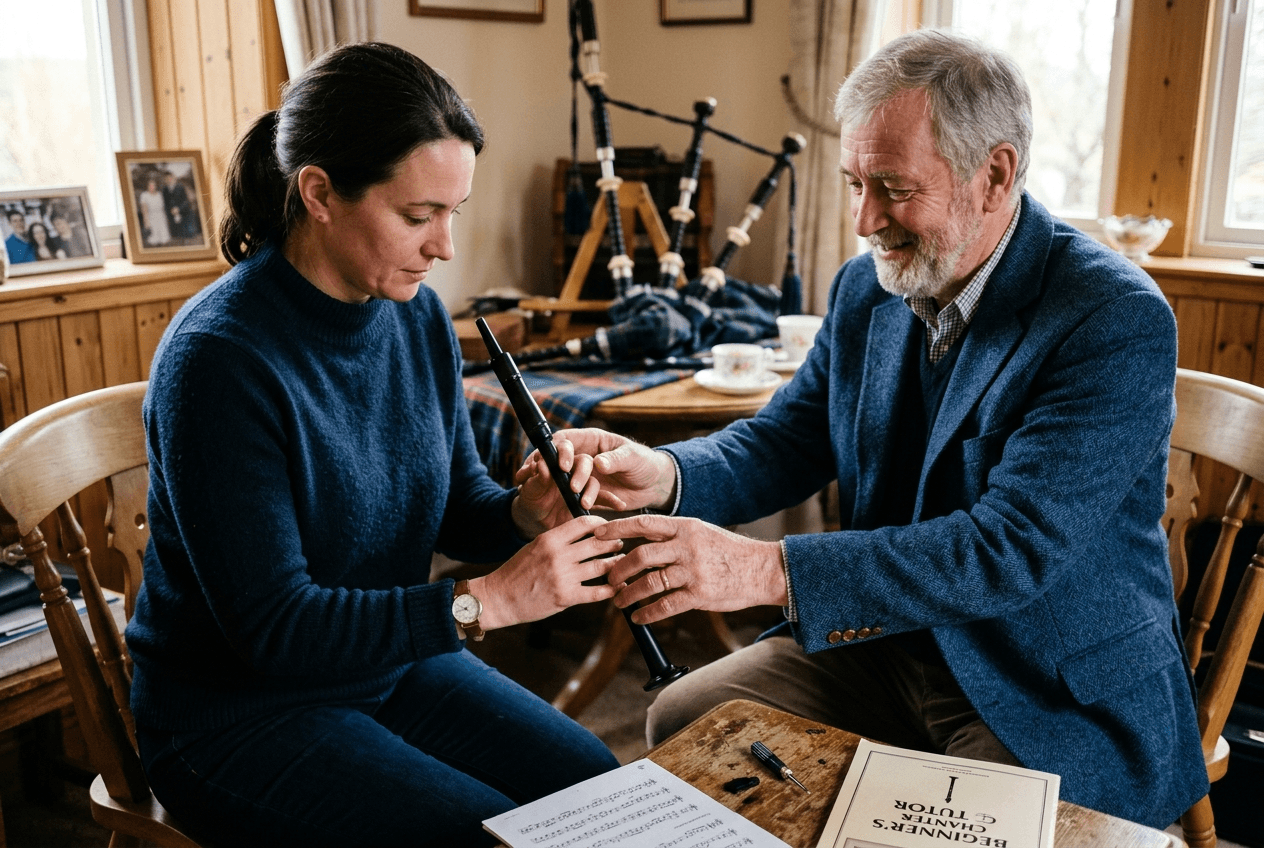 Learning bagpipes is hard in an unusual way, and the difficulty is front-loaded differently from most instruments.
You do not start on the bagpipes
Every piper begins on a practice chanter, a quiet single pipe with no bag and no drones, and stays on it for months. It looks like a delay and it is the correct sequence, since fingering and the ornament vocabulary must be automatic before the physical demands of managing bag pressure are added. A beginner attempting both at once manages neither.
The physical demand is real
Maintaining constant pressure while alternating between blowing and squeezing is genuinely tiring at first, and beginners can sustain only a few minutes before the tone deteriorates. This builds with practice and it is a stamina issue rather than a technique issue.
The ornaments are the actual work
Because there are no dynamics and no rests, everything expressive is done through finger movements executed at speed. Learning them is the substance of piping technique, and a piper is judged on the cleanness of their ornaments more than on anything else.
Nine notes is a constraint and a discipline
Everything must fit within them. That sounds limiting and it produces a repertoire of remarkable subtlety, because with the parameters so restricted, the small variations carry enormous weight. Musicians from traditions with far greater melodic freedom frequently find this the most interesting thing about the instrument.
Noise is the practical obstacle
A Highland bagpipe cannot be practised quietly, and it is loud enough to be genuinely antisocial indoors. This is why the practice chanter matters beyond pedagogy, and why serious learners eventually need somewhere they can play. Bellows-blown smallpipes are a legitimate alternative for anyone who wants to play at home without conflict.
Getting Started
Practical guidance for anyone actually considering it.
Start with a practice chanter, which is inexpensive, quiet enough for a house, and where you will spend at least six months to a year. Find a teacher or a local pipe band, since piping is taught overwhelmingly through pipe bands and they frequently teach beginners free or cheaply in exchange for eventually joining. Britain has an unusually dense network of these.
Expect to be taught by ear and by demonstration at least as much as from written music, since piping notation exists but the tradition remains substantially oral. This suits some learners very well and frustrates others, and anyone from a background where music is transmitted this way, including Indian classical training, will find it entirely familiar. The parallels with the guru shishya relationship are real, and the beginner guide to Hindustani classical music describes a comparable teaching structure.
Expect the first year to be fingering and ornaments rather than tunes, and expect the transition to the full instrument to feel like starting again, because the physical management of the bag is a new problem layered on top of skills you already have.
Maintenance matters more than on most instruments. Reeds are consumable and moisture-sensitive, the bag must be genuinely airtight, and a leak anywhere makes the instrument unplayable rather than merely worse. Moisture control systems are standard on mouth-blown pipes for exactly this reason.
Tuning is a daily task rather than an occasional one. Drones are tuned by sliding sections of pipe, the chanter reed responds to temperature and moisture, and an instrument that was perfectly in tune yesterday will need attention today. Pipers develop an ear for this quickly because they have no choice, and it is one reason piping produces musicians with unusually reliable pitch discrimination.
A Short History
 Worth setting out, because the instrument is far older and more widely spread than its modern branding suggests.
Bagpipes appear in the historical record across the ancient world, with references in Greek and Roman sources and depictions in medieval European art from many countries. They were a common instrument of ordinary people across the continent for centuries, played at fairs, dances and gatherings, and were not associated with any single nation.
The Great Highland bagpipe emerged as a distinct instrument in Scotland over several centuries, and the great piping families, the MacCrimmons among them, developed piobaireachd as a classical form with a transmitted repertoire and an elaborate teaching system. That system used a spoken notation called canntaireachd, in which tunes were sung using specific syllables representing notes and ornaments, and passed on orally rather than in writing.
The oral transmission is another point of resemblance with Indian classical music, where bols in tabla and sargam in vocal training serve exactly the same function, encoding music as speakable syllables that a student memorises before executing. Two traditions with no contact between them arrived at the same solution to the same problem.
The instrument's fortunes shifted with Scottish history, and the military connection from the eighteenth century onward is what carried it worldwide. Highland regiments took pipers on campaign, the empire distributed those regiments across continents, and pipe bands took root in places with no Scottish population at all. The modern global picture is a direct consequence.
Pipe Bands
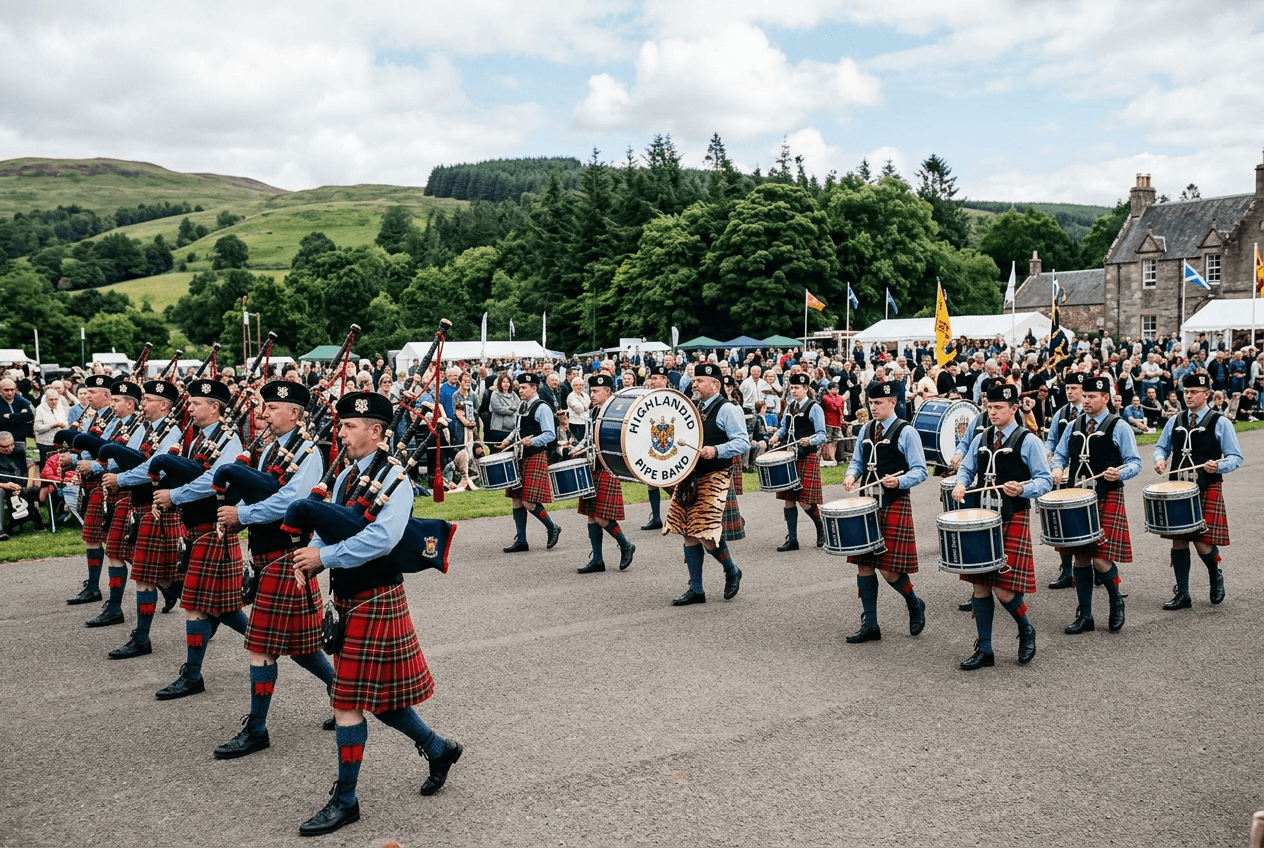 The social structure that keeps the tradition alive, and a genuine reason to take up the instrument.
A pipe band combines pipers with a drum corps of snare, tenor and bass drums, and it functions as both a performing ensemble and a teaching institution. Bands compete in a graded structure, rehearse regularly, and teach beginners as a matter of course, which makes them the standard route into the instrument.
For a learner this is unusually favourable compared with most instruments. Free or low-cost tuition, an instant ensemble to play with, performance opportunities from early on, and a social group are all provided by the same institution. Very few instruments offer that combination, and it explains why piping has retained participation where other folk traditions have declined.
Bands exist across Britain and throughout the Commonwealth, including in India and Pakistan, and the competitive circuit is international. A piper who moves country can usually find a band, which is a portability few instruments offer.
The drum corps deserves mention too, since pipe band snare drumming is a highly developed discipline in its own right with a technical vocabulary and competitive standard comparable to the piping. Anyone drawn to the ensemble but not to the pipes has a genuine alternative route in, and percussion skills transfer widely, as the beginner guide to playing tabla describes for a very different drumming tradition.
The Sound and Why People React to It
Few instruments divide opinion as sharply, and the reasons are acoustic rather than cultural.
The continuous drone is the first factor. Most Western music is built on harmony that moves, and a fixed unchanging bass note underneath everything is unusual to a listener raised on that. It creates a sense of suspension rather than progression, which some people find hypnotic and others find static.
The second is the tuning. Bagpipe chanters are not tuned to equal temperament, the compromise system a piano uses, and several notes sit noticeably away from where a piano would put them. Against the drone these intervals ring in a way that equal temperament does not allow, which is the source of the instrument's particular resonance and also of the impression some listeners have that it is out of tune. It is not; it is tuned differently and deliberately.
Indian classical listeners have an advantage here, because both features are entirely familiar. A tanpura provides exactly the same continuous drone, and the microtonal shrutis of the Indian system are similarly finer and differently placed than equal temperament permits. Someone who is comfortable with a raga alap over a tanpura will find the bagpipe's sound world considerably less strange than a listener raised only on Western harmony, and the complete guide to swaras covers the same idea in that tradition.
The third factor is simply volume, and there is no defence to offer. The Great Highland bagpipe was designed to be heard across a glen and it does that job in a living room too.
Frequently Asked Questions
How do bagpipes work?
The player blows air into an airtight bag through a valved blowpipe while squeezing the bag with their arm, forcing a constant stream of air through several reeds at once. Melody is played on the chanter, which has finger holes, while drones sound fixed notes continuously. The bag's air reserve means the sound never stops, even while the player breathes.
Why are bagpipes associated with Scotland?
Bagpipes are ancient and widespread across Europe, North Africa, the Middle East and South Asia. Scotland's Great Highland bagpipe became attached to the British Army's Highland regiments, which carried it across the empire, and the nineteenth century Highland revival consolidated the association. Other traditions continued and simply became less visible.
Is there an Indian version of bagpipes?
Yes, the mashak, a traditional mouth-blown bagpipe of North India played at weddings and festivals, particularly in Rajasthan and neighbouring regions. Separately the Great Highland bagpipe arrived through the British Indian Army and took root, and India became a significant manufacturer of bagpipes supplying instruments internationally.
Why are bagpipes so loud?
Because the reeds require constant air pressure to sound correctly, which means the instrument has effectively one volume. Reducing pressure makes the pitch drop and the reeds falter rather than making the sound quieter. The Great Highland bagpipe was also designed for outdoor use over crowds and terrain, so loudness was a requirement rather than a side effect.
Can bagpipes play quietly?
The Highland bagpipe cannot. Bellows-blown varieties including Scottish and Northumbrian smallpipes are considerably quieter and were designed for indoor playing, and they are the practical choice for anyone wanting to play at home. The Northumbrian smallpipes are also the only bagpipe capable of true silence between notes.
How many notes does a bagpipe have?
The Great Highland bagpipe chanter has nine notes, with no keys, no octave change and no chromatic scale. Every tune must fit within them. That constraint is why the repertoire relies so heavily on ornamentation, since small variations carry considerable weight when the melodic parameters are so restricted.
How hard are bagpipes to learn?
Hard in an unusual way. Every piper spends at least six months to a year on a practice chanter before touching the full instrument, learning fingering and ornaments. Then the physical management of constant bag pressure is added, which is tiring at first. The ornaments, rather than the tunes, are the substance of the technique.
What is piobaireachd?
The classical music of the Highland bagpipe, also called ceol mor or the great music. A piece presents a slow theme called the urlar, then a series of increasingly ornamented variations, before returning to the theme. A single piobaireachd can run fifteen or twenty minutes, and the structure closely resembles Indian classical performance.
What is the difference between Highland and uilleann pipes?
The Highland bagpipe is mouth-blown, very loud, has nine notes and three drones, and is designed for outdoors. Uilleann pipes are bellows-blown, played seated, considerably quieter, have a wider range, can produce staccato by stopping the chanter against the knee, and include regulators allowing the player to sound chords alongside the melody.
Can you learn bagpipes as an adult?
Yes, and adults are common among beginners. The route is the same regardless of age: a practice chanter first, then a teacher or a local pipe band, then the full instrument after fingering and ornaments are secure. Pipe bands frequently teach beginners free or cheaply, which makes it one of the more accessible instruments to take up.
Final Thoughts
What makes bagpipes genuinely interesting rather than merely loud is that they are an instrument built under severe constraint. Nine notes, one volume, no silence, and out of that a tradition produced a classical form running twenty minutes and an ornament system doing the work that dynamics and rests do everywhere else.
If you take one thing beyond the mechanics, listen to a piobaireachd once. It will not sound like what you expect from this instrument, and for anyone who knows Indian classical music the resemblance in structure and patience is immediate and surprising. Art Gharana teaches wind instruments and Indian classical music live and one-to-one, with a free first lesson.