ChatGPT
 Google AI
 Grok
Grok Claude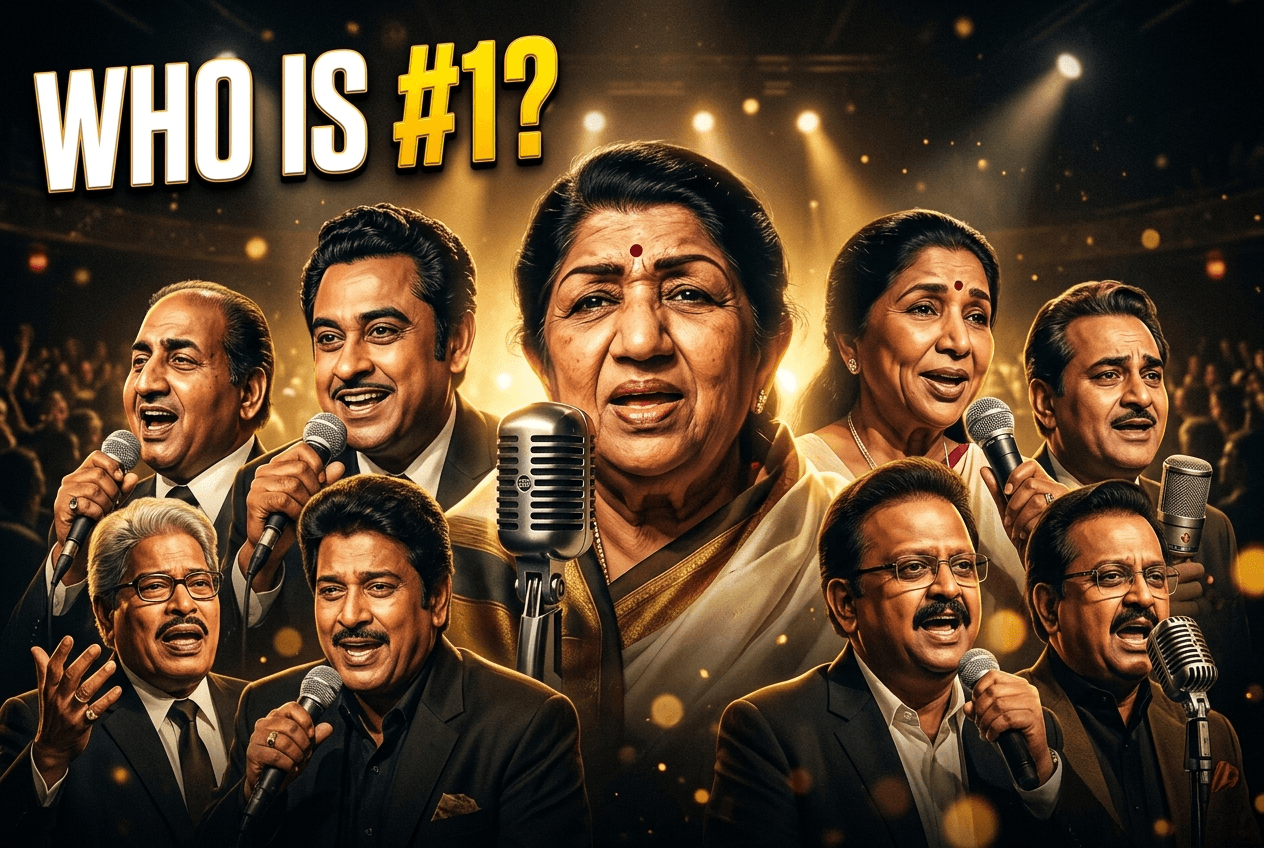
Almost every list of the top indian singers makes the same quiet assumption, which is that an Indian singer means a Hindi film playback singer. That leaves out the first musician in the country ever awarded the Bharat Ratna. It leaves out the singer who holds the record for the most National Film Awards. It leaves out the voice that recorded across sixteen languages in numbers no Hindi playback artist has approached. This guide covers all of them. For voices outside India, the companion guide to the most iconic singers in music history covers that ground separately.
What follows is organised by tradition rather than ranked, because ranking a Carnatic vocalist against a playback singer produces an argument rather than an answer. The golden age of Hindi playback, the Hindustani and Carnatic classical vocalists, the ghazal and Sufi voices, the regional giants of the south and east, and the modern era each get proper treatment. There is also a section on what actually makes a great singer technically, which is the question a music school should be answering and which no competing page attempts. Readers new to the classical side will find the guide to Hindustani classical music useful alongside this.
One promise about method. Every claim here about records and awards is checkable, every singer is placed in their tradition rather than assimilated into film music, and where a question has no clean answer, this guide says so rather than inventing one. That includes the most common question of all, which is who is number one. If you are a learner rather than a listener, the guide to easy songs for beginner singers is the practical companion to this one.
Who Are the Top Indian Singers of All Time?
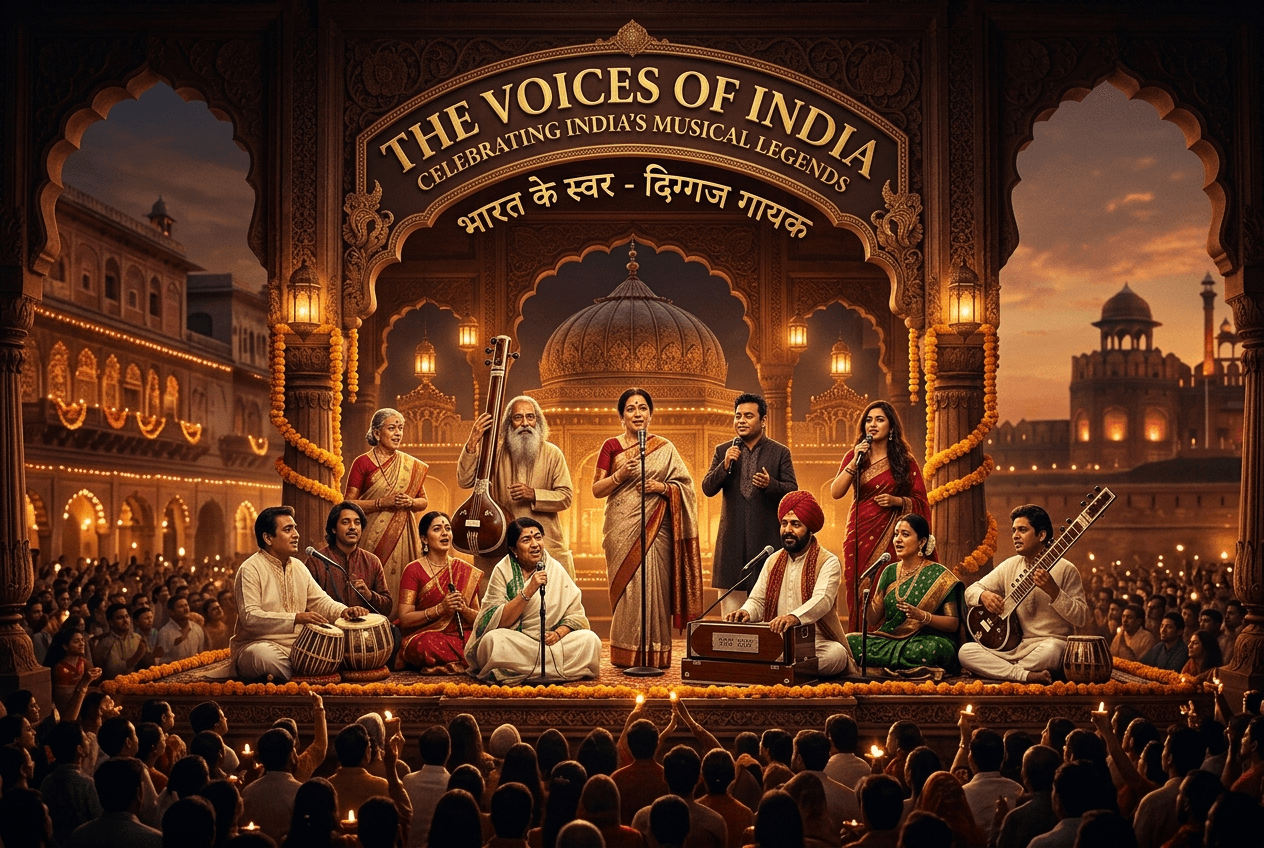 Across all traditions, the top indian singers include Lata Mangeshkar and Mohammed Rafi in Hindi playback, Kishore Kumar and Asha Bhosle alongside them, M.S. Subbulakshmi in Carnatic classical, Pandit Bhimsen Joshi and Ustad Bade Ghulam Ali Khan in Hindustani classical, Begum Akhtar in ghazal and thumri, S.P. Balasubrahmanyam and K.J. Yesudas across the southern languages, and in the modern era Sonu Nigam, Shreya Ghoshal and Arijit Singh. Lata Mangeshkar and M.S. Subbulakshmi both received the Bharat Ratna, India's highest civilian honour.
Why There Is No Number One
This is the most searched question on the topic and it deserves a straight answer rather than a confident guess.
The question assumes a single scale, and there isn't one. Comparing a Carnatic vocalist to a Hindi playback singer is comparing two different jobs. A playback singer serves a film, a character and a composer's brief, delivering a fixed composition in three minutes with the emotion the scene requires. A classical vocalist improvises across an hour within the grammar of a raga, answerable to no script. Excellence in one does not transfer to the other, and several great classical singers were indifferent playback artists while several great playback singers had no classical performance career at all.
The metrics people reach for do not settle it either. Song counts favour singers with long careers in high-output industries, which is why the southern playback figures dwarf the Hindi ones. Award counts favour eras when awards existed and categories that were contested. Streaming favours whoever is alive and current, which is why Arijit Singh tops global platforms and Mohammed Rafi does not. None of these measure singing.
The honest formulation is that Lata Mangeshkar has the strongest claim to being the most significant Indian singer by cultural reach and duration, M.S. Subbulakshmi by classical stature and institutional recognition, and Mohammed Rafi and Kishore Kumar by the affection in which they are held. Anyone who tells you there is one answer is selling a ranking rather than describing music.
The Essential Indian Singers
A reference set of the top indian singers across all traditions. Eras are approximate and several careers span more than one.
The Golden Age of Playback
Lata Mangeshkar
The scale of her career is genuinely difficult to convey. She recorded across more than three decades as the dominant female voice in Hindi cinema, sang in dozens of languages, and remained the default choice for leading actresses across generations that had nothing else in common. She received the Bharat Ratna in 2001, one of very few musicians to be honoured that way.
Technically, what set her apart was purity of tone combined with precision of diction. Her voice carried almost no breathiness and no audible strain even at the top of her range, and every word arrived intact. That combination allowed composers to write melodies of a complexity they would not have attempted for a less secure singer, which means her presence actually changed what Hindi film music was written like.
Mohammed Rafi
If Lata Mangeshkar was consistency, Rafi was range. He sang qawwali, bhajan, romantic ballad, patriotic anthem and outright comedy convincingly, and he adapted his delivery to the actor he was singing for, so that his voice for one leading man was recognisably different from his voice for another. That chameleon quality is unusual and it is why his catalogue rewards exploration more than almost anyone's.
Kishore Kumar
The great anomaly. He had no formal classical training, which every account of him mentions, and he remains one of the most beloved voices in the history of Indian music. He won eight Filmfare Awards for Best Male Playback Singer, a record that stood alone until Arijit Singh equalled it in 2025.
What he demonstrates is worth taking seriously as a musical point rather than as a curiosity. Character, timing and interpretive freedom can outweigh technical polish entirely. He yodelled, he broke rhythm deliberately, he brought comic timing into songs that were not written as comic, and audiences responded to the personality rather than the precision. Any student who believes technical training is the whole of singing should spend an afternoon with his recordings.
Asha Bhosle
The most stylistically versatile playback singer India has produced. She moved between cabaret numbers, ghazals, folk material, devotional songs and film romance, adjusting technique rather than simply mood for each, and she sustained a recording career across an extraordinary span of decades. Her collaborations with R.D. Burman in particular pushed Hindi film music into territory nobody had attempted.
Mukesh, Manna Dey, Talat Mahmood and Geeta Dutt
Four singers who are frequently reduced to a sentence in lists like this and each of whom repays attention. Mukesh owned melancholy, and his association with Raj Kapoor on screen made his voice inseparable from a particular kind of wounded idealism. Manna Dey was the classically trained one, entrusted with the film songs built on serious raga material that other playback singers could not manage. Talat Mahmood had a natural tremor in his voice that became his signature and which no one has successfully imitated. Geeta Dutt brought a Bengali-inflected sensuality and a command of mood that made her irreplaceable in a particular register.
The Classical Vocalists Most Lists Leave Out
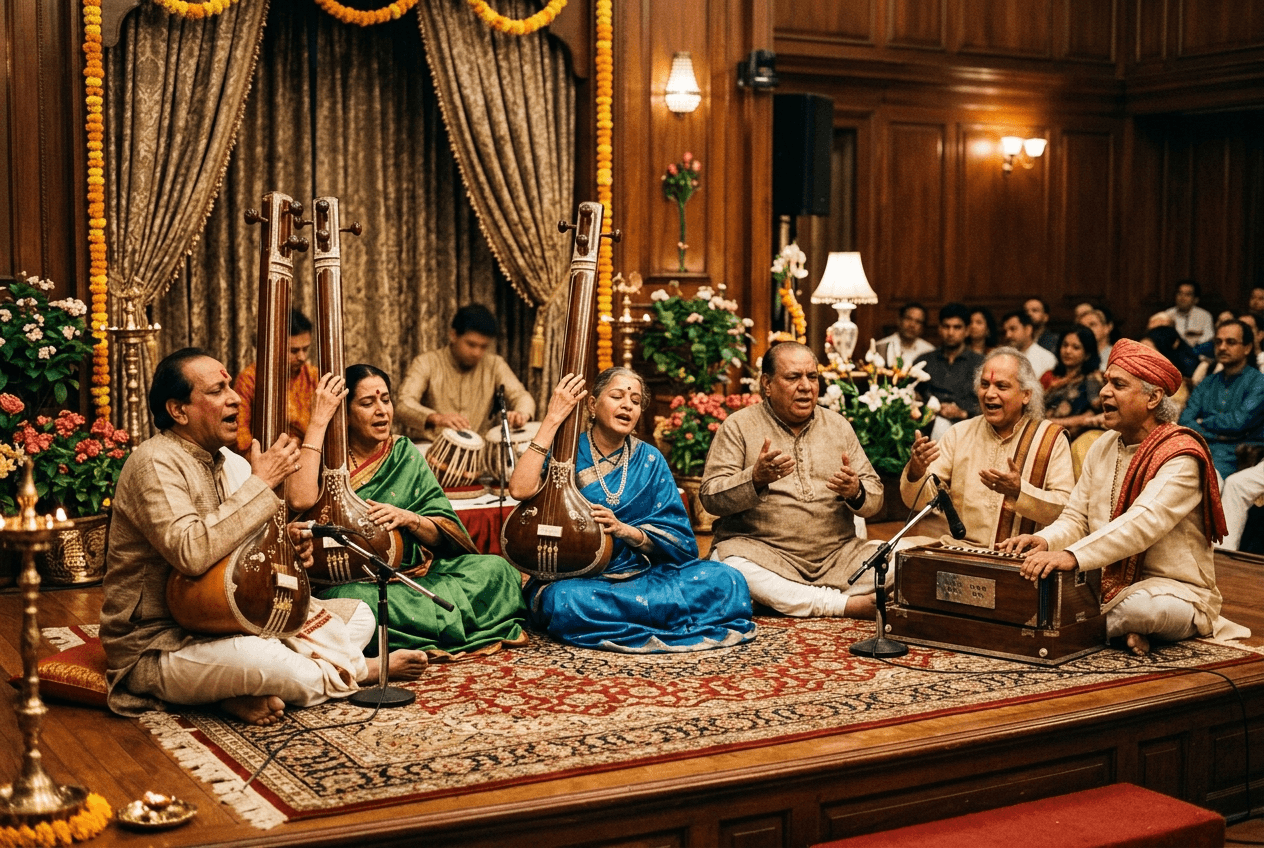 Any account of the top indian singers that stops at film music is describing an industry rather than a country. These are the voices that shaped what Indian singing means, and several of the playback legends above studied their recordings closely.
M.S. Subbulakshmi
The single most decorated Indian musician of the twentieth century and the first musician of any kind to receive the Bharat Ratna, awarded in 1998. A Carnatic vocalist of extraordinary tonal purity, she performed at the United Nations General Assembly in 1966, and her recordings of devotional repertoire remain in daily use in households across South India. Her rendering of the Suprabhatam is played at dawn in more homes than any other recording in the country.
For anyone approaching Carnatic music for the first time, she is the standard entry point, and the beginner guide to Carnatic music places her within the wider tradition alongside the other great Carnatic musicians.
Ustad Bade Ghulam Ali Khan
Among working classical musicians, his name comes up more often than any other when the question of the finest vocalist of the century is raised. A master of the Patiala gharana, he combined technical command with an immediacy that made his singing accessible to listeners with no classical training at all. His thumri recordings in particular are the recommended starting point, because they are short, emotionally direct and require no prior knowledge to be moved by.
Pandit Bhimsen Joshi
The most widely known Hindustani vocalist of the later twentieth century and a Bharat Ratna recipient in 2009. Trained in the Kirana gharana, he was known for breath control that allowed him to sustain phrases far beyond what most singers manage, and for a voice that carried enormous power without losing accuracy. His khayal performances are the standard reference for the form.
Kishori Amonkar
Trained in the Jaipur-Atrauli gharana and known for an uncompromising approach to interpretation. She was willing to depart from received practice where she felt the raga demanded it, and her performances carry an emotional intensity that some listeners find overwhelming on first hearing. She is the answer to anyone who assumes classical singing is decorous.
Pandit Jasraj and Kumar Gandharva
Jasraj, of the Mewati gharana, sang with a warmth and devotional quality across a career spanning seven decades, and taught extensively. Kumar Gandharva has one of the most remarkable stories in Indian music, having lost the use of one lung to illness and rebuilt his entire technique around the constraint, emerging with an approach to khayal that broke deliberately from gharana convention. His folk-derived work is unlike anything else in the classical repertoire.
Ustad Rashid Khan
Of the Rampur-Sahaswan gharana, and until his death in 2024 the vocalist most often named as the leading Hindustani classical singer of his generation. He also recorded for film, which brought classical singing to audiences who would not otherwise have encountered it, and his voice is a good bridge for a listener moving from film music toward classical.
Ghazal and Sufi Voices
Begum Akhtar
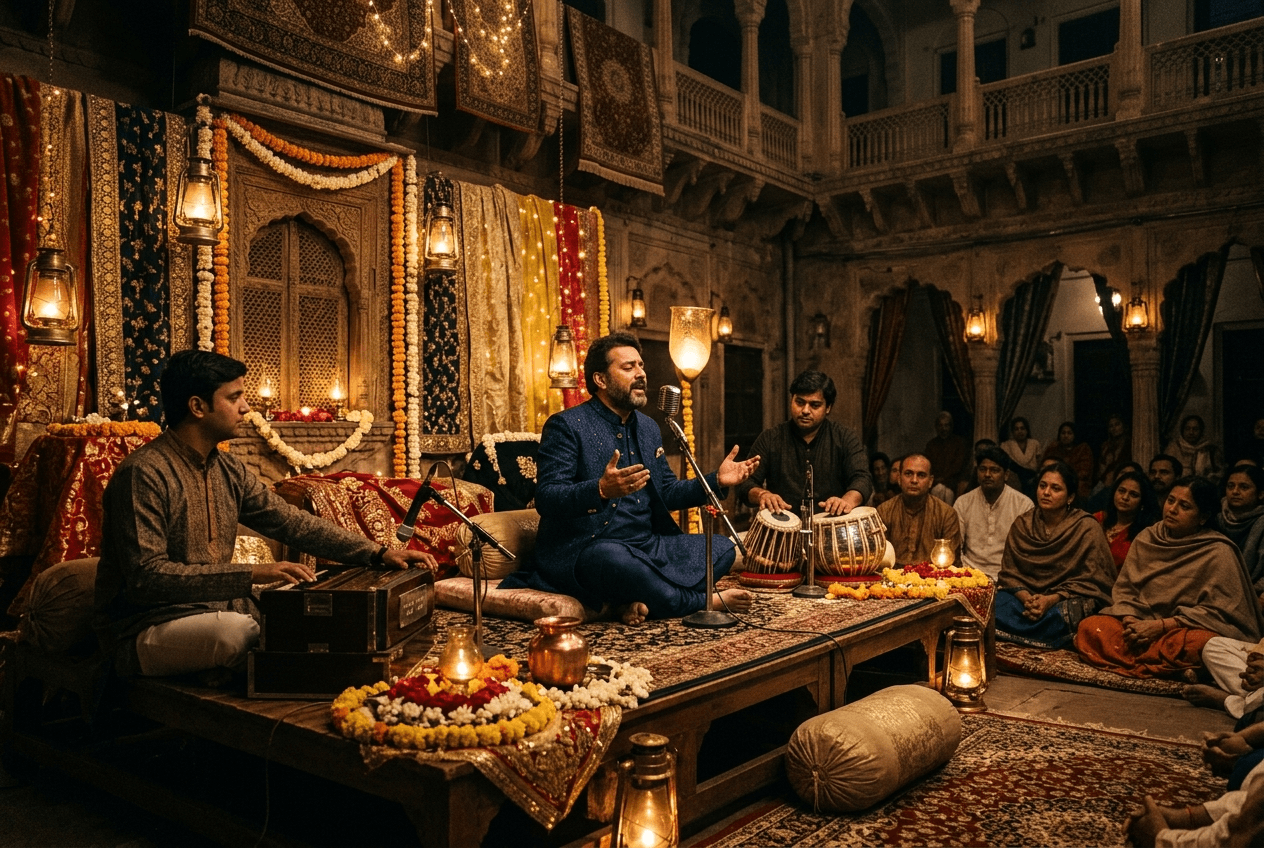
Known as Mallika-e-Ghazal, the queen of ghazal, and equally significant in thumri and dadra. Her voice carried a distinctive grain that conveyed longing without any apparent effort to produce it, and she established the template that ghazal singers have worked within ever since. She also taught, and her influence runs through the generation that followed.
Jagjit Singh
The singer who took ghazal from a connoisseur's form to a mass audience, largely by simplifying the accompaniment and choosing poetry in accessible Urdu without sacrificing the emotional weight of the form. Purists argued about the dilution at the time. The counterargument is that a very large number of people encountered Urdu poetry through his recordings who would otherwise never have heard any.
The qawwali tradition
Any honest account has to acknowledge that the greatest qawwali voice of the modern era, Nusrat Fateh Ali Khan, was Pakistani, as was Mehdi Hassan in ghazal. Music in this region does not follow the border, both were enormously influential on Indian singers, and both are essential listening for anyone studying this repertoire. On the Indian side, Abida Parveen's Sufi performances and the Sabri and Nizami qawwal traditions carry the form forward.
Beyond Hindi: The Regional Giants
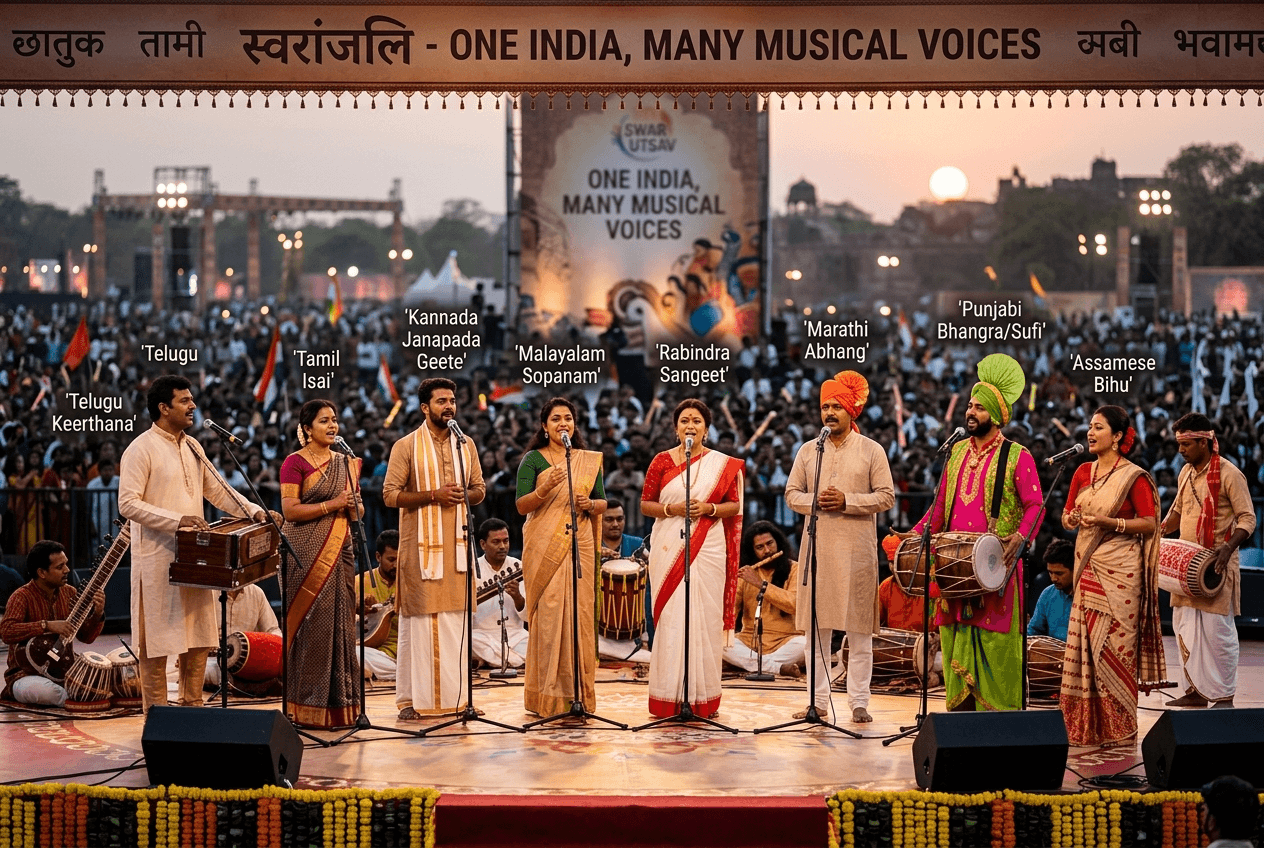 This is where Hindi-centric lists distort the picture most seriously, because on almost any quantitative measure the southern industries produced the larger careers.
S.P. Balasubrahmanyam
He recorded across sixteen languages over a career of more than five decades, with a song count running into the tens of thousands, a volume no Hindi playback singer approaches. He won six National Film Awards, acted, dubbed, and composed. His versatility across Telugu, Tamil, Kannada, Malayalam and Hindi made him the rarest kind of figure, a genuinely pan-Indian voice. He died in 2020 and the scale of public mourning across four southern states told its own story about his standing.
K.J. Yesudas
Holds the record for the most National Film Awards for Best Male Playback Singer, with eight, which is more than any Hindi playback singer has won. Trained in Carnatic music and active as a classical performer alongside his film work, he sang across Malayalam, Tamil, Telugu, Kannada and Hindi, and his devotional recordings occupy the same daily-listening place in Kerala that M.S. Subbulakshmi's do further east.
Ghantasala, P. Susheela and S. Janaki
Ghantasala defined Telugu playback singing in its formative decades. P. Susheela and S. Janaki between them dominated southern female playback for a generation, both with song counts and award records that would headline any list, and both largely absent from national ones. If your listening has been Hindi-only, these three are the most rewarding gap to fill.
The eastern and western traditions
Bengal produced Hemant Kumar, who worked across Bengali and Hindi, and Manna Dey spent significant parts of his career in Bengali music. The Rabindra Sangeet tradition has its own canon of interpreters. Marathi, Gujarati, Punjabi and Assamese music each carry singers of comparable stature within their language, and the reason they appear on no national list is reach rather than merit.
The Modern Era
From the 1990s the picture of the top indian singers changes shape, with television talent shows creating a pipeline, playback work fragmenting across more voices, and streaming eventually making individual songs travel further than films did.
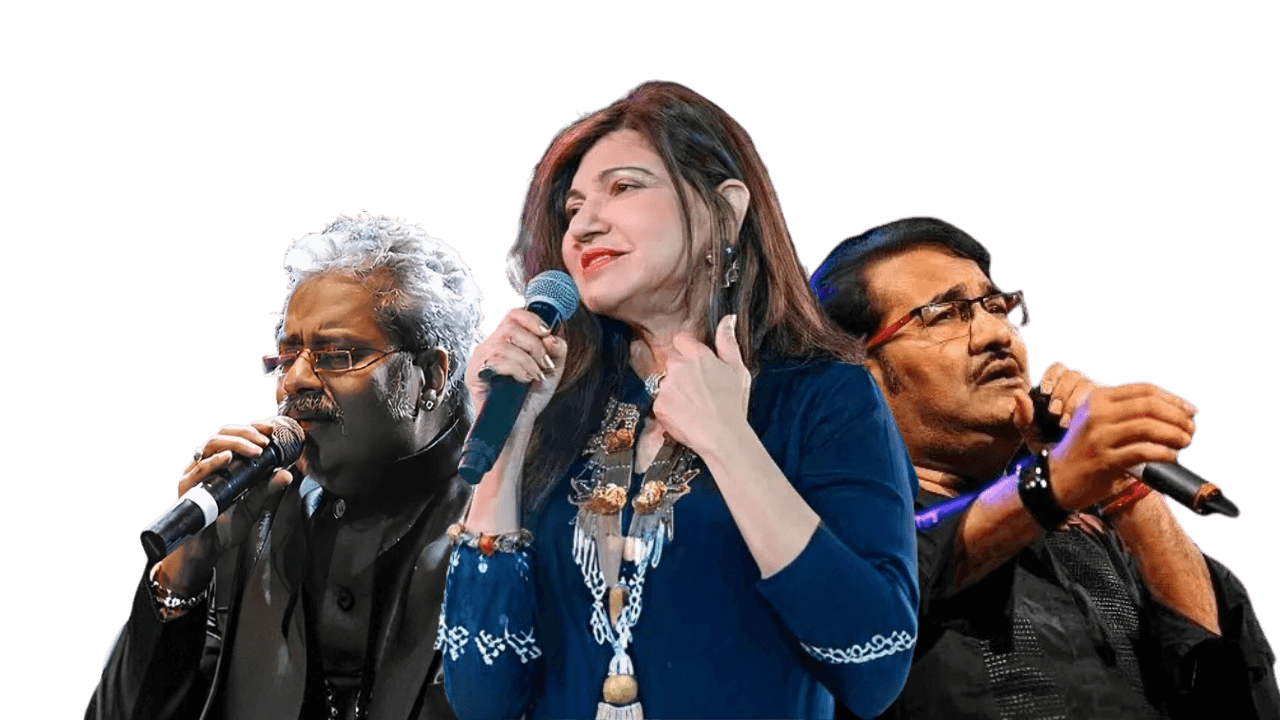
Sonu Nigam brought serious classical grounding into 1990s and 2000s playback and possesses one of the widest ranges of any singer in the field. Kumar Sanu and Udit Narayan defined the sound of 1990s Hindi cinema between them, with Alka Yagnik as the dominant female voice of the same period. KK, who died in 2022, held a distinctive place slightly outside the mainstream and is remembered with unusual warmth.
Shreya Ghoshal has been the leading female playback voice of the past two decades, with multiple National Film Awards and a command of classical ornamentation that few of her contemporaries match. Sunidhi Chauhan brought a power and edge that expanded what female playback could sound like. Arijit Singh dominated male playback from 2013 until announcing in January 2026 that he would take no further film assignments, and remains the most-followed artist on Spotify globally.
How Playback Singing Actually Worked
Understanding the job explains a great deal about why these particular voices dominated, and almost no listener outside the industry knows how the process ran.
The singer was not the artist in the way a Western recording artist is. A composer wrote the melody, a lyricist supplied the words, a director specified the emotional requirement, and the singer delivered a voice for an actor to mime to on screen. The performance had to suit the character rather than express the singer, and it had to match the actor closely enough that audiences accepted the illusion. This is why Rafi's chameleon quality mattered so much commercially, and why certain singer and actor pairings became fixed for decades.
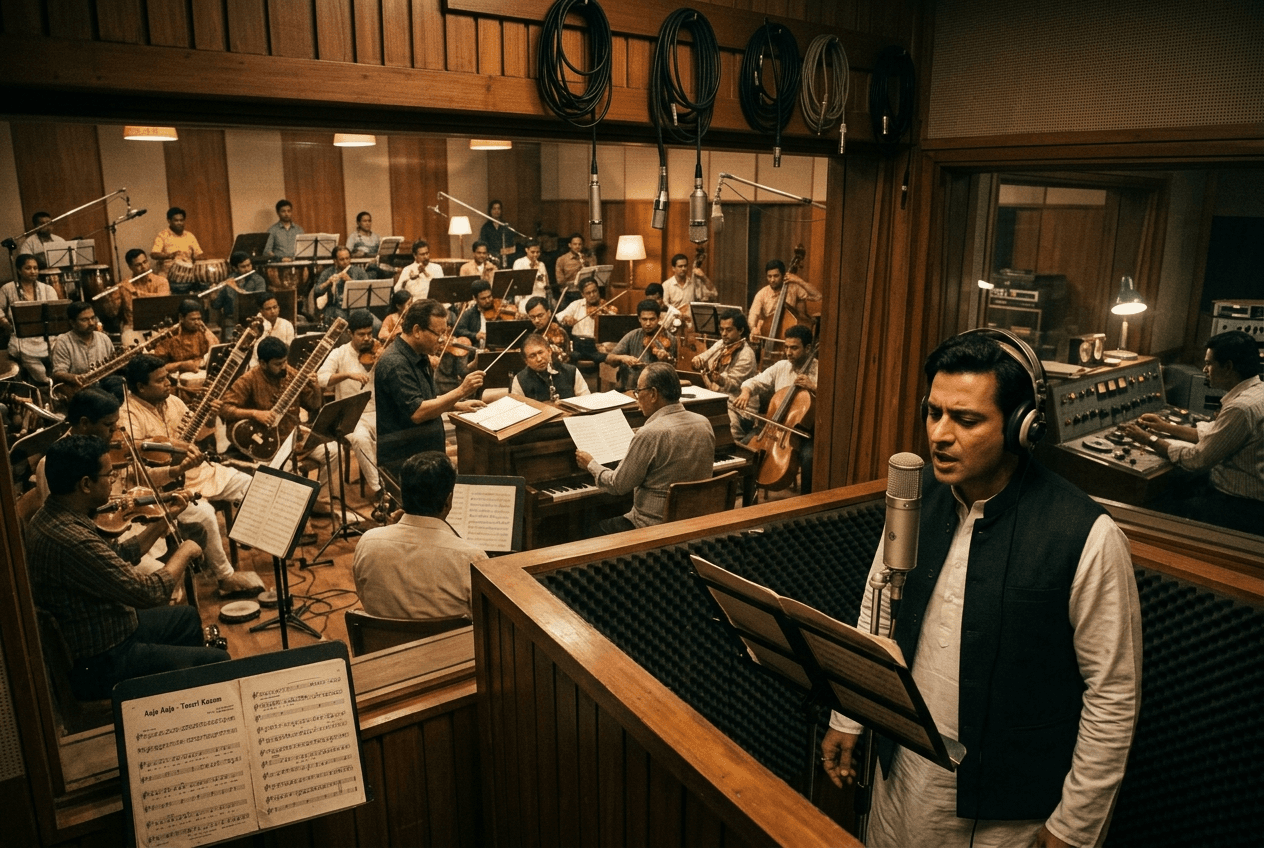
Recording conditions shaped the sound too. In the earlier decades the entire orchestra and the singer recorded together in one take, with no multitracking and no correction available, which meant a mistake at the end meant starting again. That is a considerable technical demand and it is a large part of why the golden-age voices are so secure in pitch. When multitracking arrived, the singer could record separately and repeatedly, which allowed different kinds of performance and removed a filter that had previously kept the standard extremely high.
The economics mattered as well. A small number of singers recorded an enormous share of all output, partly because composers trusted them and partly because studio time was expensive and a reliable singer finished faster. That concentration is why a handful of names define entire decades, and it is also why genuinely gifted contemporaries of theirs never got the volume of work that would have made them famous.
What Actually Makes a Great Singer
What separates the top indian singers from the merely good is the section a music school should be writing and none of the competing pages attempt. Greatness in singing is not a mystery, and the components are identifiable.
A voice recognisable within two seconds and impossible to imitate. Kishore Kumar, Geeta Dutt
The interesting thing about that list is that no singer has all eight, and the great ones are typically outstanding in three or four and merely competent in the rest. Kishore Kumar scores low on ornament control and off the scale on character. Lata Mangeshkar scores at the top on the first four. This is why comparison across singers is so unsatisfying and why the fundamentals of vocal training focus on building the measurable qualities rather than chasing an overall impression.
A Listening Path
If this guide has introduced names you do not know, here is an order that works better than starting at the top of the list.
Start with what you already like and go one step sideways. If you know Arijit Singh, listen to Sonu Nigam next, then Rafi, and you will hear a direct line. If you know modern female playback, go Shreya Ghoshal, then Asha Bhosle, then Lata Mangeshkar. Each step is small enough that the next voice sounds familiar rather than alien.
Then take one deliberate jump into classical. A short thumri by Bade Ghulam Ali Khan, or M.S. Subbulakshmi singing a devotional piece, both of which are three to six minutes rather than an hour and require no prior knowledge. If that lands, a full khayal by Bhimsen Joshi is the next step, and by then you will have the patience for it. Understanding what a raga is doing makes the difference between endurance and enjoyment, which is what the guide to Indian raga music is for.
And make one southern detour. S.P. Balasubrahmanyam or K.J. Yesudas, even without the language, because the vocal quality is legible regardless of whether you follow the words. Most Hindi-only listeners report this as the biggest gap in their listening once they close it.
Frequently Asked Questions
1. Who is the number 1 singer in India?
There is no single answer, because playback singing and classical singing are different disciplines measured on different scales. By cultural reach and career length Lata Mangeshkar has the strongest claim, by classical stature M.S. Subbulakshmi, and by public affection Mohammed Rafi and Kishore Kumar. Song counts, awards and streaming figures each favour different singers for structural reasons.
2. Who are the top 10 Indian singers?
Across traditions, the most commonly cited are Lata Mangeshkar, Mohammed Rafi, Kishore Kumar, Asha Bhosle, M.S. Subbulakshmi, Bhimsen Joshi, S.P. Balasubrahmanyam, K.J. Yesudas, Sonu Nigam and Arijit Singh. Any list of ten omits significant figures, particularly from classical, ghazal and regional traditions.
3. Who has sung the most songs in India?
S.P. Balasubrahmanyam is generally credited with the largest recorded output, running into the tens of thousands across sixteen languages over more than five decades. Song count comparisons are unreliable, because record keeping varied by industry and era, and the southern industries produced far higher volumes than Hindi cinema.
4. Which Indian singer has won the most National Film Awards?
K.J. Yesudas, with eight National Film Awards for Best Male Playback Singer, more than any Hindi playback singer has received. He is also an active Carnatic classical performer alongside his film career.
5. Which singers have received the Bharat Ratna?
Among singers, M.S. Subbulakshmi received it in 1998, becoming the first musician of any kind to be awarded it, Lata Mangeshkar in 2001, and Pandit Bhimsen Joshi in 2009. It is India's highest civilian honour and very few musicians have received it.
6. Who is the most famous Indian singer ever?
Lata Mangeshkar, on almost any measure of recognition within India. Her career spanned more than six decades as the dominant female playback voice, she recorded in dozens of languages, and she is the singer most widely known across generations and regions.
7. Did Kishore Kumar have classical training?
No, and this is one of the most remarkable facts in Indian music. He had no formal training and won eight Filmfare Awards for Best Male Playback Singer, a record that stood alone until 2025. His strength was character, timing and interpretive freedom rather than technical polish.
8. Who is the best classical singer in India?
In Hindustani music, Ustad Bade Ghulam Ali Khan and Pandit Bhimsen Joshi are the names most often cited, with Kishori Amonkar, Pandit Jasraj and Kumar Gandharva close behind. In Carnatic music, M.S. Subbulakshmi is the most decorated and widely known. Working musicians disagree productively about all of this.
9. Why are southern singers missing from most top Indian singer lists?
Because most such lists are written from a Hindi cinema perspective. On quantitative measures the southern industries produced larger careers, with S.P. Balasubrahmanyam holding the largest recorded output and K.J. Yesudas the most National Awards. Ghantasala, P. Susheela and S. Janaki are similarly under-represented nationally.
10. Who is the best Indian singer today?
In playback, Arijit Singh dominated the past decade and announced in January 2026 that he would take no further film assignments, with Shreya Ghoshal the leading female voice of the same period. In classical music the picture is more distributed, and the death of Ustad Rashid Khan in 2024 left a genuine gap in Hindustani vocal music.
Final Thoughts
The reason lists of the top indian singers feel unsatisfying is that they are answering a ranking question about an art form that does not rank. What they should be doing is opening doors, and there are more doors here than most listeners realise, because the country produced world-class singing in at least four separate traditions simultaneously for most of the twentieth century.
Pick one name from this guide you have never heard and give it twenty minutes this week. If you already know the playback canon, make it a classical or a southern voice, because that is where the largest gap in most people's listening sits. And if any of it makes you want to sing rather than listen, Art Gharana teaches Hindustani, Carnatic and Bollywood vocals live and one-to-one, with a free first class.