ChatGPT
 Google AI
 Grok
Grok Claude
A playback singer does something no other kind of vocalist does. They record a performance for a character they will never play, to be mimed on screen by an actor whose face the audience will watch instead of theirs, in a language they may not speak, expressing an emotion specified by a director they may never meet. That is a genuinely strange job and it produced some of the greatest singing of the twentieth century. If you want the wider picture of Indian vocal traditions, the guide to Hindustani classical music covers the training almost all of them came from.
This guide covers what the job actually involves, how a song gets recorded from composition to final mix, the singers who defined the profession, what has changed with technology and streaming, and an honest account of how people break in, including the part that career-aspiration articles usually leave out.
One framing point. Playback singing is not a lesser form of singing than classical performance, and it is not the same thing either. It is a distinct craft with its own demands, and the singers who excelled at it were serving a film rather than expressing themselves, which is a discipline of its own.
What Is Playback Singing?
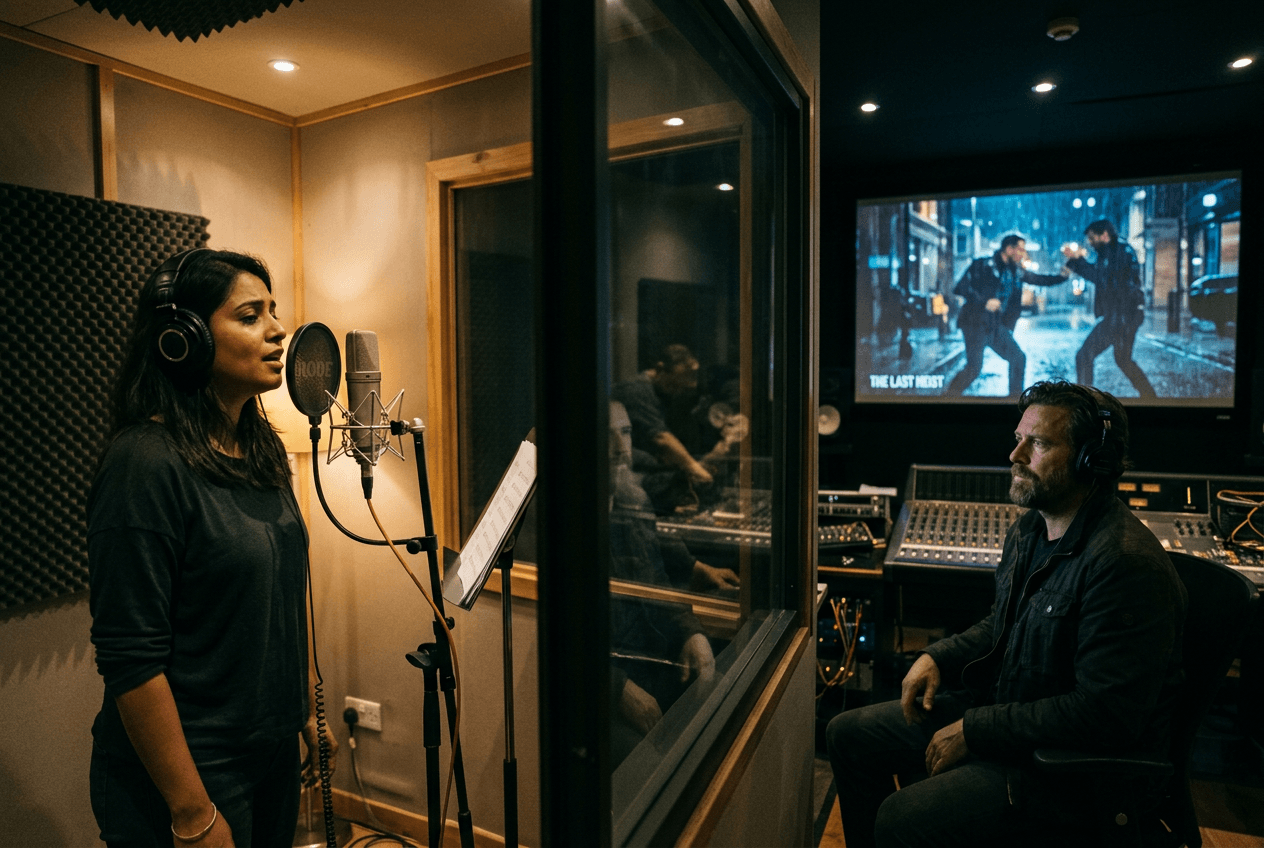 A playback singer pre-records songs for films, which actors then mime to on screen during filming. The singer's voice is played back on set or dubbed to the picture in post-production, hence the name. It is standard across Indian cinema in every language industry, and the singer is credited separately from the actor, frequently becoming as famous as them.
Why Indian cinema does it and Hollywood largely does not
A structural difference worth understanding. Western films with songs generally cast actors who can sing, or use singing actors. Indian cinema separated the two roles almost entirely, casting for screen presence and hiring voices separately, which allowed both to specialise.
The practical driver was early sound technology. Recording live on set produced poor quality, and pre-recording solved it. What began as a technical workaround became an institution, because it turned out that the best actor and the best singer are rarely the same person, and audiences accepted the convention completely, to the point that a singer could become more famous than several of the actors they voiced.
The consequence is a profession that exists at scale nowhere else. India produces an enormous volume of film music annually across many language industries, and the people singing it are specialists rather than actors who also sing.
What the Job Actually Involves
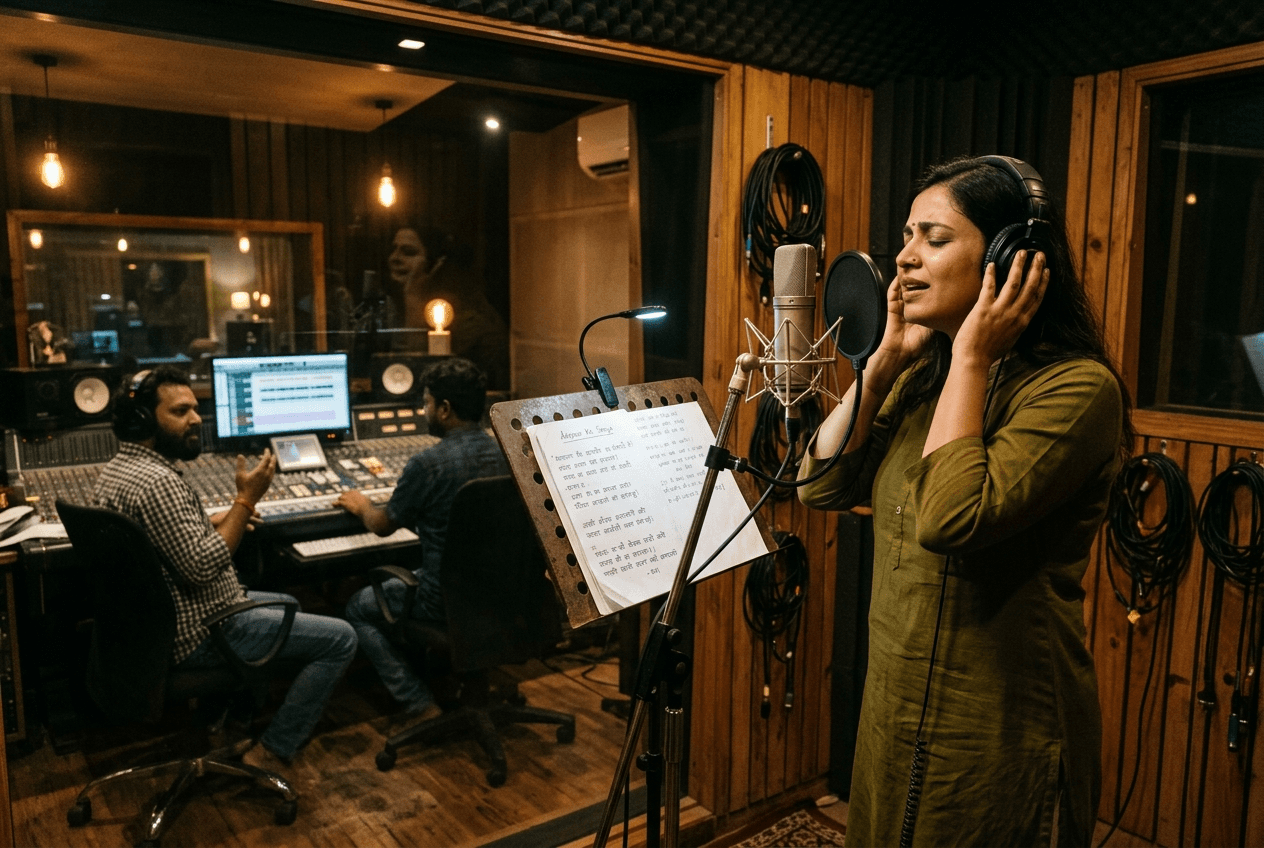 What a playback singer actually does day to day is the section career articles skip, because it is less glamorous than the reputation suggests.
Serving someone else's vision
A composer has written a melody, a lyricist has written words, and a director has a scene requiring a specific emotion. The singer delivers all of it. Personal interpretation is welcome only within limits, and a singer who imposes their own reading over the composer's intention will not be called back.
Singing for a character, not as yourself
The defining skill. The voice has to suit the actor on screen and the character they are playing, which means a singer may be asked to sound younger, older, rougher, more innocent or more world-weary than they naturally do. Mohammed Rafi's reputation rests substantially on this, since his delivery was audibly different depending on which actor he was voicing.
Working fast
Studio time costs money and sessions are scheduled tightly. A singer is expected to learn a song quickly, deliver a usable take within a reasonable number of attempts, and take direction without becoming defensive. Reliability is valued as highly as ability, and a brilliant singer who is difficult to work with gets considerably less work than a merely good singer who is easy to have in a room.
Singing in languages you may not speak
Routine rather than exceptional. Singers record across Hindi, Tamil, Telugu, Malayalam, Kannada, Bengali, Marathi and more, frequently in languages they do not speak, working from transliteration and coaching. Pronunciation must nonetheless be accurate, because the audience does speak the language and will notice a mispronunciation immediately.
Emotional delivery to order
Producing grief, joy, longing or defiance on demand, in a studio, at eleven in the morning, repeatedly, for a scene you have not seen. This is closer to acting than most singing is, and it is why so many of them describe the job in acting terms rather than musical ones. Several have said that the hardest part is not the singing but producing the feeling on cue, repeatedly, for a scene they have not seen.
How a Song Is Actually Recorded
Two things about that process are worth noting. The singer is frequently the last creative element added rather than the first, arriving after the melody, words and arrangement are settled. And modern editing means the released performance may be assembled from several takes, which is entirely standard practice everywhere in recorded music today and which changes what a recording represents in ways worth understanding before comparing modern performances with older ones.
What has changed
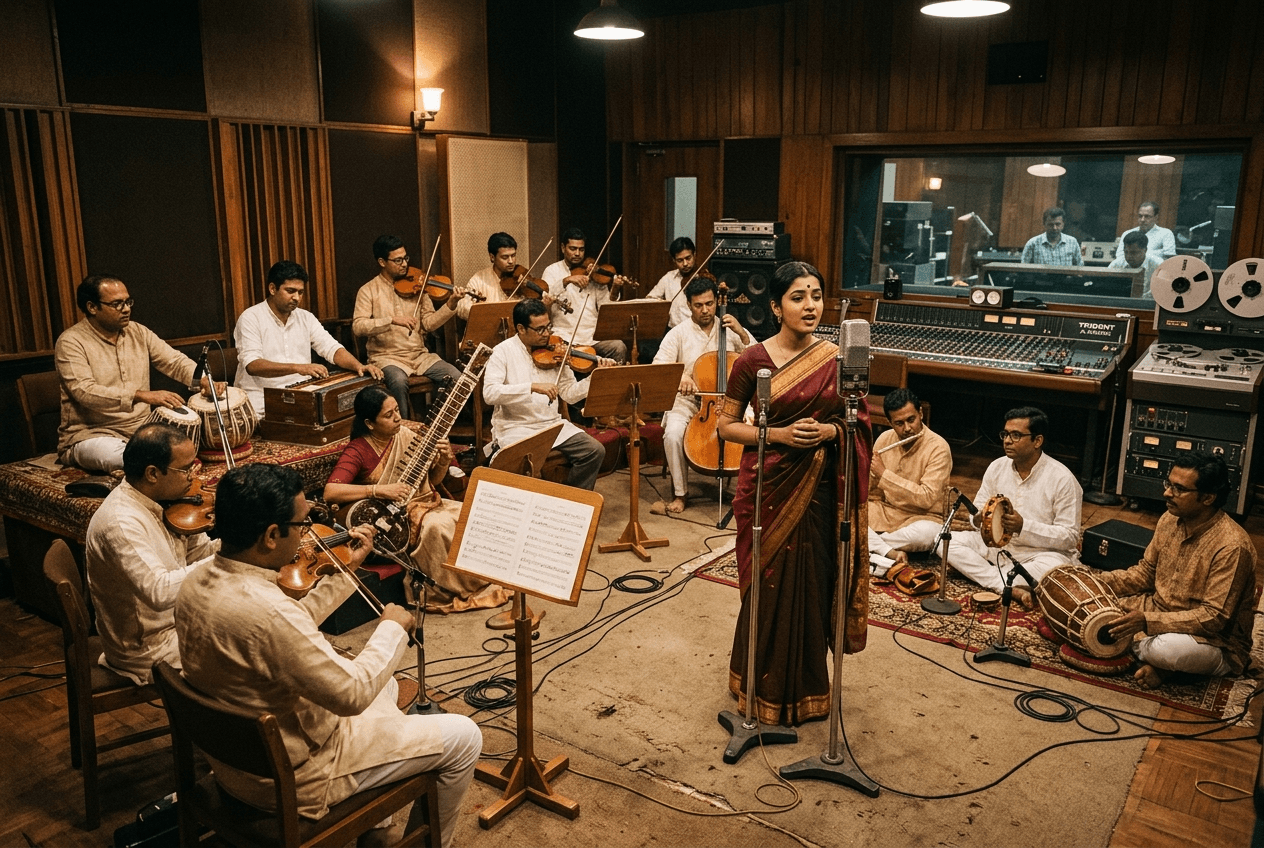
In the earlier decades, the singer and the full orchestra recorded together in one take, with no multitracking and no correction. A mistake in the final line meant everyone started again. That produced performances of remarkable technical security, because a singer who could not deliver under those conditions did not get repeat work.
Multitracking changed the demand. A singer now records separately, can repeat a phrase, and can have small imperfections corrected. That permits different kinds of performance and it removed a filter that had kept the technical standard extremely high. Both facts are true and the trade-off is genuine.
The Singers Who Defined It
 A brief orientation rather than a ranking, since the field is enormous and the greats were doing different things.
The golden age
Lata Mangeshkar dominated female playback for decades with a purity of tone and clarity of diction that let composers write melodies of a complexity they would not have attempted for a less secure singer. Mohammed Rafi was the great versatilist, credible across qawwali, bhajan, romance and comedy and audibly adapting to whichever actor he voiced. Kishore Kumar had no formal training and won eight Filmfare awards on character, timing and interpretive freedom. Asha Bhosle covered more stylistic ground than anyone, from cabaret to ghazal to folk.
Around them, Mukesh owned melancholy, Manna Dey took the classically demanding songs others could not manage, Talat Mahmood had a natural tremor nobody has imitated, and Geeta Dutt brought a mood and sensuality that made her irreplaceable in her register.
What that generation shared, beyond ability, was working conditions that no longer exist. Recording live with a full orchestra in one take, several times a week, for decades, produced a technical security that studio-by-studio assembly does not demand. Listening to those recordings knowing that is a different experience from listening to them as nostalgia, and it is the strongest argument for studying them rather than simply enjoying them.
Beyond Hindi
The Hindi industry is a fraction of the picture. S.P. Balasubrahmanyam recorded across sixteen languages in numbers no Hindi singer approaches. K.J. Yesudas holds the record for the most National Film Awards for playback singing, more than any Hindi playback singer. Ghantasala defined Telugu playback, and P. Susheela and S. Janaki dominated southern female playback for a generation. Any account that stops at Bombay is describing an industry rather than a country.
The modern era
Sonu Nigam brought classical grounding into 1990s and 2000s playback. Kumar Sanu, Udit Narayan and Alka Yagnik defined the sound of the decade. Shreya Ghoshal has led female playback for two decades with unusual ornament control. Arijit Singh dominated male playback from 2013 until announcing in January 2026 that he would take no further film assignments, and remains the most-followed artist on Spotify globally.
His departure is genuinely significant for anyone considering this career, because a decade of unusual concentration in one voice has ended and the work will redistribute. The single-artist treatment of what he actually did technically sits in the guide to Arijit Singh's songs, and the broader field is covered in the guide to the top Indian singers of all time.
How Do You Become a Playback Singer?
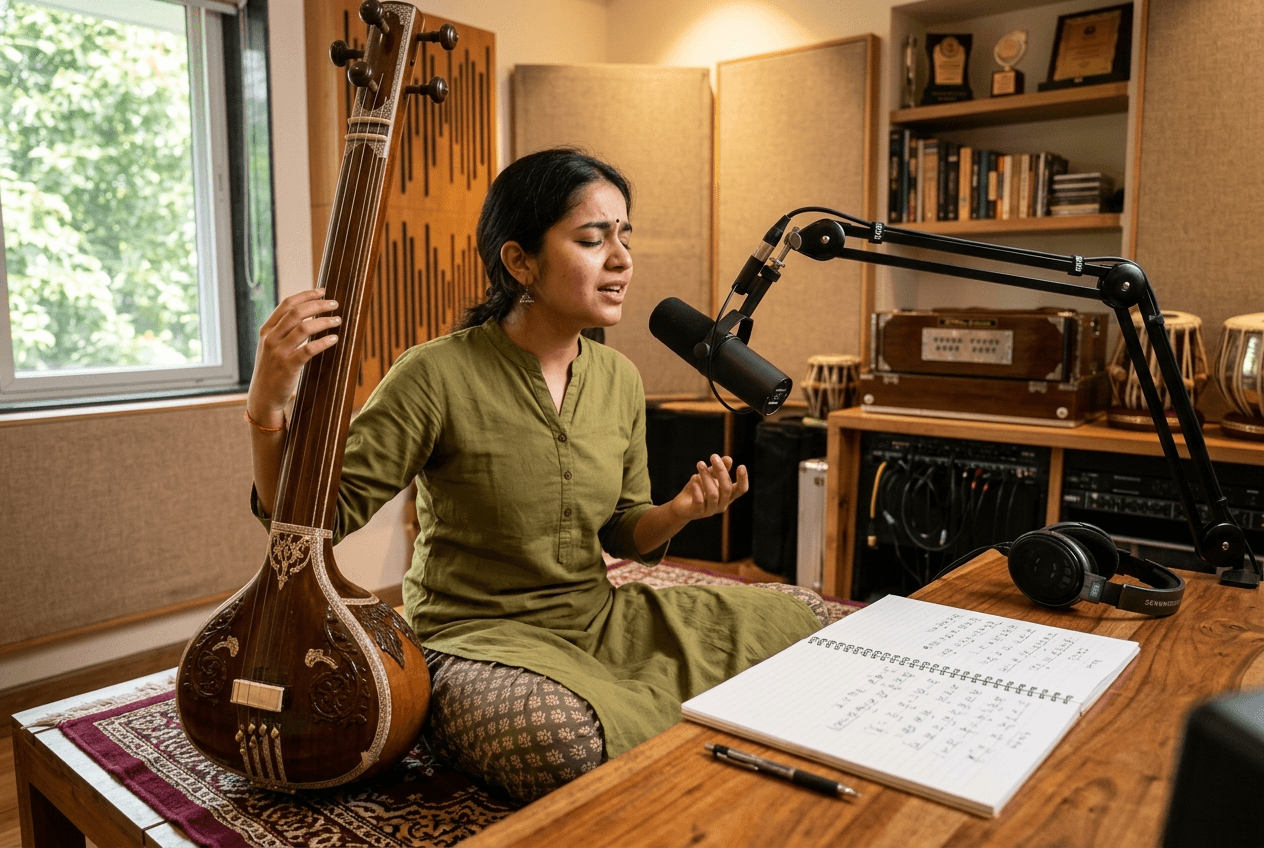 How to become a playback singer is the question the topic exists for, and the honest answer has changed substantially in the last fifteen years.
Classical training first
Nearly every established playback singer trained classically, and this is not coincidence or credentialism. The job demands pitch accuracy under studio scrutiny, breath control for long phrases, tonal consistency across a range, ornament technique, and the stamina to sing repeatedly for hours. Classical training supplies all of it, and there is no shortcut that does.
Which tradition matters less than the depth. Hindustani, Carnatic or a serious Western classical grounding all work. What does not work is learning by imitating recordings, which produces a singer who can reproduce specific songs and cannot deliver something new to order. The foundational practice is set out in the guide to swar sadhana and vocal training.
Alongside the training, breath support deserves specific mention because it is the thing that fails first under studio conditions. Long phrases delivered repeatedly across a three-hour session demand capacity that ordinary singing does not, and a singer who runs out of air on take twelve of a phrase they managed easily on take three has a support problem rather than a stamina problem. The guide to breathing techniques for singers covers how it is built.
Versatility next
A working playback singer needs to move between registers, styles and languages. Practise material well outside your comfort zone, work on diction in languages you do not speak, and record yourself constantly, because studio work is judged on recorded sound rather than on how you feel while singing.
The routes in
Historically there were two: industry proximity, meaning family or connections, and reality television, which from the 2000s opened a genuinely closed profession to people from small towns with no access at all. Both still operate.
What has been added is direct visibility. Consistent, well-produced covers and original material posted publicly have brought singers to the attention of composers who would never have met them otherwise. This is now a real route rather than a theoretical one, and it rewards consistency over virtuosity, since composers are assessing whether someone can deliver repeatedly rather than whether they can produce one impressive video.
Session and jingle work
The unglamorous entry point and the most practical. Advertising, corporate work, backing vocals, chorus work and demo singing are all paid, all build studio experience, and all put you in rooms with people who hire singers. A great many playback careers began with a singer who was reliable at jingles and got recommended.
Move to where the work is
Uncomfortable and true. Film music is recorded in specific cities, principally Mumbai, Chennai and Hyderabad, and proximity matters because sessions are booked at short notice. Remote recording has grown and has not replaced being available in person. For diaspora singers this is the hardest constraint to work around.
A related point that applies everywhere in music. Almost all work comes through people who have worked with you before or heard you in person, which means the singers who establish themselves are usually the ones who were present, reliable and pleasant to deal with over several years rather than the ones who were most talented at a single audition. Building relationships is not networking in the transactional sense, it is simply being someone people are glad to call.
Is It a Realistic Career?
Whether a playback singer can actually make a living is the section aspiration content usually avoids, and a serious guide should not.
The field is small. A few dozen singers account for the overwhelming majority of released film songs in any given language industry, and below them sits a much larger group doing occasional work, session vocals and jingles. The distribution is extremely top-heavy, more so than in most creative professions.
Income is irregular for everyone except the very top. Payment is typically per song, and royalty arrangements vary considerably, historically often unfavourably for singers, though this has improved in some markets. A singer who is not in the top tier will earn from a portfolio combining occasional film work, session work, live performance and teaching.
None of that is a reason not to try. It is a reason to build the portfolio deliberately rather than waiting for a break, and to treat teaching and live work as a legitimate part of a musical career rather than as failure. The realistic picture across the whole industry is set out in the guide to careers in the music industry.
Playback Singing From Abroad
 Worth addressing for the substantial British and wider diaspora audience, since the constraints differ.
The disadvantages are real. Distance from the recording centres means missing short-notice sessions, and the informal networks through which work circulates are geographically concentrated. Nobody should pretend otherwise.
Worth addressing for the substantial British and wider diaspora audience, since the constraints differ.
The disadvantages are real. Distance from the recording centres means missing short-notice sessions, and the informal networks through which work circulates are geographically concentrated. Nobody should pretend otherwise.
The advantages are also real and growing. Remote recording is now routine for many kinds of session work, and a singer with a properly treated home setup can deliver broadcast-quality vocals from anywhere. Online visibility has flattened access to composers. And the diaspora itself supports a live circuit, with community events, weddings, cultural associations and touring shows providing genuine paid performance work across the UK.
The home setup is worth being specific about, since it is the practical barrier most diaspora singers underestimate. A usable recording space needs acoustic treatment rather than merely a good microphone, because an untreated room puts audible reflections on everything and no amount of processing removes them cleanly. A small treated corner beats a large untreated room comprehensively, and this is the single investment that converts a singer from someone who sends demos to someone who sends usable takes.
The live circuit is also worth taking seriously rather than treating as a consolation. Weddings, sangeets, community concerts, temple and gurdwara programmes, cultural association events and touring productions all pay, all build reputation, and all provide the performance experience that studio-only singers conspicuously lack. Several UK-based singers work substantially in this world and it supports them properly.
The practical route for a diaspora singer is to build a professional recording capability, maintain visibility online consistently rather than sporadically, perform locally to build reputation and income, and visit the industry centres periodically rather than hoping to be discovered remotely. Several working singers have built careers on exactly that pattern.
The Recording Studio Skills Nobody Teaches
A set of competences distinct from singing itself, and the reason some excellent singers never establish themselves in studio work.
Microphone technique
Knowing how far to stand, when to move back on a loud phrase and when to lean in for intimacy, and how to angle away from consonants that would otherwise distort. A singer who stays fixed in position produces a recording that needs constant correction, and engineers notice.
Singing to a click
Recording to a metronome click in headphones is standard and genuinely unnatural at first. It removes the flexibility of live performance and demands precision that expressive singers frequently resist. It is a learnable skill and it is worth practising deliberately before you need it in a paid session.
Consistency across takes
Because the final vocal is assembled from several takes, phrases must match in tone, dynamic and placement. A singer who delivers a brilliant first take and three quite different ones afterwards is harder to work with than one who delivers four consistent good ones, since the second is editable and the first is not.
Working in headphones
Hearing yourself through headphones rather than in a room changes your perception of your own pitch and volume, and singers routinely oversing or undersing in their first sessions. Asking for the right monitor balance, usually more of your own voice than feels natural, is something to learn to request rather than endure.
Taking direction without defensiveness
The non-technical skill that matters most. A composer asking for a fifth take is not criticising you, they are looking for something specific. Singers who treat direction as judgement are difficult to work with and get called back less, regardless of ability.
What Makes a Great Playback Singer
What separates a great playback singer from a competent one is identifiable rather than mysterious, and worth knowing whether you sing or only listen.
Pitch security under scrutiny, since close-miked studio recording exposes everything. Diction precise enough that words arrive intact at any volume and in any language. Tonal consistency across the range with no audible register break. Ornament control, meaning meend, murki and taan executed cleanly rather than approximated. Interpretive judgement, particularly knowing what not to sing. And a voice recognisable within seconds, which is the quality that survives everything else and the one that cannot be trained into a voice that does not have it.
The interesting thing about that list is that no singer has all of it. Kishore Kumar scored low on ornament control and off the scale on character. Lata Mangeshkar was at the top on the first three. Arijit Singh built a career substantially on the fifth. Understanding which qualities you have and which you need to build is more useful than trying to be good at everything.
Playback Singing Across Indian Cinema
 Hindi cinema dominates outside coverage and it is one industry among several, each with its own playback tradition, its own stars and its own conventions.
The Tamil and Telugu industries
Both produce film music at enormous volume and both have playback traditions as deep as the Hindi one. Composers in these industries have historically drawn more directly on Carnatic classical material, which means singers frequently need genuine classical facility rather than a general musicality. The southern industries also produced the highest-output singers in Indian history.
Malayalam and Kannada
Smaller in volume and highly regarded for musical quality, with Malayalam cinema in particular known for melodic sophistication and for lyrics treated seriously as poetry. K.J. Yesudas came out of this world, and its playback tradition rewards subtlety over power.
Bengali, Marathi and the regional industries
Each carries its own repertoire and its own history. Bengali film music drew on Rabindra Sangeet and the wider Bengali song tradition. Marathi cinema has its own devotional and folk-influenced strand. Punjabi film and non-film music now operates at a scale that feeds directly back into Hindi cinema.
What this means for a singer
Versatility across languages is not merely a nice addition, it is how singers build sustainable careers. A singer working in one industry is exposed to that industry's fortunes; a singer working across three or four is considerably more resilient. It is also why pronunciation coaching is a real and unglamorous part of the profession.
Frequently Asked Questions
What does a playback singer do?
Records songs for films in advance, which actors then mime to on screen. The singer delivers a composer's melody, a lyricist's words and a director's emotional brief, singing for a character rather than as themselves, frequently in languages they do not speak, and is credited separately from the actor.
Who is the most famous playback singer?
Lata Mangeshkar by cultural reach within India, having dominated female playback for decades and received the Bharat Ratna. Mohammed Rafi and Kishore Kumar are held in comparable affection. By output, S.P. Balasubrahmanyam recorded across sixteen languages in numbers no Hindi singer approaches, and K.J. Yesudas holds the National Award record.
How do I become a playback singer?
Train classically first, since the job requires pitch accuracy, breath control, tonal consistency and ornament technique that nothing else supplies. Build versatility across styles and languages. Take session, jingle and backing work to gain studio experience and contacts. Build consistent public visibility. And be near the recording centres, since sessions are booked at short notice.
Do playback singers get royalties?
Arrangements vary considerably and have historically often been unfavourable to singers, with payment typically made per song rather than through ongoing royalties. This has improved in some markets and remains inconsistent. Any singer entering the field should understand what they are signing rather than assuming.
Is playback singing a good career?
It is a small and top-heavy field where a few dozen singers account for most released songs in any language industry. Most working singers build a portfolio combining occasional film work, session and jingle work, live performance and teaching. That is a viable musical life and it is different from the picture aspiration content usually presents.
Do playback singers need classical training?
Effectively yes. Nearly every established playback singer trained classically, because the job demands pitch accuracy under studio scrutiny, breath control, tonal consistency, ornament technique and stamina. Kishore Kumar is the celebrated exception and remains an exception rather than a model.
How is playback singing different from other singing?
The singer serves a film rather than expressing themselves, singing for a character an actor will play on screen. They take direction from a composer and director, work quickly in a studio, and frequently record in languages they do not speak. It is closer to acting than most singing, and many playback singers describe it in those terms.
Can you become a playback singer from abroad?
It is harder and it is possible. Distance from recording centres means missing short-notice sessions, and remote recording is now routine for much session work. A diaspora singer should build professional recording capability, maintain consistent online visibility, perform locally for reputation and income, and visit the industry centres periodically.
How are playback songs recorded?
The composer writes the melody, the lyricist writes words, a scratch guide vocal establishes phrasing and key, and a singer is chosen whose voice suits the actor and character. The singer learns the song shortly before recording, delivers multiple takes with the composer directing, and the best phrases are assembled and mixed. Filming follows, with the actor miming.
Who are the best playback singers today?
Shreya Ghoshal has led female playback for two decades. Arijit Singh dominated male playback from 2013 until announcing in January 2026 that he would take no further film assignments. Sonu Nigam, Sunidhi Chauhan, Armaan Malik and Neeti Mohan are among the other established names, alongside substantial figures in each of the southern industries.
Final Thoughts
What makes the playback singer an unusual profession is that success requires disappearing. The best of them served the character, the composer and the scene rather than themselves, and the paradox is that the ones who did this most completely became the most famous.
If you are considering it, train classically, build versatility, take the unglamorous work, and be realistic about the shape of the field. And if you are only listening, try one exercise: take a song you know well and listen only to the voice, ignoring the arrangement, noticing where the singer breathes and where they choose to do less. That is where the craft lives. Art Gharana teaches Hindustani, Carnatic and Bollywood vocals live and one-to-one, with a free first class.