ChatGPT
 Google AI
 Grok
Grok Claude
A song from 1957 that still works is doing something a song from 2017 that still works is not, because it has survived a change of language, of recording technology, of film convention and of two or three generations of listeners. The reason evergreen bollywood songs have lasted is not nostalgia, since the people who love them most were frequently born decades after they were recorded. This guide explains what they actually have that later material often lacks. For the wider field, the guide to the top Indian singers of all time places the voices in context.
What follows covers the essential songs, the singers and composers who made them, the recording conditions that shaped how they sound, why the lyrics are the real reason they last, and which of them a singer can learn from most usefully. That last section matters, because this repertoire is the standard training material for Indian vocal students and it is worth knowing why.
What Are the Best Old Bollywood Songs?
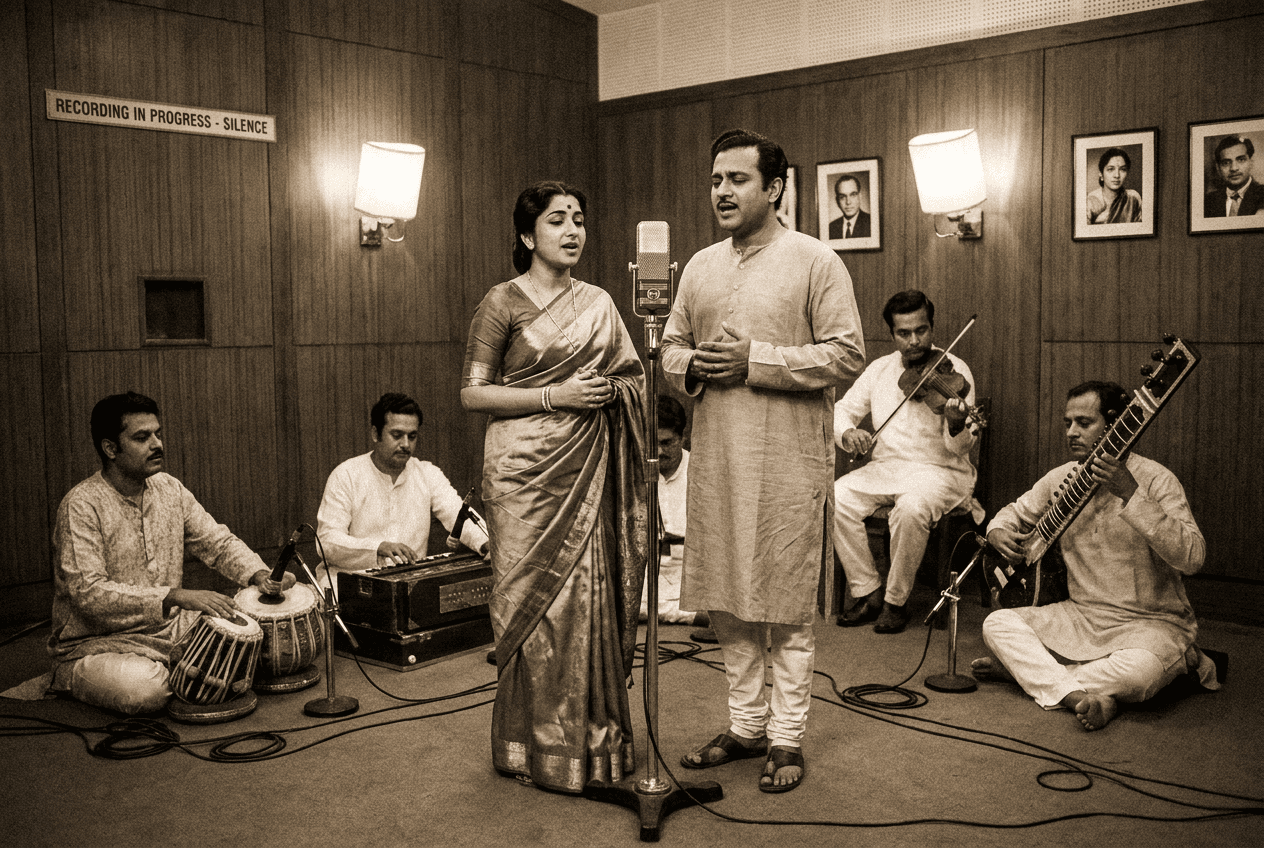 The best known evergreen bollywood songs include Pyar Hua Ikrar Hua from Shree 420, Lag Ja Gale from Woh Kaun Thi, Abhi Na Jao Chhod Kar from Hum Dono, Chaudhvin Ka Chand, Ehsaan Tera Hoga Mujhpar from Junglee, Waqt Ne Kiya from Kaagaz Ke Phool, Ajeeb Dastan Hai Yeh from Dil Apna Aur Preet Parai, Aaja Sanam from Chori Chori and Tere Bina Zindagi Se from Aandhi.
Why They Have Lasted

The lyrics were written by poets
The single largest reason and the one least discussed. Sahir Ludhianvi, Shailendra, Majrooh Sultanpuri, Kaifi Azmi, Hasrat Jaipuri and later Gulzar were published poets who wrote film lyrics without lowering their register, bringing the vocabulary of ghazal and nazm into a mass medium. A song built on genuine poetry survives a change of musical fashion in a way a song built on a hook does not.
Sahir in particular negotiated an arrangement in which he was paid slightly more than the music director, on the argument that the words came first. Whether or not that was justified, it says something about the standing lyricists held.
The melodies survive being hummed
The test every enduring song passes. These melodies work with no accompaniment at all, sung badly by one person in a kitchen, which is precisely why they persist across generations. Songs that depend on production to be affecting do not travel that way.
The arrangements left space
Orchestration in this period was light by later standards, tempos were unhurried and the voice sat at the centre of the recording rather than competing with a dense arrangement. That is why these songs sound clean rather than dated, while heavily produced material from other eras sounds of its time.
Raga underneath
A large share of these melodies draw on raga material, which gives them a melodic logic that pop structures do not have, and which is why the phrases move in ways that feel both surprising and inevitable. It is also why they are satisfying to sing. The guide to Indian raga music explains what to listen for.
How These Records Were Made
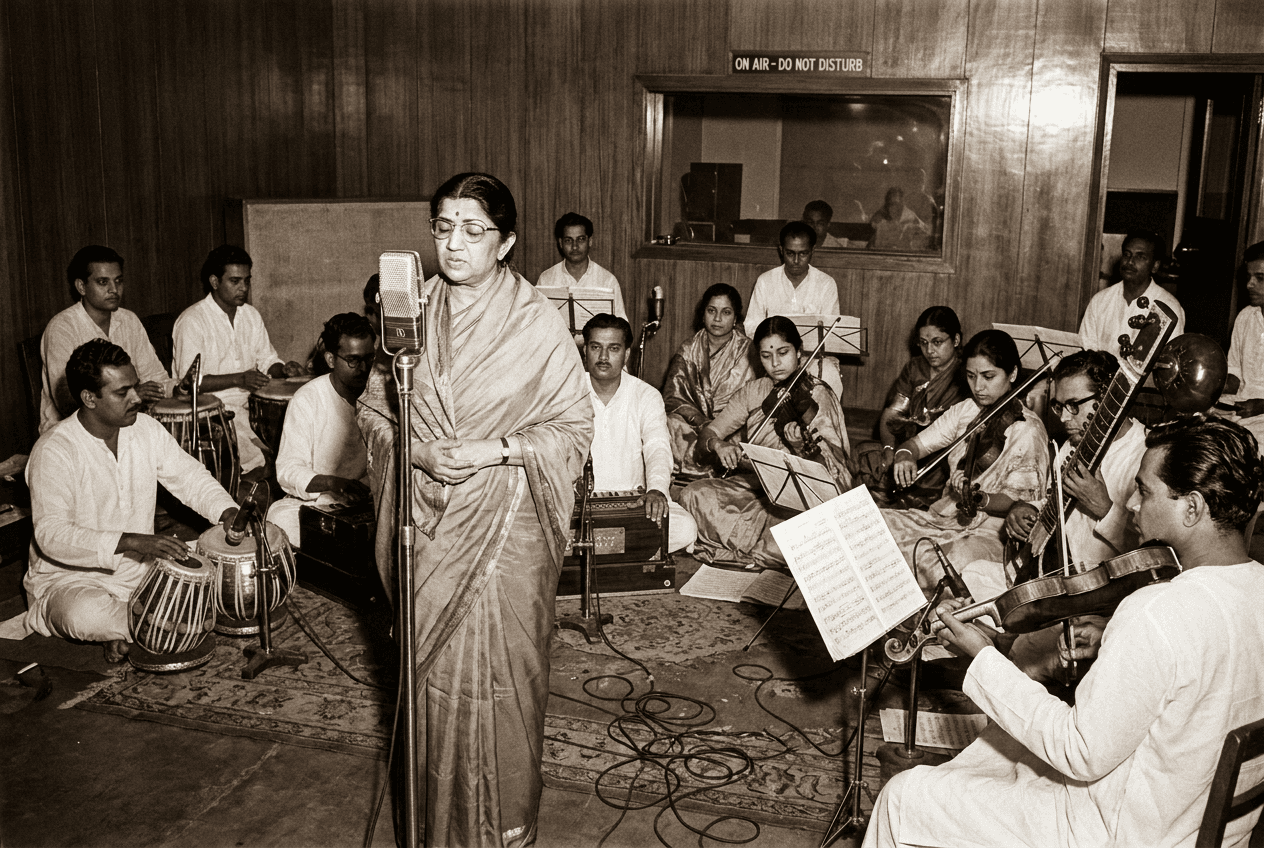 How the evergreen bollywood songs were recorded explains a great deal about how they sound, and it is almost never mentioned.
For most of this period, the singer and the full orchestra recorded together in a single take. There was no multitracking, no punching in to repair a phrase, and no pitch correction of any kind. A mistake in the final line meant the entire ensemble started again, which made studio time expensive and made a reliable singer commercially valuable quite apart from artistic considerations.
Two consequences follow. The performances have an integrity that assembled recordings do not, because what you hear genuinely happened in one continuous stretch with musicians responding to each other. And the technical standard was necessarily very high, since a singer who could not deliver a clean take under those conditions did not get repeat work.
This is worth knowing before comparing golden era singing with modern playback. The two were produced under entirely different conditions, and the security you hear in a 1960s vocal is partly a consequence of a system that permitted nothing else.
The Voices
The evergreen bollywood songs were carried by a group of singers working simultaneously at a level rarely matched since.
Brief orientation rather than a ranking, since these singers were doing different things.
Lata Mangeshkar combined purity of tone with precision of diction, and that security allowed composers to write melodies of a complexity they would not have attempted otherwise. Mohammed Rafi was the great versatilist, credible across qawwali, bhajan, romance and comedy, and audibly adapting his delivery to whichever actor he voiced.
Kishore Kumar had no formal training and brought character, timing and interpretive freedom that technical polish cannot substitute for. Asha Bhosle covered more stylistic ground than anyone. Manna Dey took the classically demanding songs others could not manage. Talat Mahmood had a natural tremor nobody has imitated. Geeta Dutt carried mood in a way that made her irreplaceable, and Hemant Kumar brought depth to the low male register.
The Composers
Less discussed than the singers and at least as responsible for what lasted.
Naushad brought serious raga material into film composition and legitimised the form musically at a point when it needed legitimising. Shankar-Jaikishan built the lush orchestral romance of the Raj Kapoor films. S.D. Burman had an unmatched instinct for the simple melody that will not leave you, drawing substantially on Bengali folk material. Madan Mohan wrote for ghazal-influenced material with a subtlety that musicians consistently rate above his public profile.
Roshan, O.P. Nayyar, Salil Chowdhury and C. Ramchandra complete the core group, each with a recognisable approach. Salil Chowdhury in particular brought Western classical orchestration into Hindi film music in ways that still sound ambitious.
Learning From This Repertoire
Learning from the evergreen bollywood songs is what makes this a music school page rather than a nostalgia list, and the reason these songs are the standard training material for Indian vocal students.
Why teachers use them
They sit in comfortable ranges, they have clear phrase structures with natural breathing points, the diction is precise enough to be worth imitating, and they draw on raga material without demanding classical technique. A student learning one of these is building the same foundations a classical student builds, in material they already enjoy.
The most useful ones to learn
Ajeeb Dastan Hai Yeh is the standard female teaching song and deserves the position, with a comfortable range, clear diction and no ornamentation to hide behind. Chaudhvin Ka Chand and Ehsaan Tera Hoga Mujhpar work the same way for male voices, sitting lower than most modern playback material.
Abhi Na Jao Chhod Kar is worth learning for the phrasing rather than the notes, since it is a conversation and delivering it as a song rather than as speech misses the point entirely. Aaja Sanam demonstrates classical grounding worn lightly and rewards a student who has some raga knowledge.
What they expose
Everything, which is the point. These songs have light arrangements and no production to hide behind, so tone, breath, pitch and diction are all audible. A student who sounds good on this material sounds good generally, and a student who does not can see exactly which of those four is failing. The guide to breathing techniques for singers covers the support the longer phrases require.
Male voices and the register point
Worth stating specifically. Golden era male playback sits considerably lower than modern material, because playback singing moved upward in register over the decades. A man who has concluded he cannot sing because every contemporary song is a strain should try Chaudhvin Ka Chand or a Talat Mahmood recording, and the result frequently surprises him.
Where to Start Listening
 A route through the evergreen bollywood songs for someone approaching them without prior familiarity.
Begin with Pyar Hua Ikrar Hua, which is as accessible as the era gets and demonstrates the simplicity that carries so much of this material. Then Lag Ja Gale, which shows what the same simplicity does with genuine emotional weight underneath.
A route through the evergreen bollywood songs for someone approaching them without prior familiarity.
Begin with Pyar Hua Ikrar Hua, which is as accessible as the era gets and demonstrates the simplicity that carries so much of this material. Then Lag Ja Gale, which shows what the same simplicity does with genuine emotional weight underneath.
Then a Rafi song and a Kishore Kumar song back to back, ideally from a similar period, and notice how differently two singers approach the same job. Then Waqt Ne Kiya for Geeta Dutt, since her register is the one most modern listeners have never encountered.
And then read the lyrics of one song properly, in translation if necessary. This is the step people skip and it is the one that changes everything, because the reputation of this era rests on writing that most listeners have never actually examined.
For Families in Canada
Two practical notes for readers here.
This repertoire is the strongest musical bridge between generations in a diaspora household. Grandparents know these songs completely, frequently better than they know anything from the last thirty years, and a grandchild who learns one has something to share that no contemporary material provides. It is also the repertoire most likely to prompt an older relative to talk about their own life, which is worth more than the song.
For heritage language learning, these songs are unusually good material. The Urdu-influenced vocabulary is richer than modern film Hindi, the diction is precise enough to imitate accurately, and the slower tempos give a learner time to hear each word. A child who learns three of these properly, understanding the meaning rather than singing phonetically, has acquired vocabulary that daily conversation would not supply. The broader tradition these connect to is set out in the beginner guide to Hindustani classical music.
The Films and the Context
These songs were written for scenes, and knowing something about the films they came from changes how several of them land.
Why the songs carried the films
Hindi cinema of this period used songs structurally rather than decoratively. A song advanced the plot, expressed what characters could not say directly under the conventions of the time, or compressed a passage of time that dialogue would have laboured over. That gave lyricists real material to work with, which is part of why the writing is as good as it is.
The restraint of the era also mattered. Romance had to be expressed obliquely, and obliquity produces better writing than directness does. Several of the finest lyrics in this repertoire are about longing precisely because arrival could not be depicted.
The picturisation
A number of these sequences are visually iconic to the point that image and music are inseparable, and the black and white cinematography of the period gave several of them a quality colour film did not replicate. Watching the sequence rather than only hearing the song is worth doing at least once for the well-known ones.
The films worth knowing
Shree 420, Pyaasa, Kaagaz Ke Phool, Guide, Mughal-e-Azam, Chaudhvin Ka Chand, Woh Kaun Thi and Aandhi between them account for a substantial share of the enduring repertoire. Several are regarded as significant films independently of their music, which is not a coincidence, since the same production culture produced both.
How the Sound Changed After
Useful context, because it explains why this era is treated as distinct rather than merely old.
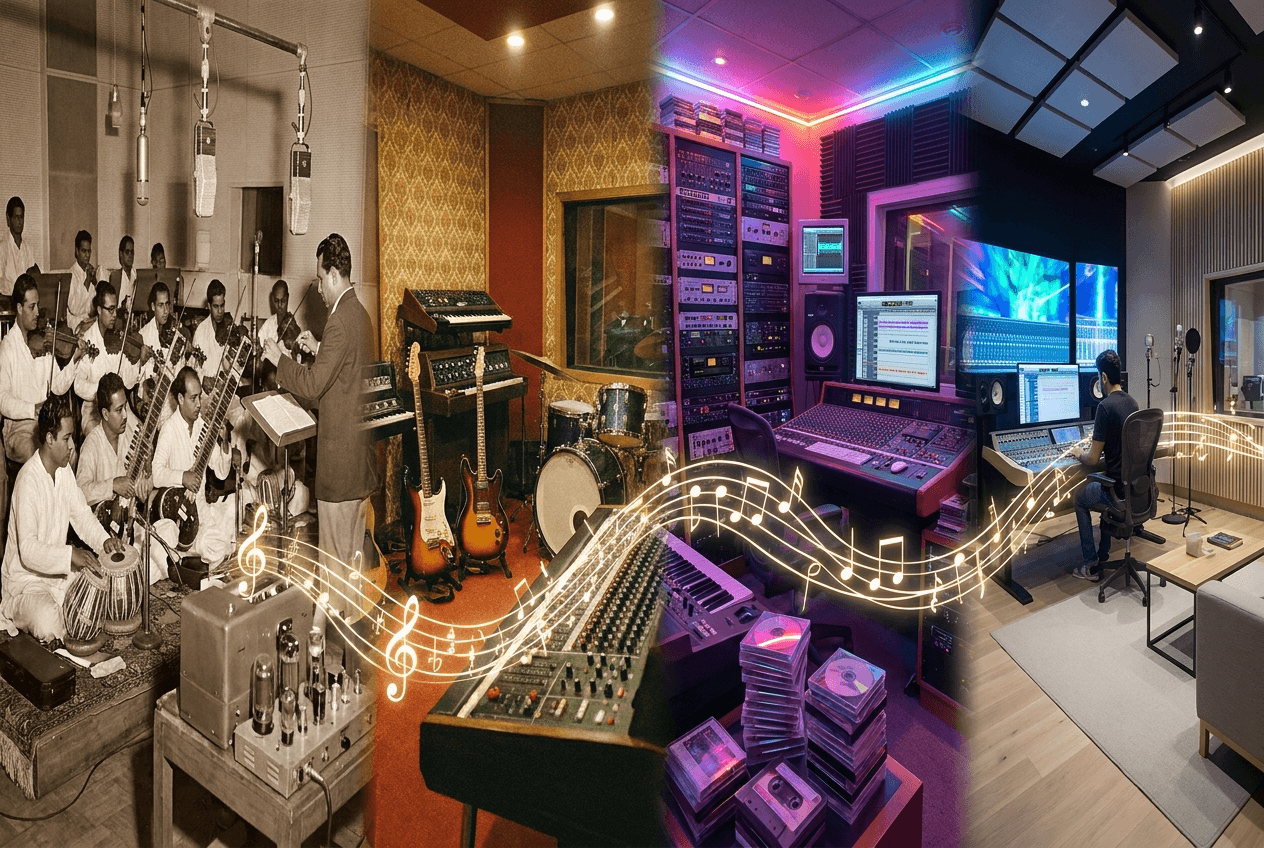
From the 1970s, arrangements grew denser, R.D. Burman imported rock, funk and Latin textures, and the register of male playback singing began moving upward. Multitracking arrived, which permitted different kinds of performance and removed the filter that single-take recording had imposed. None of this was decline; it was a different set of possibilities.
The 1980s brought synthesised production that has aged less well than the acoustic orchestration either side of it, which is why that decade is underrated. The 1990s returned to melody with Nadeem-Shravan and Jatin-Lalit, and produced its own body of enduring songs, though written and recorded under quite different conditions.
The useful comparison for a listener is to take one song from each decade and notice what changed. The orchestration, the vocal placement, the register and the relationship between voice and arrangement all shifted, and hearing that progression is more informative than any argument about which era was best.
Building a Listening Practice
 A method for anyone who wants to explore this properly rather than shuffling a playlist.
Take one singer and spend a week with them rather than sampling widely. Hearing one voice across twenty songs from different films and composers builds a picture that a mixed playlist never does, and you begin to recognise the choices that singer made repeatedly.
Then take one composer the same way. The differences between Naushad, S.D. Burman, Madan Mohan and Salil Chowdhury are substantial and become obvious quickly once you listen for them, and it is the fastest way to develop an ear for arrangement.
Then compare versions. Several of these songs have been recorded again by later singers, and hearing a modern interpretation against the original teaches a great deal about phrasing, restraint and what the original singer was actually doing.
And listen to at least one song with the lyrics in front of you, understanding each line. The reputation of this era rests on writing, and most listeners have never examined it closely. That single hour changes how the whole repertoire sounds.
The Duets and the Pairings
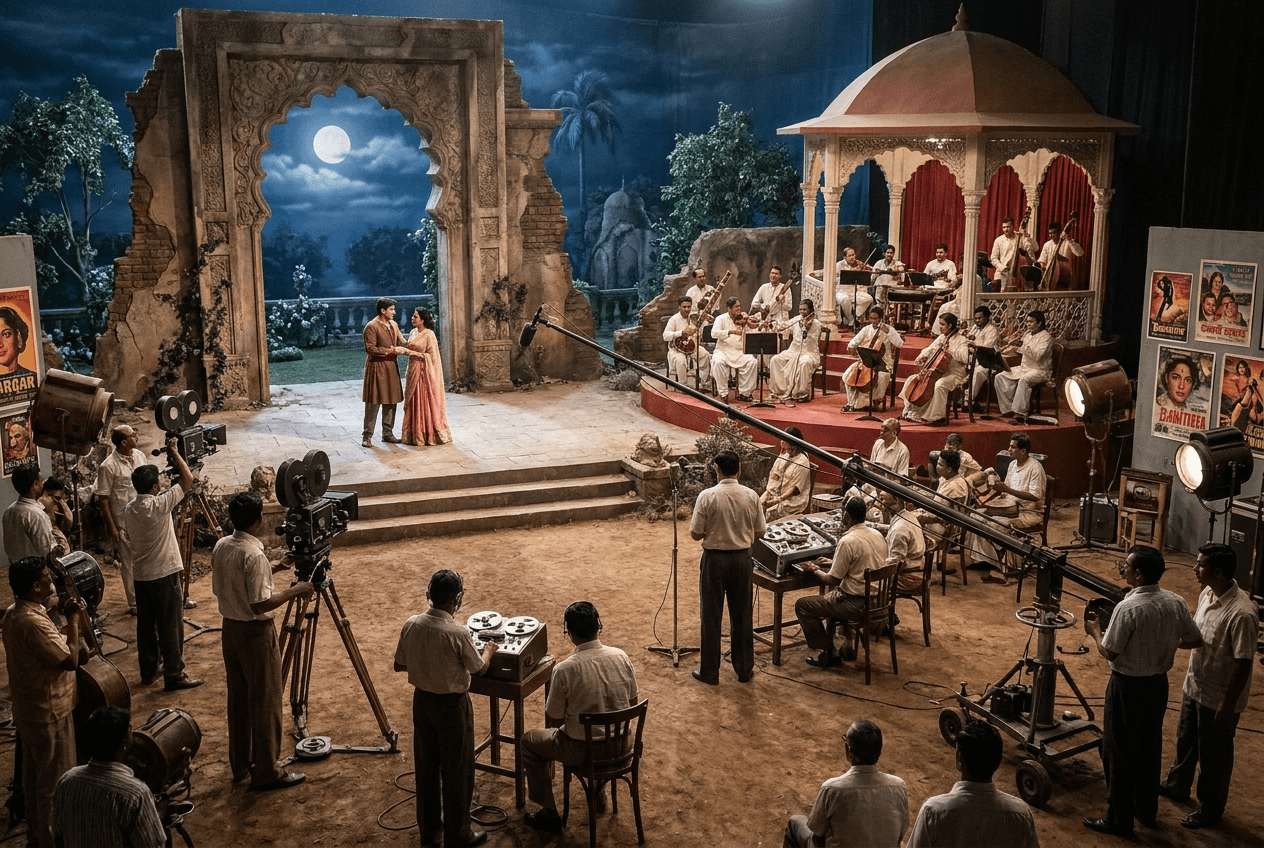 A substantial share of this repertoire is collaborative, and duet singing in this era reached a standard that is worth examining rather than simply enjoying.
What made them work
The best duets of the period sound like conversations rather than alternating solos, with each voice adjusting its dynamics and phrasing in response to what the other has just done. That requires both singers in the room together, which the single-take recording system enforced, and it is largely why later duets assembled separately rarely achieve the same quality of interaction.
The recurring pairings
Lata Mangeshkar and Mohammed Rafi produced the formal romantic duet at its most polished. Lata Mangeshkar and Manna Dey brought a classical grounding to lighter material. Kishore Kumar and Lata Mangeshkar were more conversational and less performed, and Tere Bina Zindagi Se is the outstanding example of that mode. Kishore Kumar and Asha Bhosle brought playfulness the others did not attempt.
Why duets are useful for learners
Because singing with another person exposes timing and tuning problems that solo practice conceals entirely. A student who sounds fine alone frequently discovers, in a duet, that their timing is loose or that they drift flat on sustained notes. It is also considerably more enjoyable than practising alone, which matters for persistence more than most teachers acknowledge.
Common Misconceptions
 Worth addressing, because several ideas about this era circulate widely and do not survive examination.
That the singing was simpler
It was not. The melodies frequently draw on serious raga material, several of the compositions are technically demanding, and the recording conditions permitted no correction whatsoever. What is true is that the arrangements were lighter, which is a different thing and is a large part of why the singing sounds so clear.
That it was all romantic
The repertoire includes philosophical material, social commentary, comedy, devotional songs and outright despair. Sahir Ludhianvi in particular wrote film lyrics carrying political and philosophical weight, and several of the era's best known songs are considerably darker than a casual listener assumes.
That the era ended cleanly
It did not, and the transitions were gradual. Several of these singers recorded across four or five decades, working with composers of very different generations, and the boundaries people draw between eras are convenient rather than real.
That it only appeals to older listeners
Demonstrably untrue, and the streaming numbers on this material show a substantial younger audience. The appeal is that the melodies work and the words are good, neither of which has an expiry date, and a great many people who love this repertoire were born decades after it was recorded.
Where to Find Good Versions
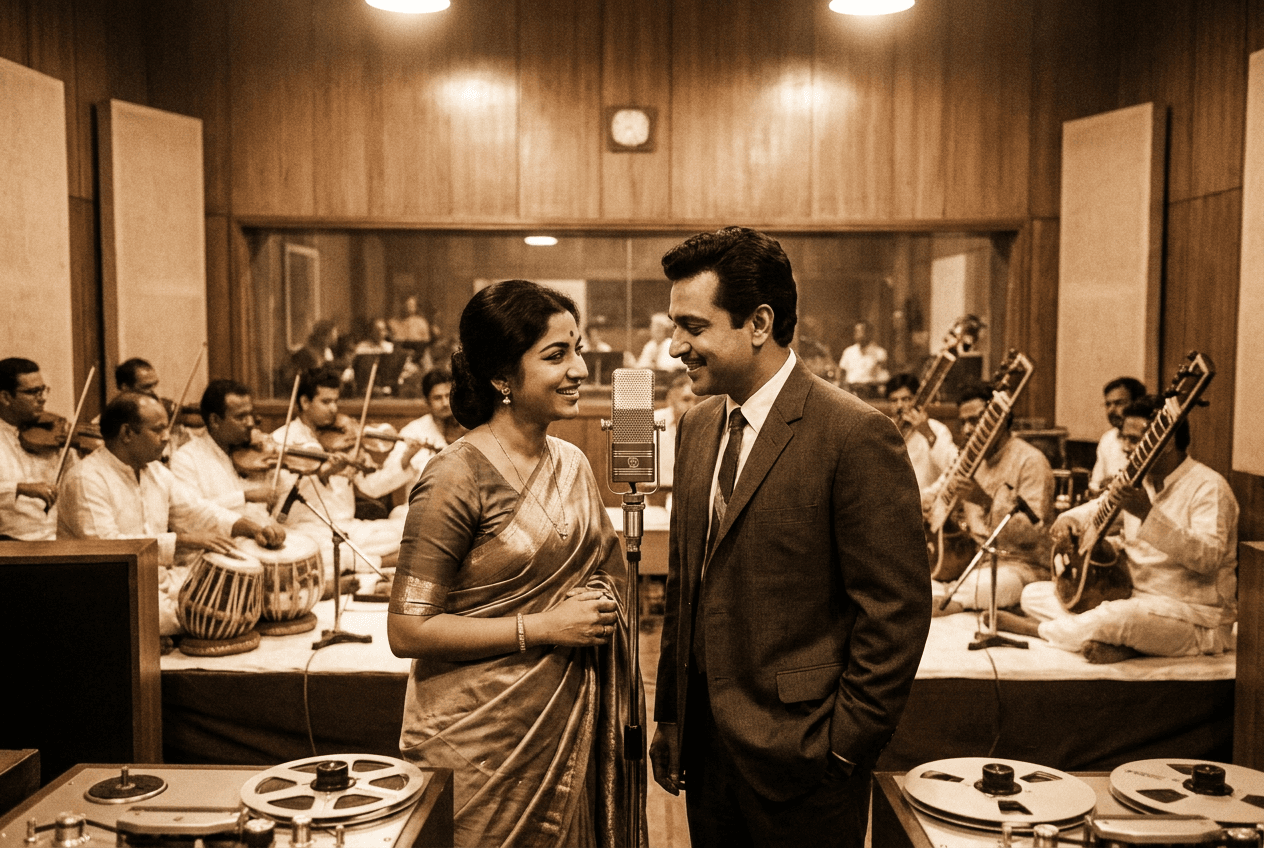 A practical note, since audio quality varies enormously on this material and it affects the experience more than people expect.
A great deal of golden era material circulating online comes from poor transfers, with compression artefacts, tape hiss and in some cases audible damage. Since the appeal of this repertoire rests substantially on the clarity of the voice against a light arrangement, a bad transfer removes precisely what makes it worth hearing. Official remastered releases exist for a substantial proportion of the significant material, and the difference between a remastered version and a poor upload is immediately audible. Where a song matters to you, it is worth finding a good version rather than accepting the first result.
Two cautions on remastering. Some remasters apply heavy noise reduction that removes hiss along with detail, producing a version that is cleaner and thinner than the original. And some apply modern loudness processing that flattens the dynamic range these recordings depend on. A well-done remaster is a genuine improvement and not every remaster is well done.
If you have access to older physical media in the family, it is worth knowing that records and cassettes frequently hold versions no longer easily available, including alternate takes and material that was never reissued. Several families discover a small archive when clearing a house, and it is worth listening before disposing of it.
A note on the singers who are less remembered
The canon of this era has narrowed over time, and several singers who were significant at the time now appear rarely. Suraiya, Shamshad Begum, Mubarak Begum and others recorded substantial bodies of work that is heard far less than it deserves, partly because reissue and streaming catalogues favour the biggest names.
It is worth going looking. The material is frequently excellent, the voices are distinct from the ones that dominate the compilations, and hearing a less familiar singer from the period gives you a better sense of what the era actually sounded like than the same twenty songs repeated.
A final practical point for anyone building a collection. Compilations are a poor route into this repertoire, because they favour the same handful of songs and strip the context of the films and composers. Working through one singer, one composer or one film at a time gives you a genuine picture, and it takes no longer than shuffling a playlist would.
And one on how to introduce this repertoire to someone younger, since that is what a great many readers are actually trying to do. Start with a song rather than a lecture, choose one with an immediately appealing melody rather than the one you think is most important, and say nothing about how they do not make them like that any more. The music makes its own case, and the framing frequently gets in its way.
Children in particular respond to these songs more readily than parents expect, because the melodies are strong and the arrangements are uncluttered. What loses them is being told in advance that this is important heritage material they ought to appreciate.
One last suggestion. If there is an older relative who knows this repertoire, ask them to pick five songs and tell you why. It takes an evening, it produces a better introduction than any list including this one, and it is a conversation most families never quite get round to having.
Frequently Asked Questions
What are the best old Bollywood songs?
Pyar Hua Ikrar Hua, Lag Ja Gale, Abhi Na Jao Chhod Kar, Chaudhvin Ka Chand, Waqt Ne Kiya, Ajeeb Dastan Hai Yeh, Ehsaan Tera Hoga Mujhpar, Aaja Sanam and Tere Bina Zindagi Se are among the most consistently named across generations of listeners.
Which Hindi songs are evergreen?
The ones whose melodies survive being hummed unaccompanied and whose lyrics were written by published poets. Light orchestration, unhurried tempos and a voice at the centre of the recording are the shared characteristics, which is why they sound clean rather than dated.
Why do old Hindi songs sound better?
Partly the lyrics, written by poets including Sahir Ludhianvi and Shailendra who did not lower their register for film. Partly the melodies, which draw on raga material and have a durable internal logic. And partly the recording conditions, since single-take orchestral sessions with no correction produced performances of unusual security.
What is the golden era of Bollywood music?
Broadly the 1950s and 1960s extending into the early 1970s, when the leading playback singers, composers and lyricists were all working at once and film music was produced under recording conditions that demanded exceptional technical standards.
Which old songs are best for learning to sing?
Ajeeb Dastan Hai Yeh for female voices and Chaudhvin Ka Chand or Ehsaan Tera Hoga Mujhpar for male voices, all with comfortable ranges and clear phrase structures. They have light arrangements and nothing to hide behind, so tone, breath, pitch and diction are all exposed, which is exactly what makes them useful.
Why do teachers use old songs for practice?
Because they sit in comfortable ranges, have natural breathing points, use precise diction worth imitating, and draw on raga material without demanding classical technique. A student learning one builds the same foundations a classical student builds, in material they already enjoy.
Are old songs easier to sing than modern ones?
For male voices, frequently yes, because playback singing moved upward in register over the decades and golden era male material sits considerably lower. Men who find contemporary songs a strain often manage this repertoire comfortably. They are not easier in every respect, since the exposure is greater.
Who were the main singers of this era?
Lata Mangeshkar and Mohammed Rafi dominated, with Kishore Kumar, Asha Bhosle, Manna Dey, Mukesh, Talat Mahmood, Geeta Dutt and Hemant Kumar all central. Each brought something distinct rather than competing at the same thing.
How were these songs recorded?
The singer and the full orchestra recorded together in a single take, with no multitracking and no correction available. A mistake in the final line meant starting again. That system produced performances of remarkable technical security and it is a large part of why the singing sounds the way it does.
Are old Bollywood songs good for teaching children Hindi?
Unusually good. The Urdu-influenced vocabulary is richer than modern film Hindi, the diction is precise enough to imitate accurately, and the slower tempos let a learner hear each word. Understanding the meaning rather than singing phonetically is what makes the difference.
Final Thoughts
What makes evergreen bollywood songs evergreen is not that older listeners are attached to them. It is that they were written by poets, set to melodies drawn from raga material, arranged with space around the voice, and recorded in single takes that permitted no correction. Every one of those things works against a song sounding dated.
If you sing at all, this is also the best training repertoire available in Hindi, because it exposes everything and forgives nothing while sitting in ranges an untrained voice can actually reach. Learn one properly, understand the words, and sing it to somebody who remembers it. Art Gharana teaches Hindustani, Carnatic and Bollywood vocals live and one-to-one, with a free first class.