ChatGPT
 Google AI
 Grok
Grok Claude
A ghazal is not a song that happens to be in Urdu. It is a poetic form with rules, in which each couplet stands alone as a complete thought, and the singer's job is to serve the poem rather than to perform over it. That is why the great ghazal singers sound restrained compared with almost everything else in Indian music, and why a listener expecting a film song frequently finds the first encounter puzzling. This guide explains the form first and then the singers. For the tradition it belongs to, the beginner guide to Hindustani classical music is the background.
What follows covers what a ghazal actually is, the poets whose work the singers set, the voices that defined the form across a century, the essential recordings, and a practical route into listening for someone who does not read Urdu. There is also a section on singing them, since this repertoire sits at an unusual point between classical training and accessibility.
What Makes a Ghazal Different From a Song?
 The form the ghazal singers serve is a poetic one, consisting of independent couplets, each called a sher, unified by a shared rhyme and a repeated refrain but not by a continuous narrative. Each couplet is complete in itself and can be quoted alone, which means a ghazal does not build toward a resolution the way a song does. Musically it is set in a light classical style, giving the singer freedom to improvise around the melody and to repeat lines for emphasis, and the performance serves the poetry rather than the reverse.
The structure, briefly
The opening couplet, the matla, establishes the rhyme and refrain that every subsequent couplet must return to. The refrain itself is the radif, a repeated word or phrase ending each couplet, and the rhyme preceding it is the qafiya. The closing couplet, the maqta, traditionally contains the poet's pen name, which is how a listener knows the poem has ended.
The consequence for a listener is worth stating plainly. A ghazal is not going anywhere. Each couplet is a separate observation about longing, separation, wine, faith or the beloved, and the pleasure is in the individual thought rather than in an arc. Listeners who find the form static are usually waiting for a development that the form does not contain.
Why the singing sounds different
Because the words carry the weight. A ghazal singer sings a line, pauses, sometimes repeats it differently, and lets a phrase land before continuing, and the audience responds audibly when a couplet strikes them. That call and response between singer and listener is part of the performance and is why live ghazal recordings frequently sound better than studio ones.
Begum Akhtar
The starting point for the modern form. She sang thumri and dadra alongside ghazal, all three drawing on the same light classical vocabulary, and she established the template that everyone since has worked within. Her voice carried a distinctive grain, and the sense of longing in her singing appears to require no effort to produce, which is the hardest thing in this repertoire to achieve.
She also taught, and her influence runs directly through the generation that followed. For anyone approaching the form seriously rather than casually, she is where to begin.
Mehdi Hassan
Among musicians, the name that comes up most often when the finest exponent of the form is discussed. His classical grounding was deep, his phrasing unhurried to a degree that can seem almost static on first hearing, and his control at low volume was extraordinary. He was Pakistani, as was much of the greatest work in this form, and the tradition has never respected the border.
His recordings reward patience rather than rewarding immediately, which is worth knowing before a first listen. A listener who finds him slow on first encounter frequently finds him unmatched on the fifth.
Jagjit Singh
The figure most responsible for the form reaching a mass audience. He simplified the accompaniment, used guitar and Western instruments alongside the traditional ensemble, and chose poetry in Urdu accessible enough that a listener with only Hindi could follow it. His work with Chitra Singh in the 1970s and 1980s made ghazal genuinely popular in a way it had not been.
Purists argued about the dilution at the time and the argument continues. The counterweight is that an enormous number of people encountered Urdu poetry through his recordings who would otherwise never have heard any, and a considerable proportion of them went on to the older singers.
Ghulam Ali and Farida Khanum
Ghulam Ali sings the most ornate version of the form, with elaborate classical ornamentation that some listeners find magnificent and others find excessive. Farida Khanum is the opposite, unhurried and conversational, letting lines sit with very little decoration. Between them they mark the two poles of how this repertoire can be delivered.
The Poets
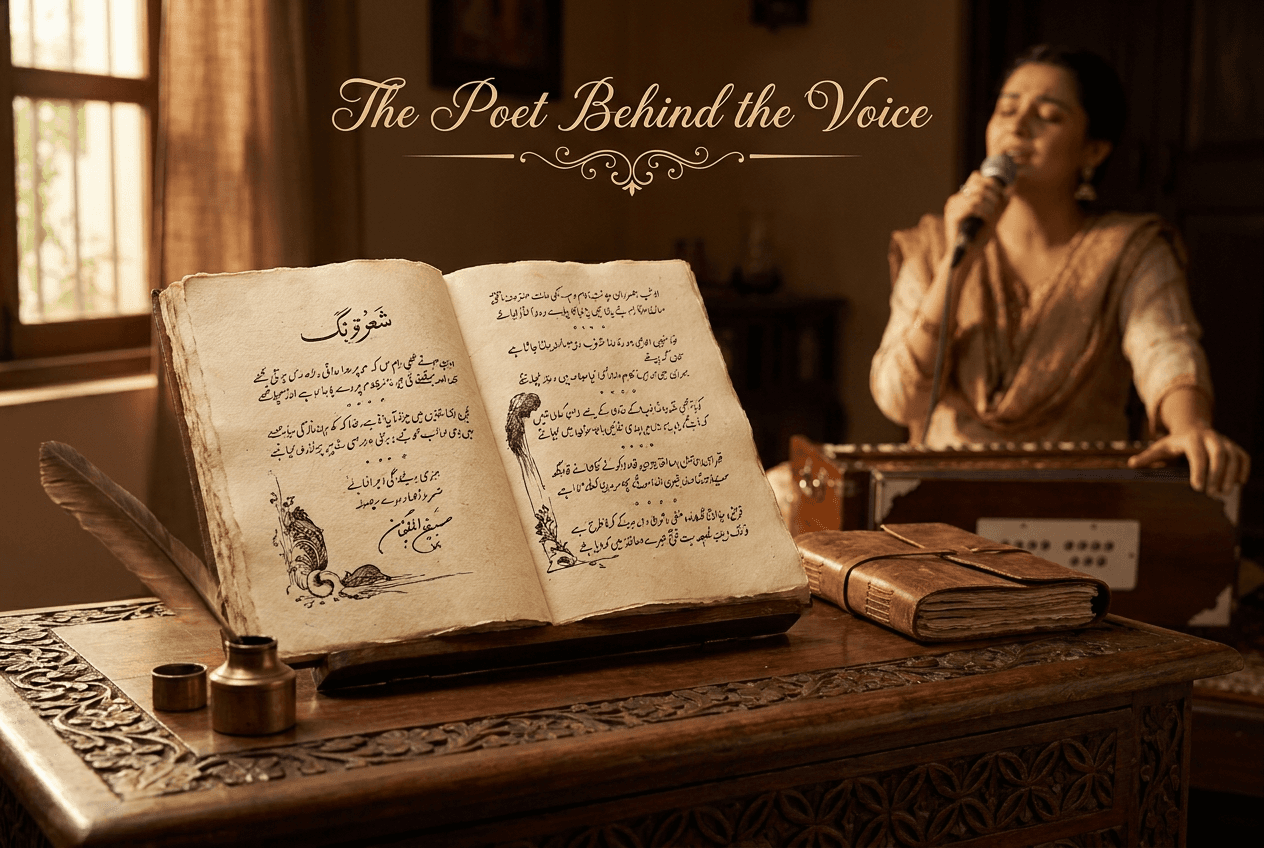 The ghazal singers are only half the story, and the other half determines whether a ghazal is worth setting at all.
The other half of the form, and the half that determines whether a ghazal is worth setting at all.
Mirza Ghalib is the towering figure, writing in the nineteenth century with a density and philosophical difficulty that continues to generate commentary. His work is set constantly and is not the easiest place to begin, since the imagery is compressed and frequently requires unpacking.
Mir Taqi Mir preceded him and is regarded by many as his equal or superior, writing with greater simplicity and directness. Faiz Ahmed Faiz brought political and social weight into the form in the twentieth century, and his work carries a resonance beyond the romantic register. Momin, Daagh, Firaq Gorakhpuri, Jaun Elia and Ahmed Faraz all supplied substantial material to the singers.
The practical point for a listener is that the poet matters as much as the singer. The same ghazal set by different singers is recognisably the same poem, and a listener who follows a poet across several settings learns more than one who follows a singer across several poets.
The Essential Listening
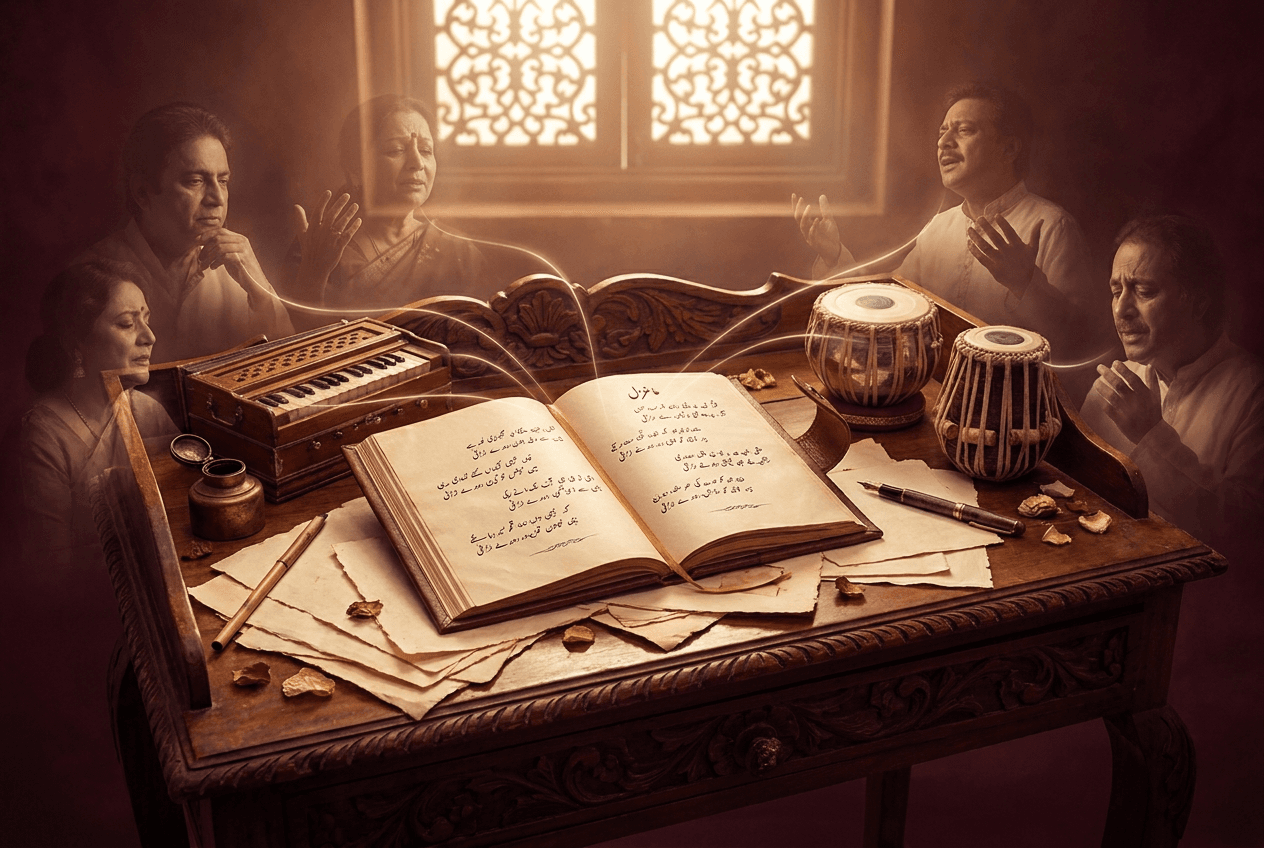 A short list of essential recordings by the major ghazal singers, chosen for range rather than for popularity.
Begum Akhtar performing a ghazal live, to hear the form before it was popularised. Mehdi Hassan on a slow ghazal, to hear technical command at its highest. Farida Khanum on something unhurried, to hear how much a singer can do by doing very little. Jagjit Singh on his best known material, to hear why the form reached a mass audience. And Ghulam Ali on something elaborate, to hear the ornamented extreme.
Five recordings, one from each, will give you a clearer picture of what this form contains than any number of compilations. Compilations tend to select for accessibility and produce a misleading impression of uniformity.
Listening Without Urdu
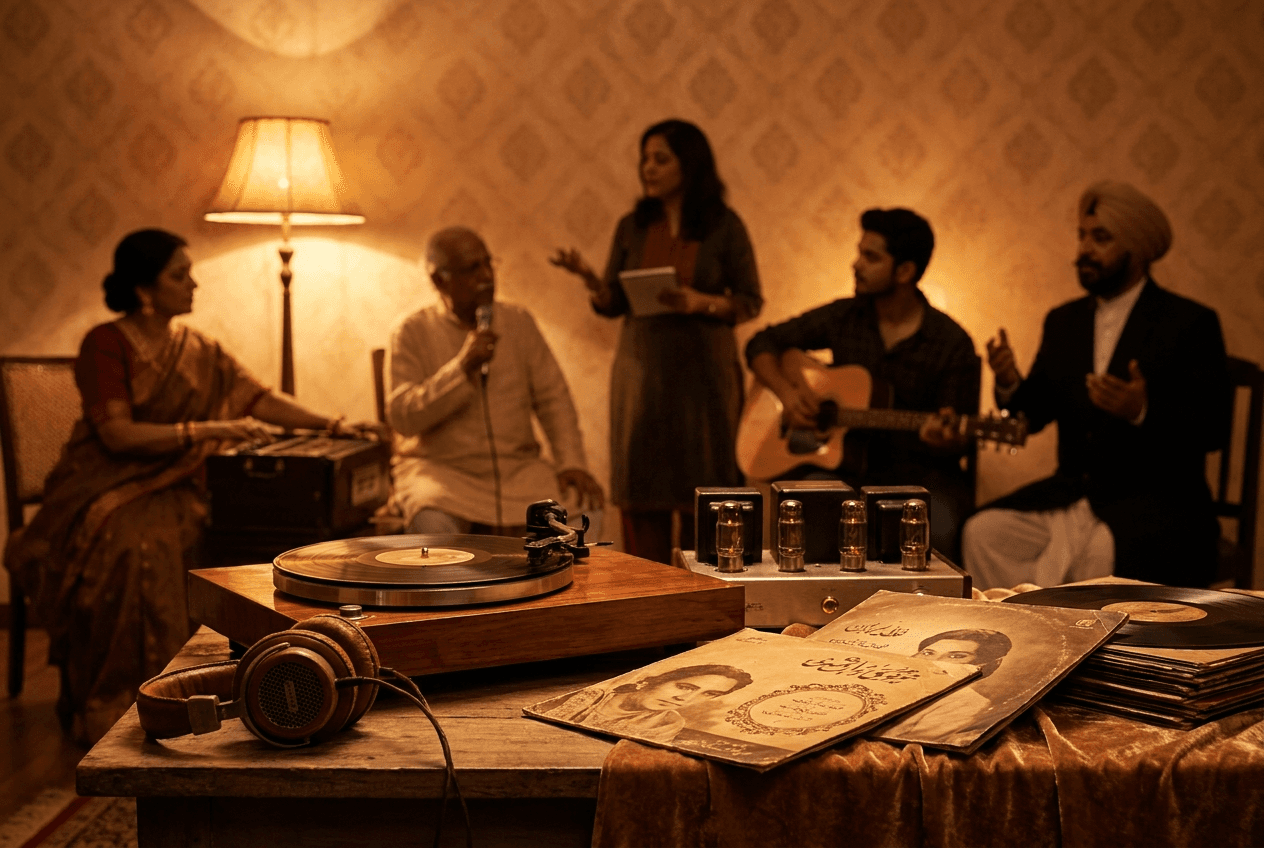 Not reading Urdu is the obstacle most people cite when approaching the ghazal singers, and it is smaller than it appears.
You already understand more than you think
Hindi and Urdu share a spoken vocabulary substantially, and a Hindi speaker will follow a considerable proportion of most ghazals without study. What causes difficulty is the specialised poetic vocabulary, which is drawn from Persian and Arabic and which recurs constantly, meaning a small amount of learning goes a long way.
Learn thirty words
The single most effective step. The core vocabulary of this poetry is smaller than it seems, since the same concepts recur, and thirty or forty words covering the beloved, separation, the heart, wine, the tavern, faith and fate will unlock a large share of the repertoire. This is an evening's work with a translation and it transforms the experience.
Read the translation once, then listen without it
Reading along while listening splits your attention and you hear neither properly. Read the poem first, understand it, then listen with the meaning already in your head. The words will surface as the singer delivers them and the effect is entirely different from following a subtitle.
Accept partial understanding
Even fluent listeners miss lines and unpack couplets afterwards. This poetry is dense deliberately and it is designed to be returned to. A listener who understands half of a ghazal and is moved by it has had the correct experience, not a diminished one.
Ghazal, Thumri and the Light Classical Family
 Worth clarifying, because the terms get used loosely and the distinction is genuine.
Ghazal is defined by its poetic form and is sung in a light classical style. Thumri is defined musically rather than poetically, being a semi-classical form built on romantic and devotional themes with considerable freedom to bend raga rules for expressive effect. Dadra is closely related to thumri and set in a particular rhythmic cycle.
What they share is the priority given to emotional expression over structural strictness, which distinguishes all of them from khayal, the principal classical vocal form. A khayal performance is governed by the raga throughout; a thumri or ghazal singer may depart from it when the words require. Several singers, Begum Akhtar among them, worked across all of these.
For a student, that shared quality is why this repertoire is such a useful bridge. It requires classical technique without requiring classical strictness, and the guide to Indian raga music explains the framework these forms operate inside.
Singing Ghazals
The section a music school should write, since this repertoire occupies an unusual position for a learner.
Why it suits an intermediate singer
The melodies sit in comfortable ranges, the tempos are slow, and the phrases are shaped around speech rather than around vocal display. None of that requires the range or power that film playback demands. What it does require is control, because there is nothing to hide behind.
What it actually demands
Tonal steadiness at low volume, since much of this singing happens quietly and every wobble is audible. Breath control for long unhurried phrases delivered without hurrying. Diction precise enough that Urdu words arrive intact, which matters more here than in any other repertoire because the words are the point. And interpretive judgement, meaning knowing which line to lean on and which to leave plain.
The trap
Over-ornamentation. A trained singer can decorate every phrase of a ghazal and it will be worse, because decoration competes with the words. The restraint that makes Farida Khanum and Mehdi Hassan compelling is a deliberate choice repeatedly made, not an absence of ability, and it is the hardest thing in this repertoire to learn.
Where to start
With a simple, slow ghazal from the Jagjit Singh repertoire rather than with Mehdi Hassan, since the melodic material is more contained and the phrasing more regular. Understand the poem completely before singing a note. And work on breath support before anything else, since the long unhurried lines are where untrained singers fail first. The guide to breathing techniques for singers covers that, and the guide to swar sadhana and vocal training sets out the foundation.
The Form Today
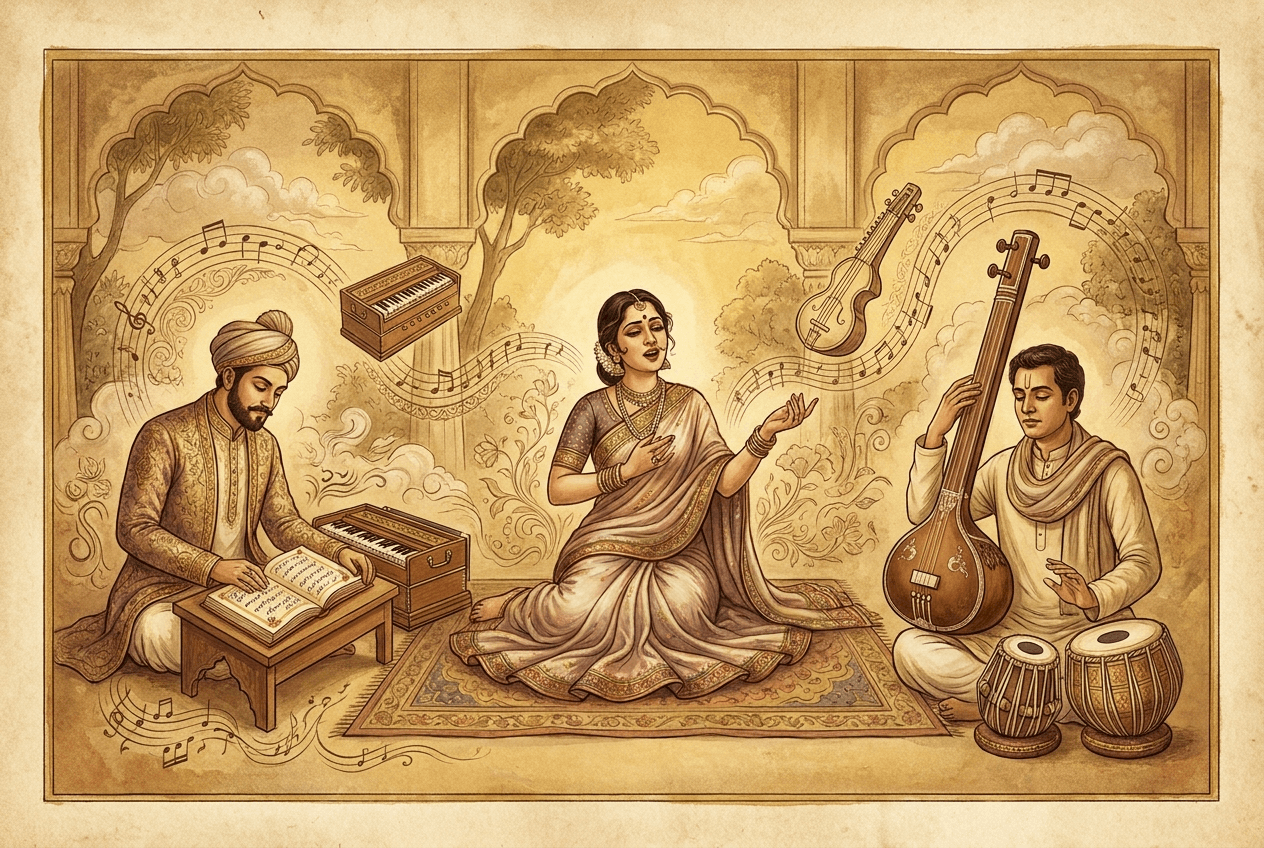 A fair assessment of where the ghazal singers stand today, since the picture is mixed.
Ghazal's commercial peak was the 1970s and 1980s, when Jagjit Singh and his contemporaries reached mass audiences and the form was a genuine part of popular music. That has receded, and ghazal is now a specialist rather than a mainstream taste, with a smaller audience and fewer new recordings.
Against that, the form has not declined artistically and it retains a devoted following. Live ghazal concerts continue in India, Pakistan and across the diaspora, younger singers work in the tradition, and streaming has made the historical catalogue permanently available in a way it never was before. A listener today has easier access to Begum Akhtar and Mehdi Hassan than any previous generation.
The honest observation is that this is a form that rewards effort and does not compete for casual attention, and its audience will always be the people prepared to make that effort. That is not a decline so much as a return to what it was before the popular period.
For Listeners in Canada
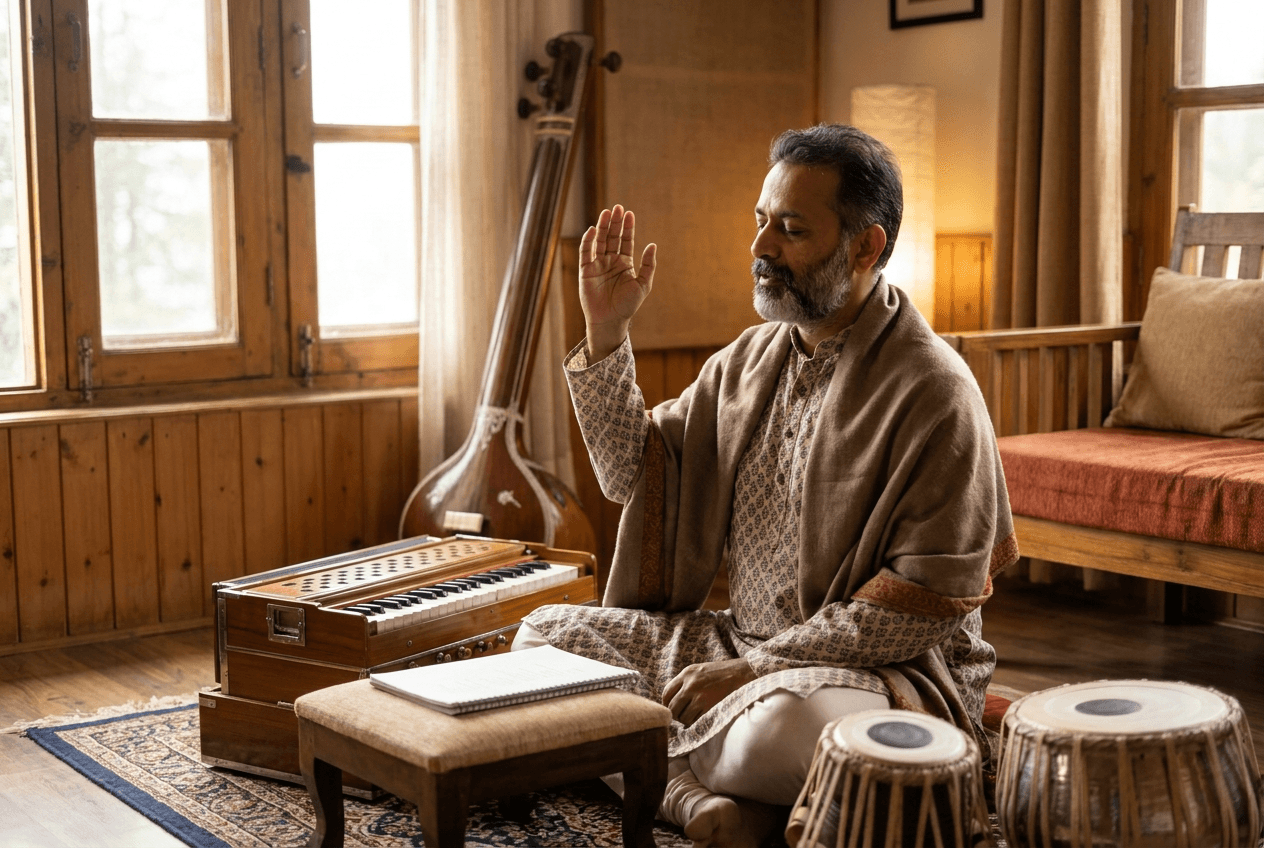 Two notes for readers here specifically.
Live ghazal performance happens more often in Canadian cities than most people realise, through cultural associations, community organisations and touring artists from India and Pakistan, and it is frequently promoted through community networks rather than mainstream listings. A ghazal in a room, with an audience responding audibly to individual couplets, is a substantially different experience from a recording, and it is where the form makes most sense.
For second-generation listeners, this repertoire is a genuine route into Urdu that formal study rarely provides, because the emotional content supplies motivation that a textbook does not. Several people describe learning to read Nastaliq script specifically in order to read ghazals properly, which is a considerable undertaking driven entirely by wanting to understand a poem. It is also, incidentally, one of the more accessible routes into Indian classical singing, since the technical demands are lower than khayal while the vocabulary is the same.
The Accompaniment
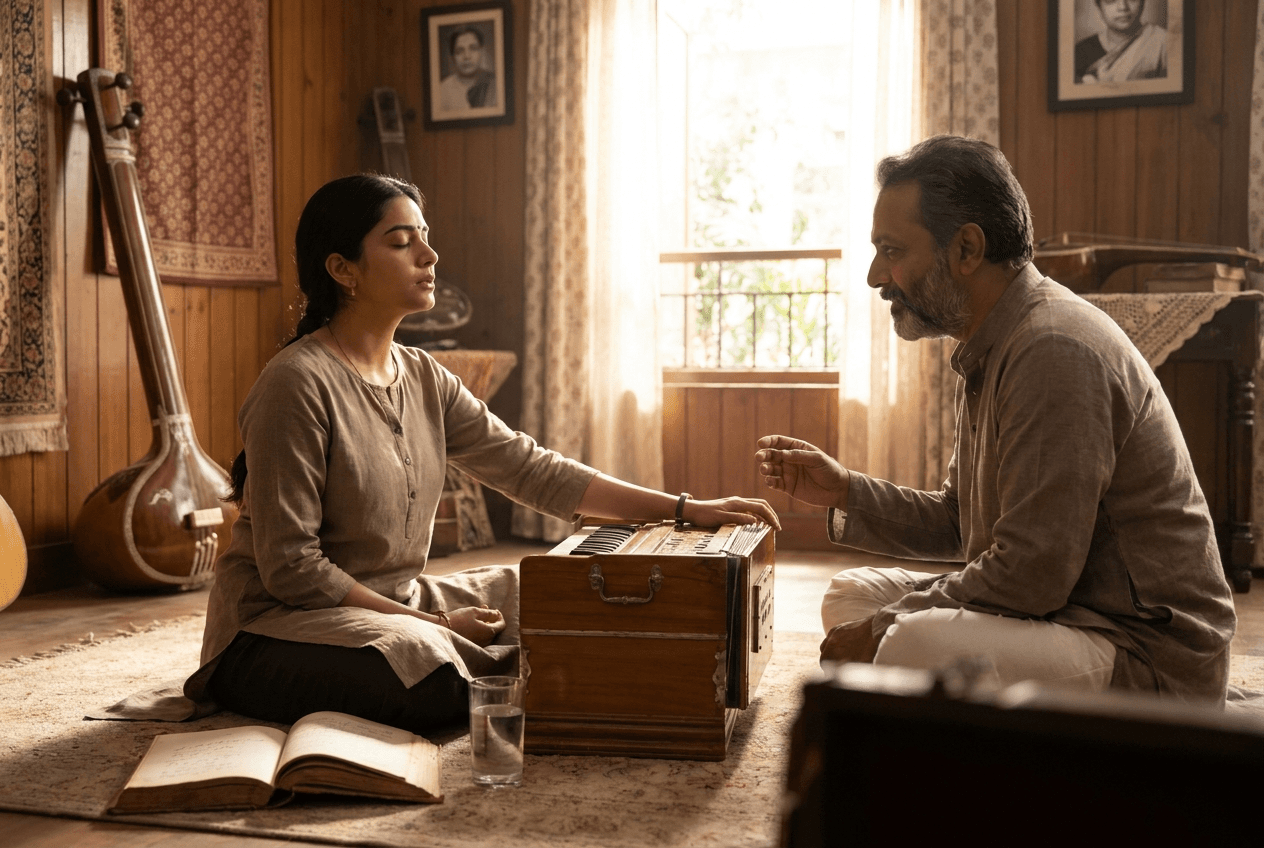 Small, deliberate and worth understanding, because the sparseness is a choice rather than a limitation.
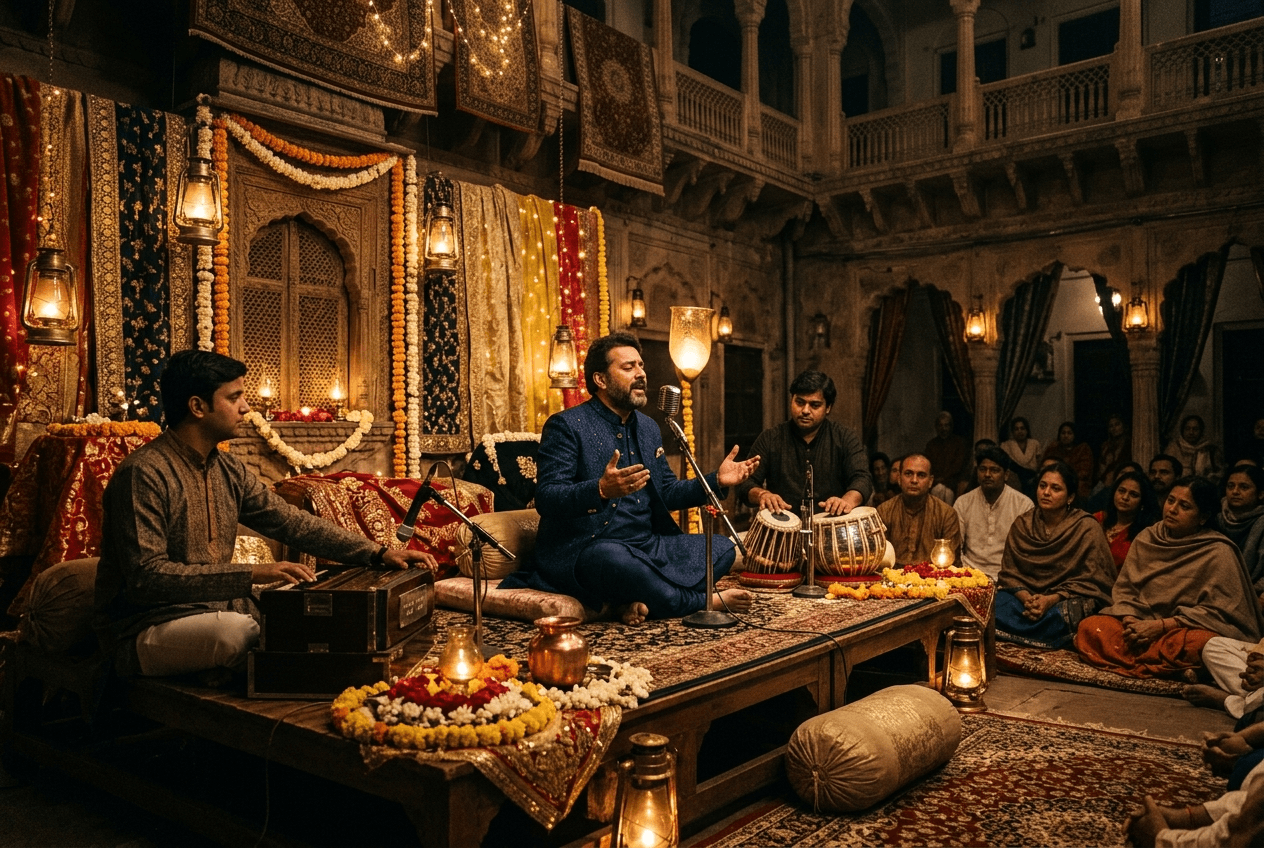
A traditional ghazal ensemble is minimal: harmonium supporting the voice and providing a pitch reference, tabla holding a light rhythmic cycle, and sarangi shadowing the vocal line. The sarangi in particular does something specific, following the voice closely enough that it functions almost as an echo, which is why the older recordings have a quality later ensembles rarely match.
Small, deliberate and worth understanding, because the sparseness is a choice rather than a limitation.
A traditional ghazal ensemble is minimal: harmonium supporting the voice and providing a pitch reference, tabla holding a light rhythmic cycle, and sarangi shadowing the vocal line. The sarangi in particular does something specific, following the voice closely enough that it functions almost as an echo, which is why the older recordings have a quality later ensembles rarely match.
Jagjit Singh changed this substantially, bringing in guitar, bass and Western string arrangements, and the debate about that is the central argument in modern ghazal. The traditional case is that added instrumentation competes with the words. The counter-case is that it made the form audible to people who would never have approached the older recordings.
What both sides agree on is that the arrangement should stay out of the way. Even the most produced ghazal recordings leave the voice unobstructed, because the moment a listener is following an arrangement rather than a couplet, the form has failed at the thing it exists to do. The instruments involved are covered in the guide to Indian classical music instruments.
Ghazal in Film Music
 A substantial overlap that most listeners encounter before they encounter ghazal proper.
Hindi cinema used ghazal extensively, particularly through the 1950s and 1960s, and several film songs widely loved as songs are ghazals in form. Madan Mohan in particular composed film material with a ghazal sensibility, and Talat Mahmood brought the delivery directly into playback singing.
The film versions are shorter, since a film song runs three or four minutes while a concert ghazal may run fifteen, and they typically present fewer couplets with less improvisation. That makes them a reasonable introduction and an incomplete picture, since the repetition and elaboration that a concert performance permits is a large part of the form.
For a listener who knows the film material and wants to go further, the natural step is a live concert recording by any of the major singers, where the same kind of poetry is given room to unfold. The difference is immediate and it is usually what converts a casual listener into a serious one.
How to Attend a Ghazal Concert
Worth knowing if you have never been, since the conventions differ from a Western concert and a first-timer can feel unsure what is expected.
Responding out loud is expected
When a couplet lands, the audience says so, and this is not an interruption but part of the form. A murmur of appreciation, a called-out word, a raised hand are all normal. Silence throughout is not respectful in this setting; it suggests nothing has landed.
The singer will repeat things
A line delivered once, then again differently, then a third time with another emphasis. This is not padding. Each repetition is a different reading of the same couplet, and the audience response frequently determines whether a line gets repeated at all.
It will be long and unstructured
A concert may run considerably beyond its billed length, the running order is frequently decided as it goes, and requests from the audience are common. Arriving expecting a fixed programme delivered to time is the wrong expectation.
You do not need to understand everything
Fluent listeners miss lines too. The experience of being moved by a couplet you only partly followed is entirely normal and is a large part of how people come into this music.
Recording Quality and Where to Listen
A practical note, since audio quality matters here more than in most repertoires.
Much of the great ghazal singing was recorded live rather than in studios, and the recordings vary enormously in quality. A poor transfer of a live concert removes exactly what makes it worth hearing, since the restraint and the low-volume control that define good ghazal singing disappear in a noisy recording.
Where official remasters exist, they are usually worth seeking out. Where they do not, live recordings frequently beat studio ones for this form, because the audience response and the singer's freedom to elaborate are part of the performance rather than incidental to it.
Ghazal in the Diaspora
The form travelled with migration and it occupies a particular place in South Asian communities abroad.
For a generation who left India and Pakistan in the decades after Partition, ghazal carried something specific, being a shared cultural inheritance that predated and transcended the border. A Punjabi Hindu family in Toronto and a Punjabi Muslim family in Vancouver frequently love the same singers and the same poems, which is not true of much else in the cultural landscape.
That shared quality is why ghazal concerts in diaspora cities draw audiences across communities that do not otherwise gather, and why touring singers from both countries perform to mixed audiences without anyone finding it remarkable. The music simply predates the politics.
For younger listeners raised abroad, the form frequently arrives late, since it demands more than film music and offers less immediately. Those who find it tend to find it through a specific poem or a specific singer rather than through a general interest, which is worth knowing if you are trying to introduce someone to it. One couplet that lands does more than any amount of context.
One further practical point. If you are trying to develop a taste for this form and finding it hard going, the most reliable fix is to stop treating it as background music. Ghazal genuinely does not work while you are doing something else, because the entire form depends on individual couplets landing, and a couplet cannot land on divided attention.
And a note for anyone who has tried and bounced off. The commonest reason is starting with Mehdi Hassan or Ghalib, both of which are the deep end. Begin with a Jagjit Singh recording of an accessible poem, understand the words first, and work backwards from there. Nobody arrives at this form through the hardest material.
Frequently Asked Questions
Who are the best ghazal singers?
Begum Akhtar is the foundational voice and the standard reference. Mehdi Hassan is most often named by musicians as the finest technician the form has produced. Jagjit Singh brought it to a mass audience, Ghulam Ali represents the most ornate delivery, and Farida Khanum the most unhurried. Talat Mahmood, Chitra Singh, Pankaj Udhas and Hariharan are also significant.
What makes a ghazal different from a song?
A ghazal is a poetic form of independent couplets, each complete in itself, unified by a shared rhyme and repeated refrain rather than by a narrative. It does not build to a resolution. Musically it is set in a light classical style where the singer serves the poetry and may repeat lines for emphasis, which is why ghazal singing sounds restrained.
What are the most famous ghazals?
The best known settings come from the repertoires of Begum Akhtar, Mehdi Hassan, Jagjit Singh, Ghulam Ali and Farida Khanum, drawing on poetry by Ghalib, Mir, Faiz Ahmed Faiz, Momin and Ahmed Faraz among others. The same poem set by different singers produces recognisably different pieces, so the poet matters as much as the performer.
Do I need to understand Urdu to enjoy ghazals?
Less than you would think. Hindi and Urdu share spoken vocabulary substantially, and the specialised poetic vocabulary is small and recurring, so learning thirty or forty core words unlocks a large share of the repertoire. Read a translation once beforehand rather than following along while listening.
What is the difference between ghazal and thumri?
Ghazal is defined by its poetic form and set in a light classical style. Thumri is defined musically, being a semi-classical form on romantic and devotional themes with freedom to bend raga rules for expressive effect. Both prioritise emotional expression over structural strictness, which separates them from khayal.
Are ghazal singers classically trained?
The significant ones generally were. Mehdi Hassan, Begum Akhtar, Ghulam Ali and Hariharan all had substantial classical grounding, and the light classical style the form uses assumes it. What distinguishes ghazal singing is the restraint applied to that training rather than its absence.
Why do ghazal singers repeat lines?
Because each couplet is a complete thought and repetition lets a singer present it differently, emphasising a different word or shading it another way. It also gives the audience time to absorb a line, and audiences traditionally respond audibly when a couplet lands, which is part of the performance.
Is ghazal Indian or Pakistani?
Both, and the form predates the border. A substantial share of the greatest ghazal singing came from Pakistan, including Mehdi Hassan, Ghulam Ali and Farida Khanum, while Begum Akhtar, Jagjit Singh and others worked in India. The tradition is shared and the poetry belongs to neither exclusively.
Can beginners learn to sing ghazals?
It suits an intermediate singer better than a complete beginner. The ranges are comfortable and the tempos slow, so it does not demand the power film playback does. It does demand tonal steadiness at low volume, breath control for long phrases and precise Urdu diction, none of which can be hidden.
Is ghazal still popular today?
Less commercially than in its 1970s and 1980s peak, when Jagjit Singh and his contemporaries reached mass audiences. It remains artistically undiminished with a devoted following, live performance continues across India, Pakistan and the diaspora, and streaming has made the historical catalogue more accessible than it has ever been.
Final Thoughts
The reason the great ghazal singers sound so restrained is that they are not the point. The poem is, and their skill lies in delivering a couplet so that it lands rather than in demonstrating what their voice can do. That is an unusual relationship between performer and material and it is why the form rewards a listener who slows down.
Start with five recordings, one each from Begum Akhtar, Mehdi Hassan, Farida Khanum, Jagjit Singh and Ghulam Ali. Read one poem properly before you hear it sung. And if you get the chance to hear a ghazal live, take it, because the audience responding to a couplet is half of what this form is. Art Gharana teaches Hindustani vocals and light classical forms live and one-to-one, with a free first class.