ChatGPT
 Google AI
 Grok
 Claude

Picture a shallow trapezoid box strung with around a hundred strings, played not by plucking or bowing but by striking, with two feather-light wooden mallets held between the fingers. That is the santoor, one of the most visually and sonically distinctive instruments in Hindustani classical music, and one of the very few that travelled from folk accompaniment to full concert-stage legitimacy within living memory rather than across centuries.
Its sound is unmistakable. Where a sitar sings and a sarod growls, the santoor shimmers. Each strike rings, decays, and overlaps with the one before it, producing a wash of sustained sound that listeners often describe as water, or rain, or light on snow. That overlapping resonance is also the instrument's central technical problem, because a note that cannot be bent cannot easily perform the sliding ornamentation that defines raga music. Solving that problem is the whole story of how this instrument became classical.
This guide covers the full picture: where the instrument came from, exactly how it is built, how many strings it really has and why the number varies, how it is actually played, the Shivkumar Sharma story that changed everything, how it compares to its Persian and European and Chinese cousins, what a beginner should expect, what to look for when buying one, and how to care for it in a cold, dry Canadian winter. If you are still mapping the wider landscape of Indian classical music instruments, this is the one that sits furthest from everything else.
What Is a Santoor?
A **santoor** is a hammered box zither from Kashmir, built as a hollow trapezoid soundbox strung with roughly 72 to 100 metal strings that are grouped into courses of three or four strings per note. The player strikes these courses with a pair of curved lightweight wooden mallets called mezrab, producing a bright, bell-like tone with long natural sustain. It is used in Hindustani classical music, Kashmiri Sufiana Mausiqi, and film scores.In instrument classification terms it is a chordophone, and more specifically a struck box zither. That places it in the same broad family as the piano, which is also a struck-string instrument, and in a different family altogether from the plucked sitar and sarod or the bowed sarangi and violin. The distinction matters more than it sounds, because striking a string sets the terms for everything the player can and cannot do with the note afterwards.
Here is the instrument at a glance before we go deeper.
Attribute Detail Instrument family Chordophone, struck box zither, hammered dulcimer family Origin region Kashmir valley, with Persian and Central Asian ancestry Typical string count 72 to 100 strings, arranged in courses of 3 or 4 Typical bridge count 25 to 31 bridges, arranged in two rows Body shape Shallow trapezoid, wider at the player's near edge Common woods Walnut, maple, sometimes tun or mahogany for student models Played with Two curved wooden mallets called mezrab Playing position Seated cross-legged, instrument flat on the lap or on a low stand Primary genres Hindustani classical, Sufiana Mausiqi, film and fusion music Landmark musician Pandit Shivkumar Sharma, who established it as a solo classical instrument
The History of the Santoor: From Sufi Shrines to the Concert Stage
Persian and Central Asian roots
The instrument's lineage runs through Persia, where the santur has existed in recognisable form for many centuries, and through the broader trade and pilgrimage corridors that connected Central Asia to the Kashmir valley. Hammered box zithers appear across a remarkably wide geographic band, from the Iranian santur to the Iraqi santur, the Greek santouri, the Hungarian cimbalom, the German hackbrett, the Chinese yangqin, and the Appalachian hammered dulcimer. They are almost certainly related, spread along trade routes rather than invented independently in a dozen places.
Kashmiri tradition also connects the instrument to an older Sanskrit reference, the shata tantri veena, literally the hundred-stringed veena. Whether that text describes the same instrument or a different one that shared a string count is genuinely debated among scholars, and honest sources present it as tradition rather than settled fact. What is not debated is that by the time written Kashmiri musical records become detailed, the instrument was firmly embedded in the valley's own art music.
Sufiana Mausiqi and the folk role
For most of its documented life in Kashmir, the instrument served Sufiana Mausiqi, the classical Sufi music tradition of the valley. In that setting it was an ensemble instrument, not a solo voice. It accompanied singers, played alongside the saz-e-Kashmir and the Kashmiri rabab, and followed the maqam system used in Sufiana rather than the raga system used in the rest of Hindustani music. Its tuning was fixed to the requirements of the ensemble, its role was supportive, and it stayed almost entirely within Kashmir.
This is the crucial point that thin online summaries usually miss. The instrument was not a suppressed classical instrument waiting to be discovered. It was a working folk and devotional ensemble instrument, structurally unsuited to Hindustani solo performance, and its promotion into the classical world required physical redesign, not just advocacy.
The twentieth century turn
The pivot came through Uma Dutt Sharma, a Jammu-based vocalist and musicologist who studied the instrument and concluded it could carry a full raga performance if it were rebuilt for the job. Rather than attempt the transition himself, he trained his son on it from childhood with that explicit goal. The son was Shivkumar Sharma, and the redesign and repertoire he developed over the following decades is the reason the instrument now appears on classical concert stages from Mumbai to Toronto. That story deserves its own section, and it gets one below.
How a Santoor Is Built: Anatomy of a Hundred Strings
The construction is simpler than the string count suggests. A shallow hollow box, a set of small bridges standing on the soundboard, a great many strings running across those bridges, and a bank of tuning pins along one edge. Everything else is refinement.The soundbox
The body is a trapezoid, typically somewhere around 70 to 90 centimetres along the wider edge nearest the player and considerably narrower along the far edge, with a depth of only a few centimetres. Walnut is the traditional and preferred wood in Kashmir, prized for both its acoustic properties and its workability under carving. The top plate, or soundboard, is the acoustically critical piece, and it carries one or more sound holes, often decorated with carved rosettes on higher-grade instruments.
The trapezoid shape is not decorative. Because the strings run parallel to the two shorter edges, the taper automatically produces progressively shorter strings as you move away from the player, and shorter strings mean higher pitch. The geometry of the box is the pitch layout.
Bridges and courses
Small wooden bridges, usually shaped like flattened cylinders or barrels and often capped with a metal or bone insert, stand in two rows on the soundboard. Each bridge carries one course of strings, and a course is a group of three or four strings tuned in unison and struck together as if they were one. This unison grouping is what produces the instrument's characteristic chorus effect, the slight beating between not quite identical strings that gives the tone its shimmer.
Bridges are not glued down. They sit under string tension alone, which means they can be nudged along the soundboard to fine-tune intonation, and it also means a knocked instrument can lose its setup entirely. Every player learns early to carry the instrument level.
Strings, pins, and the tuning hammer
The strings are steel, thinner in the treble and thicker in the bass, sometimes wound in the lowest courses. They are anchored on hitch pins along one side and wound onto square-headed tuning pins along the other, which are turned with a small tuning hammer rather than by hand. Tuning is done course by course, string by string within the course, which is exactly as slow as it sounds and is the single largest time commitment in owning one.
The mezrab
The mallets are the part most people underestimate. Each mezrab is a slender curved strip of wood, light enough to sit almost weightlessly between the index and middle fingers, with a slight upturn at the striking end. Some are left bare for maximum brightness and some are padded at the tip with felt, cotton, or leather for a warmer, rounder attack. Players often own several pairs and switch depending on the piece, the hall, and whether they are amplified.
Taken together, the parts divide cleanly by function. The walnut or maple soundbox and its thin top plate do the amplifying, with the sound holes releasing the air movement inside. The bridges, capped with bone or metal, set the speaking length of each course and are the only thing determining which note it produces. The steel strings, plain in the treble and wound in the bass, are anchored on hitch pins at one end and wound onto square-headed tuning pins at the other. And the two light curved mezrab, sometimes felted at the tip, are the only things that ever touch the strings in performance. The tuning hammer belongs on that list too, because unlike an accessory on most instruments it is used at almost every practice session.
How Many Strings Does a Santoor Have?
Most concert **santoor** instruments carry somewhere between 72 and 100 strings, and the popular description of it as the hundred-stringed instrument is a round-number tradition rather than a fixed specification. The number varies because what is actually standardised is the bridge count, not the string count.The arithmetic is straightforward. If an instrument has 25 bridges and each bridge carries a course of four strings, that is 100 strings. If it has 29 bridges with three strings each, that is 87. If it has 31 bridges carrying a mix of three-string and four-string courses, the total lands somewhere in between. Kashmiri Sufiana instruments and modern classical instruments differ here, and individual makers differ from each other, so a straight answer of one specific number would be wrong.
What matters musically is the note count, not the string count. Each course is one note. An instrument with 29 bridges gives the player 29 available pitches, and since a raga performance needs roughly three octaves of usable range with the correct swaras of that raga tuned in, the working question for any player is always which notes are tuned where, not how many pieces of wire are on the box. If the relationship between fixed pitches and raga structure is unfamiliar territory, the swaras of Hindustani music are the necessary starting point, because on this instrument the tuning decision comes before the first note is played.
That last point deserves emphasis, because it is the hardest structural fact about the instrument. A sitar player retunes a few strings between ragas. A santoor player may need to retune a significant portion of the instrument, because every note of the chosen raga must physically exist on a bridge before the performance starts. Notes outside the raga are either retuned in or simply unavailable.
How the Santoor Is Played: Technique Explained
Watch a performance and the hands look almost lazy, two small mallets bouncing across the soundboard with very little visible effort. That impression is correct and it is the point. Force does nothing useful on this instrument. The mallet is light, the string is under high tension, and the note is produced by a controlled rebound rather than a hit.
The grip
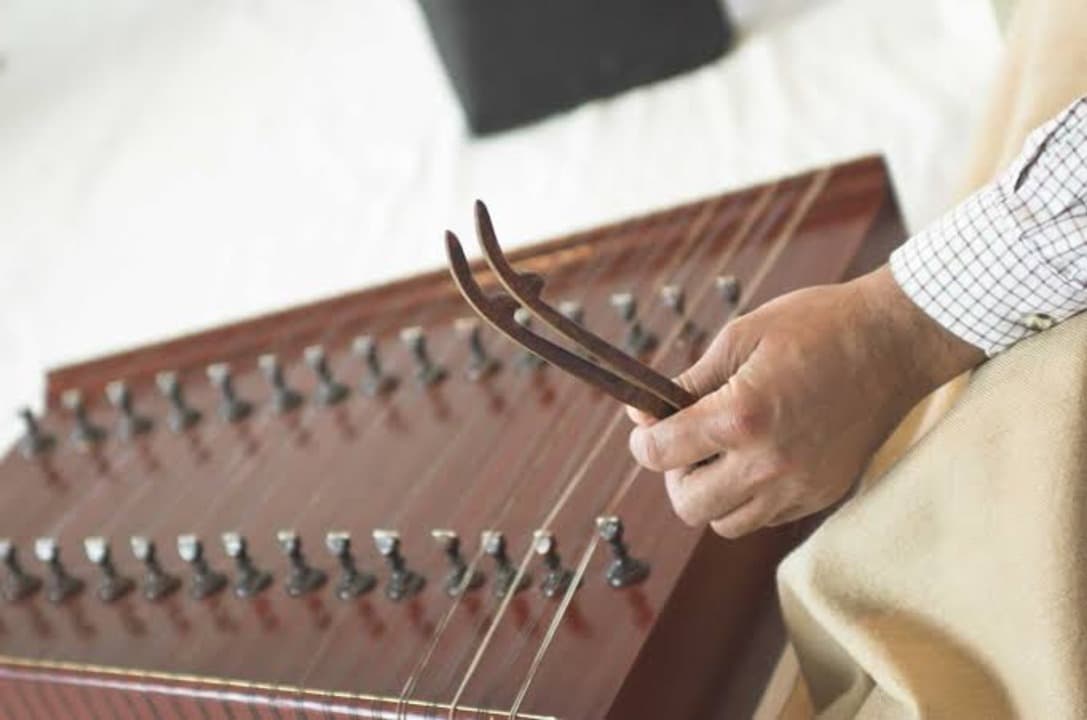 Each mezrab rests between the index and middle fingers, held loosely near the balance point, with the thumb providing light stability rather than a clamp. The wrist does most of the work and the fingers do the fine control. A tight grip kills the rebound, deadens the tone, and produces hand fatigue within minutes, which is why beginners are usually corrected on grip long before they are corrected on notes.
The stroke and hand alternation
Strokes alternate between the hands as a default, left and right in continuous succession, which allows fast passages without either hand having to move far. Because each course sits on its own bridge, and because bridges alternate between two rows, the playing surface is effectively two staggered keyboards. Learning where a given note lives, and which hand should take it, is the real fingering study on this instrument, and it is closer to learning a keyboard layout than to learning a fretboard.
Damping, the skill that separates levels
Every struck course on a santoor rings for a long time. Play a fast phrase without damping and the notes pile into a blur. Skilled players therefore damp constantly, usually with the heel of the palm or the side of the hand landing on courses that need to be silenced while the other hand plays the next note. Damping is largely invisible to an audience, it is never notated, and it is the single clearest technical difference between an intermediate player and a mature one.
The meend problem and how it is solved
Hindustani music is built on meend, the sliding glide between notes, plus gamak and kan and the whole vocabulary of ornaments that depend on continuously bending pitch. A struck string with a fixed bridge cannot bend. This is the structural objection that kept the instrument out of classical performance for so long, and it is not a small one.
Players work around it in several ways. Rapid repeated strokes on adjacent courses simulate a glide by filling the space between two notes with a dense run. Pressing a string behind the bridge with the free hand raises its pitch slightly, allowing a limited genuine bend. Modern instruments are built with enough bridges that microtonal neighbours are physically available to be struck in sequence. And the repertoire itself adapted, leaning into what the instrument does beautifully, which is shimmering sustain, rhythmic clarity, and rapid clean passagework, rather than forcing it to imitate a voice.
Rhythm and the tabla relationship
Because the attack is so clean and the decay so long, the instrument is unusually exposed rhythmically. There is nowhere to hide a late stroke. Serious practice therefore runs against a fixed pulse from the beginning, whether from a metronome in early stages or a live accompanist later. Understanding what the accompanist is doing helps enormously too, since the interplay in a concert jugalbandi is a conversation rather than a backing track, and a working grasp of how tabla is played makes a santoor student a far better ensemble partner.
A drone is equally non-negotiable. Every practice session sits on a tanpura or a shruti box, partly for raga context and partly because the drone is the reference against which the instrument's own tuning is checked.
Shivkumar Sharma: The Man Who Made the Santoor Classical
It is difficult to overstate how completely one musician changed this instrument's status. Before Shivkumar Sharma, it was a Kashmiri ensemble instrument. After him, it was a Hindustani solo concert instrument with a national and international audience. The transformation took roughly three decades and it was as much engineering as artistry.
The redesign
Sharma, trained from childhood by his father Uma Dutt Sharma specifically for this purpose, made a series of physical modifications to make full raga performance possible. He increased the number of bridges and therefore the number of available notes, extending the usable range to around three octaves. He revised the tuning layout so that a raga's swaras could be arranged logically for the hands rather than following the Sufiana ensemble order. He adjusted body proportions and string gauges for better sustain and projection in a concert hall. And he changed the playing posture, sitting cross-legged with the instrument on the lap, which gave the arms a stable geometry for the fast alternating strokes that solo repertoire demands.
The resistance
The classical establishment did not welcome any of this immediately. The instrument was widely considered incapable of meend and therefore incapable of serious raga exposition, and early performances in the 1950s met open scepticism. The counterargument was made in public, one concert at a time, by demonstrating a full alap, jod, and jhala structure on the instrument until the objection became difficult to sustain.
Call of the Valley and the wider audience
The 1967 album Call of the Valley, made with flautist Hariprasad Chaurasia and guitarist Brij Bhushan Kabra, took the sound far beyond the classical circuit. Structured loosely around a day in the life of a Kashmiri shepherd, it became one of the most widely heard Indian instrumental records ever released and introduced the instrument to listeners who had never attended a classical concert. Sharma and Chaurasia later composed together for Hindi cinema as the duo Shiv-Hari, on films including Silsila, Chandni, and Lamhe, which put the sound into the ears of a mass audience across the subcontinent and the diaspora.
His son Rahul Sharma continues the lineage as a performer and composer, and a generation of players now works in styles Sharma himself never attempted. That is usually the sign that an instrument has genuinely arrived: the tradition is no longer dependent on the person who built it.
Santoor vs Santur vs Hammered Dulcimer vs Yangqin
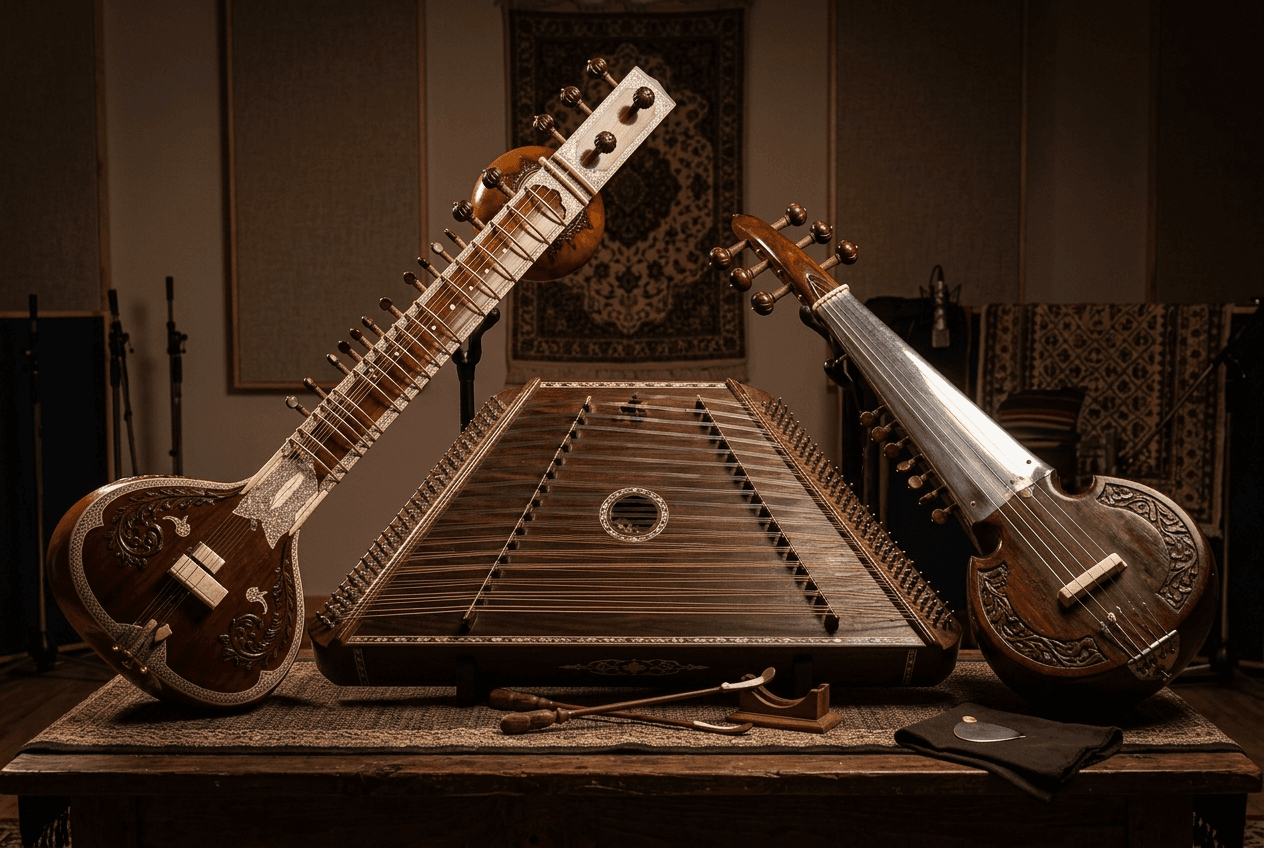 Because hammered zithers are spread so widely, comparisons are constant and usually muddled. The instruments are relatives, not the same instrument under different spellings, and the differences are musical rather than cosmetic.
The one difference worth internalising is tuning philosophy. The santoor is retuned to suit each raga and the Persian santur is retuned to suit each dastgah, while the dulcimer and yangqin are set up as fixed-scale instruments that do not change between pieces. That single distinction explains why the Indian instrument demands a tuning hammer at every session and the others largely do not.
Santoor vs Sitar and Sarod: Why It Sounds So Different
Within Hindustani music itself the more useful comparison is against the plucked instruments that dominate the solo repertoire. Sitar and sarod are both plucked with a plectrum or a coconut-shell pick, both have long necks that allow the playing hand to slide along a string, and both therefore treat meend as native vocabulary. The sitar adds sympathetic strings that ring on their own, and the sarod's fretless metal fingerboard allows continuous glissando across an entire phrase.
The struck instrument gives up all of that and gains three things in exchange. It gains simultaneity, since two hands striking independently can produce genuinely layered textures. It gains speed in straight passagework, because alternating strokes across a fixed layout are mechanically fast. And it gains a decay envelope no plucked instrument matches, where each note continues ringing under the next several notes and builds a standing cloud of sound. Listeners describe that quality as water or rain for good reason, and it is why the instrument found such a natural home in film scoring.
Notable Santoor Players to Listen To
Listening is the fastest way to understand any instrument, and this one rewards it more than most because the differences between players are audible within seconds.
Pandit Shivkumar Sharma
The essential starting point, since he redesigned the instrument and established it as a classical solo voice. Begin with Call of the Valley, then any recorded Raga Pahadi or Raga Bhoopali for the full solo treatment.
Pandit Bhajan Sopori
Representative of the Sufiana Kashmiri lineage and the Sopori gharana, which is the tradition the instrument came from rather than the one it was adapted into. His solo Sufiana recordings and devotional compositions are the clearest surviving window onto that older role.
Rahul Sharma
Shivkumar Sharma's son, working across classical, fusion and film. Useful for hearing where the instrument has travelled since the generation that made it classical, and proof that the tradition is no longer dependent on one person.
Pandit Tarun Bhattacharya and Pandit Ulhas Bapat
Both known for technical innovations to the instrument's design and range, Bhattacharya for extending what the instrument can do at speed and Bapat for tuning modifications that widened the raga repertoire available on it. Live concert recordings, particularly fast jhala sections, show the difference most clearly.
Pandit Satish Vyas
A disciple of Shivkumar Sharma known for structured, unhurried alap. A good listen for anyone who wants to hear how a raga is built slowly on this instrument rather than how fast it can be played.
Is the Santoor Hard to Learn?
It is easy to start and difficult to master, and the reasons for both are unusually clear. What makes it approachable early is that the notes are already there. There are no frets to find, no finger pressure to calibrate, no bow angle to manage, and no embouchure to develop. Strike a course cleanly and a correct, in-tune note sounds. A student can produce a genuinely musical tone in the first session, which is not true of the sarangi, the sarod, or the bansuri.
What makes it hard is everything after that. Tuning is a real and recurring workload, and a beginner who cannot tune accurately cannot practise usefully. Damping has to be developed as a continuous background skill rather than learned once. The absence of easy meend means expressive raga phrasing has to be constructed rather than simply played, and that is an interpretive problem more than a mechanical one. And because the layout is a staggered two-row map rather than a linear string, orientation takes longer than new students expect.
A fair summary is that the instrument moves a student to pleasant-sounding quickly and to musically convincing slowly. Learners coming from piano usually adapt fastest, since the fixed-pitch layout and two-handed independence are familiar territory. Learners with any vocal training adapt best of all, because they already carry the raga phrasing in their ear and only need to solve how to render it.
How to Start Learning Santoor: A Beginner Roadmap
The sequence below reflects how most structured teaching actually unfolds. Timelines assume roughly four to five practice sessions a week of thirty to forty-five minutes each, which is a realistic target for an adult learner with a job or a school-age student with homework.
The first six weeks are entirely about the hands: grip, a relaxed rebound stroke, clean single notes, hand alternation and sitting posture. Overlapping with that, from roughly week four to week ten, comes orientation, meaning learning the bridge layout well enough to locate swaras confidently and play simple ascending and descending patterns without hunting for notes.
From the second month onward tuning becomes a skill in its own right, covering use of the tuning hammer, tuning a course against a drone, and learning to hear the beats between unison strings that indicate one is slightly off. Months three to six bring the first raga work, usually a single simple raga with slow alap phrases and damping introduced deliberately rather than picked up by accident. Rhythm work runs alongside from around month four, playing to a fixed pulse and then coordinating with a percussion track or a live accompanist.
Repertoire proper, meaning gat compositions, faster jhala passages and controlled damping under speed, generally occupies months nine to eighteen. Performance level, meaning full raga structure, independent tuning for any raga and genuinely expressive phrasing, is a second-year target and beyond for most students.
Two practical notes. First, learn to tune before you feel ready, because untuned practice actively trains a bad ear and it is the most common self-taught failure. Second, do not skip the drone. A tanpura app is acceptable and free, and practising without one on a fixed-pitch instrument builds the habit of playing notes rather than playing a raga.
Buying Your First Santoor: What to Look For
A santoor varies enormously in quality from maker to maker, and the differences are not obvious to a beginner in a photograph. The broad tiers below are indicative, and prices move with maker reputation, wood, and shipping, so treat them as orientation rather than quotes.
Student instruments sit at the entry level, with a lower bridge count, simpler woods and tuning stability that is often mediocre, though they are adequate for a first year. Intermediate instruments carry the full bridge count, better seasoned wood and stable tuning, and will comfortably see a student through several years of study. Professional instruments are walnut bodied with hand-fitted bridges, built to project in a concert hall, and are generally made to order by a named maker.
When assessing a specific instrument, check that every course holds its tuning for at least a few days rather than drifting overnight, since poor pins and unseasoned wood show up here first. Check that bridges sit flat and stable without rocking. Check the soundboard for cracks, especially around the sound holes and along the grain. Ask what the bridge count is rather than the string count, because that is the number that determines what you can play. Confirm that a tuning hammer, a spare set of strings, and a padded case are included, since replacing those separately from another country is tedious.
For a buyer in Canada there is one more consideration. Ordering from India is common and usually the best value, but insist on a hard case rather than a soft one, ask the seller to loosen string tension slightly for transit, and expect to retune completely on arrival. An instrument that sounds fine on unboxing after an intercontinental flight has usually been set up well.
Caring for a Santoor in a Cold, Dry Climate
This section matters more in Canada than in most places and almost nothing written online addresses it. Indoor heating through a Canadian winter can push relative humidity well below twenty percent, and a thin wooden soundboard under the tension of ninety-odd steel strings does not tolerate that gracefully. Cracked soundboards and shifted bridges are the usual outcome.
Keep the instrument in a room held somewhere around forty to fifty percent relative humidity, using a room humidifier through the heating season and a hygrometer to actually verify it rather than guessing. Store it in its case when not in use, since a closed case buffers humidity swings far better than open air. Never store it against an exterior wall, near a radiator, near a floor vent, or in front of a window in direct sun.
Let it acclimatise before playing after any move between temperatures, particularly bringing it in from a cold car, where an hour in the closed case prevents condensation forming on the strings. Wipe the strings down after each session, because skin oils and sweat corrode steel and dull the tone within months. Expect to tune every session and to retune more often in winter than in summer, since wood moves with humidity and the pitch follows it.
The Santoor in Film Music and Beyond
Its film career is substantial. The Shiv-Hari partnership put the instrument at the centre of major Hindi film scores through the 1980s and early 1990s, and its tone became shorthand in Indian cinema for tenderness, memory, and mountain landscape. Composers reached for it whenever a scene needed to feel like snow, longing, or recollection, and that association persists in film and advertising scoring today.
Outside film, the instrument turns up steadily in new age and ambient recordings, in fusion projects with jazz and electronic musicians, and in meditation and wellness music, where its long decay does much of the work without any additional processing. Some purists regard the wellness market as a dilution. A fairer reading is that it keeps commissions flowing to working players and keeps the sound in general circulation, and a very large number of students first heard the instrument in exactly one of these contexts.
Learning Santoor in Canada
Finding a local teacher for this specific instrument in Canada is genuinely difficult. Toronto, Brampton, Mississauga, Vancouver, Surrey, Calgary, Edmonton, Ottawa, and Montreal all support active Indian classical communities with strong vocal, tabla, and sitar teaching, but santoor specialists are thin on the ground even in the largest of them. A student in a smaller city is unlikely to find one at all.
Online instruction has effectively solved this. The instrument suits video lessons better than most, because the playing surface is flat, fully visible from a single overhead or front angle, and the teacher can see hand position, stroke quality, and damping clearly on camera. Fixed pitch also means intonation problems show up as tuning problems that a teacher can diagnose remotely without ambiguity. What live one-to-one instruction preserves that recorded courses cannot is the correction loop, and on this instrument the two things that most need correcting early, grip tension and damping, are precisely the things a student cannot self-diagnose.
Time zones are the practical constraint worth planning around, and most Canadian students settle into either an early-morning or a late-evening slot to line up with an India-based instructor.
Frequently Asked Questions About the Santoor
1. What is a santoor and how is it played?
It is a hammered box zither from Kashmir with a trapezoid body and roughly 72 to 100 strings grouped into courses. The player sits cross-legged with the instrument on the lap and strikes the courses with two light curved wooden mallets called mezrab, alternating hands and damping unwanted ringing with the palm.
2. How many strings does a santoor have?
Usually between 72 and 100. The exact number depends on how many bridges the instrument has and whether each course carries three or four strings. Bridge count, typically 25 to 31, is the more meaningful specification because each bridge represents one available note.
3. Who made the santoor famous?
Pandit Shivkumar Sharma. He redesigned the instrument for classical performance, developed the solo repertoire, and reached a mass audience through the 1967 album Call of the Valley and later through Hindi film scores composed with Hariprasad Chaurasia as the duo Shiv-Hari.
4. What is the difference between the santoor and the Persian santur?
They are related instruments with different musical systems. The Persian santur typically has around nine bridges in each of two rows and is tuned for the dastgah system, while the Indian instrument has far more bridges, a wider range, and is retuned for individual ragas. Mallet design, tone, and repertoire differ accordingly.
5. Is the santoor hard to learn for a complete beginner?
Producing a clean, in-tune note is easy in the first lesson because there are no frets, no bow, and no breath control. The difficulty comes later, in tuning the instrument accurately, in developing constant damping, and in shaping raga phrasing on an instrument that cannot bend pitch easily.
6. How long does it take to learn santoor?
With four to five sessions a week, most students play simple raga phrases within three to six months and reach a comfortable repertoire level around eighteen months. Performance-level command of full raga structure and independent tuning generally takes two years or more.
7. Can I learn santoor without knowing Hindustani classical music first?
Yes. Most students learn the raga framework alongside the instrument rather than before it. A basic grasp of swaras helps a great deal from the start, though, because tuning decisions on this instrument are made raga by raga.
8. Do I need to tune a santoor every time I play?
Effectively yes. Steel strings under tension drift, and with several dozen courses even small drift is audible. Most players check tuning at the start of every session, and more often in winter when indoor heating dries the wood and shifts the pitch.
9. What age is suitable to start learning santoor?
Around eight or nine is a common starting age, since the instrument requires the arm span to reach across the soundboard and enough patience for tuning. Adults start regularly and often progress quickly, particularly those with prior keyboard or vocal training.
10. How much does a santoor cost?
Student instruments sit at the entry level of the market, intermediate instruments considerably higher, and professional walnut instruments made to order by named Kashmiri or Mumbai makers higher again. Budget separately for a hard case, a tuning hammer, and a spare string set, and factor in international shipping if ordering from India.
11. Is santoor used only in classical music?
No. It appears widely in Hindi film scores, in fusion and ambient recordings, in Kashmiri Sufiana Mausiqi, and in meditation and wellness music, where its long natural sustain needs no additional processing.
Final Thoughts
Around a hundred strings, one family's multi-decade project to make an ensemble folk instrument speak the language of raga, and a sound genuinely unlike anything else in Hindustani music. The santoor is not the easiest instrument to keep in tune or the most forgiving to phrase on, but it is one of the very few that sounds beautiful from the first lesson and keeps deepening for years afterwards.
Start by listening. One Shivkumar Sharma recording this week is enough to tell you whether the sound is for you. When curiosity turns into intent, Art Gharana teaches Hindustani foundations and instrument study live and one-to-one, with scheduling built around Canadian time zones.