ChatGPT
 Google AI
 Grok
Grok Claude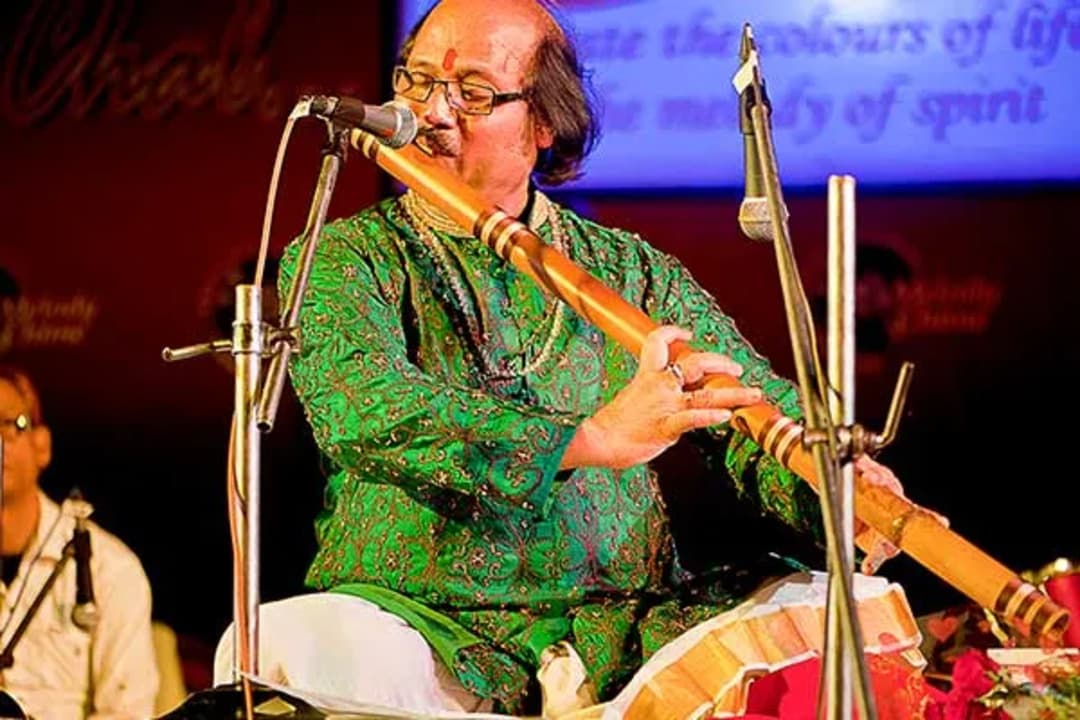
The bansuri is a bamboo tube with six or seven holes and nothing else. No keys, no mechanism, no way to correct a note once it is sounding. That an instrument this simple became capable of performing the full Hindustani classical repertoire is the achievement behind every name on this page, and it happened more recently than most people assume. The famous flute players of India did not inherit a classical instrument; they built one. For the wider family, the guide to Indian classical music instruments gives the context.
What follows covers how the flute became a classical instrument, the major players in both the Hindustani and Carnatic traditions, what makes the instrument technically distinctive, and what learning it actually involves.
Who Are the Most Famous Flute Players in India?
Among the **famous flute players** of the Hindustani tradition, Pandit Hariprasad Chaurasia is the most internationally known, with Pandit Pannalal Ghosh regarded as the figure who established the bansuri as a classical instrument. In the Carnatic tradition, T.R. Mahalingam, generally known as Mali, is the transformative figure, with Dr N. Ramani, T. Viswanathan and Shashank Subramanyam among the major names. Rakesh Chaurasia and Ronu Majumdar are prominent among later Hindustani players.The Major Players
How the Flute Became Classical
How the bansuri became classical is the part of the famous flute players story that most accounts skip, and it explains why the instrument sounds the way it does.
The starting problem
The bansuri had ancient standing in Indian culture, being associated with Krishna and appearing throughout mythology and folk music, and it was not a concert instrument. Folk flutes were short, pitched high, and suited to melody rather than to the extended slow development that Hindustani classical performance requires. An alap needs a low register and long sustained notes, and a small flute cannot produce either.
Pannalal Ghosh's solution
He lengthened the instrument substantially, which lowered its pitch and gave it the deep register that classical performance demands. That single change made the bansuri capable of an alap, and everything since follows from it. He also developed the technique and the repertoire, and established that a flautist could hold a full classical recital, which had not previously been assumed.
It is worth appreciating how recent this is. The bansuri is ancient and the concert bansuri is a twentieth century development, which puts it in a similar position to several Indian classical dance forms that were reconstructed or extended within living memory.
Hariprasad Chaurasia's expansion
He took the instrument to international audiences, collaborated extensively outside the classical tradition, and taught a generation of players. His performing career established the bansuri as a solo classical instrument in the public mind rather than only among specialists, and he is the reason most people outside India who can name an Indian flute player can name one at all.
Why the Instrument Is Difficult
The **famous flute players** all overcame the same obstacles, and they are worth explaining, because the bansuri looks simple and is among the harder classical instruments to learn.No keys means no help
Every pitch is produced by finger position and breath alone, with nothing marking where a note sits and nothing correcting you when you are wrong. Half-covering a hole produces an intermediate pitch, which is essential to the music and which means the margin for error is continuous rather than discrete. A beginner is out of tune constantly and has only their ear to tell them.
The embouchure
There is no reed, so the sound is produced entirely by directing an airstream across the edge of the blowing hole. Beginners spend weeks producing air rather than notes, and this is the point at which most people quit. The tone, once it arrives, continues improving for years.
Why the difficulty is the point
The keyless design is what makes the bansuri capable of Hindustani classical music. Meend, the continuous glide between notes, is the substance of the tradition rather than an ornament, and a keyed instrument producing discrete pitches cannot perform the repertoire properly. The flute's difficulty and its suitability are the same property. The framework is set out in the guide to Indian raga music.
One flute, one key
Because there are no keys, each bansuri plays in one key, and a professional carries a set of them in different lengths. That is a practical consideration for a student, since progressing eventually means owning several instruments rather than one.
The Carnatic Flute
The Carnatic famous flute players belong to a parallel tradition with its own instrument, technique and history, frequently collapsed into the Hindustani story and genuinely distinct.
The Carnatic flute, called venu or pullanguzhal, is generally shorter than the concert bansuri and held differently, and the playing technique differs substantially because the music does. Carnatic melody demands gamaka, oscillating ornaments applied to individual notes, executed with precision at speed, and producing those on a keyless flute is a formidable technical problem.
T.R. Mahalingam, known universally as Mali, is the transformative figure. He performed from childhood and developed an approach that brought the flute considerably closer to the human voice, which in a vocal tradition like Carnatic music is the highest standard available. Players since have worked in relation to what he established.
N. Ramani extended the technique and repertoire further and taught extensively. T. Viswanathan combined performance with scholarship and brought Carnatic flute to international academic attention. Shashank Subramanyam is among the leading contemporary players, having performed from a very young age. The tradition they work in is set out in the beginner guide to Carnatic music.
Bansuri and Western Flute Compared
A comparison worth drawing, since readers in Canada will know the Western instrument and may assume the two are versions of the same thing.
The Western concert flute is metal, has an elaborate key system developed to make every chromatic note accurately available, and produces discrete fixed pitches. The bansuri is bamboo, has six or seven open holes and no keys, and produces a continuous range of pitches through partial covering and breath control.
The consequence is that each instrument excels at what the other cannot do. The Western flute plays chromatic passages and modulates between keys with ease, which Western classical repertoire requires. The bansuri glides continuously between pitches and shades individual notes microtonally, which Indian classical repertoire requires. Neither is more advanced; they solved different problems.
A Western flautist picking up a bansuri finds the breath technique familiar and the intonation entirely unfamiliar, since nothing is marked and everything must be found. Most report it as humbling rather than easy.
Learning the Bansuri
### The first monthsTone production before anything musical. Weeks of producing air rather than notes is normal and is not a sign of unsuitability. The goal in that period is a note you can start cleanly, hold steadily and stop cleanly, and nothing else matters until that exists.
Practise with a drone from day one
The single most important habit on this instrument. With no keys and no frets, pitch accuracy depends entirely on the ear, and practising without a reference actively trains inaccuracy. A tanpura app or an electronic shruti box costs almost nothing and changes everything.
Sing before you play
Standard advice across Indian classical instruments and especially strong here, because the bansuri's entire purpose is to imitate the voice. A student who can sing a phrase accurately only has to solve how to produce it. A student who cannot is learning two things at once.
Buy properly
Bansuris are inexpensive relative to most instruments, which makes it easy to buy a poor one. Check that the instrument plays in tune across its range rather than only in the middle, that the tone is even, and that the bamboo is free of cracks. A beginner with a badly made flute will sound wrong regardless of technique and will assume the fault is theirs.
Expect it to be slow
This is not a quick instrument. A first clean note takes weeks, a simple recognisable phrase takes months, and playing something a listener would enjoy takes considerably longer than on guitar or keyboard. What it offers in return is an expressive range that few instruments match.
Learning in Canada
Practical notes for readers here.
Bansuri teachers are concentrated in Toronto, Vancouver, Montreal and a small number of other cities with substantial South Asian communities, which means that for most Canadians online instruction is the only realistic route to a qualified teacher rather than a convenience.
The instrument adapts to remote teaching reasonably well, with one caveat. Finger positions and posture film clearly from a fixed camera, and a teacher can see and correct them. Embouchure is harder to assess remotely, since the mouth position is small and subtle, and a good teacher compensates by asking for specific camera angles and by using precise verbal description. It is worth asking how a prospective teacher handles this.
Climate is the other consideration. Bamboo responds to humidity, and Canadian winters with central heating are very dry, which can cause cracking. Keep the instrument away from radiators and direct heat, oil it periodically as your teacher advises, and be aware that a flute brought in from a cold car and played immediately is under stress.
Where to Start Listening
A short route into the famous flute players for anyone unfamiliar with the repertoire.
Begin with a slow Hariprasad Chaurasia alap, which is the most accessible entry to the instrument and asks nothing of you in terms of prior knowledge. Listen to a full unhurried piece rather than an excerpt, since the gradual unfolding is the point.
Then hear Pannalal Ghosh, to understand what the instrument sounded like as it was becoming classical. Then a Carnatic player, Mali or Ramani, and notice how different the two traditions sound on what appears to be the same instrument. The ornamentation, the pace and the relationship to rhythm all differ substantially.
And listen once with attention rather than in the background. This instrument rewards it more than most, because a great deal of what a good bansuri player does happens in the shaping of individual notes, which is inaudible when the music is underneath something else.
The Flute in Film and Popular Music
A substantial life outside the concert hall, and the reason the sound is familiar to millions who have never attended a classical recital.
Indian film music has used the bansuri continuously for decades, reaching for it whenever a scene requires pastoral calm, longing, devotion or rural setting. Several classical flautists recorded extensively for film alongside their concert careers, and a considerable amount of well-known Hindi film flute playing was done by musicians whose classical work is far less widely heard than their session work.
The instrument also appears constantly in fusion and world music projects, partly because its tone blends easily with almost anything and partly because a bansuri played over Western harmony immediately signals a particular atmosphere. Purists have the usual objections and the usual counterargument applies, which is that a considerable number of current students first heard the instrument in exactly this context.
For a listener, the film repertoire is a reasonable route in. A familiar flute melody from a film, followed back to a classical alap by the same or a similar player, makes the connection between the two considerably more concrete than any explanation does.
The Physical Side of Playing
Rarely discussed and worth knowing before starting.
Breath
The bansuri demands sustained controlled exhalation over long phrases, and beginners tire quickly because the technique is inefficient before it is trained. This is the same diaphragmatic support singing requires, and the guide to breathing techniques applies directly to wind players despite being written for singers.
Hand span
Larger bansuris have widely spaced holes and require a genuine reach, which is why children and players with smaller hands start on shorter instruments and move up. This is a real constraint rather than a preference, and a student struggling to cover holes cleanly should check the instrument size before concluding the problem is technique.
Posture
The instrument is held horizontally to one side, which rotates the torso and raises one arm, and sustained playing in a poor position produces neck and shoulder problems over years. Sitting cross-legged on the floor, which is traditional, requires its own adjustment for players unused to it. A teacher who takes posture seriously in the first lessons prevents most of what emerges later.
Building a Practice Routine
What a realistic first year actually looks like, since expectations decide whether people continue.
Daily and short
Fifteen to twenty minutes most days produces considerably more than two hours on a Sunday, because embouchure development is physical adaptation and physical adaptation responds to frequency rather than to total time. Beginners also tire quickly, and a long session mostly consists of playing badly while exhausted.
Long tones first
Every session should begin with sustained notes, held as steadily and evenly as possible, checked against a drone. This is dull and it is the exercise that builds tone, breath control and pitch accuracy simultaneously. Players who skip it develop faster fingers and a poor sound.
Then the scale patterns
Alankars, the systematic melodic patterns used across Indian classical training, are the standard material and they serve the same purpose scales do on any instrument. They build finger accuracy and internalise the intervals of the raga you are working in.
Then repertoire, later than you want
Actual compositions arrive later on this instrument than on most, because tone and intonation have to be reasonable before a piece is worth attempting. A student who rushes to repertoire produces a recognisable tune played badly, which is less satisfying than it sounds.
Record yourself monthly
Uncomfortable and necessary. Tone improvement on the bansuri is gradual to the point of being invisible week to week and obvious across three months, and a recording is the only honest measure available between lessons.
The Instrument Itself
A little detail about construction, since it affects what you buy and how you care for it.
Bamboo and why it matters
A bansuri is made from a single length of bamboo, cut, seasoned and bored with a blowing hole and six or seven finger holes. There is no mechanism at all, which means the quality of the instrument comes almost entirely from the choice of bamboo and the precision of the hole placement. A millimetre of error in hole position produces a flute that is out of tune with itself and cannot be corrected.
Seasoning matters as much as the bore. Bamboo cut and used immediately will crack and shift; properly seasoned bamboo is stable. This is why good makers are worth seeking out and why very cheap instruments are frequently unplayable rather than merely inferior.
Sizes and keys
Bansuris are described by the key they play in, which corresponds to their length. Shorter flutes are higher and physically easier, with holes closer together and less breath required. Longer flutes are lower, richer and more demanding in both reach and breath, and the deep bass flutes used for slow classical alap are substantial instruments.
Beginners generally start in a middle range, since the very short flutes are shrill and the long ones are unmanageable for untrained hands and lungs. A teacher will specify which to buy, and buying before asking is a common and avoidable mistake.
Six holes or seven
Both exist. The seventh hole extends the lower range and is standard on many classical instruments, and six-hole flutes remain common. This is a decision to take on a teacher's advice rather than independently, since it affects fingering and what repertoire is accessible.
Women in the Tradition
Worth noting because the names in the main list skew heavily male, and the reasons are social rather than musical.
The Sikkil Sisters are the outstanding counterexample, performing as a duo for decades and holding a central place in Carnatic flute. Their prominence demonstrates that nothing about the instrument favoured male players, and that the imbalance elsewhere reflects who had access to training and performance opportunities rather than any aptitude difference.
The picture has changed considerably. Women perform and teach across both traditions today, and a great many current students are girls and women, which will show in the lists written twenty years from now. For a parent considering the instrument for a daughter, there is no tradition-based reason for hesitation and there are strong contemporary examples.
If You Already Play Western Flute
A specific case worth addressing, since a proportion of Canadian readers will be in it.
The good news is that breath control, embouchure fundamentals and musical literacy all transfer, which puts you well ahead of an absolute beginner on tone production. Many Western flautists produce a usable note on a bansuri within a session rather than within weeks.
The difficult part is everything else. Intonation must be found rather than fingered, half-holing produces intermediate pitches with no marked positions, and the ornamentation that defines the music has no equivalent in Western technique. Players frequently describe the experience as being competent at the mechanics and a complete beginner at the music, which is an accurate assessment.
The recommendation is to approach it as a new instrument rather than as a variation, and specifically to spend time simply listening before playing much. Western flute training builds a strong instinct for what a correct note is, and Indian classical music requires unlearning some of that, since a note is shaped and approached rather than merely placed.
And one more note on listening. The bansuri appears throughout Indian devotional and folk music as well as in classical performance, and hearing it in those settings gives a fuller picture than concert recordings alone. The instrument's association with Krishna means it turns up constantly in devotional contexts, frequently played by musicians with no classical training at all and considerable expressive command.
Getting Started From Scratch
A short checklist for anyone convinced enough to begin.
Buy on a teacher's recommendation rather than independently, since size and key matter and a wrong choice is discouraging. Find a teacher before or at the same time as the instrument, because the first weeks of embouchure work are where self-taught players develop habits that take years to correct. Get a drone, whether an app or a shruti box, and use it from the first session.
Then commit to fifteen minutes a day for three months before judging whether it suits you, because the instrument gives almost nothing back before that point and a great many people quit at week four having concluded they have no aptitude. What they have is a normal experience of a difficult instrument, and the ones who continue past it generally stay for years.
One practical addition for Canadian students specifically. Order the instrument early, since bansuris are usually shipped from India and delivery can take several weeks, and a student who has committed to lessons and is waiting on a flute loses momentum. Ask the teacher to specify the key and buy before the first lesson rather than after it.
Frequently Asked Questions
1. Who are the most famous flute players in India?
Pandit Hariprasad Chaurasia is the most internationally known, and Pandit Pannalal Ghosh is regarded as the figure who established the bansuri as a classical instrument. In the Carnatic tradition, T.R. Mahalingam, N. Ramani, T. Viswanathan and Shashank Subramanyam are the major names.
2. Who is the greatest bansuri player?
Hariprasad Chaurasia is the most widely recognised and Pannalal Ghosh is the more historically consequential, having lengthened the instrument to reach the lower register and established that a flautist could hold a full classical recital. Musicians differ on which matters more, and both are essential listening.
3. Who plays Carnatic flute?
T.R. Mahalingam, known as Mali, transformed Carnatic flute playing with an intensely vocal approach. N. Ramani extended the technique and taught extensively, T. Viswanathan combined performance with scholarship, and Shashank Subramanyam is among the leading contemporary players. The Sikkil Sisters performed as a celebrated duo for decades.
4. How is the bansuri different from a Western flute?
The bansuri is bamboo with six or seven open holes and no keys, producing a continuous range of pitches through partial covering and breath. The Western flute is metal with an elaborate key system producing discrete fixed pitches. Each excels at what the other cannot: chromatic modulation for one, continuous glides and microtonal shading for the other.
5. Why does the bansuri have no keys?
Because keys would prevent it doing the thing Indian classical music requires. Meend, the continuous glide between notes, is the substance of the tradition rather than an ornament, and an instrument producing only discrete pitches cannot perform the repertoire properly. The difficulty and the suitability are the same property.
6. Is the bansuri hard to learn?
Yes, and in two specific ways. The embouchure takes weeks before a clean note appears at all, which is where most beginners quit. And with no keys, every pitch must be found by ear and finger position, so beginners are out of tune constantly with nothing to correct them. It is slow and unusually expressive in return.
7. How many flutes does a bansuri player need?
Several. Because there are no keys, each bansuri plays in one key, and professionals carry a set in different lengths. A beginner starts with one and will eventually need more as they progress, which is a practical consideration though the instruments are inexpensive relative to most.
8. Can I learn bansuri online?
Yes, and for most people outside a few large cities it is the only realistic route to a qualified teacher. Finger positions and posture film clearly from a fixed camera. Embouchure is harder to assess remotely, so ask a prospective teacher how they handle it, since a good one compensates with specific camera angles and precise verbal correction.
9. What is the connection between the flute and Krishna?
Krishna is depicted with a flute in almost every representation, and the sound of that flute is central to the mythology as the thing that calls the gopis away from their households. That association gives the instrument a cultural standing few others carry and it appears throughout Indian art, poetry and devotional music.
10. How should I care for a bamboo flute?
Keep it away from direct heat, radiators and dry air, since bamboo cracks when it dries too quickly, which is a genuine risk in a Canadian winter with central heating. Oil it periodically as your teacher advises, avoid playing it immediately after bringing it in from the cold, and store it in a case rather than loose.
Final Thoughts
What the famous flute players of India actually achieved is easy to miss, because the instrument is ancient and the achievement is recent. Pannalal Ghosh lengthened a folk flute so it could reach the register a classical alap demands, and within a few generations a bamboo tube with six holes was holding full concert recitals.
If you take one thing from this, listen to a slow alap once with full attention rather than in the background. Almost everything a good player does happens in the shaping of individual notes, and that is precisely what disappears when the music is underneath something else. Art Gharana teaches bansuri and Indian classical music live and one-to-one across Canadian time zones, with a free first lesson.