ChatGPT
 Google AI
 Grok
Grok Claude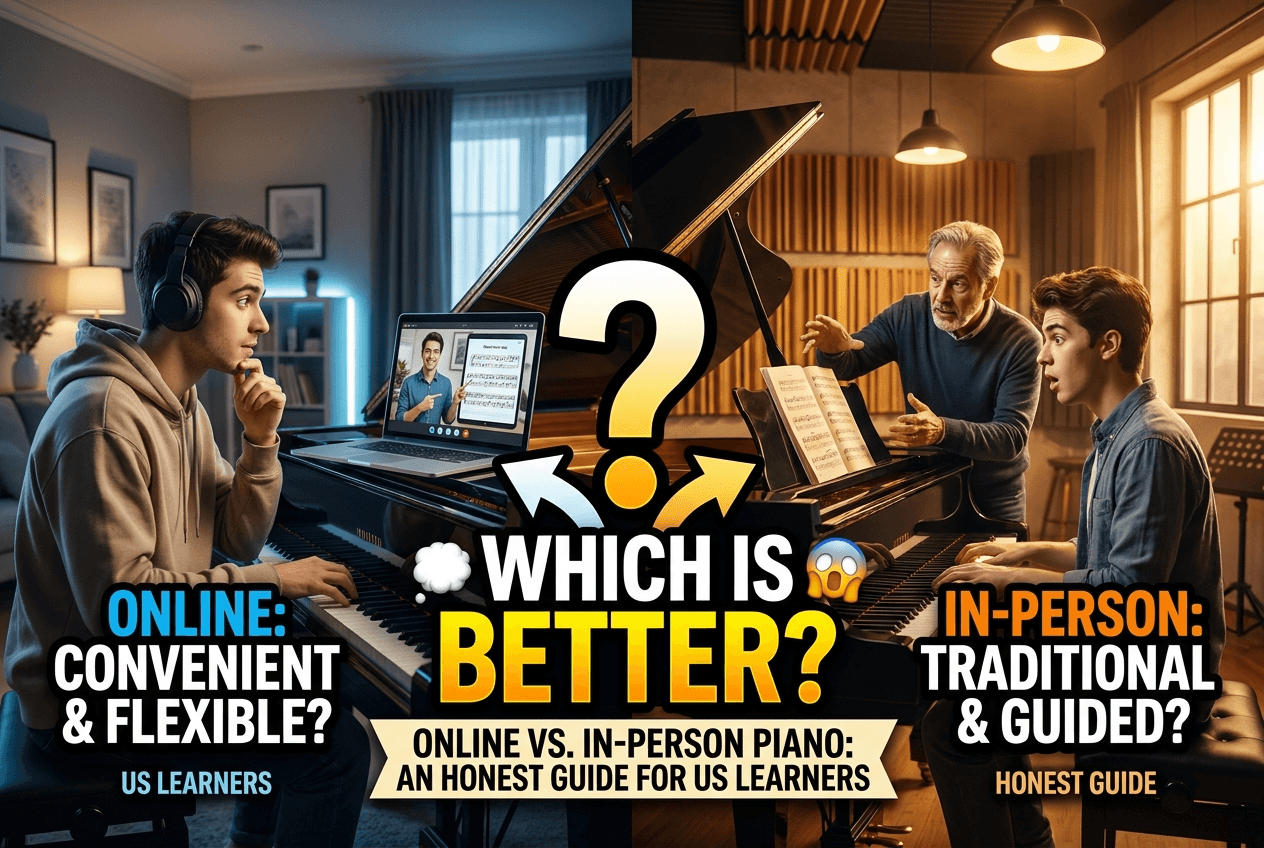
Every parent and aspiring pianist eventually hits this question head-on. The world of piano education has changed dramatically over the past decade, and the choice between learning piano online or in-person feels more complicated than ever. Both paths lead to real musical growth. Both have genuine drawbacks. And the "right" answer depends entirely on your specific situation, learning style, goals, and budget.
Learning Piano Online vs In-Person: Understanding the Core Difference
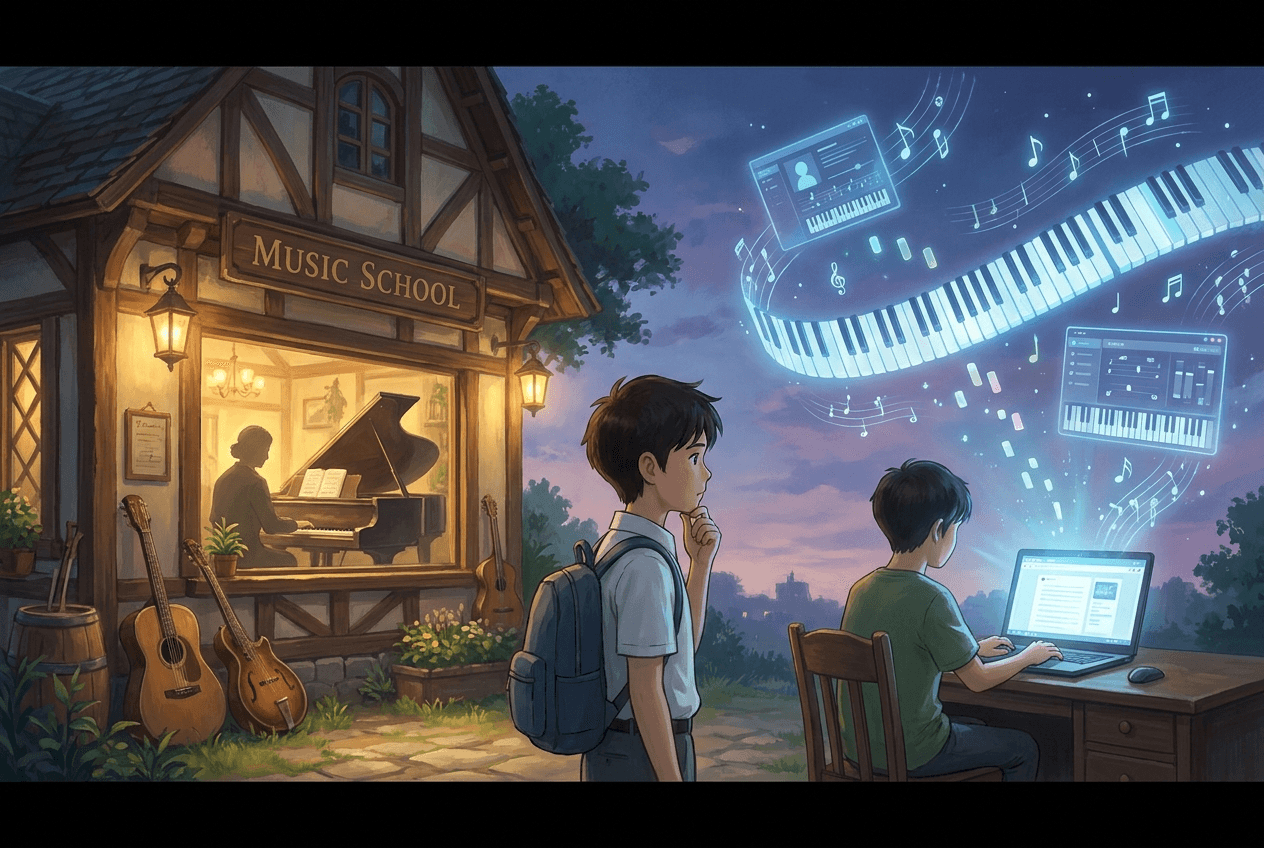 The fundamental distinction between online and in-person piano lessons goes deeper than just location. In-person lessons place the teacher and student in shared physical space, allowing the instructor to physically adjust hand positioning, demonstrate directly on the same instrument, and pick up on subtle body language cues that signal confusion or discomfort. That tactile dimension of traditional piano instruction carries genuine pedagogical weight, especially for beginners developing foundational technique.
Online piano lessons, by contrast, rely entirely on what the camera and microphone can capture and transmit. A skilled online piano teacher compensates for the absence of physical presence through superior verbal instruction, strategic camera positioning, and the use of digital tools like annotated sheet music and split-screen demonstrations. Many experienced online instructors argue that the constraint of teaching through a screen actually sharpens their communication skills and forces more precise, deliberate feedback.
The experience of sitting at a piano in a dedicated music studio carries its own psychological power. The ritual of arriving at a lesson, the focused atmosphere of a professional teaching space, and the undivided attention of a teacher sitting beside you creates a learning environment that some students find irreplaceable. For those students, the physical setting is not just a backdrop but an active ingredient in their motivation and concentration.
That said, the virtual lesson environment has its own distinct advantages. Students learn in a space they already associate with comfort and safety. Performance anxiety, which affects a surprising number of piano students during in-person lessons, tends to be lower when the student sits at their own instrument in their own home. That relaxed psychological state can actually accelerate learning for students who freeze up under the subtle social pressure of a formal studio setting.
The Real Advantages of Learning Piano Online for US Students
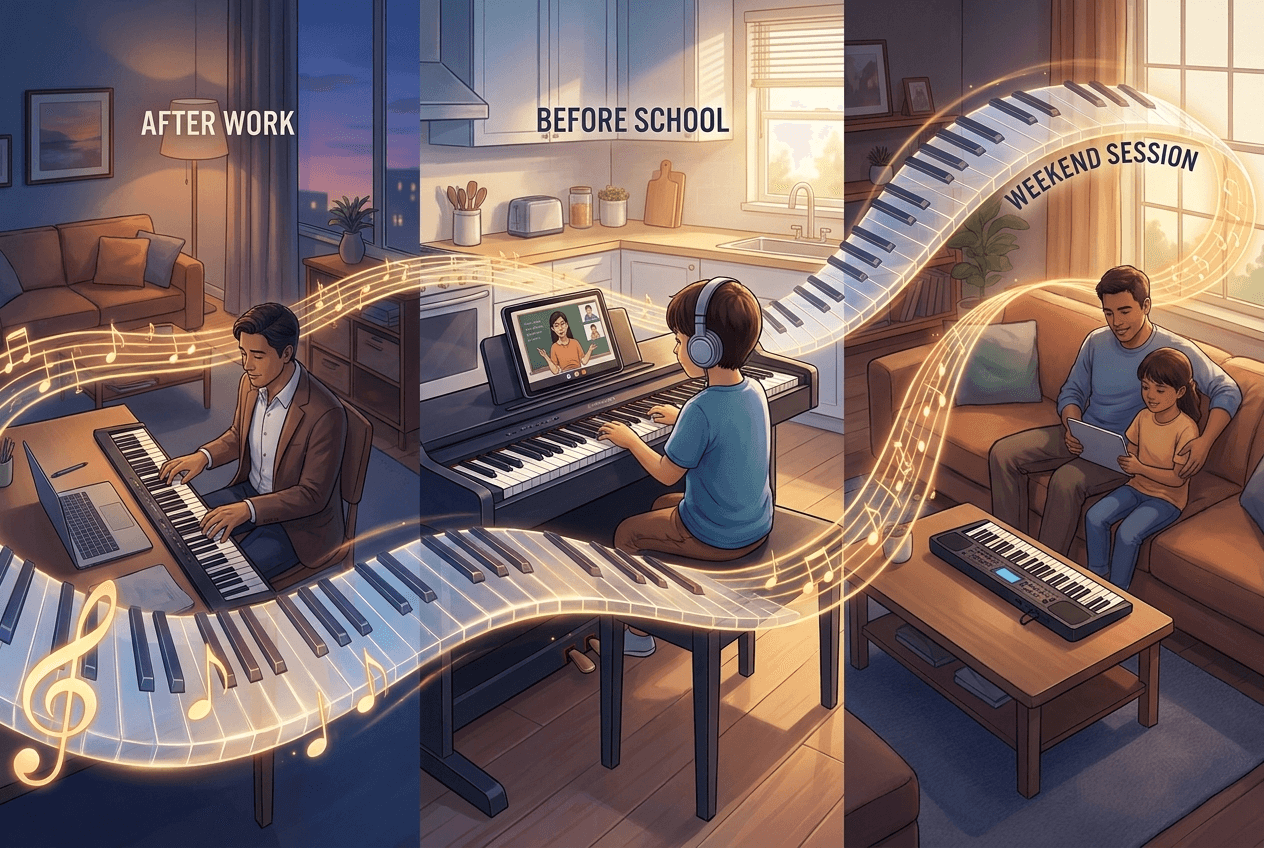 Online piano lessons offer a constellation of practical benefits that genuinely matter for busy American families and adult learners managing demanding schedules. The most obvious advantage is the elimination of commute time. In major US metropolitan areas like Los Angeles, Chicago, and New York, commuting to a piano studio can easily consume 30 to 60 minutes each way. Over the course of a year, that's dozens of hours reclaimed for actual practice, family time, or rest.
Scheduling flexibility ranks as another transformative benefit of the online format. Independent online piano teachers and platforms like TakeLessons and Lessonface typically offer lesson slots across a much wider range of hours than traditional brick-and-mortar studios. Early morning lessons before school, late evening sessions after work, and weekend slots that traditional studios often reserve for their most established students all become accessible through the online model.
Access to a dramatically larger pool of teachers is perhaps the most underappreciated advantage of learning piano online. A student in Boise, Idaho is no longer limited to the handful of piano teachers within driving distance. That same student can study with a Juilliard-trained pianist, a jazz improvisation specialist, or a teacher who holds a doctoral degree in music pedagogy from a leading conservatory. Geographic limitation simply evaporates. The best teacher for your specific goals and personality is now findable regardless of where you live in the USA.
Cost competitiveness also favors online piano lessons in most cases. Online teachers carry lower overhead costs since they don't need to rent studio space or maintain a dedicated teaching facility. Those savings frequently translate into lower per-lesson rates for students. Additionally, the ability to compare teachers globally through review-driven platforms creates healthy market competition that keeps pricing honest and accessible for families across different income levels.
The Real Advantages of Learning Piano In-Person
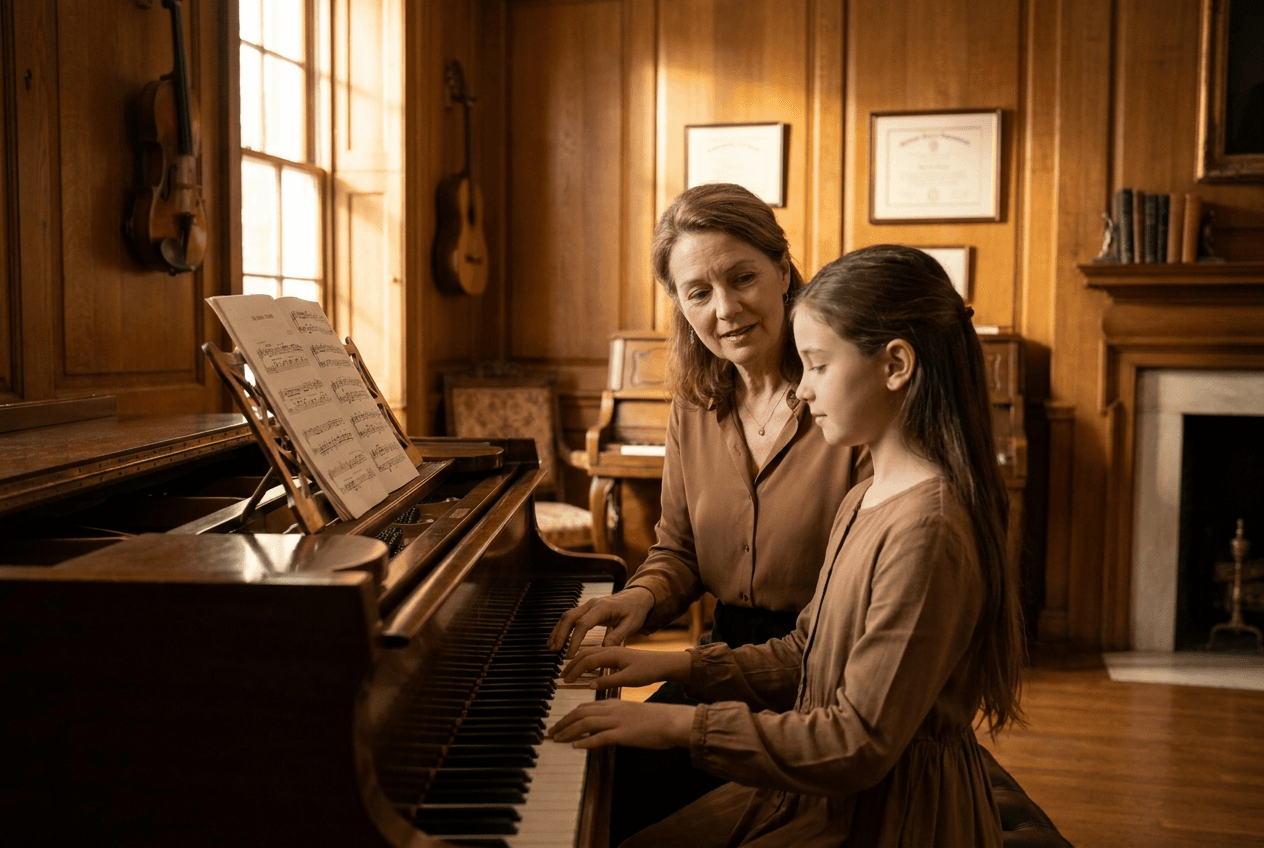 In-person piano instruction retains powerful advantages that the online format genuinely struggles to replicate. Physical proximity allows a teacher to make hands-on corrections that change everything for developing pianists. Repositioning a student's wrist angle, adjusting finger curvature, or demonstrating proper bench height and sitting posture through direct physical guidance communicates in seconds what verbal description might take minutes to convey imperfectly. For young beginners especially, this tactile teaching dimension accelerates the development of healthy technique and prevents the formation of habits that cause injury later.
The acoustic experience of learning on a quality grand or upright piano in a professional studio setting also carries educational value that home practice environments rarely match. Many students practice on digital keyboards or entry-level uprights at home, which is perfectly adequate for early stages. However, the sensitivity, dynamic range, and tonal complexity of a professional acoustic instrument teaches the ear things that budget instruments simply cannot. Regular exposure to superior instruments calibrates a student's musical ear in ways that compound powerfully over time.
Ensemble and collaborative musical experiences flow more naturally from an in-person educational context. Many traditional piano studios host regular group classes, theory workshops, and student recitals that build community and create performance opportunities. These experiences develop skills like sight-reading under pressure, musical communication, and stage confidence that private lessons alone rarely cultivate as effectively. The social fabric of a studio community gives many students a sense of belonging that sustains their motivation through the inevitable difficult periods every musician faces.
In-person lessons also provide a structured accountability that some learners find indispensable. Physically traveling to a lesson, sitting across from a teacher, and performing in real time creates a social contract that motivates consistent practice. Some students, particularly teenagers and adult beginners with competing priorities, find that the psychological weight of showing up in person to a committed appointment drives their practice habits far more effectively than the lower-stakes feel of logging into a video call from their bedroom.
How Audio and Video Technology Affects Your Piano Learning Experience
What Your Internet Connection Actually Means for Lesson Quality
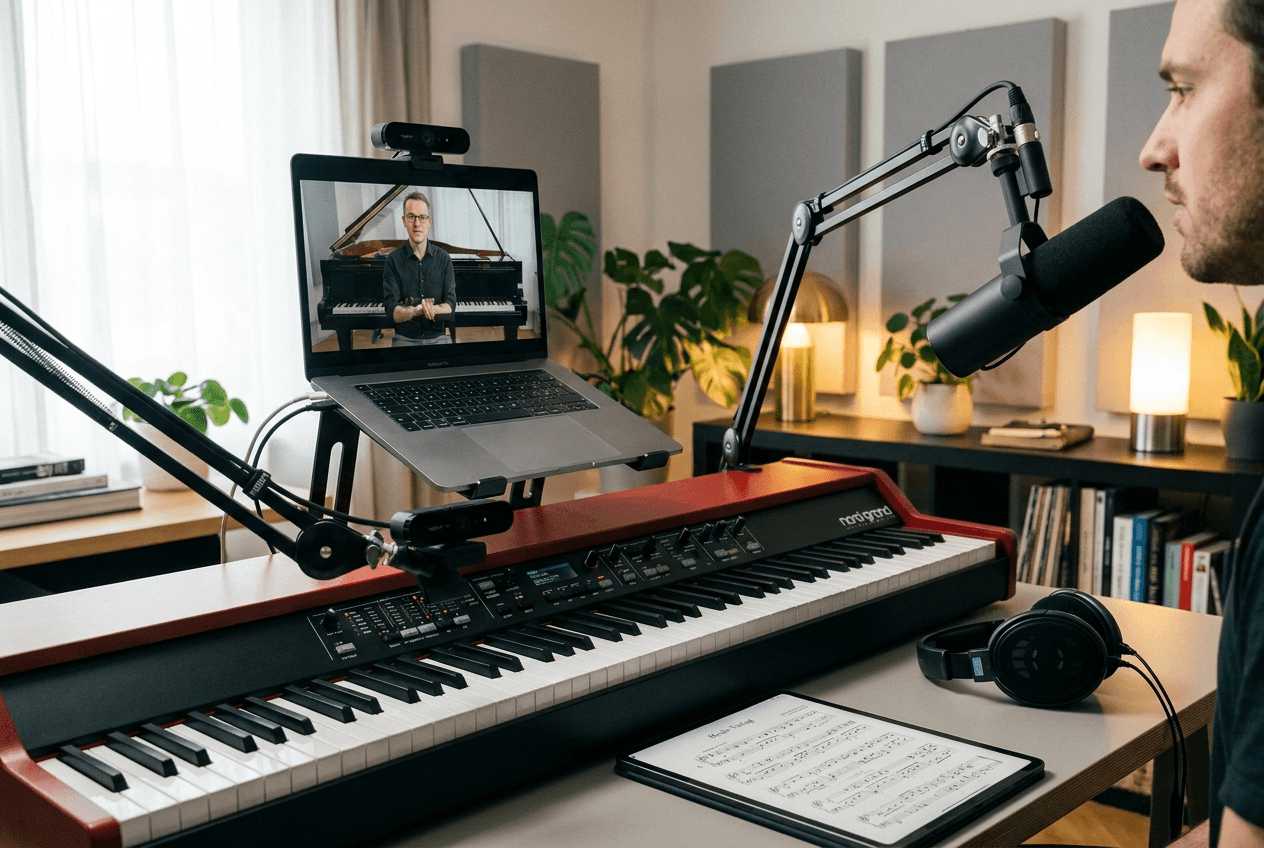
Technology sits at the heart of every online piano lesson, and understanding its limitations helps you set realistic expectations before committing to the format. Audio latency, the tiny delay between when a note is played and when the teacher hears it, represents the most significant technical challenge in online piano education. Standard video conferencing platforms like Zoom introduce audio delays of 50 to 150 milliseconds under normal conditions. That delay makes real-time duet playing between teacher and student virtually impossible and can make rhythmic feedback slightly imprecise.
Specialized platforms like JamKazam and Jacktrip have engineered solutions to reduce audio latency for musicians, though they require faster internet connections and more technical setup than standard video calling. For most piano students focused on solo repertoire and technique development, standard Zoom audio quality with a decent external microphone delivers a perfectly adequate lesson experience. The latency issue becomes most problematic for students working on intricate rhythmic precision at advanced levels.
Video resolution directly impacts how clearly a teacher can observe hand position, finger independence, and pedaling technique. A 1080p webcam positioned thoughtfully to capture both hands on the keyboard gives a competent online teacher enough visual information to provide meaningful technical feedback. Some teachers request a second camera angle focused specifically on the hands, which elevates the quality of technical observation considerably. This dual-camera setup has become a hallmark of truly professional online piano instruction.
Comparing Costs: Online Piano Lessons vs In-Person Piano Lessons in the USA
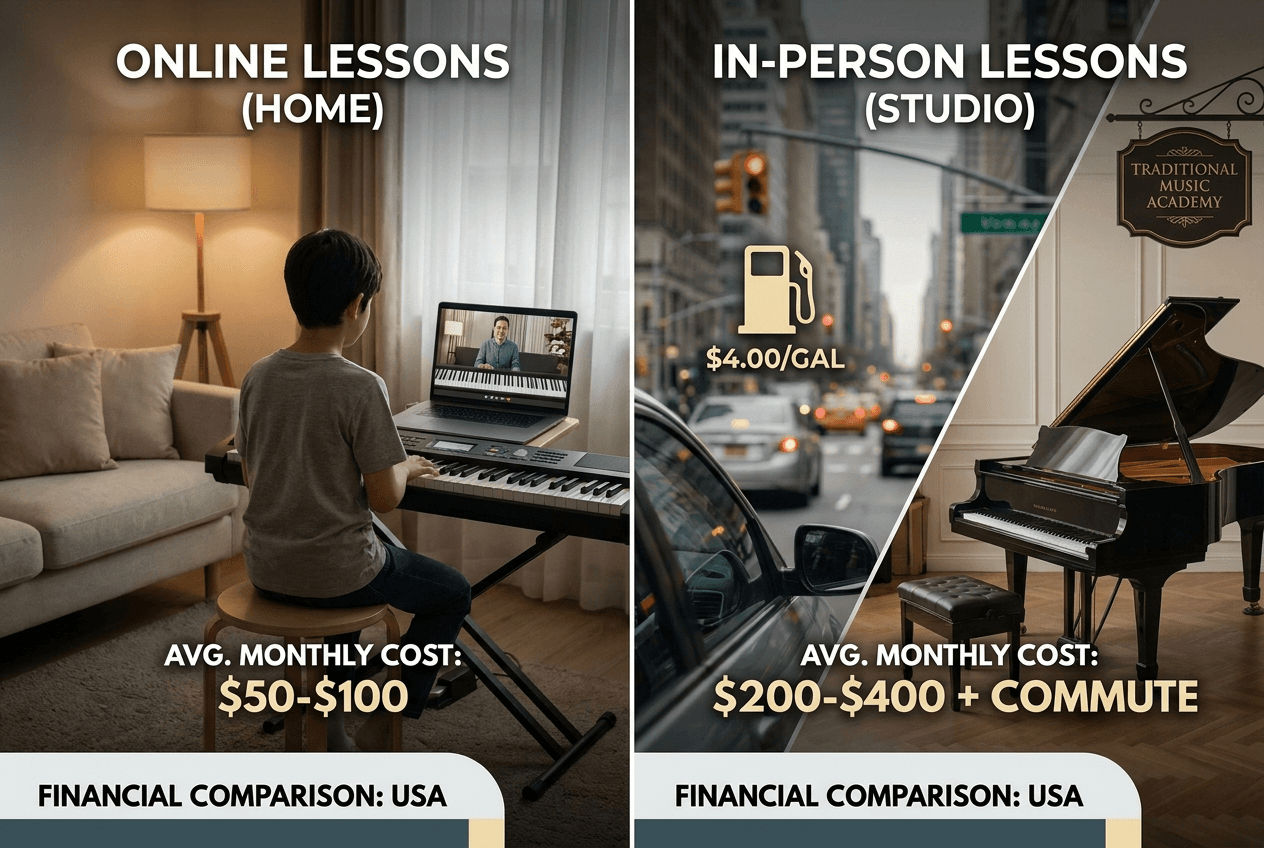 Understanding the full cost picture of both formats helps families and adult learners budget realistically and avoid unpleasant surprises down the road.
Cost Factor
Online Piano Lessons
In-Person Piano Lessons
Average 30-min lesson rate
$25 to $60
$35 to $80
Average 60-min lesson rate
$50 to $120
$70 to $150
Commute cost
None
Fuel or public transit
Equipment needed
USB mic, webcam, stable internet
None beyond instrument
Studio rental fees
Not applicable
Sometimes charged separately
Access to premium teachers
Global availability
Local availability only
Trial lesson availability
Common on most platforms
Less common
Understanding the full cost picture of both formats helps families and adult learners budget realistically and avoid unpleasant surprises down the road.
Cost Factor
Online Piano Lessons
In-Person Piano Lessons
Average 30-min lesson rate
$25 to $60
$35 to $80
Average 60-min lesson rate
$50 to $120
$70 to $150
Commute cost
None
Fuel or public transit
Equipment needed
USB mic, webcam, stable internet
None beyond instrument
Studio rental fees
Not applicable
Sometimes charged separately
Access to premium teachers
Global availability
Local availability only
Trial lesson availability
Common on most platforms
Less common
Beyond the per-lesson rate, families should factor in the cost of any equipment upgrades needed for quality online lessons. A reliable USB condenser microphone runs between $50 and $150. A quality webcam costs between $40 and $100. These are one-time investments that pay for themselves quickly compared to ongoing commute costs. For families in car-dependent US suburbs where a piano studio might be 20 minutes away, annual fuel and time costs of in-person lessons can easily exceed $500.
Many online platforms offer subscription models or lesson packages that reduce the effective per-lesson cost significantly. Monthly subscription plans through platforms like Skoove or Simply Piano offer unlimited access to structured curricula for under $20 per month, though these are app-based rather than live instructor-led. For live online instruction, purchasing a bundle of ten or twelve lessons upfront typically saves 15% to 20% compared to pay-as-you-go pricing.
Which Learning Style Benefits More from Online Piano Lessons
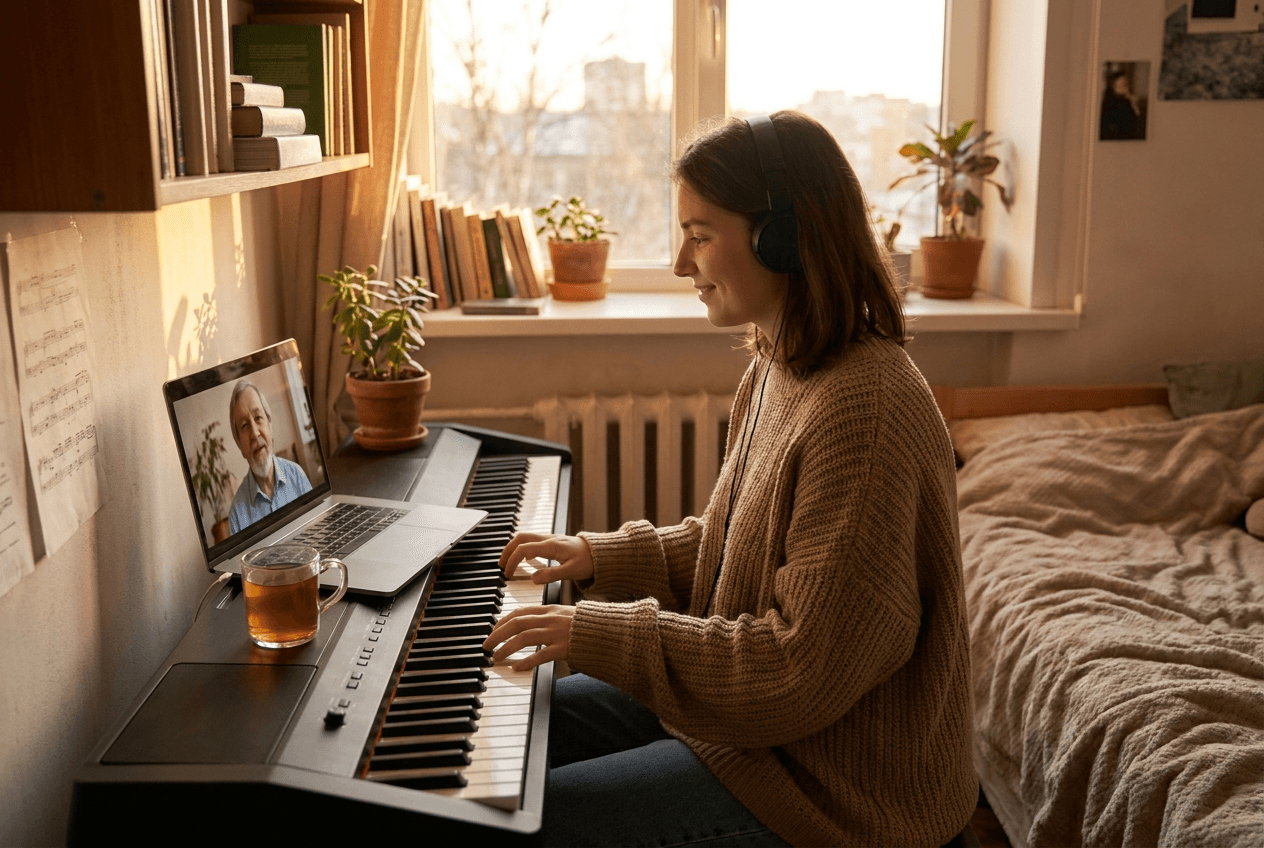 Certain learner profiles thrive in the online piano lesson environment in ways that genuinely surprise people who assume in-person instruction is automatically superior. Self-directed adult learners with clear musical goals and the intrinsic motivation to practice consistently tend to excel with online piano instruction. These learners appreciate the ability to book lessons at unconventional hours, work with highly specialized teachers, and manage their musical education with the same autonomy they apply to other areas of their professional and personal lives.
Introverted students who experience performance anxiety in formal settings frequently report that online lessons feel dramatically less intimidating than sitting beside a teacher in a studio. The psychological buffer of the screen creates enough emotional distance to allow these students to take risks, make mistakes openly, and ask questions without the social self-consciousness that sometimes inhibits learning in close physical proximity to an authority figure.
Students in rural or underserved areas of the USA who previously had no access to qualified piano instruction represent perhaps the most compelling case for online learning. According to The National Endowment for the Arts, access to arts education remains deeply unequal across geographic and socioeconomic lines in America. Online piano lessons directly address this inequity by democratizing access to high-quality instruction regardless of zip code.
Busy working adults and parents who squeeze practice into irregular windows throughout the week benefit enormously from the scheduling flexibility of online instruction. The ability to book a lesson during a lunch break, immediately after school pickup, or on a Sunday evening removes the logistical friction that causes many motivated adult learners to abandon in-person lesson commitments within the first few months.
Which Learning Style Benefits More from In-Person Piano Lessons
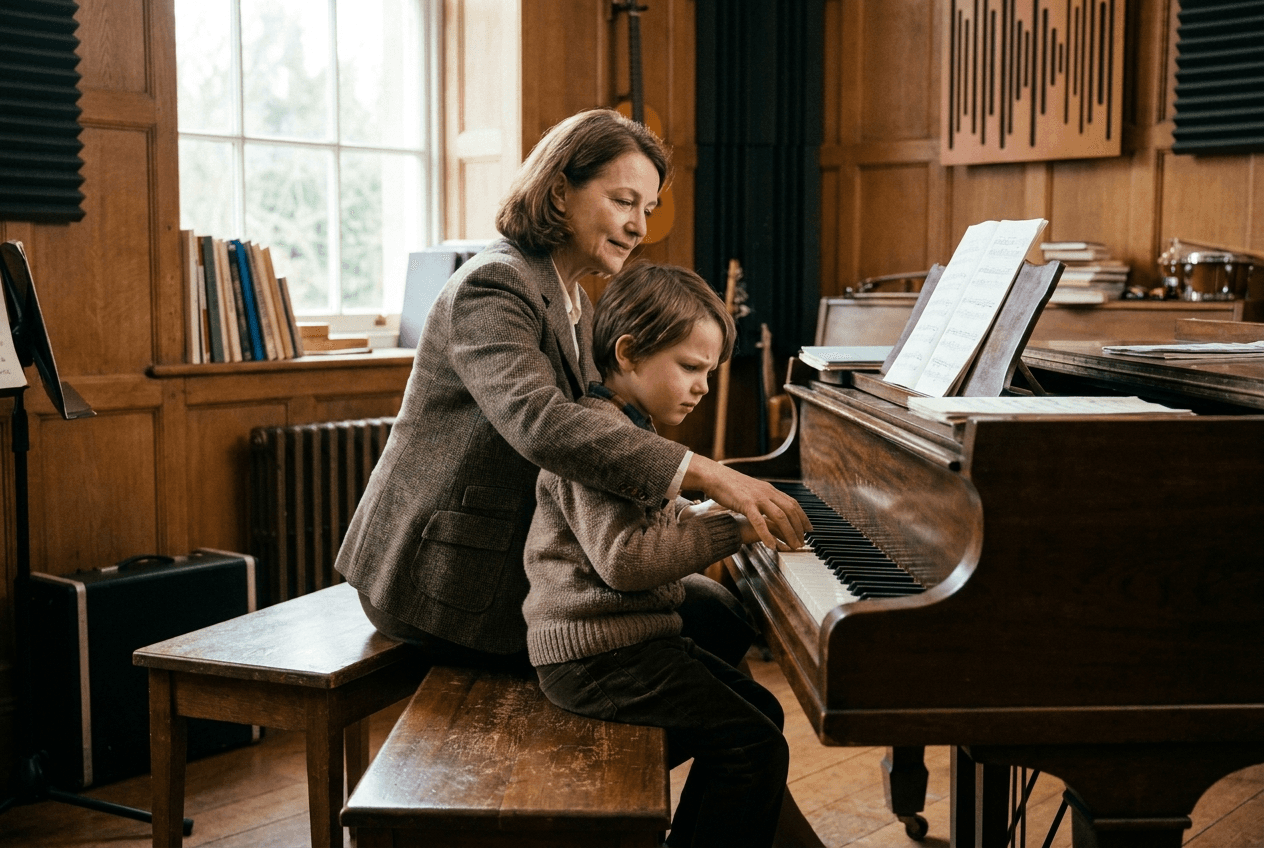 Young children under the age of eight almost universally benefit from in-person piano instruction during the earliest stages of their musical development. The physical presence of a teacher who can gently guide small hands into correct position, maintain attention through direct eye contact and physical proximity, and respond instantly to signs of confusion or frustration provides a developmental scaffold that screens simply cannot replicate. Pedagogical frameworks like the Suzuki Method, which emphasizes parental involvement and physical modeling, translate most powerfully in a shared physical space.
Students working at advanced levels on technically demanding repertoire also tend to benefit from in-person instruction. Developing the refined muscular control required for pieces by Chopin, Liszt, or Rachmaninoff involves nuances of touch, weight transfer, and physical relaxation that a perceptive in-person teacher can identify and address through direct observation and even physical demonstration at a shared keyboard. The subtle proprioceptive feedback of playing alongside or near a masterful pianist carries an educational value that goes beyond what verbal instruction through a screen can fully convey.
Students who struggle with self-motivation and consistent practice habits frequently perform better in the structured accountability environment of traditional studio lessons. The social commitment of showing up to a physical location, the interpersonal relationship built through face-to-face interaction over months and years, and the community of fellow students encountered in a shared studio space all contribute to a motivational ecosystem that the online format replicates less naturally.
What Experienced Piano Teachers Say About Both Formats
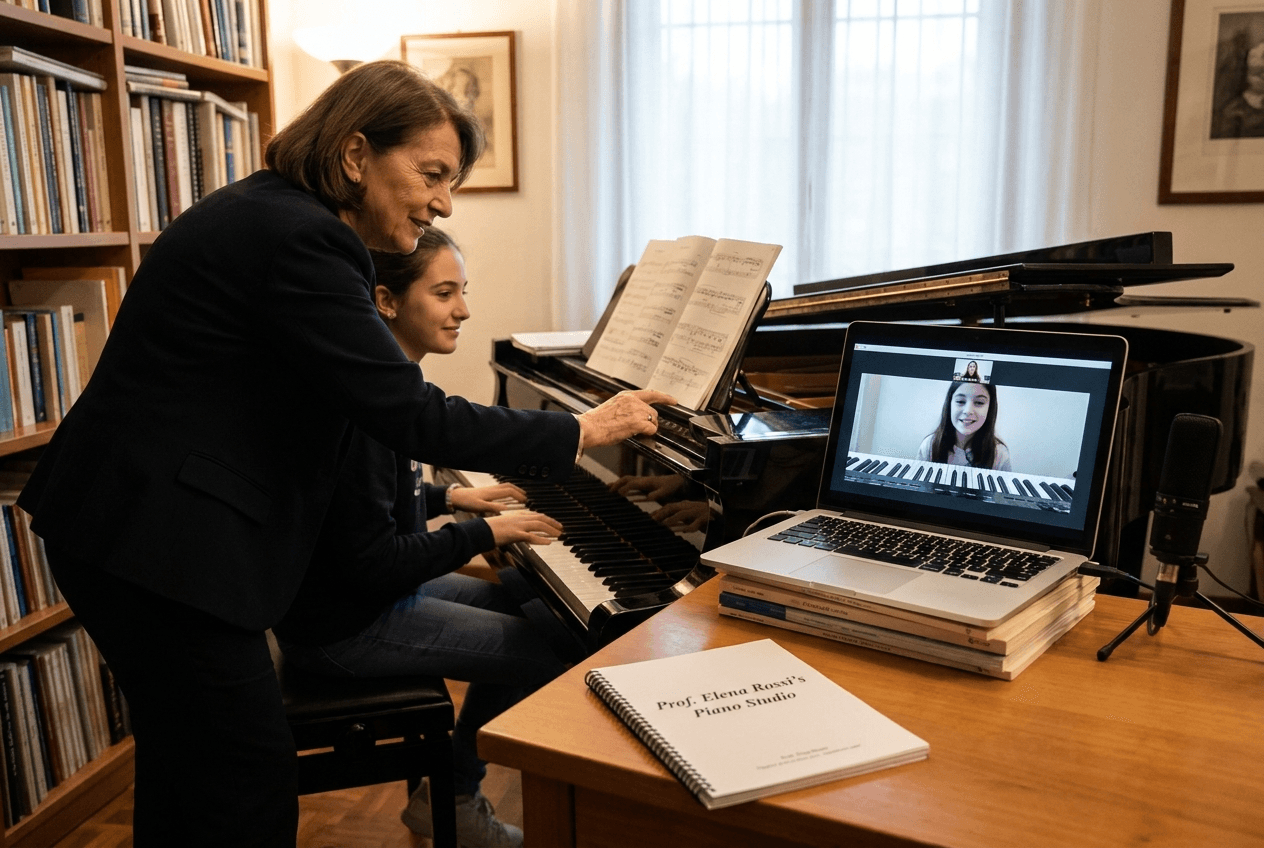 Music educators who have taught piano both in-person and online for extended periods offer nuanced perspectives that go far beyond simple preference. Many describe a genuine evolution in their teaching methodology after transitioning to online instruction. As the celebrated music educator Frances Clark once observed, "The goal of teaching is to make the student independent of the teacher." Online instruction, by placing more responsibility on students to self-monitor and self-correct between sessions, often accelerates exactly this kind of musical independence.
Teachers who specialize in adult beginner piano instruction frequently report that their online students practice more consistently than their in-person students did historically. The theory is straightforward: adults who choose online lessons have already demonstrated a degree of self-direction and technological comfort that correlates with stronger practice habits. The convenience of not commuting also means these students arrive at lessons less physically and mentally depleted than adults who rush from work to a studio.
Conversely, teachers who work primarily with young children and early beginners tend to express strong preferences for in-person instruction during the foundational years. The developmental reality of teaching a six-year-old to coordinate both hands independently, read basic notation, and maintain proper posture simultaneously demands a quality of real-time physical guidance that most online teachers acknowledge is genuinely harder to deliver through a screen. The consensus among experienced educators leans toward in-person instruction for the very young and the very advanced, with online instruction performing admirably for the broad middle range of students and skill levels.
A Practical Framework for Making Your Decision
 Making the right choice between online and in-person piano lessons becomes much simpler when you assess your situation against a concrete set of factors rather than relying on general impressions.
-
Consider your child's age and developmental stage. Children under eight generally benefit more from in-person instruction. Students aged eight and above typically adapt well to online lessons with proper setup.
-
Assess your geographic situation honestly. If you live in a region with limited access to qualified piano teachers, online instruction isn't just convenient. It's genuinely your best option for quality instruction.
-
Evaluate your home practice environment. Online learning works best when students have a reliable internet connection, a decent instrument, and a quiet dedicated practice space. Audit your home setup before committing.
-
Identify your primary musical goals. Classical performance at a competitive level may benefit from in-person masterclass experiences and conservatory-affiliated instruction. Recreational playing, songwriting, or popular music styles often thrive in the flexible online format.
-
Be honest about your motivation style. If you know from experience that external accountability drives your behavior more than internal motivation, the social commitment of in-person lessons may serve you better regardless of other factors.
-
Factor in your total budget including hidden costs. Calculate commute costs, time costs, and equipment costs alongside the lesson rate itself before concluding that one format is definitively cheaper than the other.
-
Take advantage of trial lessons in both formats. Many teachers and platforms offer introductory sessions at reduced rates. Experiencing both formats firsthand before committing to a long-term arrangement eliminates guesswork entirely.
About Art Gharana
 Art Gharana is a vibrant online arts education platform proudly serving students across the USA with live, instructor-led lessons in music, dance, and the performing arts. Their roster of experienced, vetted piano teachers offers personalized instruction tailored to every age group and skill level, from enthusiastic beginners sitting at the keys for the very first time to advancing students working on demanding classical repertoire. Art Gharana combines the flexibility and accessibility of online learning with the warmth and rigor of traditional music education. Discover your perfect piano teacher and start your musical journey at Art Gharana today.
Frequently Asked Questions
1. Is it harder to learn piano online compared to in-person lessons?
Learning piano online is not inherently harder than in-person instruction when the right technology setup is in place. Most students adapt to the online format within two to three sessions. The key factors are audio quality, camera positioning, and a teacher experienced in virtual instruction. Many students actually progress faster online due to eliminated commute stress and greater scheduling consistency.
2. What equipment do I need to start online piano lessons in the USA?
You need a working piano or digital keyboard, a computer or tablet with a camera, a stable internet connection of at least 10 Mbps, and ideally a USB condenser microphone for improved audio quality. A well-positioned webcam that shows both hands on the keyboard gives your teacher a clear view of your technique. Most families spend between $50 and $200 on equipment upgrades before their first online session.
3. Can young children aged four to six learn piano effectively through online lessons?
Very young children can participate in online piano lessons but benefit significantly from active parental involvement during each session. The parent effectively acts as a physical teaching assistant, helping position small hands and maintaining focus. Teachers who specialize in early childhood music education design lessons with games, songs, and visual activities that hold young attention spans effectively through a screen.
4. How do I find a qualified online piano teacher in the USA?
Platforms like TakeLessons, Lessonface, and Superproof allow you to search by instrument, teaching style, credentials, and student age group. Always read verified reviews from other parents or students, watch any available introductory videos, and book a trial lesson before purchasing a package. Ask specifically about the teacher's experience with online instruction since not every excellent in-person teacher transitions smoothly to the virtual format.
5. Will learning piano online prepare me for recitals and performances?
Yes, with intentional preparation. Many online piano teachers and platforms organize virtual recitals that build real performance experience and confidence. For students preparing for formal recitals or competitive examinations, supplementing regular online lessons with occasional in-person masterclasses or performance workshops provides the live audience experience that accelerates stage readiness significantly.
6. How many lessons per week does a beginner pianist need?
Most beginner pianists benefit from one lesson per week combined with daily practice sessions of 15 to 30 minutes. Weekly lessons give students enough time to absorb new material, practice it thoroughly, and arrive at the next session with meaningful questions and progress to demonstrate. Twice-weekly lessons accelerate progress noticeably for highly motivated students but require a proportionally larger commitment to daily practice to be effective.
Conclusion
The question of whether to learn piano online or in-person doesn't have a single universal answer because it genuinely depends on who you are, where you live, how you learn, and what you want from your musical journey. Young beginners and advanced students pursuing conservatory-level goals may find more value in the physical presence of in-person instruction. Busy adults, students in underserved areas, and self-motivated learners of all ages frequently thrive with the flexibility and accessibility of online piano lessons. The smartest approach is to try both, assess your results honestly, and choose the format that keeps you practicing consistently and loving the instrument. Ready to find your ideal piano teacher? Explore the exceptional roster of online piano instructors at Art Gharana and take your first lesson today.