ChatGPT
 Google AI
 Grok
Grok Claude
Australia is home to one of the world's most enthusiastic music learning communities. From the competitive AMEB examination culture of Melbourne's private schools to the flourishing independent music scene of Sydney and Brisbane, Australians take music education seriously. And in 2026, learning piano online in Australia has reached a quality and accessibility level that makes it genuinely comparable to - and in many ways more practical than - traditional in-person instruction.
Whether you are an adult Australian who has always wanted to learn piano but never had the time or local access, or a parent deciding whether piano is the right first instrument for your child, this complete guide covers everything you need to begin confidently. It addresses the specific Australian context - AMEB examinations, local instrument purchasing, Australian time zones for online teachers, and the practical realities of Australian home setups - alongside universal guidance on technique, practice, and teacher selection.
Why Piano Is the Right First Instrument for Most Australians
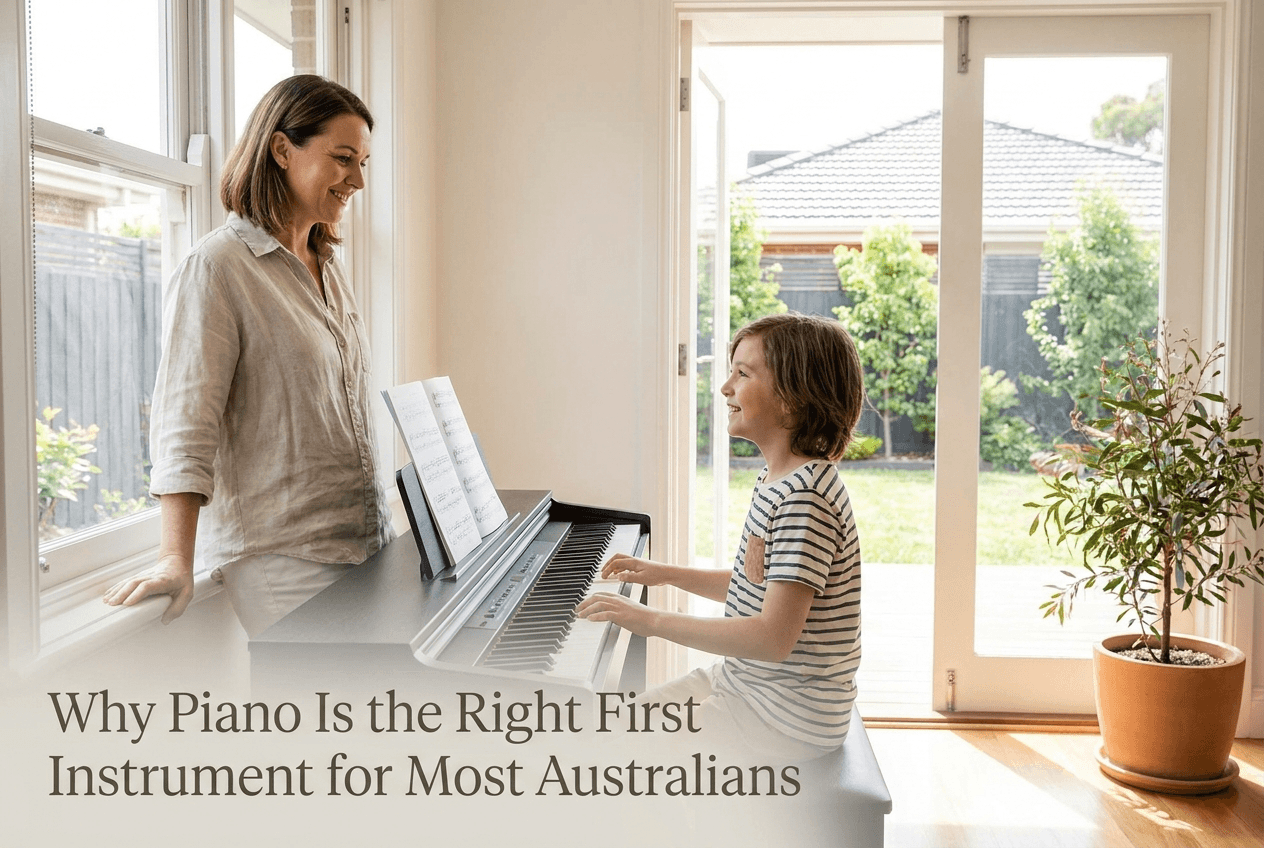 Piano holds a special place in Australian music education. The AMEB's piano examination pathway is among the country's most widely accessed music qualifications. Piano is the most common instrument taught in Australian primary and secondary schools. And the visual, tactile clarity of the keyboard makes it the most effective foundation instrument for music theory understanding, regardless of what other instruments a student may go on to learn.
The Visual Architecture That Accelerates Learning
The piano keyboard provides a visual representation of musical pitch that no other instrument matches. Each note occupies a specific, visible, fixed position. The relationship between every note is physically apparent - you can see an octave, a fifth, a major third, simply by looking at the keyboard. For children and adults beginning their musical journey, this visual architecture reduces one of the main barriers to early progress: understanding what the notes actually are and how they relate to each other.
According to research on early piano instruction and neuroplasticity, structured engagement with piano specifically promotes cortical thickness increases in auditory and motor brain areas and strengthens connectivity between brain hemispheres. These structural changes in the brain support not only musical development but general cognitive capability, particularly in areas connected to language, memory, and spatial reasoning.
AMEB Examinations and What They Mean for Australian Learners
The Australian Music Examinations Board (AMEB) piano examinations provide a formal, nationally recognised credential for Australian piano students from Grade 1 through to the highest diploma levels. AMEB grades are acknowledged by Australian universities, conservatoires, and scholarship programmes. In some states, high AMEB grades contribute to ATAR calculations through the Specialist Studies provisions.
For Australian parents who want their child's piano achievements formally documented, AMEB examinations provide the appropriate pathway. Online piano lessons with a teacher experienced in AMEB preparation are fully effective for this goal - the teacher can hear, observe, and prepare the student for all examination components (pieces, technical work, sight-reading, and aural tests) entirely through live video call instruction.
Getting Started: What You Need Before Your First Lesson
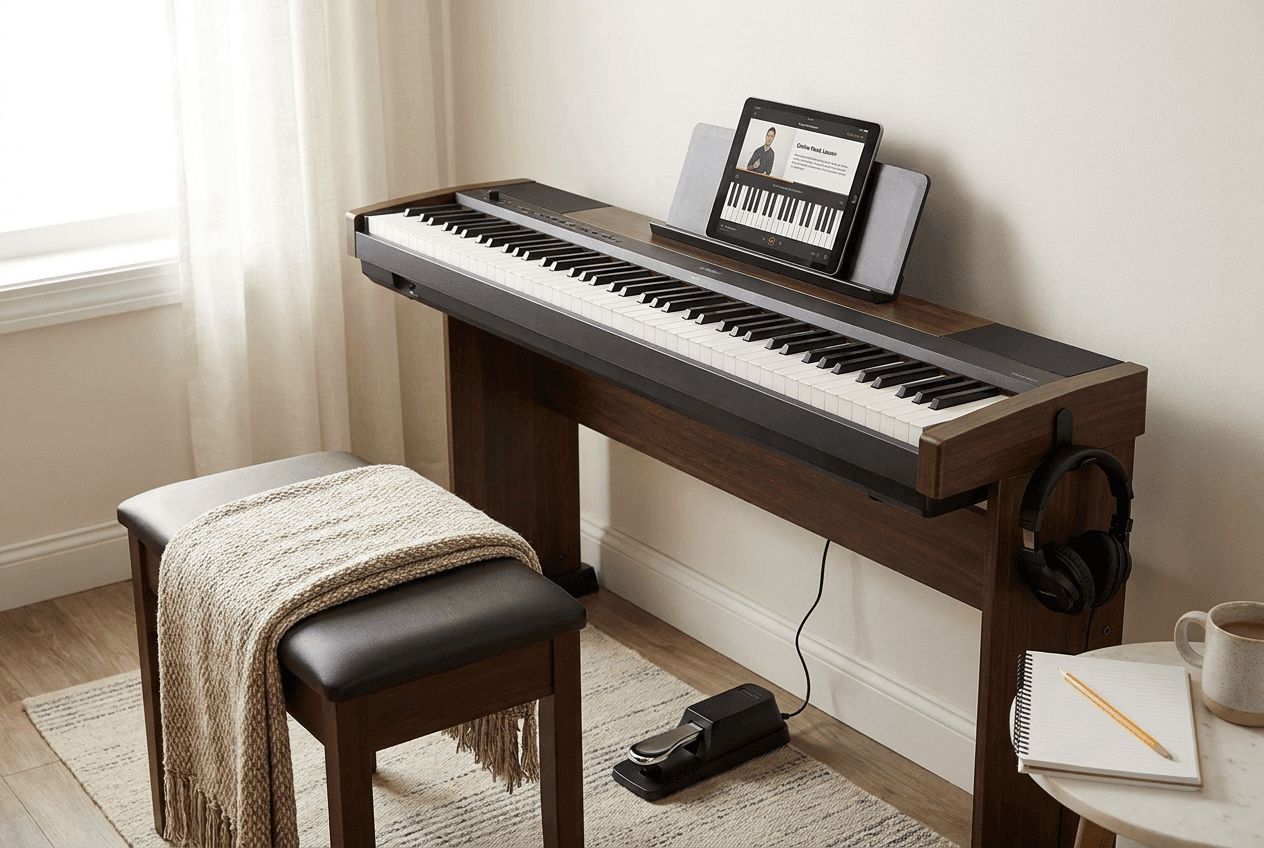 Many Australians approach online piano learning without adequate preparation of the basic requirements, and this creates avoidable friction in the early lessons. Here is a clear checklist.
The Instrument - Why Weighted Keys Are Essential
The Fundamental Distinction
There is a crucial difference between a digital piano with weighted keys and a standard keyboard with unweighted keys. A weighted digital piano has a key action that replicates the physical resistance of an acoustic piano's hammer mechanism. When you press a weighted key, you feel genuine resistance - lighter at the top of the key travel, heavier in the bass registers than the treble. This resistance develops the specific finger strength and touch sensitivity that piano technique requires.
An unweighted keyboard offers no meaningful resistance. Pressing its keys feels like pressing calculator buttons. The habits your fingers develop on unweighted keys are not piano habits - they are keyboard habits that become genuine obstacles when you encounter a real piano or take AMEB examinations.
Music educators at Guitar Guitar are explicit on this point: "Paying for bells and whistles at the expense of good sounds and a nice key feel is a mistake that will haunt you later. Don't be fooled by endless lists of features at this price point: you want a piano that feels good under your fingers and makes a good, realistic sound."
Recommended Instruments for Australian Beginners in 2026
Yamaha P-145 (approximately AUD $600-$700): The most consistently recommended beginner digital piano worldwide. Graded Hammer Standard action, 88 weighted keys, warm CFX-sampled piano sound. Available from Australian retailers including Yamaha Australia, JB Hi-Fi, and specialist music stores in all major cities.
Roland FP-10 (approximately AUD $550-$650): Roland's most accessible weighted digital piano. The PHA-4 Standard key action is exceptional at this price, offering a more realistic key feel than most competitors. According to MusicRadar's expert reviewers, it combines "a superb piano sound and an excellent weighted keybed into an affordable, no-frills instrument."
Casio CDP-S360 (approximately AUD $450-$550): The most affordable fully weighted 88-key digital piano that consistently receives positive educator reviews. A strong choice for families or adults making an initial investment while waiting to assess long-term commitment.
Roland FP-30X (approximately AUD $800-$950): For those willing to invest more meaningfully from the start, the FP-30X's improved key action, speaker system, and 3D Ambience headphone feature justify the premium for students who are serious about long-term development.
Essential Accessories for Australian Piano Beginners
A sustain pedal is needed within the first few months of learning and should be purchased alongside the piano. Most entry-level digital pianos include a basic single-pedal sustain controller. An adjustable piano bench prevents the posture problems that playing at the wrong height causes - do not substitute a dining chair. A pair of headphones (Sony MDR-7506 or Audio-Technica ATH-M20X, available at JB Hi-Fi for AUD $80-$120) enables late-night practice without disturbing family members or neighbours. A clip-on tuner is unnecessary for piano (it stays in tune), but a music stand for notation books is useful once scale and repertoire books are introduced.
Internet and Technical Setup
NBN broadband at 25 Mbps and above is entirely sufficient for video call piano lessons. Position your device at keyboard level to one side, angled to show both hands on the keyboard and your upper body simultaneously. This angle gives your teacher the most useful view of technique. Ensure your room has reasonable lighting - the teacher needs to clearly see your finger positions and hand shape.
Finding the Right Online Piano Teacher in Australia
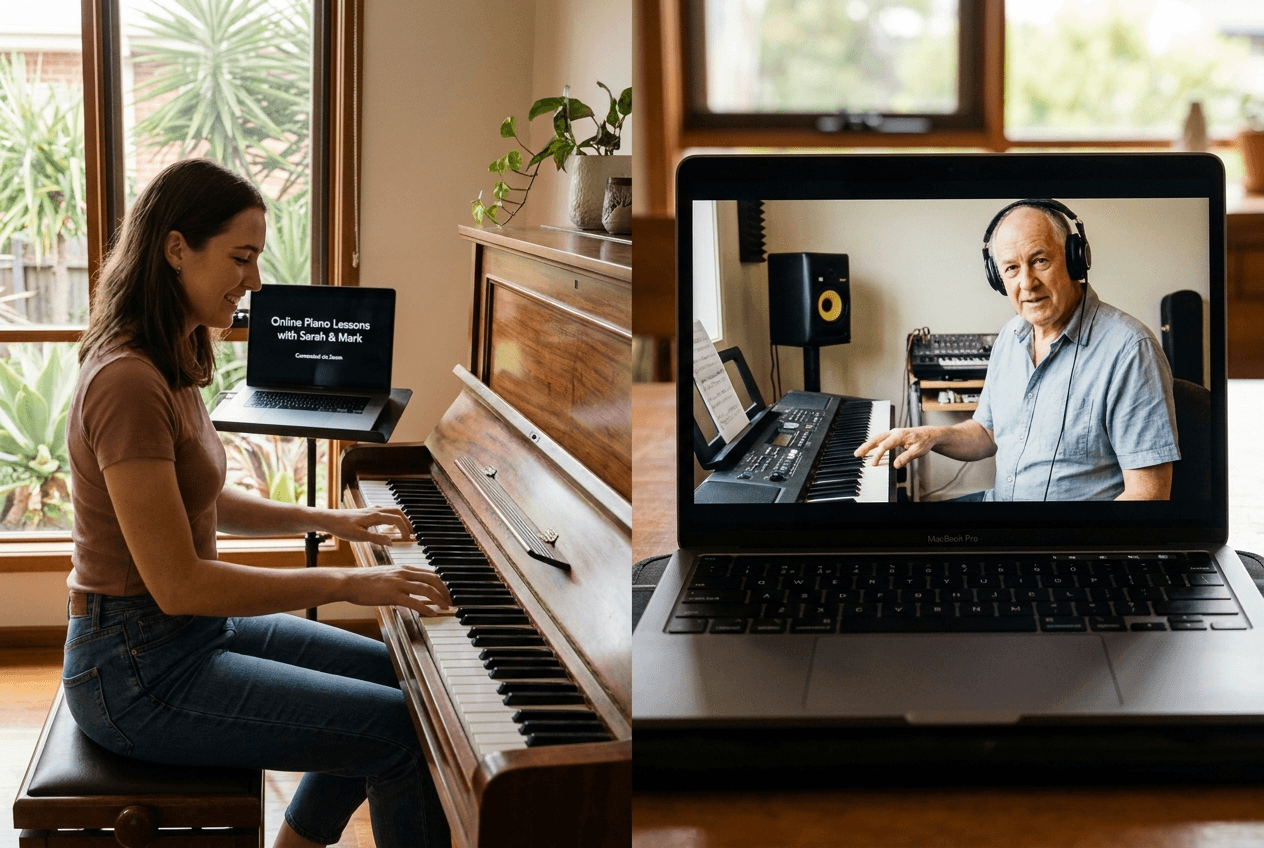 The single most important decision in your piano learning is the choice of teacher. Platform, instrument, and practice schedule all matter - but none of them compensate for a poor teacher, and a genuinely good teacher makes even an imperfect practice space and instrument work.
AMEB vs ABRSM Experience: Why It Matters for Australian Learners
Australia's primary piano examination system is the AMEB, not ABRSM. While the two systems have many similarities - both use graded examinations, both involve pieces, technical work, sight-reading, and aural tests - the specific syllabus repertoire, examination format, and assessment criteria differ meaningfully. An Australian student preparing for AMEB Grade 5, for example, needs repertoire from the AMEB Grade 5 syllabus list, not the ABRSM equivalent.
When evaluating online teachers for AMEB examination preparation specifically, ask directly: are you familiar with the current AMEB piano syllabus? Have you prepared students for AMEB examinations? A teacher whose experience is exclusively ABRSM-based may be an excellent piano teacher but may need to familiarise themselves with AMEB requirements before being optimally useful for Australian examination preparation.
What to Look for in an Online Piano Teacher
Formal Qualifications
A qualified piano teacher should hold at minimum Grade 8 ABRSM or AMEB 8th Grade in piano, ideally alongside a music degree from an Australian or international conservatoire. For teachers specifically preparing students for AMEB examinations, the AMEB's own Teaching Diploma is a meaningful credential.
Teaching Experience with Your Demographic
If enrolling a child, ask specifically about experience with children at your child's age. If enrolling yourself as an adult beginner, ask about experience with adult learners specifically - adult teaching requires different approaches from child teaching, and not all excellent children's music teachers are equally effective with adults.
A Free Trial Before Financial Commitment
One lesson tells you more than any profile description. At Art Gharana, we offer free trial piano and keyboard lessons for students across Australia. Explore our complete course catalogue to find the right lesson format for your goals.
The First Year of Online Piano Learning: A Realistic Roadmap
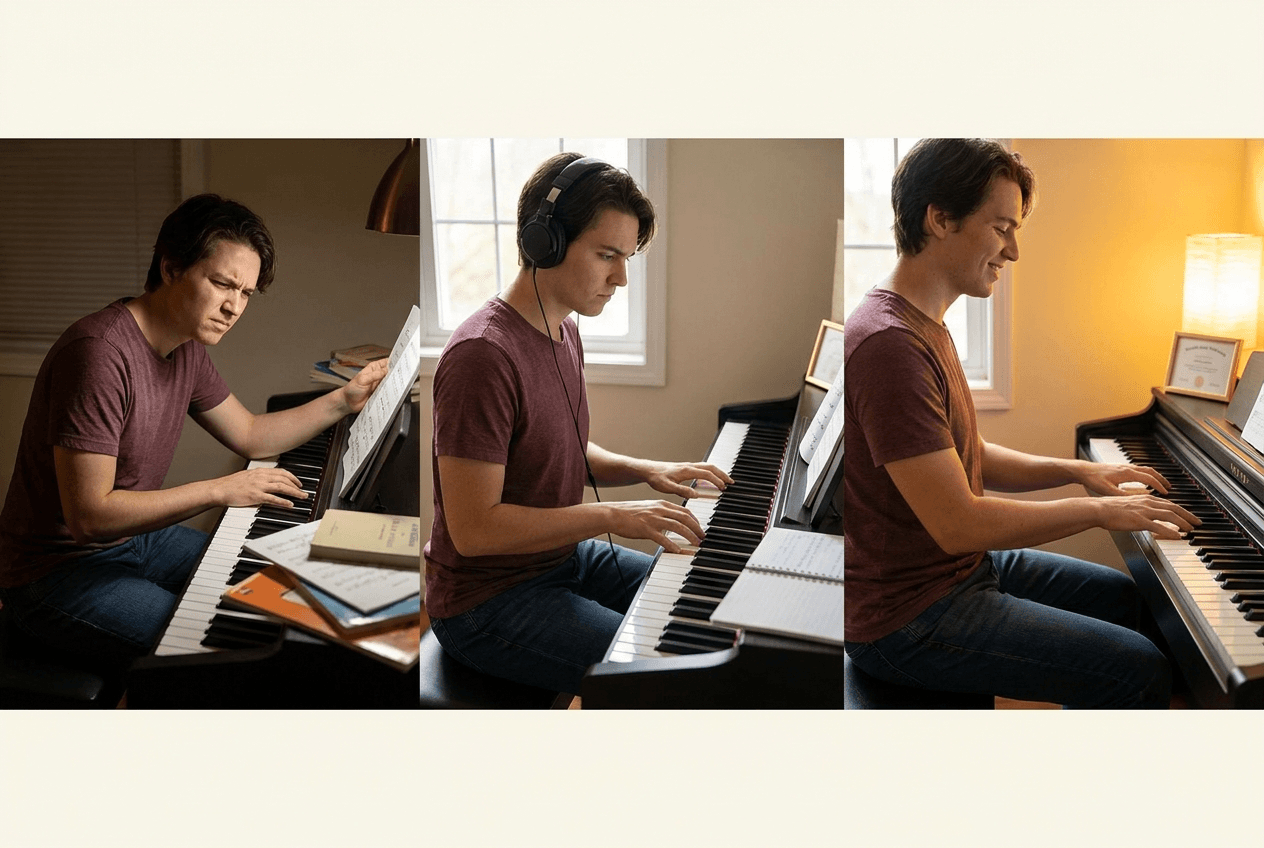 Understanding what to expect in your first year prevents the most common cause of piano student dropout: unrealistic expectations about the pace of progress.
Months One Through Three: The Technical Foundation Phase
The first three months are the least musical and the most important. You are building the physical and cognitive infrastructure that everything subsequent depends on. Expect this phase to feel slow. Expect the songs you can play to be simple. Expect your fingers to be sore in the first two weeks (calluses form). Expect to feel clumsy when trying to coordinate both hands. All of this is normal and temporary.
What you are actually doing in these months: developing correct hand position and posture that prevents injury, learning note names in both treble and bass clef, building rhythmic understanding through count-aloud practice, and developing finger independence through targeted exercises. Every one of these foundations will serve you for the rest of your musical life.
Months Four Through Six: The First Real Music
The transition from exercises to pieces that feel genuinely musical usually happens around month four for most students who practise consistently. The pieces are still simple by objective measure - but they have melody, dynamics, and musical character that makes practice feel meaningful rather than purely technical.
Two-hand coordination develops during this phase, and with it comes the most significant challenge of the first year: keeping both hands independent while maintaining rhythmic accuracy. This is genuinely difficult for most people. The key is practising hands separately until each is completely confident, then combining at very slow tempo and building speed gradually. Rushing this process is the most common and most costly beginner mistake.
Months Seven Through Twelve: Building Toward Examination Standard
By the end of the first year, students with consistent daily practice of 15-20 minutes are typically approaching AMEB Grade 1 level. Grade 1 requires three pieces from the current AMEB syllabus, basic technical work (scales and arpeggios in C, G, D, and A major), sight-reading of simple Grade 1 standard, and aural tests.
Working toward Grade 1 in the first year is an entirely realistic goal for most motivated students. It provides a clear developmental arc and a meaningful milestone that makes the first year feel purposeful.
The Non-Negotiable Practice Principle
Research on musical skill development is consistent and unambiguous: 15-20 minutes of focused daily practice produces faster progress than occasional hour-long sessions. According to the University of Bath study, even just one hour of piano practice per week over 11 weeks produced measurable improvements in audio-visual processing and reductions in depression, stress, and anxiety. Daily practice compounds these benefits significantly.
For Australian families managing busy school-plus-extra-curricular schedules, 15 minutes daily is realistic and sufficient. The habit of daily practice, established in the first month, is the most valuable gift you can give a young piano student.
Online Piano Learning for Indian-Australian Families: The Dual-Track Approach
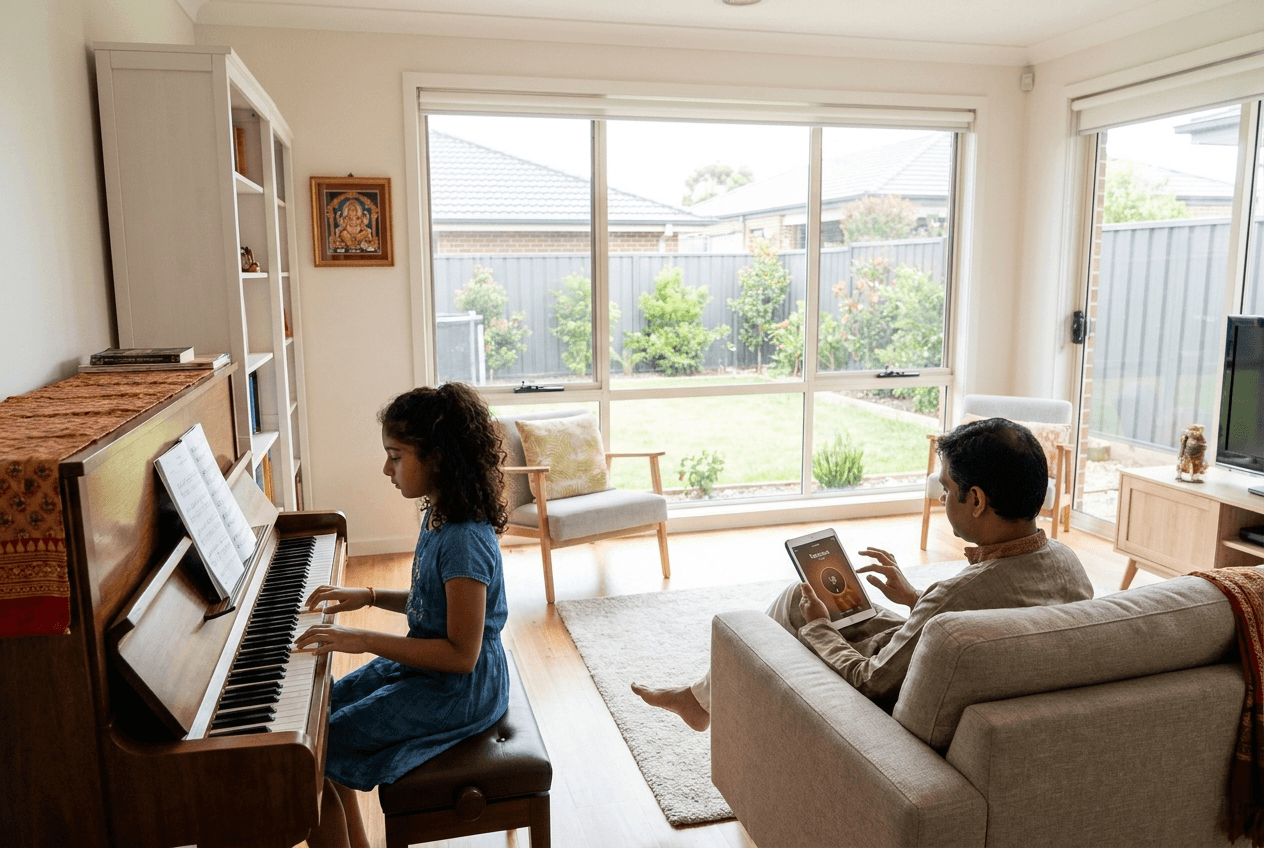 Many Indian-Australian families pursue both piano for AMEB qualifications and Indian classical music for cultural connection simultaneously. This dual-track approach is increasingly common and genuinely manageable.
How Piano and Indian Classical Music Complement Each Other
The theoretical overlap between Western music theory (developed through piano) and Indian classical music theory is substantial and mutually illuminating. Understanding the Western major scale makes the concept of melakarta ragas in Carnatic music far more accessible. Understanding raga aroha-avaroha makes the Western concept of modes more intuitive.
Children who study both piano and Indian classical music from ages six to twelve typically develop a richer overall musicianship than children who study either tradition alone. The ear training developed through Carnatic swara practice improves pitch accuracy in piano playing. The rhythmic precision of Hindustani tala practice strengthens rhythmic accuracy in piano performance. The connections are genuinely productive.
Our online Hindustani vocal classes and complete course catalogue support this dual-track approach for Australian families seeking both AMEB credentials and Indian classical cultural education for their children.
Conclusion
Learning piano online in Australia in 2026 is genuinely practical, affordable, and effective for students at any age and level. The combination of Australia's excellent music examination culture, world-class digital piano instruments at accessible price points, and the availability of highly qualified online teachers regardless of Australian geography has created an exceptional landscape for anyone who wants to learn.
Three things to take away. First, invest in a proper weighted digital piano - the Yamaha P-145 or Roland FP-10 are the benchmarks in Australia at accessible price points. Second, 15-20 minutes of daily practice beats occasional longer sessions every time. Third, for Australian families seeking AMEB examination preparation, confirm your teacher's specific AMEB syllabus experience before enrolling.
Book your free trial piano lesson at Art Gharana today and start building real technique from the very first session.
Frequently Asked Questions
1. What is the best digital piano for beginners in Australia in 2026?
The Yamaha P-145 (approximately AUD $600-$700) and the Roland FP-10 (approximately AUD $550-$650) are consistently the two most recommended beginner weighted digital pianos in Australia. Both offer fully weighted 88 keys, high-quality piano sounds, and build quality appropriate for AMEB examination preparation. The Yamaha is more widely available; the Roland offers a slightly better key feel for the price.
2. Can online piano lessons prepare students for AMEB examinations in Australia?
Yes, completely. Online lessons with a teacher experienced in the current AMEB piano syllabus are fully effective for examination preparation. Confirm your teacher's specific AMEB experience (rather than ABRSM experience alone) before committing, as the two examination systems have different syllabus repertoire and assessment criteria.
3. Is there a minimum age for online piano lessons for Australian children?
Most music educators recommend starting between ages six and nine for optimal results. Before age six, exploratory play-based music activities are more developmentally appropriate than formal notation-based instruction. Starting between ages nine and twelve is equally effective and often produces faster initial progress.
4. How long does it take for an adult beginner to play recognisable songs on piano?
Most adult beginners who practise 20 minutes daily can play simple recognisable songs within six to eight weeks. Playing them smoothly with good timing and tone typically takes three to five months. Reaching AMEB Grade 2-3 equivalent standard is achievable within 12-18 months for a consistently practising adult beginner.
5. Do Australian families need to find a teacher in their time zone?
Not necessarily. Many highly qualified piano teachers based in India, the UK, and other countries offer lesson times compatible with Australian schedules, particularly weekend afternoon slots. Australian-based teachers are also available through Art Gharana and other platforms. The most important criterion is teaching quality and specific AMEB experience, not geography.