ChatGPT
 Google AI
 Grok
 Claude

There is a moment in every bansuri learner's journey that stays with them for years. It is the moment the first clean, clear note comes out of the bamboo tube, a sound so warm, so immediate and so completely unlike anything produced by a mechanical instrument that the learner stops, listens to it dying in the room, and decides they will do whatever it takes to make that sound again. If you are reading this guide as a complete UK beginner, you are a few sessions away from that moment. Our online bansuri flute classes connect UK students with certified Hindustani flute teachers for live, one-to-one instruction in UK-friendly scheduling, beginning with a completely free first class.
This guide covers everything a UK beginner needs to know before starting: what the bansuri actually is, how online learning compares to in-person instruction, what instrument to buy and how much to spend, what the first six months of learning looks like, and the most common questions UK families and adult beginners ask before committing to their first class.
What Is the Bansuri? Understanding India's Sacred Bamboo Flute
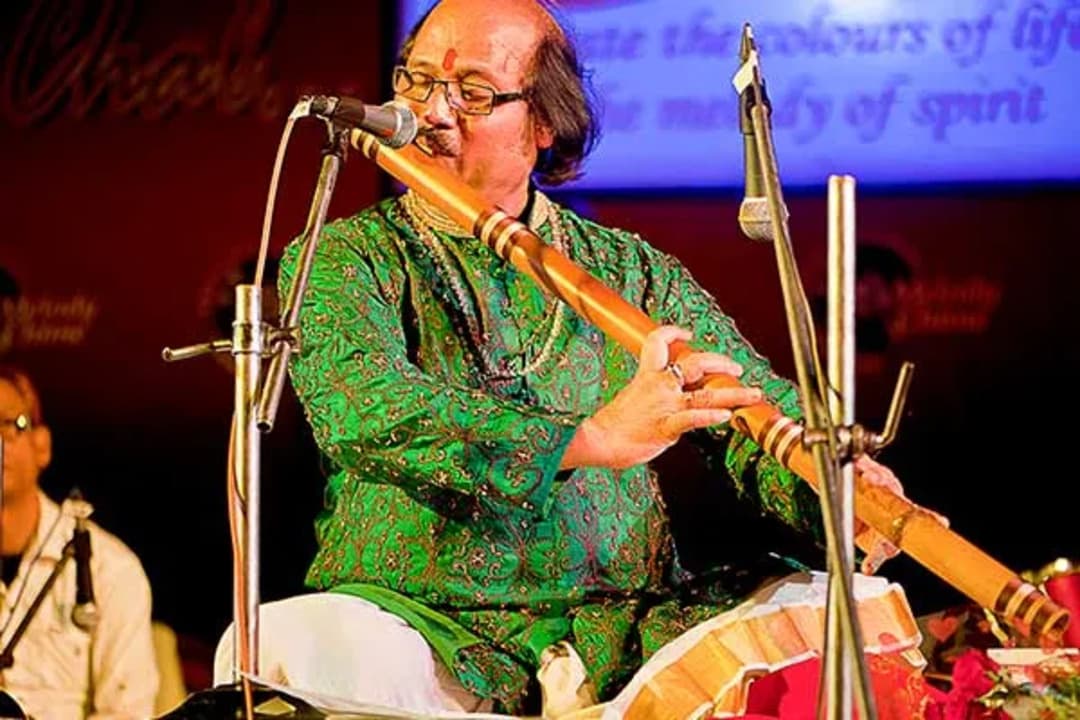
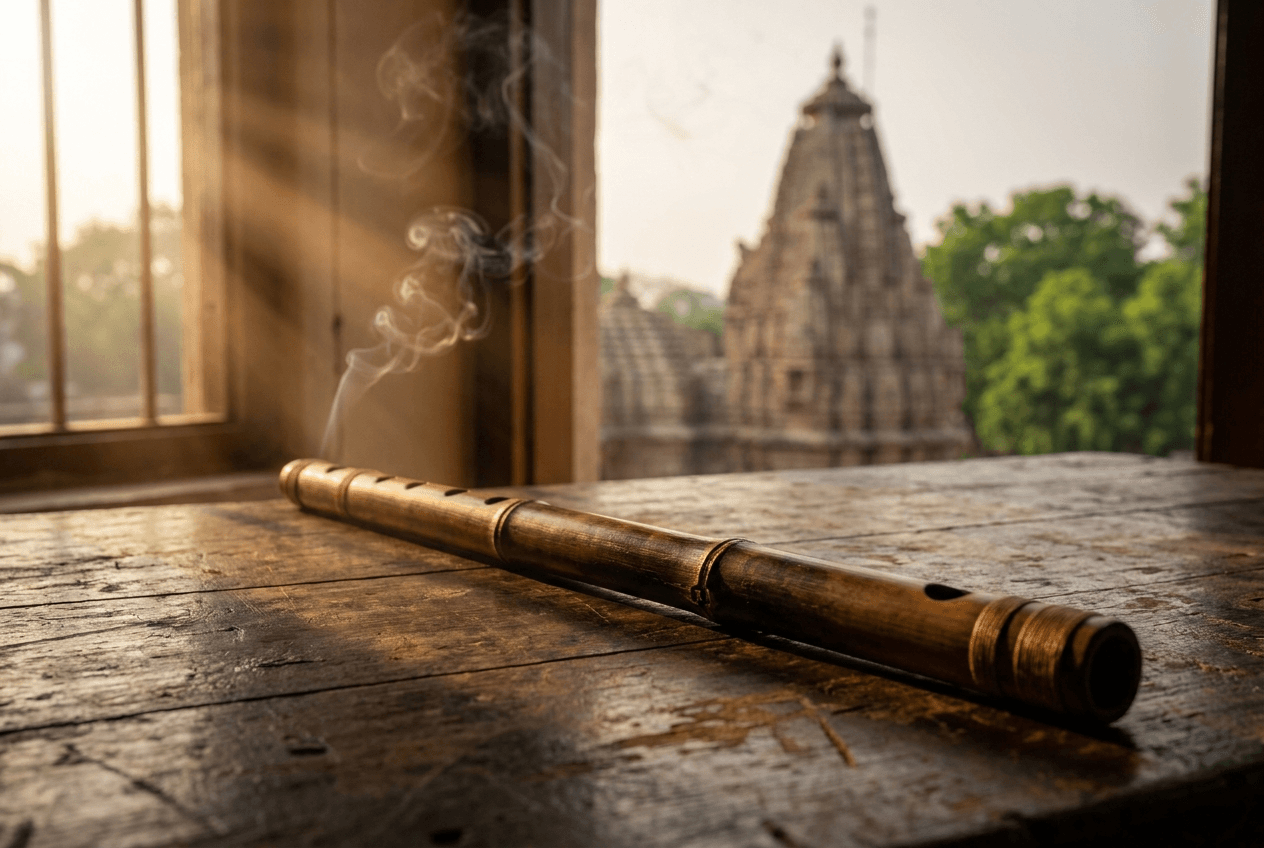 The bansuri is a transverse bamboo flute from the North Indian classical tradition. It is one of the oldest continuously played instruments in human history, ancient Sanskrit texts mention it, temple sculptures depict it, and the devotional literature of North India treats it as the instrument of Lord Krishna. In the hands of twentieth-century masters like Pandit Hariprasad Chaurasia, the bansuri became a fully developed concert instrument capable of sustaining an entire evening's classical performance. For a deeper look at where the bansuri sits within the Indian classical instrument family, read our guide to Indian classical music instruments.
Unlike the Western concert flute, which uses a mechanical system of keys to change pitch, the bansuri has six or seven open holes. Pitch is produced entirely by the player's breath and fingers, with partial hole coverage allowing the microtonal ornaments, the gliding meend, the oscillating gamak, the gentle andolan, that define the Hindustani classical sound. This direct physical relationship between the player's breath, fingers and the bamboo is what gives the bansuri its extraordinary expressive range.
The instrument is built in different scales, from the small high-register Eb flute to the long, deep-voiced E flute used in bass-register classical performance. UK beginners almost always start on a medium-scale A or B-flat bansuri, which sits comfortably between the extremes and produces a tone that is both accessible and genuinely beautiful.
Why Learn Bansuri Online? The Case for Live One-to-One Instruction
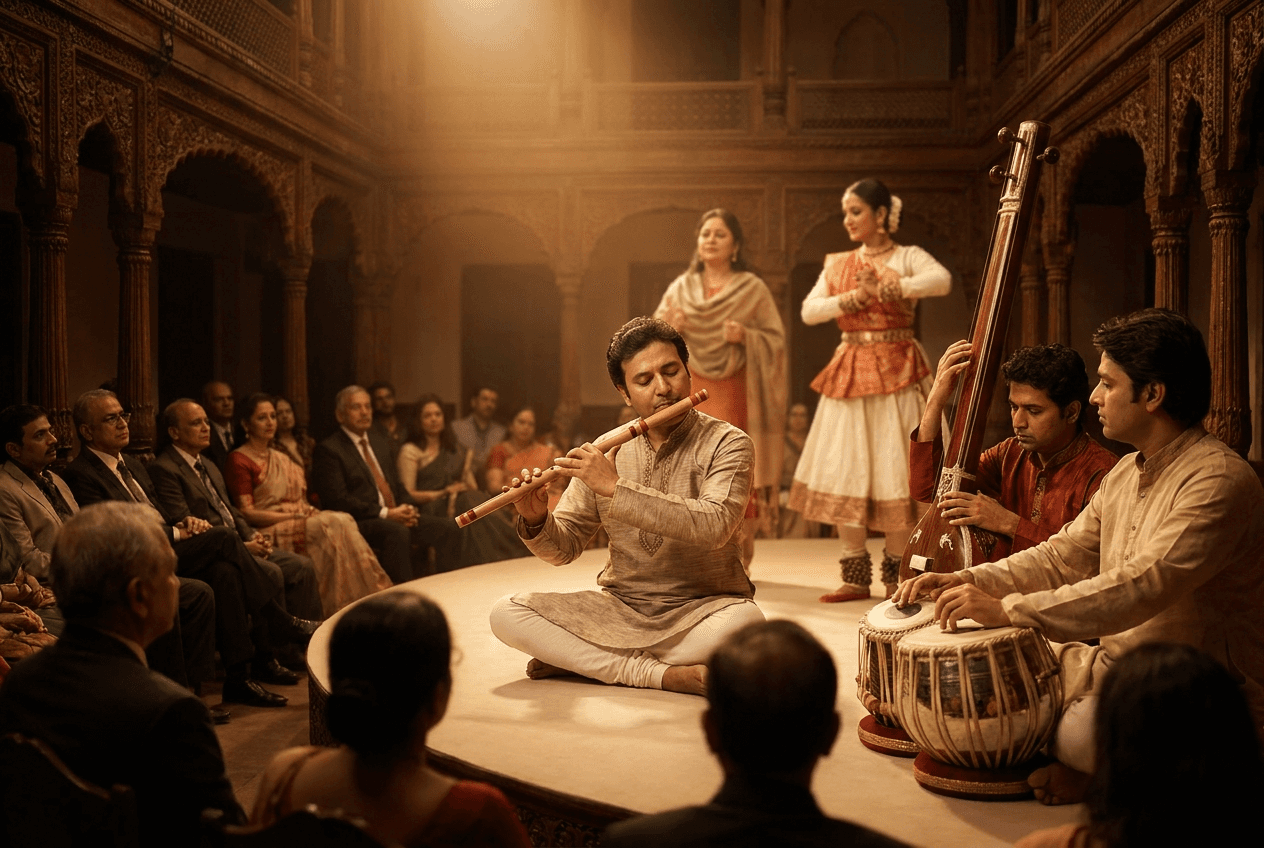 The UK bansuri learning market divides broadly into three categories: self-directed YouTube learning, recorded online courses, and live instruction. Each has its place, but only live instruction solves the problem that defeats most self-taught bansuri players before they get properly started: embouchure feedback.
The embouchure, the position of the lips over the blowing hole, is the single most technically critical element of bansuri playing, and it cannot be corrected from a recorded video. A teacher watching a live video feed can see in real time whether the student's lower lip is covering too much or too little of the embouchure hole, whether the angle of the breath stream is too steep or too shallow, and whether the tension in the student's jaw and throat is undermining the tone quality they are trying to produce. A certified Art Gharana teacher corrects these issues at the first class, preventing the formation of incorrect habits that become progressively harder to fix over time.
The UK-specific challenge is scheduling. The major recorded bansuri course providers, The Mystic Bamboo (Himanshu Nanda), BansuriBliss (Dr Kerry Kriger), and GAALC, all offer valuable content but no live UK-timed instruction. BansuriBliss live sessions run on US Pacific time. GAALC's scheduled lessons are built around Indian Standard Time. Art Gharana's live 1-on-1 bansuri classes run across all UK time zones, morning through evening, in both BST and GMT. View our plans and pricing for full details on scheduling and subscription options.
How to Choose Your First Bansuri: A Buyer's Guide for UK Beginners

Scale: Start with A or B Flat
The scale of a bansuri determines its pitch range and physical size. An A-scale bansuri (also written A natural or A#) is the most common beginner instrument, it sits in a comfortable mid-range, produces a warm and accessible tone and is neither so small that breath control is difficult nor so large that it is physically demanding to cover the holes. B-flat is also popular for beginners. Your Art Gharana teacher will advise on the specific scale most appropriate for your vocal range if you are also pursuing Hindustani vocal, as matching the bansuri to the voice is beneficial for students studying both disciplines.
What to Spend
A functional student bansuri for UK beginners costs between £15 and £45. At this price point, you are looking for a consistently tuned instrument with clean holes and a smooth finish, not a concert-quality instrument, but one that will not actively impede your learning with poor tuning or rough construction. Avoid the cheapest options on generic retail sites, as instruments priced under £10 are often poorly finished and produce a dull tone that makes embouchure development unnecessarily difficult.
Where to Buy in the UK
Several online retailers ship good quality beginner bansuri sets to UK addresses. Your Art Gharana teacher will give specific supplier recommendations at the trial class based on current availability and current pricing. Do not purchase an instrument before your first class, the teacher's guidance on scale, construction and supplier is more valuable than any generic recommendation. For context on where the bansuri fits within the broader Indian instrument landscape, our guide to the top musical instruments in India covers the full range of Hindustani and Carnatic instruments, which is helpful background reading for new learners.
Six-Hole or Seven-Hole Bansuri
Beginner bansuri are available in both six-hole and seven-hole versions. Six-hole instruments cover two and a half octaves and are slightly easier to manage for beginners because the seventh hole, a small hole near the blow end, requires a specific right-hand position that adds complexity. Art Gharana teachers typically start students on six-hole instruments and introduce the seven-hole when the student is ready. Ask your teacher at the trial class which they recommend for your specific learning plan.
The Bansuri Learning Journey: From First Tone to First Raga
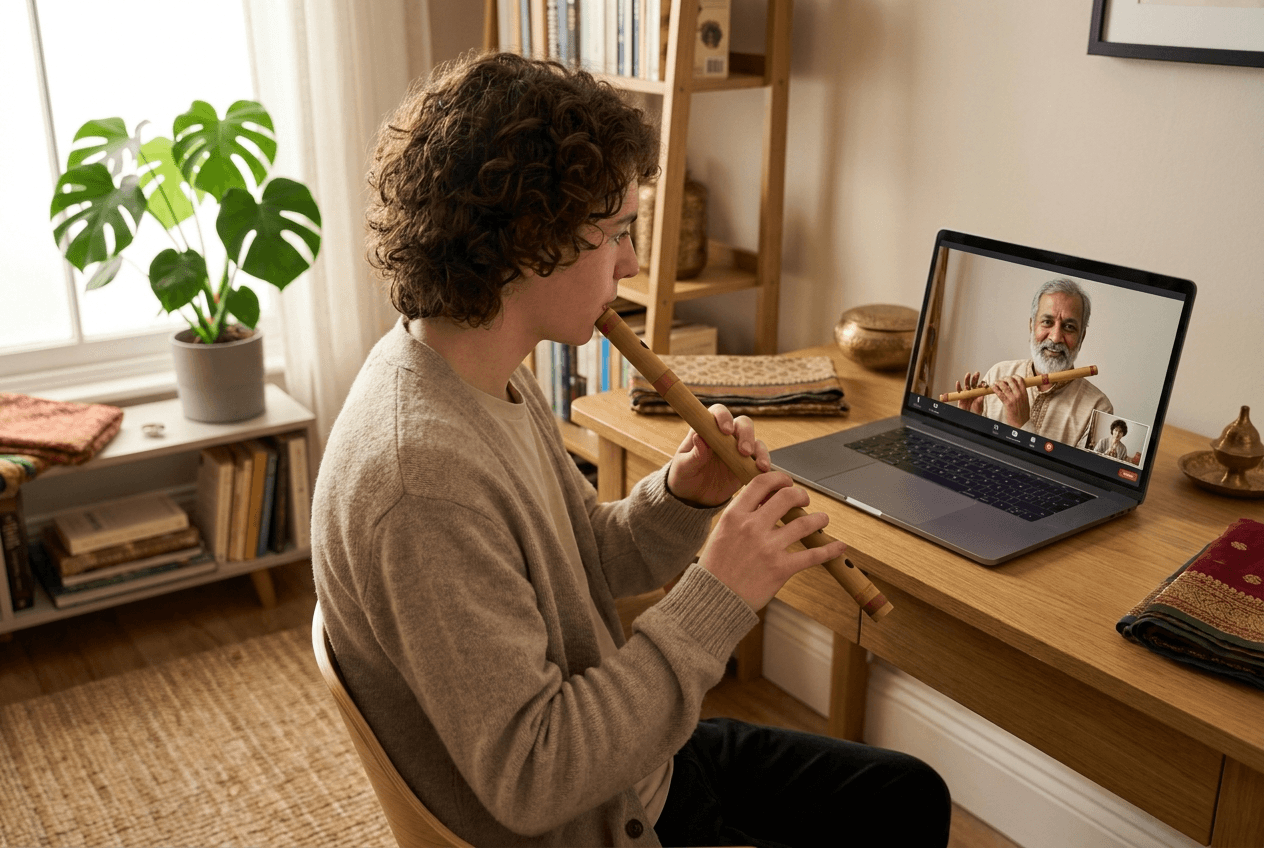
Month 1-2: The Embouchure Foundation
The first two months of bansuri learning are almost entirely about producing a clean, stable tone. This requires finding the correct embouchure position, the angle of the lips over the blowing hole, the degree to which the lower lip covers the hole, the direction and force of the breath stream. Most students produce a consistent tone by their fourth or fifth session; some manage it in the first. The milestone matters less than the process: a certified Art Gharana teacher guides the embouchure development live and in real time, catching problems the moment they appear rather than letting them solidify into habit.
Once basic tone is established, students begin learning the seven fundamental swaras: sa, re, ga, ma, pa, dha, ni. Ascending and descending scale patterns, controlled breathing exercises and simple alankar (ornamentation exercises) follow. The goal is not speed but clarity, each swara produced with a clean, consistent tone and accurate intonation relative to the tanpura drone the student plays in the background of every practice session.
Month 3-4: The First Raga
The introduction of the first raga is the most significant milestone in bansuri training. Art Gharana teachers typically introduce Raga Bhoopali as the beginner's first raga. Bhoopali uses only five notes, sa, re, ga, pa, dha, making it technically accessible while being musically beautiful. More importantly, it is a late afternoon raga with a quality of serene warmth that most students experience as immediately moving, giving them their first direct experience of what raga study is actually for.
Understanding what a raga is and why it matters for bansuri learning is enormously helpful at this stage. Our comparison of Carnatic vs Hindustani classical music explains the raga framework within which bansuri sits and helps beginners understand the difference between the note-set (the scale) and the full raga personality (the characteristic phrases, the emotional quality, the time associations). This context transforms the early technical work from drill into genuine musical understanding.
Month 5-6: Meend and Ornamentation
The characteristic ornamental vocabulary of the bansuri, meend (the glide between notes), gamak (a rapid oscillation), andolan (a slow, gentle shake) and khatka (a rapid ornamental flourish), is introduced progressively as the student's basic technique becomes reliable. Meend is the most important and most distinctive ornament in bansuri playing and requires the student to partially cover and uncover holes in a controlled, smooth motion while maintaining breath flow. Learning a clean meend from sa to pa on Bhoopali is a genuine artistic achievement that most students reach within six months of consistent weekly classes and daily practice.
Hariprasad Chaurasia and the Bansuri Tradition
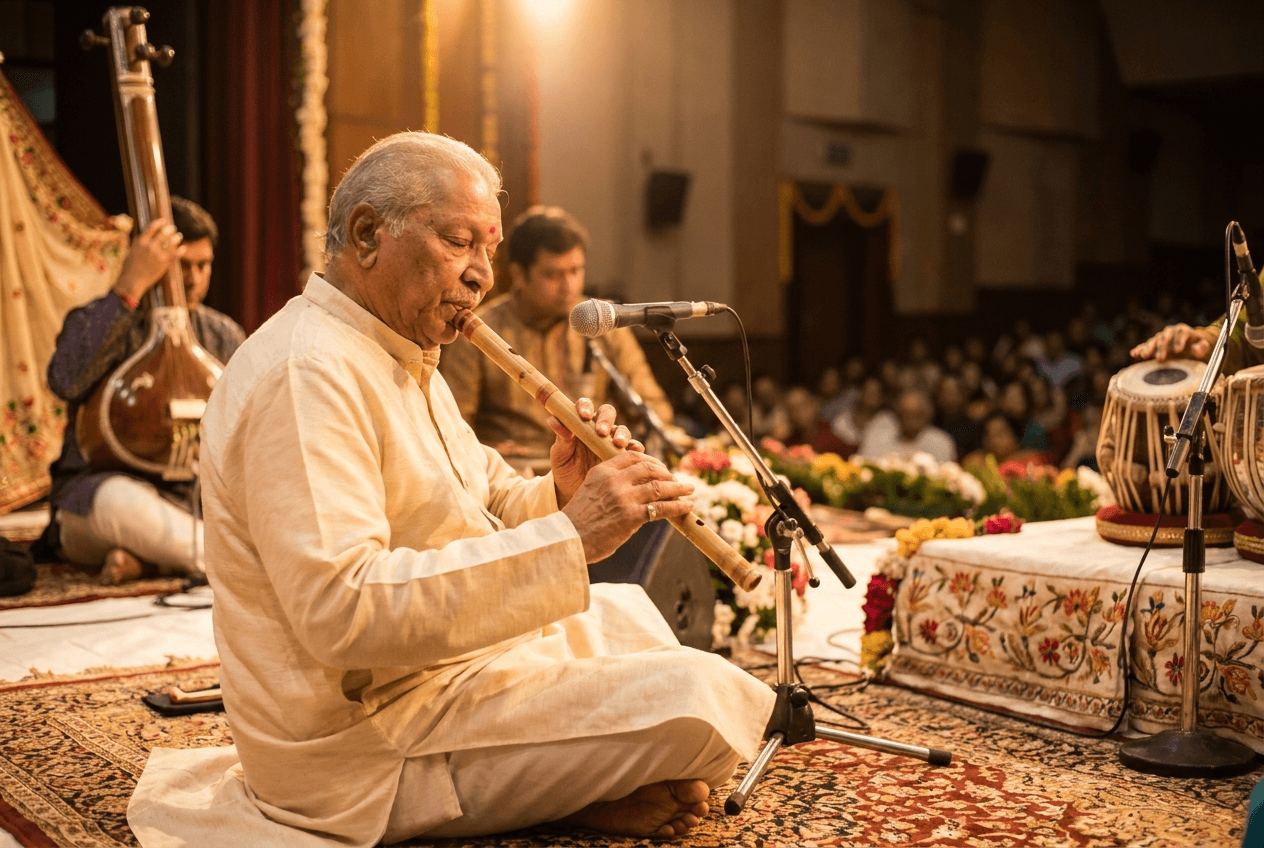 No discussion of bansuri learning is complete without acknowledging Pandit Hariprasad Chaurasia, whose recordings and teaching have shaped the modern understanding of what bansuri can do. Born in 1938 and trained initially as a Hindustani vocalist, Chaurasia took up the bansuri at nineteen and went on to become the instrument's most celebrated contemporary exponent. His recordings with Zakir Hussain, Shivkumar Sharma and others from the 1970s through today established the bansuri as a solo concert instrument capable of the full depth of classical raga performance.
Art Gharana's certified bansuri teachers carry training lineages that connect back to the classical tradition through their own gurus. When students ask about their teacher's background at the trial class, they should expect to hear a specific lineage, a named guru, a named institution, a tradition of transmission that places the teacher within the living classical tradition rather than outside it.
Setting Up for Online Bansuri Classes: What You Need at Home
The Physical Space
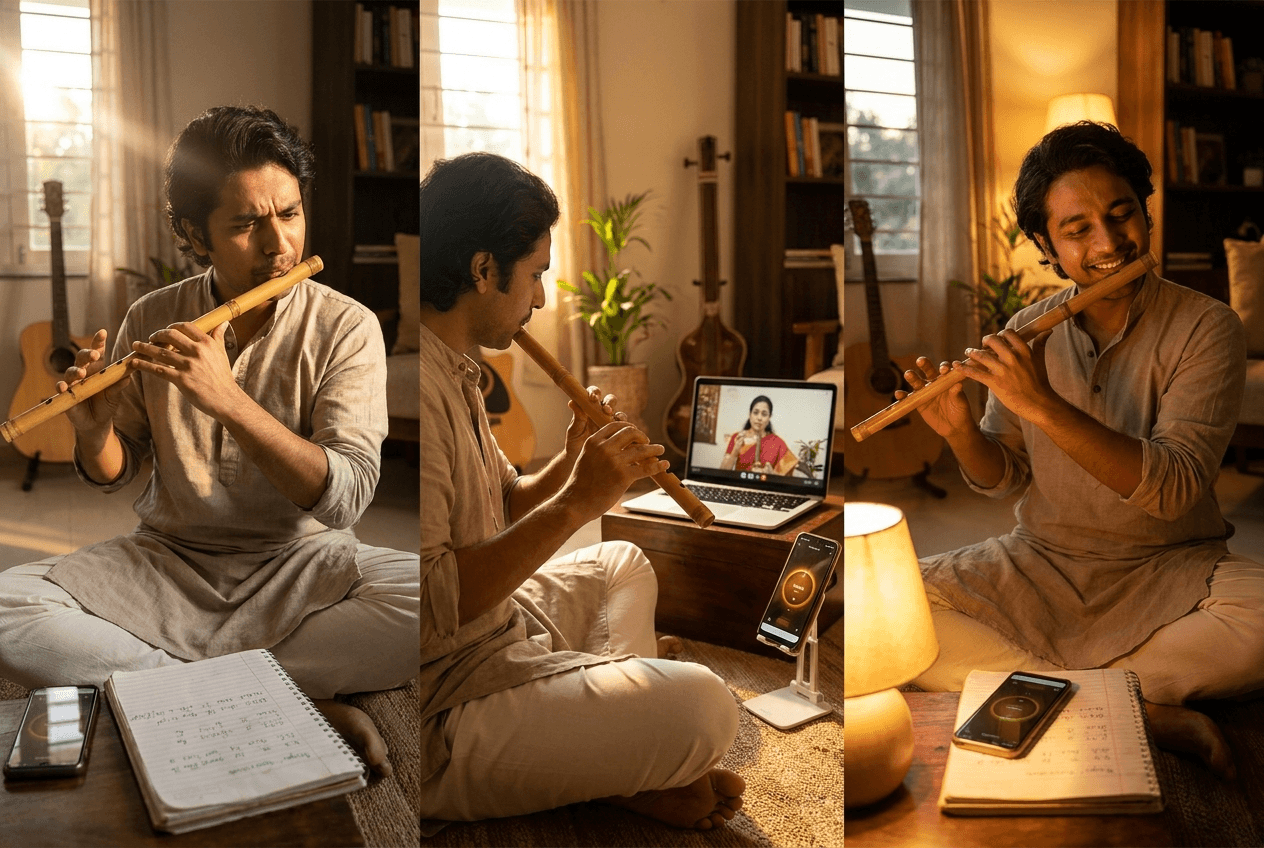
You need a quiet space, not soundproofed, just free of the background noise that makes teacher communication difficult. A standard living room or bedroom with the door closed is sufficient. Good lighting that illuminates your hands and face without backlighting you is important: the teacher needs to see your embouchure and finger placement clearly to give useful corrections. Position yourself so your face, lips and hands are all clearly visible in the camera frame.
Technology
A stable broadband connection, a laptop or tablet with camera and microphone, and standard video call software are all that is required. The bansuri's tone carries well through standard video call audio, this is one of the practical advantages of the instrument for online learning. You do not need a dedicated microphone; the built-in microphone on a modern laptop is sufficient for the teacher to assess tone quality accurately.
The Tanpura
Every bansuri practice session should be accompanied by a tanpura drone. The tanpura provides the tonic reference note against which all pitch accuracy is measured. Several free tanpura apps are available for smartphones, and your teacher will advise on the specific settings (scale, tuning, volume) appropriate for your instrument at the first class. Practising without the tanpura is the single most common mistake beginner bansuri students make, it allows incorrect intonation habits to form that become difficult to correct later. For more on how vocal practice and bansuri practice reinforce each other, see our notes on Hindustani vocal classes, where the tanpura plays an identical foundational role.
What to Expect in Your First 3 Months of Bansuri Classes
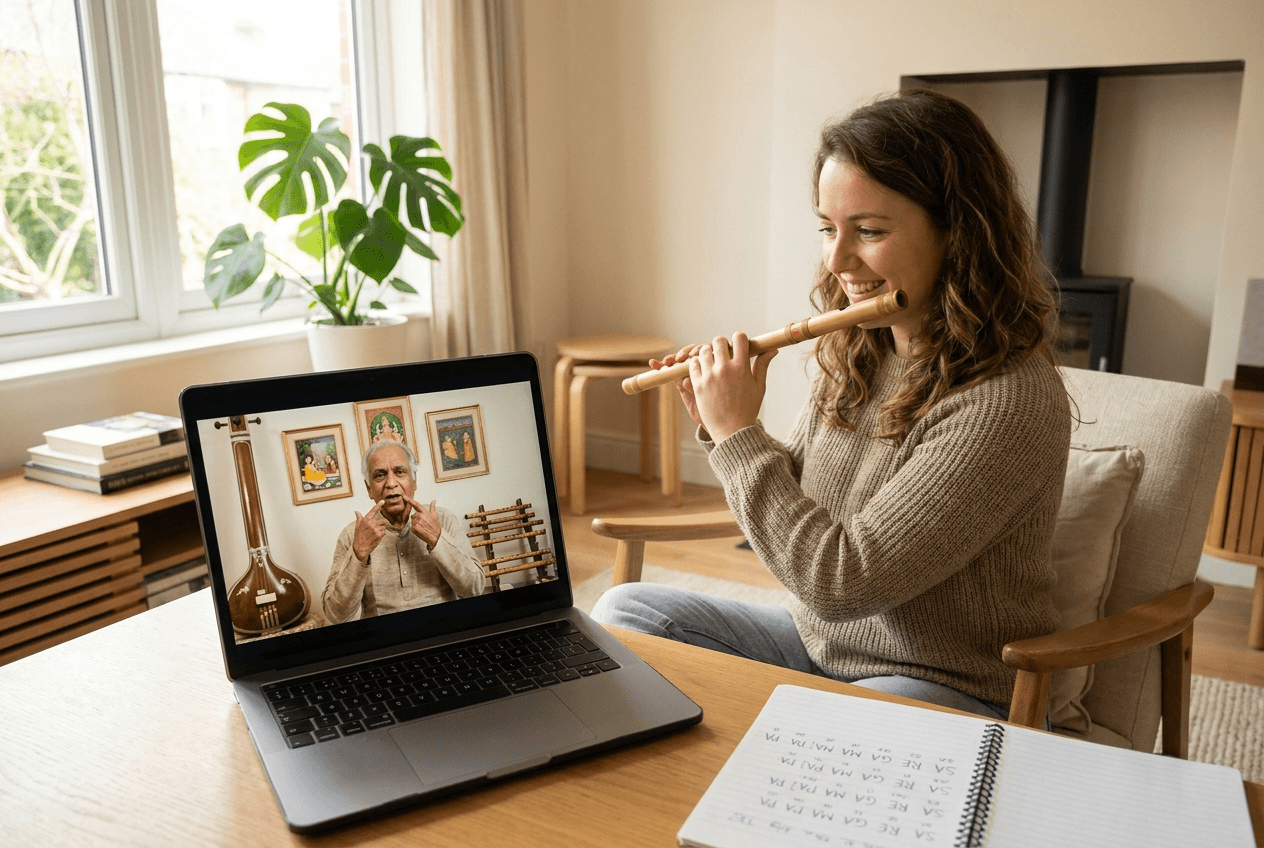 The first three months of bansuri learning, with weekly one-to-one classes and fifteen to twenty minutes of daily practice, produces progress that consistently surprises UK beginners. By week four, most students are producing reliable tones across at least four or five swaras. By week eight, basic alankar patterns are fluent and the first simple folk melodies are playable. By week twelve, students are beginning Raga Bhoopali and experiencing their first real musical engagement with the raga system.
The three-month mark is also when many students discover the meditative dimension of bansuri practice. The requirement to sustain a clean breath, maintain a specific embouchure position and produce the correct pitch, all simultaneously, in the context of a tanpura drone, produces a quality of focused, absorbed attention that practitioners describe variously as meditation, flow or simply the feeling of being completely present in the moment. This quality is one of the most consistently reported unexpected benefits of bansuri learning among Art Gharana's UK adult students.
Bansuri and the Broader Indian Classical World
The bansuri sits within a rich ecosystem of Indian classical instruments and traditions. Tabla players and bansuri players often study together because understanding rhythm from the tabla perspective transforms bansuri performance in raga compositions. If you are curious about what the tabla learning journey involves, our detailed tabla buying guide is a useful parallel read, it covers the beginner's instrument selection process in detail, which mirrors the bansuri buying process in several respects.
The relationship between the bansuri and Hindustani vocal is equally close: both traditions share the same raga system, the same tala framework and the same classical theoretical foundation. Students who study both simultaneously find that each accelerates understanding of the other. Our wider guide to types of Indian music puts the bansuri's classical tradition in context alongside Carnatic, folk and other Indian music forms, which is valuable background for any student beginning the classical arts journey.
People Also Ask: Bansuri Flute Classes in the UK
1. Can I learn bansuri without any music background?
Yes. Art Gharana's bansuri curriculum starts from absolute zero. No prior music theory knowledge, no ability to read notation and no previous instrument experience are required. The teacher assesses your specific starting point at the free trial class and builds the curriculum from there.
2. Is bansuri harder to learn than a Western flute?
The embouchure on the bansuri is similar in difficulty to the Western concert flute, both require the player to direct a focused breath stream across an open hole to produce a tone. The absence of mechanical keys on the bansuri means the finger technique is different but not necessarily harder. The ongoing learning challenge on bansuri is the depth of raga study rather than the basic mechanics of the instrument.
3. What is the best age to start bansuri?
Children can typically begin bansuri from age 8 to 10, when breath capacity and concentration are sufficient for the initial embouchure work. Adults can begin at any age. Art Gharana has active adult bansuri students in their 40s, 50s and 60s who began as complete beginners.
4. How much practice does a bansuri student need?
Fifteen to twenty minutes of focused daily practice between weekly classes is the minimum effective dose. Practice quality matters more than duration, fifteen focused minutes with the tanpura running, working on specific exercises the teacher has set, produces more progress than an hour of unfocused noodling.
5. Can I combine bansuri with other Indian arts?
Yes, and many students do. The most natural combinations are bansuri with Hindustani vocal (shared raga system), bansuri with tabla (shared tala framework) and bansuri alongside classical dance (Kathak specifically, for the shared Hindustani aesthetic). Art Gharana's Kathak classes and Hindustani vocal classes are popular choices alongside bansuri for UK students who want a more immersive classical Indian arts education.
6. Do I need to buy a bansuri before the trial class?
No. Do not purchase an instrument before your trial class. The teacher will assess your hands, breath capacity and learning goals at the trial and advise on exactly which instrument to purchase, in which scale and from which supplier. Buying before the trial risks purchasing the wrong instrument.
7. Is Art Gharana's bansuri course structured or flexible?
Both. Art Gharana's bansuri curriculum has a structured progression, from embouchure foundation through swara exercises, alankar patterns, first raga introduction and into the full classical repertoire, but the pace within this structure is entirely adapted to each individual student. There are no group class schedules to keep up with; the teacher moves at the speed that is right for this specific student. Find full details on our certified teacher profiles page and review our plans and pricing before your trial.
8. Where can I hear what a bansuri sounds like?
The best starting point is Pandit Hariprasad Chaurasia's recordings, search YouTube for his Raga Bhoopali, Raga Yaman or Raga Desh performances. Art Gharana's own website features instructor demonstration videos on our book a free trial class page, where you can also schedule your first session directly.
Common Mistakes UK Bansuri Beginners Make (And How to Avoid Them)
Practising Without the Tanpura
The tanpura drone is not optional. Every bansuri practice session should have a tanpura app running in the background from the very first day. Without the tanpura, the student has no pitch reference, and the ear develops in a vacuum that allows intonation errors to become habitual. The tanpura is free to download, takes thirty seconds to set up, and is among the most important tools in the bansuri learner's kit.
Forcing the High Register Too Early
The upper octave of the bansuri is produced by increased breath pressure combined with subtle changes in embouchure position. Many beginners try to jump to the high register before the lower register is secure, producing a thin, squeaky sound that discourages them. Art Gharana teachers keep students in the lower octave until the tone there is genuinely clear and consistent, usually two to three months, before introducing the upper register systematically.
Neglecting Daily Practice
Weekly classes without daily practice between sessions produce negligible progress on the bansuri. The embouchure, like any fine motor skill, develops through repetition rather than instruction alone. Fifteen minutes of daily practice, a fixed time, attached to an existing daily habit, produces dramatically better results than one hour of catch-up practice the night before the weekly class. Art Gharana teachers provide specific daily practice plans after every session, making the daily routine concrete and achievable.
Why the UK South Asian Community Is Discovering Bansuri
The bansuri is experiencing a revival of interest among British Indian, Pakistani and Bangladeshi families who want to connect their children and themselves to the North Indian classical tradition through an instrument that is both genuinely beautiful and directly connected to cultural and religious heritage. The association with Lord Krishna gives the bansuri a significance in the Hindu devotional context that few other instruments share. Several Art Gharana UK students have mentioned that their interest in the bansuri was first awakened by hearing it at a temple bhajan programme and wanting to understand the instrument that could produce that specific, ethereal sound.
The interest is not limited to children. Art Gharana's UK adult bansuri student community includes software engineers, doctors, teachers and business owners in their 30s, 40s and 50s who began bansuri as complete beginners. The one-to-one online format is particularly well-suited to the lives of these adults, who need scheduling flexibility and individual attention rather than the fixed weekly slot and group dynamics of a local community class.