ChatGPT
 Google AI
 Grok
Grok Claude
The harmonium is one of the most accessible, culturally relevant, and immediately rewarding instruments in Indian classical and devotional music. For British-Indian families, learning harmonium online from the UK is entirely practical with the right teacher, a basic instrument, and a simple home setup. This complete guide covers what the harmonium is, how it works, what a complete beginner needs to get started, how online lessons are structured, what the first year of learning looks like, and how to choose a qualified teacher from anywhere in Britain.
There is a sound that lives in the memory of nearly every person who grew up in an Indian household or attended an Indian temple or community gathering. A sustained, warm, slightly reedy keyboard sound underneath the bhajans and kirtans. The sound of devotion expressed through music.
That's the harmonium. And for tens of thousands of British-Indian families, it is the instrument most associated with heritage, worship, and the feeling of being part of something ancient and alive.
The harmonium is also one of the most learner-friendly instruments in Indian classical and devotional music. Unlike the violin (which requires months before producing a pleasant sound) or the bansuri (which demands weeks of embouchure development), the harmonium produces a consistent, beautiful tone from the first note. Beginners experience musical reward immediately.
Learning harmonium online in the UK is now genuinely practical and widely available. This guide tells you everything you need to know.
What Is the Harmonium and How Does It Actually Work?
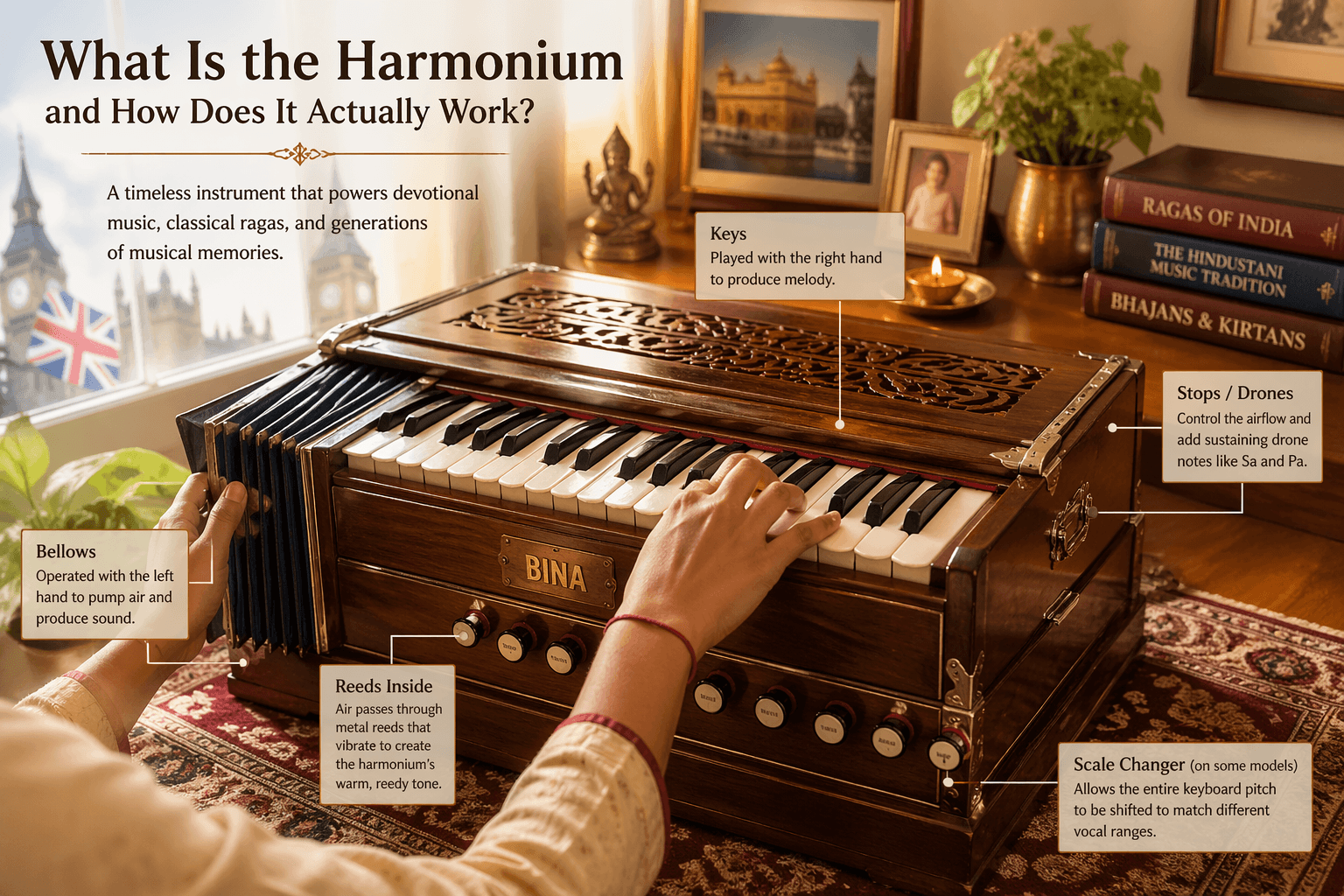
The Instrument's Origins and Indian Adoption
The harmonium is a keyboard instrument that arrived in India during British colonial rule in the 19th century. According to historical accounts, it was adapted from European cabinet organs and table harmoniums and quickly became central to Indian devotional and classical music practice, despite initial resistance from some classical purists who felt a Western instrument had no place in Indian music.
This resistance was eventually overcome by simple musical reality: the harmonium was practical, portable, affordable, and capable of producing a drone that supported Indian classical melodic structures. Within decades of its introduction, it had become standard in Hindustani classical performance, bhajan sessions, film music recording, and devotional practice across the Indian subcontinent.
Today, the harmonium is used in:
- Hindustani classical music accompaniment (supporting vocalists)
- Bhajans and devotional singing (both as accompaniment and as the primary melody instrument)
- Bollywood music production
- Gurudwara kirtan (Sikh devotional music)
- Classical pedagogy (for teaching ragas and swaras)
The Physical Components of a Harmonium
The Keys
A standard Indian portable harmonium has between 2.5 and 3.5 octaves (approximately 22-42 keys). The layout mirrors a piano keyboard: white keys for natural notes and black keys for sharps and flats. The physical playing action is similar to a piano keyboard, making the harmonium accessible to anyone familiar with keyboard instruments.
The Bellows
The rear bellows is the harmonium's "lung." In the standard Indian portable harmonium, the bellows is operated manually by one hand (typically the left) pushing the bellows in and out to force air through the reeds while the other hand plays the melody on the keys.
Some harmoniums have a small bellows on the front operated by a single hand, allowing both hands to be used on the keyboard. These are common in Pakistan and some North Indian traditions.
The quality and integrity of the bellows is one of the most important factors in harmonium quality. Leaky bellows produce inconsistent tone and require constant pumping.
The Stops and Drones
Most harmoniums have stop knobs on the sides or top. These include:
Master stop (wind supply): Controls the main air supply to all reeds.
Drone stops: Allows specific low-pitched notes (typically Sa, Pa, and Sa an octave lower) to sound continuously when pulled out. These drone notes provide the tonic reference that is essential in Indian classical music practice.
Reed bank stops: Higher-quality harmoniums have multiple reed banks with slightly different tunings or octave placements, allowing tonal variation.
Scale Changers
Some harmoniums include a scale-changer mechanism that shifts the entire keyboard up or down in pitch without retuning the instrument. This allows a harmonium accompanist to match different vocalists' tonic pitches by physically shifting the keyboard's starting position.
Why the Harmonium Is Ideal for British-Indian Beginners
Visual pitch map: The keyboard provides a visible, physical layout of pitches. Unlike the violin or flute where pitch is determined by invisible adjustments, on the harmonium you can see exactly where each swara is. This visual-physical mapping accelerates ear training significantly.
Immediate tonal reward: The harmonium produces a consistent, pleasant tone from the first note. Beginners hear musical results immediately, sustaining motivation through the early months.
Cultural immediacy: Within months of starting, beginners can accompany simple bhajans and participate in devotional settings. This immediate real-world application makes the learning feel meaningful and connected.
Solo and accompaniment versatility: The harmonium works beautifully as a solo melody instrument and as a vocalist's accompaniment instrument. Its versatility means the skills are applicable in a wide range of cultural settings.
What Equipment Does a UK Beginner Need?
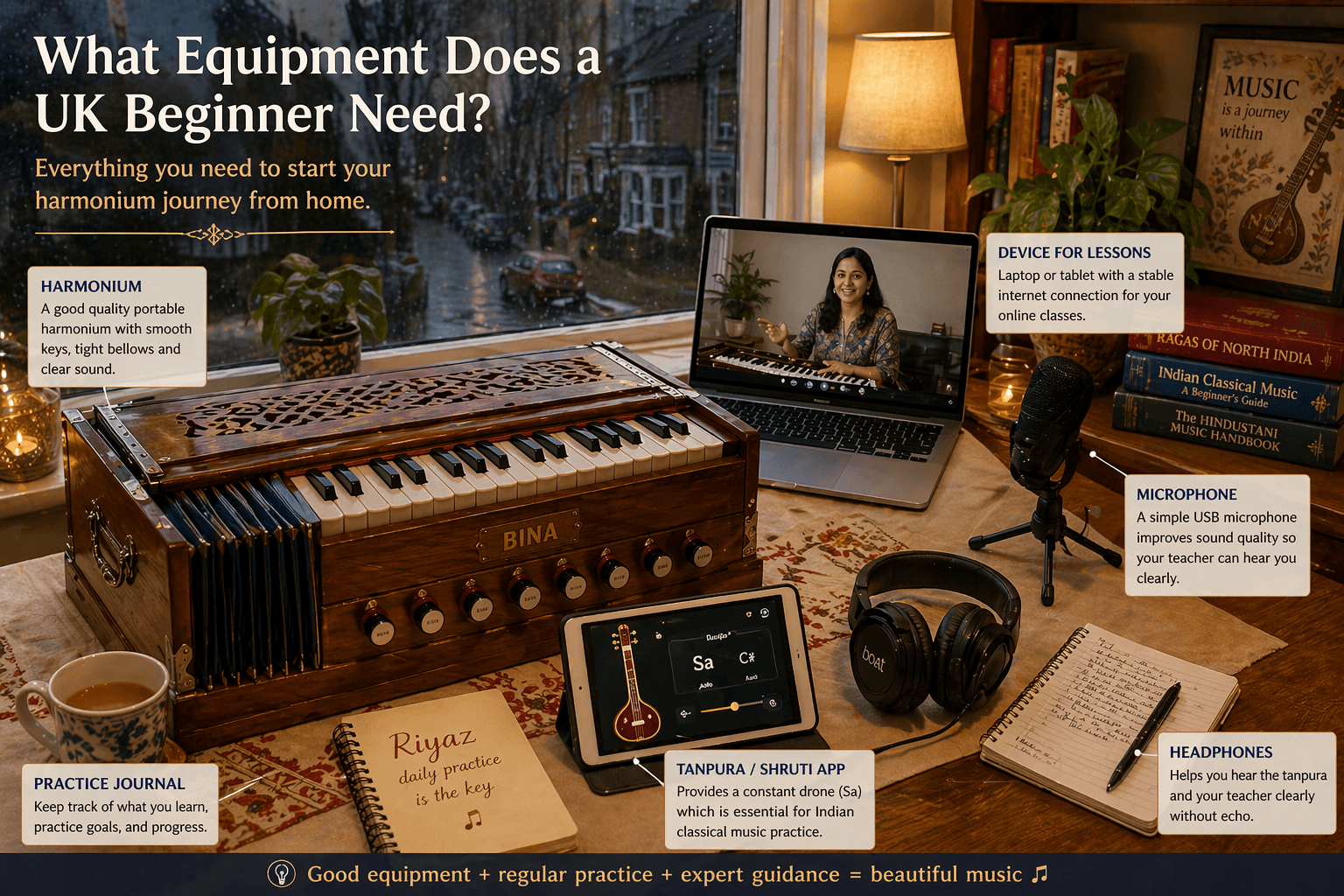
Choosing Your First Harmonium
For UK beginners, a portable box harmonium is the standard starting instrument. Investing appropriately in the first instrument makes a genuine difference to the learning experience.
Entry Level (£80-£150)
Functional basic portable harmonium. Suitable for the first 6-12 months of learning. Key considerations at this price:
- Check that keys press smoothly without sticking
- Verify the bellows doesn't have obvious air leaks (you'll hear an uneven tone if it does)
- Ensure the tuning is approximately correct (A=440Hz standard)
Where to buy in the UK: Hussain Music (Leicester, UK's largest Indian instrument retailer), India Musical Instruments (London), Tabla Shop (online), Amazon UK (from Indian instrument sellers).
Mid-Range (£200-£400)
Significantly better build quality, more stable tuning, better bellows operation, and improved reed quality. This price range is appropriate for serious beginners who are committed to learning. Mid-range harmoniums from reputable Indian makers like Bina, Paloma, or Bhargavi represent excellent value.
Quality Indicators to Check
Regardless of price:
- Keys press down smoothly and return immediately
- Bellows pumps evenly without air leaks (press keys while slowly operating the bellows and listen for consistency)
- The instrument is reasonably in tune (check Sa against a tuner app)
- The syahi (black drone paper on some models) is clean and unobstructed
Device Setup for Online Harmonium Lessons
Camera position: Position your camera at keyboard level, slightly to the side, angled to show:
- Your right hand on the keys
- Your left hand on the bellows
- The overall keyboard layout
The teacher needs to see your hand positions, finger placement, and bellows technique simultaneously.
Microphone: The built-in microphone on a laptop or tablet is usually adequate. A simple USB condenser microphone (£20-30) dramatically improves audio quality if you want the teacher to hear your tone more clearly.
Tanpura app: Install a tanpura or shruti box app (iTablaPro, Shruti Box Pro, or similar) before your first lesson. Your teacher will help you set the correct pitch.
What Does a Beginner Learn in the First Year?
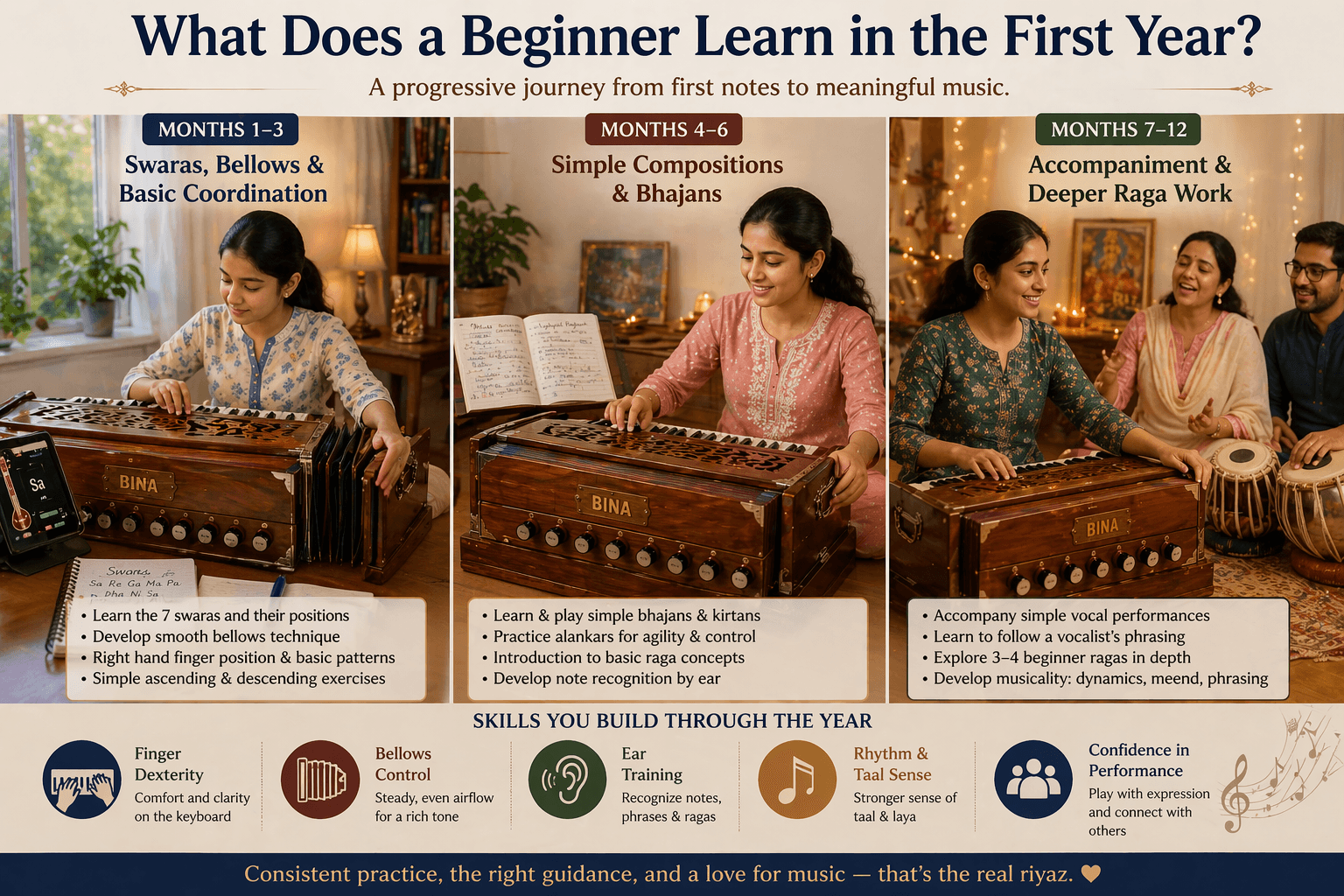
Months 1-3: Swaras, Bellows, and Basic Coordination
The foundation of all harmonium learning is establishing the seven swaras on the keyboard and developing smooth bellows technique simultaneously.
Locating the Swaras
Unlike the fixed absolute pitch of Western music, Indian classical music uses a moveable tonic. Your teacher will establish your Sa (tonic) at a specific key on the keyboard based on:
- The vocal range you're accompanying (if accompanying a singer)
- A comfortable pitch for the ensemble
- Standard conventions for the specific musical context
From Sa, the other swaras follow their fixed intervallic relationships. Students spend the first weeks learning to locate and name each swara on the keyboard, play simple ascending and descending patterns (sarali varisai), and maintain steady bellows operation.
Bellows Technique
The left hand's bellows operation must be smooth and consistent. Common beginner errors:
- Pumping too fast, creating uneven air pressure and pitch wobble
- Not pumping enough, causing the tone to fade between strokes
- Pumping in irregular rhythms
The teacher will introduce specific bellows exercises: long sustained notes on Sa while maintaining even bellows pressure, then the same while playing simple swara patterns.
Right Hand Finger Position
Harmonium fingering differs from piano fingering. Indian harmonium tradition uses specific fingering patterns that suit the melodic movement of Indian classical music, including characteristic slides (meends) between adjacent notes. Your teacher establishes correct finger position in the first lessons.
Months 4-6: Simple Compositions and Bhajans
Once swaras and bellows are established, the music begins.
Simple Bhajans and Kirtans
Most devotional learners begin with one or two simple bhajans that they know and love. Learning to play a familiar bhajan on harmonium provides immediate cultural connection and musical satisfaction. The teacher shows how to find the notes by ear, then refines the melodic accuracy and phrasing.
Simple Alankars
Alankar exercises (systematic swara patterns) build technical agility and extend the student's musical vocabulary. These are the harmonium equivalent of scales and arpeggios in Western music.
Introduction to Raga Concepts
For students interested in Hindustani classical music, the teacher begins introducing basic raga concepts: which swaras belong to a specific raga, the characteristic ascending and descending patterns, and simple compositions (bandish) within accessible ragas like Yaman or Bhupali.
Months 7-12: Accompaniment and Deeper Raga Work
The end of the first year typically includes:
- Accompanying simple vocal performances (either a family member or the student themselves)
- Learning to follow a vocalist's melodic phrasing
- Exploring 3-4 beginner-level ragas with their characteristic phrases
- Developing musical sensitivity (dynamics, ornamentation, phrasing)
How to Choose an Online Harmonium Teacher in the UK

Essential Qualifications
Hindustani classical music background: The harmonium teacher should have formal training in Hindustani classical music, not just self-taught playing ability. Understanding raga structure, tala systems, and the theoretical foundations of what they teach is essential.
Online teaching experience: Ask specifically how the teacher adapts their instruction for the online format. Experienced online harmonium teachers have developed specific techniques for correcting bellows operation and key technique through the camera.
Clear curriculum progression: A structured, progressive curriculum indicates pedagogical professionalism. Ask what the first six months of learning looks like.
Trial class: Mandatory. Always trial before committing.
At Art Gharana, our harmonium and Indian classical music teachers are experienced, qualified, and culturally aligned with the British-Indian community. Explore our full course range and read our beginner's guide to Indian classical music.
Harmonium in Gurdwara Kirtan: A Special Note for Sikh Families
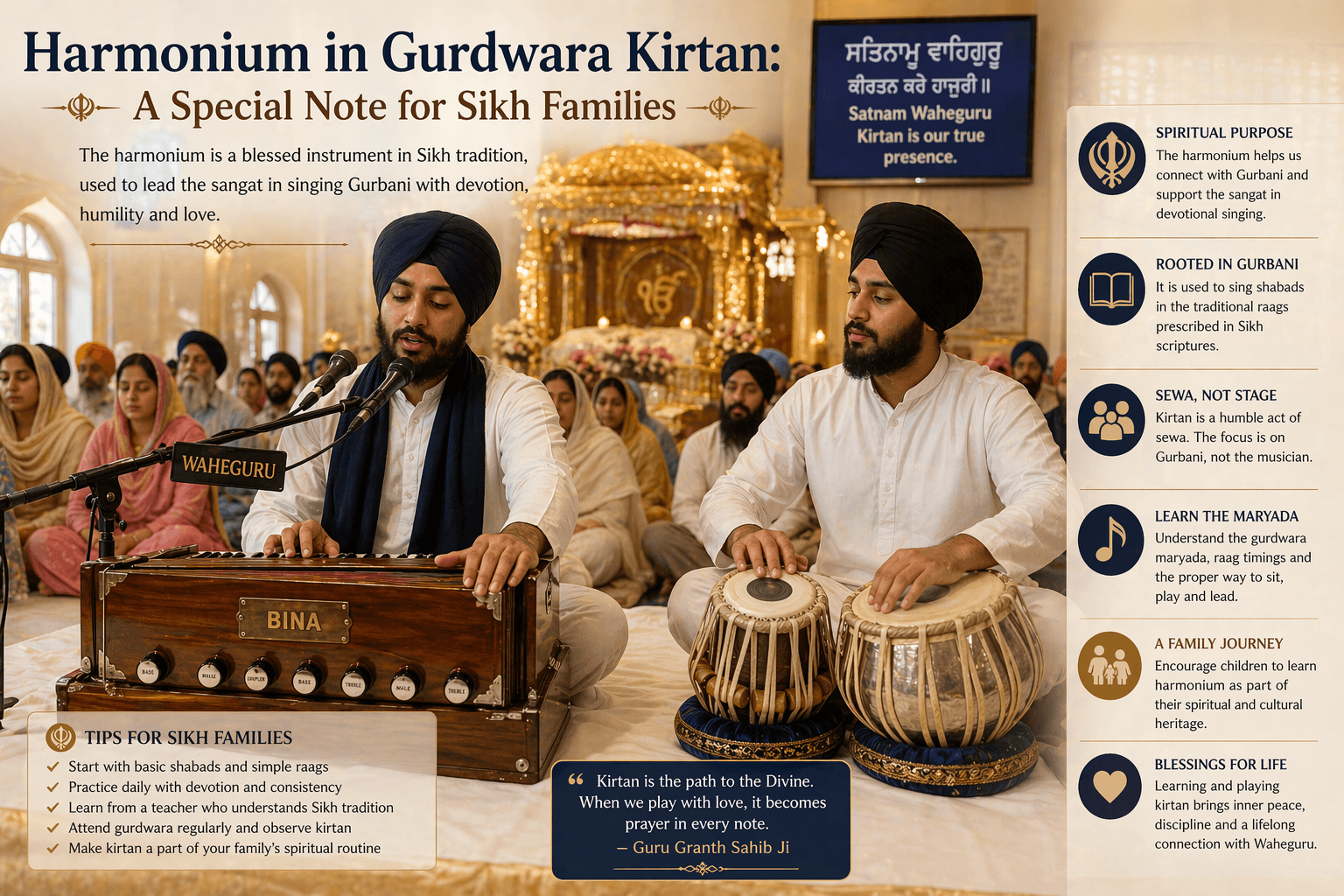
The Harmonium's Central Role in Sikh Devotional Music
For British Sikh families, the harmonium holds particular significance. In Gurdwara kirtan (devotional singing of Gurbani), the harmonium is the standard accompanying instrument alongside the tabla. Learning to play harmonium gives Sikh children and adults the ability to participate meaningfully in the Gurdwara musical tradition.
The ragas specified in the Sri Guru Granth Sahib for specific shabads (hymns) are classical Indian ragas. Learning harmonium in the context of kirtan involves understanding these ragas, their characteristic phrases, and how they are applied in the specific shabad traditions.
Many harmonium teachers who work with British-Indian communities have specific experience in kirtan accompaniment. If this is your primary goal, mention it explicitly when choosing a teacher.
Conclusion
The harmonium is one of the most accessible, culturally immediate, and musically rich instruments a British-Indian family can begin learning. Whether your goal is accompanying bhajans, developing classical musicianship, or participating in Gurdwara kirtan, the harmonium opens every door.
Three things to take away. First, invest in a decent harmonium from the start. Even a mid-range instrument makes learning dramatically more enjoyable than a poor-quality one. Second, consistent bellows technique is the most common early challenge. Give it focused attention from the first lesson. Third, daily 15-20 minute practice is far more effective than occasional long sessions.
Book a free trial harmonium lesson at Art Gharana today and begin your musical journey.
Frequently Asked Questions
1. Do I need any musical experience to start learning harmonium?
No. The harmonium is genuinely beginner-friendly. Its keyboard layout is visually intuitive, it produces consistent tones immediately, and its physical demands are manageable for complete beginners at any age.
2. Can I learn harmonium on an electronic keyboard instead?
A standard electronic keyboard can substitute for early swara location learning. However, the specific bellows technique that is central to authentic harmonium playing cannot be practised on an electronic keyboard. For serious learning, an acoustic harmonium is necessary.
3. How long does it take to accompany a simple bhajan on harmonium?
Most beginners can provide basic accompaniment to a simple bhajan within 3-6 months of consistent weekly lessons and home practice. Developing musical sensitivity and smooth accompaniment ability typically takes 12-18 months.
4. Is the harmonium used in Carnatic music?
Traditionally, no. The harmonium is associated primarily with Hindustani (North Indian) classical music and devotional traditions. Carnatic music uses the shruti box (a simpler drone instrument) and does not incorporate harmonium in the traditional ensemble.
5. What is a scale changer harmonium and do I need one?
A scale changer harmonium has a mechanism that shifts the keyboard up or down in pitch, allowing the player to change tonic (Sa) without retuning. For beginners accompanying their own singing, it's helpful. For those accompanying different vocalists regularly, it's very useful. For the first year of solo learning, a standard harmonium without a scale changer is fine.