ChatGPT
 Google AI
 Grok
Grok Claude
Choosing your first keyboard or digital piano in Canada in 2026 involves navigating a wide range of options, price points, and technical specifications. This comprehensive guide covers the critical differences between keyboards and digital pianos, what weighted and unweighted keys actually mean for your learning, which specific models represent the best value at each Canadian price point, the essential accessories you need from day one, and how to avoid the most expensive beginner buying mistakes in Canada's music market.
Keyboard vs Digital Piano: Understanding the Difference
Why This Distinction Matters for Beginners
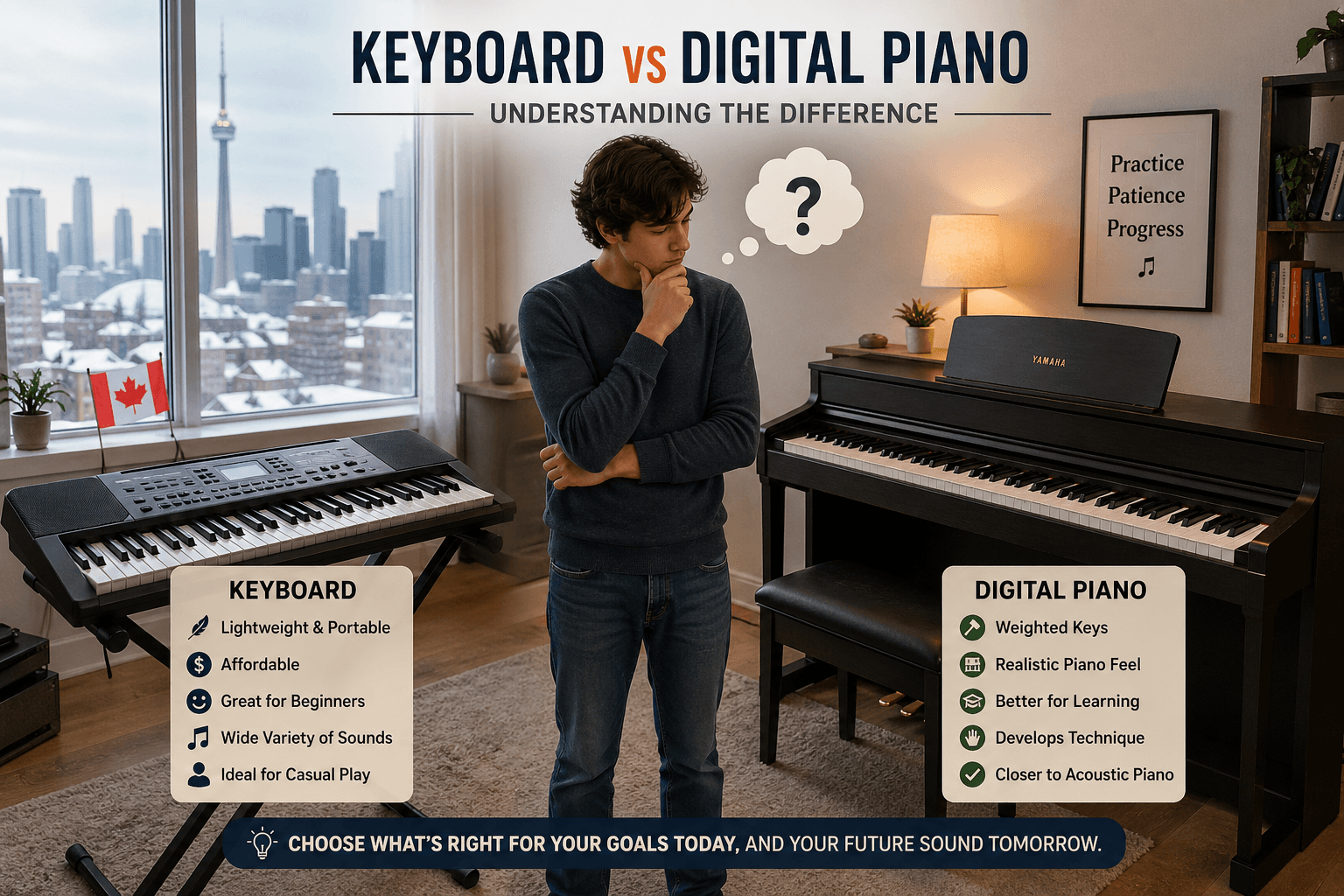
The terms "keyboard" and "digital piano" are used interchangeably by many beginners but refer to genuinely different products with meaningfully different implications for learning. Understanding this distinction before making a purchase saves most Canadian beginners considerable frustration.
Unweighted Keyboards
An unweighted keyboard has keys that move with no physical resistance - like pressing a calculator button. These are the least expensive keyboard instruments and are appropriate for:
Very young children (under age five) doing exploratory music play Music production and MIDI control (recording and synthesizer applications) Casual hobbyists who want to pick out simple melodies without systematic learning
For anyone intending to learn piano technique seriously - including working toward ABRSM grades - unweighted keys are genuinely inappropriate. Playing on unweighted keys develops different finger habits from playing on real piano keys, habits that become obstacles when transitioning to a real or digital piano.
Semi-Weighted Keyboards
Semi-weighted keys have a spring mechanism that provides some resistance, giving a slightly more piano-like feel without the full acoustic piano action. These are a step up from unweighted and are acceptable for beginners in the first year who cannot yet invest in a full digital piano.
Weighted Digital Pianos
Weighted (or hammer-action) keys replicate the physical feel of acoustic piano keys. Each key is heavier to press at the bottom and lighter at the top, matching the resistance created by the acoustic piano's hammer mechanism. This weight:
Develops the finger strength that real piano technique requires Trains touch sensitivity (how hard you press affects how loud the note sounds) Creates muscle memory that transfers directly to acoustic piano playing
For any student receiving serious piano instruction, working toward examinations, or learning for more than casual play, a fully weighted digital piano is the right choice.
Key Count: How Many Keys Do You Need?
88 Keys (Full Size)
The full standard piano has 88 keys. A digital piano with 88 weighted keys is the ideal choice for any student receiving systematic instruction. It ensures that any piece, in any range, can be played without running out of keyboard.
76 Keys
A reasonable compromise for students with space or budget limitations. Most beginner and intermediate repertoire fits within 76 keys. ABRSM Grade 1-5 repertoire is typically accessible on a 76-key instrument.
61 Keys
Acceptable for very early beginner exploration but limiting once intermediate repertoire is introduced. Not recommended for students working toward examinations or serious development.
49 Keys and Below
For exploration and music production only. Not appropriate for piano instruction.
Top Keyboard and Digital Piano Recommendations for Canadian Beginners in 2026
Under $400 CAD - Entry Level
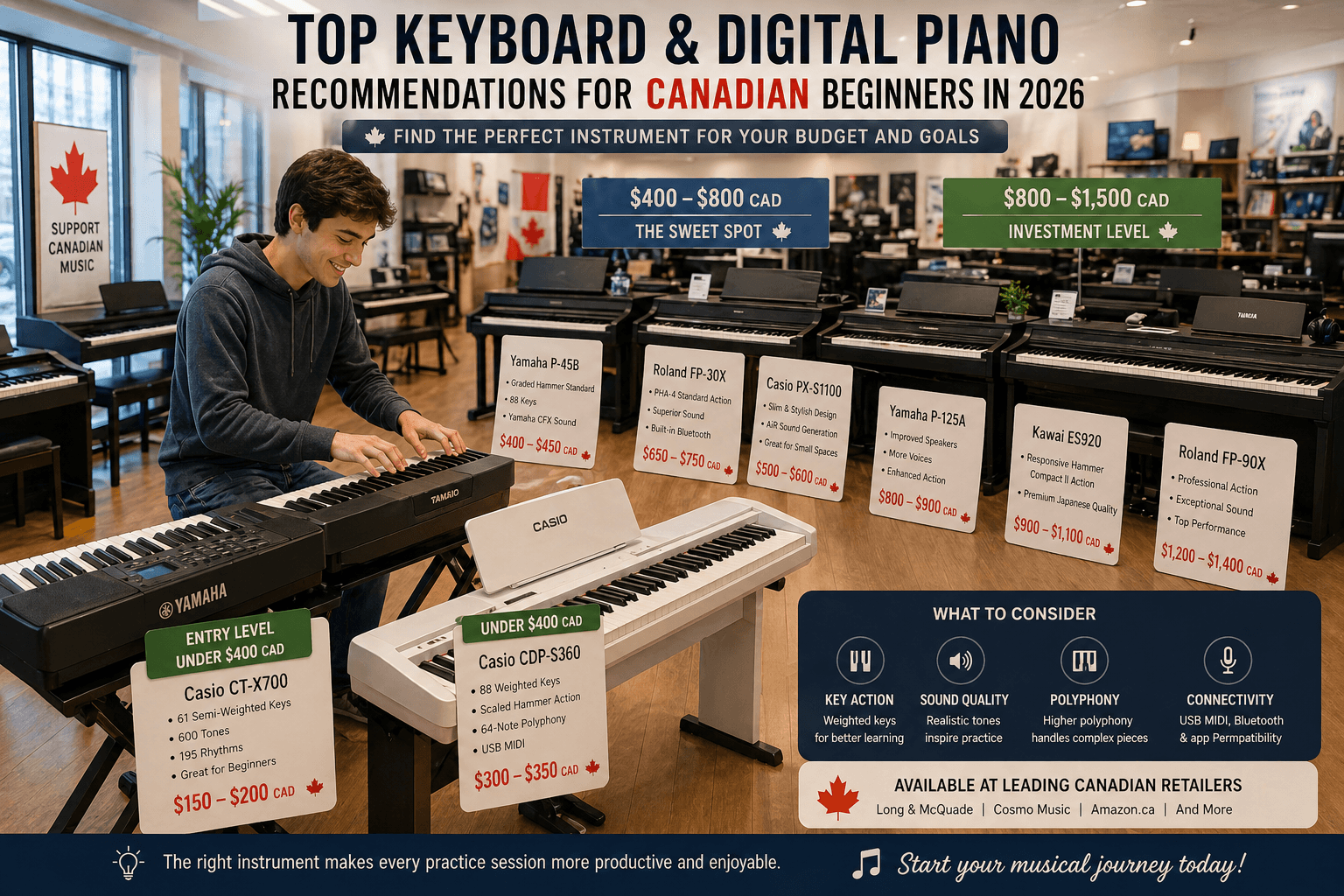
Casio CT-X700 ($150-200 CAD)
Semi-weighted, 61 keys. The best entry-level keyboard at this price for beginners who need to start very affordably. Acceptable for the first two to three months before upgrading to a weighted instrument.
Casio CDP-S360 ($300-350 CAD)
The most recommended fully weighted 88-key digital piano under $400 in Canada. Scaled hammer action, 64-note polyphony, USB MIDI connectivity. Excellent value for a beginner who wants a proper instrument without a large investment.
$400-$800 CAD - The Sweet Spot
Yamaha P-45B ($400-450 CAD)
The industry standard recommendation for beginner digital piano in Canada and worldwide. Graded hammer standard weighted keys, 88 keys, excellent Yamaha CFX grand piano sample. Available at Long & McQuade, Cosmo Music, and online retailers across Canada. The single most defensible recommendation for Canadian piano beginners at this price.
Roland FP-30X ($650-750 CAD)
A significant step up in key feel and sound quality. Roland's PHA-4 Standard keyboard action is widely considered the best-feeling keyboard action in this price range. For beginners willing to invest slightly more for a noticeably better playing experience.
Casio PX-S1100 ($500-600 CAD)
Extremely slim profile, excellent sound quality, AiR Sound Generation technology. A good option for learners with limited space who want a high-quality weighted instrument.
$800-$1,500 CAD - Investment Level
Yamaha P-125A ($800-900 CAD)
The next step up from the P-45. Better speaker system, more voice options, improved action. For students who are committed to piano learning and want an instrument they won't outgrow quickly.
Roland FP-90X ($1,200-1,400 CAD)
Professional-level digital piano action that rivals acoustic piano feel. An investment for students who are serious about development and want the closest possible approximation to acoustic piano without the maintenance costs.
Kawai ES920 ($900-1,100 CAD)
Japanese-made, outstanding action, excellent sound. Kawai's Responsive Hammer Compact II action is particularly well-regarded for its realistic feel.
Essential Accessories for Canadian Keyboard Beginners
The Non-Negotiable Accessories
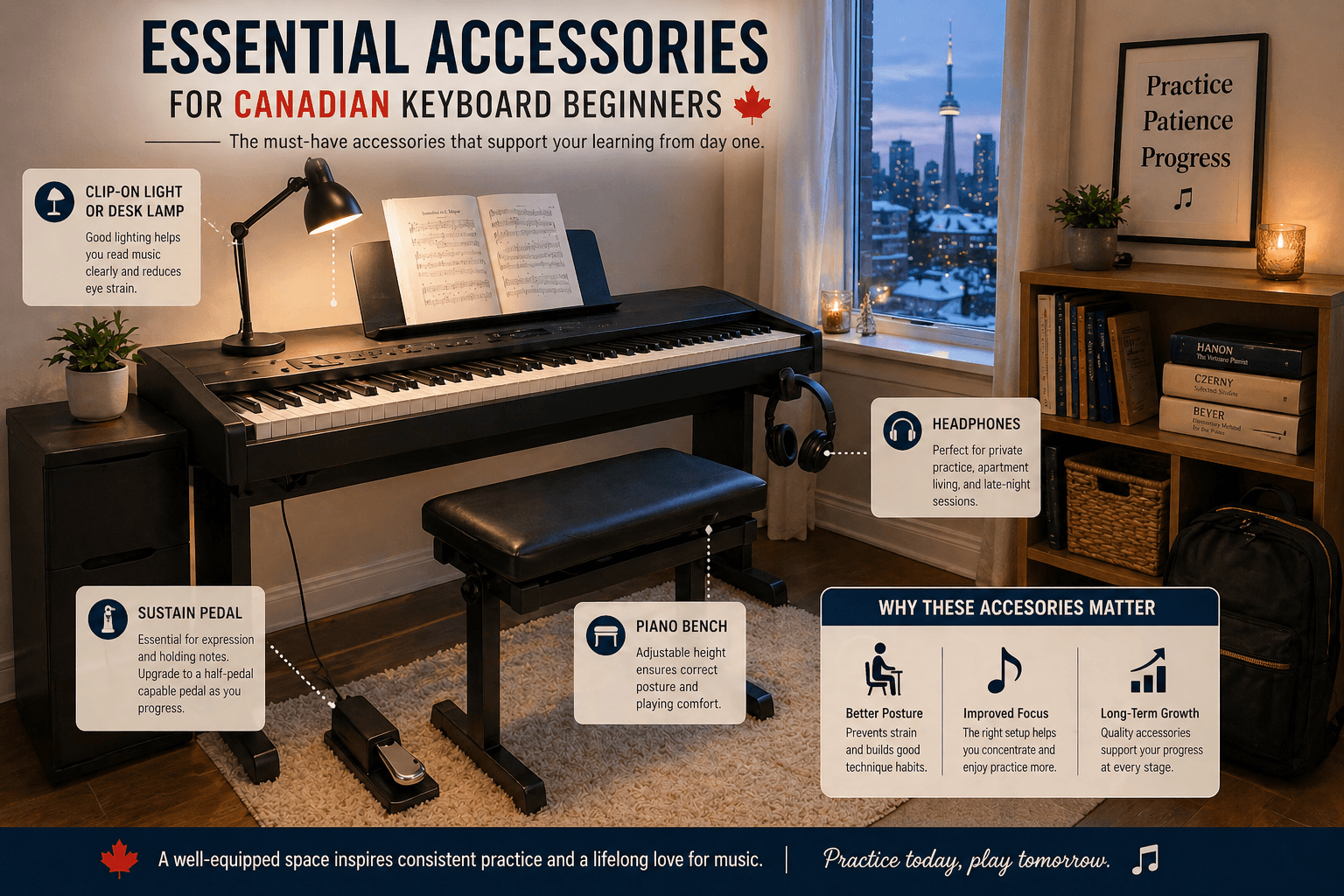
Sustain Pedal
The sustain pedal (the rightmost foot pedal on an acoustic piano) is essential for most intermediate piano pieces. Many entry-level digital pianos include a basic sustain pedal. Upgrade to a half-pedal-capable pedal (like the Roland DP-10 or Yamaha FC3A) when your instruction reaches the point where pedalling subtlety matters.
Piano Bench
An adjustable-height bench is essential for correct posture. Playing at the wrong height is one of the most common causes of piano-related strain. Piano benches are available from Long & McQuade for CAD $60-$150.
Clip-On Light or Desk Lamp
Good lighting over the keyboard is important for reading notation. A simple adjustable desk lamp works well.
Headphones
For apartment living or late-night practice, headphones are invaluable. The Sennheiser HD 280 Pro ($80-120 CAD) or Sony MDR-7506 ($90-120 CAD) are both excellent choices for piano practice.
Stand Considerations
Many entry-level digital pianos include a simple X-stand. For ongoing serious use, a dedicated furniture-style stand that positions the keyboard at a fixed, correct height is significantly better for posture. Yamaha and Roland both offer matching stands for their digital piano models.
The Learning Journey: What to Expect in Your First Year
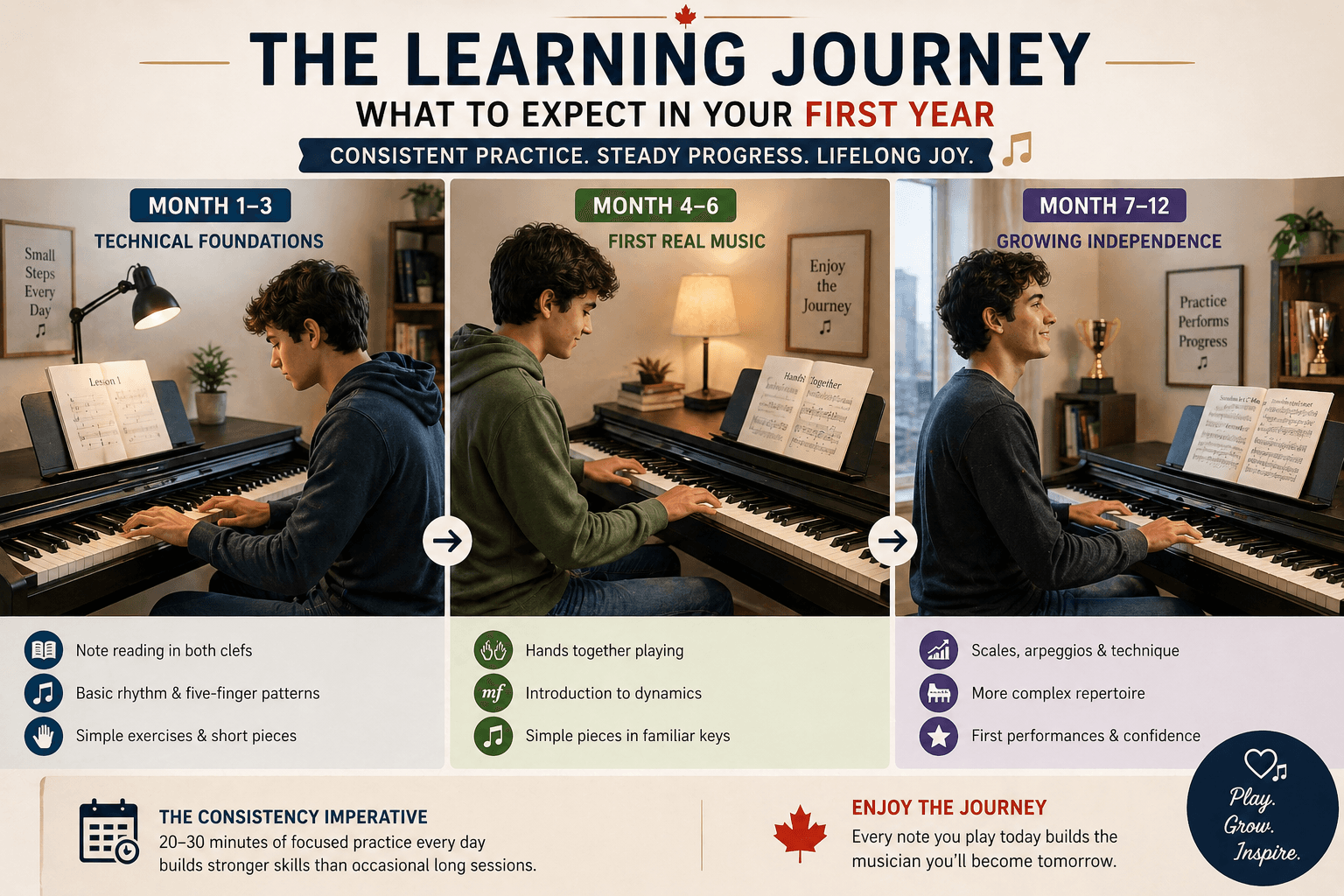
Month 1-3: Technical Foundations
Both hands learning their home positions, note reading in treble and bass clef, basic rhythm notation, simple five-finger pieces. This phase is often slower and less musical than beginners expect. Patience through the foundation phase produces dramatically better results than rushing to impressive-sounding pieces before the foundations are solid.
Months 4-6: First Real Music
Hands together playing, simple pieces in familiar keys, first introduction to dynamics and expression. Most students reach ABRSM Grade 1 equivalent standard within this timeframe with consistent practice.
Months 7-12: Growing Musical Independence
Scale work, arpeggios, more complex pieces, beginning music theory, first performance experiences. The end of the first year for a consistent, motivated adult beginner often sees Grade 2-3 equivalent capability and genuine musical expression.
The Consistent Practice Imperative
Research consistently confirms that 20-30 minutes of daily focused practice produces faster progress than occasional longer sessions. For Canadian adults with busy schedules, 20 minutes daily is both realistic and sufficient for meaningful progress. The key is daily contact with the instrument, not session length.
Online Keyboard and Piano Lessons for Canadian Beginners
Why Online Lessons Work for Keyboard and Piano
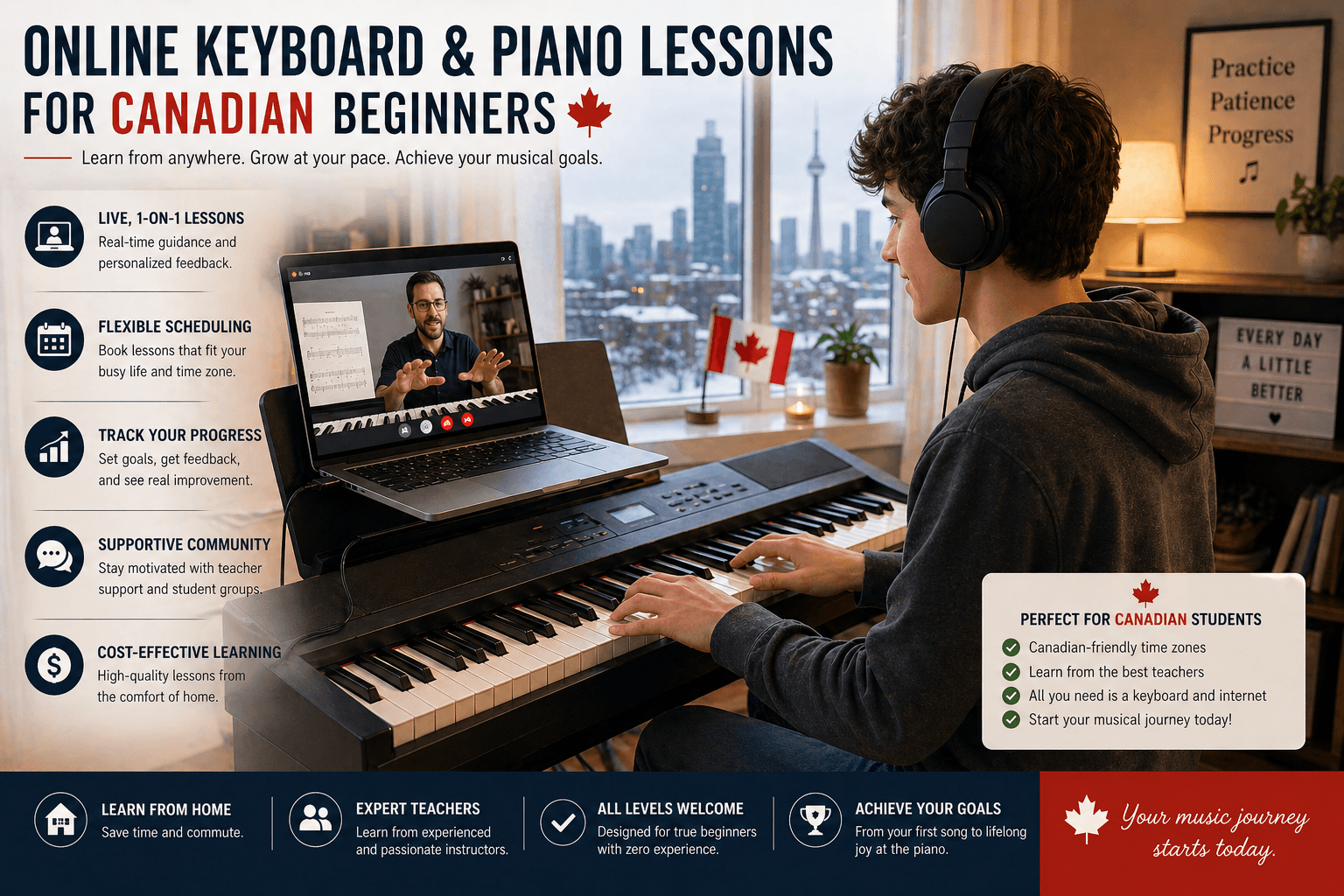
Piano is one of the best-suited instruments for online instruction. The camera can clearly show hand positions, finger placement, and technique. The teacher hears tone quality and rhythm clearly. And unlike ensemble instruments, piano is a solo instrument that doesn't require physical proximity to other musicians.
What to Look for in an Online Piano Teacher in Canada
Formal qualifications (Grade 8 ABRSM minimum, ideally a music degree or diploma) ABRSM examination experience if examinations are a goal Experience teaching beginners in your age group (adults vs children require different approaches) A free trial lesson
Art Gharana offers live 1:1 online keyboard and piano lessons for beginners across Canada, taught by certified, experienced instructors. Explore our instrument courses or book a free trial directly.
Conclusion
Choosing the right keyboard or digital piano is one of the most consequential decisions a Canadian music student makes. An appropriate instrument makes learning significantly more productive and enjoyable. An inappropriate instrument (unweighted keys for serious instruction, too few keys for advancing repertoire) creates limitations that compound over time.
Three things to take away. First, buy weighted keys for any serious learning - the Yamaha P-45B is the most defensible single recommendation for most Canadian beginners. Second, invest in the essential accessories (sustain pedal, bench) from the start. Third, find a qualified teacher and commit to 20 minutes of daily practice.
Book a free trial keyboard or piano lesson at Art Gharana today and start building real skills on a proper instrument.
Frequently Asked Questions
1. What is the best keyboard for a beginner in Canada under $500 CAD?
The Yamaha P-45B (approximately $400-450 CAD) is the most consistently recommended weighted digital piano for beginners in Canada. It offers graded hammer standard weighted keys, 88 keys, and Yamaha's high-quality piano samples at an accessible price point.
2. Do I need 88 keys to start learning piano?
Ideally yes. 88 keys ensures any piece in any range can be played and prevents the frustrating limitation of running out of keyboard as your repertoire advances. If budget requires a compromise, 76 keys is acceptable for early learning.
3. Is a weighted keyboard necessary for learning piano properly?
Yes. Unweighted keys develop different technique habits that become significant obstacles when transitioning to acoustic piano or working toward examinations. Weighted keys develop the finger strength and touch sensitivity that real piano technique requires.
4. Can online piano lessons teach proper technique?
Yes. Live 1:1 online lessons allow teachers to observe hand position, posture, and technique through the camera and provide real-time corrections. Most piano technique correction is verbal and visual and works fully effectively through video call instruction.
5. What is the difference between a digital piano and a stage piano?
A digital piano is designed for home use as an acoustic piano substitute, typically with furniture-style or portable stands, internal speakers, and beginner-to-intermediate features. A stage piano is designed for live performance, typically without built-in speakers, with more robust construction. For home learning, a digital piano is the appropriate choice.