ChatGPT
 Google AI
 Grok
Grok Claude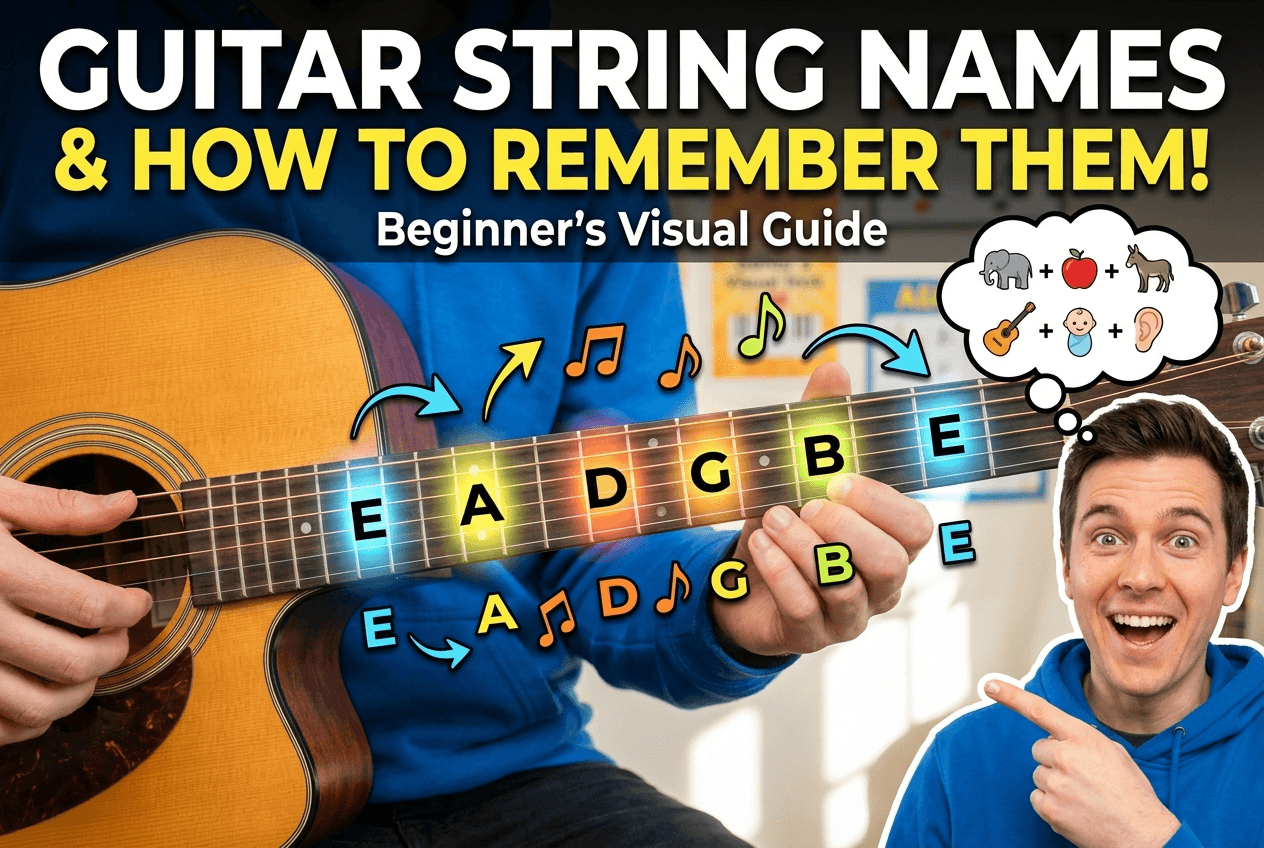
Every guitarist remembers the moment they stared at their instrument and thought, "Which string is which?" Six strings, two directions to count from, and a handful of competing mnemonic devices thrown at you from every YouTube tutorial and guitar book you've ever opened. It's genuinely confusing at first. But here's the good news: learning guitar string names is actually one of the fastest foundational skills you'll ever master as a beginner, and once they click, they stay with you for life.
Why Knowing Your Guitar String Names Matters More Than You Think
 Most beginner guitarists treat string names as a trivial memorization exercise, something to check off before getting to the "real" learning. That attitude costs them time, clarity, and progress in ways they don't immediately recognize. Knowing your string names fluently transforms how quickly you absorb everything else your teacher, tutorial, or chord chart throws at you.
Think about what happens every single time you read a guitar tab, watch a lesson video, or follow a chord diagram. The instructor says "play the G string" or "mute the low E." If you have to pause and mentally reconstruct which string they mean, you lose the thread of the lesson in that moment. Multiply that pause across hundreds of lessons and practice sessions and you begin to understand why fluent string name recall is genuinely foundational rather than trivially preliminary.
String names also unlock your ability to communicate effectively with other musicians. Jamming with a friend, taking lessons with a new teacher, asking a question in an online guitar forum, or reading a music theory explanation all require a shared vocabulary. The six string names are the most basic unit of that vocabulary. Without them, you're navigating a foreign city without street names, making progress but always slightly lost and always taking longer than necessary.
Beyond communication, string names connect directly to music theory in ways that pay dividends as your playing develops. Each string's name corresponds to its open pitch, the note it produces when played without fretting. Understanding that the open strings produce specific named pitches anchors your developing sense of the fretboard's layout, accelerates the process of learning individual note positions, and gives you the conceptual framework for understanding tuning, capo usage, and eventually alternate tunings that expand your creative palette dramatically.
The Six Guitar String Names in Order: Your Essential Reference
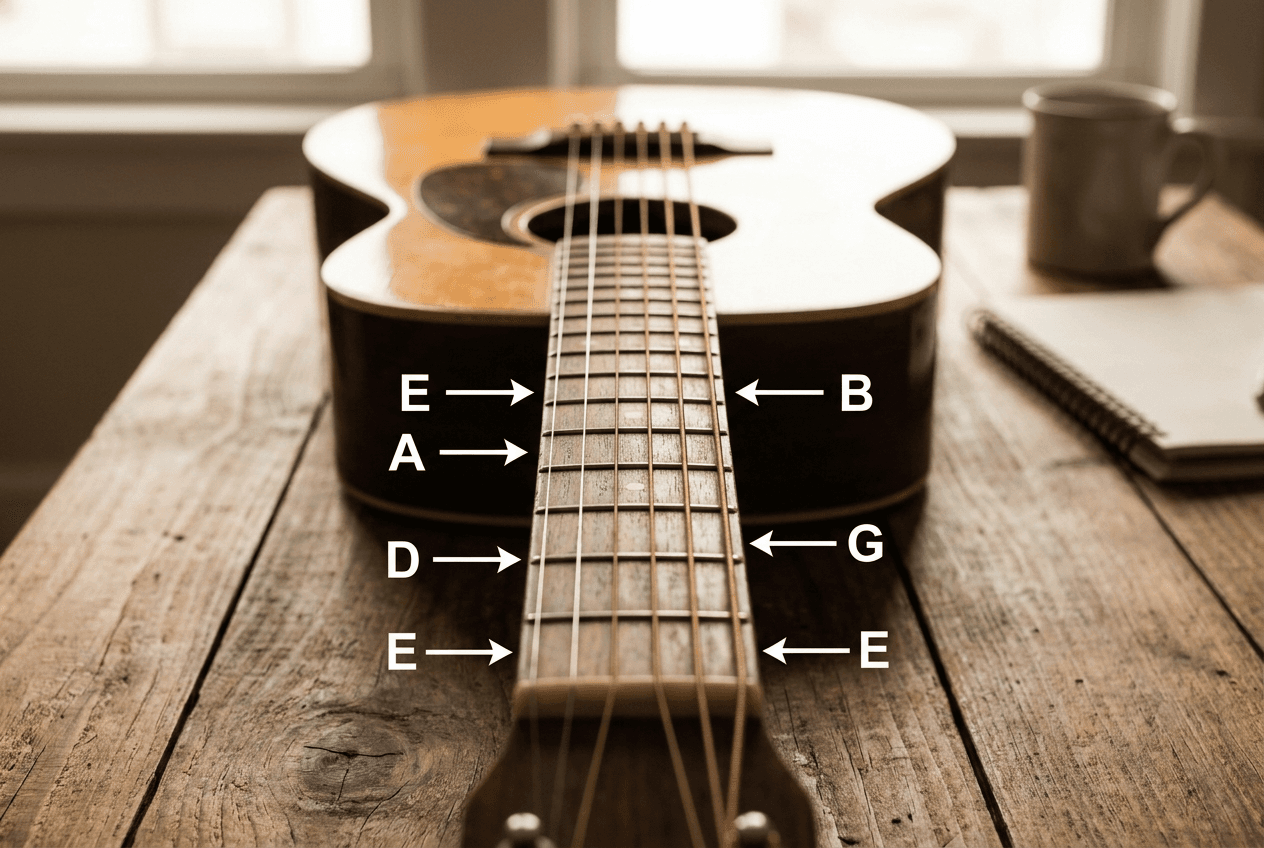 Before diving into memory techniques, establish the foundational facts clearly. A standard six-string guitar has strings numbered one through six, with two equally valid directions for that numbering depending on context.
When guitarists refer to strings by number, string one is the thinnest string closest to the floor when you hold the guitar in playing position. String six is the thickest string closest to the ceiling. When guitarists refer to strings by pitch name, each string carries the name of the note it produces when played open, meaning unfretted.
Here are the six strings from thickest to thinnest, which is also from lowest pitch to highest pitch:
String Number Note Name Thickness Common Description 6th string E Thickest Low E 5th string A Second thickest A string 4th string D Middle D string 3rd string G Middle G string 2nd string B Second thinnest B string 1st string E Thinnest High E
Notice immediately that the thickest and thinnest strings share the same letter name: E. Both are tuned to the note E but in different octaves. The thickest string produces a low, resonant E two octaves below the thin string's bright, crisp E. This shared name trips up many beginners initially, so musicians distinguish them by calling the sixth string the low E and the first string the high E.
Reading from thinnest to thickest gives you E, B, G, D, A, E. Reading from thickest to thinnest gives you E, A, D, G, B, E. Both sequences represent exactly the same six strings, just approached from opposite directions. Different memory devices use different directions, so knowing both sequences prevents confusion when you encounter them.
The Most Popular Mnemonics for Remembering Guitar String Names
 Memory devices, called mnemonics, transform abstract letter sequences into vivid, story-driven phrases that the brain retains far more reliably than raw information. The guitar community has invented dozens of mnemonics for string names over the decades. Some are clever. Some are silly. Some are genuinely unforgettable. Here are the most widely used ones, organized by reading direction.
Reading from Thickest to Thinnest (E A D G B E)
This direction reads from the sixth string down to the first string and represents the most common teaching order because it moves from the lowest-pitched string to the highest.
"Eddie Ate Dynamite, Good Bye Eddie" This is probably the single most widely taught guitar string mnemonic in the English-speaking world. The dramatic narrative arc makes it sticky: poor Eddie makes a catastrophically poor snacking decision, someone bids him farewell, and the story ends with his name repeated as a kind of rueful epitaph. Ridiculous? Absolutely. Memorable? Remarkably so. Beginners who learn this phrase in their first week of guitar study routinely report remembering it decades later.
"Every Amateur Does Get Better Eventually" This motivational alternative resonates particularly strongly with adult beginners who appreciate the encouraging subtext embedded in their string memorization exercise. Every time you recite the string names, you're also reminding yourself that progress is inevitable with consistent practice. That's not a bad psychological bonus to build into a foundational memory device.
"Elephants And Donkeys Grow Big Ears" The vivid animal imagery makes this version particularly effective for younger learners whose imaginations respond powerfully to concrete, whimsical pictures. Visualizing an elephant with comically oversized ears while reciting string names engages the visual memory system alongside the verbal, creating a stronger neural encoding of the information.
"Easter Arrives During Green Blossom Events" A seasonal alternative that some learners find more elegant than the dynamite story. The natural imagery of spring blossoms creates a pleasant mental picture that some adult learners prefer to more chaotic scenarios.
Reading from Thinnest to Thickest (E B G D A E)
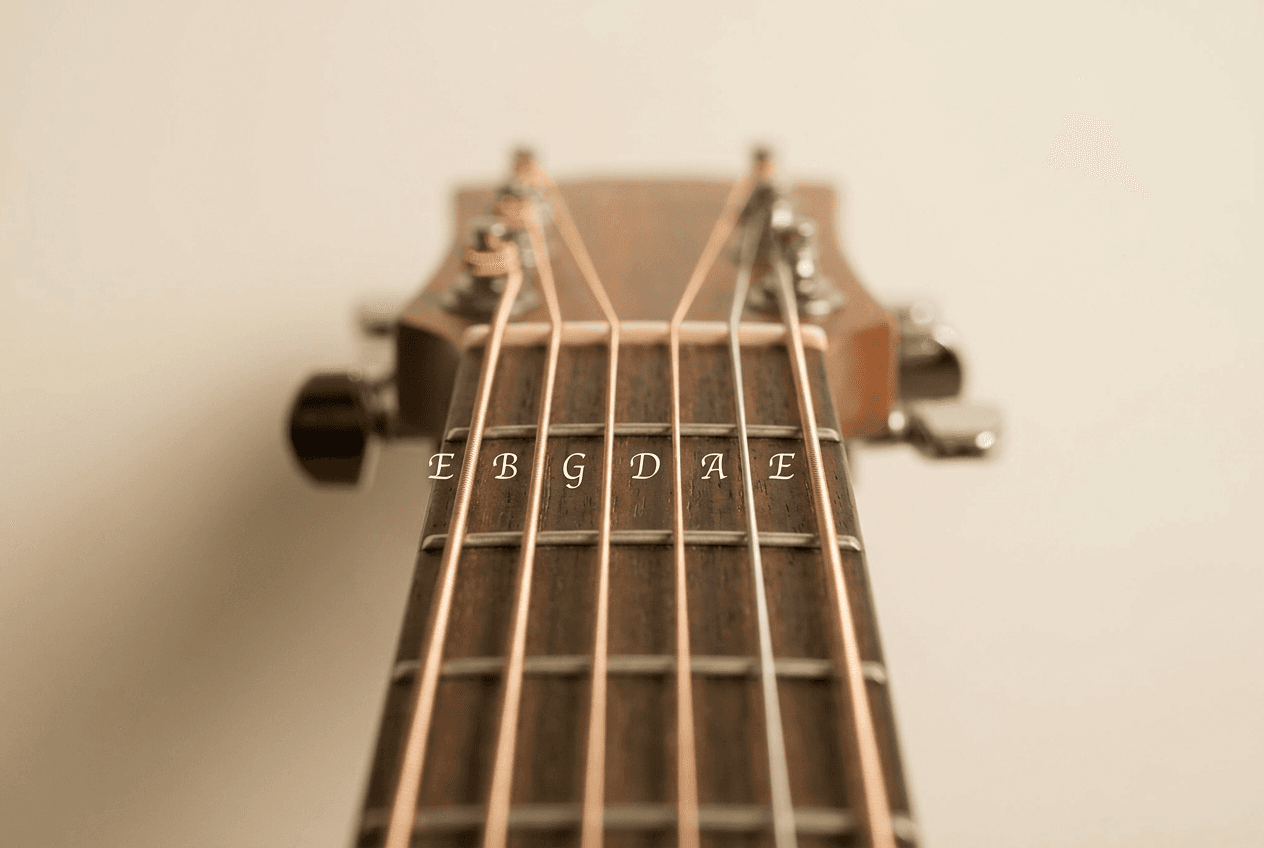 Some teachers introduce strings from thinnest to thickest because beginners often find thinner strings easier to press and play initially. This direction reverses the standard sequence.
"Every Body Gets Down And Eats" A casual, almost conversational phrase that reads naturally and conjures a relaxed social scene. The informality of the image matches the relaxed vibe many beginner guitarists cultivate around their instrument in early learning stages.
"Empty Bottles Get Drunk At Everything" A more vivid alternative that some learners find easier to picture specifically because of its slightly unusual imagery. Memory researchers consistently find that mildly unusual or surprising mental images encode more strongly than ordinary ones, a phenomenon called the bizarreness effect in cognitive psychology.
"Eat Big Green Dill And Enjoy" A food-based mnemonic that works particularly well for learners with strong gustatory or sensory memories. Imagining the sharp, fresh taste of dill while reciting this phrase engages an additional sensory memory channel that strengthens recall.
Creating Your Own Personal Guitar String Mnemonic
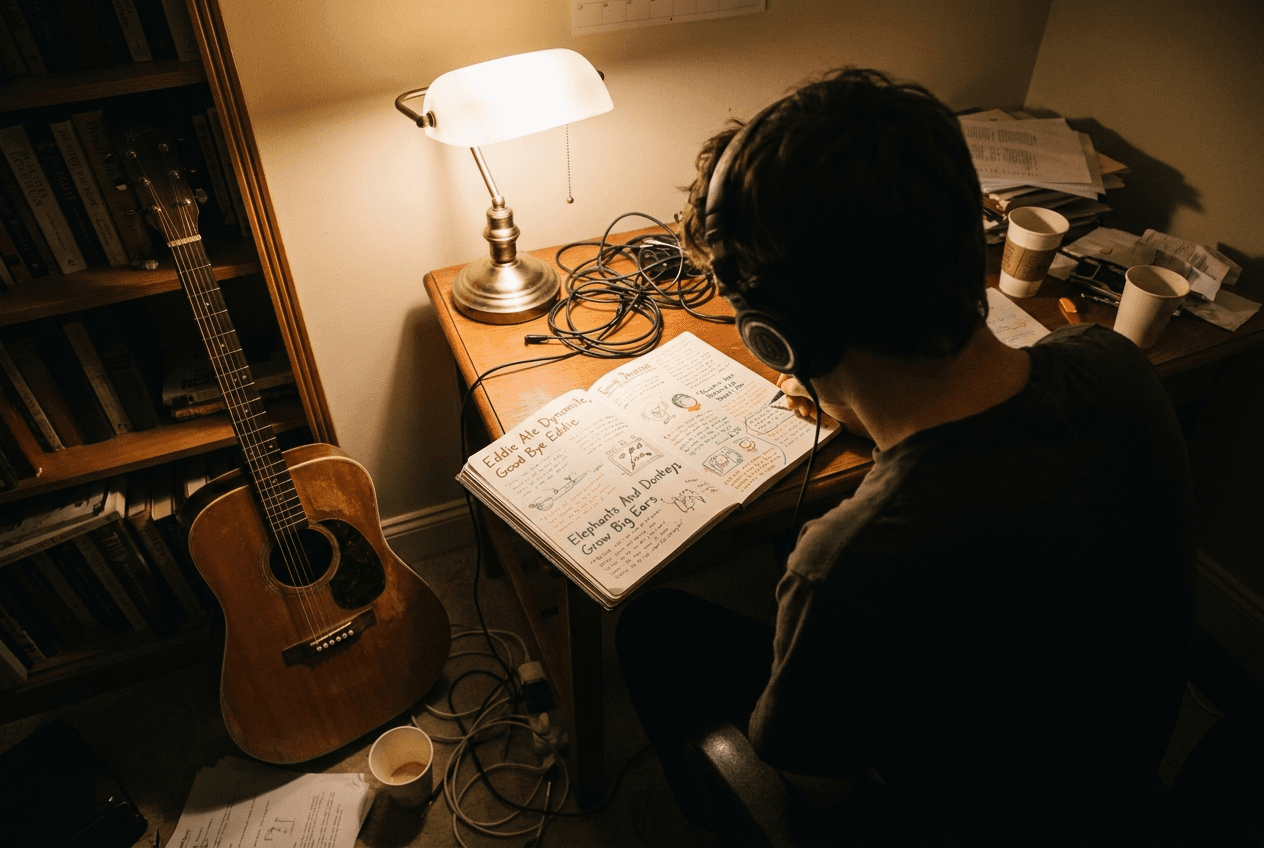 The most effective mnemonic for any individual learner is almost always the one they create themselves. Memory research consistently demonstrates that self-generated memory cues outperform externally provided ones because the act of creation itself encodes the information more deeply. The mental effort of constructing a phrase forces your brain to process the letter sequence actively rather than passively receiving someone else's formulation.
Creating your own guitar string mnemonic follows a simple process. Take the letter sequence you want to memorize, either E A D G B E or E B G D A E, and brainstorm words beginning with each letter. Don't aim for sophistication. Aim for personal relevance, humor, or vivid imagery. A mnemonic featuring your dog's name, your favorite food, your city, or an inside joke with a friend will outlast any textbook phrase because it connects the abstract information to something that already matters to you.
Here's a practical approach to building your own version in under five minutes. Write the letters E, A, D, G, B, E vertically on a piece of paper. Beside each letter, write three or four words beginning with that letter that feel personally meaningful, funny, or vivid. Then string together the most compelling combination into a phrase that flows naturally when spoken aloud. Say it out loud several times. If it makes you laugh or produces a strong mental image, it will stick.
The additional benefit of this creative process is that the struggle itself accelerates learning. Cognitive scientists call this the desirable difficulty effect: learning tasks that require more mental effort produce stronger, more durable memory traces than tasks that feel easy. By wrestling with letter combinations and crafting your own phrase, you're actually studying the string names more effectively than you would by simply reading someone else's mnemonic five times.
Visual Methods for Learning Guitar String Names
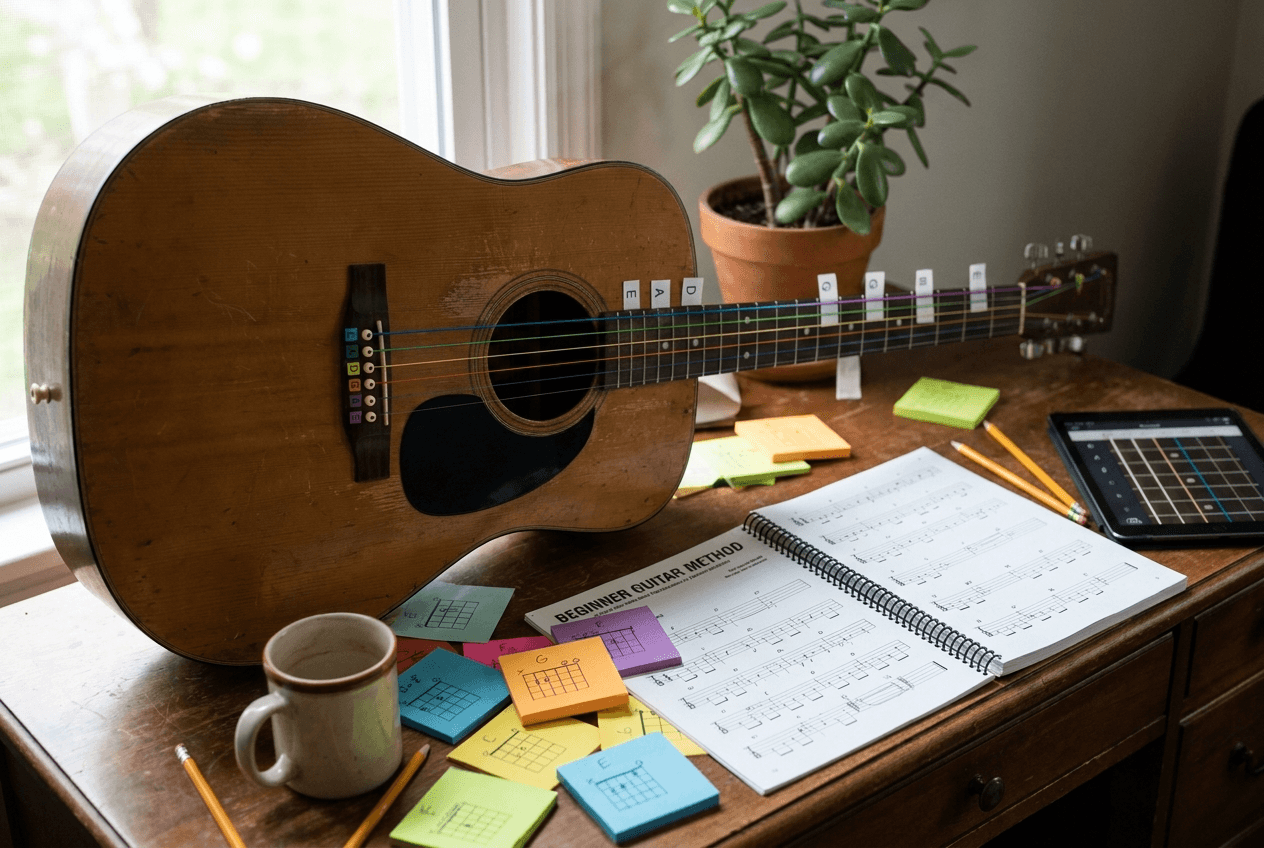 Not every learner thinks primarily in verbal or narrative terms. Visual learners, who represent a substantial portion of the learning population, often find image-based memory techniques more natural and effective than word-based mnemonics. Fortunately, several powerful visual approaches to learning guitar string names work beautifully alongside or instead of verbal mnemonics.
Color coding represents one of the simplest and most effective visual techniques. Assign a specific color to each string name and consistently use those colors whenever you write, draw, or annotate anything related to your guitar practice. Write the letter E in deep red for the low E string, orange for A, yellow for D, green for G, blue for B, and violet for the high E string. This rainbow sequence from low to high creates an intuitive visual gradient that mirrors the physical layout of the strings on your instrument.
Physical mapping exercises train your fingers and eyes to identify strings automatically without conscious recall. Practice touching each string slowly and deliberately while speaking its name aloud. Close your eyes, touch a string at random, and name it before opening your eyes to verify. This tactile-visual-verbal combination engages three separate memory systems simultaneously, creating a multisensory encoding that produces dramatically faster and more durable recall than any single-channel approach.
Fretboard diagrams with string names clearly labeled serve as powerful visual reference tools during the early stages of learning. Printing a simple diagram and posting it at eye level in your practice space means the string names exist in your visual field during every practice session. This passive exposure supplements your active memorization efforts and accelerates the process of making string names feel automatic rather than recalled.
Many online guitar education resources including platforms like Justin Guitar, one of the world's most respected free guitar education sites, provide downloadable fretboard diagrams and visual learning materials that beginning guitarists can use to supplement their lessons. These resources are genuinely high quality and worth bookmarking early in your guitar journey.
How String Thickness Connects to String Names
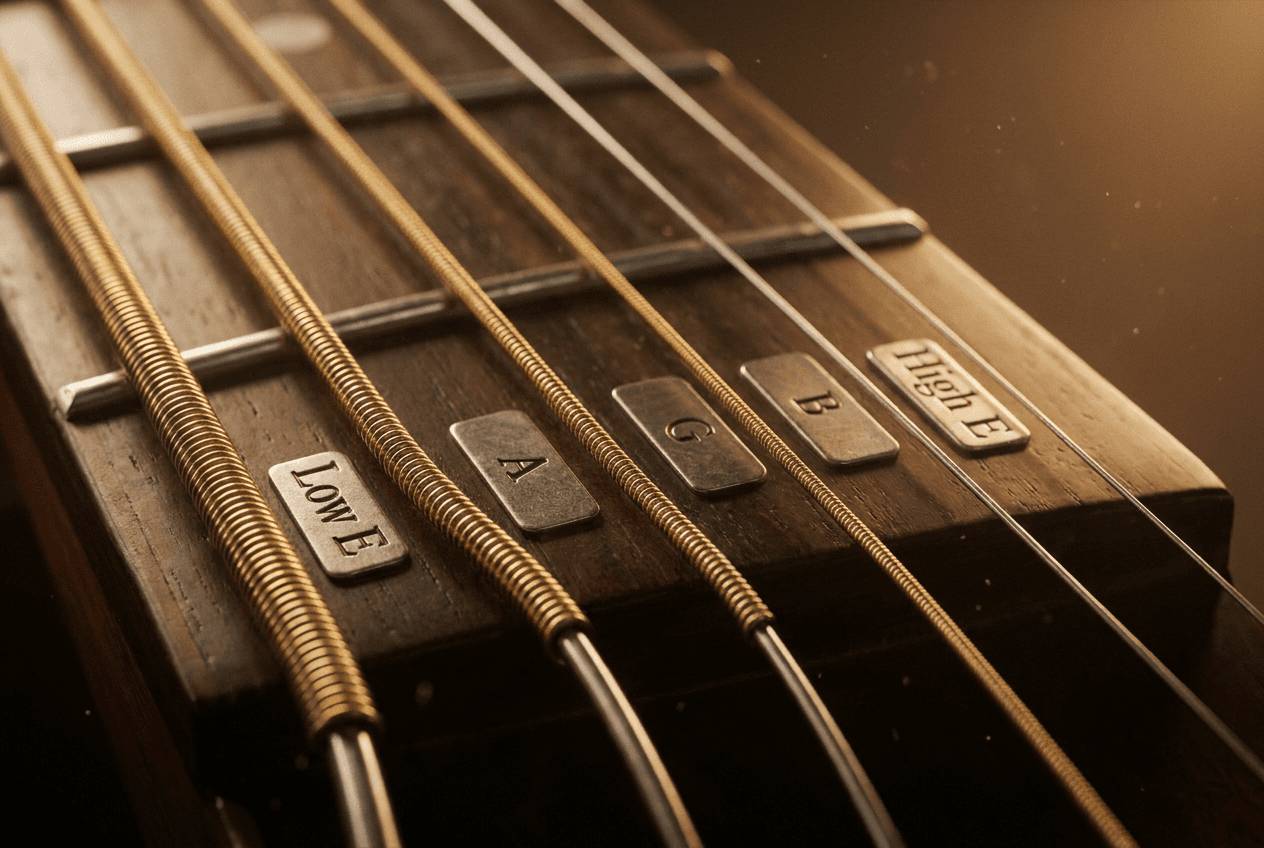 Understanding why strings have the names they do, rather than simply memorizing the names as arbitrary labels, gives you a conceptual anchor that makes the information feel logical rather than random. The name of each string reflects its tuned pitch in standard tuning, the default tuning configuration that virtually all beginner guitar instruction assumes.
String thickness and pitch exist in a direct physical relationship. Thicker strings vibrate more slowly when plucked, producing lower-frequency sound waves that the ear perceives as lower-pitched notes. Thinner strings vibrate more rapidly, producing higher-frequency waves perceived as higher pitches. This physical relationship means that the thickest string produces the lowest note, E, and the thinnest string produces one of the highest notes in the guitar's open-string range, also E but in a much higher octave.
The specific pitches of standard tuning aren't arbitrary. They were established over centuries of instrument evolution to create a configuration that allows guitarists to play a wide range of chords and melodies across the fretboard with comfortable, practical hand positions. The interval relationships between adjacent strings, mostly intervals of a fourth with one exception between the G and B strings, create a logical pattern that eventually reveals itself to developing guitarists as they learn more about music theory and fretboard navigation.
Understanding these physical and theoretical underpinnings transforms string names from a memorization chore into a meaningful entry point into the physics of sound and the logic of musical instrument design. That conceptual understanding motivates learners in a way that pure memorization never quite achieves because it satisfies the deeply human desire to understand why things are the way they are rather than simply accepting that they are.
Common Mistakes Beginners Make When Learning String Names
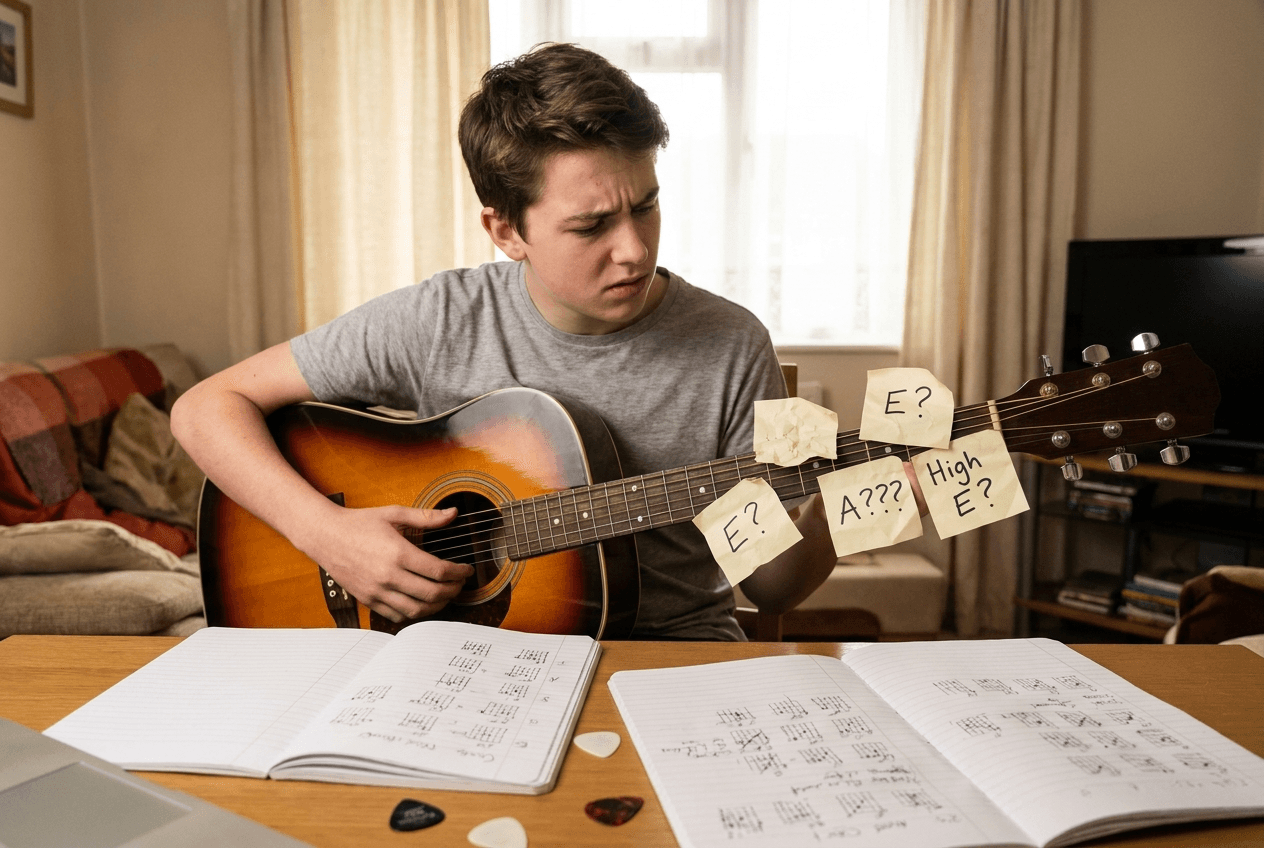 Awareness of common errors accelerates learning by helping you avoid the pitfalls that slow down most beginners before you encounter them yourself. The most frequent mistake is confusing string number direction. When a teacher says "the first string," they mean the thinnest string, the one closest to the floor in playing position. Many beginners instinctively count from the top, which places the thick E string as "first." This reversal causes persistent confusion when following chord diagrams and tablature until the correct numbering becomes automatic.
Conflating the two E strings represents another extremely common source of confusion. Because both the thickest and thinnest strings share the name E, beginners frequently apply information meant for one to the other. When a chord diagram indicates playing the low E string, playing the high E instead produces a dramatically different sound that makes the chord unrecognizable. Developing the habit of always specifying "low E" or "high E" rather than simply "E" in your internal monologue eliminates this confusion efficiently.
Over-relying on a single memorization method limits the depth and speed of learning. Beginners who learn only a verbal mnemonic but never practice tactile string identification, visual fretboard recognition, or actual playing contexts find that their recall remains slow and effortful for longer than necessary. Combining at least two or three different learning approaches, verbal, tactile, and visual, produces the kind of fluent, automatic recall that genuinely serves you during real playing situations.
Neglecting to practice string name recall in the context of actual playing represents perhaps the most significant missed opportunity. Knowing the string names as an isolated fact is useful. Knowing them so automatically that you can identify any string instantly while simultaneously thinking about chord fingering, strumming rhythm, and song structure is what actually serves you as a developing guitarist. Always practice string identification while playing, not just while reciting lists.
Connecting String Names to Your First Guitar Chords
 The fastest way to cement guitar string names in permanent memory is to connect them immediately to the actual playing you're doing rather than treating them as a separate study task. Your first open chords provide the perfect vehicle for this integration because every chord diagram references specific strings by name and number.
Consider the open G major chord, one of the most common and important chords every beginner learns early. Playing G major correctly requires strumming all six strings, with specific fingers fretting specific strings at specific frets. When you know your string names fluently, your teacher's instruction to "place your middle finger on the sixth string at the third fret" lands immediately and precisely. Without that fluency, every such instruction requires a mental lookup that interrupts the flow of learning.
The open D major chord illustrates the importance of knowing which strings to avoid as well as which to play. D major is typically played on strings one through four only, with the low E and A strings muted or avoided. Executing this cleanly requires instant identification of the strings you're not playing, which demands exactly the kind of automatic string name recall that deliberate memorization practice builds.
Platforms like Art Gharana offer beginner guitar lessons that integrate string name fluency into practical chord and melody work from the very first lesson, accelerating the process of making this foundational knowledge feel genuinely natural rather than academically imposed. Working with a live instructor who reinforces string names constantly within the context of real music making is by far the most effective way to build lasting fluency.
Practice Exercises That Lock Guitar String Names Into Long-Term Memory
 Deliberate practice exercises designed specifically for string name memorization accelerate fluency far more efficiently than passive review. These exercises work best when incorporated into the first five minutes of every practice session during your first month of guitar study.
-
The random naming drill. Close your eyes and touch any string on your guitar at random. Name it aloud before opening your eyes to verify. Repeat twenty times without rushing. Speed comes naturally with repetition. Accuracy matters far more in the early stages.
-
The teacher-student game. Ask a family member or friend to call out string names while you locate and pluck the correct string as quickly as possible. The mild social pressure of performing for another person accelerates automaticity in a way that solo practice rarely matches.
-
The backward sequence drill. Practice reciting the string names in both directions, thickest to thinnest and thinnest to thickest, until both sequences flow as effortlessly as the alphabet. Many learners find one direction much easier than the other initially, and deliberately practicing the harder direction closes that gap quickly.
-
The chord context drill. Every time you practice a chord, name each string you're playing or muting as you check your hand position. This integrates string name recall into the motor memory of chord formation, building the two skills simultaneously rather than sequentially.
-
The tuning ritual. Every time you tune your guitar before practice, name each string aloud as you tune it. Tuning is a ritual that every guitarist performs at every session, making it the perfect vehicle for passive but consistent reinforcement of string names throughout your entire musical life.
-
The notation connection. Write out simple tablature for any melody you're learning and label each string line with its note name. This visual-verbal-physical integration encodes string names through three separate learning channels simultaneously, producing the fastest and most durable memorization results.
About Art Gharana
 Art Gharana is a dynamic online arts education platform offering live, expert-led music lessons to students across the USA. Their experienced guitar instructors specialize in guiding complete beginners through exactly the kind of foundational skill building that turns nervous first-timers into confident, joyful players. From guitar string names and basic chord shapes to music theory and original songwriting, Art Gharana's personalized online lessons adapt to every student's pace, personality, and musical goals. If you're ready to move beyond memorization exercises and start making real music on your guitar, the inspiring instructors at Art Gharana are ready to meet you exactly where you are and take you exactly where you want to go.
Frequently Asked Questions
1. How long does it take to memorize guitar string names?
Most beginners achieve reliable recall of all six guitar string names within one to two weeks of consistent daily practice. Using a memorable mnemonic from day one and reinforcing it through tactile string identification exercises during every practice session accelerates this timeline considerably. Some learners with strong auditory or visual memory report confident recall within just two or three focused practice sessions when they combine multiple memorization approaches simultaneously.
2. Why do guitars have two strings with the same name?
Both the thickest and thinnest strings are tuned to the note E, but in different octaves separated by two full octaves of pitch. This configuration results from centuries of instrument evolution that optimized the guitar's standard tuning for practical chord playing and melodic range across the fretboard. The shared name reflects a genuine musical relationship between the two strings rather than a naming oversight, and understanding this relationship deepens your grasp of how the fretboard is organized logically.
3. Does the string numbering system change for different guitar types?
The string naming convention remains consistent across acoustic, electric, and classical guitars in standard tuning. Variations arise with seven-string guitars, which add a low B string below the standard low E, and twelve-string guitars, which double each string in pairs. Bass guitars use only four strings tuned to E, A, D, and G, which correspond to the four lowest strings of a standard guitar. The foundational logic of naming strings by their open pitch remains consistent across all these variations.
4. Should I learn string names before or after learning my first chords?
Learning string names and first chords simultaneously produces the best results for most beginners. Treating string names as a prerequisite that must be fully mastered before touching chords delays the musical reward that motivates consistent practice. Instead, begin learning your first one or two chords immediately while actively working on string name memorization in parallel. The practical context of chord learning reinforces string names far more powerfully than isolated memorization exercises alone.
5. What is the best mnemonic for guitar string names?
The best mnemonic is whichever one produces the strongest, most immediate mental image for you personally. "Eddie Ate Dynamite, Good Bye Eddie" works brilliantly for most people because of its dramatic and slightly absurd narrative. However, a mnemonic you create yourself using personally meaningful words, your pet's name, your favorite food, or a private joke will almost always outperform any externally provided phrase because self-generated memory cues encode more deeply than received ones.
6. Do string names change when I use a capo?
The string names themselves never change regardless of capo position. The strings retain their standard names, low E through high E, at all times. What changes with a capo is the pitch each string produces when played open. A capo at the second fret raises every string's open pitch by two semitones, so the low E string produces an F sharp when played open. However, guitarists still refer to that string as the low E or sixth string regardless of the capo's effect on its sounding pitch.
Conclusion
Guitar string names are the first language of the fretboard, and learning to speak that language fluently is one of the most leveraged investments you'll make in your entire guitar education. The six names, E, A, D, G, B, and E from thickest to thinnest, unlock every chord diagram, tablature reading, and music theory concept you'll encounter as your playing develops. Choose a mnemonic that makes you laugh or produces a vivid mental picture, reinforce it through tactile practice and real chord playing every single day, and you'll find these names becoming as automatic as your own phone number within weeks. Ready to accelerate your guitar journey with personalized live instruction? The expert guitar teachers at Art Gharana are ready to guide you from string names all the way to the music you've always dreamed of playing.