ChatGPT
 Google AI
 Grok
Grok Claude
Parents usually arrive at this subject with two questions and find answers to neither. The first is what a trinity music exam actually involves, and the second, less often asked out loud, is whether graded exams are a good idea for their child at all. This guide answers both, including the second honestly. If you are still choosing an instrument rather than an exam board, the guide to Indian classical music instruments is the earlier decision.
What follows covers how the grades are structured, what happens in the exam room, how Trinity differs from ABRSM in ways that genuinely matter, the Rock and Pop route that many families do not know exists, UCAS points, and a preparation timeline that works. It also covers what graded exams do not measure, which matters more than the syllabus does.
What Are Trinity Music Exams?
 A trinity music exam is a graded qualification from Trinity College London, an international exam board offering assessments in music, drama and English. Its music grades run from Initial, available in many subjects as an introduction for new performers, through Grades 1 to 8, followed by diploma levels at Associate, Licentiate and Fellowship. The qualifications are regulated in the UK and internationally recognised, and Grades 6 to 8 carry UCAS points for university applications.
The defining characteristic, in Trinity's own framing, is that performance sits at the heart of the assessment, on the basis that musicianship is most effectively demonstrated through practical playing rather than through testing knowledge in the abstract.
How the Grades Work
Level Who it is for What it establishes Initial New performers, often children in their first year or two An introduction to the exam format with minimal pressure Grades 1 to 3 Early stage students Core technique, reading, and the habit of preparing to a standard Grades 4 to 5 Intermediate students, typically several years in Real technical control and interpretive choices Grades 6 to 8 Advanced students Performance-level playing. Carries UCAS points in the UK Diplomas Post-Grade 8, at Associate, Licentiate and Fellowship levels Professional and teaching-level qualifications with prerequisites
There are no formal prerequisites between grades, which surprises people. A student may enter at any grade without having taken the ones below, and the recommendation is simply to have a solid foundation in the lower-grade skills before attempting a higher one. Diplomas do carry prerequisites.
In practice most students take a grade every twelve to eighteen months, and skipping grades is common and reasonable. A student who has played for four years before taking any exam might sensibly enter at Grade 3 or 4 rather than starting at Initial.
There is a related decision families get wrong in the other direction, which is entering a grade the student is not comfortably above. A candidate who can only just manage the material on a good day will not manage it under exam conditions, since nerves reliably cost something. The rule of thumb most teachers use is that a student should be able to play the programme securely several weeks before the exam, not on the day itself.
What Happens in the Exam
The structure of a trinity music exam varies by instrument and grade, and the components are consistent in principle.
Pieces
The largest share of the marks. Candidates perform a set number of pieces, chosen from Trinity's repertoire lists for that grade, with a substantial degree of choice. Trinity's piano repertoire, for instance, spans Western classical, stage and screen, video game music, twentieth century works, global pop and jazz and Latin standards, which is a considerably broader range than the word exam suggests.
Technical work
Scales, arpeggios, broken chords, exercises and chord sequences depending on the grade and instrument. At higher grades in some instruments this extends to orchestral extracts. Candidates typically have options here rather than a single fixed requirement.
Supporting tests
Sight reading, aural tests, improvisation and musical knowledge appear depending on the grade and the exam type chosen. Trinity's structure allows candidates to select among some of these rather than sitting all of them, which is one of the board's distinguishing features and a genuine advantage for students with uneven strengths.
The flexibility options
Worth knowing about because families frequently do not. On piano, candidates can choose to play a duet up to Grade 3, with either a live or a recorded duet part, or perform their own composition. Digital candidates can choose a repertoire-only pathway focused entirely on performance. These options exist to let a candidate play to their strengths rather than to a fixed template.
Face-to-face or digital
Both routes exist. Face-to-face exams take place at a centre with an examiner present. Digital exams are recorded and submitted, which removes travel and nerves for some candidates and suits others less well. The choice is genuine rather than a pandemic-era stopgap, and it is worth discussing with a teacher rather than defaulting to whichever is offered first.
Trinity or ABRSM?
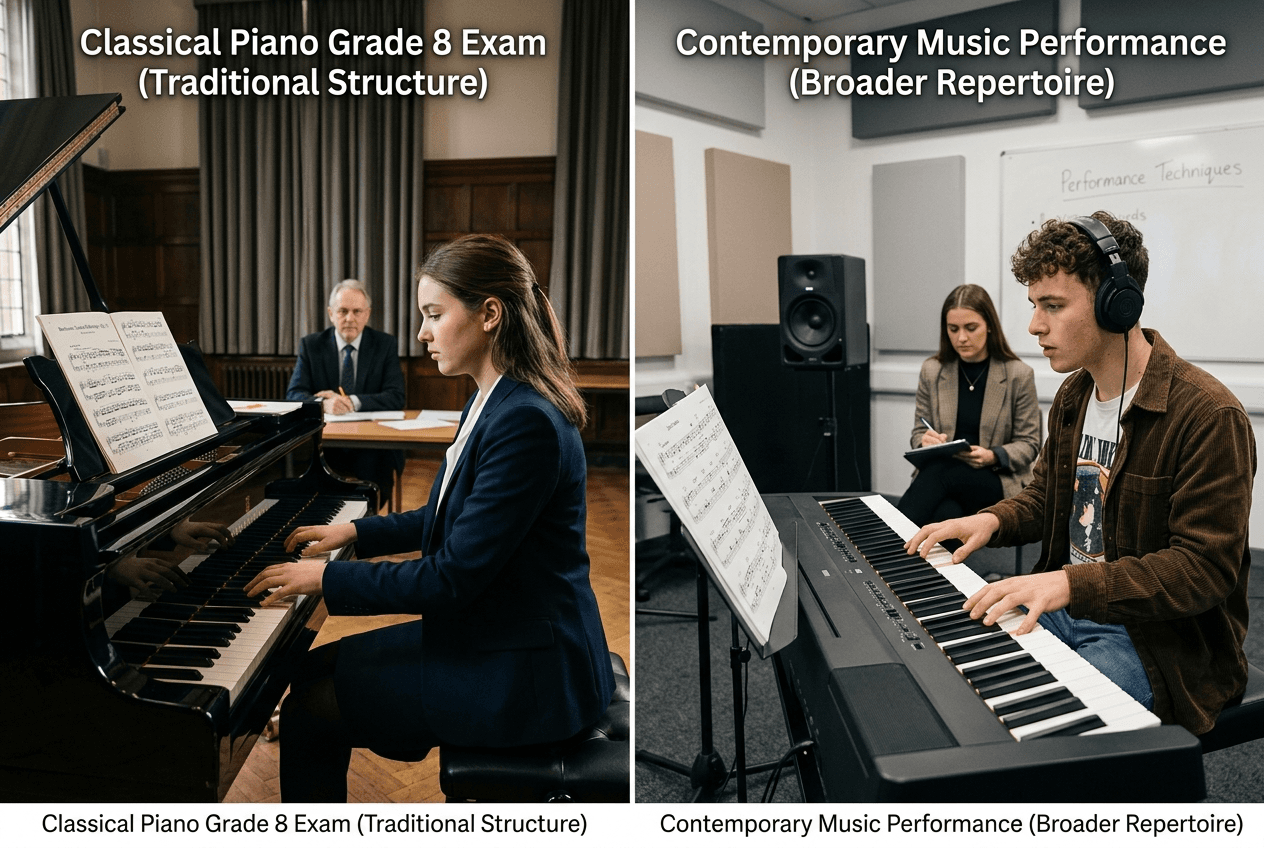 Whether to take a trinity music exam or an ABRSM one is the question every UK parent asks, and the honest answer is that both are respected, both are regulated, both carry the same UCAS points at Grades 6 to 8, and universities and employers do not meaningfully distinguish between them when assessing an application.
What differs is emphasis and format, and those differences suit different students.
Repertoire breadth
Trinity's lists are generally regarded as broader in style, incorporating film, stage, video game and popular music alongside classical repertoire. ABRSM is traditionally more classically weighted. For a student motivated by playing music they recognise and enjoy, this matters considerably.
Flexibility of assessment
Trinity allows more choice in which supporting tests a candidate sits and offers options including duets and own compositions. ABRSM's structure is more uniform. A student who is a strong performer and a weak sight reader may fare better under a structure that lets them lean into performance.
Theory requirements
This is the practical difference that catches families out. ABRSM requires a Grade 5 theory qualification before entering practical Grades 6 and above. Trinity does not impose that prerequisite in the same way. For a student who wants to progress quickly on their instrument without a parallel theory course, this is a real consideration, and the counterargument is that theory knowledge is genuinely useful regardless of whether an exam board demands it.
The honest recommendation
Choose based on the student rather than on prestige, since there is no prestige gap. A classically focused student who enjoys structured theory may suit ABRSM. A student who wants breadth of repertoire, flexibility in assessment, or a route that does not require a separate theory qualification may suit Trinity. Ask the teacher, who will know which board they prepare students for most effectively and why.
Rock and Pop
A separate Trinity syllabus that a great many families do not know exists, and which solves a specific problem. Trinity Rock and Pop offers graded exams built around performing songs, with graded songbooks containing the required material, demo and backing tracks, and the option to bring own-choice songs. It covers the instruments a student in a band actually plays, and in the UK Grades 6 to 8 carry the same UCAS points as the classical grades.
The value is motivational rather than academic. A teenager who has stopped practising classical repertoire will frequently practise a song they chose, and a qualification attached to that music converts private enthusiasm into recognised achievement. For a student drifting away from lessons, this route is worth raising before giving up on exams entirely.
It is also a genuine qualification rather than a lesser alternative, which parents occasionally need reassuring about. The standard required at each grade is comparable, the assessment is regulated in the same way, and the UCAS points are identical. What differs is the repertoire and the format, not the rigour.
Instruments covered include the ones a band actually needs, which is the practical point. A student who plays electric guitar, bass or drums has historically had fewer graded options than a pianist or violinist, and this route closes that gap. The choice between acoustic and electric setups is covered in the guide to buying a first guitar for anyone at that decision.
Do Music Grades Give UCAS Points?
Yes, for Grades 6, 7 and 8, in both the classical grades and Rock and Pop, and the points scale with the grade and the mark achieved.
The practical weight is modest and real. Music grades will not substitute for A-level results, and they contribute to a total and demonstrate sustained commitment to something demanding outside academic study, which personal statements benefit from. For students applying to music courses specifically, a Grade 8 is close to an expectation rather than an advantage.
The honest framing for a parent is that UCAS points are a reason to continue to Grade 6 and above if a student is already progressing well, and a poor reason to start graded exams in the first place.
Preparing for an Exam
Twelve to sixteen weeks is realistic
A trinity music exam needs twelve to sixteen weeks for a student already at the level, working with a teacher weekly and practising most days. Less than eight weeks is possible for a confident candidate and frequently produces a rushed result. More than six months tends to produce staleness, since a candidate can only maintain interest in three pieces for so long.
Choose repertoire early and deliberately
The choice matters more than students realise. Pieces should contrast with each other, since a programme of three similar pieces demonstrates less. At least one should be genuinely comfortable, providing a secure opening. And a student should actually like the music, because they will be playing it several hundred times.
Technical work is the easy marks
Scales and exercises are entirely learnable and entirely predictable, unlike performance nerves, and they are where a candidate can reliably bank marks. Students consistently neglect them in favour of pieces, then lose marks that required only routine work.
The efficient approach is short and frequent rather than long and occasional. Five minutes of technical work at the start of every practice session, rotating through the requirements so each is covered across a week, produces reliable results by the exam. Attempting to learn all of them in the final fortnight does not, since technical fluency is muscle memory and muscle memory needs time rather than intensity. A metronome used with a proper method makes this work considerably more effective than practising scales at whatever speed feels comfortable.
Sight reading improves only through doing it
A short new piece every day, played once without stopping, is worth more than an hour of concentrated sight-reading practice once a week. The skill is reading ahead while playing, and it builds through frequency rather than intensity. The guide to reading guitar sheet music covers the principles for fretted instruments, and they apply broadly.
Practise the whole run-through
In the final month, run the entire exam in order, without stopping, at least twice a week. Students practise pieces individually and then find the exam demands sustained concentration across fifteen or twenty minutes with no restarts. That stamina is a separate skill.
Perform to people before the exam
The most neglected preparation and the most effective. Playing the programme to family, to a friend, at a school assembly or at a teacher's informal concert exposes the gap between practising and performing, and it does so at low stakes with people who want them to do well. A candidate who has performed the material three times to an audience walks into the exam room a different person.
Managing Exam Nerves
Worth addressing directly, since it affects the result more than any amount of extra practice in the final week. Nerves are physiological rather than a failure of preparation. Adrenaline raises the heart rate, shortens the breath and makes fine motor control less reliable, which is why a passage that was secure at home can fall apart in a room with an examiner. Knowing this is happening, and that it happens to professionals, removes some of its power.
Practical measures that work: arrive early enough to stop rushing, warm up physically and musically beforehand rather than going in cold, breathe out slowly several times before starting, and take a deliberate pause before the first note rather than beginning immediately. If something goes wrong mid-piece, continue rather than restarting, since examiners assess the whole performance and a recovered slip costs far less than a stop.
For singers specifically, nerves shorten the breath first, which is why phrases that were comfortable become difficult. The guide to breathing techniques for singers covers the support that survives adrenaline, and it is worth working on well before the exam rather than discovering the problem in the final fortnight.
What Graded Exams Do Not Measure
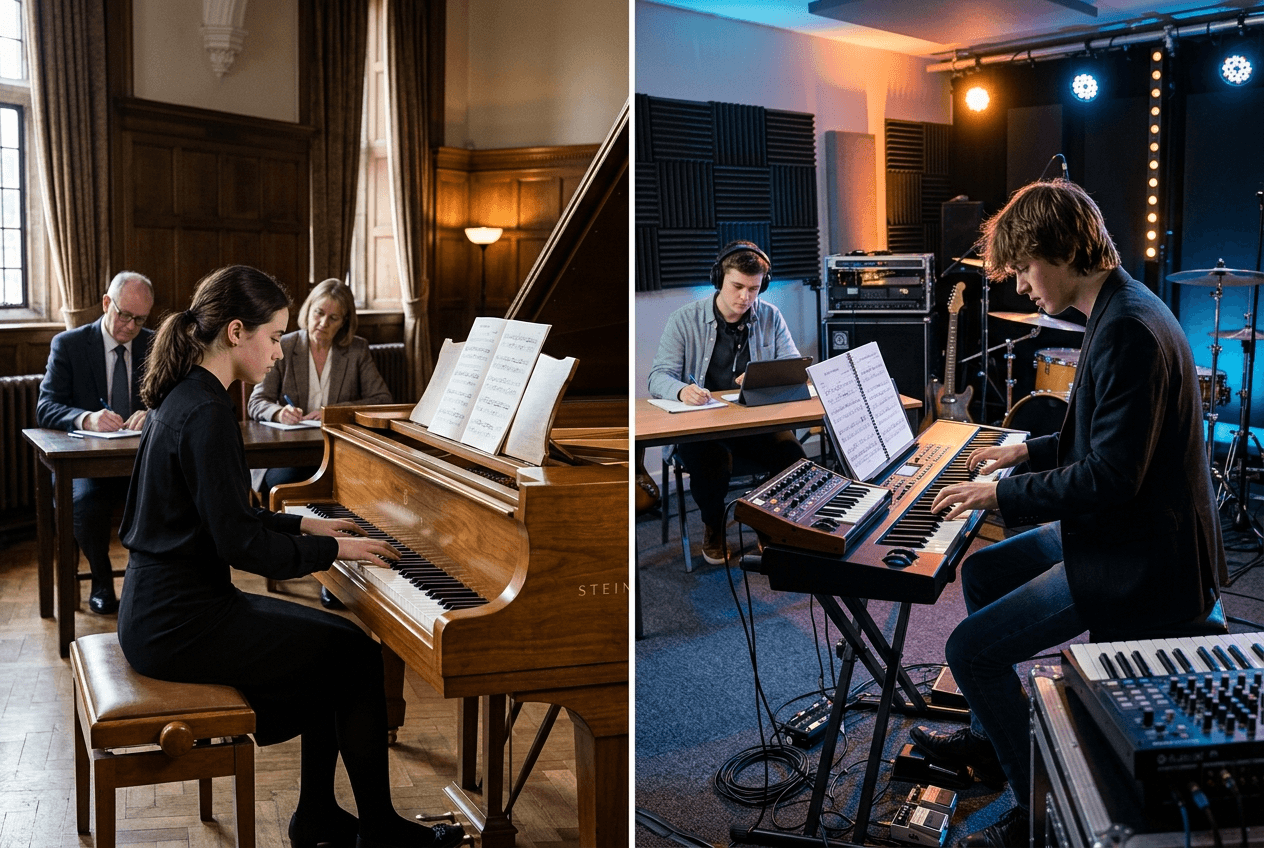 What a trinity music exam does not measure is the section a music school should write and most avoid, because the answer is commercially inconvenient and true.
Graded exams measure the ability to prepare specific material to a standard on a specific day. That is a genuine and useful skill, and it is not the same as musicianship. A student can reach Grade 8 without being able to play anything they have not been taught, without improvising, without playing by ear, and without ever having played with other people.
They also do not measure enjoyment, and this is where families get into trouble. A child pushed through grades on a schedule, playing repertoire they dislike, will frequently pass every exam and stop playing entirely the moment the exams end. That outcome is common enough that any honest guide should name it.
The useful framing is that exams are one tool among several. They provide structure, external validation and a deadline, all of which help a great many students. They should sit alongside playing for fun, playing with other people, learning music the student chose, and playing by ear, none of which the syllabus rewards and all of which produce musicians.
Understanding the Result
 Marks and what they mean, since a certificate arrives with a number and families frequently do not know how to read it.
Trinity awards a pass at a defined threshold, with merit and distinction bands above it, and the report breaks the mark down by component so you can see where marks were gained and lost. That breakdown is the useful part and it is routinely ignored in favour of the headline result.
Read the examiner's comments carefully, because they are specific and they are written to inform continued learning rather than merely to justify a mark. An examiner noting that rhythm was secure but dynamics were undifferentiated has just told you exactly what the next six months of lessons should address, which is worth considerably more than the certificate.
If the result is disappointing
A pass at the lower end, or a fail, is not a verdict on musical ability. The commonest causes are entering a grade too early, under-preparing the technical work, or nerves on the day, and all three are addressable. The response that works is to look at the component breakdown, identify where the marks went, and either retake with that fixed or move on and take the next grade properly.
What does not work is treating the result as a judgement of the child. Music examinations are low-stakes in every way that matters, and a child who concludes from a modest mark that they are not musical has drawn a conclusion the exam was never designed to support.
Should Your Child Take Graded Exams?
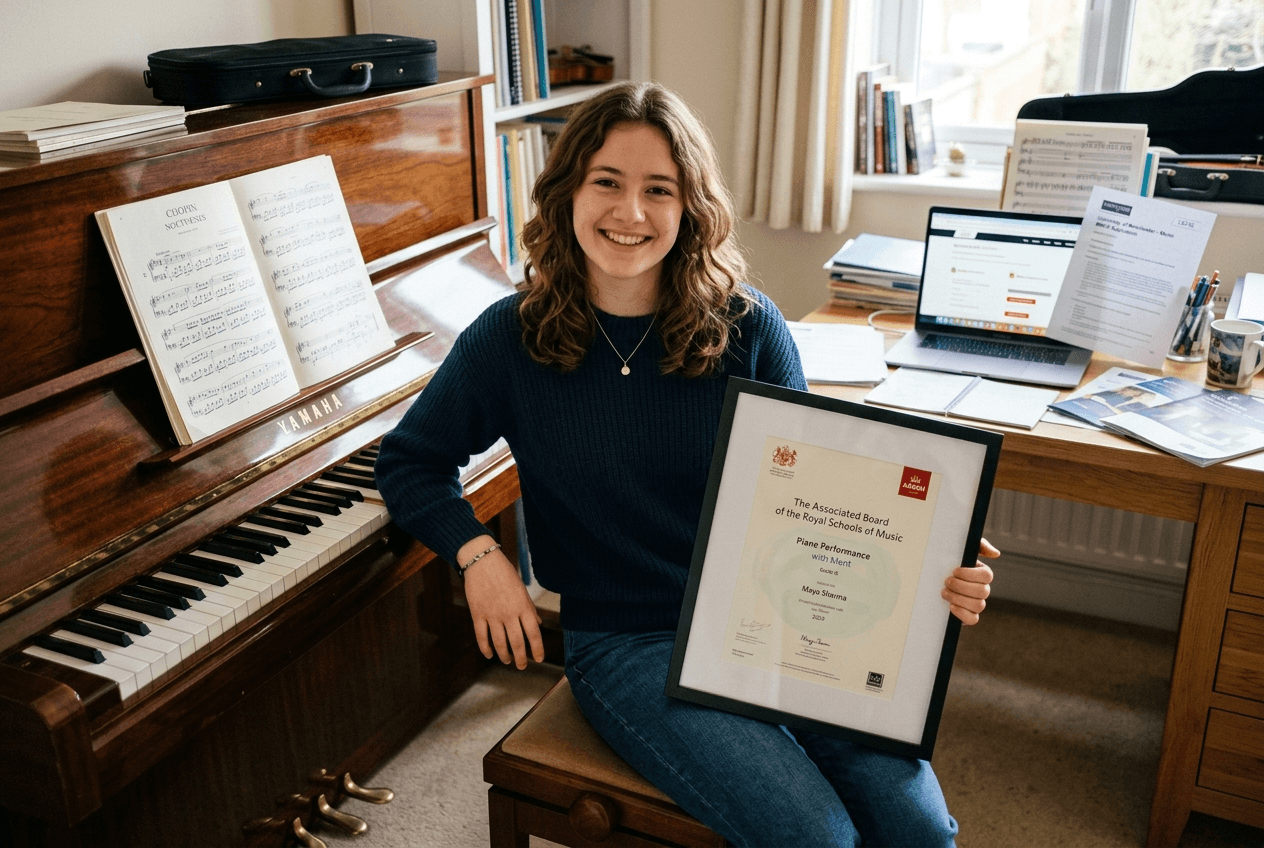
They suit students who
Respond to structure and deadlines, since a scheduled exam converts vague intention into scheduled practice. Enjoy measurable progress, which a grade certificate provides in a way that gradual improvement does not. Are aiming at music college, further study or UCAS points. Or need external motivation to maintain practice, which describes a great many students and is nothing to apologise for.
They suit students less well who
Are already intrinsically motivated and practising happily, in which case exams may add pressure without adding much. Respond badly to assessment and become anxious about it, where the cost may exceed the benefit. Or want to play a tradition the graded system does not cover well, which includes most Indian classical music.
The middle path
Taking grades occasionally rather than every year is entirely legitimate and is what many good teachers recommend. A grade every two years, with the intervening time spent on repertoire the student chose, ensembles and playing by ear, produces a better musician than an annual exam treadmill and keeps the structural benefits. Teachers who suggest this are usually thinking about the student rather than about their own schedule, and it is worth listening to.
Graded Exams and Indian Classical Music
 Worth addressing for families pursuing both, which a great many British Indian families are.
The Western graded system does not map onto Hindustani or Carnatic training, and attempting to force it produces confusion. Indian classical music is transmitted through an extended relationship with a teacher, assessed continuously rather than by examination, and organised around raga and taal knowledge that the Trinity syllabus does not contain. There are examination structures within Indian music, principally through institutions such as the Prayag Sangit Samiti and the Gandharva Mahavidyalaya, and they work differently.
For a child learning both, which is increasingly common in Britain, the practical advice is to keep the two tracks separate rather than trying to align them. A child might take Trinity grades on piano while studying Hindustani vocal in the traditional way, and the two support each other musically without needing to be reconciled administratively. The foundations of the Indian tradition are set out in the beginner guide to Hindustani classical music and the southern system in the beginner guide to Carnatic music.
One genuine benefit runs across both. The reading, theory and technical discipline that graded exams build transfer directly, and an Indian classical student who can read Western notation has access to a body of material and a set of collaborative opportunities that a purely oral training does not provide.
The Cost and the Logistics
 Practical matters that families frequently discover late, and which are easier to plan for than to react to.
Fees
Entry fees rise with each grade and vary by country and centre, so check current figures on Trinity's own site rather than relying on any third party. Budget also for the repertoire books, which are a separate cost, and for any additional lessons in the run-up, which many teachers recommend and some require. The total for a single grade is more than the entry fee alone.
Booking and deadlines
Exams are booked through a local Trinity representative or centre, and entry deadlines fall well before the exam period. Missing a deadline usually means waiting for the next session, which can be several months. Put the deadline in a calendar rather than relying on the teacher to remind you, since teachers manage many students and the responsibility ultimately sits with the family.
What to bring
Original copies of the music rather than photocopies, since examiners may ask to see them and photocopies raise copyright issues. Confirmation of entry. And for instruments not provided at the centre, the instrument itself, correctly set up and recently serviced. A candidate arriving with a guitar that will not stay in tune has created an avoidable problem.
On the day
Arrive with time to spare rather than exactly on time, since rushing raises the heart rate before anything has started. Expect a short warm-up opportunity at most centres. And expect the examiner to be pleasant rather than intimidating, since their job is to assess accurately, not to unsettle candidates, and this surprises a great many students who have imagined something far worse.
Frequently Asked Questions
What are Trinity music exams?
Graded music qualifications from Trinity College London, running from Initial through Grades 1 to 8 and on to diplomas at Associate, Licentiate and Fellowship level. They are regulated in the UK and internationally recognised, and Grades 6 to 8 carry UCAS points. Performance sits at the centre of the assessment.
Which is better, Trinity or ABRSM?
Neither. Both are respected and regulated, both carry the same UCAS points at Grades 6 to 8, and institutions do not distinguish between them. Trinity offers broader repertoire and more assessment flexibility. ABRSM is more classically weighted and requires Grade 5 theory before practical Grades 6 and above. Choose based on the student.
How do I prepare for a Trinity music exam?
Allow twelve to sixteen weeks. Choose contrasting repertoire early, including one piece that is genuinely comfortable. Do not neglect technical work, which is where reliable marks sit. Practise sight reading briefly every day rather than intensively once a week. Run the whole exam without stopping in the final month, and perform the programme to people beforehand.
Do music grades give UCAS points?
Yes, for Grades 6, 7 and 8, in both the classical grades and Trinity Rock and Pop, scaling with the grade and mark. The contribution is modest and real, and it also demonstrates sustained commitment. For music course applications specifically, Grade 8 is closer to an expectation than an advantage.
What grade should my child start at?
There are no formal prerequisites between grades, so a student may enter at any level. Initial suits a genuine beginner wanting a low-pressure introduction. A student who has played for several years might reasonably enter at Grade 3 or 4. The teacher is the right person to judge this.
Can you skip Trinity grades?
Yes. Grades have no formal prerequisites and skipping is common and reasonable, provided the student has a solid foundation in the skills the lower grades cover. Diploma levels do carry prerequisites. Most students take a grade every twelve to eighteen months rather than every year.
What is Trinity Rock and Pop?
A separate graded syllabus built around performing songs, with graded songbooks, demo and backing tracks, and the option of own-choice songs. It covers band instruments and, in the UK, Grades 6 to 8 carry the same UCAS points as the classical grades. It is particularly useful for teenagers losing interest in classical repertoire.
Are Trinity exams recognised internationally?
Yes. Trinity College London operates internationally and its qualifications are recognised in many countries, which makes them useful for families who may relocate. Verify recognition in a specific country and for a specific purpose rather than assuming, since requirements vary.
Should my child take music exams at all?
They suit students who respond to structure and deadlines, who like measurable progress, or who are aiming at further study. They suit less well students who are already practising happily without external pressure, or who become anxious about assessment. Taking grades every other year rather than annually is a legitimate middle path.
Do graded exams make you a good musician?
They measure the ability to prepare specific material to a standard, which is genuine and is not the same as musicianship. A student can reach Grade 8 without improvising, playing by ear, or playing with others. Exams work best alongside those activities rather than instead of them.
Final Thoughts
A trinity music exam is a good tool used well and a poor substitute for musical life. It supplies structure, a deadline and external validation, all of which help most students, and it measures a narrower thing than parents sometimes assume.
Use it deliberately. Choose repertoire the student actually likes, do not neglect the technical marks, perform the programme to people before the day, and make sure that alongside the exam there is music the child chose, people they play with, and time spent playing by ear. That combination produces both the certificate and the musician. Art Gharana teaches piano, guitar, voice and Indian classical music live and one-to-one, with a free first lesson.