ChatGPT
 Google AI
 Grok
Grok Claude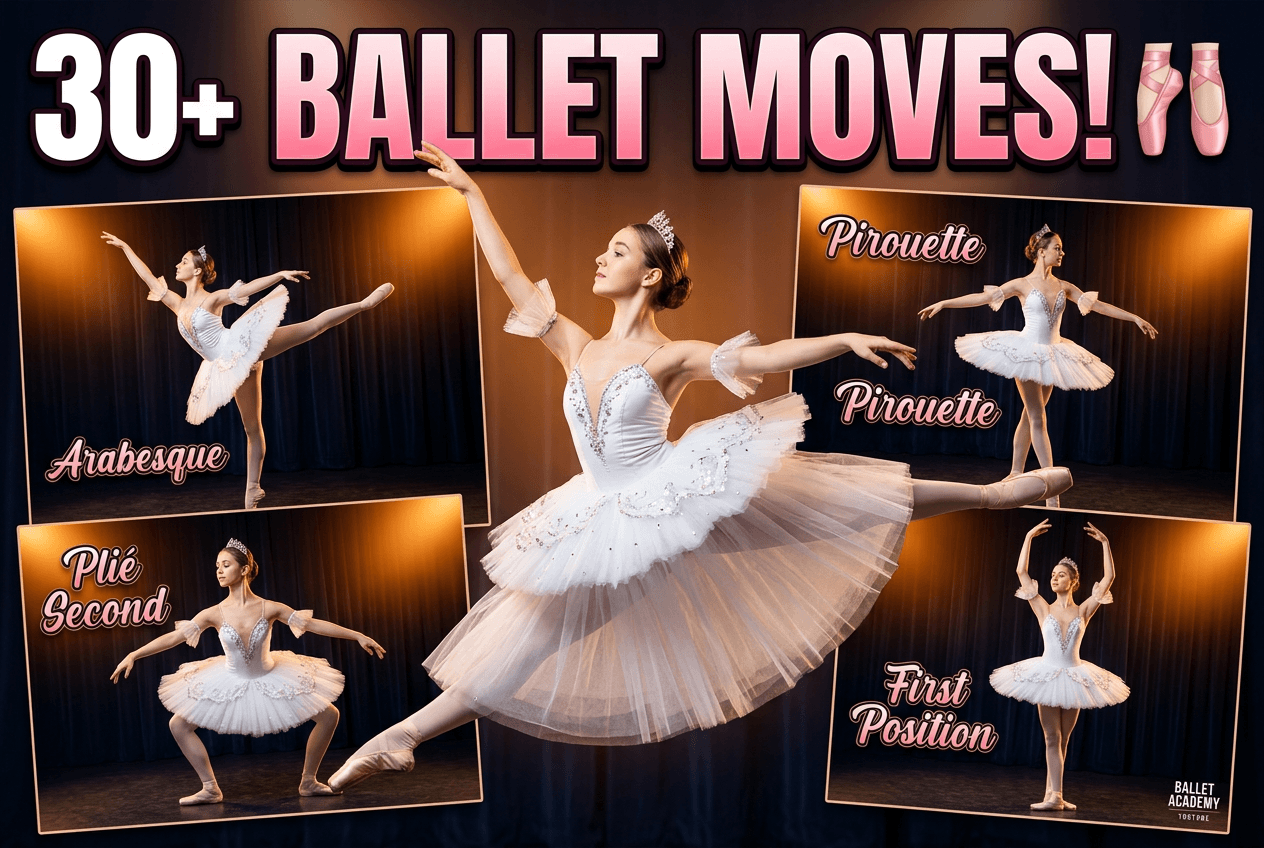
Ever watched a dancer float across a stage and wondered how each step gets its name? Welcome to the beautiful world of ballet dance moves, where every jump and turn carries centuries of history. This guide covers the five positions, essential barre exercises, famous poses like the arabesque, and spins like the pirouette. You'll learn more than thirty steps, understand the French terminologyup memory tricks that make everything stick. Whether you dream of pointe shoes or simply want stronger dance foundations, these pages hand you the complete vocabulary. Stretch those ankles, find a little floor space, and let's begin.
Why Ballet Has Its Own Language
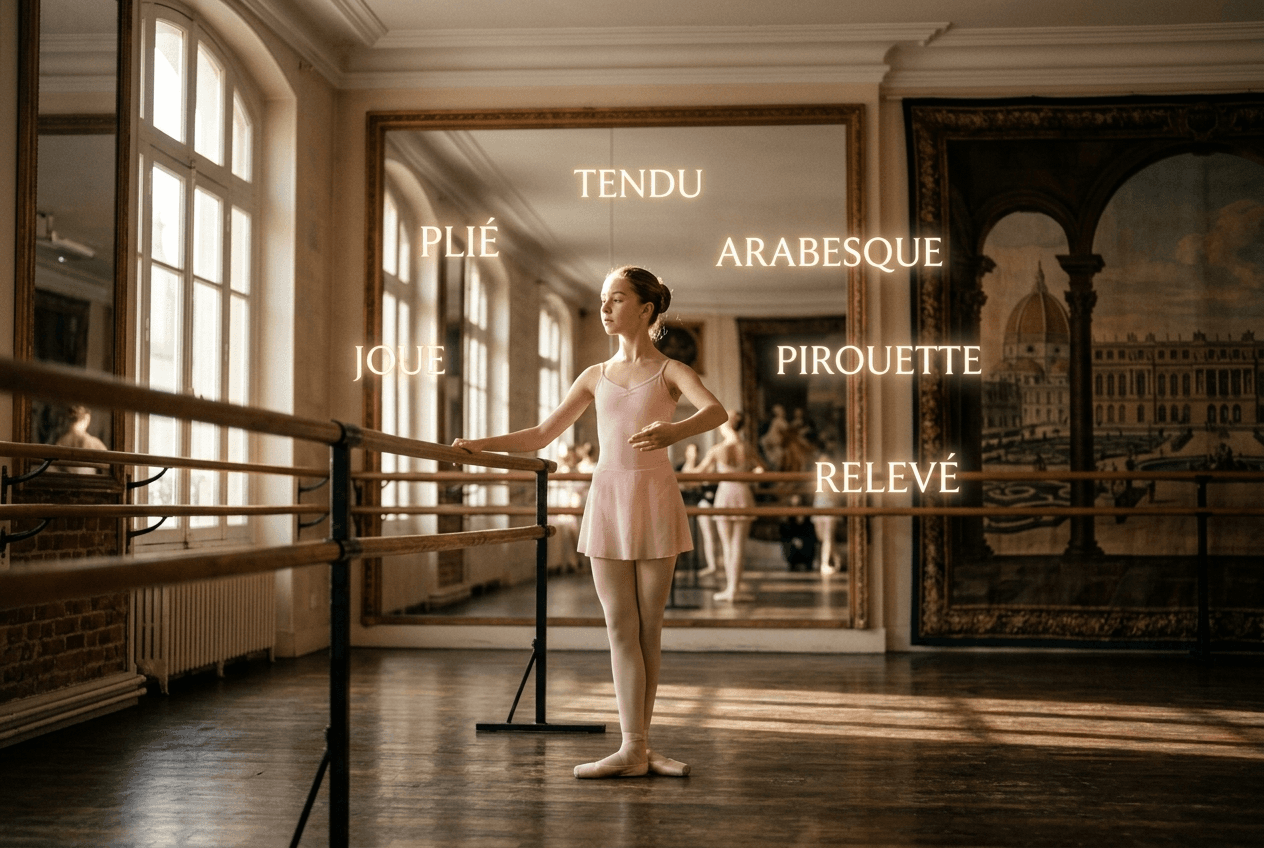 Ballet was born in Italian courts during the 1400s and grew up in France. That's why nearly all French terminology survives today. When your teacher says plie or tendu, you're speaking the same dance vocabulary used at the Paris Opera three centuries ago.
Here's the practical payoff. Because the names are universal, a class in New York, London, or Mumbai runs on identical words. Learn this classical ballet language once and every studio on earth understands you. Few skills travel so well across borders and styles.
The Five Basic Ballet Positions
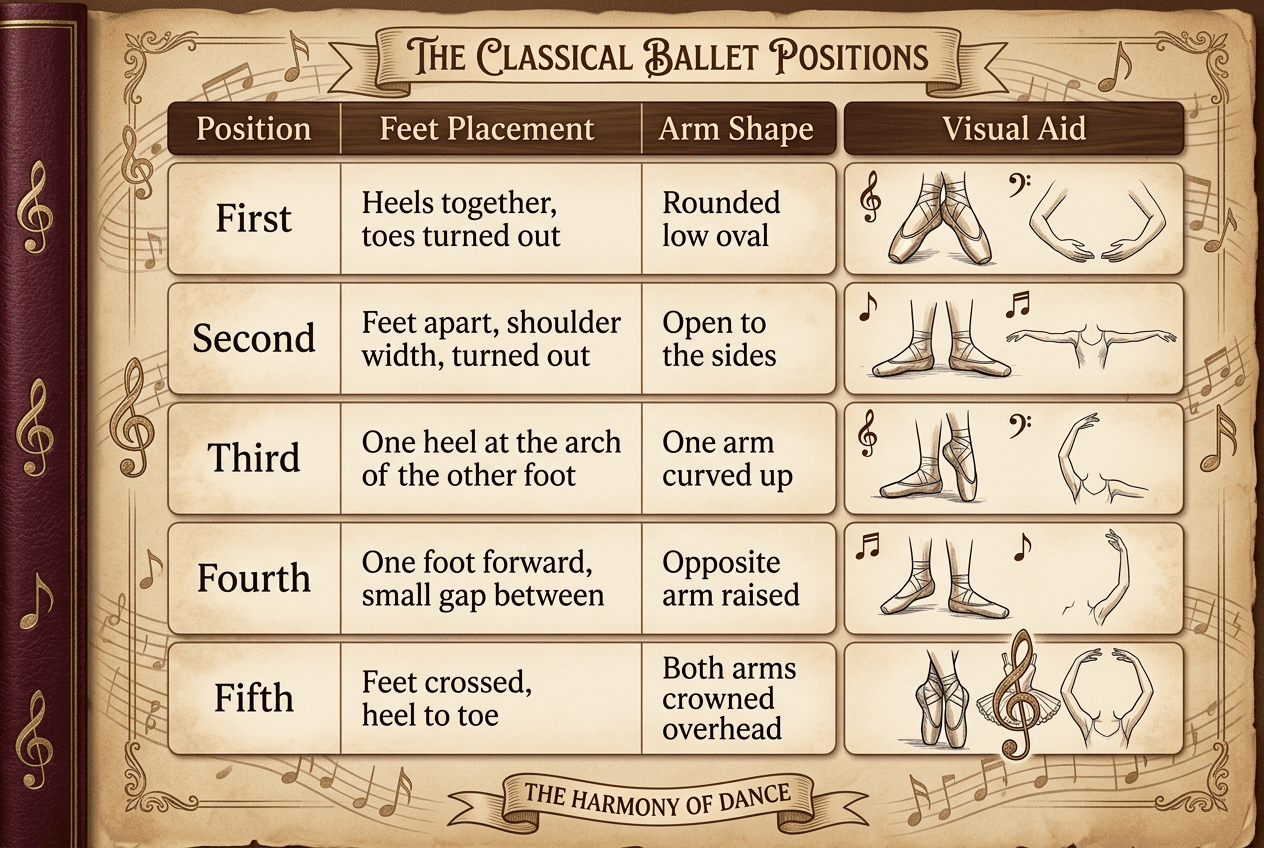
Everything in ballet starts from the five positions of the feet. They were codified in 1661 and they haven't changed since. Each position trains turnout, the outward leg rotation from the hips that gives classical ballet its signature line.
Don't rush these. Professionals still drill them daily, the way pianists drill scales. Master the positions and every step later in this guide becomes easier, because complex ballet dance moves are really just journeys between these five home bases.
First and Second Position
First position places your heels together with toes pointing outward, forming a neat V. Second simply opens the feet apart. Both teach balance and turnout without strain. Practice them while brushing your teeth. Honestly, thirty daily seconds builds visible stability within two weeks.
Third, Fourth, and Fifth Position
Third position tucks one heel against the other foot's arch. Fourth slides a foot forward. Fifth crosses the feet fully, heel meeting toe. Fifth is the launchpad for most basic ballet steps, so give it extra attention during your barre exercises.
The Seven Movements of Dance
Surprise: every step in ballet, no matter how fancy, combines just seven fundamental actions. French masters named them centuries ago. Bend, stretch, rise, glide, jump, turn, and dart. That's the entire engine room of classical ballet in one elegant list. Why does this matter for you? Because once you spot these seven actions inside complicated choreography, intimidating ballet dance moves suddenly look logical. A grand allegro sequence is simply jumping plus gliding. Analysis beats memorization every single time in dance vocabulary learning.
 Walk into any studio and you'll grip a wooden rail before anything else. Barre exercises warm the body, align the spine, and rehearse each action slowly. Think of the barre as training wheels that professionals never actually outgrow, even after decades onstage.
A typical barre sequence flows from plies into tendus, then builds speed and height. The order is intentional. Muscles wake gradually, protecting knees and ankles. Skip the barre and injuries follow, which is why every serious classical ballet class protects this ritual fiercely.
Plie The plie is a smooth knee bend with heels grounded, the shock absorber of ballet. Every jump takes off from one and lands in another. Demi plie bends halfway; grand plie sinks deeper. Strong plies quietly power all your future ballet moves names list.
Tendu Tendu means stretched. Your working foot slides along the floor until only the pointed toes touch, then returns. It looks tiny yet it teaches the leg pathways used in nearly every step. Teachers call tendu the most important exercise in dance vocabulary.
Degage Degage begins exactly like tendu but the toes release a few inches off the floor. The name means disengaged. It sharpens speed and prepares your legs for jumps. Do them in sets of eight, alternating feet, and feel the ankles strengthen fast.
Rond de Jambe Here your leg draws a semicircle on the floor, front to side to back. The name means circle of the leg. Done a terre or raised en l'air, it lubricates the hips and builds the control behind every arabesque you'll ever hold.
Frappe Frappe means struck. The foot flexes at the ankle, then strikes outward with a crisp brush, like a match being lit. This percussive action develops the sharp attack needed for fast jumps. Pair it with a metronome and your rhythm improves too.
Grand Battement The grand battement is a controlled high kick, launched from the hip while the torso stays calm. Football warmups borrowed it. Cheer squads borrowed it. Keep the supporting leg firm, kick to hip height or beyond, and lower with resistance. Power meets poise here.
Ballet Jumps and Their Names
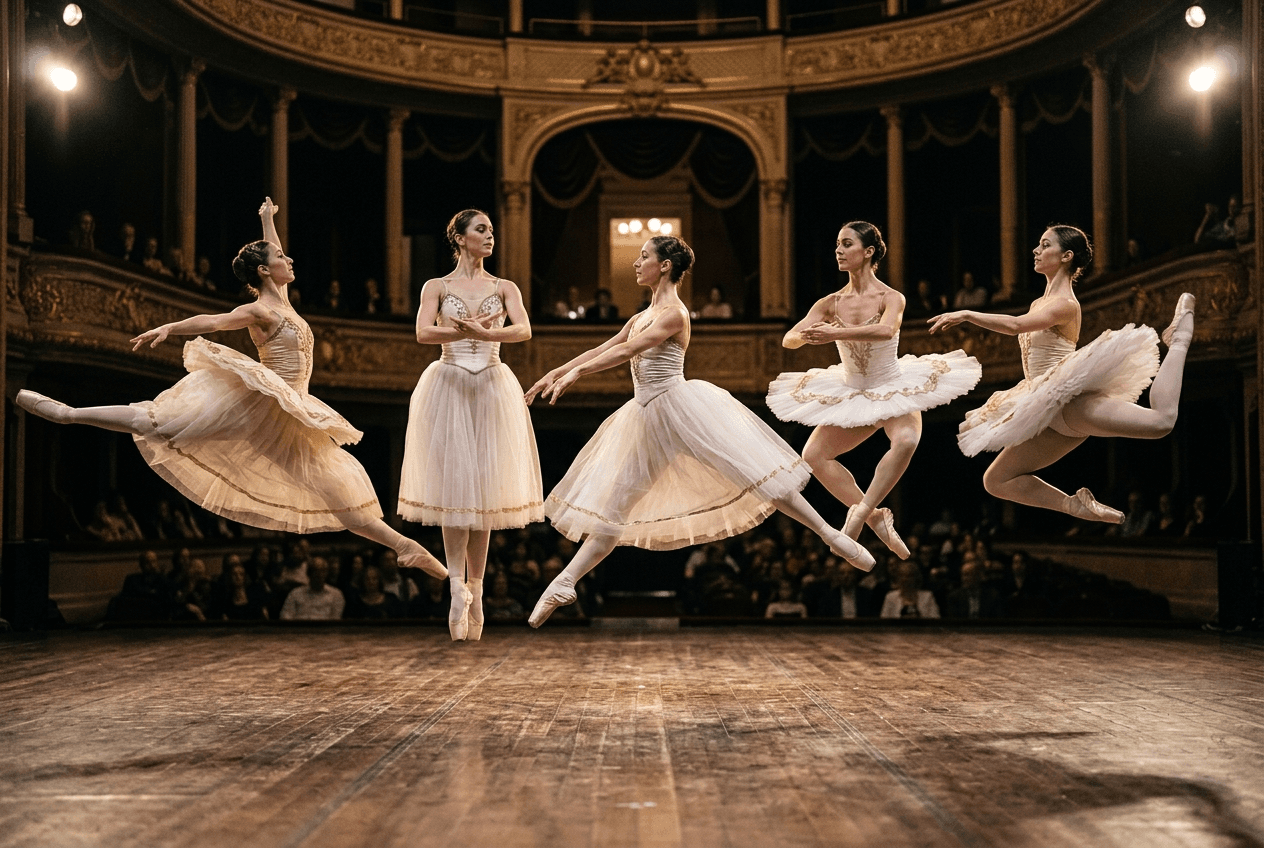 Jumps are where ballet turns airborne and audiences gasp. The family ranges from small petit allegro hops to soaring grand allegro leaps. Each one takes off from a plie, travels through a pointed shape, and lands silently. Silence, dancers joke, is the loudest applause.
Learn the small jumps first. Height comes from technique, not raw legs. Once basic ballet steps feel automatic, elevation arrives almost by accident. The eight jumps below build from beginner to breathtaking, and together they cover most airborne steps you'll see onstage.
Saute Saute simply means jump. Both feet press the floor, spring upward, and land together in a soft plie. It's usually the first jump ever taught. Early French court dancers used sautes to imitate birds, showing off lightness and noble grace before kings.
Changement Changement means change. You spring from fifth position and swap which foot lands in front. Watch the feet flutter mid-air like scissors. Do sixteen in a row and your calves will introduce themselves loudly the next morning. Consider that a rite of passage.
Assemble Assemble means assembled. One leg brushes out, the body rises, and both feet meet in the air before landing together in fifth. It teaches coordination between brush and spring, which later feeds bigger leaps. Precision here separates tidy dancers from messy ones.
Jete A jete throws you from one foot to the other, the word literally meaning thrown. Petit jetes stay small and quick. The step trains weight transfer in mid-air, a skill borrowed by jazz, contemporary, and even hip hop dance steps choreography today.
Grand Jete The grand jete is ballet's postcard image: a flying split across the stage. The front leg shoots forward, the back leg stretches behind, and gravity briefly loses the argument. Every dancer remembers their first real one. Strong grand jete work needs years of patient plies.
Sissonne Named after its 17th-century inventor, the sissonne launches from two feet but lands on one, the other leg sweeping open like scissors. It travels forward, sideways, or back. Choreographers love it for covering ground while looking effortless. Your thighs will disagree at first.
Entrechat The entrechat is a vertical jump where the legs beat together, crossing swiftly in the air before landing. Counting the beats gives entrechat quatre, six, and beyond. Nijinsky reportedly managed ten. Start with two beats and celebrate. Everyone begins exactly there.
Pas de Chat Pas de chat means step of the cat. Knees lift one after the other, feet tucking up like paws as you spring sideways. It's playful, quick, and famous from the Dance of the Cygnets in Swan Lake. Kids usually adore this one instantly.
Ballet Turns and Their Names
Turning is ballet's magic trick. The secret is spotting: your eyes lock on one point, the head whips around last, and dizziness mostly disappears. Every turning step in classical ballet relies on this simple trick plus a strong, lifted center.
Practice turns on both sides even when one feels easier. Balanced training prevents lopsided technique. The six turns below appear constantly in class and choreography, and they're the ballet moves names beginners most often ask about after watching any professional performance.
Pirouette The pirouette is a spin on one leg, the other foot pressed at the knee in passe. One clean rotation beats three wobbly ones, always. Push from a deep fourth-position plie, spot the mirror, and land like you planned it all along.
Chaine Turns Chaines means chains. These rapid half-turns link together as you travel in a straight line, feet in a tight first position on demi-pointe. They're the spinning blur in every ballet finale. Start slow across the room. Speed arrives once spotting becomes automatic.
Pique Turn For a pique turn you step directly onto a straight leg on releve and whip around, the free foot tucked behind the knee. Rows of them circle the stage in Swan Lake. The stepping action makes them friendlier than pirouettes for most beginners.
Attitude Turn Here the lifted leg bends at ninety degrees behind you while you rotate. The pose copies the Roman statue of Mercury. It signals transformation in story ballets, and it demands serious back strength. Hold the shape first; add the turn only afterward.
Fouette The fouette is ballet's endurance stunt. The working leg whips out and in, powering rotation after rotation on one supporting leg. Odile fires off thirty-two in Swan Lake and audiences count aloud. Treat it as a long-term goal, not a first-year target.
Pencil Turn The pencil turn keeps both legs pressed straight and together during the spin, drawing a clean vertical line. It's a newer, neoclassical favorite rather than a strict classical ballet step. Contemporary choreographers use it as a sharp exclamation mark between softer phrases.
Soutenu Turn Soutenu means sustained. The legs cross tightly on releve and the body unwinds in a smooth half or full rotation, feet swapping places. It's the gentlest turn in the dance vocabulary, perfect for beginners learning to spot without the fear of falling.
Graceful Poses and Extensions
Poses are where ballet breathes. Between the jumps and spins, a held shape lets the story land. Photographers chase these moments because a single silhouette can carry an entire ballet's emotion. Strength disguised as stillness: that's the real skill being displayed.
Flexibility helps here, but placement matters more. A modest, well-aligned line beats a high, crooked one every time. Work these five shapes at the barre before trying them center floor, and film yourself weekly. Progress hides until video reveals it suddenly.
Arabesque The arabesque extends one leg straight behind while the arms reach forward, creating the longest possible line. It's the emblem of ballet itself. Early masters modeled it on Greek statues, chasing stillness in motion. Clara reaches for magic with one in The Nutcracker.
Attitude The attitude resembles an arabesque with the raised leg bent at ninety degrees, front or back. It reads as regal and slightly mysterious. Balanchine built entire ballets around its geometry. Square your hips, lift the knee high, and the shape sings immediately.
Developpe A developpe unfolds the leg slowly through passe into a full extension, like a flower opening in real time. The move whispers control. In Giselle it shows yearning; in modern works, quiet power. Slow practice here builds strength no gym machine touches.
Releve Releve means to rise. Heels lift until you balance on the balls of the feet, or fully on pointe work shoes after years of training. The rise traditionally symbolizes the soul reaching upward. Practically, it forges the steel ankles every dancer needs.
Passe In passe, the working foot draws up to touch the side of the supporting knee, forming a neat triangle. It's the pit stop inside pirouettes and developpes. Nail a rock-solid passe balance on releve and your turns improve almost overnight. Truly.
Penche Penche means leaning. From a high arabesque, the torso tips forward as the back leg climbs toward vertical, forming a dramatic six o'clock line in advanced dancers. Work it at the barre first. Even a modest penche photographs like pure poetry.
Traveling and Connecting Steps
Connecting steps are the grammar between the poetry. They carry dancers across space and link showpiece ballet dance moves into flowing sentences. Audiences barely notice them, which is precisely the point. Smooth transitions are what make choreography look inevitable rather than assembled.
Beginners often rush these, hunting the flashy steps instead. Resist that. Choreographers privately judge dancers by their transitions, not their tricks. Master the six movers below and any combination your teacher throws at you will suddenly feel half as difficult.
Chasse Chasse means to chase: one foot slides out and the other chases it, catching up mid-glide. It builds momentum before leaps and appears everywhere from Coppelia to figure skating. Say it as you do it. The rhythm of the word teaches the step.
Pas de Bourree This quick three-step weight shift, back-side-front, is ballet's most used connector. It preps turns, links jumps, and fills musical gaps. Jazz and Broadway borrowed it wholesale. Drill it until your feet do it while your mind plans the next move.
Glissade Glissade means glide. From fifth position, one foot slides out, weight transfers through a small skim of air, and the feet close again. It's the polite handshake before a grand jete. Keep it low and smooth; height belongs to the leap after.
Balance The balance rocks side to side in a waltz rhythm, down-up-down, like a gentle swing. It teaches musicality more than muscle. Pair it with three-four timing and you'll feel the music breathe. Romantic ballets scatter balances through every moonlit scene.
Pas de Basque Borrowed from Basque folk dancing, this sweeping side-to-side step blends folk warmth with courtly polish. It introduces noble characters in Raymonda and Paquita. The half-circle floor pattern makes it a favorite for entrances, setting an elegant tone within two counts.
Point Step The point step extends one foot with pointed toes before the weight follows. It's the visible inhale before action, the hesitation before a character decides. Simple as it looks, it teaches intention. Every step in ballet begins with a decision made visible.
Quick Reference: 30 Ballet Terms at a Glance
Bookmark this table for class. Reciting names while marking steps cements the French terminology twice as fast, because saying and doing wire together in memory. Quiz yourself weekly, cover the middle column, and watch your recall sharpen before each lesson.
Notice how many meanings are plain physical verbs: bend, rise, glide, chase, throw. Ballet's dance vocabulary is really a list of actions dressed in French. Translate mentally as you read choreography and the mystery evaporates, leaving only clear instructions.
How to Memorize Ballet Moves Faster
Memory loves stories, not lists. Attach each term to its literal meaning and a mental image: a cat for pas de chat, scissors for sissonne, a whip for fouette. Within days the ballet moves names stop being foreign words and become pictures.
Then use spaced repetition. Review terms for five minutes daily rather than an hour on Sundays. Speak names aloud while marking steps with your hands, a trick professionals call marking. Voice plus movement plus meaning locks dance vocabulary into long-term memory remarkably fast.
Practice with Visualization
Before sleep, mentally dance a short sequence: plie, tendu, pirouette, arabesque. Athletes call this motor imagery and studies show it activates the same brain regions as physical practice. Two silent minutes nightly measurably improves your next class. Free training, zero sweat.
Ballet and Indian Classical Dance: Surprising Parallels
Here's a perspective most ballet guides never offer. Indian classical forms like Bharatanatyam also build from codified positions, half-seated stances, and named hand gestures. Araimandi mirrors the plie principle. Both traditions turned discipline into classical ballet-level artistry, oceans apart.
Cross-training pays. Ballet's turnout and line sharpen Bharatanatyam geometry, while Indian footwork gifts ballet dancers rhythmic precision. Explore our guide to Indian dance styles and the 6 classical dance forms to see how deep the parallels run.
How to Start Learning Ballet at Home
You need less than you think: two square meters of floor, a chair back as a barre, and consistency. Begin with ten-minute sessions covering plies, tendus, and releves. Our roundup of easy dance moves for beginners makes a gentle warmup companion.
Adults, hear this clearly: you are not too late. Ballet studios across the USA report booming adult beginner classes. Bones and brains both adapt at any age. Prefer learning Bollywood or fusion styles alongside? Live online dance classes let you study from your living room.
What to Wear and Set Up Skip the tutu for now. Fitted clothing that shows your knees, plus socks or ballet slippers on a non-slip floor, is plenty. Add a mirror if possible and film one run-through weekly. Comparing videos month to month keeps motivation genuinely alive.
Common Beginner Mistakes to Avoid
Mistake one: forcing turnout from the knees instead of the hips. It looks fine for a week and hurts for a month. Rotate from the hip sockets only. Mistake two: holding your breath during balances. Breathing is part of the choreography too.
Mistake three: chasing pointe work before the ankles are ready. Teachers require years of preparation for good reason. Mistake four: skipping plies because they seem boring. Every professional you admire still does them daily. Boring, it turns out, is the foundation of brilliance.
A Short History Behind the Names
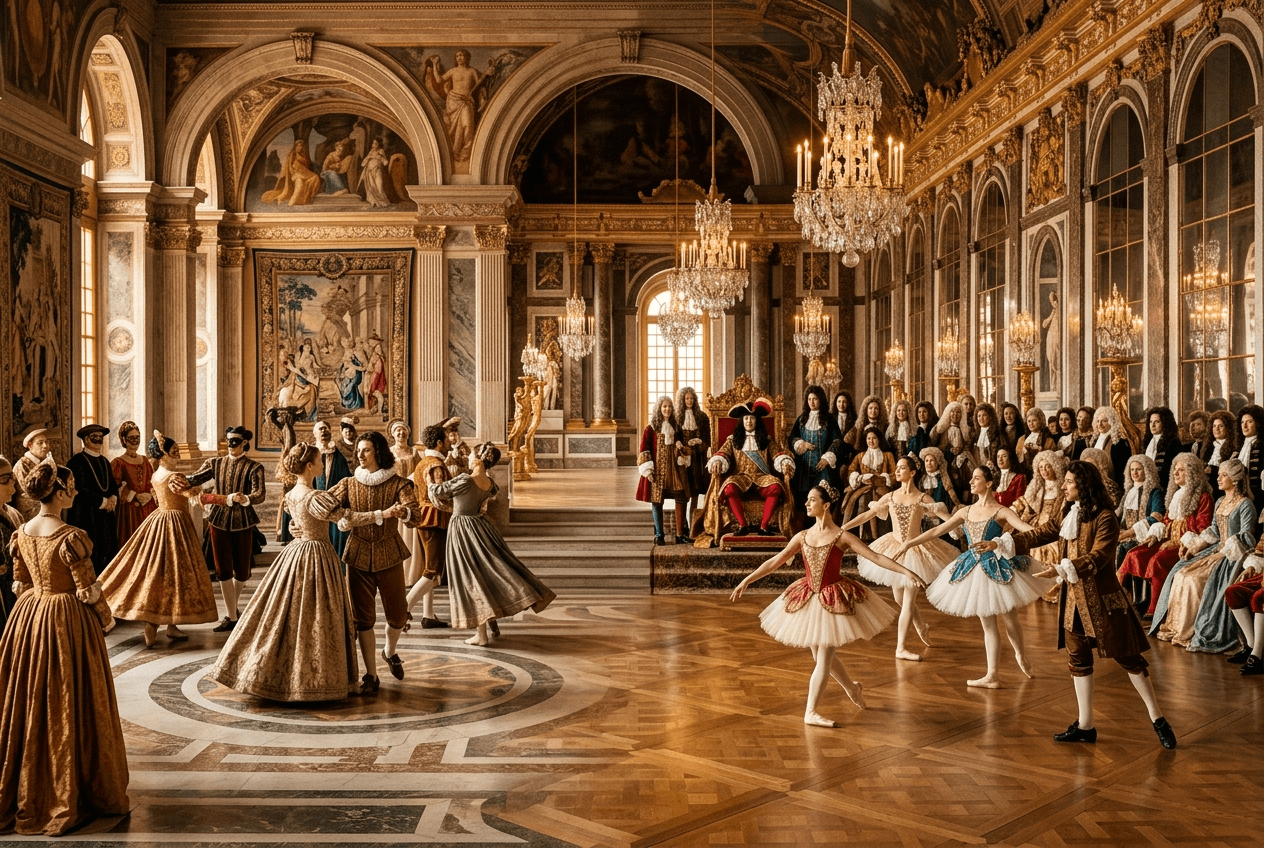 The story starts in 1400s Italy, where court spectacles mixed dance, poetry, and politics. Catherine de Medici carried the art to France, and in 1661 Louis XIV founded the Academie Royale de Danse. His masters wrote down the five positions we still use.
Russia later added athletic fire, producing Swan Lake and The Nutcracker. The twentieth century brought Balanchine's speed to America. Through every era the French terminology survived untouched, which is why a 350-year-old vocabulary still runs every studio in the world today.
Why the Names Never Translated Teachers tried translating terms into local languages many times. It never stuck. A shared vocabulary lets a dancer trained in Chennai audition in Paris without missing a count. The untranslated names became ballet's passport, and honestly, plie sounds far better than knee bend.
Famous Ballets Where You'll See These Steps
Watching full ballets is secret homework that feels like entertainment. Spot the steps you've learned and choreography transforms from pretty blur into readable language. Streaming platforms and YouTube carry excellent recordings from the Royal Ballet, Bolshoi, and American Ballet Theatre archives.
Start with the story classics below. Each pairs signature classical ballet steps with unforgettable music, so your ears learn rhythm while your eyes learn shape. Keep a notebook nearby and tally every arabesque. You'll lose count within minutes, guaranteed.
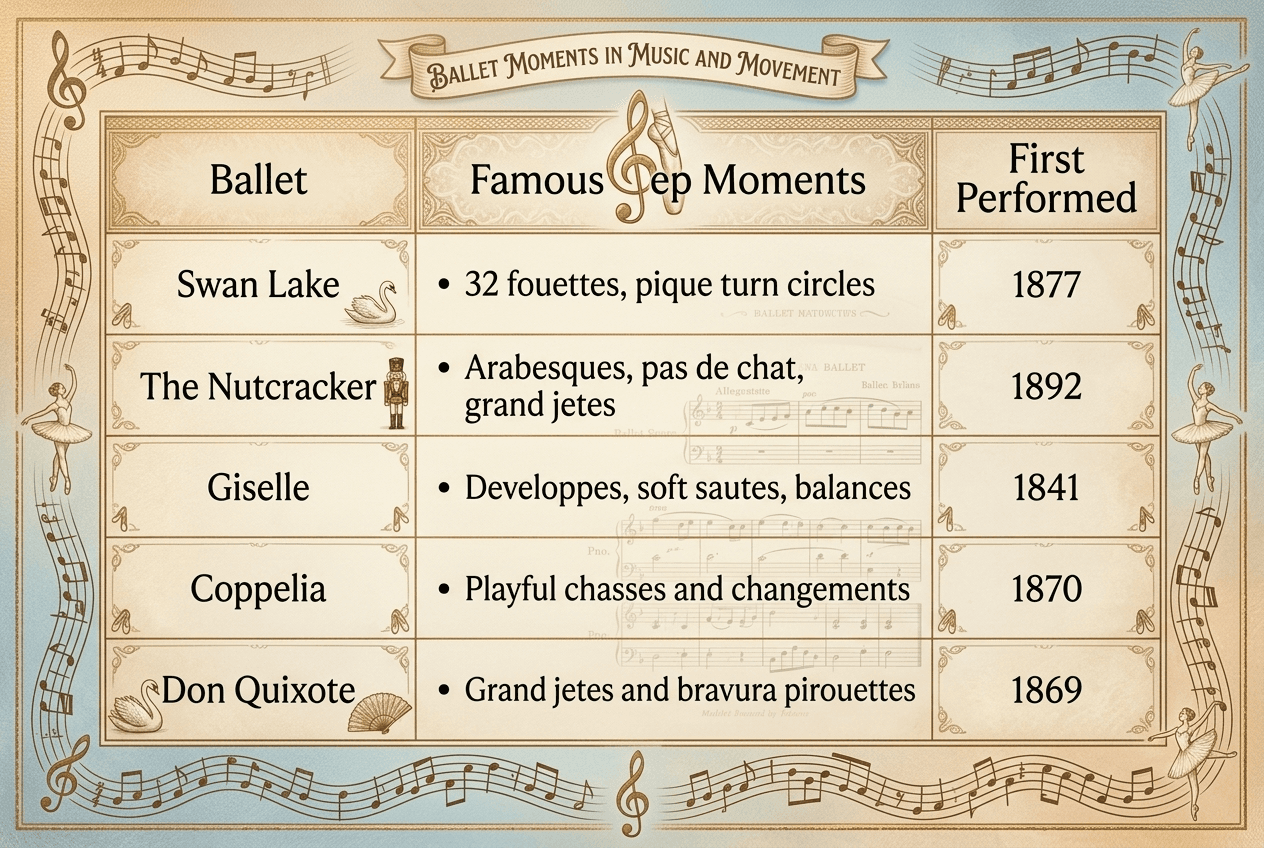
Benefits of Learning Ballet at Any Age
Ballet quietly rebuilds the whole body. Posture straightens within weeks because every exercise stacks the spine. Balance sharpens as ankles strengthen through endless releve work. Harvard research repeatedly links dance practice with better memory and coordination across every age group studied.
The mental gains surprise people most. Memorizing combinations is a workout for the brain, and the barre exercises routine becomes moving meditation. Many adult students report better focus at work within a couple of months. Grace, it turns out, is a transferable skill.
Ballet for Kids in the USA
For children, ballet builds discipline, musicality, and confidence before any stage debut. American studios typically accept students from age three with creative movement classes. The named steps arrive around age seven, when memory and motor skills happily meet the dance vocabulary halfway.
What a Typical Ballet Class Looks Like
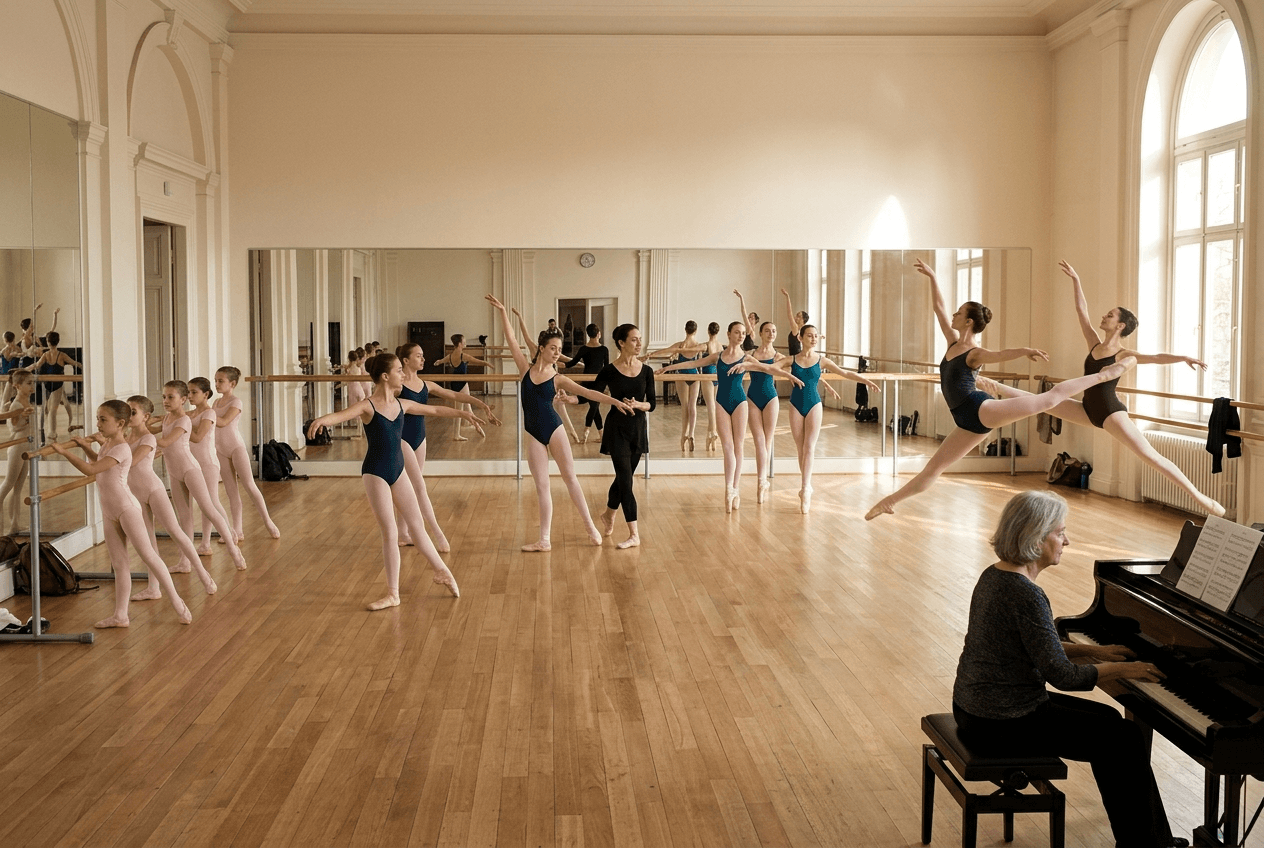
Every class worldwide follows the same comforting arc. Thirty minutes of barre exercises warm and align the body. Then comes center practice, repeating the material without support. Adagio builds slow control, pirouette drills add spins, and small jumps wake the feet.
Class ends with grand allegro, the big traveling leaps, and finally reverence, a bow thanking teacher and pianist. The ritual is identical in Manhattan and Mumbai. Walk into any first class knowing this map and half your nervousness disappears at the door.
Frequently Asked Questions
What are the moves called in ballet?
Ballet movements are called steps and positions, nearly all named in French. Students start with the five positions of the feet, barre exercises like plie and tendu, then progress to center work such as pirouettes, arabesques, and jumps like the grand jete.
What are the 7 movements of dance?
Classical ballet defines seven fundamental actions: plier to bend, etendre to stretch, relever to rise, glisser to glide, sauter to jump, tourner to turn, and elancer to dart. Every complex sequence you'll ever perform combines these seven simple building blocks.
What are the 5 basic jumps in dance?
The five foundation jumps are saute, jumping from two feet to two; assemble, joining the feet mid-air; jete, leaping foot to foot; sissonne, launching from two feet onto one; and entrechat, beating the legs together before landing. Together they build power and precision.
What does releve mean in ballet?
Releve means to rise. The dancer lifts both heels and balances on the balls of the feet, or on full pointe after advanced training. It strengthens ankles, improves balance, and appears inside countless ballet dance moves from pirouettes to simple poses.
How long does it take to learn basic ballet?
With two classes weekly, most adults perform the positions, core basic ballet steps, and simple turns confidently within six months. Clean pirouettes usually take a year. Pointe readiness needs two to four years. Progress tracks consistency far more than age or body type.
Is ballet good for learning other dance styles?
Absolutely. Ballet is called the mother of Western dance because jazz, contemporary, Broadway, and even hip hop choreography borrow its vocabulary and body control. Indian classical students gain too, since posture, balance, and discipline transfer directly across every tradition.
Final Thoughts
Thirty steps might sound like a mountain. It isn't. It's five positions, seven actions, and a lifetime of graceful combinations built from them. Learn a term a day and within a month the entire ballet dance moves vocabulary belongs to you.
Every dancer you've ever admired once stood wobbling in first position, exactly where you are now. Keep your practice short, daily, and joyful. When you're ready for structured guidance, Art Gharana's live dance instructors will meet you at the barre, wherever you live.