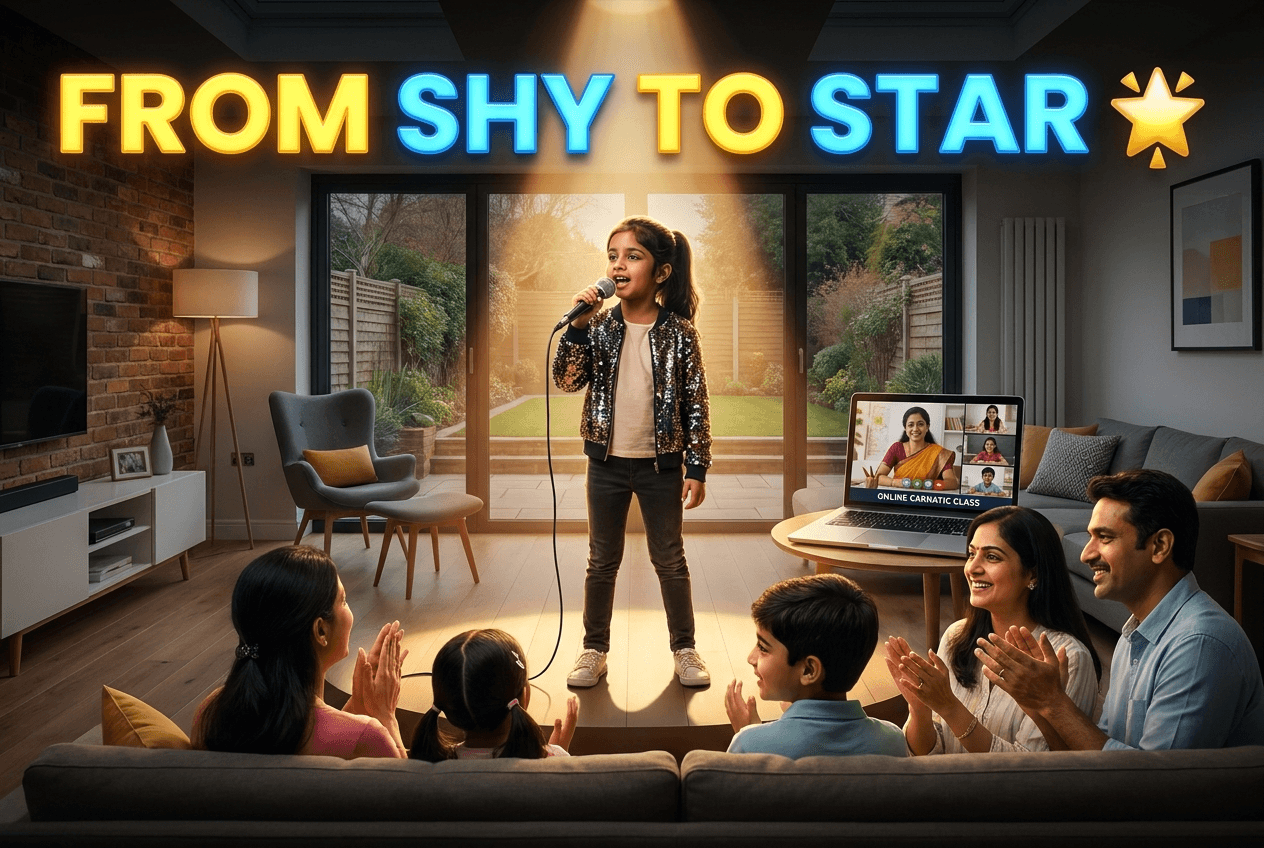
Carnatic music is the classical music of South India and one of the oldest, most sophisticated musical traditions in the world. For Tamil, Telugu, Kannada and Malayalam families living in the United Kingdom, Carnatic vocal training is more than a skill. It is a direct and living connection to a cultural heritage that spans thousands of years. The raga, the kriti, the swara, the tala, these are not just musical concepts. They are the language in which generations of South Indian families have expressed devotion, joy and cultural identity. Finding a genuinely qualified Carnatic vocal teacher in the UK has historically been one of the most difficult challenges for South Indian families. The number of traditionally trained Carnatic musicians based in the UK is small, and those who do teach online are not always accessible or verifiable. Art Gharana solves this directly by connecting UK students with certified Carnatic vocal teachers for live, one to one online Carnatic vocal classes in the UK, scheduled entirely in UK time zones at morning, evening and weekend slots. This guide covers everything UK families need to know about Carnatic vocal training in 2026. Whether your child is a complete beginner or has had some prior exposure to Indian classical music, you will find a thorough account of what to expect, how to choose the right teacher and why Art Gharana is the right choice for your family.
What Is Carnatic Music?
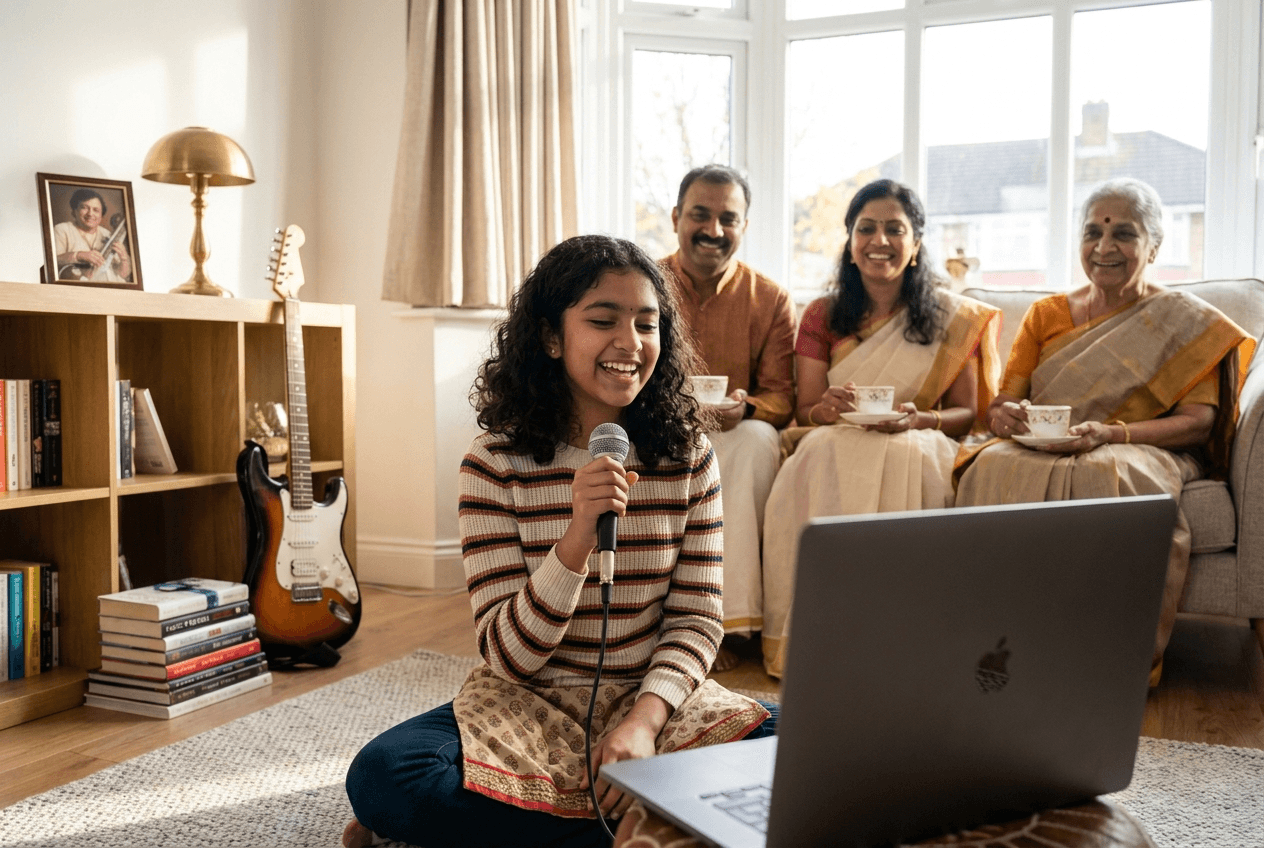 Carnatic music is a system of classical music rooted in the ancient Sanskrit musical treatise Natya Shastra, which dates back more than two millennia. It is primarily associated with the states of Tamil Nadu, Karnataka, Andhra Pradesh, Telangana and Kerala, and its development over the centuries has produced one of the most codified, intricate and deeply expressive musical traditions anywhere in the world.
At the heart of Carnatic music is the raga, a melodic framework that defines not just which notes are used but how they move, which characteristic phrases define the raga's identity, and what emotional quality or bhava the raga is designed to evoke. There are hundreds of ragas in the Carnatic system, and the ability to sing a raga with authenticity, rendering its characteristic phrases and ornaments with precision and feeling, is the central skill of a Carnatic vocalist.
Rhythm in Carnatic music is governed by tala, a system of rhythmic cycles of different lengths and structures. The most commonly encountered tala for beginners is Adi Tala, an eight-beat cycle. As students advance, they encounter increasingly complex and irregular tala structures. The compositional repertoire of Carnatic music is anchored by the works of the saint composers of the eighteenth and nineteenth centuries, particularly the Trinity of Thyagaraja, Muthuswami Dikshitar and Syama Sastri, whose thousands of compositions form the living core of the performing tradition today.
Carnatic music is a system of classical music rooted in the ancient Sanskrit musical treatise Natya Shastra, which dates back more than two millennia. It is primarily associated with the states of Tamil Nadu, Karnataka, Andhra Pradesh, Telangana and Kerala, and its development over the centuries has produced one of the most codified, intricate and deeply expressive musical traditions anywhere in the world.
At the heart of Carnatic music is the raga, a melodic framework that defines not just which notes are used but how they move, which characteristic phrases define the raga's identity, and what emotional quality or bhava the raga is designed to evoke. There are hundreds of ragas in the Carnatic system, and the ability to sing a raga with authenticity, rendering its characteristic phrases and ornaments with precision and feeling, is the central skill of a Carnatic vocalist.
Rhythm in Carnatic music is governed by tala, a system of rhythmic cycles of different lengths and structures. The most commonly encountered tala for beginners is Adi Tala, an eight-beat cycle. As students advance, they encounter increasingly complex and irregular tala structures. The compositional repertoire of Carnatic music is anchored by the works of the saint composers of the eighteenth and nineteenth centuries, particularly the Trinity of Thyagaraja, Muthuswami Dikshitar and Syama Sastri, whose thousands of compositions form the living core of the performing tradition today.
Why Carnatic Vocal Training Is Invaluable for UK Children
Language and Cultural Connection
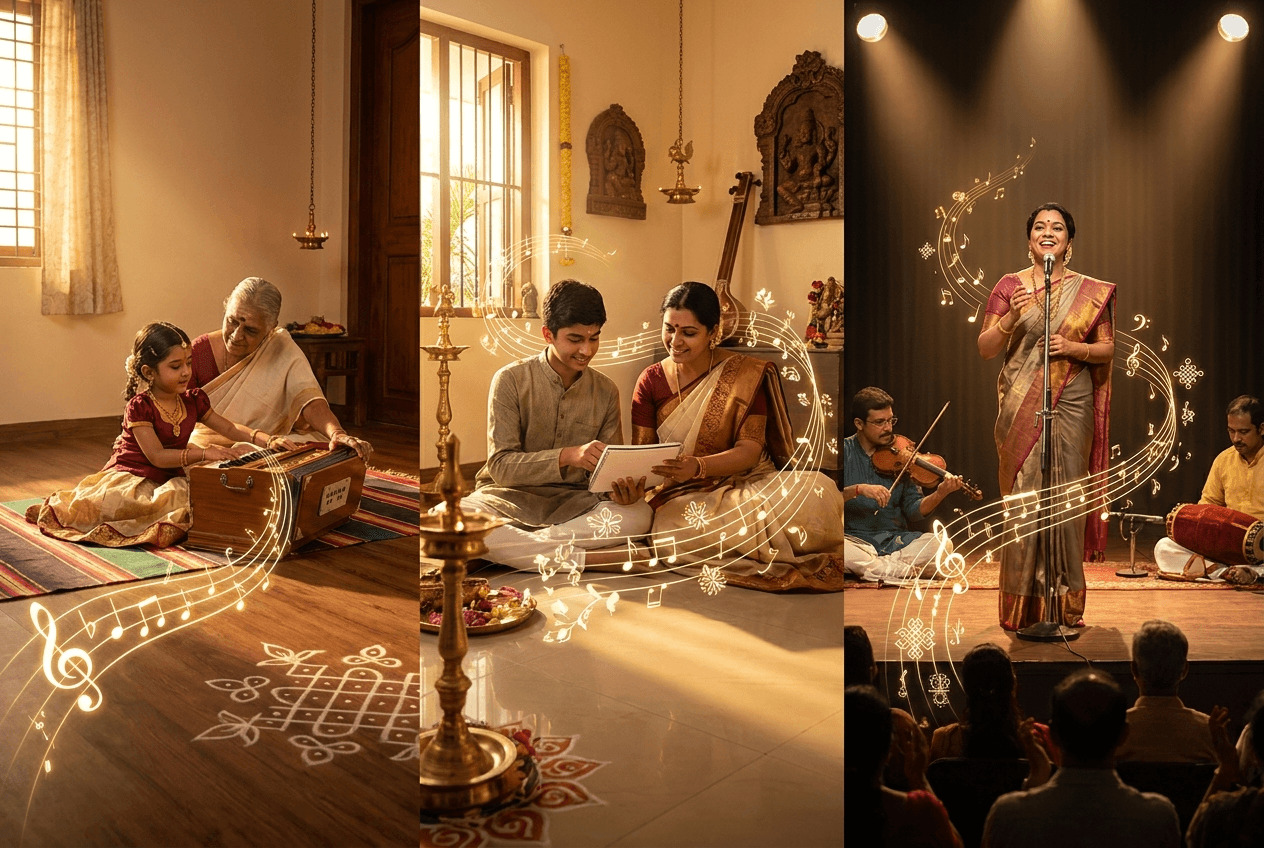
The Carnatic repertoire is sung primarily in Sanskrit, Tamil, Telugu and Kannada. Learning to sing compositions in these languages gives children an embodied, musical connection to the languages of their heritage that no classroom can replicate. For Tamil children growing up in Leicester, Birmingham or London, singing Thyagaraja compositions in Tamil and Telugu, or Muthuswami Dikshitar kritis in Sanskrit, is a profound act of cultural continuity.
Mathematical and Pattern Thinking
The rhythmic structures of Carnatic music are genuinely mathematical. The ability to subdivide a tala cycle correctly, to understand how gamaka ornaments are placed within a melodic phrase, and to handle complex rhythmic compositions like konnakol requires a form of mathematical pattern thinking that directly supports academic performance. Children who study Carnatic music seriously consistently demonstrate stronger abilities in numeracy, logic and analytical thinking.
Vocal Development and Breath Control
Carnatic vocal training, with its emphasis on correct breathing, posture, tone production and pitch accuracy, develops the voice in a healthy and sustainable way. Students learn to project their voice correctly, manage breath efficiently across long musical phrases, and develop the tonal clarity and pitch precision that characterise great Carnatic singing. These skills serve children across all forms of vocal activity, from school presentations and performances to social confidence in everyday life.
Devotional Depth and Emotional Intelligence
Many Carnatic compositions are devotional in nature, expressing the poet-composer's love for and surrender to the divine. Learning to sing these compositions with understanding and feeling, rather than merely technically, develops a quality of emotional depth and inner attention in children that few other educational activities cultivate. The bhakti dimension of Carnatic music connects children to a spiritual tradition that is at the heart of South Indian cultural identity.
What Your Child Will Learn: The Carnatic Vocal Curriculum
Foundation Stage
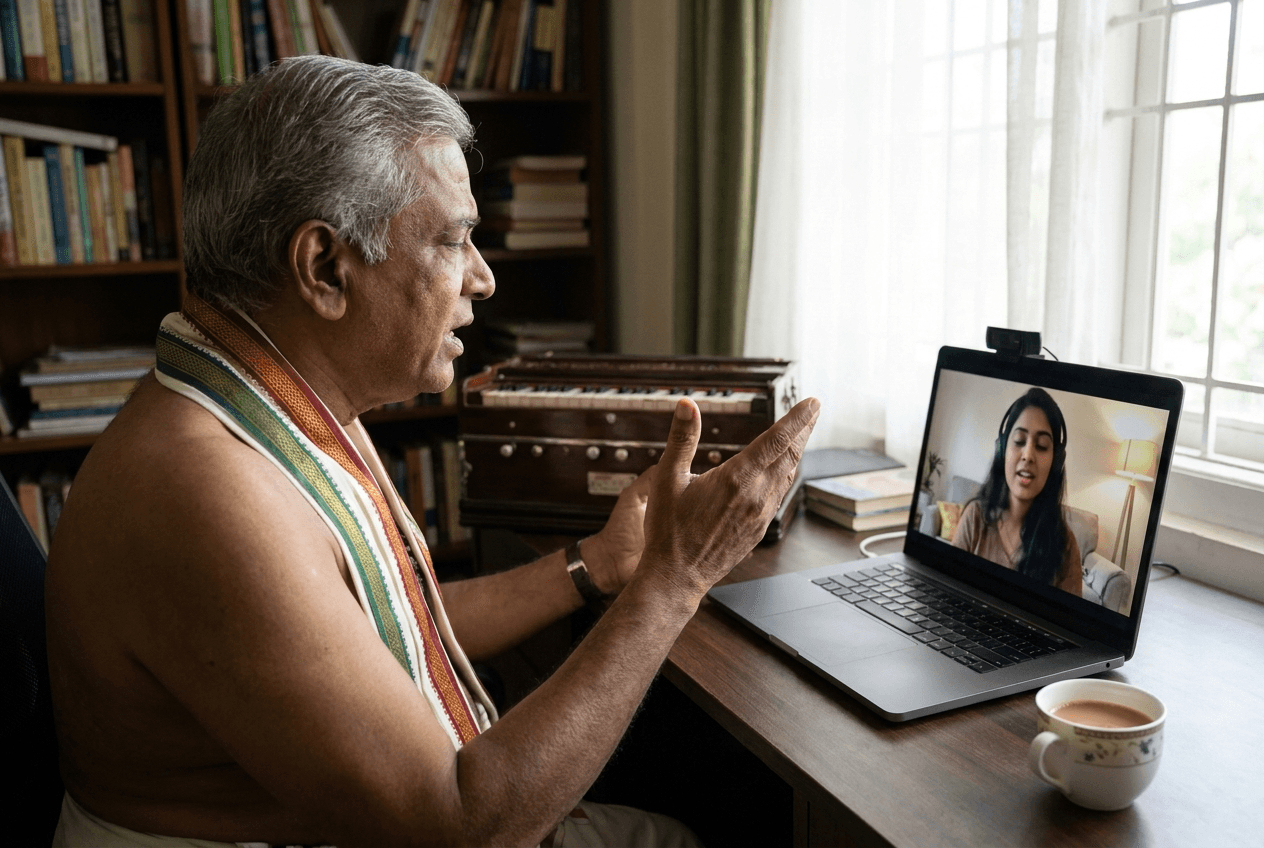
All Carnatic vocal training begins with swara practice, learning the seven basic notes of the scale, called Sa Re Ga Ma Pa Da Ni, and singing them clearly and in tune. Students then progress to sarali varisai exercises, systematic patterns through the notes of a scale that develop intonation, breath control and the ability to navigate the octave range comfortably. Alankarams follow, introducing students to the ornamental patterns that are central to Carnatic melodic expression. Simple compositions called gitams are introduced once the swara foundation is established, giving students the experience of singing a complete Carnatic piece for the first time.
Intermediate Stage
At the intermediate stage, students begin learning swarajathis and varnams. The varnam is one of the most important compositional forms in Carnatic music, and it introduces students to the full expressive and rhythmic complexity of the tradition in concentrated form. Students at this stage also begin to explore a wider range of ragas and learn to identify, sing and improvise within each one. Understanding the difference between ragas, and being able to switch fluently between their distinctive vocabularies, is one of the most sophisticated skills in all of classical music.
Advanced Stage
Advanced students work on kritis by the Trinity composers and other great Carnatic composers, developing their ability to render each composition with the appropriate raga character, rhythmic precision and emotional conviction. At this stage, students also begin to explore manodharma sangita, the improvisatory dimension of Carnatic performance, learning to sing alapana, neraval and swarakalpana within the framework of a raga and a tala.
How Art Gharana Compares to Other Online Carnatic Vocal Providers
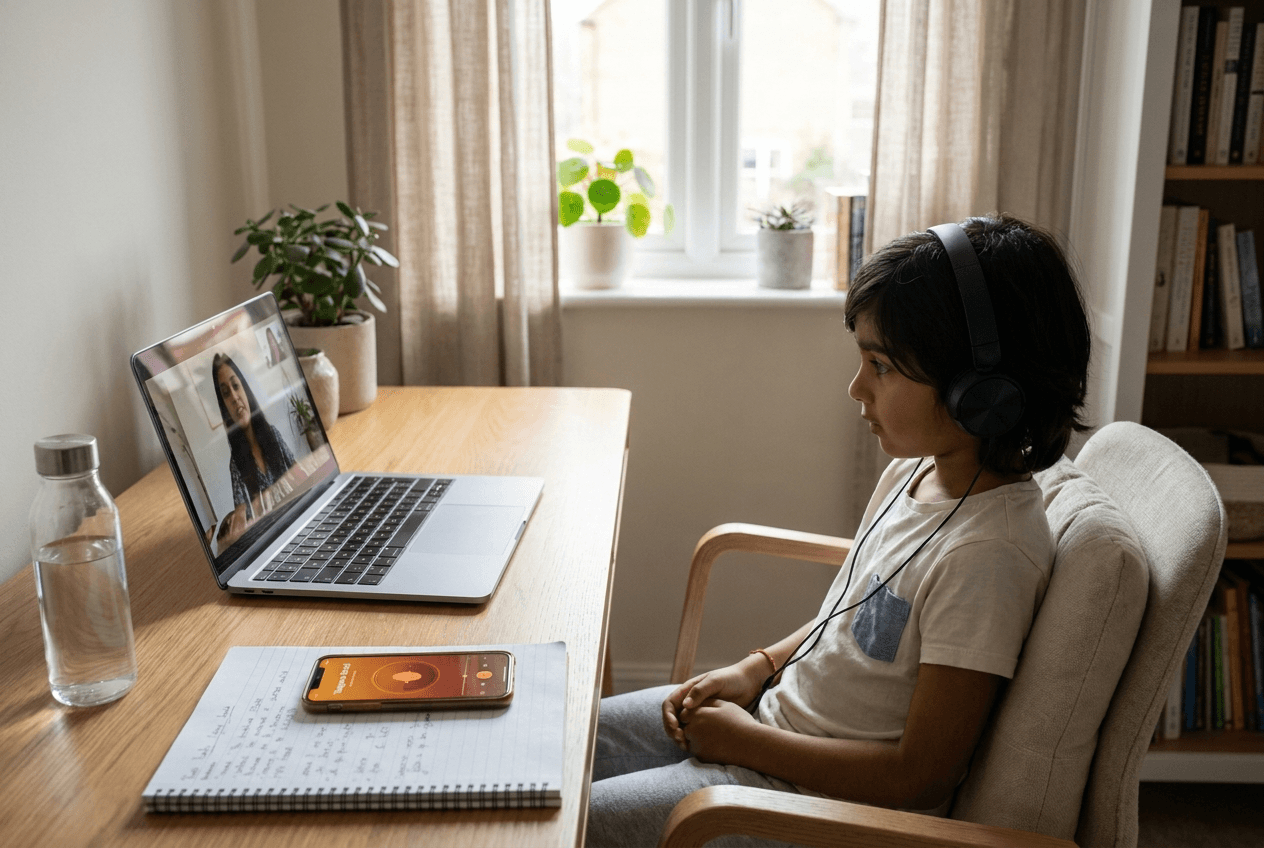 UK families searching for online Carnatic vocal classes will find a number of providers, from group Zoom classes to pre-recorded video platforms to tutor marketplaces. The quality and relevance of what is available varies enormously. Here is a clear comparison.
The most significant gap in the current online Carnatic vocal market for UK families is the combination of live one to one instruction, genuine UK time zone availability and content built specifically for South Indian diaspora children. Several providers explicitly restrict enrolment to female students, which means boys and male adults have no access. Art Gharana welcomes all students regardless of gender, and our curriculum is designed to honour the Carnatic tradition while making it genuinely accessible to young people growing up in a UK context.
UK families searching for online Carnatic vocal classes will find a number of providers, from group Zoom classes to pre-recorded video platforms to tutor marketplaces. The quality and relevance of what is available varies enormously. Here is a clear comparison.
The most significant gap in the current online Carnatic vocal market for UK families is the combination of live one to one instruction, genuine UK time zone availability and content built specifically for South Indian diaspora children. Several providers explicitly restrict enrolment to female students, which means boys and male adults have no access. Art Gharana welcomes all students regardless of gender, and our curriculum is designed to honour the Carnatic tradition while making it genuinely accessible to young people growing up in a UK context.
Equipment Setup for Online Carnatic Vocal Classes
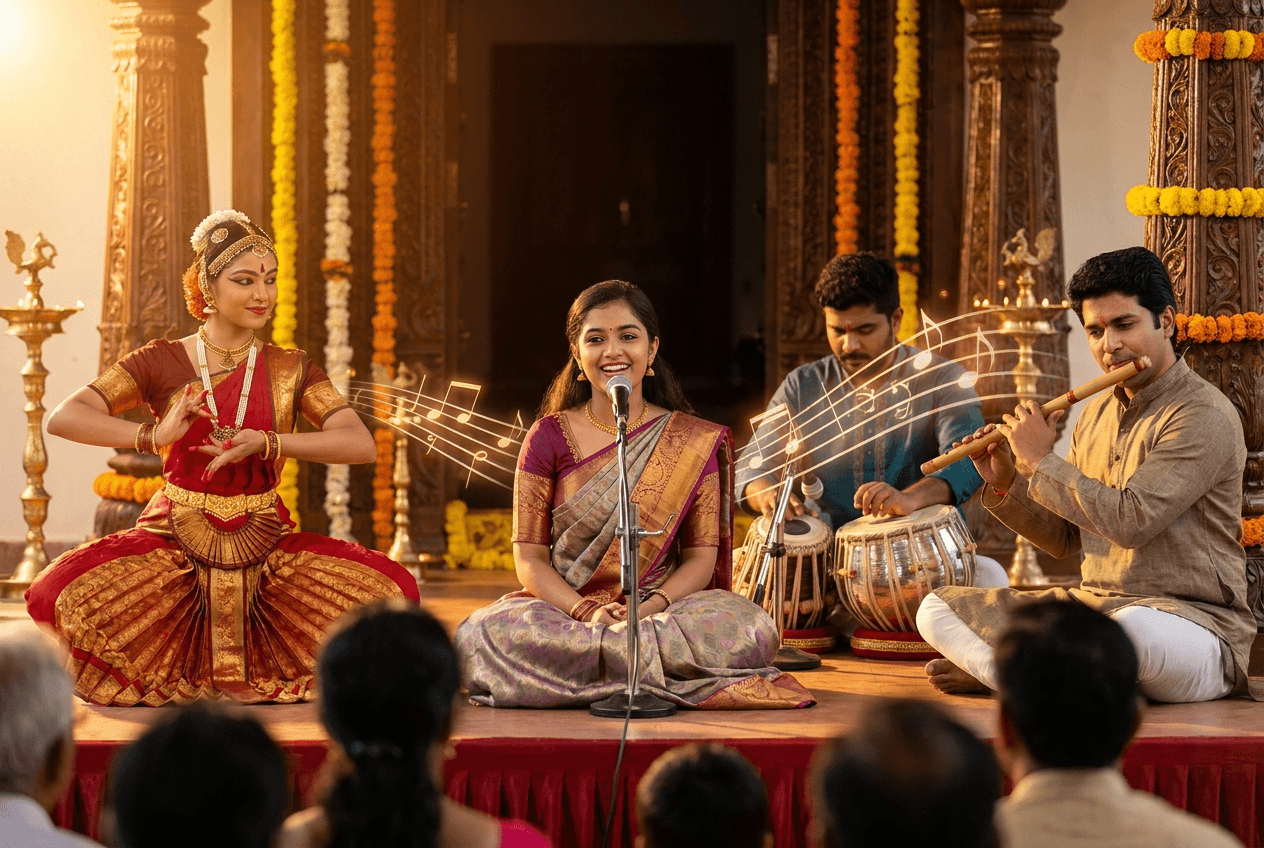 The great advantage of vocal music is that the primary instrument requires no purchase. Your child's voice is all they need to begin. However, a few additional tools significantly enhance the Carnatic vocal learning experience.
A tanpura provides the essential tonal reference for Carnatic singing. The tanpura drone gives the student a stable pitch centre to tune to, which is fundamental to developing accurate intonation. Physical tanpuras are large and expensive, but high-quality tanpura apps are available for smartphones and tablets and work perfectly for both practice and online lessons. Your teacher will recommend a specific app at the first class.
A quiet space with soft furnishings that absorb echo makes a significant difference to the audio quality in online lessons. Carpeted rooms with curtains and furniture work well. The teacher needs to hear the student's voice clearly without reverberation or background noise to provide accurate intonation feedback.
The great advantage of vocal music is that the primary instrument requires no purchase. Your child's voice is all they need to begin. However, a few additional tools significantly enhance the Carnatic vocal learning experience.
A tanpura provides the essential tonal reference for Carnatic singing. The tanpura drone gives the student a stable pitch centre to tune to, which is fundamental to developing accurate intonation. Physical tanpuras are large and expensive, but high-quality tanpura apps are available for smartphones and tablets and work perfectly for both practice and online lessons. Your teacher will recommend a specific app at the first class.
A quiet space with soft furnishings that absorb echo makes a significant difference to the audio quality in online lessons. Carpeted rooms with curtains and furniture work well. The teacher needs to hear the student's voice clearly without reverberation or background noise to provide accurate intonation feedback.
Carnatic Music and the Wider South Indian Arts Tradition
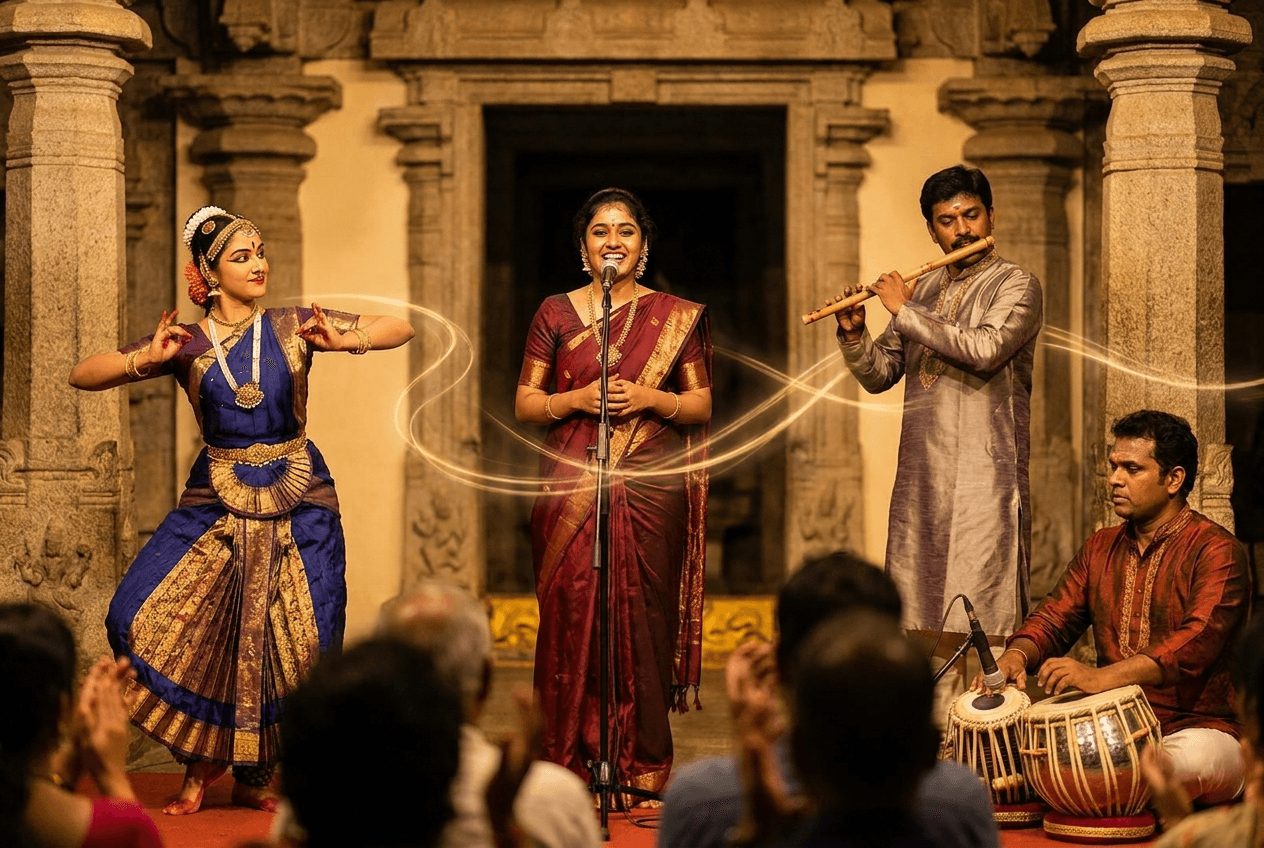 Carnatic music is deeply intertwined with other South Indian classical arts. Students who also study our Bharatanatyam classes find that understanding Carnatic music from the inside, as a singer rather than just a listener, transforms the quality of their dance. Every Bharatanatyam composition is set to a Carnatic musical piece, and a dancer who can sing the music they are dancing to has a depth of musical understanding that is immediately visible in their performance.
Our tabla classes complement Carnatic vocal training beautifully. The tala structures that Carnatic students learn conceptually become physically real when studied through tabla, and students who understand rhythm from a performer's perspective develop a quality of rhythmic precision in their singing that is immediately evident. Our flute classes provide another complementary path, as the Carnatic flute tradition shares the same raga and tala framework as the vocal tradition, and students who study both develop a richer musical understanding than those who study only one. For families from North Indian backgrounds who are interested in classical vocal music, our Hindustani vocal classes follow the Hindustani classical tradition with the same live one to one format and UK time zone availability. You can explore our full range of courses to see everything we offer for UK families.
About Art Gharana
Art Gharana is a specialist online Indian arts education platform with over 50 certified teachers across dance, music and vocal disciplines. Our Carnatic vocal programme serves South Indian families across the UK, USA, Canada, Australia and India. All classes are live, one to one and scheduled in UK time zones. You can browse full teacher biographies on our teacher profiles page, and review our plans and pricing to understand exactly what each session includes.
Carnatic Music in the UK: Building a Community
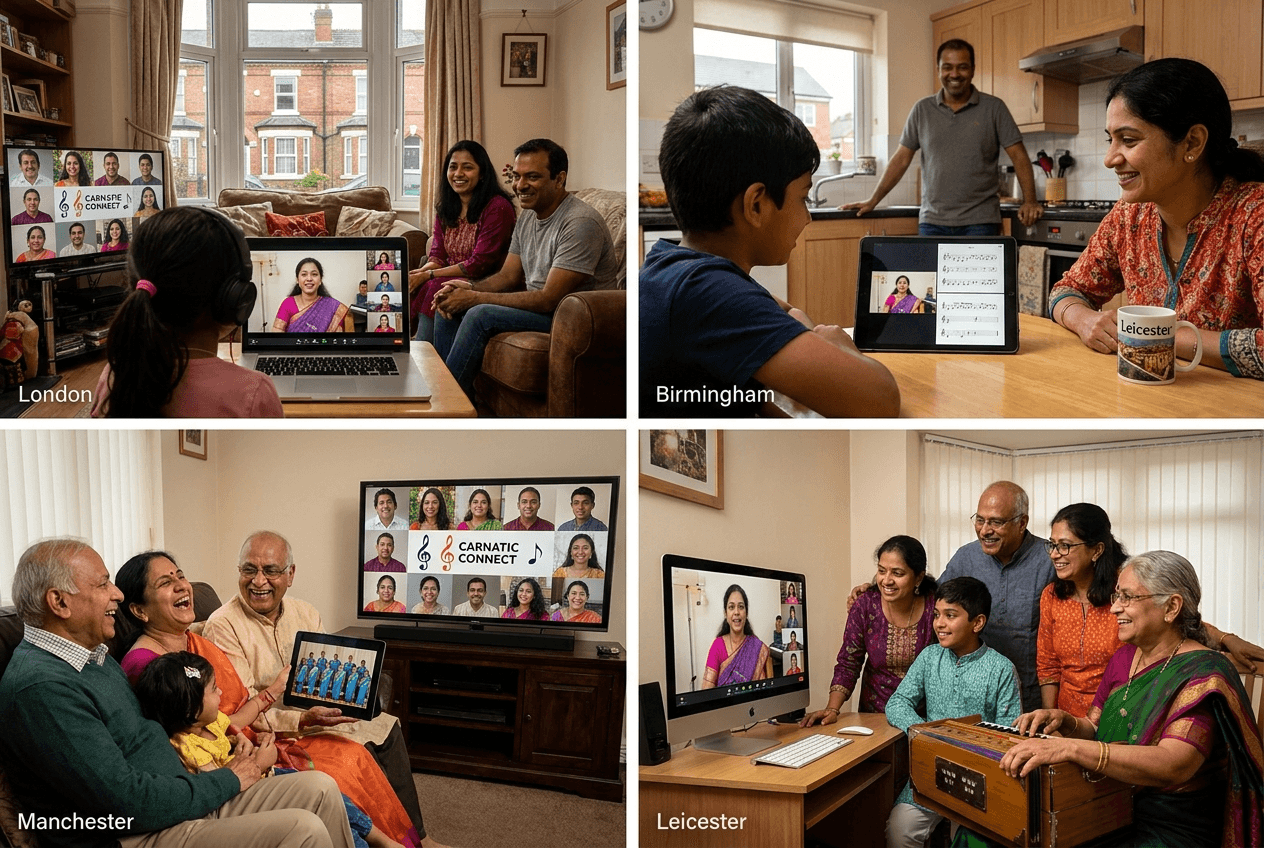 One of the often-overlooked benefits of online Carnatic vocal training through a platform like Art Gharana is the community dimension it creates. Students across the UK, USA, Canada and Australia are learning the same compositions, working with teachers from the same tradition, and progressing through the same curriculum. This shared experience creates a sense of community among students and families that transcends geography.
For Tamil and South Indian families in the UK, this community dimension is particularly meaningful. The relative scarcity of authentic Carnatic music culture in UK cities, compared to Chennai or Bangalore, can make families feel isolated in their cultural pursuits. Knowing that their child is part of a broader global community of young people learning Carnatic music, connected through Art Gharana, provides both motivation and belonging.
The Relationship Between Carnatic Vocal and Other South Indian Arts
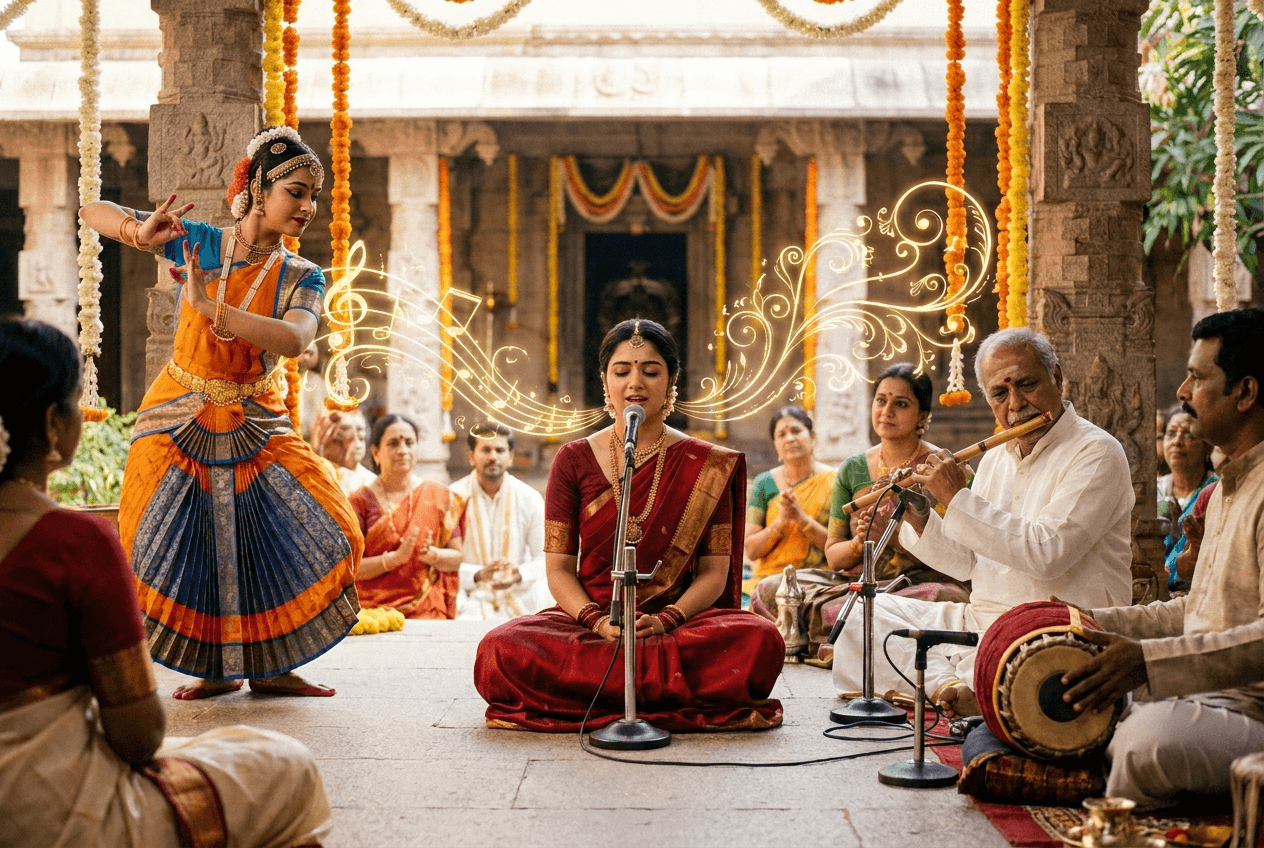 Many students who begin Carnatic vocal training at Art Gharana find that the musical knowledge they develop opens doors to a much wider engagement with South Indian classical culture. The ragas they learn to sing become recognisable in the classical music they hear at concerts and cultural events. The tala structures they master become the framework through which they understand Bharatanatyam performances. The devotional compositions they learn become a living part of how they express their relationship with South Indian spiritual tradition.
This broadening of cultural engagement is one of the most valuable long-term outcomes of Carnatic vocal training. What begins as a weekly music lesson becomes, over years of consistent study, an entire orientation towards South Indian classical culture that shapes how a young person understands and participates in their heritage. For Tamil and South Indian families in the UK, that outcome is one of the most meaningful gifts they can give their children.
It is also worth noting that Carnatic vocal training has significant benefits for children who go on to pursue Western classical music, pop singing or any other form of vocal activity. The precise pitch training, the breath control, the ear for melodic nuance and the rhythmic sophistication that Carnatic training develops are assets in any musical context. Many Art Gharana students who study Carnatic vocal report that it has made them noticeably better in their school choir or their Western music lessons, because the foundational musical skills it builds are genuinely universal.
Frequently Asked Questions
1. Can I find certified Carnatic vocal teachers online in the UK?
Yes. Art Gharana connects UK students with certified Carnatic vocal teachers for live one to one classes, all scheduled in UK time zones with morning, evening and weekend slots available.
2. What age can children start Carnatic vocal training?
Children can begin from around age 5 to 6. Basic swara practice is well suited to young voices, and our beginner curriculum is designed to be age-appropriate, engaging and fun for young learners with no prior musical knowledge.
3. Do I need a tanpura for online Carnatic classes?
A physical tanpura is not needed. A tanpura app on a smartphone or tablet works perfectly well for both practice and online lessons. Your teacher will recommend a suitable app at your child's first class.
4. What is the difference between Carnatic and Hindustani vocal music?
Carnatic music is the classical tradition of South India, associated with Tamil Nadu, Karnataka, Andhra Pradesh and Kerala. Hindustani music is the classical tradition of North India. Both use a raga-based system but have distinct compositional forms, performance styles, ornamentation techniques and cultural contexts. They are separate traditions that developed largely independently over many centuries.
5. How long does it take to learn Carnatic vocal?
Basic proficiency, including a small repertoire of compositions and a working knowledge of a few ragas, typically takes two to three years of regular practice. Carnatic music is a lifelong tradition, and even highly accomplished performers describe themselves as eternal students of the art.
6. Is prior musical knowledge required?
No. Art Gharana's beginner Carnatic vocal curriculum starts from the absolute foundations. No prior knowledge of music notation, ragas or talas is assumed or required.
Book Your Free Carnatic Vocal Trial Class Today
Whether your family is in London, Leicester, Birmingham, Manchester or anywhere else in the UK, Art Gharana's certified Carnatic vocal teachers are ready to welcome your child into this extraordinary tradition. With live classes in UK time zones, a structured curriculum from sarali varisai to advanced kritis, and a completely free first lesson, there is no reason to wait. Head to our book a free trial class page and reserve your child's first session today.
Practising Carnatic Vocal at Home
One question parents frequently ask is how to support their child's Carnatic vocal practice between sessions. The good news is that Carnatic vocal practice at home requires no specialist equipment beyond a tanpura app. The practice itself, which consists mainly of swara exercises and repetition of compositions learned in class, is quiet enough to fit into any household routine without disruption.
The most effective practice sessions are short and regular rather than long and infrequent. Twenty to thirty minutes of daily swara practice and composition revision produces far better results than a two-hour session once a week. Your teacher will provide a specific practice plan after each class, covering exactly what to work on and how much time to devote to each element. Following this plan consistently is the single most effective step a student can take to accelerate their progress between class sessions.