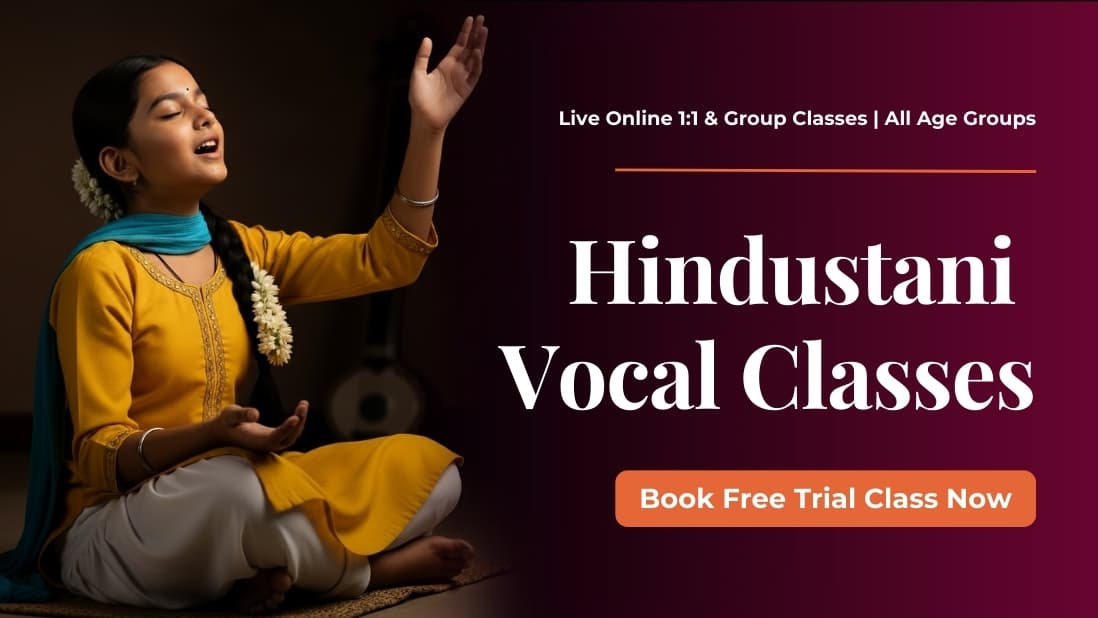
Hindustani classical music is one of the greatest musical traditions in human history, and it is the living heritage of millions of North Indian families across Canada. From the Punjabi and Gujarati families of Brampton and Surrey to the UP and Bengali families of Scarborough and Markham, from the North Indian communities of Calgary and Edmonton to the diverse Indian families of Ottawa and Montreal, Hindustani vocal music is the musical bedrock of a vast and culturally rich diaspora.
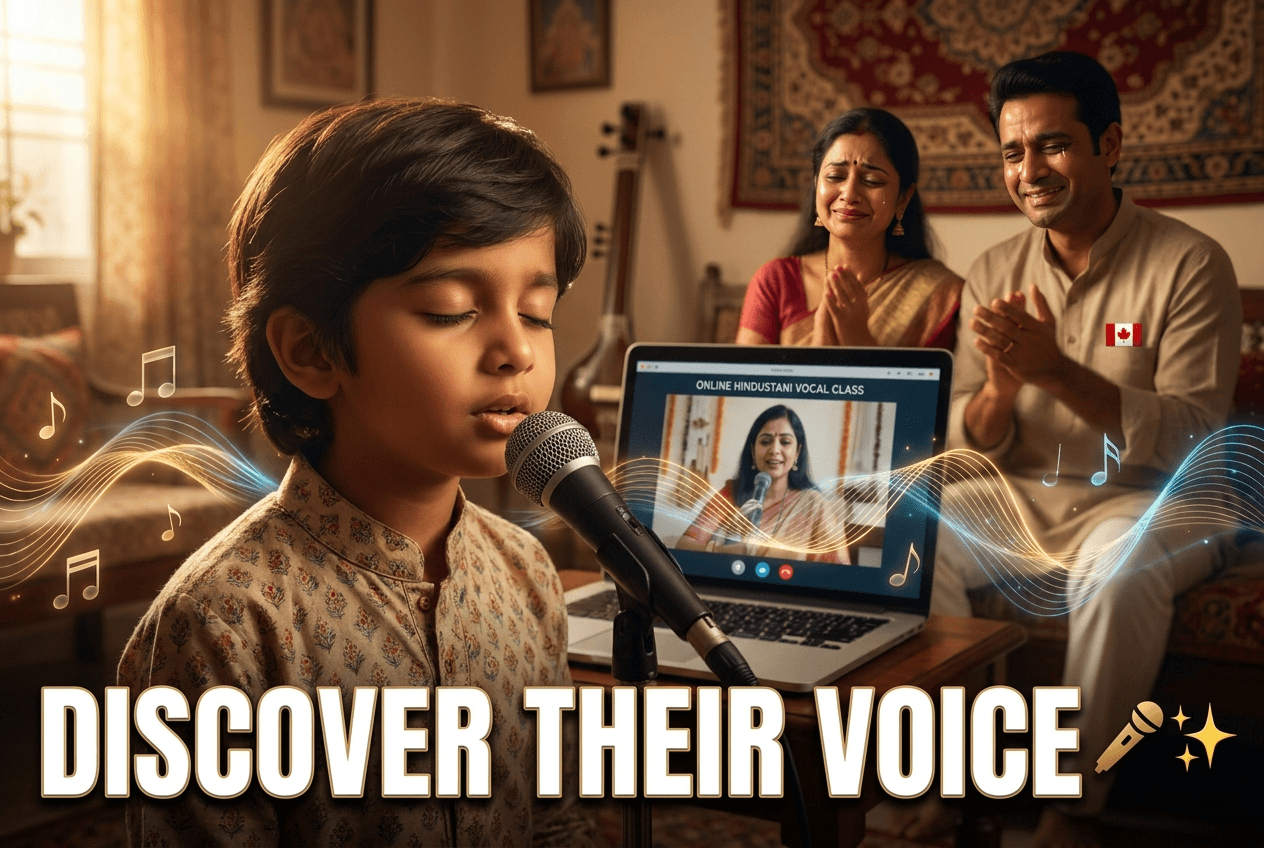
Finding a genuinely qualified Hindustani vocal teacher in Canada who teaches live, one-to-one, in Canadian time zones has always been difficult. Art Gharana's live online Hindustani vocal classes in Canada provide genuine classical training from certified teachers in all Canadian time zones, with a completely free first lesson and no gender restrictions.
What Is Hindustani Classical Vocal Music?
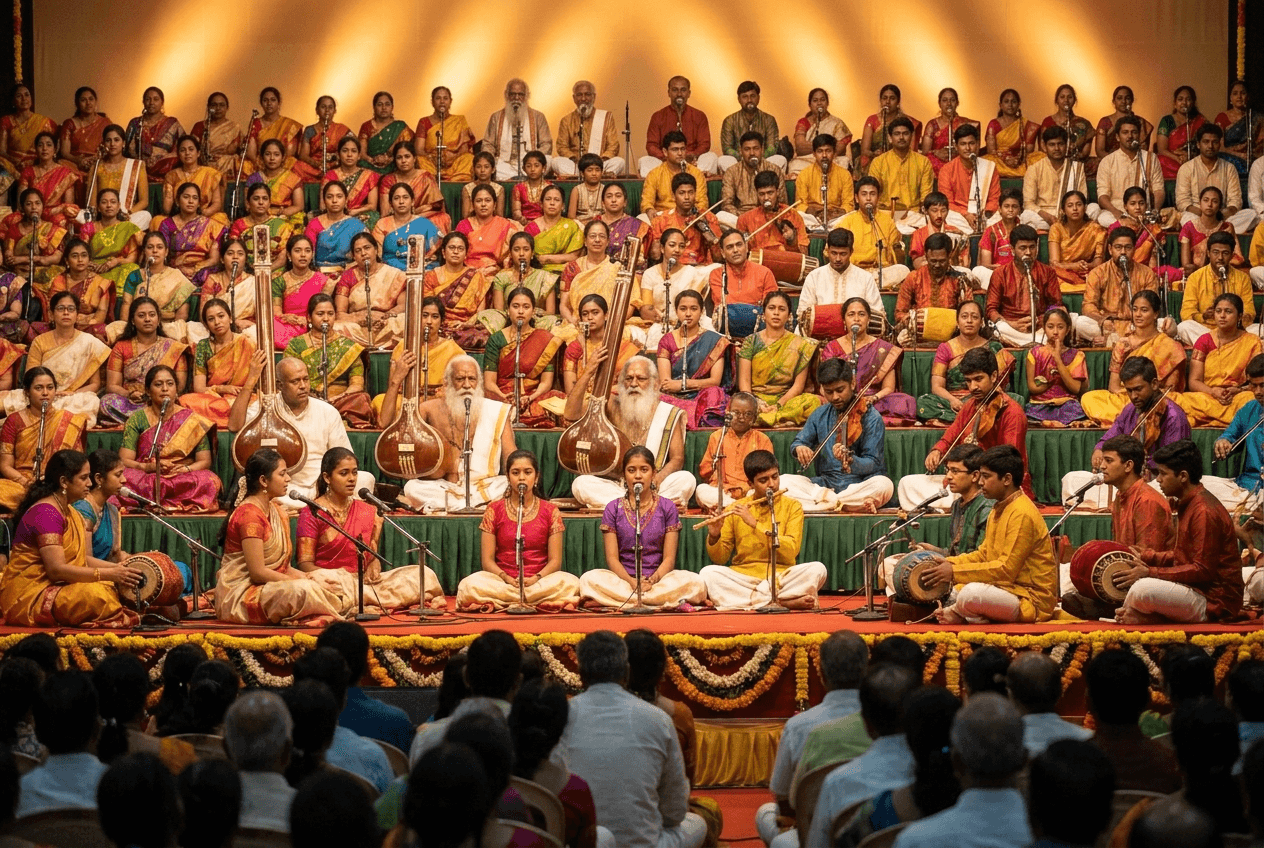 Hindustani classical music is the classical tradition of North India, developed over centuries from the ancient Sanskrit musical tradition through the influence of Persian and Central Asian musical cultures during the Mughal era. The result is a musical system of extraordinary richness and flexibility, built on the twin pillars of raga and tala.
A raga is a melodic framework defining a specific set of notes, their characteristic movements, their ornamentation, their emotional quality and the time of day with which they are associated. There are hundreds of ragas in the Hindustani system. The major compositional forms include khayal, the most important form in classical performance; thumri, the lighter, emotionally expressive semi-classical form; dadra and bhajan, the devotional songs that form the most accessible entry point for beginners.
Hindustani Vocal in Canada's Indian Communities
Greater Toronto Area
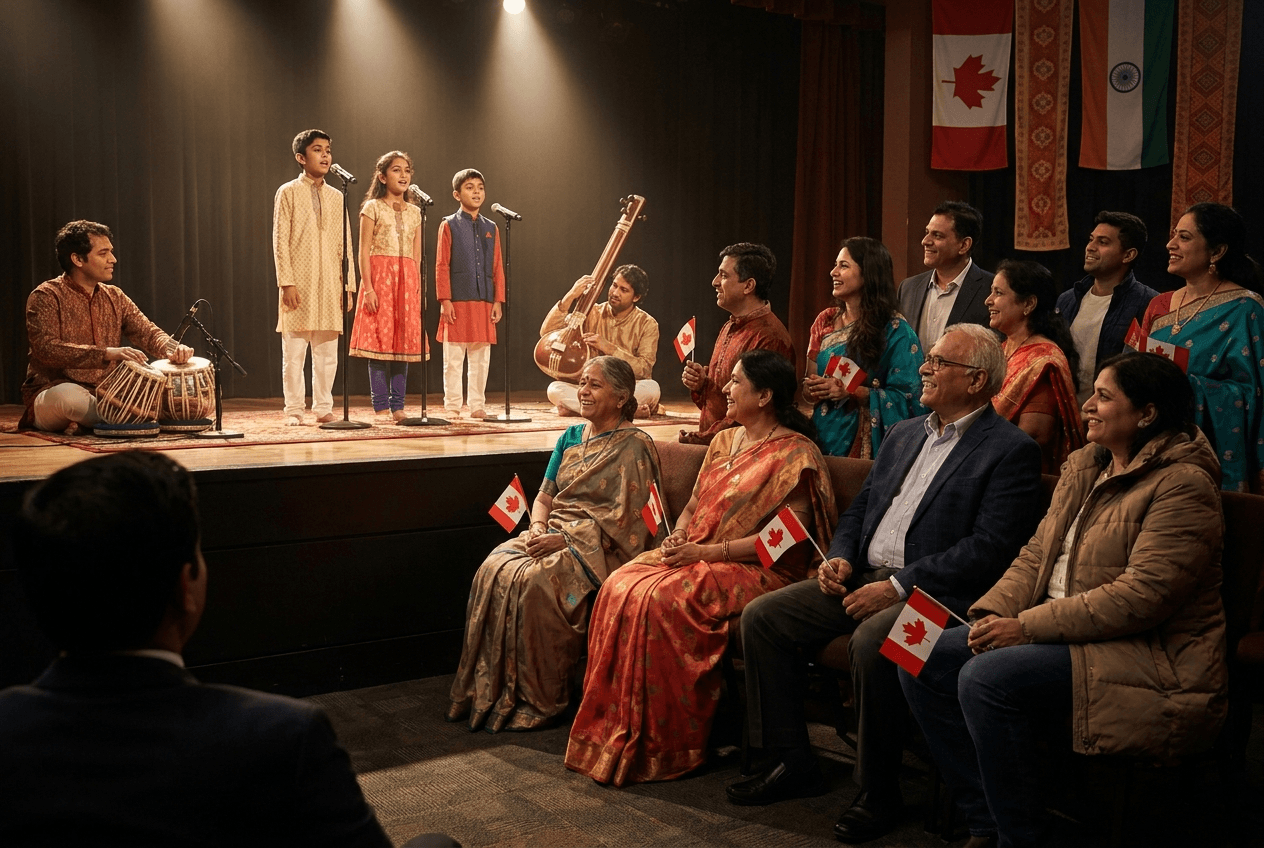
The GTA's North Indian community, encompassing Punjabi, Gujarati, UP, Bengali and many other regional communities, has a rich musical tradition. Temples, cultural organisations and community events in Brampton, Mississauga, Scarborough and Markham host bhajan evenings, classical music performances and cultural gatherings throughout the year. Children who have trained in Hindustani vocal are welcomed as participants rather than mere observers at these events.
Vancouver and the Punjabi Community
Vancouver's Punjabi community has a deep relationship with North Indian music through the bhangra and gurbani traditions, and Hindustani classical vocal training is increasingly sought as a complement to this musical background. The melodic sophistication and raga framework of Hindustani vocal enriches the musical understanding of children who have grown up in a bhangra household in ways that are immediately apparent and deeply valued.
Calgary, Edmonton and the Rest of Canada
For North Indian families in Alberta, Manitoba, Quebec and the Atlantic provinces, local Hindustani vocal instruction with certified classical training is rarely available. Art Gharana's nationwide online programme serves all of these families through live one-to-one classes in their local Canadian time zone.
Why Hindustani Vocal Training Is Exceptional for Canadian Children
Voice Development
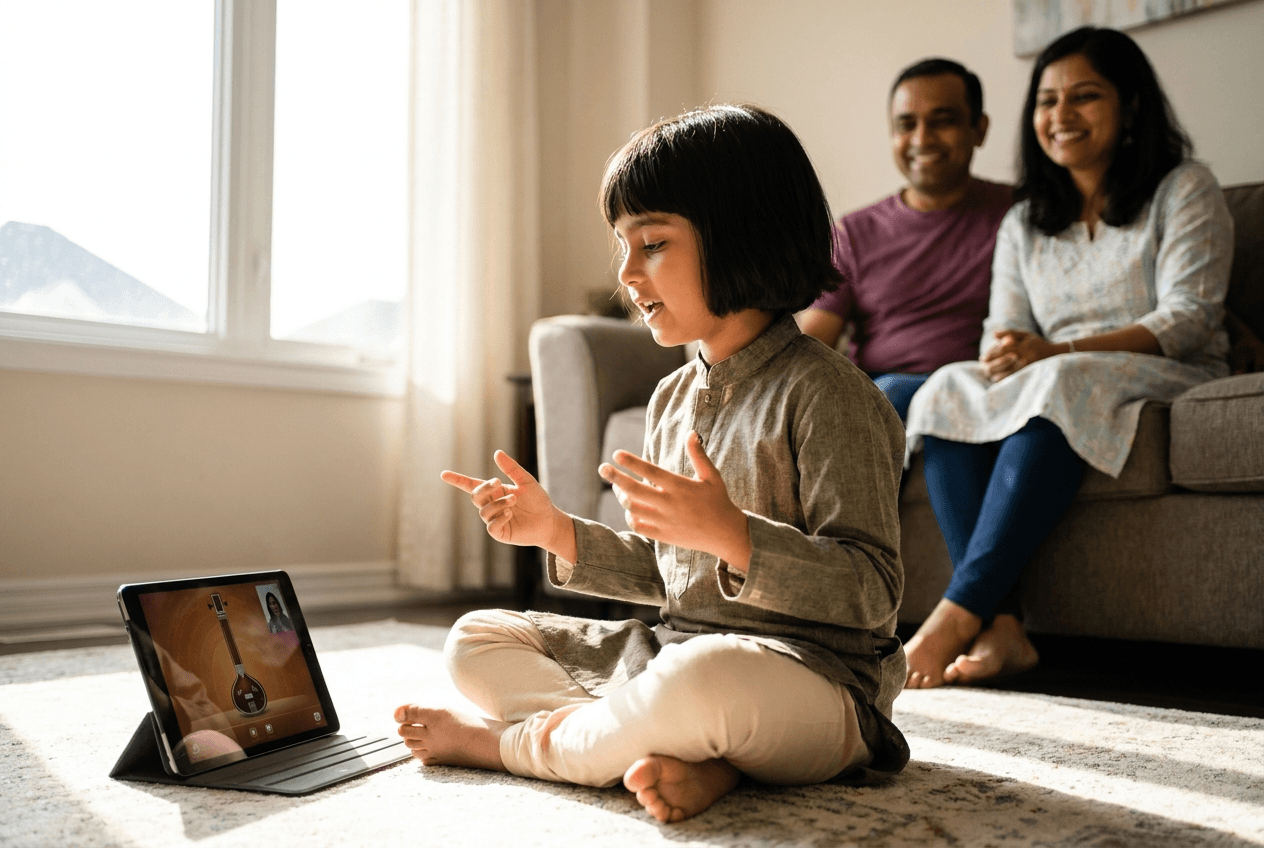
Hindustani vocal training develops the voice in a healthy, sustainable way, emphasising correct breathing, posture, tone production and the gradual extension of vocal range. Children who begin classical vocal training develop voices that project clearly, sustain without strain and retain their quality over a lifetime. The emphasis on correct technique from the earliest stages prevents the vocal habits that can cause problems in later life.
Ear Training and Musical Intelligence
The microtonal precision demanded by raga singing develops a sense of pitch that exceeds what any Western music training produces. Students learn to hear and reproduce intervals, ornaments and microtonal inflections with extraordinary accuracy. This acute ear for pitch is an asset in every musical context, and Hindustani vocal students consistently perform better in all musical activities they engage in.
Language and Heritage Connection
The memorisation of bandish lyrics in Hindi, Sanskrit, Braj Bhasha and Urdu develops both memory capacity and language skills. For Indian-Canadian children whose connection to heritage languages may be limited, singing compositions in these languages is a form of language education that no classroom can provide, delivered through the joy of music rather than the duty of study.
Cultural Identity in Canada's Multicultural Society
Canada's identity as a multicultural nation creates a uniquely supportive context for cultural arts education. A child who can sing a classical Hindustani raga is contributing something genuinely impressive and beautiful to the cultural life of their school and community. The admiration this earns from peers, teachers and members of other cultural communities builds the kind of cultural pride and confidence that sustains children throughout their Canadian lives.
The Curriculum: From Riyaz to Raga
Foundation Stage, Ages 6 to 9
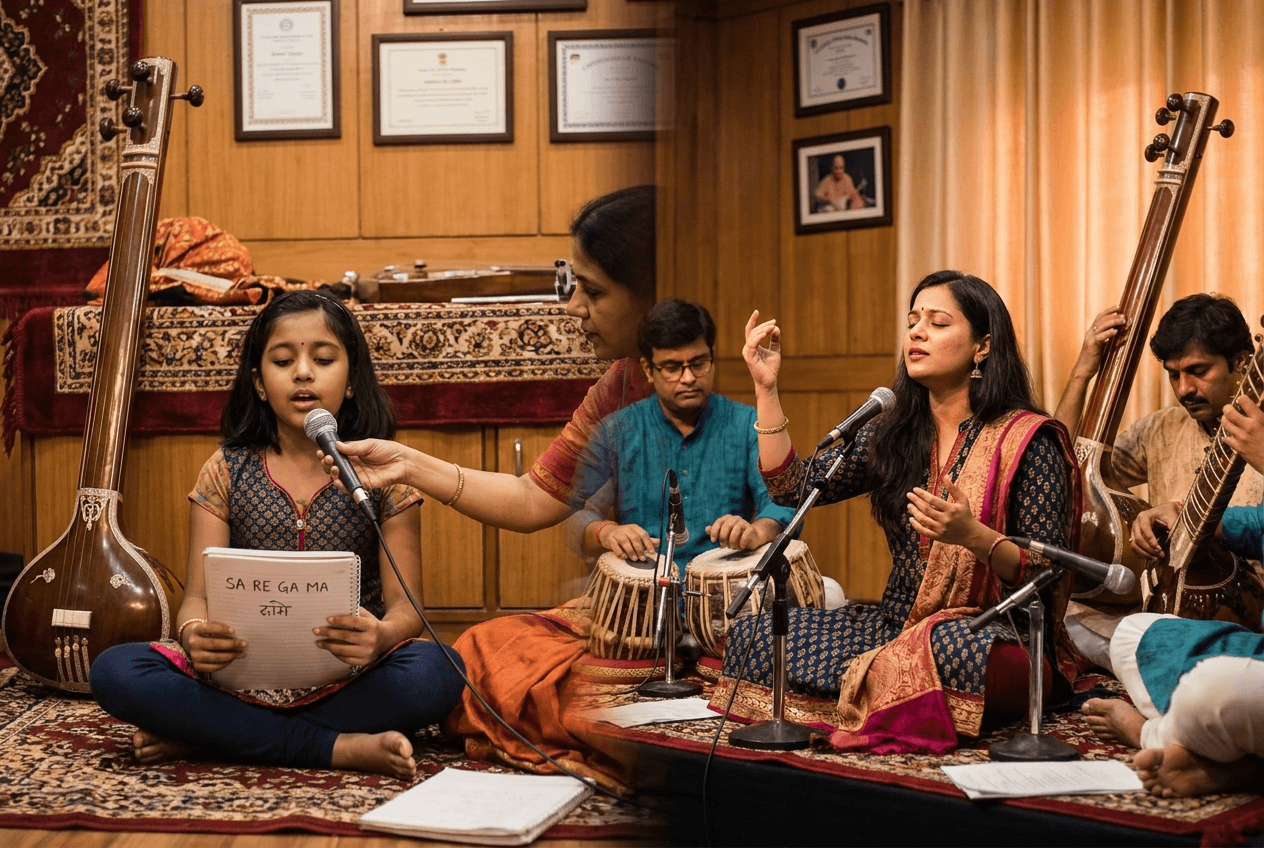
All Hindustani vocal training begins with riyaz, daily practice of swara exercises that develops correct tone production, intonation and breath control. Students learn the sargam, the syllables of the scale, and practice singing through the scale in ascending and descending forms. Simple alankaras are introduced progressively. Short compositions in accessible ragas such as Bilawal, Yaman and Bhoopali are introduced once the foundation is established.
Elementary Stage, Ages 9 to 12
Elementary students expand their raga vocabulary, begin working on the khayal form, and develop their understanding of tala through work with the tabla. The ability to identify and sing the characteristic phrases of a range of ragas is developed systematically.
Intermediate and Advanced Stage
Intermediate and advanced students work on more complex ragas, develop alap skills and begin exploring thumri and other lighter forms. The improvisatory dimension of Hindustani performance becomes a central focus, and students develop the spontaneous musical intelligence that characterises the tradition at its highest levels.
How Art Gharana Compares
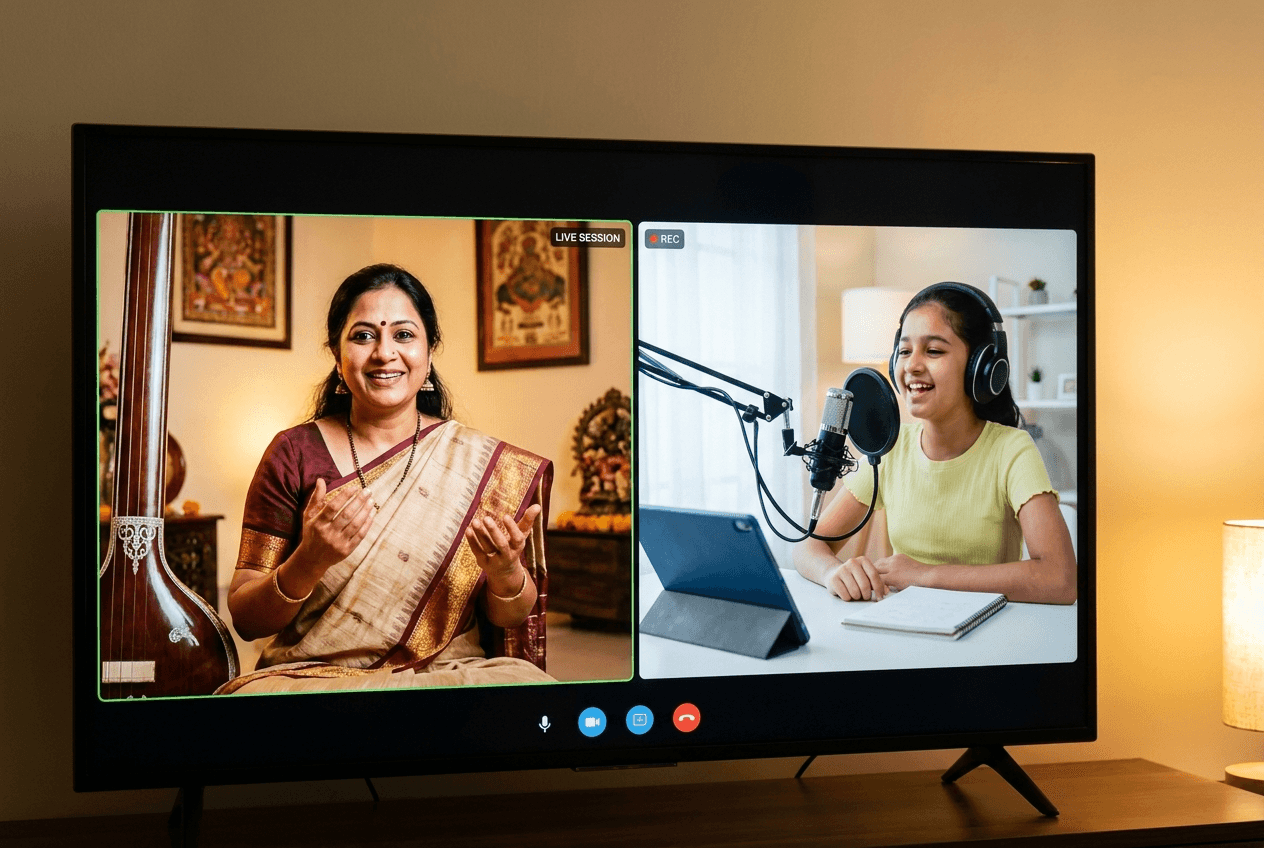 Canadian families searching for online Hindustani vocal classes will encounter a landscape of India-time-zone marketplace tutors, pre-recorded courses and scattered individual teachers. Art Gharana offers live one-to-one instruction from certified Hindustani classical vocalists with Canadian time zone scheduling, a structured curriculum from swara practice to raga performance, and a completely free first lesson. Unlike many online providers who conflate Bollywood song coaching with classical Hindustani training, Art Gharana teachers are formally trained classical vocalists who teach the authentic tradition.
Hindustani Vocal Alongside Other Indian Arts
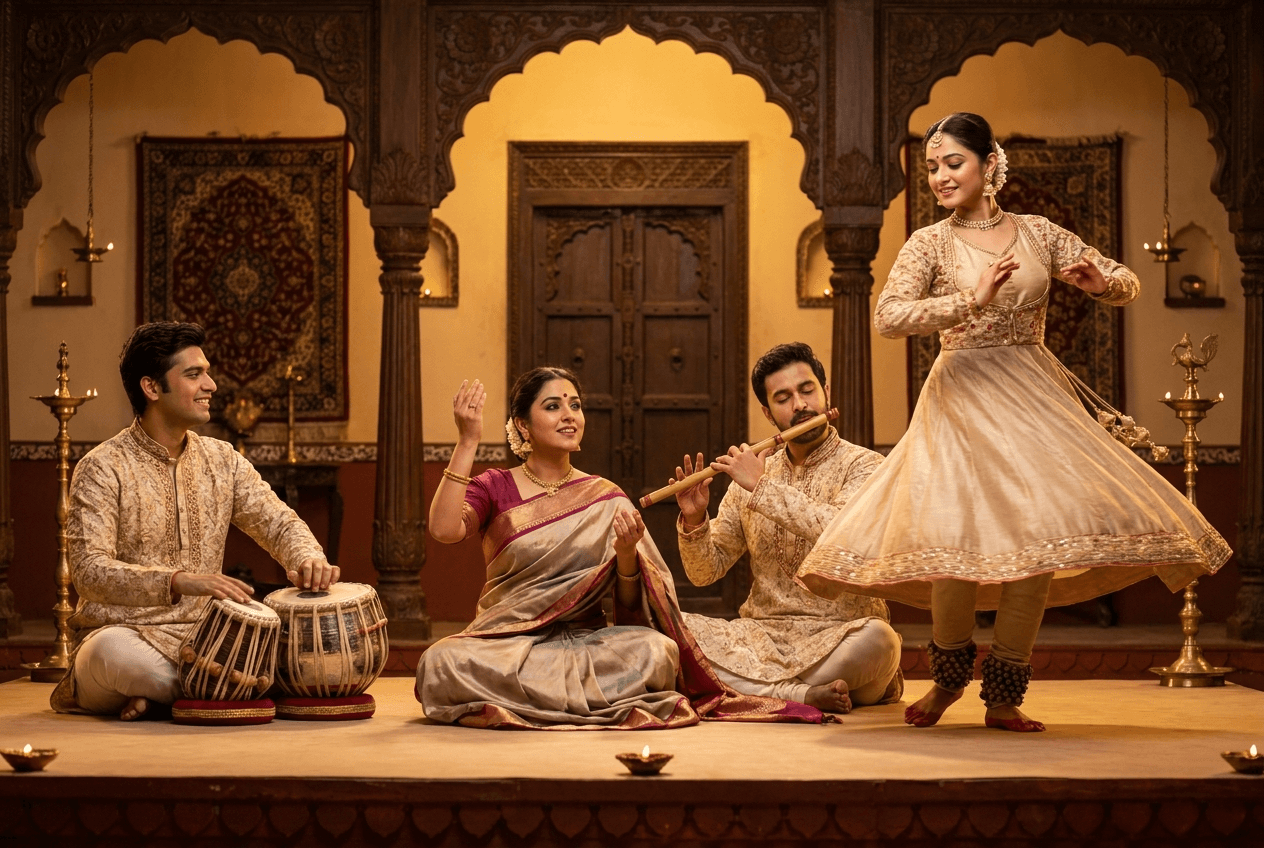 Hindustani vocal training pairs naturally with tabla classes. The tabla-vocal dialogue is one of the most central features of classical Hindustani performance, and students who study both simultaneously develop a much richer and faster musical intelligence than those who study only one. Our flute classes share the same raga and tala framework as Hindustani vocal and pair naturally with vocal training.
For families from South Indian backgrounds interested in classical music, our Carnatic vocal classes offer the South Indian classical tradition with the same live one-to-one format and Canadian time zone scheduling. And for families interested in dance alongside music, our Kathak classes develop a parallel understanding of the rhythmic and melodic structures that vocal students explore in their singing. Explore our full range of courses for all available options.
Hindustani vocal training pairs naturally with tabla classes. The tabla-vocal dialogue is one of the most central features of classical Hindustani performance, and students who study both simultaneously develop a much richer and faster musical intelligence than those who study only one. Our flute classes share the same raga and tala framework as Hindustani vocal and pair naturally with vocal training.
For families from South Indian backgrounds interested in classical music, our Carnatic vocal classes offer the South Indian classical tradition with the same live one-to-one format and Canadian time zone scheduling. And for families interested in dance alongside music, our Kathak classes develop a parallel understanding of the rhythmic and melodic structures that vocal students explore in their singing. Explore our full range of courses for all available options.
Riyaz: Building a Daily Practice Habit
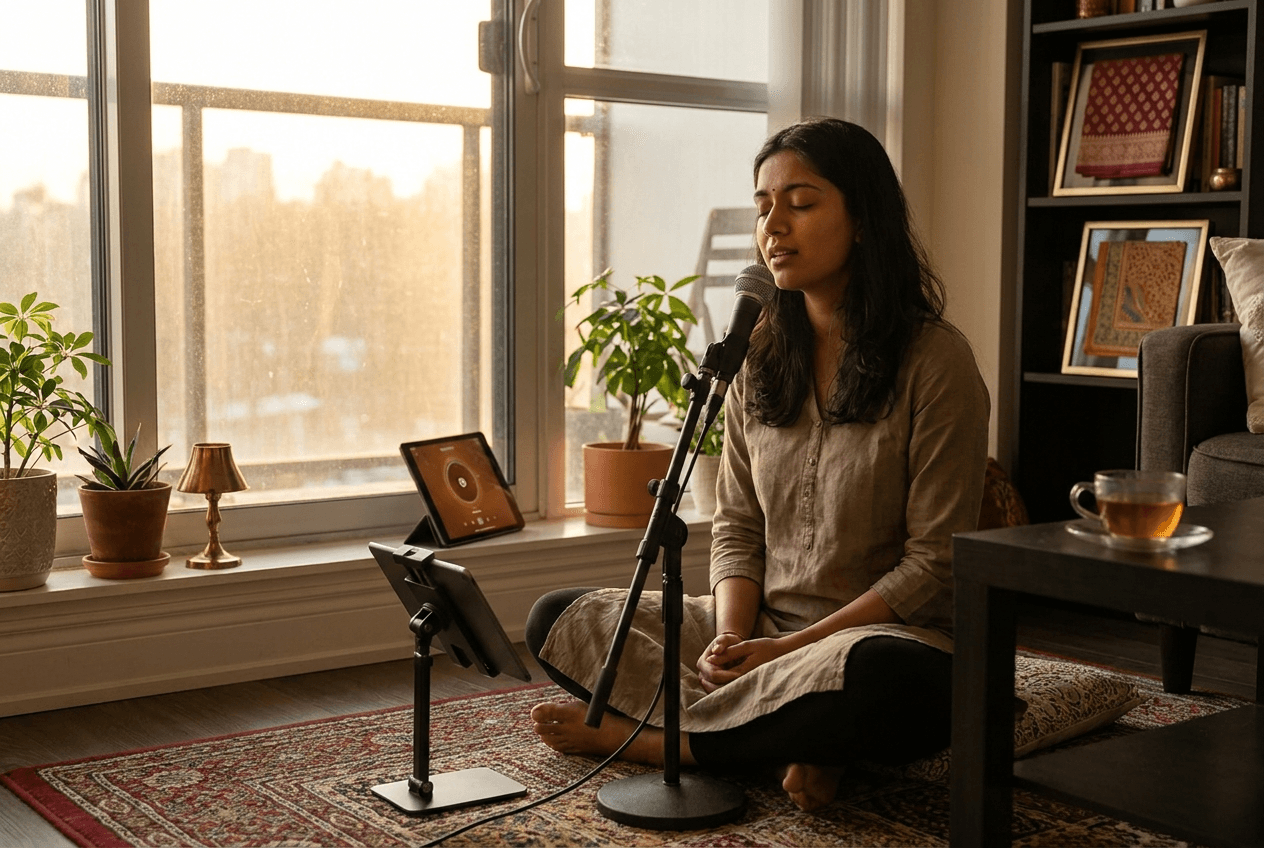 The most important thing Canadian parents can do to support their child's Hindustani vocal progress between classes is help them build a consistent daily riyaz practice. Art Gharana teachers assign specific riyaz exercises after each class, typically 15 to 20 minutes of swara practice using a tanpura app as a reference. This short, focused daily practice session develops intonation accuracy and voice quality far more effectively than occasional longer sessions.
Many Canadian families find that the quiet, focused quality of riyaz practice provides a valuable counterpoint to the busy pace of Canadian school and after-school life. Children who build the riyaz habit often come to value it as one of the most calming and centring parts of their day, a moment of musical focus and creative expression that is entirely their own. Building that habit is the single most powerful thing a parent can do to accelerate their child's progress in Hindustani vocal training.
About Art Gharana
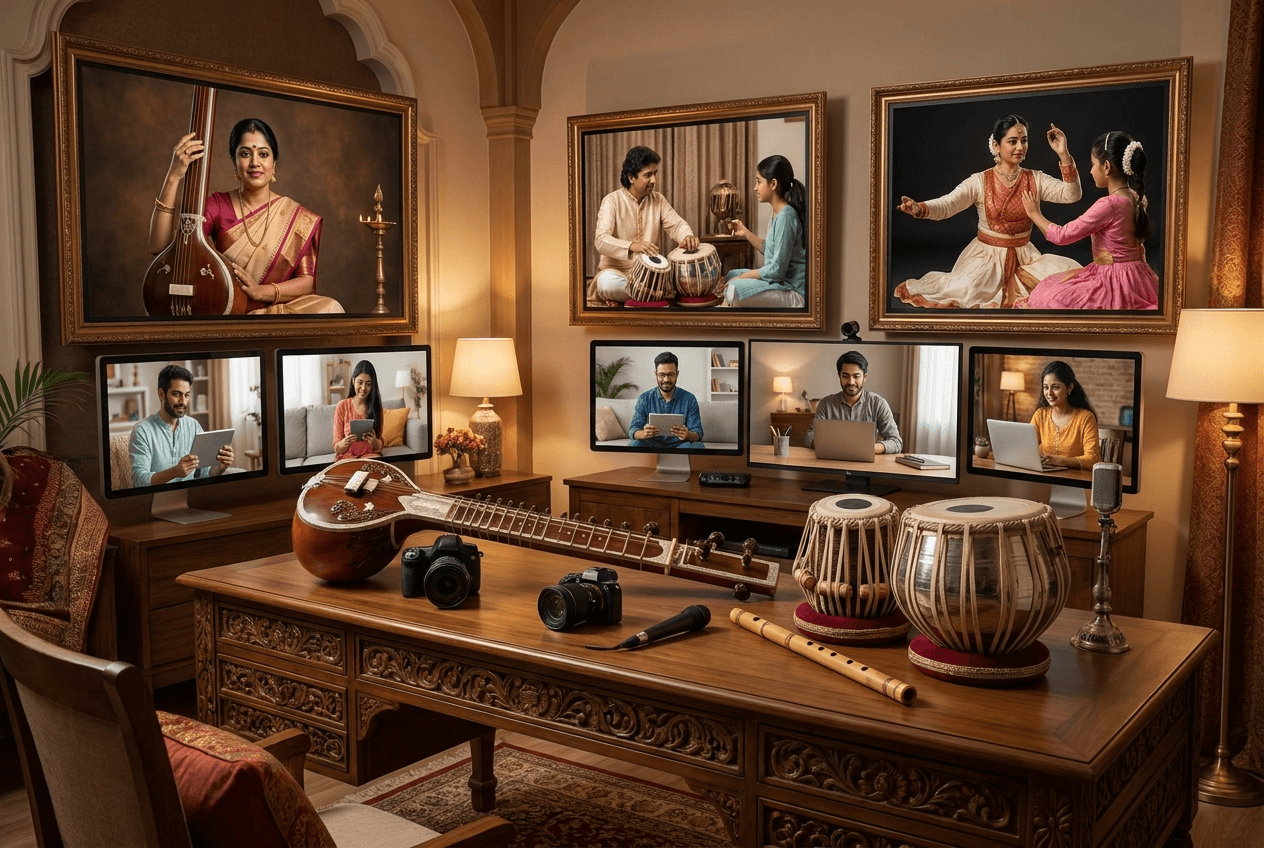 Art Gharana is a specialist online Indian arts education platform with over 50 certified teachers across dance, music and vocal disciplines. Our Hindustani vocal programme serves North Indian families across all Canadian provinces with live one-to-one classes in all Canadian time zones. Browse our teacher profiles and review our plans and pricing to choose the right plan for your family.
Frequently Asked Questions
1. Can I find a certified Hindustani vocal teacher online in Canada?
Yes. Art Gharana connects Canadian students with certified Hindustani classical vocalists for live one-to-one classes in all Canadian time zones.
2. Is Hindustani vocal suitable for children in Canada?
Yes. Children can begin from around age 6. The beginner curriculum develops the voice gently and sustainably through swara practice and simple compositions in accessible ragas.
3. What is the difference between Hindustani and Carnatic vocal?
Hindustani is the classical tradition of North India; Carnatic is the classical tradition of South India. Both use a raga-based system but have distinct compositional forms, ornamentation styles and cultural heritage. They developed largely independently over many centuries.
4. Do I need a harmonium or tanpura for online classes?
A tanpura app on a smartphone or tablet is sufficient for beginners. A harmonium becomes useful as students advance into khayal training. Your teacher will advise on both at the appropriate stage.
5. Are classes available across Canada?
Yes. Art Gharana serves families across all Canadian provinces and territories in all time zones.
Book Your Free Hindustani Vocal Trial Class Today
Whether your family is in the GTA, Vancouver, Calgary, Edmonton, Ottawa or anywhere else in Canada, Art Gharana's certified Hindustani vocal teachers are ready to begin your child's classical musical journey. Live one-to-one instruction, Canadian time zone scheduling, a structured curriculum and a completely free first lesson. Head to our book a free trial class page and begin today.
The Ragas Your Child Will Learn
For many Canadian parents, one of the most fascinating and initially unfamiliar aspects of Hindustani vocal training is the raga system. A raga is not simply a scale or a musical key. It is a complete melodic personality with characteristic ascending and descending movements, specific ornamental gestures, a particular emotional quality called rasa and, in the classical tradition, associations with specific times of day and seasons of the year.
The first ragas that students encounter in Hindustani vocal training are typically the accessible, beautiful ragas that have been taught to beginners for generations. Bilawal, which closely corresponds to the Western major scale and has a warm, direct character. Yaman, the evening raga whose elevated fourth gives it a quality of longing and aspiration that is among the most beautiful sounds in all of Indian music. Bhoopali, the gentle pentatonic raga of simple beauty. And Bhairavi, the morning raga of devotion and surrender that is perhaps the most emotionally beloved raga in the entire Hindustani repertoire. Each of these ragas has a substantial repertoire of compositions, from simple beginner bandishes to the most sophisticated concert pieces. As students advance, they encounter more complex ragas with narrower note sets, more specific ornamental requirements and subtler emotional characters, adding to a growing collection of musical worlds that they can inhabit whenever they choose to sing.
Classical Music in the Indian-Canadian Home
One of the most significant and often unexpected benefits of Hindustani vocal training that Canadian parents report discovering is its transformative effect on the musical atmosphere of the home. Families where a child is studying Hindustani music seriously find that Indian classical music begins to appear naturally in the background of family life. Parents who had not previously listened to Hindustani classical music start exploring recordings of the great masters: the khayal recordings of Pandit Bhimsen Joshi, the thumri performances of Girija Devi, the raga explorations of Ustad Rashid Khan. Siblings who are not studying music develop an ear for raga and begin to identify familiar ragas in Bollywood film music and devotional bhajans. Grandparents who visit from India find an unexpected and joyful musical common ground with their grandchildren in Canada.
This widening of musical culture in the family is one of the most quietly significant long-term effects of classical arts education, and it compounds over years. The home that has been a household of Hindustani classical music for a decade produces adults who carry that musical inheritance with them throughout their lives, returning to it in moments of stress, joy, grief and celebration as a cultural resource that has been part of who they are since childhood. For Indian-Canadian families who want to give their children a living relationship with their heritage, the transformation of the home's musical environment through Hindustani vocal training is one of the most unexpectedly powerful outcomes of that investment.
The Role of Canada's South Asian Cultural Events
The Indian-Canadian cultural event calendar is rich with opportunities for Hindustani vocal students to perform and participate. Diwali celebrations across Brampton, Mississauga, Surrey and other cities feature classical music performances alongside dance and other arts. Temple bhajan evenings, which are a regular feature of North Indian temple life across Canada, provide an immediate and culturally meaningful performance context for vocal students who have developed sufficient repertoire. Cultural competitions, heritage festivals and school multicultural events all add to the range of platforms available.
Art Gharana teachers actively encourage their Canadian Hindustani vocal students to seek out and participate in these performance contexts, and they prepare students specifically for the kinds of pieces and performance formats that suit each occasion. A student preparing to sing at a temple bhajan evening receives guidance on appropriate bhajan repertoire, on how to project the voice in a temple acoustic environment and on the etiquette and presentation customs of that specific performance context. This event-specific preparation is something that self-study or generic online courses cannot provide, and it is one of the clearest demonstrations of the value of the one-to-one format with a culturally knowledgeable teacher.
Hindustani Vocal and Canadian Academic Life
For Indian-Canadian families who prioritise academic achievement, the relationship between Hindustani vocal training and school performance is worth understanding clearly. Multiple meta-analyses have confirmed that children who receive sustained classical music training outperform comparable non-music-trained peers in mathematics, reading comprehension, working memory and executive function. The mechanisms are well understood: the memorisation demands build working memory; the rhythmic and mathematical structures of music develop numerical thinking; the language learning involved in singing bandish lyrics develops phonological awareness; and the discipline of consistent riyaz practice builds the habits of sustained focused effort that underlie academic success.
Several Art Gharana families in Canada have noted that beginning Hindustani vocal training coincided with significant improvements in their children's school performance, and some have attributed this directly to the working memory and concentration demands of the vocal training. For Indian-Canadian parents who are navigating the tension between cultural education and academic preparation, the research on this question is reassuring and consistent: investing in your child's Hindustani vocal training is not a choice between culture and academics. It is choosing both simultaneously, in an activity that delivers cultural grounding and cognitive development in equal measure.
Practical Information for Canadian Families Starting Hindustani Vocal
Beginning Hindustani vocal training at Art Gharana requires minimal setup. The only tool needed before the first class is a tanpura app on a smartphone or tablet, which provides the drone reference essential for accurate pitch practice. Your teacher will recommend a specific app at the first session. A quiet room with reasonable acoustic quality, a device with a working camera and microphone and comfortable clothing that allows relaxed posture are all that is required. Classes are 45 minutes long and scheduled at the family's preferred time in their Canadian time zone.
The Canadian school calendar and its seasonal rhythms, the long winter holiday, the spring break, the summer gap, all require planning for families committed to consistent arts training. Art Gharana's flexible rescheduling policy means that the weekly class commitment can be maintained around school events, holidays and the various activities that populate Canadian family life throughout the year. Many Art Gharana families use holiday periods as opportunities for intensive practice, consolidating the material from the preceding months and arriving at the new term with noticeably stronger foundations.
Long-Term Value: What Hindustani Vocal Builds Over Years
Parents frequently ask about the long-term value of the investment in Hindustani vocal training. The answer, drawn consistently from the experience of Art Gharana families in Canada and the wider Indian diaspora, is that the long-term value far exceeds what is visible in the early years. Children who commit to several years of serious Hindustani vocal training develop a musical sensitivity, a cultural knowledge, a performance confidence and a disciplined work ethic that serve them in every area of their lives.
Many Art Gharana alumni, now in university and early professional life across Canada, describe their Hindustani vocal training as one of the most significant formative experiences of their upbringing. It gave them a cultural identity that is genuinely their own rather than received secondhand. It gave them a performance skill that draws admiration and opens conversations in the most unexpected contexts. And it gave them a relationship with Indian classical music that has deepened rather than faded as they have moved further into their Canadian adult lives. The investment in Hindustani vocal training, made consistently over years of childhood, pays dividends that a lifetime cannot exhaust.
The Hindustani classical tradition has survived centuries of political upheaval, cultural transformation and geographical displacement because it carries something essential and irreplaceable in the human spirit. For Indian-Canadian families in Canada, the opportunity to pass this tradition on to children growing up in one of the world's most multicultural societies is a gift that compounds across generations. Art Gharana is the partner that makes this possible. The free trial class is waiting. The music is ready. Your child's journey begins whenever you choose to take the first step.
For North Indian Canadian families who want the best possible Hindustani vocal education for their children in 2026, the answer is equally clear. Certified classical vocalists teaching live and one-to-one in your Canadian time zone, with a structured curriculum that progresses from the first swara exercise to genuine raga performance, and a free first lesson that lets you and your child experience the quality before committing to anything. That is what Art Gharana provides. Begin today.
Art Gharana serves Hindustani vocal students across every Canadian province and territory. From the GTA to the Rocky Mountains to the Atlantic coast, the classical tradition of North India is available to every Indian-Canadian family that wants it. The free trial class is the beginning of everything that follows.