Canada is a country built on cultural diversity. Its Multiculturalism Act, its multicultural school curricula, its celebration of heritage months and its broad social acceptance of diverse cultural identities create a context for raising Indian-Canadian children that is genuinely supportive of cultural transmission in ways that few other countries match. And yet, for Indian-Canadian parents, the question of how to pass on their heritage to children who are growing up as Canadians, who speak English without an accent, who follow Canadian sports teams and Canadian popular culture, remains one of the most pressing and personal challenges of family life.
This guide is for Indian-Canadian parents who want to think carefully and practically about cultural transmission. It draws on the experience of hundreds of Indian-Canadian families who have used Art Gharana's live online arts education programme to build a living Indian cultural practice into their children's Canadian lives.
Cultural Mosaic and Indian Heritage
 Canada's official policy of multiculturalism, unique among major Western nations, does not merely tolerate cultural diversity. It actively celebrates it. Indian-Canadian children grow up in schools where heritage weeks and multicultural events are genuine institutional priorities, where diversity is a source of pride rather than a mark of difference. This context creates an unusual opportunity: Indian culture can be transmitted not as something to be maintained secretly against a resistant mainstream, but as something to be shared publicly and celebrated as part of the Canadian fabric.
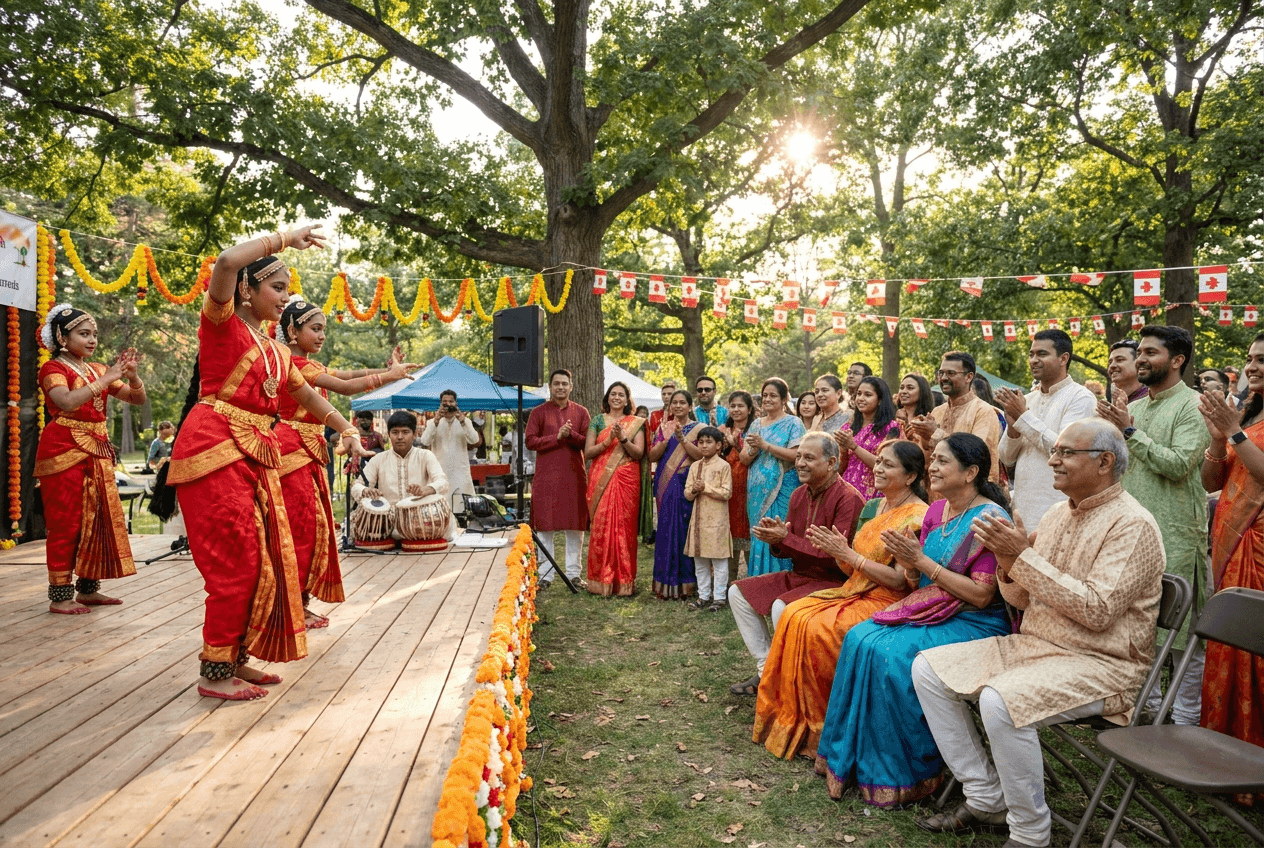
The practical implication is that Indian-Canadian children who have genuine, visible cultural skills, who can perform Bharatanatyam at the school multicultural assembly, who can play tabla at the heritage showcase, who can sing a classical Indian raga at the cultural festival, are not marked as different. They are celebrated as contributors to the cultural richness of their school and community. This Canadian context makes Indian arts education both more publicly rewarding and more practically sustainable than in many other diaspora environments.
The Challenge Facing Indian-Canadian Families
 Despite Canada's multicultural support, the challenge of cultural transmission is real and most Indian-Canadian parents know it intimately. Children grow up in a dominant culture that is compelling, familiar and constantly present. The gravitational pull of Canadian popular culture is powerful and relentless, and it is entirely natural for children to want to fit in with their peers.
The danger is not that children will become too Canadian. Canadian values of tolerance, fairness, creativity and inclusion are wonderful values that most Indian parents actively embrace for their children. The danger is that children will grow up feeling that their Indian heritage is something separate from their real life, something their parents care about but that has no living presence in their own Canadian world. This disconnection, when it happens, tends to be felt most acutely in early adulthood, when young people struggle to answer the question of who they really are.
The solution is to make cultural engagement a natural, joyful and regular part of family life from an early age, so that Indian heritage is not something separate from who they are but a living, active dimension of their identity that they carry with pride into every part of their Canadian life.
Music and Dance: The Most Powerful Cultural Bridge
 Of all the strategies available to Indian-Canadian parents for cultural transmission, music and dance are uniquely effective for three reasons.
First, they are active and embodied. Learning to perform Indian classical arts does not merely teach children about their heritage. It teaches them to inhabit it physically, to feel Indian culture in their muscles, their breath, their hands and their voice. This embodied knowledge is far more durable and identity-forming than any amount of factual cultural knowledge.
Second, they produce skills that generate concrete, visible pride. An Indian-Canadian child who can perform a Bharatanatyam piece at the school heritage show, or play tabla at the Diwali community event, has something specific and impressive to demonstrate. That pride in genuine skill is one of the most powerful anchors for cultural identity available.
Third, they create community. Indian arts classes connect children with other Indian-Canadian children who share their cultural background and their questions. The friendships formed in these classes are often among the most meaningful of a child's social life precisely because they are grounded in a shared experience that is unavailable in mainstream Canadian schooling.
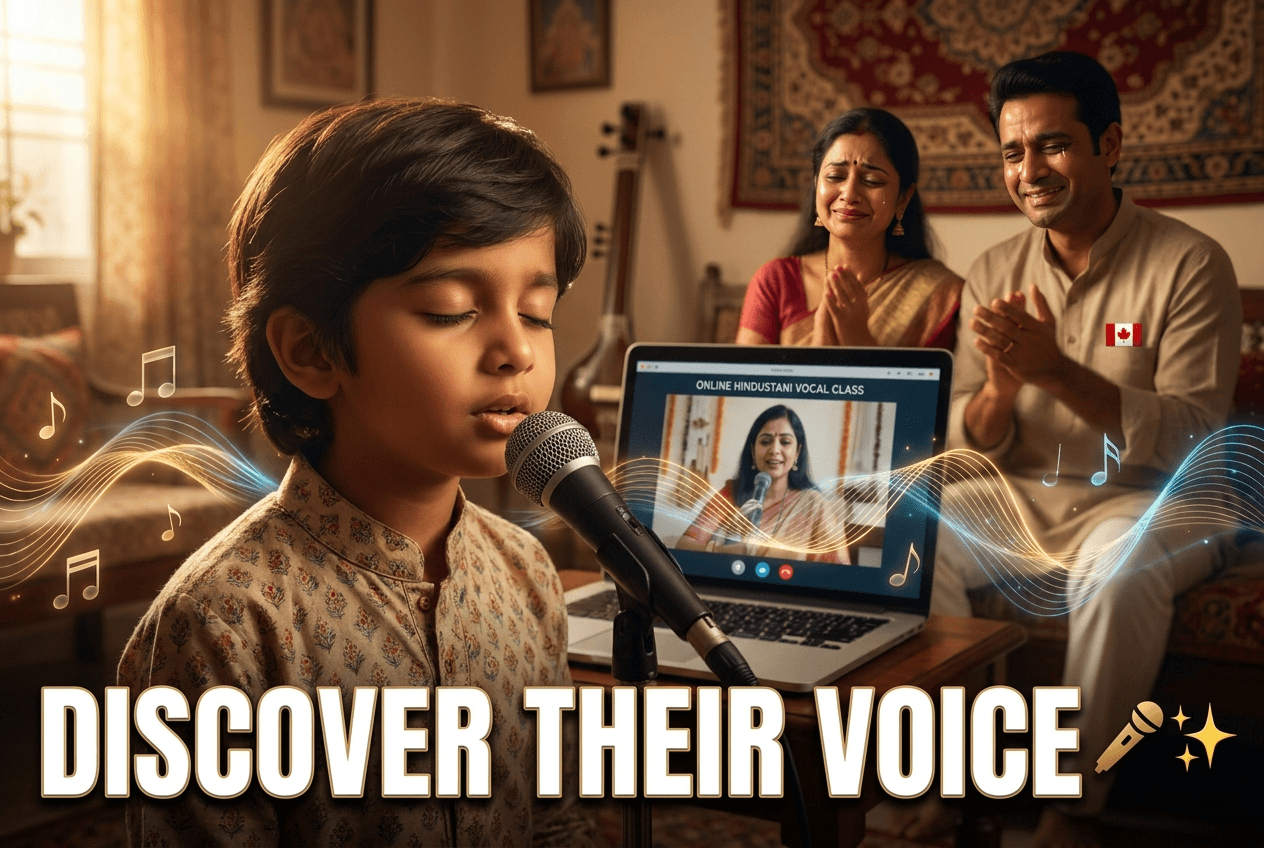
Art Gharana offers live online classes in Bollywood dance classes, Kathak classes, Bharatanatyam classes, tabla classes, Carnatic vocal classes and Hindustani vocal classes, all delivered by certified Indian teachers in Canadian time zones. For hundreds of Indian-Canadian families, Art Gharana has become the most important source of structured Indian cultural education for their children.
Eight Practical Strategies for Indian-Canadian Families
Enrol Your Child in Indian Music or Dance Classes
This is the single highest-impact step available. Regular, structured engagement with a certified teacher gives cultural education the depth and continuity that occasional special events cannot provide. Even one class per week, maintained consistently over years, creates a profound and lasting cultural foundation. Start with a free trial class at Art Gharana to find the art form that resonates most deeply with your child's personality and interests.
Speak Your Mother Tongue at Home
Language is the most intimate carrier of culture. If you speak Hindi, Punjabi, Tamil, Telugu, Gujarati, Bengali, Kannada, Malayalam or any other Indian language, commit to using it at home. Children who grow up bilingual have measurable cognitive advantages, and the language itself carries cultural knowledge that cannot be translated. It does not matter if your child responds in English at first. Consistent exposure over years builds the foundation.
Celebrate Canadian Indian Community Events
Canada's Indian communities host some of the most vibrant cultural events in the diaspora world. Brampton's Diwali celebrations, the Mississauga South Asian Cultural Festival, the Vancouver India Mela, the Calgary South Asian Heritage Month events and countless temple and community events across the country all provide rich cultural engagement. Attend these events as a family, explain their significance to your children and help them see themselves as active participants in this community life rather than passive spectators.
Cook Indian Food Together
Food is one of the most immediate and sensory connections to cultural heritage. Cooking together, making dal, rolling roti, preparing biryani for a family gathering, making halwa for Diwali, is a cultural education that engages all the senses and creates powerful memories. Children who grow up cooking Indian food with their parents carry those skills and memories into their adult Canadian lives with warmth and gratitude.
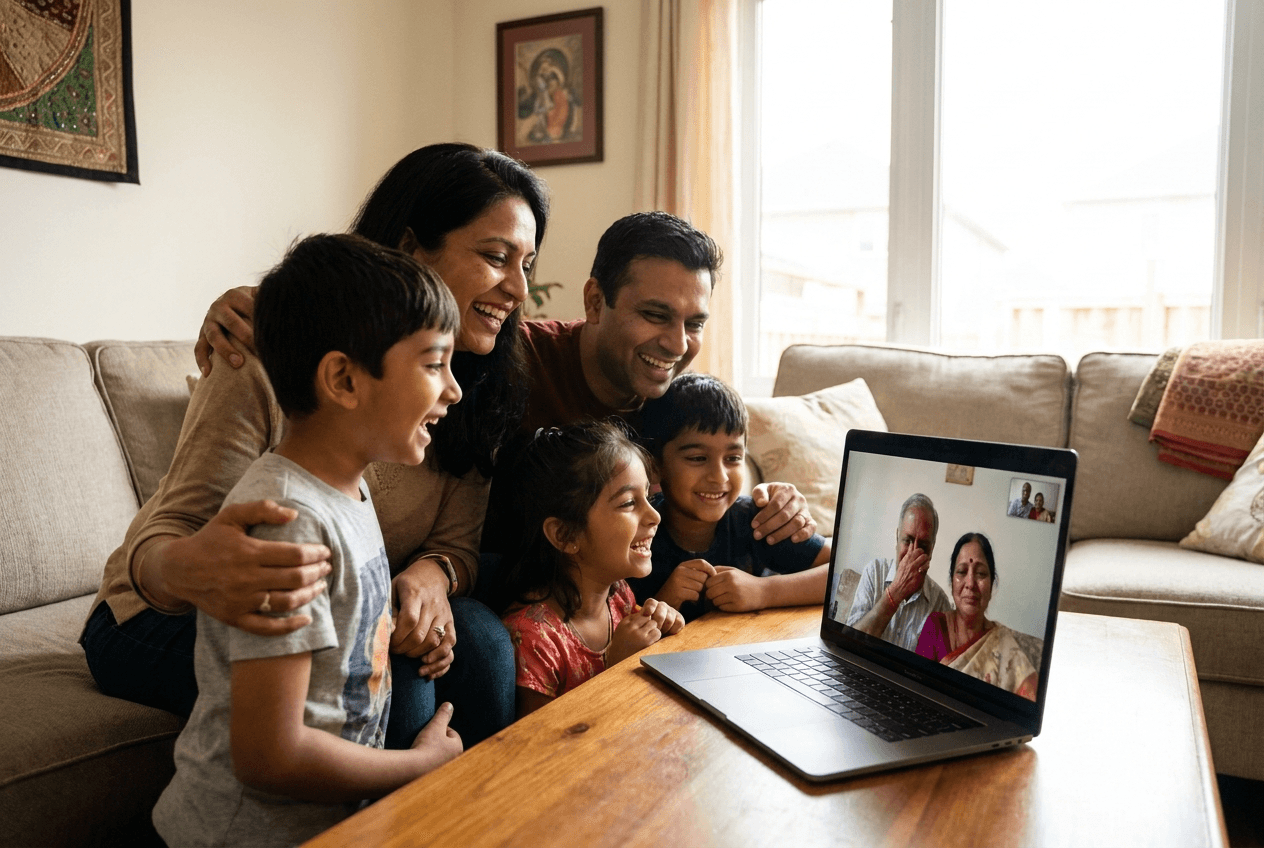
Build Regular Connections with India
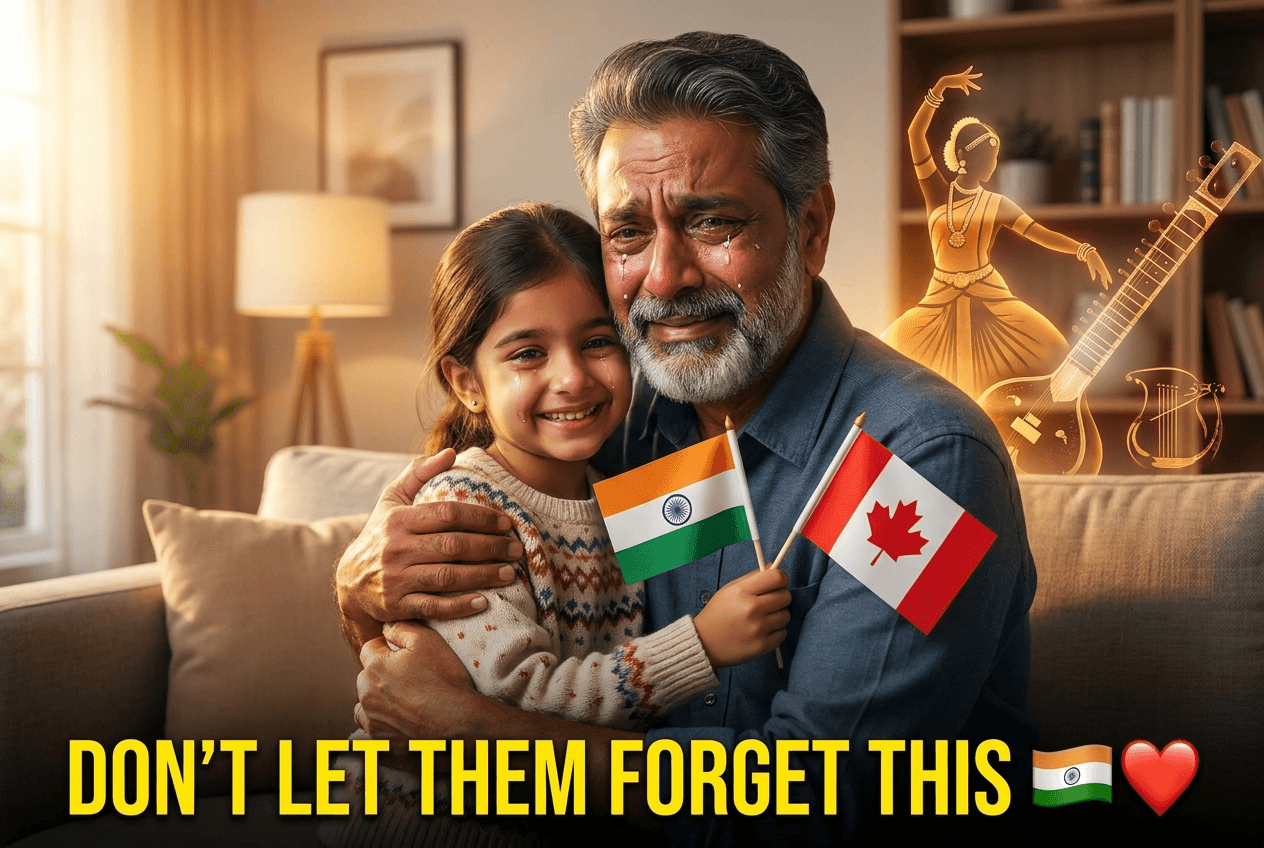
Video calls with grandparents, cousins and family friends in India are simple but powerful tools for cultural continuity. When India is populated with real people your child knows, loves and regularly talks to, Indian identity becomes concrete and personal rather than theoretical. Encourage regular contact beyond festivals and birthdays, making it a natural part of weekly family life.
Engage with Canada's Multicultural Schools
Canadian schools provide regular opportunities for Indian-Canadian children to share their cultural heritage: heritage weeks, multicultural nights, diversity showcases and international day events. Encourage your children to participate in these events as performers and presenters of their heritage, not just as audience members. A child who performs Bharatanatyam at the school multicultural night and receives genuine applause from a diverse audience carries that experience of cultural pride for years.
Fill Your Home with Indian Art and Music
The aesthetic environment of a home shapes children's sense of identity in ways that are easy to underestimate. Playing Indian classical music in the background during family time, displaying art and objects from India and your family's home state, having Indian books and films available, all of these small choices accumulate into a cultural atmosphere that tells your child every day that their heritage is beautiful and worth celebrating.
Start Early and Be Consistent
The research on cultural transmission is clear on one point: earlier is significantly better. Children between the ages of four and eight absorb language, movement, music and cultural knowledge with an ease that diminishes significantly as they get older. Starting arts classes early means that cultural engagement becomes a natural part of who your child is before the social pressures of adolescence begin.
The Long-Term Value
 The investment you make in your children's cultural education is one of the most lasting gifts you can give them. Indian-Canadian adults who received sustained arts education as children consistently describe it as one of the most significant gifts of their upbringing, one that gave them cultural confidence, artistic capability, a distinctive identity in diverse Canadian environments and a deep connection to their heritage that has grown stronger rather than weaker as they have moved through their Canadian lives.
Many describe moments of profound cultural recognition: performing tabla at a multicultural event and discovering that shared musical knowledge creates instant bonds with other Indian-Canadians they have never met; teaching their own children the Kathak movements they still remember from classes twenty years ago; singing a Thyagaraja composition for a South Indian colleague and seeing their face change with surprised delight. These moments of cultural transmission and connection are the long-term fruit of an investment made in childhood.
Frequently Asked Questions
1. How can I help my Indian-Canadian child stay connected to Indian culture?
The most effective approaches are enrolling children in Indian music or dance classes, speaking an Indian language at home, celebrating festivals with genuine understanding of their meaning, building regular connections with family in India and engaging with your local Indian community.
2. What is the best starting point for Indian arts education in Canada?
The best choice depends on your child's temperament. Bollywood dance is the most immediately engaging for most children. Classical forms like Kathak and Bharatanatyam provide deeper grounding. Tabla, flute and vocal classes suit musically inclined children. Art Gharana offers free trial classes across all disciplines so your child can experience each before deciding.
3. Can online Indian arts classes keep children culturally connected in Canada?
Yes. Live online classes with certified Indian teachers provide not just musical or dance training but cultural context, language exposure and a direct human connection with someone who understands and shares the child's heritage. Many Art Gharana students in Canada describe their teacher as one of the most meaningful Indian cultural connections in their lives.
Begin Today
Art Gharana is here to support your family's cultural journey. Explore our full range of courses, read about our teachers on our teacher profiles page, and head to our book a free trial class page to begin today.
Canada's Cultural Mosaic: A Unique Advantage for Indian-Canadian Families
Canada's official policy of multiculturalism, embodied in the Multiculturalism Act and reflected in the inclusive values of Canadian public culture, creates a unique and genuinely supportive context for Indian arts education. In most other countries where significant Indian diaspora communities exist, classical Indian arts are practised in cultural community spaces but rarely celebrated or even acknowledged in mainstream educational and social contexts. In Canada, the opposite is increasingly true. Heritage weeks, multicultural events, diversity showcases and cultural pride months are regular features of Canadian school and community life, and Indian-Canadian children who have genuine, impressive cultural skills are actively sought and celebrated as contributors to these events.
This means that the investment in Indian arts education for Canadian children has a public return as well as a private one. A child who can perform Bharatanatyam at the school multicultural assembly receives not just cultural validation from their own community but genuine appreciation and admiration from classmates, teachers and parents of diverse backgrounds. That cross-cultural appreciation, experienced repeatedly over years of performance at Canadian events, builds a confidence and cultural pride that is qualitatively different from what is possible in contexts where Indian heritage is invisible in the mainstream.
The Second-Generation Identity Challenge in Canada
Despite Canada's multicultural support, the identity challenge for Indian-Canadian children remains real and significant. Children grow up fully immersed in Canadian popular culture: Canadian music, Canadian sports, Canadian social media trends, Canadian school norms. The pressure to fit in with Canadian peers is powerful and constant, and it is entirely natural for children to respond to this pressure by downplaying or distancing themselves from cultural markers that feel different from the majority.
The families who navigate this most successfully are those who have given their children a foundation in their Indian heritage so strong and so actively practised that it coexists confidently alongside their Canadian identity rather than competing with it. A child who has been dancing Kathak for five years does not experience their Indianness as something that makes them different from their Canadian peers. They experience it as something that makes them impressively distinctive, a source of genuine skill and cultural depth that their peers, in the curious and open spirit that characterises many Canadian children, find interesting and admirable rather than alienating. Building this confident, publicly celebrated cultural identity is the real goal of Indian arts education in the Canadian context.
The Arts as Cultural Memory
The philosopher and cultural historian Suzanne Langer observed that art is the most powerful form of cultural memory that human beings possess, more durable than written record, more vivid than oral tradition and more accessible than formal scholarship. The body that has learned to perform Bharatanatyam, the hands that have learned to produce the Na stroke on a tabla, the voice that has learned to render a Thyagaraja kriti in Carnatic raga, carry a form of cultural memory that no amount of reading about Indian culture can produce. This is why arts education is irreplaceable as a tool of cultural transmission. It does not merely teach children about their heritage. It gives their heritage a home in their bodies and their voices that persists through all the changes of a long Canadian life.
Indian-Canadian adults who received sustained classical arts education as children consistently describe it, looking back from middle age, as one of the most significant gifts of their upbringing. Not merely because of the skills it gave them, though those are real and lasting. But because of the relationship it created with their heritage, a relationship that is active and embodied rather than passive and theoretical, that deepens rather than fades as the years go by, and that provides a source of cultural continuity that becomes more rather than less valuable as the distance from India increases with each generation.
Indian Arts Education and Canadian Academic Achievement
For Indian-Canadian parents who are focused on academic achievement and for whom any extracurricular activity must justify its claim on limited time and energy, the relationship between Indian arts education and school performance is an important practical consideration. The research on this question is clear, consistent and reassuring. Structured music and dance training is associated with significantly better academic performance, not the opposite. Meta-analyses across dozens of studies show that children who receive sustained classical arts training consistently outperform comparable non-arts-trained peers in mathematics, reading comprehension, working memory and executive function.
The mechanisms are well understood and directly applicable to Indian classical arts training specifically. The memorisation demands of Kathak or Bharatanatyam choreography build working memory. The rhythmic and mathematical structures of tabla or Carnatic music develop numerical and pattern-thinking skills. The discipline of consistent riyaz or practice builds the habits of sustained effort that underlie academic success. And the confidence and sense of achievement that arts training provides supports the social and emotional wellbeing that is a prerequisite for effective learning. For Indian-Canadian families already striving for academic excellence, investing in classical arts education is not choosing between culture and achievement. It is choosing both simultaneously.
A Note on Timing: Why Starting Early Matters
The developmental research is consistent on one point that has direct practical implications for Canadian Indian families: earlier is significantly better. Children between the ages of four and eight absorb movement vocabulary, musical patterns, language and cultural knowledge with a neurological ease that diminishes significantly after the age of ten. The critical developmental window for arts education is short, and families who begin classical arts training during this window give their children a foundation that those who start later must work significantly harder to achieve.
This does not mean that children who begin at ten or twelve or fourteen cannot make excellent progress. Art Gharana has many students who have begun classical training in their teens and developed genuine artistic capability. But it does mean that the family that begins the Bollywood dance or Kathak or [tabla classes]https://www.artgharana.com/courses/instruments/online-tabla-classes) at age five is giving their child a gift whose value compounds over the following decade in ways that are impossible to replicate by starting later. The best time to start was five years ago. The second-best time is today.
Canada is the country that has come closest, among all Western nations, to creating a social context in which Indian heritage can be transmitted actively and publicly rather than quietly and privately. Indian-Canadian families in 2026 have an opportunity that their parents and grandparents did not have: to raise children who are proud and publicly celebrated Canadians and proud and publicly celebrated inheritors of one of the world's great civilisations simultaneously. Art Gharana is the partner that can help you build the cultural foundation that makes that dual pride possible. Begin today.
The final and most important piece of practical advice this guide can offer is the simplest: do not wait. Cultural education, like all education, rewards consistency above everything else, and the consistent investment of small amounts of time and attention over years produces results that seem disproportionately large. An Indian-Canadian child who receives one hour of structured Indian arts training per week for ten years has received over five hundred hours of cultural education. That investment changes who they are. It is the most lasting gift a parent can give. Art Gharana makes it possible. Begin today.
Canada gives Indian-Canadian families the gift of a country that celebrates their heritage. Art Gharana gives them the tools to make that heritage real and living in their children's lives. Together, those two gifts produce something extraordinary: Indian-Canadian children who are proud, skilled, culturally grounded and fully, confidently Canadian. Begin today.