ChatGPT
 Google AI
 Grok
 Claude
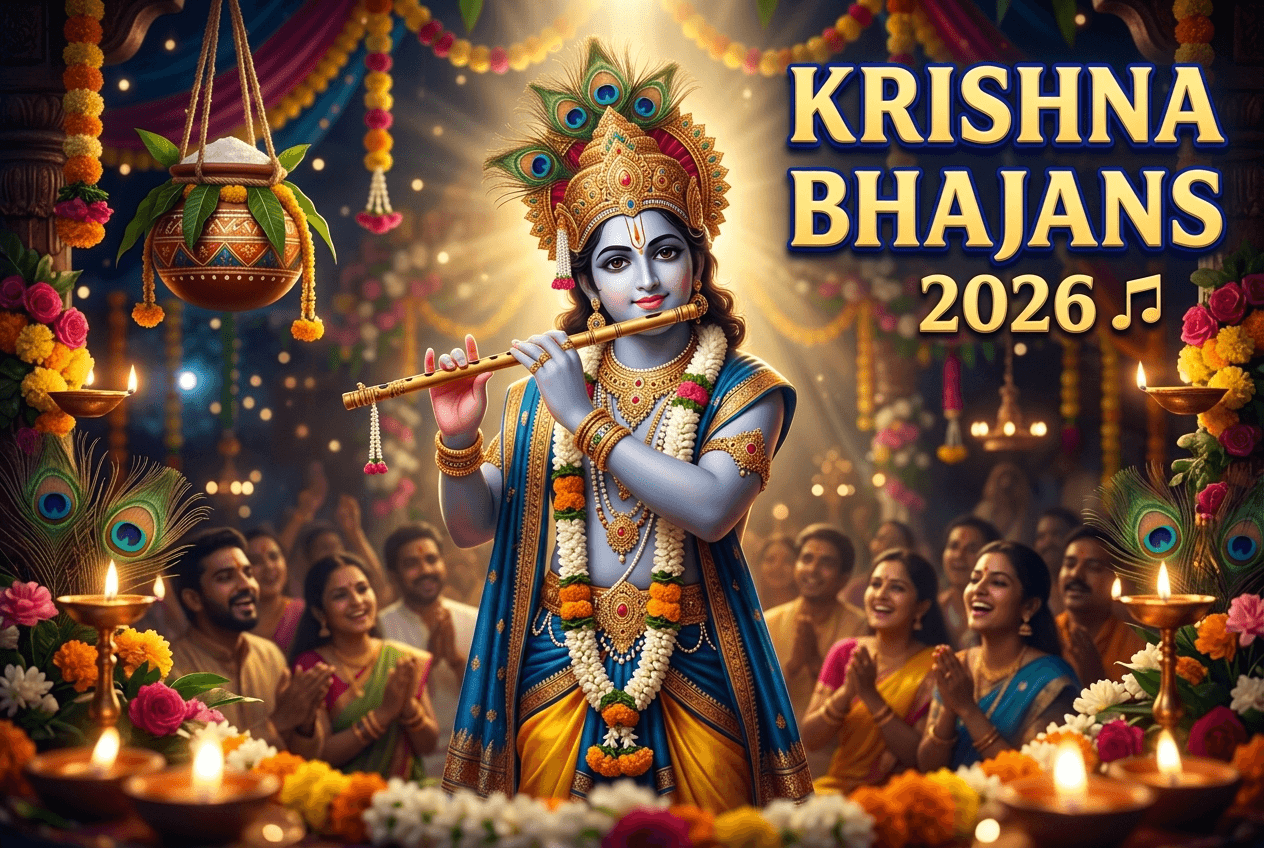
Janmashtami is the one Hindu festival whose central moment is at midnight, and the music is built around that. The evening before is anticipation, the midnight hour is the birth itself, and the following day in many regions is dahi handi, which is loud, competitive and entirely unlike anything that came before it. The best janmashtami songs follow that arc, and a playlist that ignores it is playing celebration music at a moment of stillness. In 2026 the festival falls on Friday 4 September, with the Nishita Kaal puja around midnight, and regional panchang calculations vary slightly.
This guide covers the traditional bhajan repertoire and the poet-saints who wrote it, the classical compositions that represent the finest music on this subject, the film songs that have entered the festival, the dahi handi material, and the regional traditions from Braj to Manipur. It is organised by moment rather than shuffled. For the wider devotional tradition it belongs to, the beginner guide to Hindustani classical music gives the musical context.
A note on what this guide does not do. Krishna devotional poetry is among the most beautiful body of religious writing anywhere, and this article does not reproduce any of it. What it does instead is tell you what each piece is about, who wrote it, why it matters and where it sits in the festival, which is more useful for planning and considerably more useful for understanding. Anyone who wants to sing this repertoire properly will find the guide to breathing techniques for singers more practically valuable than a page of transliterated text.
What Are the Best Krishna Bhajans for Janmashtami?
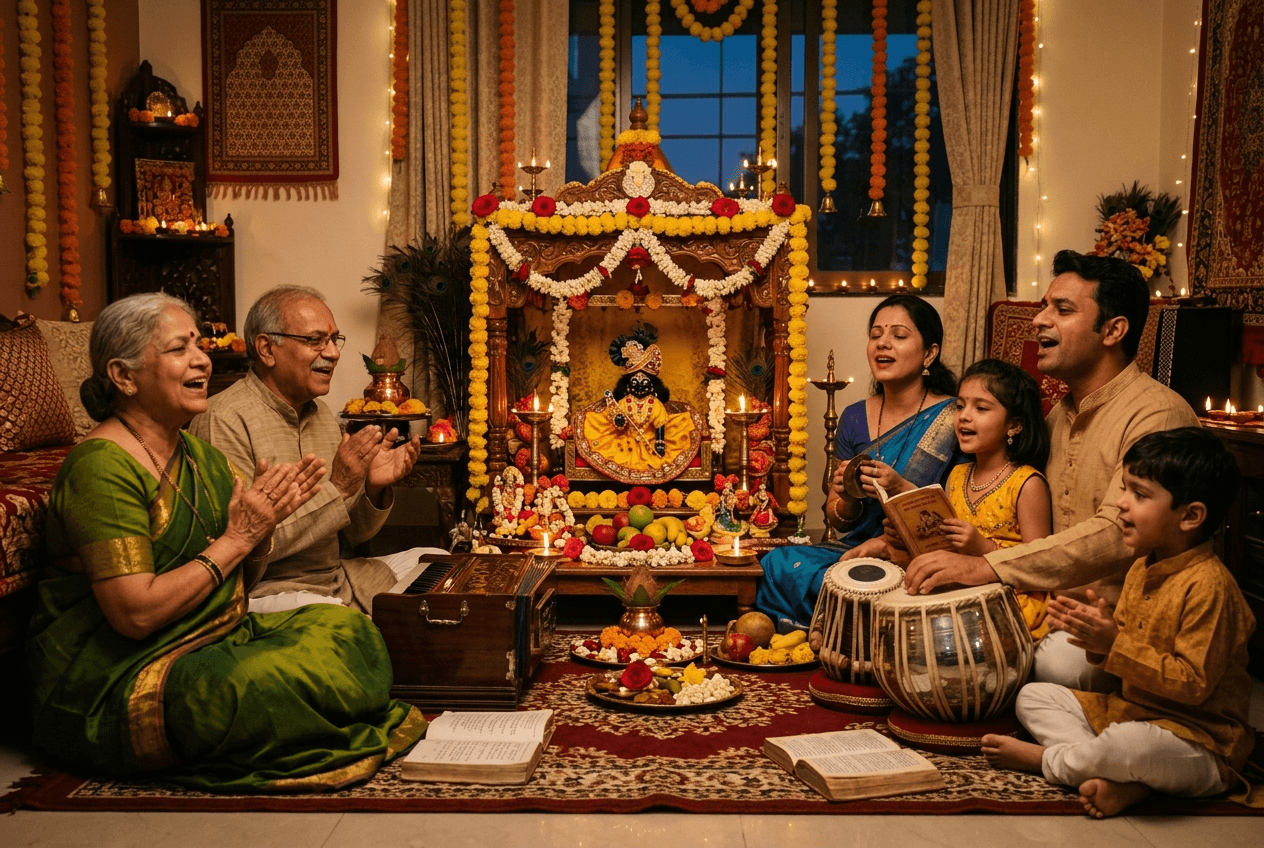 The core janmashtami songs repertoire includes Achyutam Keshavam, Shri Krishna Govind Hare Murari, Madhurashtakam by Vallabhacharya, Govind Bolo Hari Gopal Bolo, and the Hare Krishna mahamantra. Among the poet-saints, Meera's bhajans and Surdas's compositions on the child Krishna are foundational. From film, Yashomati Maiya from Satyam Shivam Sundaram, Bada Natkhat Hai from Amar Prem and Woh Kisna Hai from Kisna are the most widely played, and for dahi handi, Govinda Aala Re and Go Go Govinda.
The Playlist by Moment
The Poet-Saints
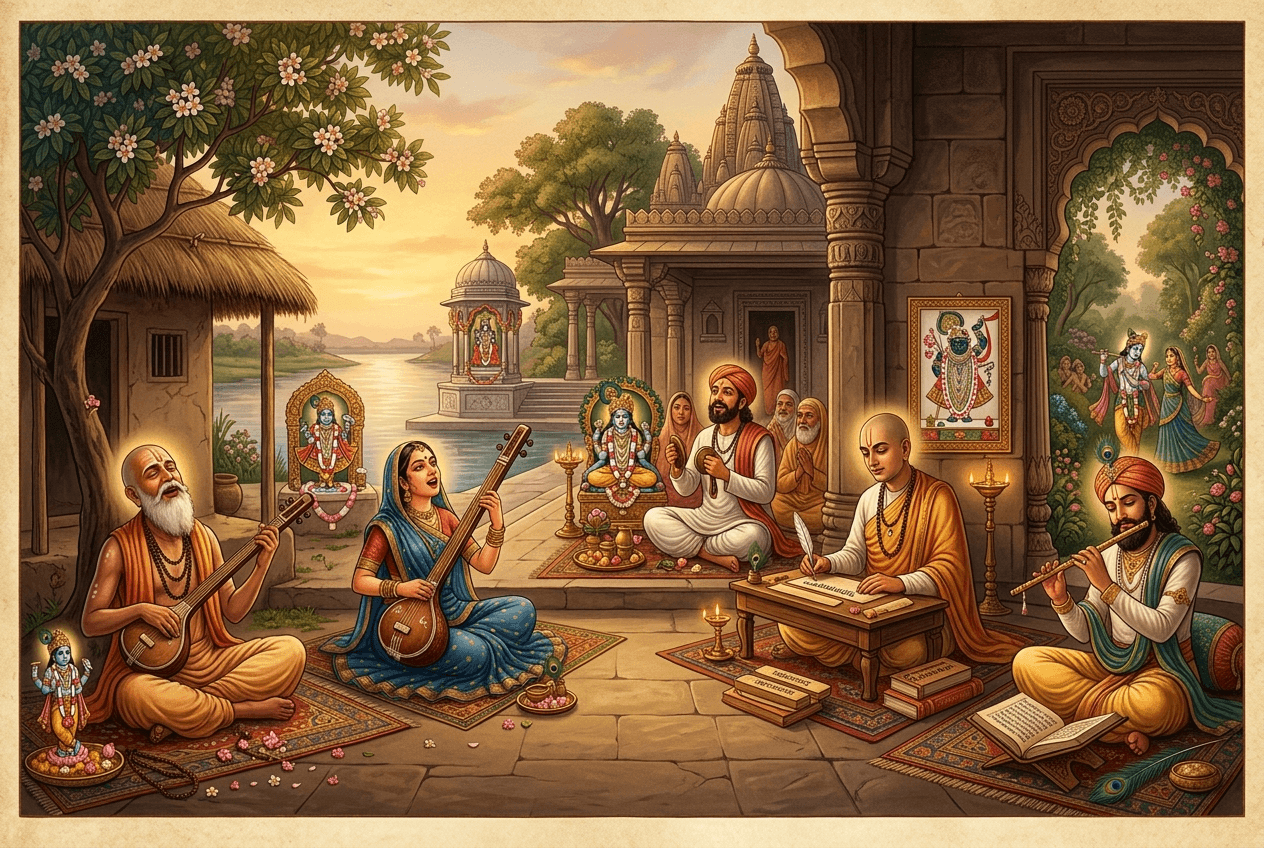 The janmashtami songs everyone knows are not anonymous folk material. It was largely written by identifiable poets across several centuries, and knowing who wrote what changes how you hear it.
Surdas
A sixteenth century poet of the Braj region, blind from birth by tradition, whose compositions on the childhood of Krishna are the foundation of the entire bal Krishna repertoire. His pads describe the child stealing butter, being scolded by Yashoda, playing tricks on the gopis, and they are affectionate and domestic rather than grand. Almost every tender song about the child Krishna in Indian music descends from this body of work.
Meera
The sixteenth century Rajput princess who abandoned her position for devotion to Krishna, and whose bhajans express longing, defiance and complete personal surrender. Her poems are written in the first person, addressed directly to Krishna as beloved, and they carry an emotional directness that startles listeners encountering them for the first time. She is also the figure through whom a great many women in India first encounter devotional poetry as something written from a woman's position.
Jayadeva
The twelfth century Sanskrit poet of the Gita Govinda, which describes the love of Radha and Krishna across a sequence of songs called ashtapadis. It is sung daily at the Jagannath temple in Puri, it supplies the expressive repertoire for Odissi dance, and it is unusual in treating divine love in explicitly human emotional registers including jealousy, sulking and reconciliation.
Narsinh Mehta and the Gujarati tradition
The fifteenth century Gujarati poet-saint whose devotional compositions remain central to Gujarati bhakti music, and whose most famous work became widely known nationally through its association with Gandhi. Gujarat's Krishna devotion, centred on Dwarka, has its own substantial repertoire distinct from the Braj tradition.
Vallabhacharya and Madhurashtakam
A short Sanskrit composition of eight verses, each describing an aspect of Krishna as sweet, and it is among the most widely sung pieces at Janmashtami. It is brief, repetitive in structure, and therefore unusually easy for a gathering to learn and join, which explains its ubiquity.
The Classical Repertoire
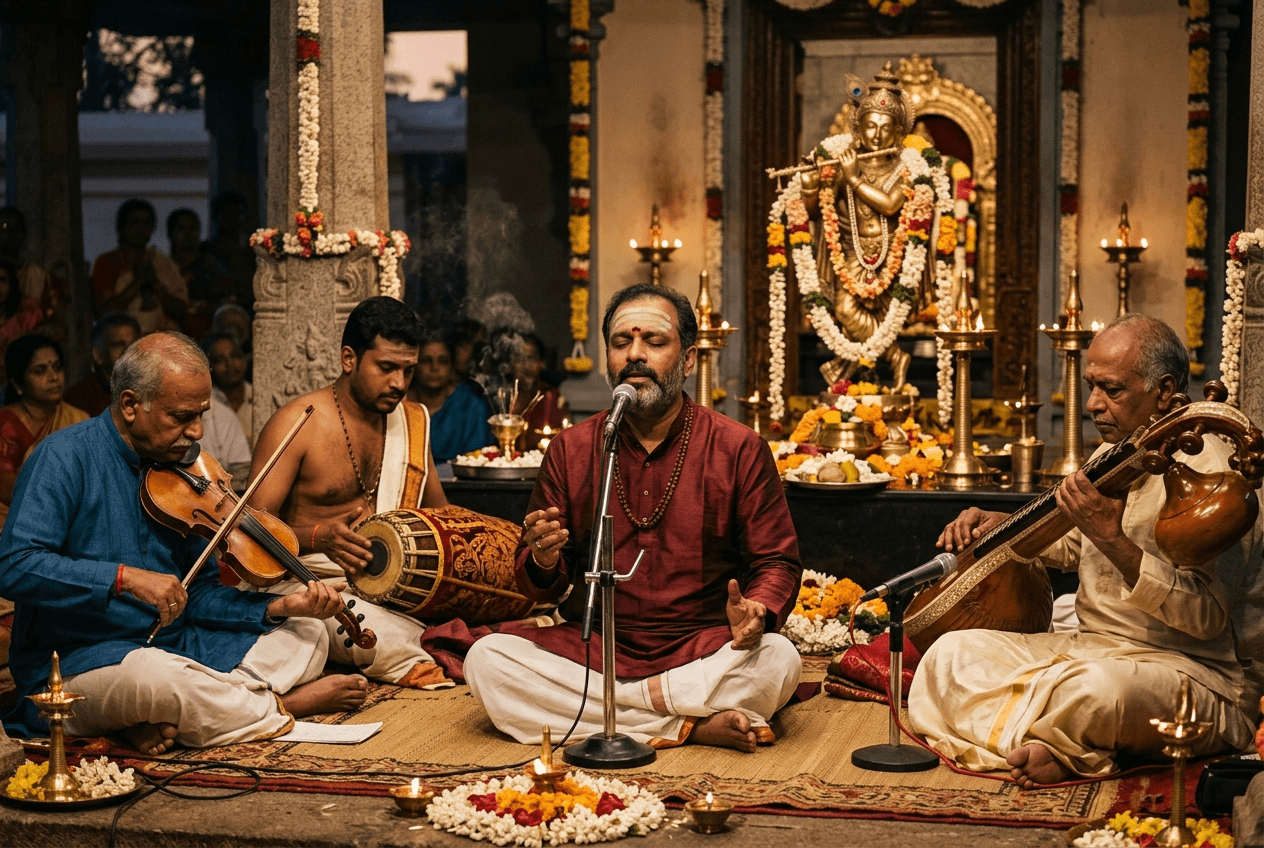 The finest music written on this subject sits in the classical traditions rather than in film or popular devotional recording, and it is largely absent from festival playlists.
In Carnatic music, Krishna Nee Begane Baro, attributed to Vyasatirtha, is among the most beloved compositions in the entire repertoire, addressing Krishna as a child and asking him to come quickly. Alaipayuthe Kanna by Oothukkadu Venkata Kavi is another cornerstone. The Carnatic tradition contains a very large body of Krishna compositions, and the beginner guide to Carnatic music explains how this repertoire is structured.
In Hindustani music, Krishna material appears through bhajan, through thumri, and through the seasonal forms associated with the monsoon, since Janmashtami falls in the rainy season and a substantial body of Braj repertoire concerns Krishna and the rains. Jhula songs, describing Radha and Krishna on a swing, belong to this seasonal group and are specifically associated with this period.
The practical recommendation is to include one classical piece in your festival listening. Krishna Nee Begane Baro requires no prior knowledge to be affected by and takes six minutes. For a family that plays the same eight bhajans every year, it is the single easiest addition that raises the musical level of the evening.
The Film Songs
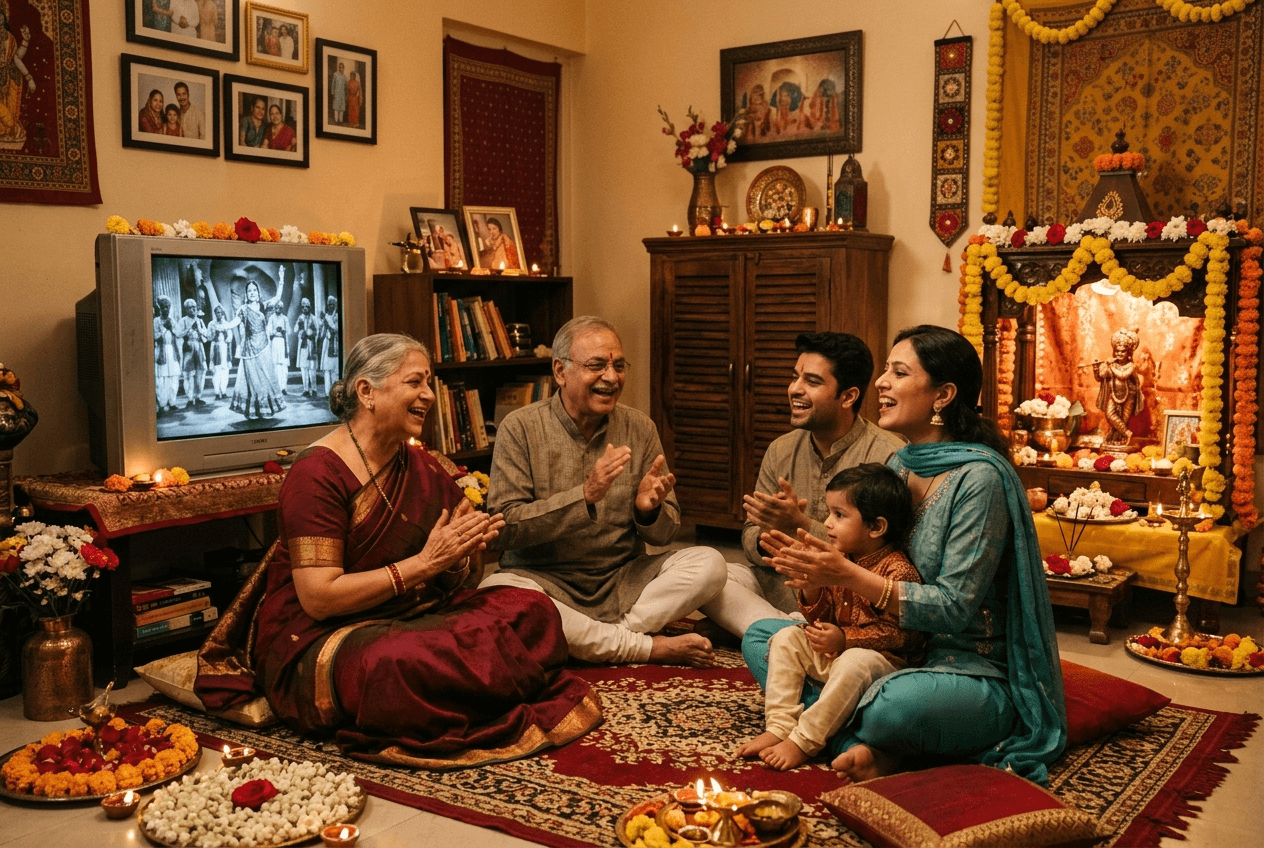 Hindi cinema has produced a substantial layer of janmashtami songs, and unusually for film music, a good deal of it is musically serious.
Yashomati Maiya from Satyam Shivam Sundaram is the most widely played, describing Yashoda being questioned by the child Krishna about why he is dark and Radha is fair, which is a story drawn directly from the traditional repertoire. Bada Natkhat Hai from Amar Prem is a lullaby about the mischievous child and is among the finest devotional songs Hindi cinema has produced. Woh Kisna Hai from Kisna, Shyam Teri Bansi from Geet Gata Chal, and Man Mohana from Jodhaa Akbar are all substantial.
What distinguishes the good ones is that they draw on the traditional material rather than inventing a generic devotional mood. The songs that last are the ones telling stories the audience already knows, from Surdas and the Bhagavata Purana, in a musical language the audience can follow.
Dahi Handi
The day after the midnight observance, in Maharashtra and parts of Gujarat, is entirely different in character. A pot of curd is suspended high above a street and teams of young people, the govindas, form human pyramids to reach and break it, re-enacting the child Krishna stealing butter.
The music is street music, loud and rhythmic, built for a crowd that is physically active and competitive rather than devotional. Govinda Aala Re from Bluff Master is the traditional anchor and has been for decades. Go Go Govinda from OMG Oh My God is the modern equivalent. Live dhol carries much of it, and the chanting from the crowd is as much a part of the sound as anything played.
It is worth noting for anyone planning a family observance that dahi handi and the midnight puja are almost opposite experiences. One is a still, devotional moment at home; the other is a loud public competition. Families frequently participate in both and should plan the music separately rather than treating the festival as a single event.
There is also a safety dimension that has become part of the public conversation around dahi handi, since human pyramids reaching considerable heights carry real risk and injuries occur every year. Several states have introduced height limits and age restrictions for participants, and organisers increasingly use safety equipment and trained teams. Anyone planning a community event should check current local rules rather than relying on how it was done previously, and events involving children need particular care.
Why Krishna Produced So Much Music
No other figure in Indian religious life has generated anything approaching this volume of music, and the reasons are specific rather than mysterious.
The first is that Krishna is himself a musician. He is depicted with a flute in almost every representation, the sound of that flute is central to the mythology as the thing that calls the gopis away from their households, and a deity who plays an instrument invites musical devotion in a way that a deity who does not simply cannot.
The second is that the theology permits emotional intimacy. Bhakti as a devotional mode allows the worshipper to relate to Krishna as a child to be cared for, a friend, a lover, or a mischievous nuisance, which gives poets an enormous emotional range to work within. Devotional music addressed to a remote and majestic deity is necessarily reverent; devotional music addressed to a child who steals butter can be affectionate, funny and domestic. Almost every register available to human feeling has been used in this repertoire.
The third is regional spread. The Krishna story is set in Braj but the devotion took root across Bengal, Odisha, Gujarat, Maharashtra, Rajasthan, Manipur and the south, and each tradition developed its own musical language for it. The result is that Krishna repertoire exists in almost every Indian language and in every major classical and folk tradition, which is not true of any other figure. The instruments used vary just as widely, as the guide to Indian classical music instruments makes clear.
Kirtan and the Bengali Tradition
Worth separating out because it is a developed musical form rather than a category of song, and it is frequently misunderstood outside Bengal.
The Gaudiya Vaishnava tradition, deriving from Chaitanya in the sixteenth century, made congregational singing the central devotional practice rather than one element among several. Kirtan in this tradition is sung in extended sessions, sometimes running for hours, with a lead singer and a responding group, accompanied by khol drum and karatal cymbals. It has its own rhythmic conventions, its own melodic structures and a body of composed repertoire.
What distinguishes it musically is the use of gradual acceleration. A kirtan frequently begins slowly and builds in tempo across a long stretch, so that the same material is transformed by pace, and the collective experience of that acceleration is the point rather than a side effect. Anyone who has only encountered kirtan as a short recording has not really heard it, since the form depends on duration.
The Manipuri tradition took this in a different direction again, developing Sankirtana as a performance combining singing, drumming and dance, which is recognised as a distinct cultural form and is inseparable from Manipuri classical dance.
Regional Traditions
Braj
The region around Mathura and Vrindavan is where the Krishna story is set, and its observance is the most elaborate anywhere. Raas Leela performances dramatise episodes from Krishna's life with music and dance, temple singing runs continuously, and the local repertoire in the Braj Bhasha dialect is vast and largely unknown outside the region. Anyone with a serious interest in this music should hear Braj material rather than only the national standards.
Maharashtra and Gujarat
Maharashtra's observance centres on dahi handi and on the abhang tradition, with Krishna material appearing in the wider Varkari devotional repertoire. Gujarat's Krishna devotion focuses on Dwarka, where Krishna ruled as king rather than lived as a child, which shifts the emotional register from playful to majestic, and the repertoire follows.
The east and the south
Bengal's Gaudiya Vaishnava tradition, deriving from Chaitanya in the sixteenth century, produced kirtan as a distinct and highly developed musical form, sung in extended sessions with its own rhythmic and melodic conventions. Odisha carries the Gita Govinda tradition at Puri. Manipur has Raas Leela as a classical dance form devoted entirely to the Krishna story. In the south, the Carnatic repertoire and the Tamil and Kannada devotional traditions each contribute substantially, and the guide to famous Carnatic musicians points to the recordings worth seeking out.
What the Songs Actually Mean
A great many people sing this repertoire without knowing what they are singing, having learned it phonetically as children, and the meanings are worth having because they change how the music feels.
Achyutam Keshavam is a sequence of names and epithets, each invoking a different aspect of Krishna and Rama, building through repetition into something closer to a meditation than a narrative. Its power comes from accumulation rather than from any single line, which is why it works so well sung repeatedly in a group.
Madhurashtakam takes a single idea, that everything about Krishna is sweet, and applies it in turn to his speech, his movement, his form, his flute and every other attribute, with the same word closing every line. That structural repetition is what makes it memorable and what makes it easy for a gathering to join within one verse.
The Surdas material about the child Krishna is domestic and often funny. Yashoda scolding him for eating mud, the child denying it and then opening his mouth, the neighbours complaining about stolen butter. Understanding that these are family scenes rather than solemn theology explains the affectionate tone the music carries, and it makes the repertoire far more accessible to children, who respond to the story rather than the devotion.
Meera's bhajans are the emotionally hardest of the group, written in the first person by a woman who gave up everything for a devotion her family regarded as a scandal. They are about longing and refusal rather than celebration, and singing them at a joyful festival creates a deliberate contrast that experienced bhajan leaders use knowingly.
The Fast and the Long Night
The observance is physically demanding in a way that affects the music, and nobody plans for it.
Many families fast through the day, breaking the fast after the midnight puja or the following morning, and a gathering that has not eaten since dawn arrives at eleven at night with limited energy. Singing for hours in that state is harder than it sounds, and voices tire faster than usual because hydration is typically also reduced.
Two practical adjustments help. Keep the early evening session at a comfortable pitch and moderate volume rather than starting at full energy, because the peak needs to be at midnight and a group that has sung hard for three hours will not have voices left for it. And plan the midnight material to be short and communal rather than extended, since that moment works through intensity rather than duration.
For anyone leading the singing, a practical note: warm up quietly beforehand even though it feels odd to do so at a religious occasion. Leading four hours of bhajan on a cold, unfed voice is how people lose their voice for the following week.
Celebrating Away From India
Diaspora observance runs into a specific difficulty with this festival that others do not present. The central moment is at midnight on a weekday, and in 2026 the fourth of September is a Friday, which helps but does not solve it for families with school-age children.
Community celebrations commonly move to the nearest weekend, while households observe the actual night quietly and briefly. That split is entirely workable, and the music divides accordingly: a short, focused observance at home with a handful of bhajans and the midnight moment marked properly, and a longer participatory session at the community event.
The thing most worth preserving in a small household observance is participation. A family of four singing three bhajans together, badly, at midnight, is closer to the tradition than a large playlist running while everyone watches. Children raised on the first version tend to carry the songs; children raised on the second tend to remember a sound rather than a practice.
Building the Evening
Your janmashtami songs should follow the arc of the observance rather than running at one level for four hours.
The evening has a genuine shape rather than running at one level for four hours.
Start low. Early evening is arrival, preparation and decoration, and the music should be unobtrusive devotional material that people can talk over. This is the moment for longer bhajans and for classical recordings.
Build slowly through the bhajan session. As more people gather, move to participatory material with clear refrains, and let one person lead with the gathering answering. This is the longest stretch and it is where a household with any musical ability should be singing rather than playing recordings.
Peak precisely at midnight. The birth is the moment everything has been building toward, and it should be marked with a definite change: conch, bells, the whole gathering singing together, the fastest and loudest material of the night. This is not a moment for a playlist to shuffle into something inappropriate, so cue it deliberately.
Come down afterwards. Aarti, then quieter material for whoever stays. Many of the best musical moments of the festival happen in the hour after midnight, when the crowd has thinned and the people remaining are the ones who actually want to sing.
Krishna in Dance
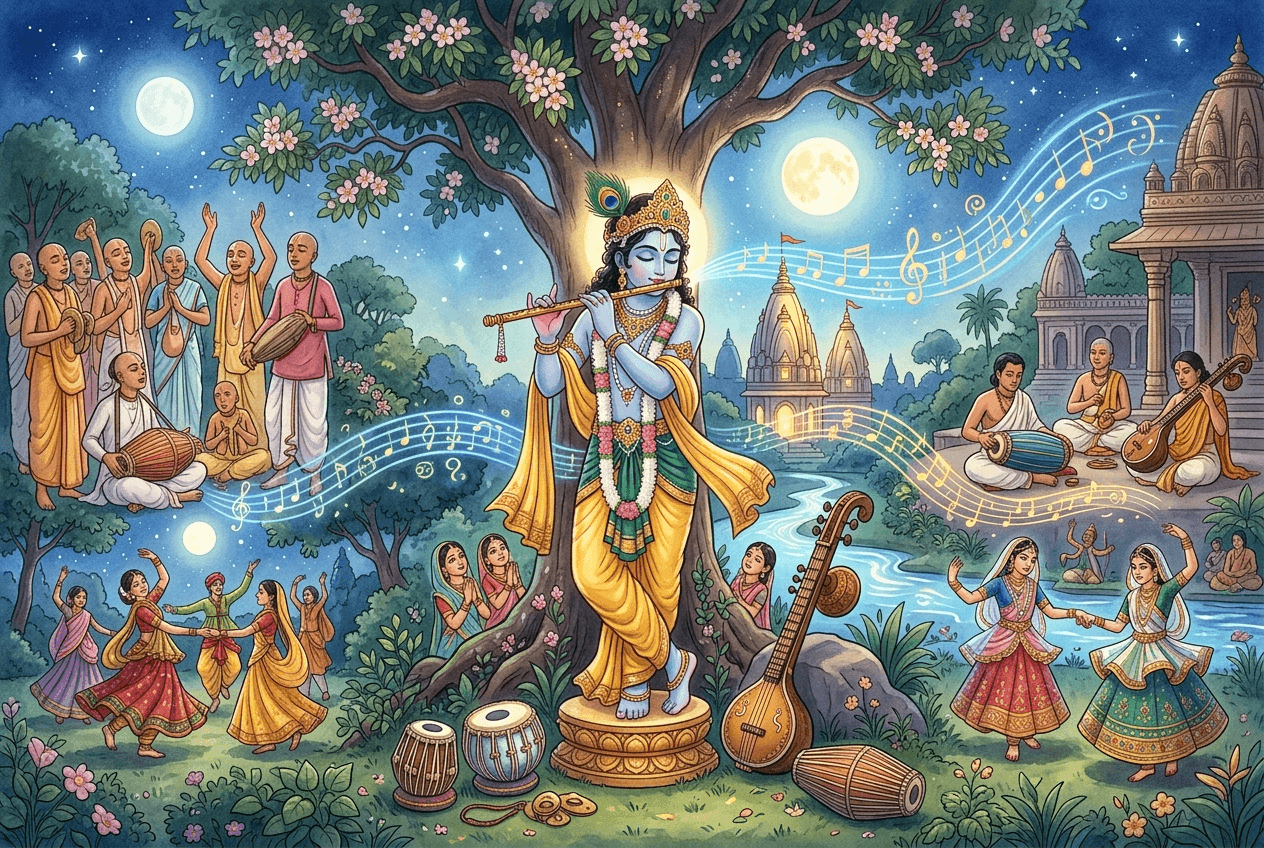 The Krishna story is danced as much as it is sung, and for families with children in classical dance the festival is a natural occasion to connect the two.
Odissi draws its expressive repertoire substantially from the Gita Govinda, and the abhinaya sections of an Odissi recital are frequently portrayals of Radha and Krishna drawn directly from Jayadeva. Kathak carries the Braj tradition through gat bhav sections depicting episodes from Krishna's childhood, and the form's own origins lie partly in the storytelling of exactly this material. Manipuri Raas Leela is devoted to the Krishna story entirely, and Bharatanatyam and Kuchipudi both carry substantial Krishna repertoire.
The practical point for a parent is that a child learning classical dance is already learning this material, and Janmashtami is the obvious moment to make that connection explicit. A child who can perform even a short piece depicting the child Krishna at a family gathering is doing something more meaningful than reciting, and the occasion supplies an audience that is guaranteed to be appreciative. The wider picture of how these forms relate is set out in the guide to Indian classical dance roots.
Singing This Repertoire
Most janmashtami songs belong to bhakti music, which is the most accessible entry point into Indian singing that exists, and Janmashtami is a good occasion to start.
The repertoire is designed for untrained voices. Ranges are narrow, tempos are moderate, phrases are short, and structures are built on repeated refrains that a gathering picks up within one or two passes. Nothing in the core devotional repertoire requires classical technique, which is precisely why it spread as widely as it did.
Three things improve any bhajan session immediately. Pitch for the room rather than for the strongest singer, since the entire purpose is participation. Establish the refrain before the verses, so people can join within the first minute rather than waiting to learn. And keep a steady pulse, because bhajans drift in tempo when nobody is holding time, and a simple manjira or dholak keeping the beat transforms the coherence of a group. The guide to easy songs for beginner singers covers how to choose material that suits a voice that has not been trained.
Frequently Asked Questions
1. What are the best Krishna bhajans for Janmashtami?
Achyutam Keshavam, Shri Krishna Govind Hare Murari, Madhurashtakam, Govind Bolo Hari Gopal Bolo and the Hare Krishna mahamantra form the core participatory repertoire. Among the poet-saints, Meera's bhajans and Surdas's compositions on the child Krishna are foundational.
2. When is Janmashtami 2026?
Friday 4 September 2026, with the main puja at Nishita Kaal around midnight, since Krishna is held to have been born at that hour in the Rohini nakshatra. The fast is customarily broken the following morning once the Ashtami tithi ends. Regional panchang calculations vary slightly, and some communities observe on the adjacent day, so confirm the date and timing locally rather than relying on a single source.
3. What songs are sung at midnight on Janmashtami?
The midnight moment marks the birth and calls for the loudest and most joyful material of the night, typically Madhurashtakam, Nand Gher Anand Bhayo, the mahamantra, and the sounding of conch and bells with the whole gathering singing together. It should be cued deliberately rather than left to a shuffled playlist.
4. Which songs are played for dahi handi?
Govinda Aala Re from Bluff Master is the traditional anchor and Go Go Govinda from OMG Oh My God is the modern equivalent. Live dhol carries much of the sound, along with chanting from the crowd. Dahi handi music is street music and is entirely different in register from the midnight observance.
5. What is the most famous Krishna song?
It depends on tradition. In Carnatic music, Krishna Nee Begane Baro is among the most beloved compositions in the entire repertoire. In popular devotional music, Achyutam Keshavam is the most widely sung. From Hindi cinema, Yashomati Maiya from Satyam Shivam Sundaram is the best known.
6. Who wrote the traditional Krishna bhajans?
Identifiable poet-saints across several centuries. Surdas in the sixteenth century wrote the foundational repertoire on the child Krishna. Meera wrote from a position of personal devotion and longing. Jayadeva wrote the Gita Govinda in the twelfth century. Vallabhacharya wrote the Madhurashtakam, and Narsinh Mehta founded the Gujarati devotional tradition.
7. What is Madhurashtakam?
A short Sanskrit composition of eight verses by Vallabhacharya, each describing an aspect of Krishna as sweet. Its brevity and repetitive structure make it unusually easy for a gathering to learn and join, which is why it is sung so widely at Janmashtami.
8. Are there Krishna songs in classical music?
A great many, and they represent the finest music on the subject. Krishna Nee Begane Baro and Alaipayuthe Kanna are cornerstones of the Carnatic repertoire. Hindustani music carries Krishna material through bhajan, thumri and the monsoon-season Braj repertoire including jhula songs about Radha and Krishna on a swing.
9. Can children learn Janmashtami songs easily?
Yes, and this repertoire is unusually well suited to them. Ranges are narrow, tempos moderate, and the structures are built on repeated refrains. Teach the refrain before the verses so a child can join within the first minute, and choose the Surdas-derived material about the child Krishna, which is story-driven and holds attention.
10. Do I need training to sing bhajans?
No. Bhakti music was written to be sung by ordinary people in groups and requires no classical technique. Pitch the songs for the room rather than the strongest voice, establish the refrain early, and use a manjira or dholak to hold the tempo, since unaccompanied group singing drifts.
Final Thoughts
What separates a good Janmashtami from an ordinary one is not the number of janmashtami songs on the playlist. It is whether the music follows the shape of the night, from quiet anticipation through a long participatory bhajan session to a deliberate peak at midnight and a settling afterwards.
Add one thing this year: a classical Krishna composition, played once, in a quiet moment. Krishna Nee Begane Baro takes six minutes and asks nothing of a listener beyond attention. For many families it becomes the piece they associate with the festival long after the playlist has changed. Art Gharana teaches Hindustani, Carnatic and devotional vocals live and one-to-one, with a free first class.