ChatGPT
 Google AI
 Grok
Grok Claude
Introduction
 Have you ever listened to your favourite singer and thought — I wish I could do that?
You're not alone. The desire to sing — to open your mouth and produce something beautiful, powerful, and emotionally true — is one of the most universal human impulses there is. And yet so many people hold back, convinced that great singing is a gift you're either born with or you're not.
Here's the truth that every vocal coach, music educator, and professional singer knows: your voice is an instrument — and like every instrument, it can be learned, developed, and transformed with the right training and consistent practice.
The singers who inspire us most — the voices that stop us in our tracks and give us goosebumps — didn't simply wake up sounding that way. They worked. They practised. They studied their craft with dedication and intention. And while natural ability plays a role, the gap between a raw beginner and a confident, capable singer is almost always bridged by one thing: deliberate, well-structured vocal training.
The good news? You don't need a professional recording studio or an expensive in-person coach to begin that journey. With the right knowledge, the right exercises, and the right approach, learning how to improve your singing voice at home is not just possible — it's one of the most rewarding things you can do as a musician or music lover.
In this guide, we're going to walk you through everything you need to know as a beginner vocalist. From the science of how your voice actually works, to practical breathing techniques, pitch training exercises, vocal warm-ups, and strategies for developing your own unique singing style — this is your complete, actionable roadmap to becoming a better singer.
Whether you've never had a singing lesson in your life or you've been practising for a while and feel stuck, these beginner vocal training tips will give you a clear, structured path forward — one built on genuine musical understanding rather than guesswork.
Your voice is waiting. Let's develop it.
Why Your Singing Voice Can Always Improve
 Before we dive into the practical exercises and techniques, let's address the most important question of all — can your singing voice actually get better?
The answer is an unequivocal, science-backed yes. And understanding why is the first step toward approaching your vocal training with the confidence and consistency it deserves.
The Science of the Singing Voice and How It Develops
Your singing voice is produced by a remarkably complex system of muscles, cartilage, and tissue — centred on the vocal cords, two small folds of mucous membrane stretched across the larynx. When air passes through them, they vibrate — and that vibration, shaped and amplified by your throat, mouth, and nasal cavities, becomes the sound we call your voice.
What makes this system so exciting from a training perspective is that it responds to exercise exactly the way any other muscle group does. With targeted, consistent practice:
- Vocal cord strength and flexibility increase — giving you greater range and control
- Breath support muscles develop — giving your voice more power and stamina
- Resonance chambers are used more effectively — giving your tone more richness and depth
- Neural pathways for pitch accuracy strengthen — making hitting the right notes feel increasingly natural and instinctive
This is the physiological foundation of vocal training — and it means that every singer, at every level, has genuine room to grow.
Why Consistent Practice Matters More Than Natural Talent
 Here's something that surprises many beginners: the most important factor in vocal development isn't the voice you were born with. It's the consistency and quality of your practice.
Natural talent gives some singers a head start — a naturally resonant tone, an instinctive sense of pitch, or an unusually flexible larynx. But talent without training plateaus quickly. Meanwhile, a singer with modest natural gifts who practises deliberately and consistently will almost always surpass a naturally gifted singer who doesn't.
This is genuinely liberating information. It means that your vocal journey is fundamentally in your own hands — and that the investment you make in understanding how to train your singing voice will pay dividends that no amount of passive wishful thinking ever could.
The key word is deliberate. Singing along to your favourite songs in the shower is enjoyable — but it isn't vocal training. Deliberate practice means working on specific skills, targeting specific weaknesses, and measuring your progress over time.
How Beginners Can Build Remarkable Voices With the Right Approach
The history of music is full of singers who developed remarkable voices through training rather than pure natural gift. Many of the most iconic singers in music history — artists who became global legends — have spoken openly about the years of dedicated vocal work that shaped their extraordinary abilities.
What distinguishes the singers who develop remarkable voices from those who stagnate at a beginner level almost always comes down to three things:
- Structure — following a logical, progressive training programme rather than practising randomly
- Patience — understanding that vocal development is measured in months and years, not days and weeks
- Expert guidance — learning from teachers and coaches who can identify problems and correct them before they become ingrained habits
For anyone serious about how to improve your singing voice at home, combining self-directed practice with structured guidance from online vocal training courses is the most effective and efficient path forward available today.
Common Myths About Singing Ability That Hold Beginners Back
 Before we move on, let's dismantle a few of the most persistent myths about singing that hold beginners back from even starting their vocal journey.
Myth 1: "You're either born a singer or you're not." False. While some people have natural advantages, singing is fundamentally a learned skill. The vast majority of professional singers developed their voices through training — not genetics.
Myth 2: "If you can't sing in tune naturally, you never will." False. Pitch accuracy is a trainable skill. The brain's ability to match pitch improves dramatically with targeted ear training and vocal exercises — even in people who consider themselves "tone deaf."
Myth 3: "You need to start young to become a good singer." False. While early training has advantages, the vocal instrument continues to develop and mature well into adulthood. Many singers have developed their finest vocal qualities in their 30s, 40s, and beyond.
Myth 4: "Singing loudly means singing powerfully." False. True vocal power comes from breath support, resonance, and technique — not volume. Singing too loudly without proper technique is one of the fastest routes to vocal strain and long-term damage.
Understanding the truth behind these myths is genuinely liberating — because it means that your voice improvement journey starts the moment you decide to begin. And that moment can be right now.
Getting the Basics Right: Posture, Breathing, and Warm-Ups
Every experienced vocal coach will tell you the same thing: the most common reason beginner singers struggle to improve isn't a lack of talent or even a lack of practice. It's a lack of fundamentals.
Posture, breathing, and warm-up routines are the unglamorous foundations of great singing — the work that happens before a single note is sung in performance. Get these right, and everything else in your vocal training becomes dramatically easier. Neglect them, and even the most talented voice will consistently underperform.
Why Singing Posture Is the Foundation of Vocal Performance
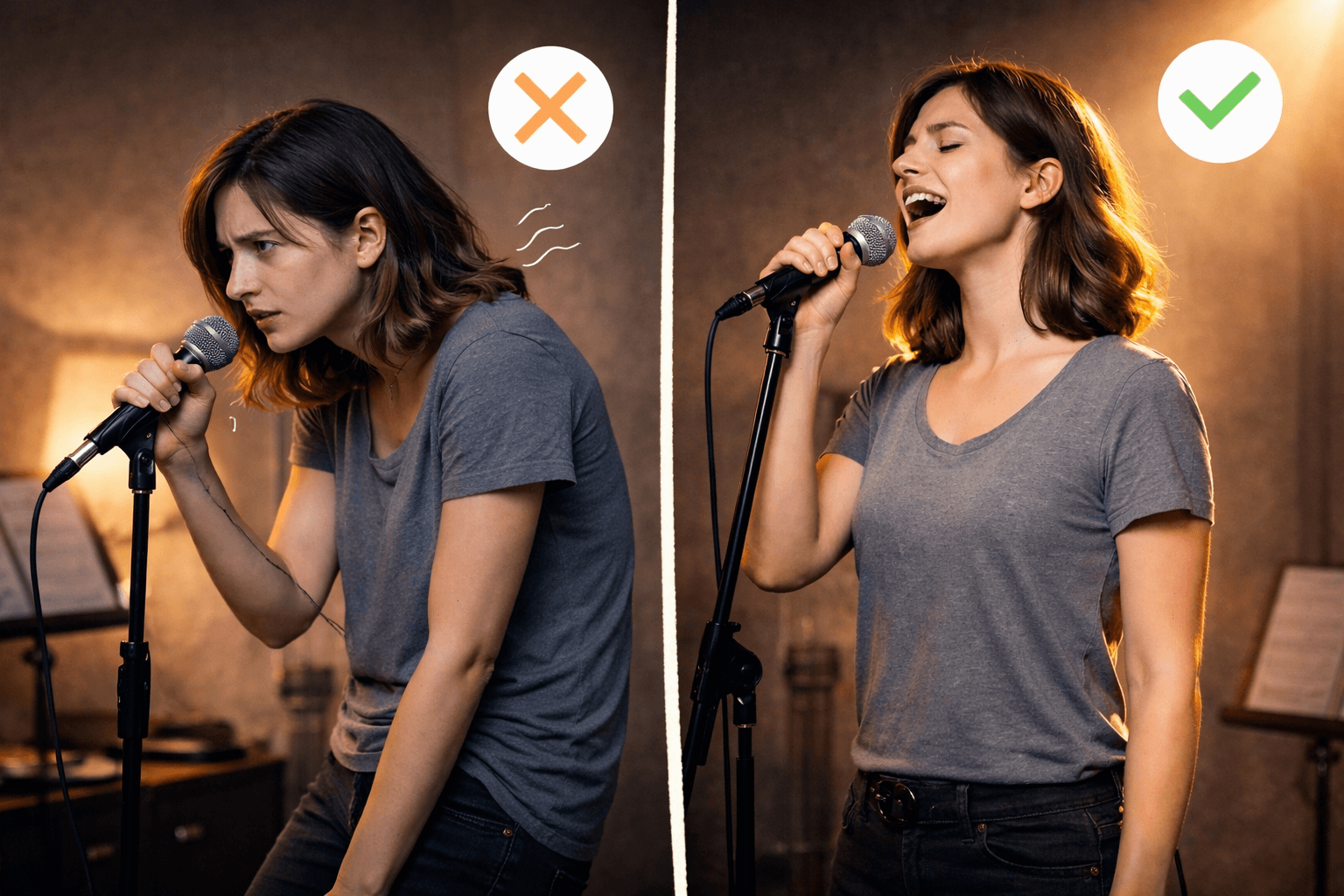
Your body is your instrument — and the position of that instrument directly affects the quality of the sound it produces. Singing posture isn't about standing rigidly to attention. It's about aligning your body in a way that allows your breath to flow freely, your resonance to develop fully, and your muscles to work efficiently.
The key elements of good singing posture are:
- Feet shoulder-width apart — creating a stable, grounded physical foundation
- Knees soft, never locked — locked knees restrict blood flow and create unnecessary physical tension
- Spine lengthened, not rigid — think of growing taller from the crown of your head rather than forcing your shoulders back
- Shoulders relaxed and down — tension in the shoulders travels directly to the throat and constricts vocal production
- Chin parallel to the floor — tilting the chin up or down restricts the larynx and limits your range
- Chest open and naturally lifted — this maximises lung capacity and allows for full breath support
A simple test: try singing a sustained note while slumping your shoulders and rounding your back — then repeat the same note with aligned, open posture. The difference in tone, power, and ease will be immediately and dramatically apparent.
Breathing Exercises for Singers That Build Power and Control
Breath is the fuel of the singing voice. Without deep, controlled, efficiently managed breath support, even the most technically gifted singer will struggle to produce a tone of genuine power and consistency.
The breathing technique used by trained singers is called diaphragmatic breathing — a method that uses the diaphragm muscle, rather than the chest, as the primary engine of breath intake and control.
Here are three essential breathing exercises for singers that every beginner should practise daily:
Exercise 1: Diaphragmatic Breathing Place one hand on your chest and one on your stomach. Breathe in slowly through your nose — the hand on your stomach should rise while the hand on your chest remains relatively still. Exhale slowly through pursed lips. Practise for 5 minutes daily until diaphragmatic breathing becomes your natural default.
Exercise 2: The Sustained Hiss Take a full diaphragmatic breath, then exhale slowly and continuously on a sustained "ssss" sound — like air escaping from a tyre. Your goal is to extend the hiss for as long as possible while maintaining consistent air pressure. This builds the breath control muscles essential for long phrases and sustained notes.
Exercise 3: The Staccato Breath Take a full breath and then exhale in sharp, rhythmic bursts — "sh, sh, sh, sh" — engaging your abdominal muscles with each burst. This exercise develops the muscular control needed for dynamic variation and rhythmic precision in your singing.
Practise these breathing exercises for singers for just 10 minutes before every vocal session and you will notice a measurable improvement in your vocal stamina and tone quality within weeks.
Essential Vocal Warm Up Exercises Every Beginner Needs
Warming up your voice before singing is non-negotiable — not just for performance quality, but for vocal health and longevity. Cold vocal cords are inflexible, vulnerable to strain, and incapable of producing your best tone. A proper warm-up changes all of that.
Here is a simple but effective beginner warm-up sequence:
- Lip trills (2 minutes) — blow air through relaxed, loosely closed lips to produce a motorboat-like trill. Slide up and down through your range. This gently warms the vocal cords without strain.
- Humming scales (2 minutes) — hum gently up and down a five-note scale, keeping your jaw relaxed and your lips lightly closed. Feel the vibration in your lips and cheekbones.
- Sirens (2 minutes) — slide your voice smoothly from your lowest comfortable note to your highest and back down, like a siren. This exercises your full range and helps identify any areas of tension or break.
- Vowel scales (3 minutes) — sing a five-note scale on each vowel sound — AH, EH, EE, OH, OO — focusing on keeping the tone even and the throat relaxed throughout.
This 9-minute sequence takes almost no time and makes a significant difference to both your vocal health and your performance quality every single time you sing.
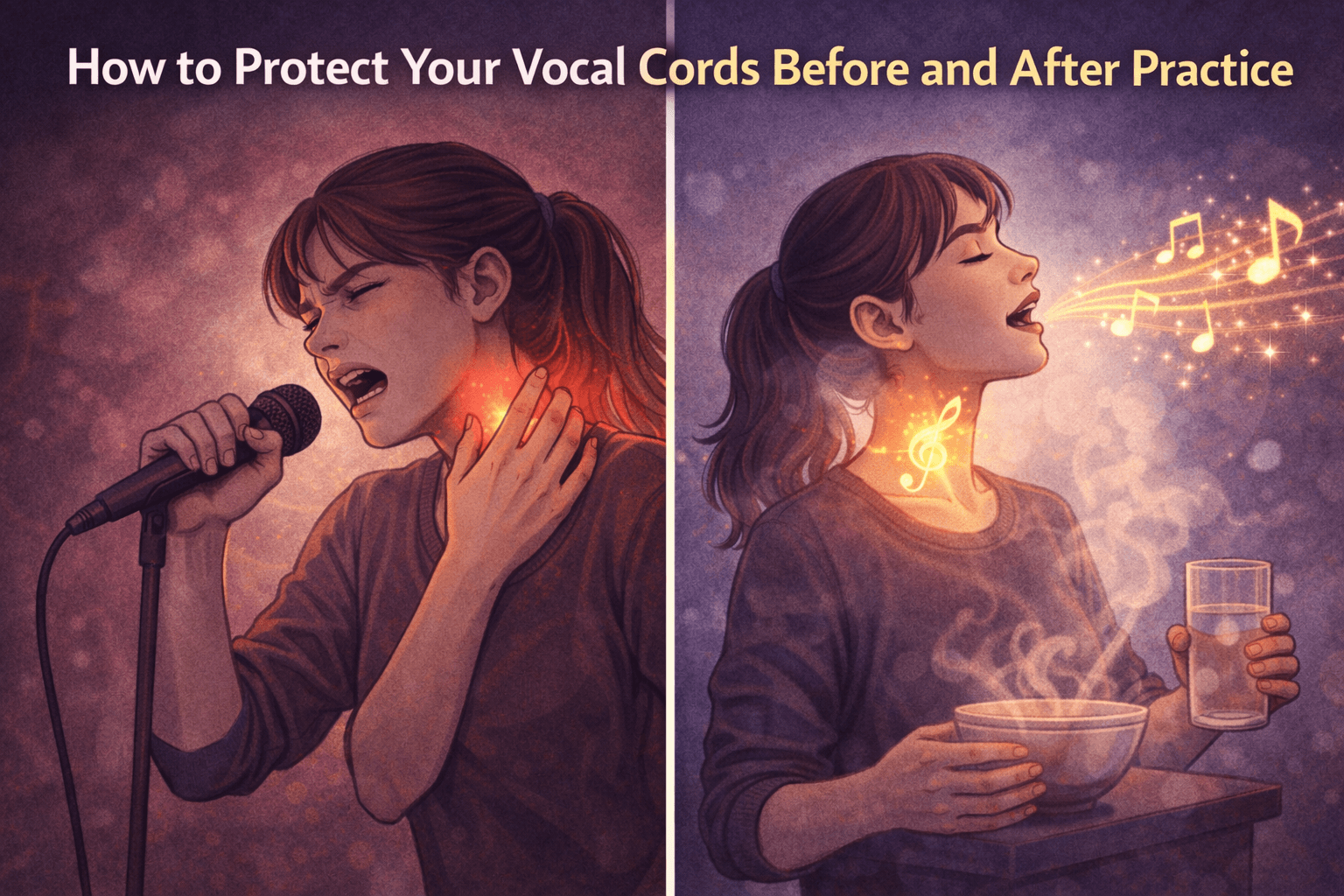
How to Protect Your Vocal Cords Before and After Practice
Vocal cord care is an aspect of singing that beginners frequently overlook — until something goes wrong. Your vocal cords are delicate tissues, and consistent misuse or neglect leads to hoarseness, vocal fatigue, and in serious cases, nodules that require medical attention.
Essential vocal health habits every beginner singer should adopt:
- Hydrate consistently — drink plenty of water throughout the day, not just during practice. Hydrated vocal cords are flexible and resilient; dehydrated ones are stiff and vulnerable
- Avoid throat clearing — habitual throat clearing is one of the most damaging things you can do to your vocal cords. If you feel the need to clear your throat, try swallowing instead
- Rest your voice after intensive practice — vocal recovery is as important as vocal exercise. Build rest periods into your training schedule
- Avoid whispering when hoarse — contrary to intuition, whispering puts more strain on inflamed vocal cords than speaking at a normal volume
- Steam inhalation — inhaling steam from a bowl of hot water or a personal steamer hydrates and soothes vocal cord tissue before and after intensive singing sessions
- Identify your current comfortable range — the notes you can sing without strain, tension, or thinning of tone
- Work consistently at the edges — practise scales and exercises that reach just slightly beyond your current comfortable range, without pushing into strain
- Use your mix voice — the blend of chest voice and head voice that allows you to access higher notes with power and control rather than switching abruptly into a weak falsetto
- Be patient — meaningful range expansion happens over months, not days. Each semitone of genuine, controlled range you add is a real and lasting achievement
- Tongue twisters sung to a scale — "red lorry, yellow lorry" or "unique New York" sung on ascending notes develops both articulation precision and rhythmic accuracy simultaneously
- Exaggerated consonant practice — practise songs at half tempo, exaggerating every consonant dramatically. When you return to normal tempo, a natural clarity will remain
- Vowel purity exercises — practise holding each vowel sound for a sustained count of four, focusing on keeping the shape of the vowel consistent from beginning to end without drifting
- Phrasing — where do they breathe? How do they shape the beginning and end of each phrase?
- Dynamics — how do they move between soft and loud? What emotional effect does that dynamic variation create?
- Tone colour — how does their tone change to reflect different emotional content within the same song?
- Vibrato — do they use it consistently, sparingly, or as a specific expressive tool?
- Rhythmic feel — do they sit exactly on the beat, ahead of it, or behind it? How does that rhythmic placement affect the feeling of the song?
- Understand the lyric deeply before you sing it. What is the song actually saying? What is the emotional truth at its core?
- Connect the lyric to personal experience — find something in your own emotional history that resonates with the song's content and draw on that connection when you sing
- Use your face and body — emotional expression isn't just in the voice. Your face, your posture, your physical presence all communicate feeling to your audience/li>
- Allow imperfection — some of the most emotionally powerful vocal moments in recorded history are technically imperfect. A crack in the voice, a slight breathiness, a moment of rawness — these are signs of genuine feeling, not vocal failure
- Drink at least 2 litres of water daily — more on days when you're singing extensively
- Avoid caffeine and alcohol before singing sessions — both are dehydrating and affect vocal cord function
- Avoid dairy products before singing — they increase mucus production and coat the vocal cords
- Keep your practice environment humidified — dry air, particularly in heated indoor spaces, dehydrates vocal cord tissue rapidly
- Structured progression — a logical, sequential curriculum that builds skills in the right order
- Accountability — the motivational power of regular sessions with a teacher who tracks your progress
- Personalisation — exercises and approaches tailored specifically to your voice, your goals, and your current level
- Musical context — understanding not just how to sing but why certain techniques work, rooted in genuine musical knowledge
- Qualified, experienced teachers — vocal coaches with genuine performance and teaching credentials, not just online personalities with large followings
- Structured, progressive curriculum — a clear learning pathway from beginner to advanced, with each stage building on the last
- Individual feedback mechanisms — the ability to submit recordings and receive personalised feedback, not just watch pre-recorded videos
- Genre diversity — exposure to a range of musical styles that broadens your vocal vocabulary and prevents stylistic narrowness
- Vocal health emphasis — a course that prioritises the long-term health of your voice, not just short-term performance results
- Monthly recordings — record yourself singing the same song or exercise at the beginning of each month. Comparing recordings from three or six months apart reveals growth that's often invisible on a day-to-day basis
- Range mapping — regularly identify and record your highest and lowest comfortable notes to track range development over time
- Skill journals — keep a brief written log of each practice session noting what you worked on, what felt good, and what needs attention
- Teacher feedback records — if you're working with an online vocal coach, keep notes from each lesson highlighting the key points and corrections
- Why your voice can always improve — and the science that proves it
- How posture, breathing, and warm-ups form the unshakeable foundation of great singing
- The core vocal exercises that build pitch accuracy, range, resonance, and diction
- How to develop a singing style that is genuinely, authentically yours
- The most common beginner mistakes — and exactly how to fix them
- How online resources and structured training accelerate everything
These vocal health habits aren't optional extras — they are the maintenance routine that keeps your instrument in peak condition and your vocal development on track.
Core Vocal Exercises to Improve Your Singing Voice at Home
With your posture aligned, your breathing developed, and your warm-up routine established, you're ready for the core work — the targeted vocal exercises that will systematically build your singing ability and help you improve your singing voice at home with genuine, measurable results.
Pitch Training Exercises for Accuracy and Confidence
Pitch accuracy — the ability to consistently hit the notes you intend to sing — is the single most fundamental skill in all of vocal training. Without it, even a beautiful tone becomes a liability. With it, even a modest voice becomes genuinely musical.
Here are three highly effective pitch training exercises for beginners:
Exercise 1: Piano or Keyboard Matching Play a single note on a piano, keyboard, or piano app — then sing that exact pitch. Listen carefully to the difference between the note you're playing and the note you're producing. Adjust until they match precisely. Work through a full octave, note by note. This simple exercise is one of the most powerful pitch training tools available and requires no equipment beyond a basic piano app on your phone.
Exercise 2: Interval Training Sing two notes that form a specific musical interval — a fifth, a third, an octave — and train your ear to recognise and reproduce each interval accurately. Apps like EarMaster and Functional Ear Trainer make this process structured and progressive.
Exercise 3: Scale Singing With Recording Sing a major scale — do, re, mi, fa, sol, la, ti, do — while recording yourself on your phone. Play it back and listen critically. Are all eight notes in tune? Which ones feel uncertain? Target those specific notes in your next practice session.
Recording yourself is one of the most powerful and underused tools in beginner vocal training. It gives you objective feedback that your own ears — distracted by the physical sensation of singing — simply cannot provide in the moment.
How to Expand Your Vocal Range Safely and Effectively
 One of the most common goals for beginner singers is expanding their vocal range — reaching higher notes, accessing lower registers, and developing a more complete and versatile voice.
The key word in vocal range development is safely. Forcing your voice into ranges it isn't yet equipped to handle is one of the most reliable ways to damage your vocal health and set your development back significantly.
Safe, effective range expansion follows this principle:
Lip trills and sirens are particularly effective range expansion tools — they allow the voice to move through its full range with minimal tension, gently stretching the vocal cords without the strain that comes from range exercises sung on open vowels.
Resonance and Tone Exercises for a Richer, Fuller Sound
Resonance is what gives a singing voice its richness, warmth, and carrying power. It's the difference between a voice that sounds thin and effortful and one that fills a room with apparent ease.
Resonance is developed by learning to direct your voice into the resonating spaces of your body — primarily your chest, throat, mouth, and the bones of your face. Here are two highly effective resonance exercises:
Exercise 1: The Humming Exercise Hum a comfortable note and focus your attention on where you feel the vibration in your body. Gradually try to move that vibration — from your throat, up into your face, into your cheekbones and forehead. The sensation of vibration in your face and skull indicates that you're accessing your head resonance — one of the most important tonal qualities in a developed singing voice.
Exercise 2: The "Ng" Exercise Sing a scale on the "ng" sound — as in "sing." This sound naturally positions the voice in a forward, resonant placement that produces a brighter, more projecting tone. Once you've established the sensation on "ng," transition to open vowels — "ng-AH, ng-EH, ng-EE" — maintaining the same forward placement.
Articulation and Diction Exercises for Clearer Singing
A beautiful tone means very little if your audience can't understand a single word you're singing. Clear diction — precise, energetic articulation of consonants and vowels — is what makes lyrics land and stories connect.
Practical diction exercises for beginner singers:
Clean diction is the final polish that turns good singing into genuinely communicative, audience-connecting performance.
How to Develop Your Unique Singing Style
 Technical exercises build capability. But capability alone doesn't make a great singer. What transforms a technically competent voice into a genuinely compelling one is style — a distinctive, personal approach to music that reflects who you are as an individual and an artist.
Developing your unique singing style is one of the most exciting parts of the vocal journey — and one of the most misunderstood.
Learning From the Most Iconic Singers in Music History
Every great singer developed their style partly through deep, attentive study of the singers who came before them. Listening analytically — not just passively enjoying, but actively studying how great singers do what they do — is one of the most powerful developmental tools available to any beginner vocalist.
When you study the most iconic singers in music history, pay close attention to:
This kind of analytical listening develops your musical ear and your stylistic vocabulary simultaneously — giving you a rich palette of techniques and approaches to draw from as your own style develops.
Finding Your Natural Vocal Register and Working With It
One of the most important — and most frequently ignored — pieces of advice in beginner vocal training is this: work with your natural voice, not against it.
Every voice has a natural register — a range and tonal quality that it produces most easily, most beautifully, and most authentically. Fighting against your natural register in pursuit of someone else's sound is one of the surest ways to sound strained, inauthentic, and vocally unhealthy.
Your natural register is your greatest asset. The goal of vocal training isn't to change it — it's to develop it. To make it stronger, more flexible, more expressive, and more consistently available to you across a wider range of musical contexts.
Ask yourself honestly: in what part of your range do you feel most free, most resonant, and most naturally yourself? Start there — and build outward from that foundation.
How to Sing With Genuine Emotion and Audience Connection
Technical perfection without emotional authenticity is one of the most hollow things in music. Audiences don't ultimately remember perfectly executed scales — they remember moments of genuine human connection, vulnerability, and feeling.
Singing with genuine emotion is a skill — and like all skills, it can be developed:
Building Singing Confidence Through Consistent Practice
Singing confidence is perhaps the most undervalued component of vocal development — and for many beginners, it's the biggest barrier of all.
The most reliable way to build singing confidence is deceptively simple: sing more, and sing in progressively more challenging situations.
Start by singing alone at home. Then sing in front of a mirror. Then record yourself and listen back. Then sing in front of one trusted friend. Then a small group. Each step builds the neural pathways of performance confidence — teaching your nervous system that singing in front of others is safe, enjoyable, and within your capability.
Confidence isn't something you wait to feel before you perform. It's something you build by performing, repeatedly, before you feel ready.
Common Beginner Singing Mistakes and How to Fix Them
Every beginner singer makes mistakes. That's not a criticism — it's simply the nature of learning any complex skill. What matters is identifying those mistakes early, understanding why they happen, and correcting them before they become ingrained habits that are harder to shift later.
Singing Too Loud Too Soon — Why This Damages Vocal Development
The most common and potentially most damaging mistake beginner singers make is pushing their voice too hard too soon — singing at full volume before their technique is developed enough to support it safely.
Singing loudly without proper breath support and technical foundation puts enormous strain on the vocal cords. The short-term result is vocal fatigue and hoarseness. The long-term result can be vocal nodules — callous-like growths on the vocal cords that require rest or medical intervention to resolve.
The fix is counterintuitive but effective: practise at lower volumes than you think you need to. Focus on tone quality, resonance, and breath support at a comfortable, moderate volume. Power will develop naturally as your technique strengthens — and it will be genuine, sustainable power rather than the strained, effortful loudness of an undertrained voice.
Neglecting Vocal Health and Hydration
Dehydration is one of the most common and most easily preventable causes of poor vocal performance and vocal fatigue in beginner singers. Vocal cords need to be consistently well-hydrated to vibrate efficiently — and the hydration that reaches your vocal cords comes from the water you drink hours before you sing, not minutes before.
Vocal health tips every beginner singer should make non-negotiable:
Skipping Warm-Ups and the Consequences for Your Voice
We covered warm-up exercises earlier — but it's worth emphasising just how costly the habit of skipping warm-ups is for beginner singers.
Cold vocal cords lack the flexibility and blood flow needed for efficient, safe singing. Singing on cold cords increases the risk of vocal strain, reduces the quality of your tone, limits your accessible range, and makes pitch accuracy significantly harder to maintain.
The fix is simple: never sing without warming up first. Even on days when you're short on time, a 5-minute abbreviated warm-up — lip trills, gentle humming, a couple of siren slides — is infinitely better than none at all.
Trying to Copy Other Singers Instead of Developing Your Own Voice
Learning from great singers is essential. Trying to become another singer is a trap that holds countless beginners back from discovering the most valuable thing they have — their own unique voice.
Every great singer sounds the way they do because of the specific combination of their physical instrument, their life experience, their musical influences, and their personal artistic choices. You cannot replicate that combination — and spending your practice time trying to will produce a pale imitation rather than a genuine artistic identity.
Study great singers. Learn their techniques. Absorb their approaches. But always bring what you learn back to your own voice — and ask not "how can I sound like them?" but "what can I take from them that serves my voice and my artistic expression?"
Taking Your Vocal Training Further With Online Resources
Self-directed practice at home is a powerful starting point — but there comes a point in every singer's development where external guidance, structured curriculum, and expert feedback become essential for continued growth.
That's where online vocal resources come in — and the quality and accessibility of what's available today is genuinely remarkable.
How Online Vocal Lessons Accelerate Your Development
The single biggest advantage of working with an online vocal teacher over self-directed practice alone is the quality and specificity of the feedback you receive.
When you practise alone, you hear your voice from the inside — which is a fundamentally different experience from how your audience hears it. Bad habits can develop and solidify without you ever being aware of them. An experienced vocal teacher hears what you cannot hear yourself — and can identify, explain, and correct problems in real time before they become deeply ingrained.
Beyond feedback, online vocal lessons provide:
What to Look for in a Quality Online Singing Course
Not all online singing courses are created equal — and choosing the right one can make a significant difference to the speed and quality of your vocal development.
When evaluating online vocal courses, look for:
How to Track Your Vocal Progress Effectively
 One of the most motivating and practically useful habits you can develop as a beginner singer is consistent, systematic tracking of your vocal progress.
Simple but highly effective progress tracking methods:
Progress in vocal training can feel frustratingly slow in the short term — which makes long-term tracking not just useful but genuinely essential for maintaining motivation and perspective.
Building a Consistent Daily Singing Practice Routine
Consistency is the single most important variable in vocal development. Thirty minutes of focused, deliberate practice every day will produce dramatically better results than three hours of unfocused practice once a week — because the voice responds to regular, repeated stimulation rather than occasional intensive effort.
Here is a simple, effective daily practice structure for beginner singers:
Time Activity 5–10 minutes Breathing exercises and physical warm-up 10 minutes Vocal warm-up sequence 15–20 minutes Core technical exercises — pitch, range, resonance 10–15 minutes Song work — applying technique to actual music 5 minutes Cool-down — gentle humming, breath release
This 45–60 minute structure covers every essential component of vocal development in a manageable, sustainable daily commitment. Adapt it to your schedule — but protect it. Your voice will thank you.
Conclusion
Your voice is already an instrument. Everything we've covered in this guide — the science, the exercises, the techniques, the healthy habits — is simply the process of learning to play it.
And what an instrument it is.
Unlike a guitar or a piano, your voice is entirely unique to you. No one in the world has ever produced exactly the sound you are capable of producing — and no one ever will. That uniqueness isn't something to be hidden or apologised for. It's something to be discovered, developed, and shared with genuine pride and confidence.
The journey of vocal training is one of the most personally rewarding paths a musician can take. Every breath exercise that builds your support, every pitch drill that sharpens your accuracy, every warm-up that protects your voice — all of it adds up, gradually and inexorably, to a singing voice that surprises you with what it can do.
Here's what we covered together on that journey:
The singers who inspire you most — the voices that make you feel something deep and true every time you hear them — all started exactly where you are right now. They were beginners once. They were uncertain, self-conscious, and unsure whether their voice was worth developing.
They decided it was. And they were right.
So are you.
If you're ready to take your vocal development to the next level with expert guidance, personalised feedback, and a structured curriculum built around your unique voice and goals, book a free trial singing lesson today — and take the first real step toward the singer you're capable of becoming.
Your voice is waiting. Let it be heard.
Frequently Asked Questions
Q1. Can I really improve my singing voice at home without a teacher?
Yes — significant vocal improvement is absolutely achievable through self-directed practice at home, provided you follow a structured, well-informed approach. Consistent daily practice of breathing exercises, vocal warm-ups, pitch training, and resonance exercises will produce measurable improvements in your voice over time. However, combining home practice with guidance from online vocal training courses accelerates your development considerably — giving you expert feedback and personalised correction that self-directed practice alone cannot provide.
Q2. How long does it take to improve your singing voice?
The timeline for vocal improvement varies depending on your starting point, the consistency of your practice, and the quality of your training approach. Most beginner singers notice meaningful improvements in tone quality, pitch accuracy, and vocal confidence within 8 to 12 weeks of consistent, structured daily practice. Significant range development and stylistic refinement typically take 6 to 12 months of dedicated training. The most important factor is consistency — 30 minutes of focused daily practice will always outperform occasional longer sessions.
Q3. What are the most important vocal exercises for beginner singers?
The most essential vocal exercises for beginners cover five core areas. Breathing exercises — particularly diaphragmatic breathing and sustained hiss exercises — build the breath support that powers every other aspect of your singing. Vocal warm-ups including lip trills, humming scales, and sirens prepare your voice for safe, effective practice. Pitch matching exercises develop the accuracy and ear training that underpin musical singing. Resonance exercises like humming and the "ng" technique build tonal richness and projection. Range exercises including gentle sirens and scale work expand your accessible notes safely and progressively over time.
Q4. How do I stop my voice from cracking when I sing high notes?
Voice cracking on high notes is one of the most common challenges for beginner singers and is almost always a sign of tension, insufficient breath support, or an underdeveloped mix voice — the blend of chest and head voice that allows smooth, powerful access to higher notes. The most effective fixes are: ensuring your breath support is fully engaged before attempting higher notes, practising the transition between chest and head voice using gentle siren exercises, reducing tension in your jaw, tongue, and shoulders, and approaching your upper range gradually rather than forcing notes beyond your current comfortable ceiling.
Q5. What are the best breathing exercises for singers?
The three most effective breathing exercises for singers are diaphragmatic breathing, the sustained hiss, and the staccato breath exercise. Diaphragmatic breathing trains you to use your diaphragm as the primary engine of breath intake and control — the foundation of all supported singing. The sustained hiss builds the breath control muscles needed for long phrases and sustained notes. The staccato breath develops the abdominal muscular control needed for dynamic variation and rhythmic precision. Practising all three for 10 minutes before every vocal session produces measurable improvements in vocal stamina and tone quality within weeks.
Q6. How do I find my natural singing voice?
Finding your natural singing voice begins with identifying the range and tonal quality your voice produces most easily, most beautifully, and most authentically — without strain, tension, or imitation of other singers. Start by speaking in your natural pitch and then gently extend that spoken tone into sustained notes. Notice where your voice feels most free, resonant, and effortless — that is your natural vocal home. Build your training from that foundation outward, developing strength and flexibility in both directions rather than fighting against your natural instrument in pursuit of someone else's sound.
Q7. Is it too late to start vocal training as an adult?
Absolutely not. The vocal instrument continues to develop and mature well into adulthood — and many singers produce their finest vocal work in their 30s, 40s, and beyond. Adult learners often have significant advantages over younger beginners: greater emotional maturity, stronger ability to understand and apply technical instruction, and a clearer sense of the musical styles and expressive goals they want to pursue. With structured vocal training, consistent practice, and proper vocal health habits, adult beginners are entirely capable of developing remarkable singing voices regardless of when they start.
Q8. How do I improve my pitch accuracy when singing?
Pitch accuracy is a trainable skill that improves significantly with targeted, consistent practice. The most effective approach combines three elements: ear training — developing your ability to hear and identify pitches and intervals accurately using tools like piano apps or ear training software; pitch matching exercises — singing single notes played on an instrument and adjusting until they match precisely; and recorded self-assessment — recording your singing and listening back critically to identify which notes are consistently sharp, flat, or uncertain. Addressing these specific pitch challenges in focused practice sessions produces rapid and lasting improvements in overall pitch accuracy.
Q9. What should I do to protect my vocal health as a beginner singer?
Protecting your vocal health as a beginner singer requires a combination of good daily habits and smart practice discipline. Drink at least 2 litres of water daily to keep your vocal cords well hydrated. Always warm up thoroughly before singing and cool down gently afterward. Avoid singing through hoarseness or illness — rest is the most effective medicine for a strained or unwell voice. Limit caffeine, alcohol, and dairy before singing sessions. Avoid habitual throat clearing, which damages vocal cord tissue over time. Build rest periods into your practice schedule and never push your voice into pain or significant strain during exercises or performance.
Q10. How do online singing lessons compare to in-person vocal training
Online singing lessons offer several significant advantages over traditional in-person training — particularly for beginner singers. They provide access to high-quality vocal coaches regardless of your geographic location, offer flexible scheduling that fits around work and life commitments, and are typically more affordable than equivalent in-person instruction. Modern video platforms allow teachers to hear and observe your singing with sufficient clarity to provide genuinely useful, specific feedback. The most effective approach for many beginners is to combine structured online vocal courses with self-directed home practice — creating a comprehensive, flexible, and highly accessible training environment that supports consistent vocal development over time.