ChatGPT
 Google AI
 Grok
Grok Claude
Adults who want to learn singing in the UK face a genuine and interesting choice between two world-class vocal traditions: Hindustani classical music with its raga-based melodic system and improvisational depth, and Western vocal training covering everything from pop to operatic classical. Both are accessible through live online lessons, both have unique rewards, and both are suitable for adult beginners. This comprehensive guide compares the two traditions honestly, explains what adult beginners can realistically expect from each, covers the science of adult singing development, and helps you decide which path fits your voice, goals, and background.
You've wanted to learn to sing properly your whole life. Not necessarily to perform. Not necessarily to compete. Just to open your mouth and have something beautiful come out. To sing along to music you love and sound like you mean it.
This is one of the most human desires there is. And adult beginners are, contrary to popular mythology, among the most successful singing students.
The myth that adults can't learn to sing is exactly that: a myth. What's true is that adults learn differently from children, and a good teacher works with those differences rather than against them. Adults understand explanations. Adults practise purposefully. Adults connect emotionally with repertoire in ways that accelerate expressive development.
For British-Indian adults, the question of which singing tradition to study adds an interesting layer. This guide helps you navigate that choice with clarity.
The Reality of Adult Singing Development

What Science Says About Adult Vocal Learning
The vocal cords are muscular structures. Like other muscles, they respond to systematic training at any age. Research on vocal training and neuroplasticity confirms that structured music education improves the fine motor control of the vocal instrument throughout adulthood. What does change with age is the initial baseline: adults who haven't sung regularly may have stiffer musculature, slightly reduced flexibility in the extreme registers, and ingrained speaking habits that took decades to develop. These are starting conditions, not permanent limitations. Systematic training addresses all of them.
Most adult beginners make the following progression:
Months 1-3: Developing basic breath support, finding comfortable pitch range, eliminating the most obvious technical inefficiencies.
Months 4-6: Beginning to hear their own voice accurately and adjust pitch in real time, building repertoire in a comfortable range.
Months 7-12: Noticeably improved tone quality, expanded range, growing confidence in performance settings.
Year 2: Most adults who began with "I can't sing" have developed a genuinely pleasing voice with expanding range and musical expression.
The critical factor is consistent weekly lessons and daily 20-minute practice. Without consistency, progress stagnates. With it, the development can be remarkable.
Why Adult Beginners Often Progress Faster Than Children in Specific Areas
Adult learners have cognitive advantages that children don't:
Metacognitive awareness: Adults can hear themselves critically and articulate what they're hearing. This accelerates technical correction.
Emotional connection: Adults have richer emotional experience to draw on for expressive singing. This gives Hindustani abhinaya practice and Western interpretive singing immediate depth.
Autonomous practice: Adults can practice independently without parental supervision, managing their own routines.
Conceptual understanding: Music theory concepts that take months to emerge in children's understanding are often grasped by adults in one explanation.
Hindustani Vocal Training: What Adult Beginners Experience
The Core Pedagogy
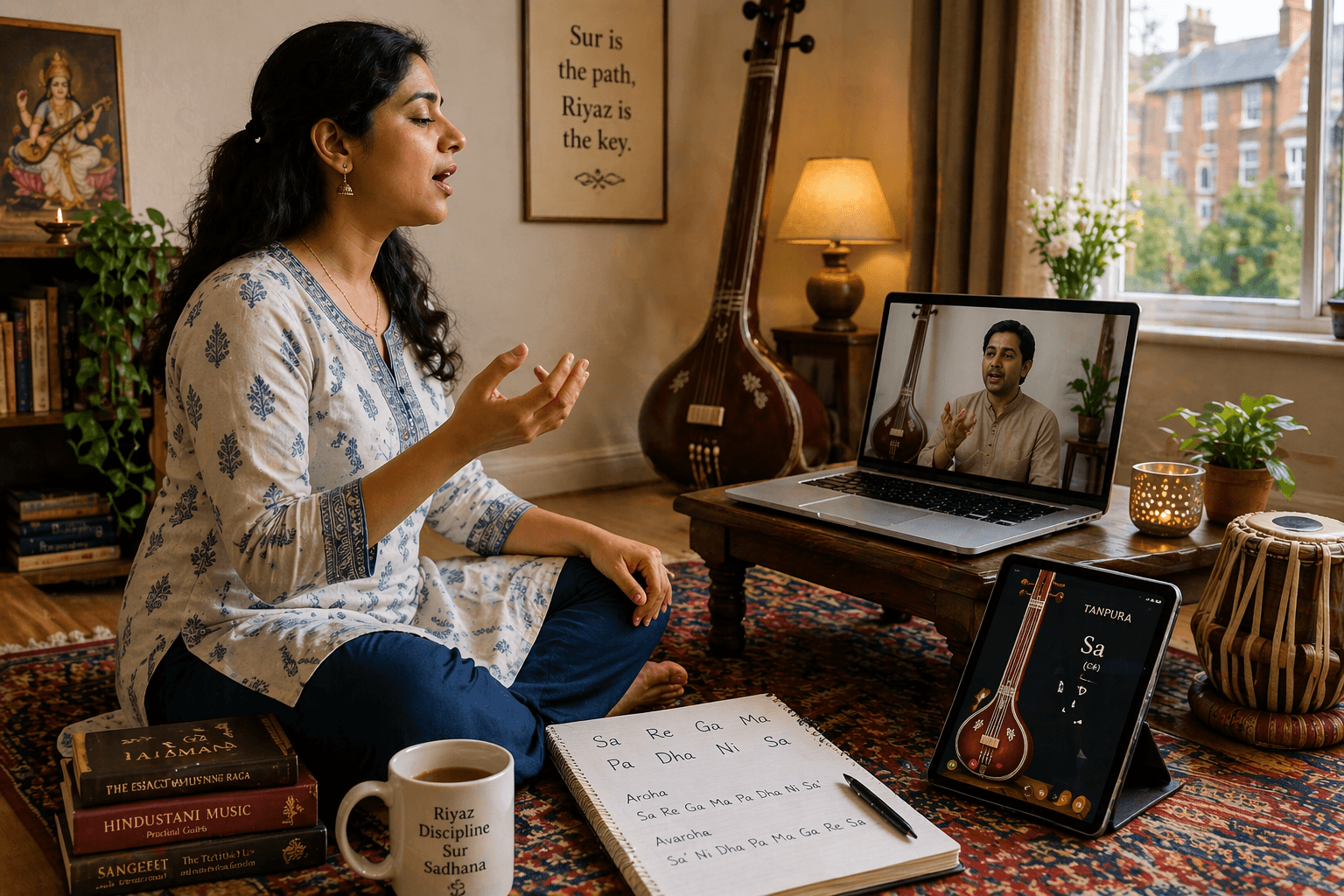
Hindustani classical vocal training is built on the guru-shishya parampara (teacher-student tradition) and emphasises aural learning, oral transmission, and systematic exploration of raga frameworks.
For adult beginners, the first six months typically involve:
Establishing the Sruti (Tonic Pitch)
Your teacher identifies the pitch range most natural and resonant for your voice, setting the tonic (Sa) at that pitch. This is one of the most immediately validating experiences for adult beginners: having a trained professional hear your voice, assess it, and set a pitch specifically for you.
Swara Practice with Tanpura
Daily practice of ascending and descending swara patterns against a tanpura drone. At first this feels simple. Within weeks, the subtleties begin revealing themselves: the exact quality of each note, the smoothness of transitions, the ornamental possibilities. The ear develops rapidly.
First Raga Exploration
Most adult beginners are introduced to Raag Yaman within the first few months. Yaman (using komal ma, the flattened fourth) has a serene, evening quality and is the most commonly taught introductory raga in Hindustani music. The teacher introduces its characteristic ascending and descending patterns (aroha and avaroha), its signature phrases (mukhyas), and a simple composition (bandish) within it.
Alap (Free Melodic Exploration)
The alap is the slow, free-time melodic introduction of a raga. For adults, alap practice is often described as the most creatively satisfying aspect of Hindustani vocal training. It is genuinely improvisational within the raga's grammar, giving the singer creative agency from early in their training.
What Adult Learners Specifically Find Rewarding in Hindustani Training
From practitioner accounts and teaching experience:
The drone: The tanpura drone provides constant tonal reference that many adults find deeply calming and focusing. Practice with the drone has a meditative quality that appeals strongly to adults drawn to Indian classical music.
The raga framework: Adult learners often describe the raga system as intellectually satisfying in ways that Western pop repertoire isn't. Understanding the grammar of a raga (which notes to use, which to avoid, how to move between them) gives adult learners a conceptual framework for musical creativity that feels genuinely deep.
Cultural connection: For British-Indian adults whose parents or grandparents sang Indian classical music, learning Hindustani singing reconnects them to a tradition they grew up hearing but never formally studied.
No requirement to perform immediately: Hindustani classical training prioritises depth of exploration over quick performance repertoire. Many adult beginners prefer this orientation.
Western Vocal Training: What Adult Beginners Experience
The Core Pedagogy
Western vocal training encompasses a broad range of styles (classical/operatic, pop, musical theatre, jazz, R&B, contemporary commercial music) but shares a common technical foundation.
For adult beginners:
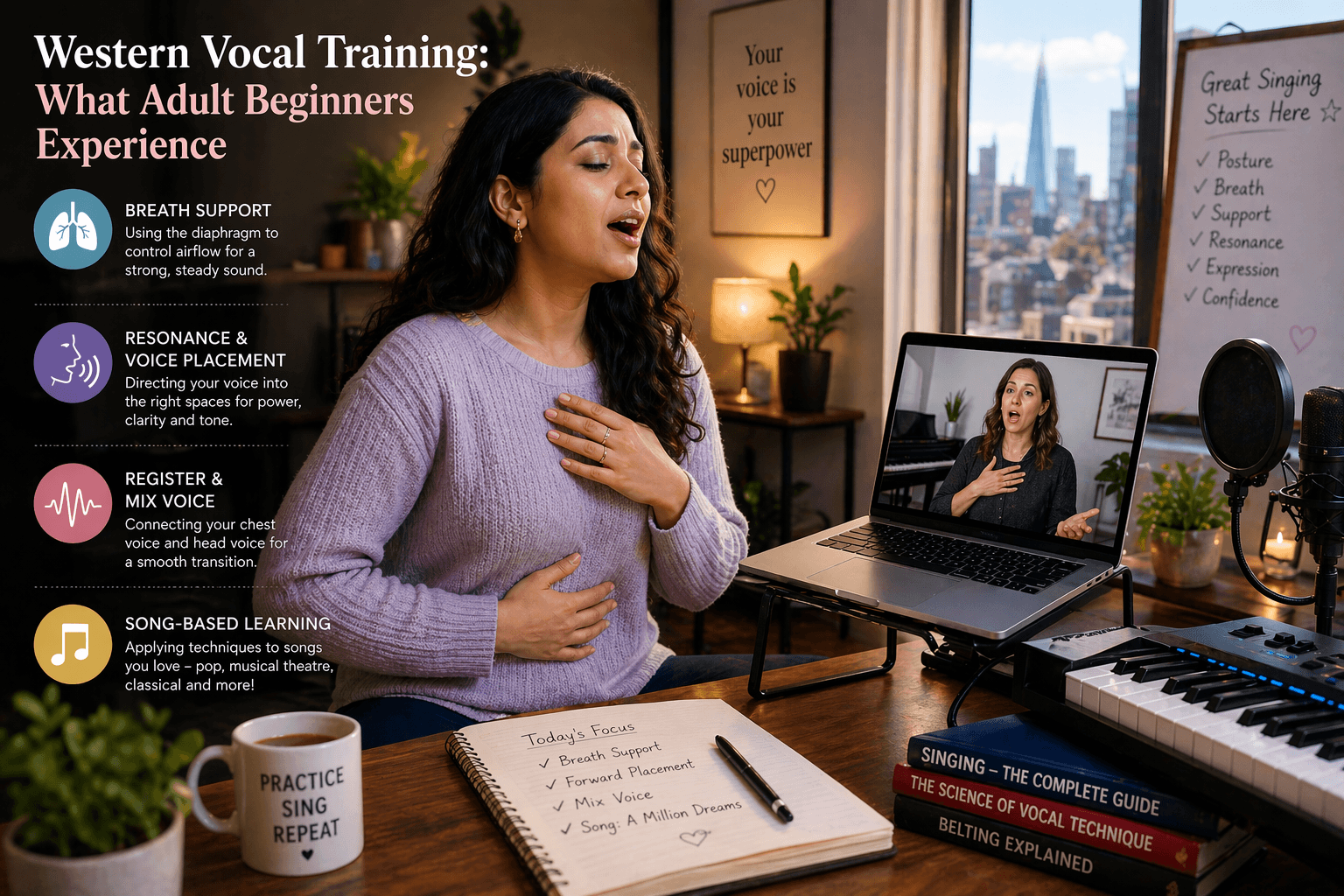
Breath Support and Diaphragmatic Control
The foundation of all Western singing is diaphragmatic breathing. The diaphragm (the dome-shaped muscle below the lungs) is the primary driver of breath in singing. Most adults breathe shallowly into the chest by default. Learning to breathe into the lower abdomen (diaphragmatic breathing) and control the expiration during singing is the first major technical milestone.
Resonance and Voice Placement
Western vocal training teaches singers to direct their voice into specific resonance spaces (chest, mask/face, head) to produce different tonal qualities. Finding "forward placement" (directing sound into the front of the face, creating a bright, projecting tone) is one of the most transformative technical breakthroughs for adult beginners.
Register Development and Mix Voice
Most adult voices have a noticeable "break" between their chest voice (lower register) and head voice (upper register). Western vocal training addresses this through specific exercises that strengthen both registers and gradually develop a smooth transition zone (mix voice) that connects them.
Repertoire-Based Learning
Western vocal training typically uses specific songs as the vehicle for technical learning. This repertoire-oriented approach appeals strongly to adults who want to sing specific music they know and love: pop songs, Bollywood numbers in a Western style, musical theatre numbers, or classical art songs.
What Adult Learners Specifically Find Rewarding in Western Training
Immediate repertoire: Adults can work on songs they genuinely love from early in their training. The emotional connection to familiar repertoire sustains motivation.
Social applicability: Western vocal skills apply immediately to karaoke nights, family gatherings, community events, and social singing contexts.
Technical explicitness: Western vocal pedagogy is often described as technically explicit in ways that appeal to analytically-minded adults. Concepts like breath support mechanics, resonance placement, and register breaks are explained with physiological clarity.
Side-by-Side Comparison for British-Indian Adult Beginners
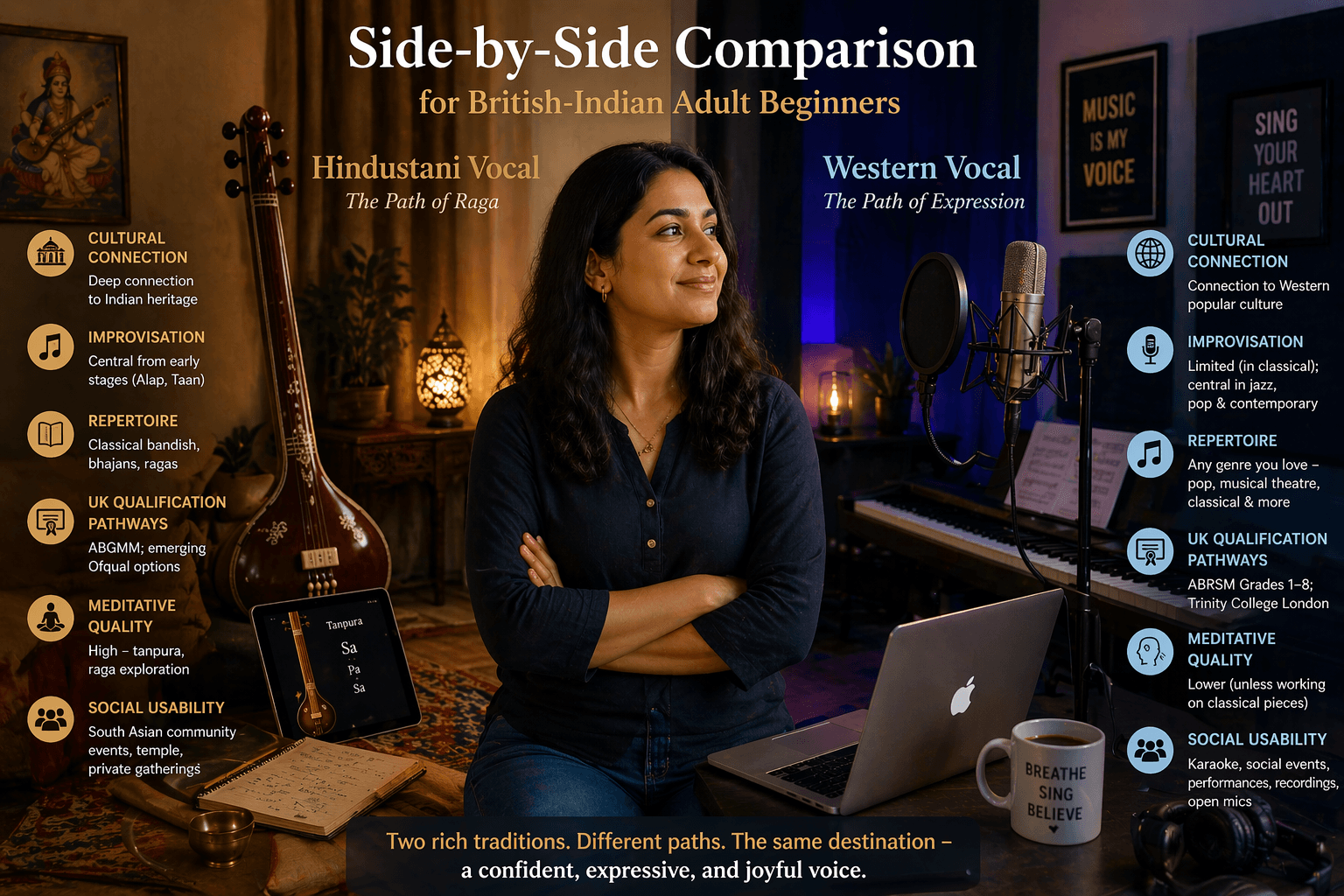
Practical Comparison Table
Dimension Hindustani Vocal Western Vocal Cultural connection Deep connection to Indian heritage Connection to Western popular culture Learning approach Aural/oral, teacher-centred Mix of aural and notated Improvisation Central from early stages Limited (in classical); central in jazz Immediate repertoire Classical compositions (bhajans quickly) Any genre you choose UK qualification pathways ABGMM; emerging Ofqual options ABRSM Grades 1-8; Trinity Meditative quality High (tanpura, raga exploration) Lower (unless classical meditation pieces) Social usability South Asian community events, temple Karaoke, social events, performance
The Dual-Path Option
Many British-Indian adults choose to study both traditions, either simultaneously with two teachers or sequentially. This is increasingly common and genuinely rewarding. Hindustani training develops pitch sensitivity and ornamental technique that makes Western singing more expressive. Western breath technique and resonance development strengthens Hindustani vocal stamina.
If you're drawn to both, discuss this explicitly with prospective teachers. A qualified teacher in either tradition will have an opinion on how to manage both without compromising either.
How to Get Started with Singing Lessons Online in the UK

Step 1 - Identify Your Primary Goal
Be honest with yourself. Is your primary goal:
- Singing bhajans more beautifully for your family and temple community?
- Developing classical Hindustani musicianship with raga knowledge?
- Being able to sing confidently at karaoke or social events?
- Developing versatile vocal skills across multiple styles?
Each of these points to a different starting tradition, or combination of traditions.
Step 2 - Find a Qualified Teacher
For Hindustani training, look for teachers with formal classical training background and experience teaching adults. Our Hindustani vocal classes at Art Gharana are taught by certified instructors experienced with adult British-Indian learners.
For Western training, look for teachers with ABRSM or Trinity qualifications, experience across your preferred genre, and explicit adult teaching experience.
Step 3 - Create a Sustainable Practice Routine
Adult beginners who practise 20 minutes daily consistently outperform those who practise for an hour twice a week. Daily contact with the voice, even brief, builds the muscle memory and ear training that transforms beginners into singers.
Conclusion
Both Hindustani and Western vocal training offer adult beginners in the UK a rich, rewarding, achievable path to singing with confidence and expression. The choice is not between good and better. It's between different and both valid.
Three things to take away. First, adult beginners can and do develop excellent vocal technique. The myth that it's too late is simply false. Second, choose based on what music genuinely moves you, not on what seems more impressive or culturally appropriate. Third, consistency matters more than duration. Twenty minutes daily beats two hours weekly.
Book your free trial vocal lesson at Art Gharana today and discover what your voice can do.
Frequently Asked Questions
1. Can adults who have never had singing lessons learn to sing properly?
Yes. Adults who have never had formal training regularly develop strong vocal technique, expanded range, and confident expressive singing with consistent lessons and practice. Many adults who believed they "couldn't sing" discover genuine capability with qualified guidance.
2. How long does it take an adult beginner to sing confidently?
Most adult beginners can sing simple songs with real confidence and control within 6-12 months of regular weekly lessons and consistent home practice.
3. Is online vocal training as effective as in-person for adults?
For most vocal goals, yes. Live 1:1 online lessons allow the teacher to hear the student clearly, provide real-time corrections, and guide breath and resonance techniques as effectively as in-person instruction.
4. Can I learn Hindustani singing without knowing any Indian classical music theory?
Yes. Qualified Hindustani teachers begin with complete beginners and introduce theoretical concepts progressively. Prior theoretical knowledge is helpful but never required.
5. What equipment do I need for online vocal lessons in the UK?
A device with a reliable microphone (laptop or tablet is usually sufficient), a quiet room, stable internet, and a tanpura app for Hindustani lessons. For Western vocal training, a free piano app is useful for pitch reference.