ChatGPT
 Google AI
 Grok
Grok Claude
TL;DR: For Indian-Canadians seeking to learn Hindustani classical vocals, the choice between online and in-person instruction is one of the most practically important decisions in the learning journey. Canada's vast geography, variable climate, and concentrated South Asian population in specific cities make this decision uniquely nuanced. This comprehensive guide examines both formats honestly, covering the practical, pedagogical, and cultural dimensions of each, with specific attention to the Canadian context, and helps you decide which approach or which combination is right for your learning goals.
The Hindustani Vocal Tradition: What You Are Learning
Understanding the Art Form Before Choosing the Format
Before comparing online versus in-person instruction, understanding what Hindustani classical vocal music actually involves is essential. The format decision cannot be made well without knowing what the learning process requires.
The Oral Transmission Tradition
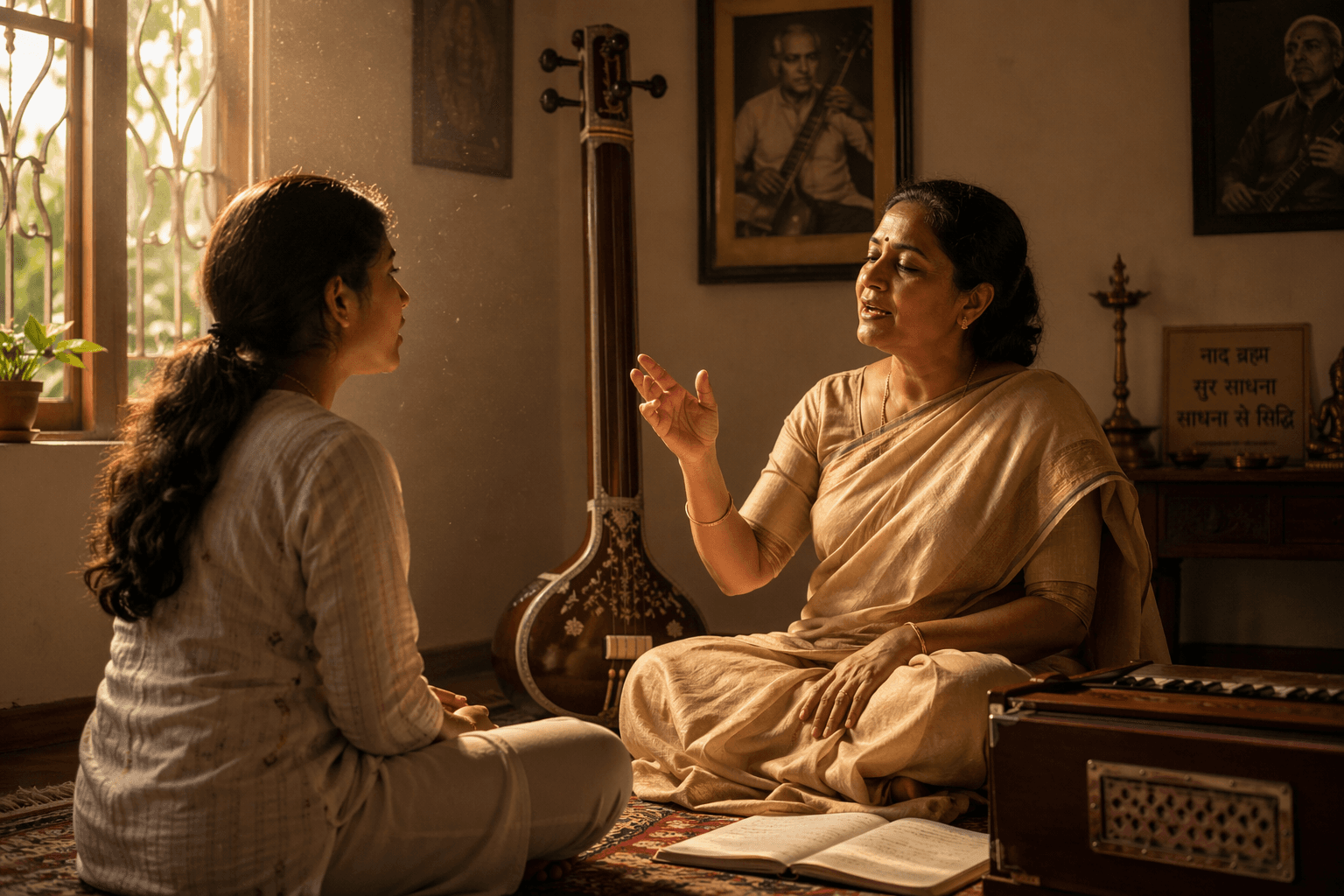
Hindustani classical music is a guru-mukhi vidya — knowledge that comes from the mouth of the teacher. For thousands of years, this tradition has been transmitted through direct oral instruction, with students sitting with their guru, listening, imitating, being corrected, and internalising the tradition through embodied, relational learning.
This oral transmission tradition is not merely cultural preference. It reflects a genuine pedagogical reality: the nuances of Hindustani vocal technique — the precise gamaka (ornamentation) inflections, the quality of taan (rapid note sequences), the emotional depth of a specific bandish, the characteristic approach to a raga's development — are extraordinarily difficult to transmit through text, notation, or pre-recorded audio alone. The living presence of a skilled teacher who can hear your voice and respond to it in real time is the most efficient vehicle for this transmission.
The Riyaaz Relationship
A key aspect of Hindustani vocal learning that most beginners underestimate is the importance of the teacher-student riyaaz (practice) relationship. In the traditional model, a student practises regularly and brings their practice to the teacher for correction and refinement. The teacher doesn't just teach new material — they monitor, refine, and shape the student's daily practice through ongoing feedback.
This monitoring relationship works effectively in both online and in-person formats, provided the teacher is committed to it. What it cannot work without is the live, real-time presence of the teacher, whether that presence is physical or virtual.
The Case for Online Hindustani Vocal Classes in Canada

Geography Is the Most Compelling Argument
Canada is the second-largest country in the world by land area. Even within individual provinces, cities are separated by distances that make regular travel to a specific music teacher impractical. The Indian-Canadian population is concentrated primarily in the Greater Toronto Area, Metro Vancouver, Calgary, Edmonton, Ottawa, and Montreal. Outside these centres, finding a qualified Hindustani vocal teacher within reasonable travelling distance is often impossible.
For Indian-Canadian families in cities like Saskatoon, Winnipeg, Halifax, or smaller communities, online instruction is not a second-best option — it is the only option for accessing qualified Hindustani vocal instruction.
Canadian Climate Is a Real Practical Factor
Canada's winters make regular weekly travel genuinely difficult for several months of the year. Heavy snowfall, road closures, extremely cold temperatures, and the unpredictability of winter driving conditions all create friction around regular weekly travel commitments. Online lessons continue regardless of weather. This consistency is not trivial: music learning depends on consistency above almost all other factors, and any format that improves consistency improves outcomes.
Scheduling Flexibility for Busy Canadian Families
Indian-Canadian families in Canada's major cities typically have demanding schedules: both parents working full-time professional jobs, children involved in multiple after-school activities, and time zones that sometimes make international family coordination complex.
Online lessons can be scheduled for early morning, lunch hour, or evening with no travel time. This flexibility significantly reduces the scheduling friction that causes many adult learners to eventually drop their music lessons.
The Research on Online Music Learning Effectiveness
A 2020 study examining online music lessons during the pandemic transition found that most students maintained similar progress rates online as they had achieved in-person, provided the teacher adapted their instruction appropriately for the online format. The key variables were teacher engagement quality, student home setup, and internet reliability — not the format itself.
The Financial Case for Online Lessons
In-person Hindustani vocal lessons in Canada's major cities from qualified teachers typically cost CAD $70-$150 per hour. When you add travel costs and time, the effective cost of in-person lessons is significantly higher. Online lessons eliminate travel costs entirely and, in many cases, are priced slightly lower because teachers can serve a larger geographic market.
The Case for In-Person Hindustani Vocal Classes in Canada

Physical Presence Enables Specific Types of Correction
For certain aspects of Hindustani vocal technique, physical presence provides advantages that online cannot fully replicate:
Resonance and Placement Guidance
A teacher who can physically indicate where resonance should be felt (by touching their own face, chest, or forehead while the student simultaneously pats their own body) provides proprioceptive guidance that purely verbal and visual instruction cannot fully replace.
Accompanying on Harmonium or Tanpura
A teacher playing harmonium or tanpura live in the room creates a sonic environment with a richness, immediacy, and shared physical presence that even high-quality audio through a video call cannot fully replicate. The experience of singing within a live harmonium drone versus singing with a digital tanpura app is genuinely different, particularly for beginners developing pitch sensitivity.
The Emotional Dimension of Physical Presence
The guru-shishya relationship in Hindustani music has traditionally involved a profound emotional and spiritual dimension that extends beyond the technical transmission of skills. Some aspects of this relationship — the non-verbal communication, the physical gestures of approval or guidance, the shared experience of performing together in a room — are diminished in a video call context.
When In-Person Instruction Is Preferable
In-person instruction is preferable when:
The student lives within reasonable distance of a genuinely qualified Hindustani vocal teacher and the travel time is manageable.
The student is at an advanced level where specific subtle corrections to resonance, ornamentation quality, or improvisational development would benefit from physical presence.
The student has specific auditory processing differences that make video call audio quality a meaningful limitation.
The student finds the emotional and relational dimension of in-person learning significantly more motivating.
The Hybrid Approach: Combining Both Formats
How Many Advanced Canadian Students Use Both
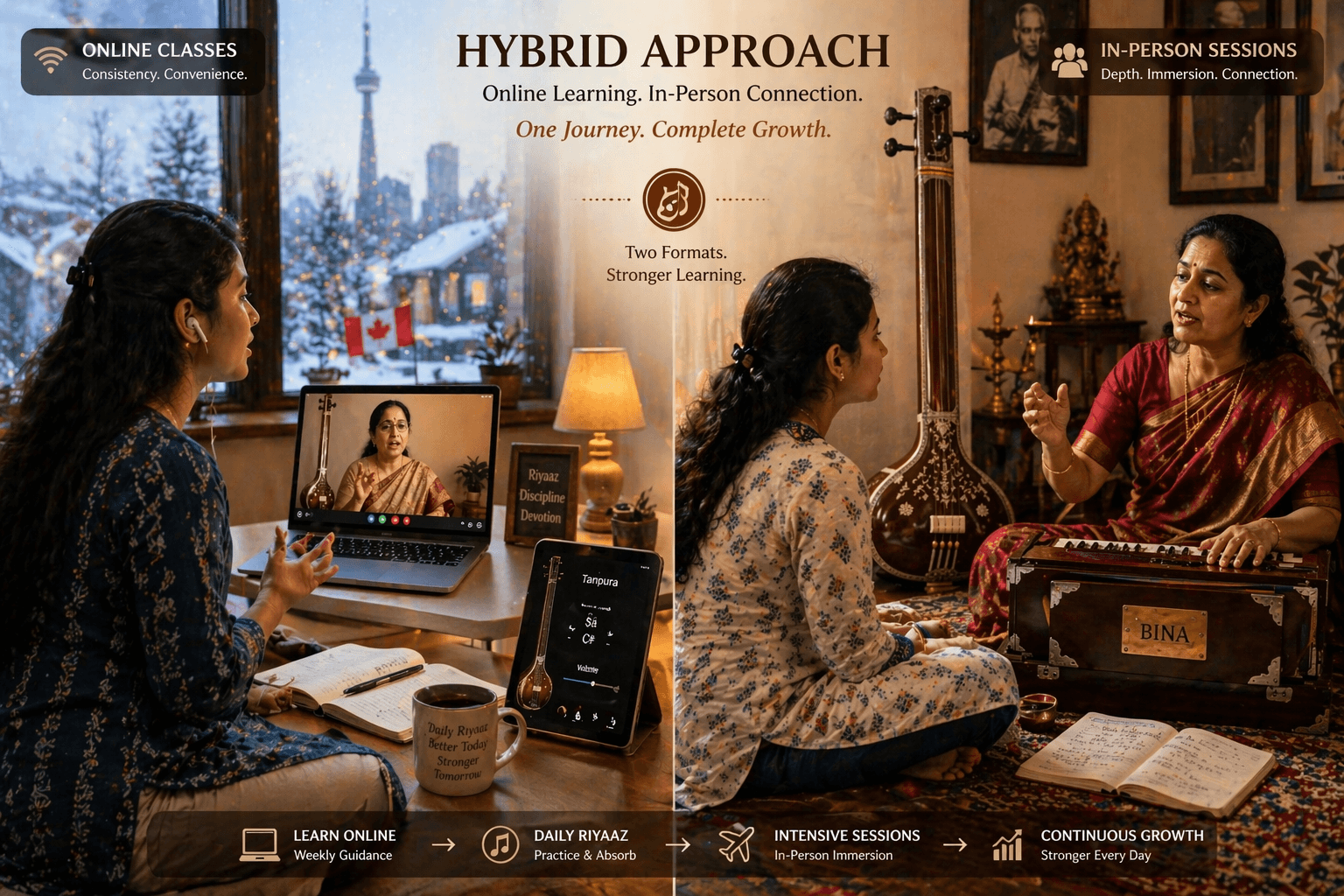
An increasingly common approach among serious Indian-Canadian Hindustani vocal students is a hybrid model:
Regular weekly instruction online with a qualified teacher accessible remotely — the primary learning relationship.
Periodic intensive in-person sessions when visiting India, attending Canadian South Asian music festivals, or when the primary online teacher visits Canada for workshops or masterclasses.
This hybrid approach captures the practical advantages of online learning (consistency, accessibility, flexibility) while preserving the occasional richness of in-person transmission at key developmental moments.
Visiting India for Intensive Training
Many Indian-Canadian students plan annual or biannual visits to India specifically to spend one to four weeks with their online teacher in person, attending intensive daily lessons in a traditional setting. This compressed in-person period accelerates development significantly and deepens the guru-shishya relationship in ways that online classes alone cannot fully achieve.
Setting Up for Effective Online Hindustani Vocal Classes in Canada
Technical Requirements
Microphone Quality
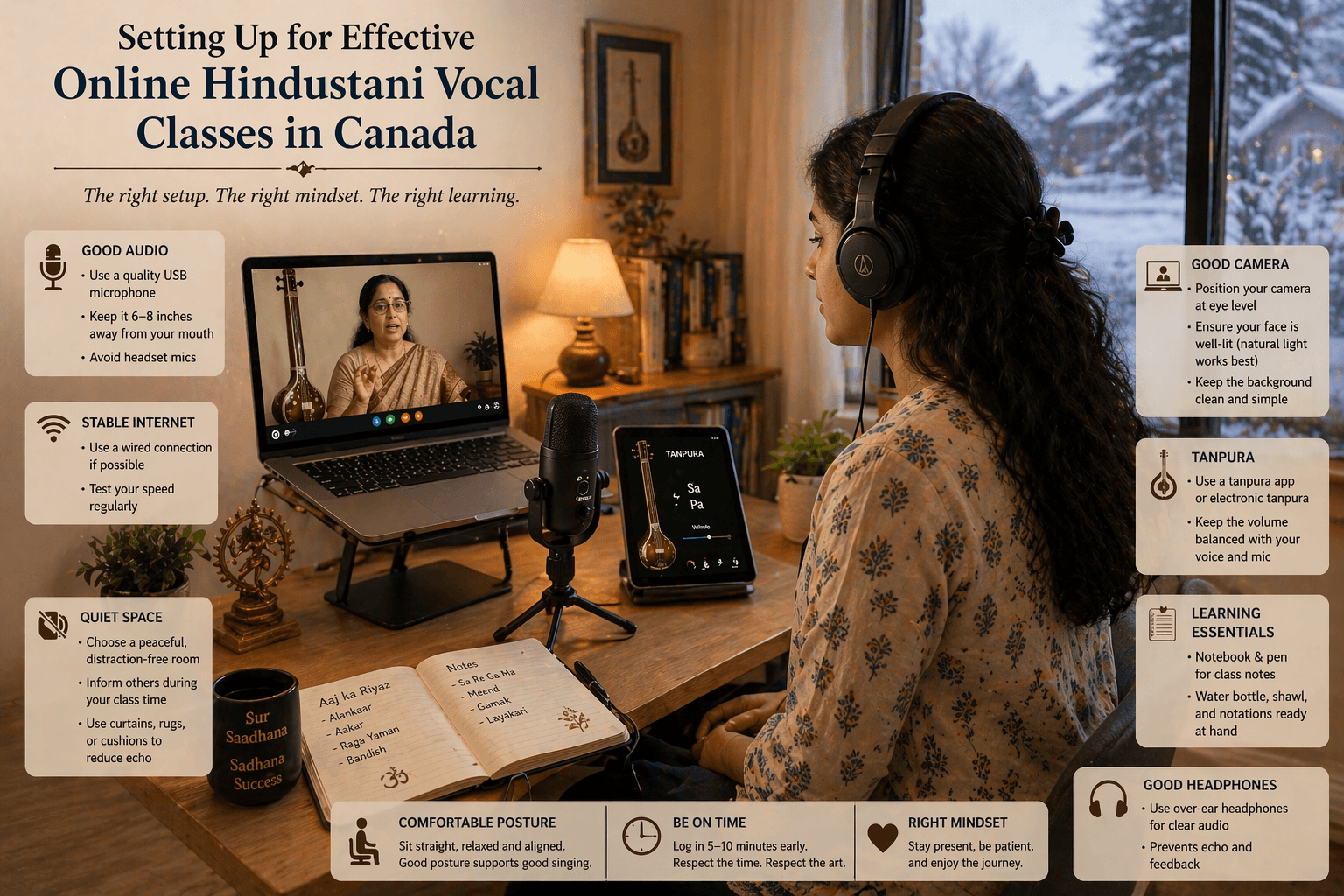
The most important technical investment for online Hindustani vocal classes. Your teacher needs to hear the precise quality of your voice — pitch accuracy, tone quality, ornamental inflections — to guide you effectively. A basic external USB condenser microphone (CAD $50-$100) dramatically improves audio quality compared to a laptop's built-in microphone.
Recommended: Blue Snowball iCE or Audio-Technica AT2020USB+ for home studio quality at reasonable cost.
Tanpura Application
Install a reliable tanpura app before your first lesson. iTablaPro is the most widely used among Indian classical music students. Your teacher will advise on the correct sruti (tonic pitch) setting for your voice.
Quiet Practice Space
Hindustani vocal practice requires a quiet space where the teacher can hear your voice without competing background sounds. Even in family homes with young children, establishing a dedicated 30-minute quiet practice window is manageable and worth the effort.
Internet Stability
A stable broadband connection (20 Mbps and above) is adequate for video call quality. If your home WiFi has dead spots, consider a powerline adapter to bring ethernet connectivity to your practice space.
What to Look for in a Hindustani Vocal Teacher in Canada
The Essential Qualifications
Training in a Recognised Gharana
A qualified Hindustani vocal teacher should be able to state their gharana affiliation and their guru lineage. The major gharanas (Kirana, Gwalior, Agra, Jaipur-Atrauli, Patiala) each have distinctive stylistic characteristics. A teacher with a clear gharana lineage has received structured transmission within a coherent musical tradition.
Formal Examination Credentials
Look for teachers who have completed Visharad or equivalent qualifications. This indicates structured, examined training rather than purely informal learning.
Experience Teaching Online
Ask specifically about online teaching experience and what technical setup recommendations they make for Canadian students.
At Art Gharana, our Hindustani vocal teachers offer live 1:1 online classes for students across Canada. Explore our online Hindustani vocal classes and our beginner's guide to Indian classical music.
Conclusion
For most Indian-Canadian students pursuing Hindustani classical vocal education, online instruction is not merely adequate — it is genuinely excellent and, in many respects, better suited to Canadian life than the traditional in-person model. Geography, climate, schedule, and cost considerations all favour online learning in the Canadian context.
Three things to take away. First, invest in microphone quality. It is the single most impactful technical improvement you can make for online vocal instruction. Second, establish a consistent daily riyaaz practice with tanpura from the beginning. Third, consider the hybrid approach: regular online lessons with periodic intensive in-person sessions during India visits or Canadian workshops.
Book a free trial Hindustani vocal lesson at Art Gharana today and experience what structured, expert-led online instruction can achieve.
Frequently Asked Questions
1. Can you really learn Hindustani classical vocals effectively online?
Yes. Live 1:1 online lessons with a qualified teacher are effective for Hindustani vocal learning, including the development of gamaka technique, taan fluency, raga knowledge, and bandish learning. The key variables are microphone quality, internet stability, and the teacher's skill in adapting their instruction for the online format.
2. How many times per week should a beginner practise Hindustani singing?
Daily practice of 20-30 minutes is the ideal baseline for beginners. Specifically, daily riyaaz with tanpura drone, covering swara exercises and the compositions currently being learned, builds the pitch accuracy and muscle memory that formal instruction alone cannot develop.
3. How long does it take to reach an intermediate level in Hindustani classical vocals?
Most students with daily practice and weekly instruction reach a confident beginner level (able to present one or two compositions in simple ragas) within 12-18 months. Reaching intermediate level (a repertoire of multiple ragas, confident taan development, ability to improvise in alaap) typically takes three to five years of consistent, structured practice.
4. What equipment do I need to start Hindustani vocal classes online in Canada?
A stable internet connection, a USB condenser microphone (CAD $50-100), a quiet practice space, a tanpura app (iTablaPro), and a device capable of running Zoom or Google Meet. Total setup cost for most Canadian students is under $150.
5. Is there a difference between online Hindustani vocal teachers in India and teachers based in Canada?
Both can be excellent. Teachers based in India may have deeper connections to the living performance tradition and closer access to lineage holders. Teachers based in Canada may have greater cultural empathy with the diaspora experience and more flexibility around Canadian time zones. The most important factor is the teacher's qualifications, experience, and commitment to your learning — not their geographic location.