ChatGPT
 Google AI
 Grok
 Claude
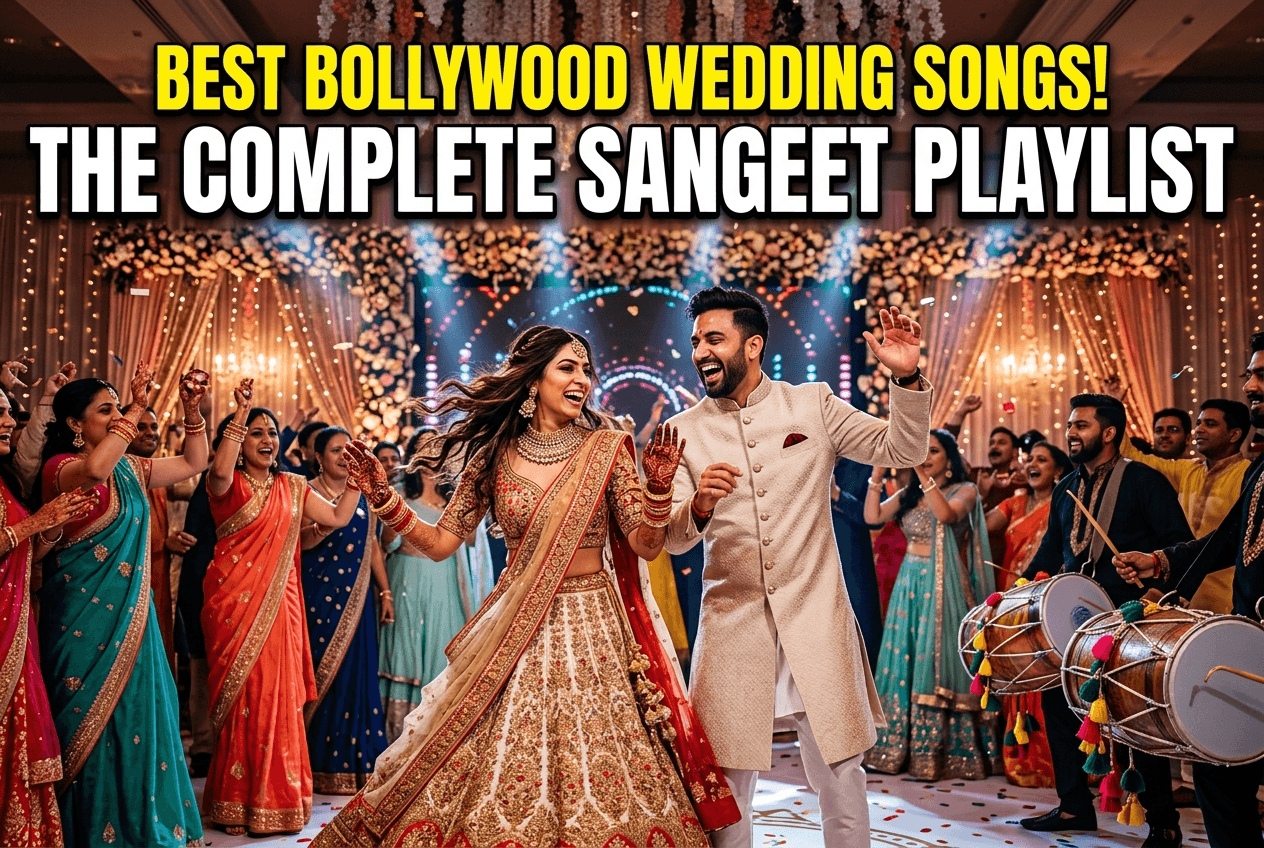
Every list of bollywood wedding songs makes the same mistake, which is to hand you eighty songs in one undifferentiated pile. That is close to useless when you are actually planning, because the song that works for a bridal entry is precisely the wrong song for a baraat, and the mehndi playlist has almost nothing in common with the vidaai. An Indian wedding is not one event. It is six or seven distinct functions with different moods, different guests and different energy levels, and the music has to follow that. If you are planning a choreographed performance alongside the playlist, the introduction to Bollywood dance covers the movement side.
This guide is organised by function, so you can find what you need without scrolling through material for an event you are not planning. It also covers how to build a sangeet performance that works, how long each segment should run, the mistakes that show up at every wedding, and the practical logistics that ruin more evenings than bad song choices do. Families building mixed playlists across occasions may also find the Bollywood celebration song list useful for the non-wedding functions.
One thing worth establishing before the list. The dhol is doing more work than the melody at almost every point in an Indian wedding, and the songs that work best are the ones with a rhythm strong enough to carry people who are not dancing so much as moving. Anyone who has studied tabla or Indian percussion will hear immediately why certain tracks fill a floor and others empty it.
What Are the Best Bollywood Wedding Songs?
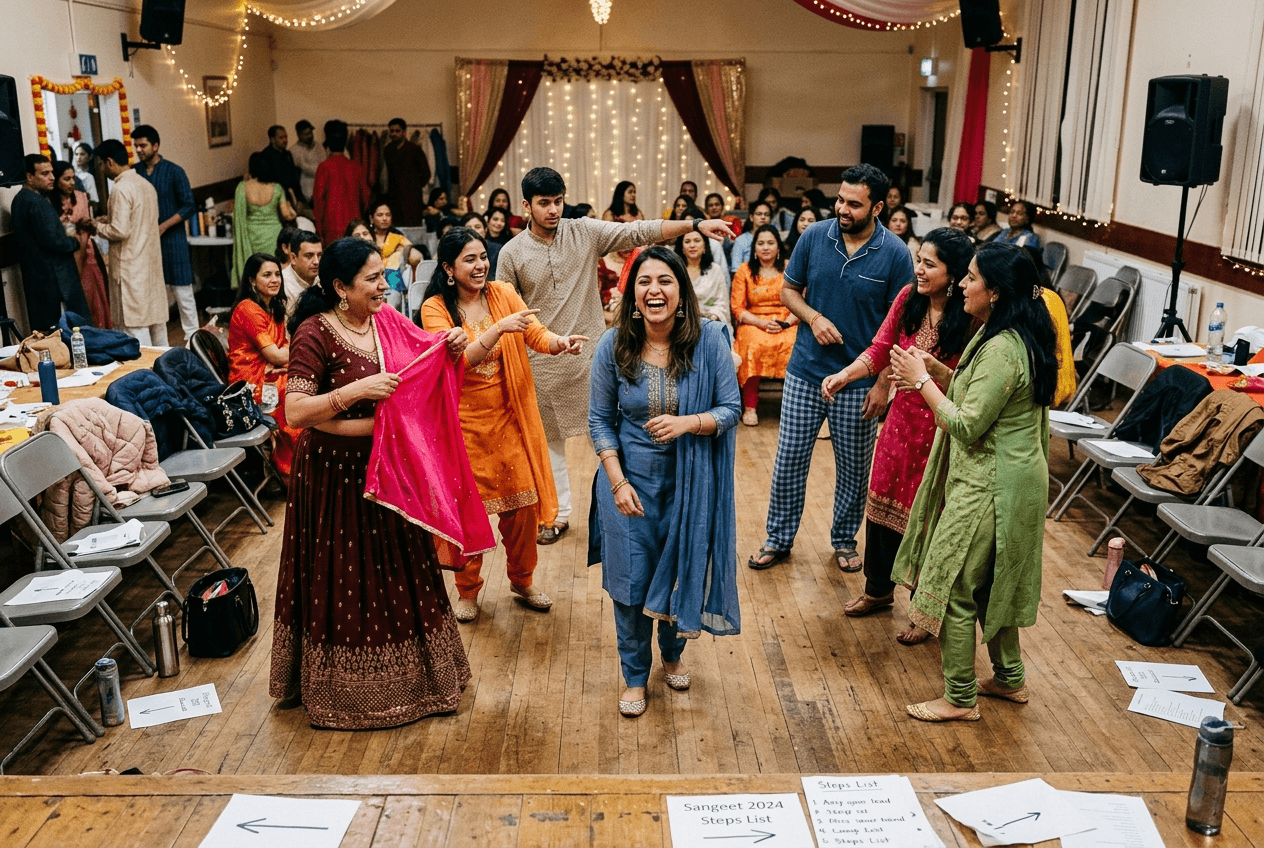 The essential bollywood wedding songs playlist is anchored by Mehndi Laga Ke Rakhna and Din Shagna Da for the ceremonial moments, Gallan Goodiyaan and London Thumakda for the sangeet, Kala Chashma and Morni Banke for the baraat, and Babul for the vidaai. Across functions, the songs that appear at the greatest number of Indian weddings are Mehndi Laga Ke Rakhna, Nagada Sang Dhol, Kajra Re, Gallan Goodiyaan, Kala Chashma, Din Shagna Da and Ainvayi Ainvayi.
Mehndi and Haldi
These are daytime functions and they are the ones people most often get wrong by treating them like a party. At a mehndi, half the guests have wet henna on their hands and physically cannot dance, and the bride certainly cannot. The music has to work for a room that is largely seated, talking, eating and waiting.
Mehndi Laga Ke Rakhna from Dilwale Dulhania Le Jayenge is the anchor and has been for three decades. Mehndi Hai Rachne Wali from Zubeidaa is the more musically interesting choice and works beautifully in a smaller gathering. Navrai Majhi from English Vinglish brings a Marathi wedding flavour that lands well with mixed families, and Banno from Tanu Weds Manu Returns has the folk energy that gets the few people who can dance onto their feet. Haldi is different in character, being short, messy and physically active, with people applying turmeric to the couple and each other. Energy comes in bursts rather than sustained, so plan for peaks. Rangilo Maro Dholna and Banno Tera Swagger both work, and Holi songs transfer surprisingly well here because the physical activity is similar, which is why Balam Pichkari turns up at haldi functions constantly.
The Sangeet
The centrepiece, and the function that generates most of the searches that bring people to lists of bollywood wedding songs. It is a performance evening, which means the playlist has two jobs: backing the choreographed items, and filling the floor between them.
Songs for choreographed performances
Choose for the hook step, not for the melody. Gallan Goodiyaan is the single most reliable sangeet performance song because the choreography is loose, the energy is high and every age group knows it. London Thumakda works for the same reason. Kajra Re is the classic and rewards a group that can actually dance, since the original choreography is demanding. Nagada Sang Dhol suits a larger formation and a bride who wants a showpiece. Badri Ki Dulhania and The Punjaabban Song are the contemporary equivalents.
For a family group with mixed ability, a medley beats a single song, since it lets you give the confident dancers a harder section and the aunts and uncles a thirty-second segment they can manage. The most successful sangeet performances are usually the ones where somebody's grandmother appears for eight counts.
Songs to fill the floor between items
Different requirement entirely. These need no rehearsal and no knowledge, just a beat. Desi Girl, Ghagra, Saturday Saturday, Kar Gayi Chull and any current Punjabi track will do this work. The mistake is programming performance songs here, since a track everyone associates with a routine makes people watch rather than dance.
How long a sangeet should actually run
The dance segment should be forty-five minutes to an hour, not two hours. Individual performances should run one to three minutes each, and the couple's dance three to five. Beyond that, guests stop watching and start checking their phones, which is visible from the stage and demoralising for the people who rehearsed. Cut ruthlessly rather than including everyone who volunteered.
Baraat
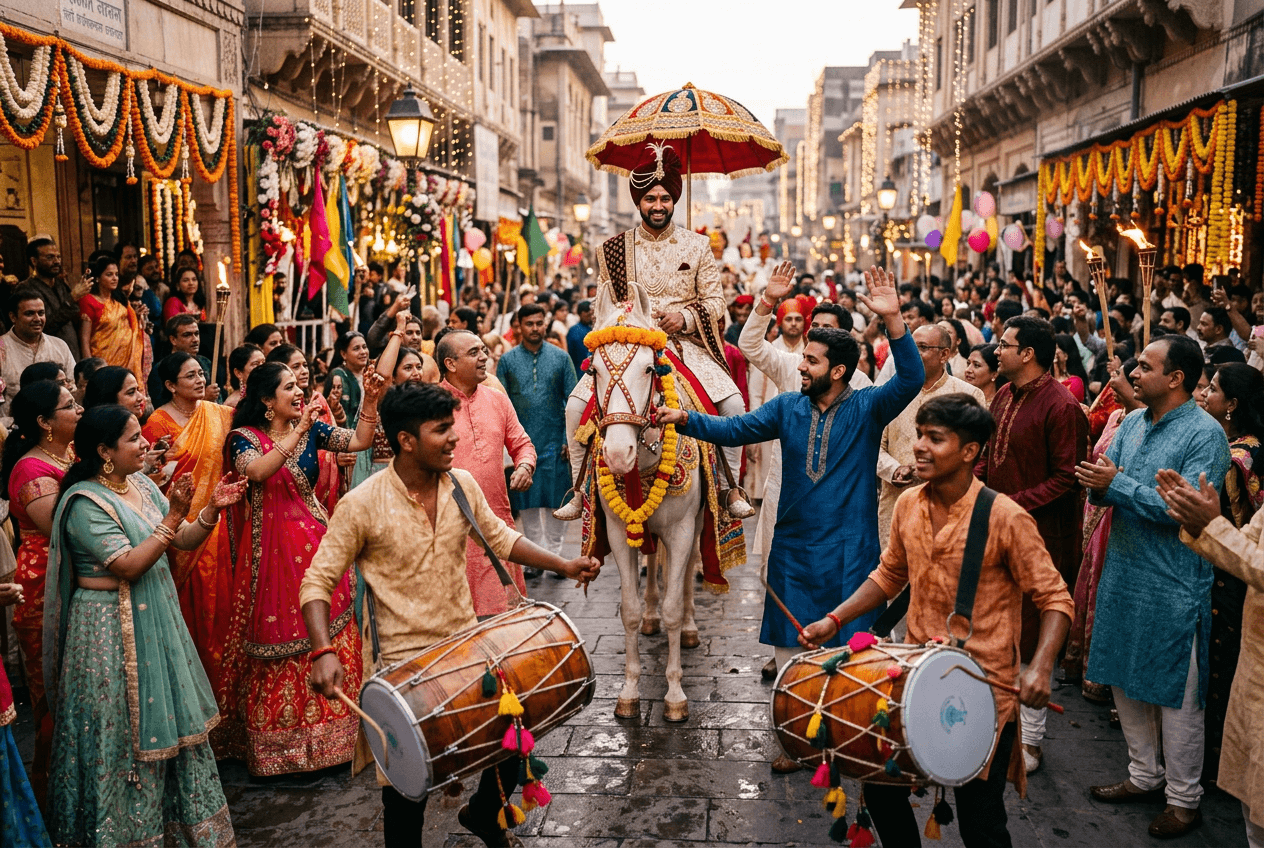 The baraat is where bollywood wedding songs earn their keep. An outdoor procession, on foot, in the street, with a dhol and often a brass band. Different acoustic problem from every other function, because you are competing with traffic, open air and a crowd, and nothing subtle survives.
Kala Chashma is the current default and works because the beat is relentless and the movement it invites is simple. Morni Banke, Gud Naal Ishq Mitha and Nach Punjaban all do the same job. The traditional entries, Aaj Mere Yaar Ki Shaadi Hai and Dulhe Ka Sehra, are worth keeping for the older guests and for the moment the groom is actually being received.
Practical note that matters more than song choice. Live dhol beats a recording at a baraat every time, and the reason is that a dholi watches the crowd and adjusts, which a playlist cannot. If the budget allows one live element across the whole wedding, this is where to spend it.
Bridal Entry, Varmala and Pheras
These are the moments where restraint matters most and where over-programming is most common.
The bridal entry
One song, chosen for the walk, not for the dance floor. Din Shagna Da is the most-used bridal entry song in Indian weddings for good reason: it is slow, emotionally direct and short enough to time to an actual entrance. Mere Yaaraa, Bolna, Tera Ban Jaunga and Ranjha all work similarly.
The technical point everyone misses is timing. A bridal entry takes ninety seconds to three minutes depending on the venue, and the song needs to reach its emotional peak as the bride reaches the mandap or stage, not thirty seconds before. Time the walk at the venue during rehearsal and cue the track accordingly.
Varmala
Shorter than people plan for, frequently under two minutes, and often comic because of the traditional lifting. Tum Se Hi, Raabta and Tera Hone Laga Hoon all suit it. Keep something upbeat cued in case the lifting turns into a contest, which it usually does.
Pheras
Recorded film music is the wrong choice here. Instrumental shehnai, light classical or soft devotional music sits underneath the ceremony without competing with the priest, which is what the moment needs. This is also the one point in the wedding where live musicians make the most difference, and the instruments of Indian classical music guide covers the ensemble usually engaged for it.
Vidaai
The departure, and the most emotionally loaded moment of the wedding. It is also where playlists most often overreach.
Babul from Hum Aapke Hain Koun is the standard and is genuinely affecting. Yeh Galiyan Yeh Chaubara works similarly. Beyond that, the honest advice is to underplay it. A vidaai that is already emotional does not need music pushing it further, and families frequently report afterwards that the loud sad song made a hard moment harder rather than more meaningful. A gentle instrumental at low volume is usually the better choice.
Reception
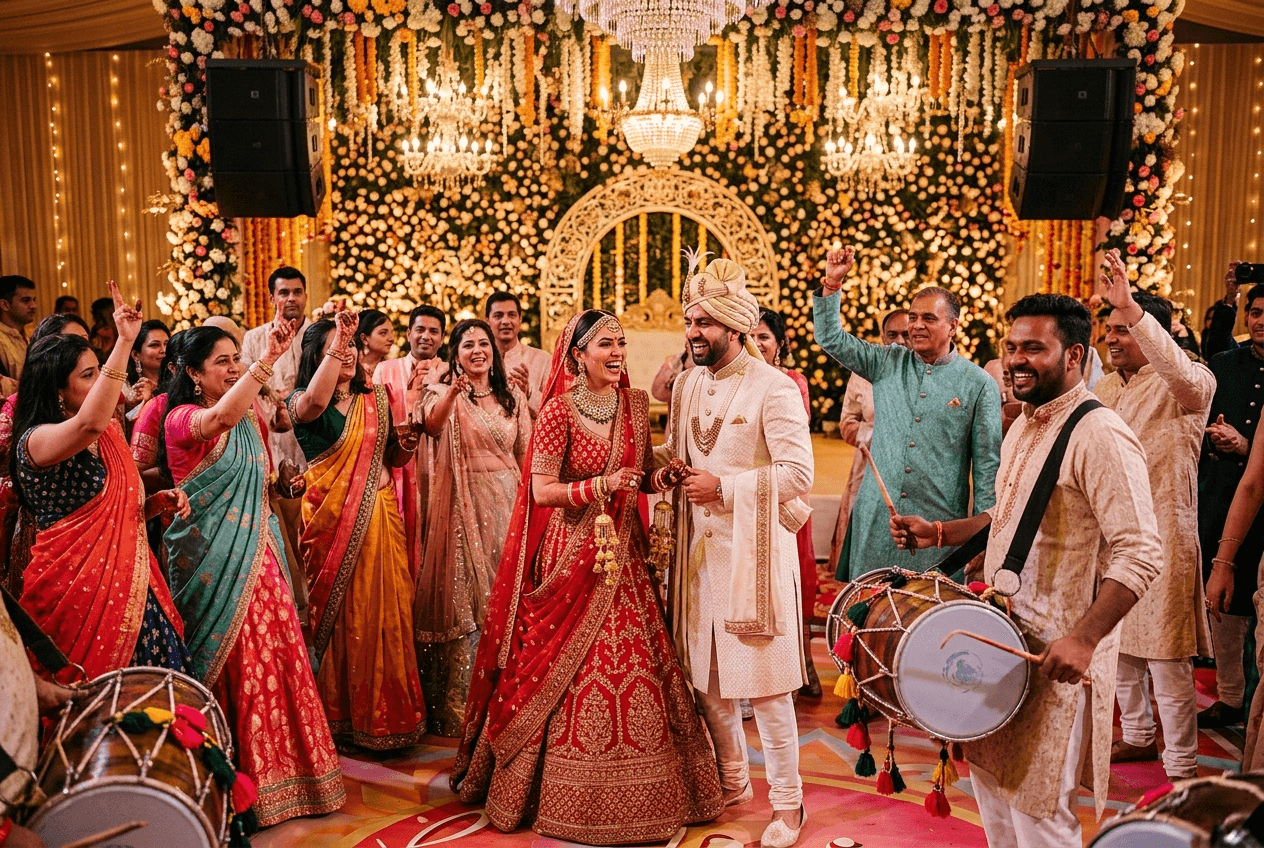 The reception asks more of a bollywood wedding songs playlist than any other function. It is a party with a wider age range than any nightclub, which is the whole design challenge. The music has to work for a twenty-two year old cousin and a seventy year old uncle within the same hour.
Ainvayi Ainvayi, Dilliwaali Girlfriend, Kar Gayi Chull, Abhi Toh Party Shuru Hui Hai and Saturday Saturday are the reliable modern entries. The technique that actually works is alternating eras rather than segregating them, so a current track, then a nineties one, then a current one again. Playing all the old songs early and all the new songs late empties the floor twice.
Building the Playlist Properly
Think in arcs, not lists
Each function has a shape. Open below the energy you want, build gradually, peak once, and come down. The universal error is front-loading the biggest songs, which produces a spectacular twenty minutes and a long flat evening. Hold your strongest track until the largest number of people are present.
Test the transitions
Two great songs back to back in incompatible tempos will clear a floor as effectively as a bad song. Listen to your running order in sequence at least once before the event rather than assuming a good list makes a good evening.
Have a shortlist for the moments that run long
Something always overruns. The baraat takes twenty minutes longer than planned, the varmala turns into a wrestling match, the bride's entry is delayed. Keep three extra tracks cued for each ceremonial moment so nobody is standing in silence.
Assign one person and only one person
The most common technical failure at Indian weddings is not equipment, it is four family members with access to the playlist making simultaneous changes. One person controls the music, that person is not performing, and everyone else routes requests through them.
Download everything
Venue wifi fails, mobile data fails in crowded halls and outdoor venues, and streaming a wedding playlist is a genuine risk rather than a theoretical one. Download the entire playlist and have it on two devices.
Preparing a Sangeet Performance
Most people reading about bollywood wedding songs are also, somewhere in the back of their mind, worrying about a performance they have agreed to. Here is a realistic timeline.
Eight weeks out, confirm who is genuinely available rather than who says yes, and choose the song. Seven weeks out, get the choreography built around the weakest dancer rather than the strongest, because a routine pitched at the most confident person leaves half the group visibly lost. Six weeks out, hold the first rehearsal and teach the hook step first, so everybody leaves able to do something.
Four to five weeks out, learn the verses and fix formations permanently. Three weeks out, run the whole thing and record it, then fix timing rather than adding material. Two weeks out, rehearse in the actual outfits, or at minimum the actual shoes. One week out, two full run-throughs at performance energy and no further changes. On the day, mark through gently and warm up properly, but do not rehearse at full energy.
What actually goes wrong
Choreography pitched too high. Rehearsals scheduled but not attended. Formation changes added late, which is the single most common cause of collisions on stage. Outfits never tested, so a dupatta catches on a raised arm nobody anticipated. Slippery venue floors, which is why shoes need testing on the actual surface. And relying on somebody to press play at the right moment when that somebody is also in the routine.
Live Music or DJ?
Both, if the budget allows, and in a specific division. Live dhol for the baraat, live shehnai or classical ensemble for the pheras, and a DJ for the sangeet and reception. That split puts the live musicians where they add something a recording cannot, which is responsiveness to a crowd and a ceremony, and puts recorded music where variety and volume matter more than presence.
If the budget only allows one, choose live for the baraat. A dholi transforms a procession in a way no sound system does, and the baraat is the function where guests are most physically involved.
Beyond Bollywood: Regional Wedding Music
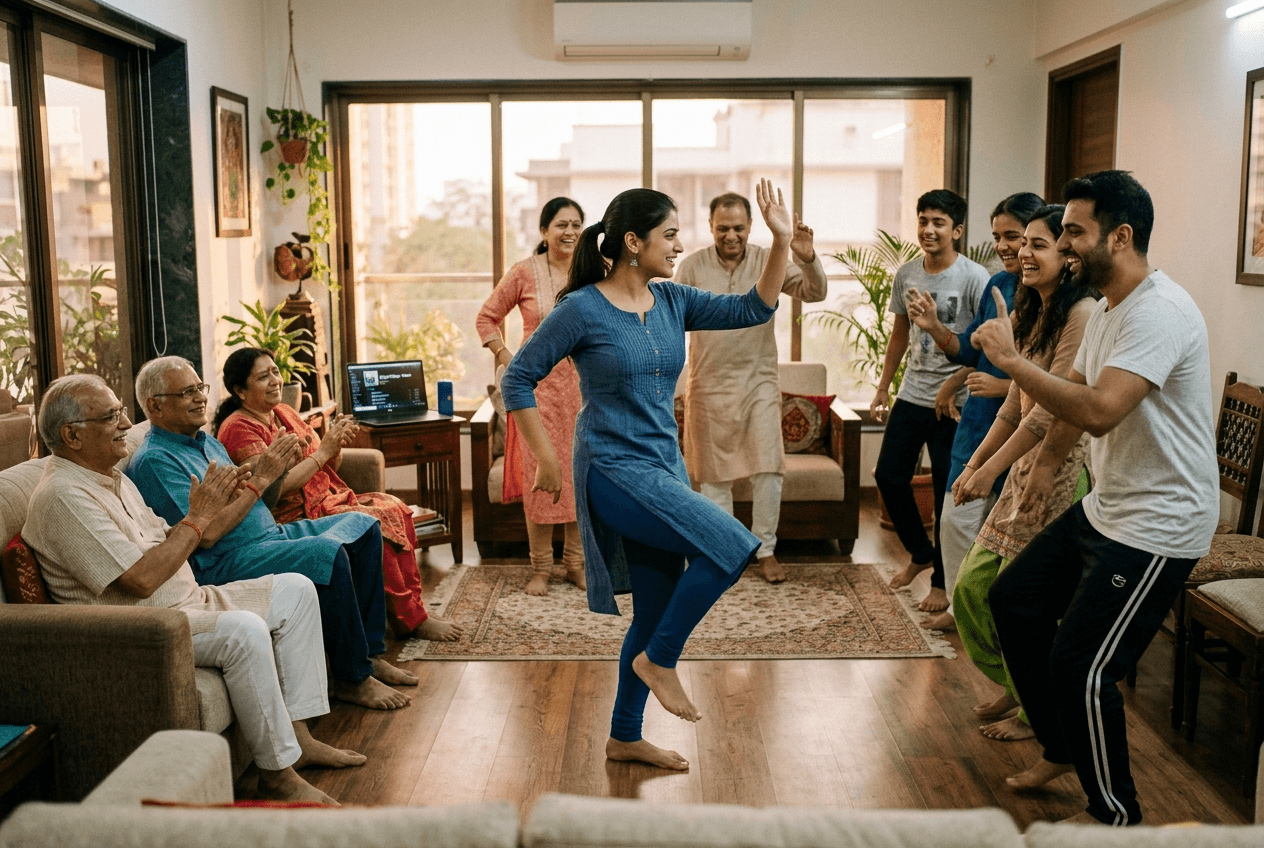 Hindi film music dominates these lists and it is not what most Indian weddings actually sound like. Almost every wedding blends filmi material with the community's own repertoire, and a playlist that ignores that side reads as generic to the families who matter most.
Punjabi
The most widely borrowed regional tradition, to the point that Punjabi tracks turn up at weddings with no Punjabi connection at all. Boliyan, the call-and-response verses sung by women, and giddha remain central at Punjabi functions, and live dhol is close to mandatory. If your gathering is Punjabi, the filmi Punjabi tracks are the floor rather than the ceiling.
Marathi and Gujarati
Marathi weddings carry their own repertoire of mangalashtak and lavani-influenced celebration music, and Gujarati functions frequently build an entire evening around garba and dandiya, which changes the format completely since the guests are participants rather than an audience. A Gujarati sangeet with a garba segment needs floor space planned for it.
Tamil, Telugu, Kannada and Malayalam
South Indian weddings are structured differently, with the nadaswaram and thavil ensemble carrying the ceremonial music rather than recorded film songs, and the ceremonies themselves running at times that Hindi-wedding timelines do not anticipate. Film songs appear at receptions and sangeet-equivalent functions rather than throughout. The instruments involved are covered in the guide to Carnatic music instruments.
Bengali and eastern traditions
Bengali weddings carry shehnai, ulu dhwani and their own song repertoire, and Rabindra Sangeet appears at many functions in a way that has no Hindi equivalent. Assamese, Odia and north-eastern traditions each bring distinct ceremonial music.
The practical advice for a mixed-community wedding, which is increasingly the norm, is to give each side a dedicated segment rather than blending everything into one playlist. Guests recognise their own music and respond to it, and a fifteen-minute block that belongs unmistakably to one family does more for the evening than an hour of material that belongs to nobody.
The Rise of the Choreographed Wedding
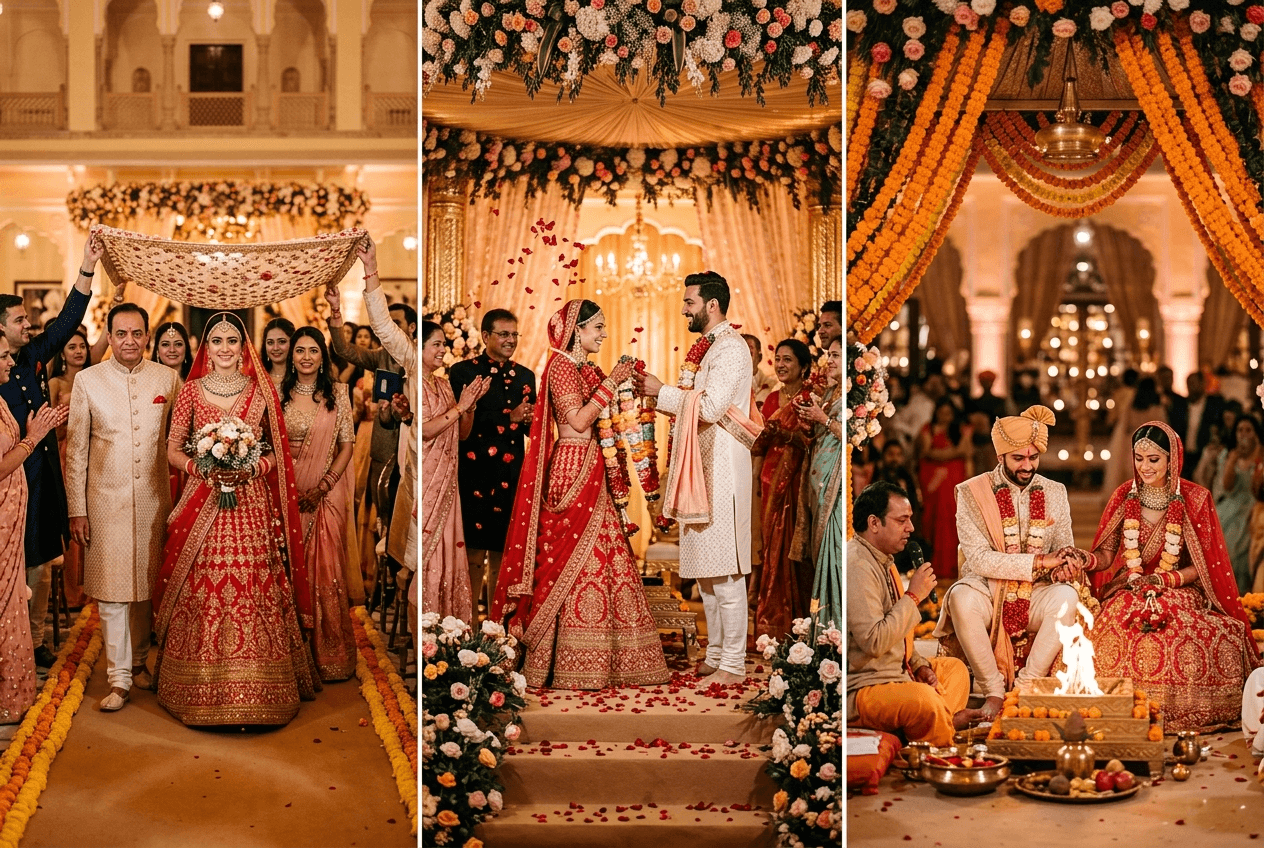 Something has changed over the past fifteen years and it is worth naming, because it shapes what people expect from a playlist now. Sangeet performances used to be spontaneous, with people getting up and dancing badly to whatever was playing. They are now increasingly rehearsed, choreographed and sometimes professionally taught, with families booking instructors weeks in advance.
There are real gains in that. A rehearsed performance is more enjoyable to watch, it involves people who would otherwise never dance, and the rehearsals themselves become part of the wedding for families who live apart. Several families report the practice sessions as the part they remember most fondly.
The cost is that the informal dancing has shrunk. A sangeet that is entirely performances leaves no space for the aunt who wants to dance without being watched, and that spontaneous element is what made these evenings work in the first place. The fix is structural rather than cultural: schedule performances into a defined block and leave a genuine open floor afterwards, rather than letting the programme run until people leave. The broader picture of how film dance developed into this is set out in the guide to Indian classical dance roots, since much of the vocabulary being choreographed today traces back there.
Songs Worth Reconsidering
A short list of things that get programmed at weddings and frequently should not be, offered as observation rather than instruction.
Songs about heartbreak and separation appear at weddings surprisingly often, chosen because the melody is beautiful and the lyrics were never checked. It is worth reading the words of anything you programme for a ceremonial moment. Songs strongly associated with a specific film's tragedy carry that association for anyone who knows the film. Item numbers with explicit lyrics land badly with older relatives at a family function, however well they work elsewhere. And anything currently overplayed will sound dated to the couple within two years of the video being made, which matters more than it seems given how much wedding footage gets rewatched. One more, gently. The couple's chosen song is the couple's chosen song. If it is unfashionable, sentimental or from a film nobody rates, it belongs in the wedding anyway, and a family member overriding it on grounds of taste is a small unkindness that gets remembered.
Planning the Music Timeline
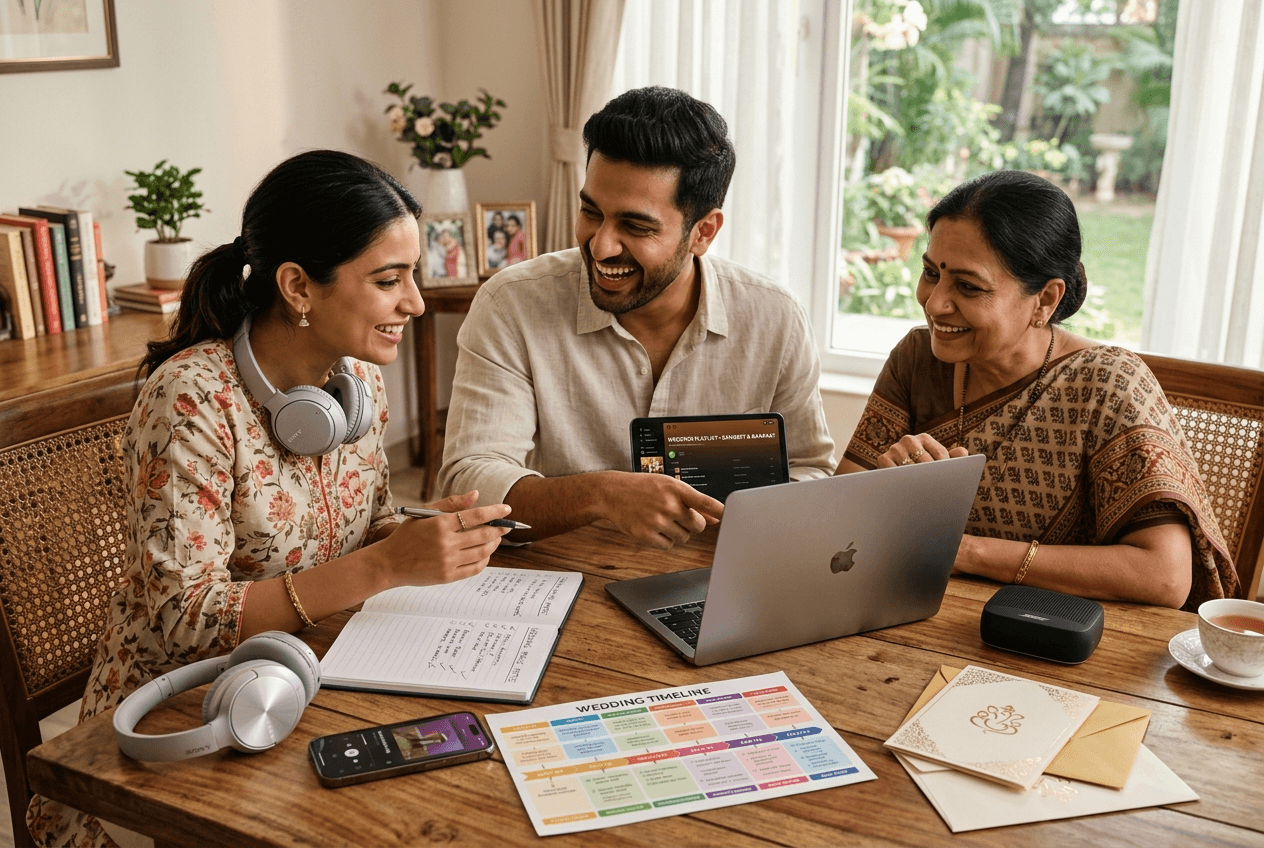 A wedding runs to a schedule that nobody writes down and everybody assumes. Writing it down is the single most useful hour of planning you can do, and it takes the pressure off whoever is running the music on the day.
For each function, note four things: the start time, the moment the energy needs to peak, the moments requiring a specific cued song, and who is authorised to change anything. The cued moments are the ones that go wrong, because they depend on timing rather than taste. A bridal entry, a varmala, a cake cutting, a speech ending, a couple's dance. Each needs a song ready and a person watching for the cue.
Build in buffer. Indian weddings run late as a matter of routine, not exception, and the function that starts an hour behind compresses everything after it. If your sangeet programme only works when it starts on time, it does not work. Decide in advance which two performances get cut if you are running ninety minutes late, and tell those groups gently before the day rather than in the moment.
The equipment conversation nobody has
Ask the venue three questions well in advance. What sound system exists and does it cover the outdoor areas as well as the hall. Is there a volume limit or curfew, which many venues and municipalities enforce. And is there a reliable power supply for the DJ, or a generator arrangement. Baraat processions in particular frequently happen outside the venue's coverage entirely, which is another argument for live dhol.
Also, test the actual playlist on the actual system before guests arrive if you possibly can. Music mixed for headphones frequently sounds thin on a large PA, and a track that seemed powerful on a phone can disappear in a hall.
If Someone in the Family Sings
A live vocal performance at a sangeet lands harder than almost any choreographed item, because it is rarer and because it cannot be faked. If there is a singer in the family, this is worth planning properly rather than leaving to an impromptu request halfway through the evening.
Choose repertoire that suits the voice rather than the occasion. A wedding song sung badly serves nobody, and a beautifully sung ghazal or film ballad with no wedding connection at all works far better. Sound check matters more than for recorded music, since a live voice through an unfamiliar PA is unpredictable. And the singer should go before the dancing rather than after, when the room is still listening. Anyone preparing for this will find the guide to breathing techniques for singers useful, since the main risk at a live wedding performance is nerves shortening the breath and cutting phrases short.
For family members who want to sing but have never performed, pick something within a comfortable range and rehearse it standing up, in the room, with someone listening. The guide to easy songs for beginner singers covers how to choose material that will not expose an untrained voice.
Frequently Asked Questions
What are the best Bollywood wedding songs?
Across functions, the most widely used are Mehndi Laga Ke Rakhna for the mehndi, Gallan Goodiyaan and London Thumakda for the sangeet, Kala Chashma and Morni Banke for the baraat, Din Shagna Da for the bridal entry, Babul for the vidaai and Ainvayi Ainvayi for the reception.
Which songs work for a sangeet dance performance?
Choose for the hook step rather than the melody. Gallan Goodiyaan is the most reliable because the choreography is loose and every age group knows it. London Thumakda, Nagada Sang Dhol, Badri Ki Dulhania and Kajra Re all work, with Kajra Re demanding the most from the dancers.
What are the best bridal entry songs?
Din Shagna Da is the most-used, being slow, emotionally direct and short enough to time to an actual walk. Mere Yaaraa, Bolna, Tera Ban Jaunga and Ranjha are the other reliable choices. Time the entry at the venue so the song peaks as the bride arrives, not before.
What songs should play at a mehndi?
Melodic rather than loud, because most guests are seated with wet henna and cannot dance. Mehndi Laga Ke Rakhna, Mehndi Hai Rachne Wali, Navrai Majhi, Banno and Nachde Ne Saare all suit a daytime function where people are talking and eating.
How long should a sangeet performance be?
The whole dance segment should run forty-five minutes to an hour. Individual performances should be one to three minutes each and the couple's dance three to five. Longer than that and guests stop watching, which is visible from the stage.
How long before the wedding should we start rehearsing?
Eight weeks for a group of mostly non-dancers learning a three-minute routine, assuming weekly rehearsals that people actually attend. Build the choreography around the least experienced dancer and stop making changes a week out.
Should we hire a live dhol or use recorded music?
Live dhol for the baraat if you choose only one live element. A dholi watches the crowd and adjusts, which a playlist cannot, and the baraat is where guests are most physically involved. Recorded music works better for the sangeet and reception where variety matters more.
What music should play during the pheras?
Instrumental shehnai, light classical or soft devotional music at low volume. Recorded film songs compete with the priest and the ceremony. This is the point in the wedding where live musicians add the most.
What songs work for a vidaai?
Babul from Hum Aapke Hain Koun is the standard, and Yeh Galiyan Yeh Chaubara works similarly. The better advice is to underplay this moment. It is already emotional and loud sad music frequently makes it harder rather than more meaningful.
How do we build a playlist for a mixed age crowd?
Alternate eras rather than segregating them, so a current track, then a nineties one, then current again. Playing all the older songs early and all the newer ones late empties the floor twice. Test your running order in sequence before the event.
Final Thoughts
The reason most lists of bollywood wedding songs disappoint is that they answer a question nobody is asking. Nobody needs eighty songs. They need the right twelve for the function they are planning next weekend, in an order that builds.
Take the function you are closest to, pick six songs from that section, and put them in an arc that opens gently and peaks once. Then hand the whole thing to one person who is not dancing. If there is a sangeet performance in your near future, Art Gharana teaches Bollywood dance live and one-to-one for groups and individuals, with a free first class.