ChatGPT
 Google AI
 Grok
Grok Claude
Music begins to make logical sense when musicians start understanding diatonic chords within a scale. A scale works like a scale as note bank, where every note contributes to harmony, melody, and chord progressions. Once you see this connection, harmony stops feeling random and begins to feel structured and predictable.
When learning understanding diatonic chords, musicians also learn how scale degrees guide harmony inside a key signature. The seven notes of a scale form the basic pool for building major chords, minor chords, and diminished chords, which together create the musical language used in thousands of songs.
The Role of Chords in Music Theory
Chords organize sound into meaningful harmony by combining notes through musical intervals, often following simple chord formulas based on the root, third, fifth, and when musicians begin understanding diatonic chords they recognize how the tonic chord, dominant chord, mediant chord, and subdominant chord function together to support melody and define the key of a song.
How Scales and Harmony Work Together
Scales provide the tonal environment where harmony exists because each note becomes a possible chord root, and when musicians practice understanding diatonic chords they realize that chords simply come from stacking notes within the scale while respecting half-step and whole-step patterns that shape both major key chords and minor key chords.
Why Diatonic Harmony Matters for Musicians
A strong grasp of understanding diatonic chords allows musicians to predict which chords sound stable within a key signature, which helps composers create smooth chord progressions, improvise melodies confidently, and even identify harmony during chord progression by ear, making music theory practical rather than abstract.
The Meaning of Diatonic Chords in Music
 At its core, understanding diatonic chords means recognizing chords that belong naturally inside a musical scale without introducing accidentals in music or external tones. These chords come directly from the seven notes of a scale and form the harmonic framework behind most Western music.
When musicians explore diatonic chords, they quickly see how these harmonies create balance in songs. Unlike chromatic chords or non-diatonic chords, which borrow notes outside the scale, diatonic harmony maintains tonal stability and reinforces the key of a song.
Simple Definition of Diatonic Harmony
Diatonic harmony describes chords built only from notes found within the scale of a given key signature, meaning every chord respects the internal structure of the scale while supporting harmony that feels cohesive and natural within the tonal system musicians study while understanding diatonic chords.
Relationship Between Scales and Chords
A scale works like a note bank, and during triad building musicians stack notes from that bank to create chords, which explains why major chords, minor chords, and diminished chords emerge naturally from specific scale degrees inside the scale.
Why These Chords Naturally Fit a Key
Because diatonic harmony avoids outside tones and focuses only on notes inside the scale, the resulting chords share common tones and intervals, allowing smooth transitions between the tonic chord, dominant chord, and subdominant chord without clashing harmony.
Understanding Scale Degrees in Music Theory
 Every note inside a scale holds a specific position called a scale degree, and learning these positions becomes essential while understanding diatonic chords because each degree generates a specific chord type with a predictable harmonic function.
Scale degrees also explain why chords carry names like tonic, mediant, or dominant, and they help musicians analyze chord progressions across keys using the number system in music rather than memorizing every chord individually.
What Are Scale Degrees
Scale degrees are numbered positions of notes in a scale starting from the tonic, and while learning understanding diatonic chords, musicians discover that each degree influences harmony differently depending on its interval relationship with the root of the scale.
How Each Degree Creates a Chord
Every scale degree can form a chord when musicians apply triad building, stacking notes separated by musical intervals to create structures consisting of root, third, fifth, which form the backbone of triads on piano.
Roman Numerals and Their Musical Significance
Musicians label chords using Roman numeral chord notation such as I, ii, iii, IV, V, vi, vii°, allowing them to describe harmony independent of key and making transposing chords and chord transposition far easier across instruments.
How Chords Are Built from Musical Scales
 Chord construction becomes clear when musicians explore triad building, a process where notes from a scale combine using chord intervals. This simple approach reveals how harmony evolves naturally from scales without requiring complex theory.
Through this process musicians begin understanding diatonic chords because they see that every chord originates from stacking notes separated by thirds within the scale.
The Concept of Stacking Thirds
The foundation of chord construction involves stacking notes separated by musical intervals called thirds, and when musicians apply this method consistently they form triads that produce major chords, minor chords, and diminished chords inside a scale.
Understanding Triads in Harmony
A triad contains three notes structured as root, third, fifth, and these simple structures become the building blocks of harmony while musicians develop deeper skill in understanding diatonic chords.
Basic Structure of Chords in a Scale
Each chord in a scale follows predictable chord formulas, which determine whether the chord becomes major, minor, diminished, or occasionally an augmented chord when chromatic alterations appear.
Types of Triads Found in Diatonic Harmony
 Triads form the simplest harmonic structures in tonal music, and mastering them is essential when studying understanding diatonic chords. These triads appear across all musical genres from classical compositions to modern pop songwriting.
Each triad type carries a unique sound and emotional character, helping composers shape musical storytelling through harmony.
Major Chords and Their Sound
Major chords produce a bright and stable sound because the interval pattern between notes creates a strong tonal center, which explains why the tonic chord and dominant chord often appear as major chords in many major key chords progressions.
Minor Chords and Their Character
Minor chords introduce emotional depth and darker tonal color, and they frequently appear on the mediant chord or subdominant chord positions when musicians build minor key chords within the natural minor scale.
Diminished Chords and Their Function
Diminished chords create tension because their internal chord intervals contain unstable spacing, which makes them naturally lead toward resolution especially when the chord contains the leading tone that pushes harmony toward the tonic.
Diatonic Chords in Major Keys Explained
 Major scales generate a clear pattern of harmony that musicians rely on when studying understanding diatonic chords. Each scale contains seven chords created through triad building, forming the harmonic environment of a major key.
These chords repeat across every key even though the notes change, which explains why the number system in music helps musicians quickly understand harmony in any key.
The Seven Chords in a Major Scale
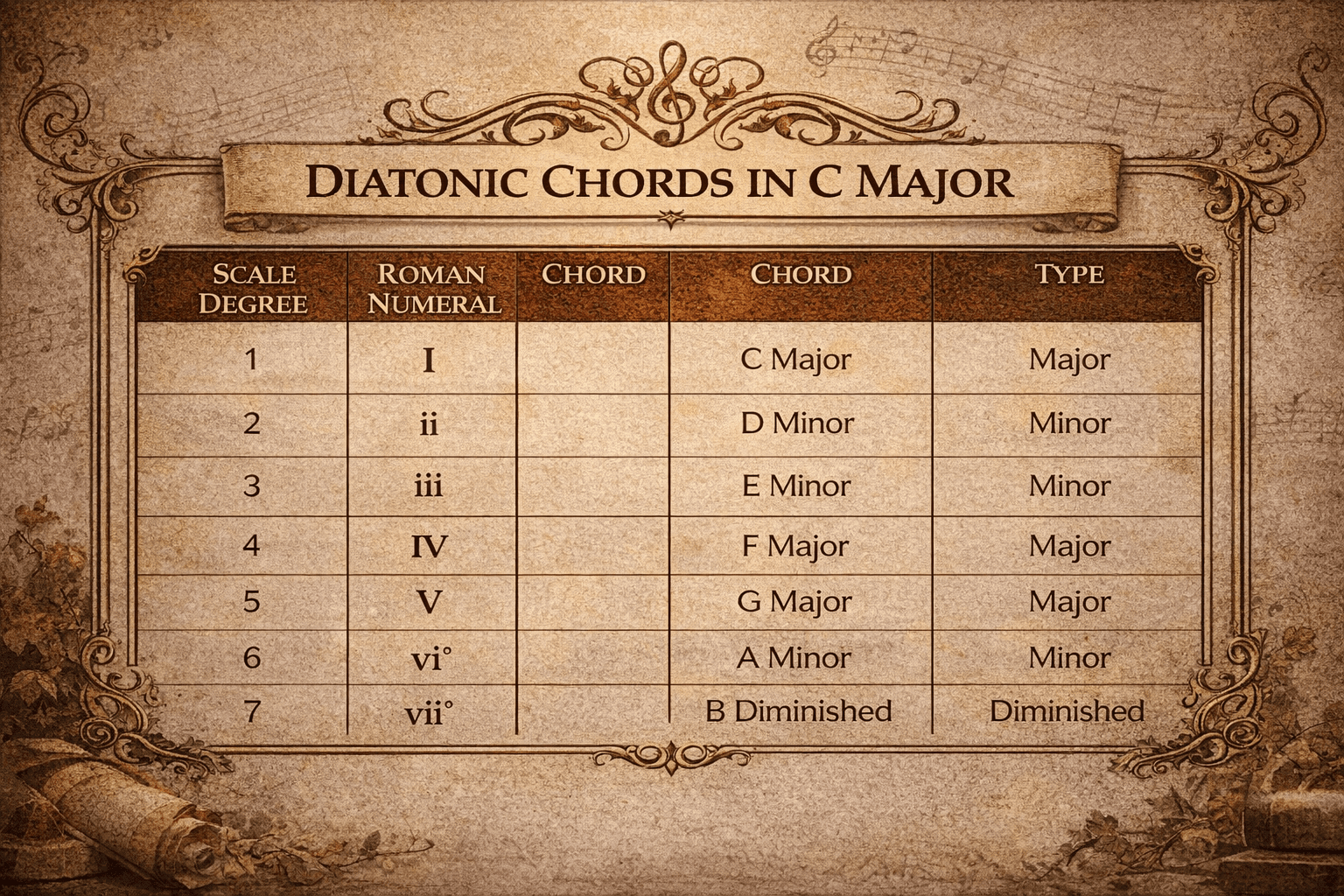
A major scale produces seven chords built from its scale degrees, and these chords follow the pattern I, ii, iii, IV, V, vi, vii°, which determines how major chords, minor chords, and diminished chords appear in the scale.
Chord Pattern in Major Keys (I – vii°)
The predictable pattern of chord quality in major keys helps musicians recognize harmony instantly and simplifies transposing chords because the structure remains identical across keys.
Example of Diatonic Chords in the C Major Scale
The C major triad becomes the tonic chord in the key of C, and when triads build on each scale degree the scale produces familiar chords such as D minor triad, E minor, F major, G major, A minor, and B diminished.
Diatonic Chords in Natural Minor Keys
 Minor tonalities reveal a different emotional color in harmony, and understanding diatonic chords inside the natural minor scale helps musicians see how darker harmonic textures develop naturally from the same concept used in major scales. The same seven scale degrees generate chords that define the key of a song.
While studying minor key chords, musicians often compare them with major key chords to notice the difference in sound and function. These changes appear because the half-step and whole-step structure shifts inside the scale, altering how triads on piano form and how chord progressions resolve.
Structure of the Minor Scale
The natural minor scale follows a distinct pattern of half-step and whole-step intervals which shapes harmony differently from a major scale, and once musicians begin understanding diatonic chords in this structure they recognize how chords such as the tonic minor chord and the dominant minor chord naturally appear.
Chord Pattern in Minor Keys (i – VII)
Minor keys produce a recognizable pattern of minor chords, major chords, and diminished chords, which musicians describe through Roman numeral chord notation using the sequence i, ii°, III, iv, v, VI, VII.
Example of Diatonic Chords in the A Minor Scale
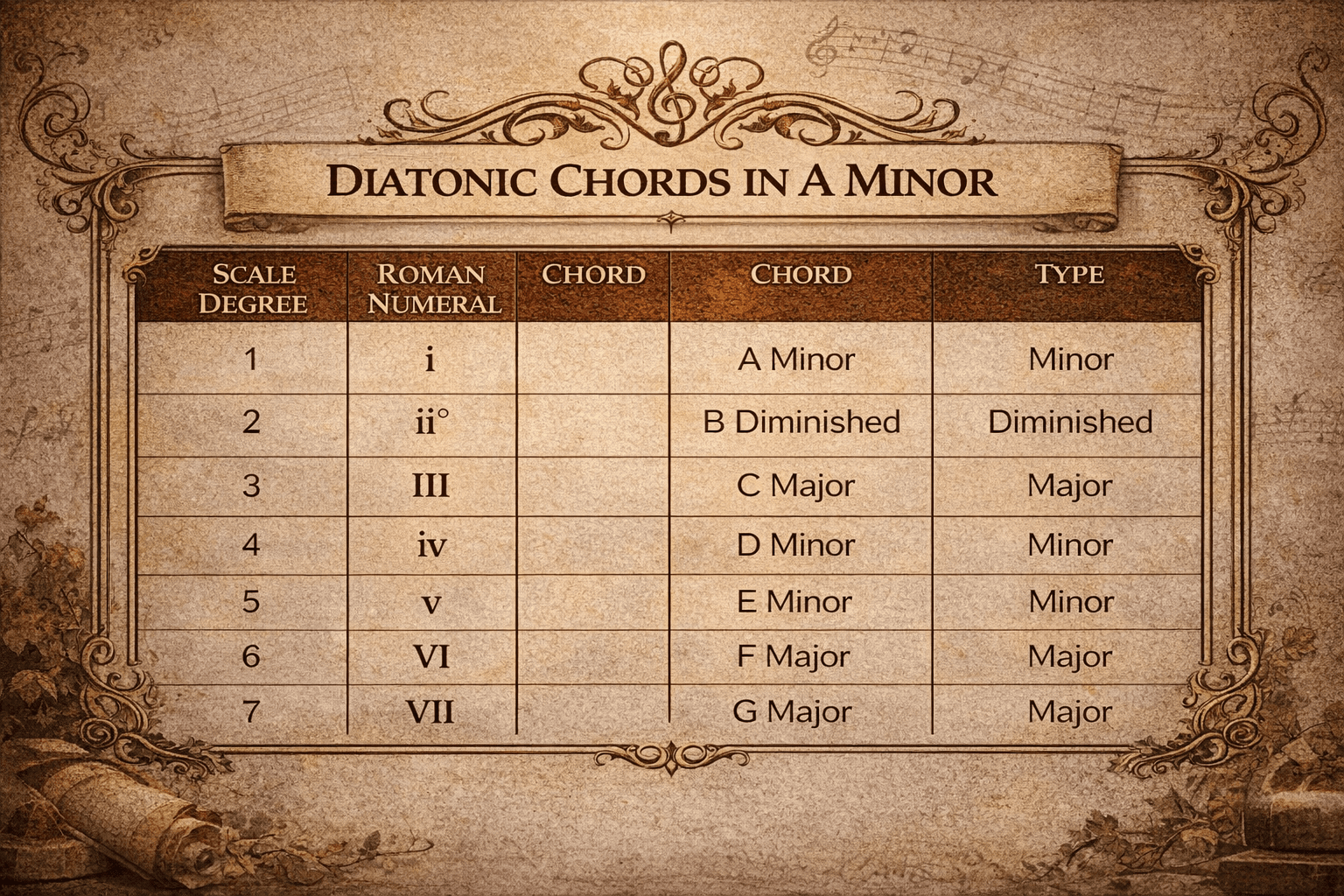 The A minor scale illustrates understanding diatonic chords clearly because its notes contain no accidentals in music, producing chords such as A minor, B diminished, C major, D minor, E minor, F major, and G major.
Understanding the Difference Between Diatonic and Non-Diatonic Chords
 A key concept in understanding diatonic chords is recognizing which chords belong to the scale and which introduce outside notes. When musicians encounter non-diatonic chords, they immediately know that additional harmonic color has entered the progression.
These chords often include chromatic chords or altered tones that contain accidentals in music, creating musical tension that can dramatically reshape the sound of a chord progression.
What Makes a Chord Non-Diatonic
A chord becomes non-diatonic when one or more of its notes fall outside the scale defined by the key signature, introducing tones that require accidentals in music.
Borrowed Chords and Chromatic Harmony
Many composers use borrowed harmony by pulling chords from the harmonic minor scale or parallel modes, creating expressive sounds that expand harmony beyond simple major key chords.
When Musicians Use Non-Diatonic Chords
Musicians introduce chromatic chords and borrowed harmony to add drama, surprise, or emotional tension before resolving back to a stable tonic chord.
The Roman Numeral System in Chord Progressions
Music theory becomes easier when chords are described using the number system in music instead of memorizing note names in every key. This approach lies at the heart of understanding diatonic chords and helps musicians analyze harmony quickly.
The Roman numeral chord notation system describes chords according to their scale degrees, allowing musicians to recognize patterns across different keys and making chord transposition much simpler.
How the Number System Works in Music
The system labels chords as I, ii, iii, IV, V, vi, vii°, and these numbers represent the chord built on each scale degree within the scale.
Why Musicians Use Roman Numerals
Roman numerals simplify analysis because they describe harmonic function rather than specific pitches, helping musicians understand the tonic chord, dominant chord, and subdominant chord relationships.
How the System Helps Transpose Songs Easily
Because the numbers remain constant across keys, musicians can easily perform transposing chords or chord transposition while maintaining the same harmonic structure.
Using Diatonic Chords to Create Music
Many famous songs rely almost entirely on diatonic chords, proving that simple harmony can produce memorable music. When musicians develop skill in understanding diatonic chords, songwriting becomes much more intuitive.
Composers also rely on these chords when improvising because they create a predictable tonal framework that supports melody and rhythm.
Common Chord Progressions in Popular Music
Modern music frequently uses repeating chord progressions based on diatonic harmony, especially progressions built from I, IV, V, or vi chords.
Writing Songs Using Diatonic Harmony
Songwriters often begin composing with the tonic chord, move toward the subdominant chord, and then create tension with the dominant chord before resolving the harmony.
How Musicians Use These Chords for Improvisation
Improvisers rely on scale degrees and the underlying chord intervals to guide melodic ideas during solos.
Examples of Diatonic Chord Progressions
Understanding harmony becomes easier when musicians observe real chord progressions used in songs. These patterns appear across genres including classical, pop, rock, and jazz.
Recognizing these structures helps musicians develop chord progression by ear and strengthens practical music theory knowledge.
Basic Three-Chord Progressions
Many traditional songs use simple progressions such as I–IV–V, which combine the tonic chord, subdominant chord, and dominant chord to create a strong harmonic cycle.
Popular Four-Chord Progressions in Modern Music
A widely used progression in modern music follows the pattern I–V–vi–IV, which appears in countless pop songs and demonstrates the power of simple diatonic chords.
Examples Used in Classical and Contemporary Songs
From classical symphonies to modern chart hits, composers repeatedly use diatonic harmony because it balances stability with expressive movement.
Tips for Practicing Diatonic Chords on Piano
Learning triads on piano is one of the fastest ways to understand harmony. When musicians repeatedly practice chords within a scale, they internalize the sound of diatonic chords naturally.
This practice also strengthens the ability to recognize chord functions and improves musical memory.
Step-by-Step Practice Method
Begin with the C major triad, then build the D minor triad, E minor triad, and continue through the scale until every chord becomes familiar.
Exercises to Memorize Chord Patterns
Repeated practice of scale-based triad building helps musicians memorize the pattern of major chords, minor chords, and diminished chords.
Practicing Chord Progressions in Different Keys
Once a progression feels comfortable, musicians should practice transposing chords into new keys using Roman numeral chord notation.
Learning Music Theory and Piano at Art Gharana
Serious musicians strengthen their foundation by studying understanding diatonic chords through structured training that explains harmony, scale degrees, and chord progressions clearly. When lessons guide students through triads on piano, chord construction, and the number system in music, harmony becomes logical rather than confusing.
Students also explore major key chords, minor key chords, and chord function inside a key signature, which helps them identify the tonic chord, dominant chord, and subdominant chord while recognizing how musical intervals create emotional movement within a composition.
Frequently Asked Questions About Diatonic Chords
Are all chords in a song diatonic
Not every chord in a song belongs to the scale because composers sometimes introduce non-diatonic chords or chromatic chords that include accidentals in music, which briefly change the harmony before returning to the original key of a song and reinforcing the central tonic chord.
Can a song use both diatonic and non-diatonic chords
Many songs combine diatonic chords with chromatic chords or borrowed harmony from the harmonic minor scale, creating dramatic color while still keeping the overall harmonic structure centered around the original key signature.
Are diatonic chords important for songwriting
Songwriters rely heavily on understanding diatonic chords because they provide the harmonic framework behind most chord progressions, allowing melodies to connect naturally with harmony while maintaining musical clarity and emotional balance.
How long does it take to learn diatonic harmony
Most beginners begin recognizing major chords, minor chords, and diminished chords within a few weeks of focused practice, although mastering chord inversion, chord transposition, and identifying harmony by ear may require several months of consistent study.
Conclusion: Mastering Diatonic Harmony in Music
Developing a strong grasp of understanding diatonic chords transforms the way musicians interpret harmony because they begin seeing every scale as a scale as note bank where chords naturally emerge through triad building and predictable musical intervals. This knowledge helps musicians understand why chord progressions feel stable or tense.
Once musicians recognize the relationship between scale degrees, Roman numeral chord notation, and the number system in music, they can easily analyze songs, perform transposing chords, and create original music using major key chords, minor key chords, and expressive harmonic movement built around the tonic chord, dominant chord, and leading tone.