ChatGPT
 Google AI
 Grok
Grok Claude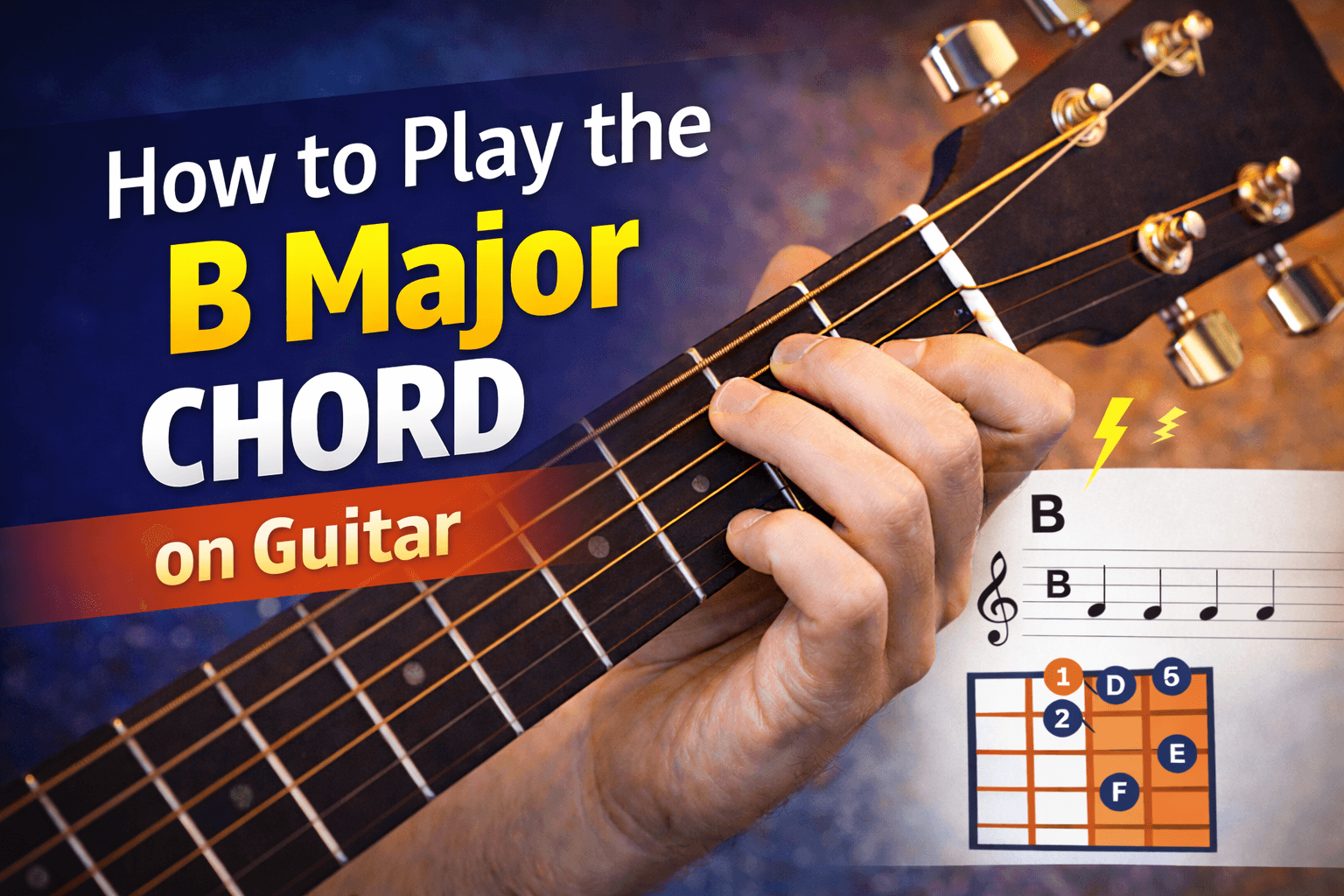
What Is the B Major Guitar Chord?
 The B major chord on guitar is a powerful, bright-sounding major triad consisting of three essential notes: B, D#, and F#. Unlike beginner-friendly open chords like G, C, or A, the B major chord is usually played as a barre chord. This gives it a fuller, more controlled sound but also makes it slightly challenging for beginners. However, once mastered, the B major chord opens the door to numerous musical styles including pop, rock, funk, R&B, metal, jazz, and worship music.
Learning the B major chord diagram helps guitarists understand chord construction in closed positions, gain finger strength, and apply movable shapes across the fretboard. Because there is no standard open B major shape, mastering its barre and alternative voicings is essential for performing chord progressions smoothly and confidently.
The B major chord is a key component in many popular songs and is widely used in keys such as B major, E major, and F# major. Understanding how this chord functions in harmonic contexts allows guitarists to switch between chords fluidly, unlock new songwriting possibilities, and enhance improvisational skills.
What Makes the B Major Chord Special
 The B major chord stands out because of its distinct tonality and structural strength. Built on the interval pattern of root–major third–perfect fifth (1–3–5), the chord features the notes B, D#, and F#. This arrangement gives the chord a crisp, bright, and assertive sound, making it essential in modern and energetic styles of music.
Because B major is often played as a barre chord, it helps players develop the hand strength necessary for more advanced chords. Its closed shape produces a tighter, more balanced tone compared to open chords. Additionally, the B major chord is movable, meaning players can transpose the same shape to create other major chords across the neck using the CAGED system.
Understanding the tonal behavior of the B major chord enhances a guitarist’s musical expression. It frequently serves as the tonic (I), dominant (V), or subdominant (IV) depending on the key, making it crucial for both rhythm and lead guitar applications.
B Major Chord Notes and Formula
 The B major chord is built from three essential notes taken from the B major scale:
- B (Root)
- D# (Major Third)
- F# (Perfect Fifth)
These tones form the B major triad using the major chord formula: 1–3–5.
B Major Chord Tone Breakdown
Note Interval B Root D# Major Third F# Perfect Fifth
Understanding this triad is fundamental for improvisation, chord tone targeting, fretboard mapping, and creating new voicings. Once guitarists know where these notes appear across the strings, they can construct chord variations, inversions, triads, and arpeggios seamlessly.
How the Major Chord Is Built
The B major chord is created through stacked thirds taken from the B major scale. The scale consists of the notes:
B, C#, D#, E, F#, G#, A#
Selecting the 1st, 3rd, and 5th degrees gives:
- 1 → B
- 3 → D#
- 5 → F#
This results in the B major triad. Understanding major chord intervals helps guitarists build chords in any position on the fretboard. This knowledge also lays the foundation for more advanced concepts such as chord extensions, modal harmonization, and triad-based improvisation.
The B major chord has a naturally strong sound due to its tight interval structure, making it a powerful harmonic anchor in progressions.
B Major Chord on Guitar
 Unlike most beginner chords, the B major chord does not have a true open-position version. It is commonly played as a barre chord on the 2nd or 7th fret, making it essential for developing proper technique, hand strength, and overall fretboard familiarity.
Players can choose from several variations, including:
- E-shape barre chord (7th fret)
- A-shape barre chord (2nd fret)
- Triad shapes on top strings
- Movable closed voicings
- Higher-register voicings for a lighter tone
These shapes allow guitarists to adapt the chord to different musical needs, whether they want a full, powerful sound or a thin, shimmering tone.
The Basic B Major Shape (Common Barre Form)
 The most frequently used shape for B major is the A-shape barre chord rooted on the 2nd fret. This requires barring the second fret with the index finger and forming the major shape with remaining fingers.
Many beginners find this shape challenging due to finger pressure requirements and the difficulty of cleanly holding a barre while fretting three additional notes. Consistent practice helps develop the strength needed for this form.
Another popular alternative is the E-shape barre chord at the 7th fret. This version gives a fuller, more resonant sound and is often used in rock and pop progressions.
Keys Where You’ll Find the B Major Chord
The B major chord appears naturally in several keys and functions prominently in many harmonic contexts.
Keys Containing B Major Key I ii iii IV V vi vii° B Major B C#m D#m E F# G#m A#dim E Major E F#m G#m A B C#m D#dim F# Major F# G#m A#m B C# D#m E#dim G# Minor G#m A#dim B C#m D#m E F# C# Minor C#m D#dim E F#m G#m A B
Understanding these relationships helps guitarists analyze music, write progressions, and choose appropriate scale options for improvisation.
Common Chord Progressions With B Major
 Because B major often appears in keys like E major and F# major, it is featured in a variety of powerful chord progressions used in rock, pop, and contemporary worship music.
Popular Progressions Involving B Major
- I–V–vi–IV (B–F#–G#m–E)
- I–IV–V (B–E–F#)
- vi–IV–I–V (G#m–E–B–F#)
- I–vi–IV–V (B–G#m–E–F#)
- IV–V–I (E–F#–B)
- Every Breath You Take – The Police
- Wonderwall (chorus progression) – Oasis
- Yellow – Coldplay
- Clocks – Coldplay
- Fix You – Coldplay
- Livin’ on a Prayer – Bon Jovi
- Counting Stars – OneRepublic
- Bmaj7
- Badd9
- Bsus2
- Bsus4
- B6
- Badd11
- Move the B major A-shape to the 3rd fret → C major
- Move it to the 5th fret → D major
- Move it to the 7th fret → E major
- chord melody
- arpeggio-based soloing
- harmonizing scales
- arranging for multiple guitar parts
- Keep the wrist low and the thumb neutral behind the neck
- Avoid squeezing too hard
- Apply pressure from the arm, not just the fingers
- Practice slow transitions to adjacent chords like E, F#, and G#m
- Buzzing due to incomplete barre
- Sore hands from pressing too hard
- Muted inner strings
- Difficulty maintaining wrist alignment
- It forms part of powerful progressions in pop, rock, and worship music
- It serves as the I chord in B major, the V chord in E major, and the IV chord in F# major
- It supports modal interchange when borrowed from parallel modes
- It enables expressive chord voicing modifications and dynamic rhythm patterns
These structures help players understand how B major supports melodic movement and rhythmic flow. Practicing these sequences also improves timing, transitions, and musical memory.
Scales to Play Over a B Major Chord
Improvising over the B major chord requires choosing scales that contain its chord tones (B, D#, F#). Targeting these notes enhances melodic phrasing and creates solos that sound connected to the harmony.
Scales Compatible With B Major
Scale Notes Mood B Major Scale B C# D# E F# G# A# Bright, uplifting G# Minor Scale G# A# B C# D# E F# Emotional, warm B Major Pentatonic B C# D# F# G# Clean, versatile B Lydian B C# D# E F# G# A# Dreamy, airy B Mixolydian B C# D# E F# G# A Relaxed, bluesy
Learning how these scales interact with the B major chord helps with lead guitar, chord tone targeting, and melodic improvisation.
Popular Songs That Use the B Major Chord
Many well-known songs feature the B major chord due to its role in common keys like B major, E major, and F# major. Some examples include:
These songs demonstrate how B major contributes to smooth harmonic transitions and expressive progressions.
How to Play the B Major Chord: Guitar Shapes & Positions
The B major chord can be played in multiple shapes across the neck using the CAGED method.
B Major Chord Positions Position Root Note Shape Type 1 2nd fret A string Barre A-shape 2 7th fret E string Barre E-shape 3 9th fret D string Triad D-shape 4 12th fret A string Movable High voicing 5 14th fret G string Triad Inversion
These voicings allow players to choose the tonal character they prefer based on context—full, tight, bright, or soft.
Alternate Voicings and Extensions
Advanced players often explore alternative voicings and chord extensions to add color to the B major chord. Common variations include:
These extensions enrich rhythm guitar playing, improve harmonic expression, and offer fresh textures for songwriting.
Play This Chord With Other Roots
The B major chord shape can be transposed across the fretboard just like any other movable chord. For example:
Mastering movable chord forms strengthens your understanding of fretboard geography and allows effortless transposition across keys.
How to Build the B Major Chord on Guitar
Building the B major chord involves identifying all B, D#, and F# notes across the fretboard. Using chord tone visualization helps players construct new shapes, understand inversions, and apply triads effectively.
This knowledge is valuable for:
Learning the roots and intervals of the chord deepens harmonic awareness and supports advanced musicianship.
Tips to Master the B Major Chord
Because B major is typically a barre chord, technique and practice are crucial. Recommendations include:
B Major Practice Routine
Exercise Duration Goal Barre strength drills 5 mins Improve finger pressure Transition B–E–F# 10 mins Smooth chord changes Progression B–G#m–E–F# 10 mins Rhythm flow and timing
Consistent practice helps overcome the initial difficulty of playing B major.
Troubleshooting Common Problems
Players often face issues such as:
Correcting finger angle, reducing unnecessary tension, and practicing slowly leads to clean, resonant chord execution.
Advanced Applications of the B Major Chord
The B major chord is important in advanced harmony for several reasons:
Using B major arpeggios, inversions, and extended voicings enhances melodic soloing and compositional depth.
FAQ About the B Major Guitar Chord
1. Is B major a difficult chord for beginners?
Yes, B major is considered one of the more challenging beginner chords because it requires a barre shape. However, with consistent practice, it becomes significantly easier.
2. What notes make up the B major chord?
The B major triad includes B (root), D# (major third), and F# (perfect fifth).
3. Which chords go well with B major?
Chords like E major, F# major, G# minor, and C# minor pair naturally with B major in common progressions found in keys such as B and E major.
4. How can I play B major without doing a full barre chord?
You can play simplified versions such as the B power chord, B triad shapes on top strings, or a partial barre using only the A, D, and G strings.
5. What is the difference between B major and B minor?
B major uses B–D#–F#, while B minor uses B–D–F#. Lowering the third (D# to D) changes the sound from bright to dark.