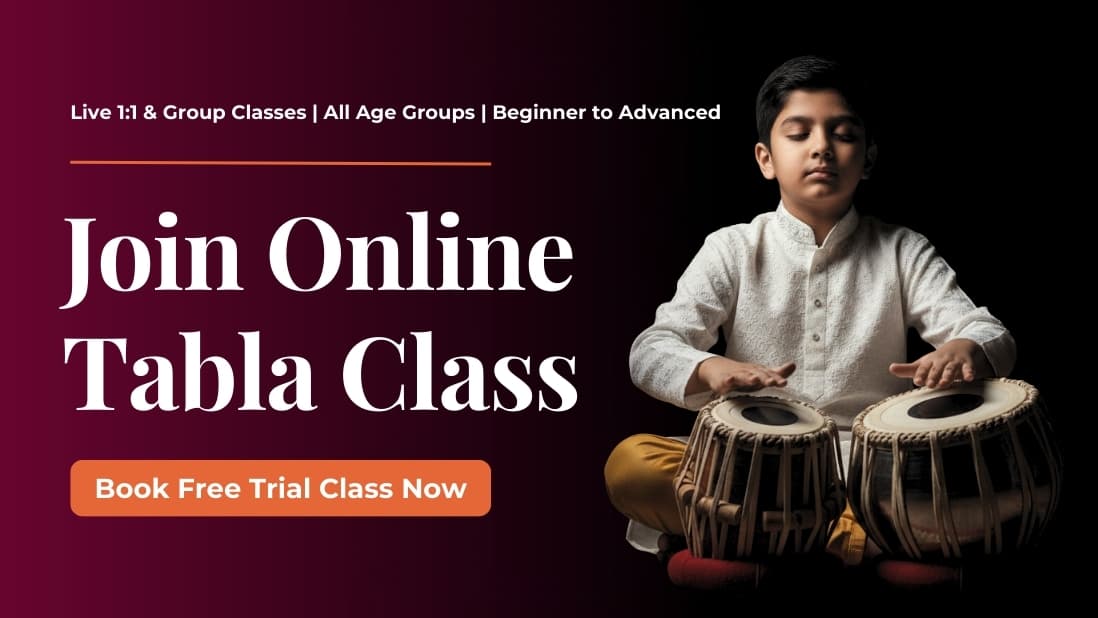
The tabla is the heartbeat of Hindustani classical music and one of the most distinctive and beloved sounds in Indian cultural life. For Indian-Canadian families across the country, from the North Indian communities of Brampton and Mississauga to the Punjabi families of Surrey and Abbotsford, from the Bengali and UP families of Calgary to the diverse Indian communities of Ottawa, table training has always been a priority. The challenge has been access to genuinely qualified teachers offering the individual attention that produces real results.
Unlike the USA, Canada has very few dedicated tabla teaching organisations. The most established tabla instruction in Canada happens in GTA community settings, often tied to specific temples or cultural organisations, with group classes on fixed schedules and limited flexibility. For families outside the GTA and Vancouver, local tabla instruction is essentially absent. Art Gharana's live online programme brings certified tabla teachers to every family across Canada through live one-to-one online tabla classes, scheduled in your Canadian time zone, from your home.
The Tabla: A Unique and Extraordinary Instrument
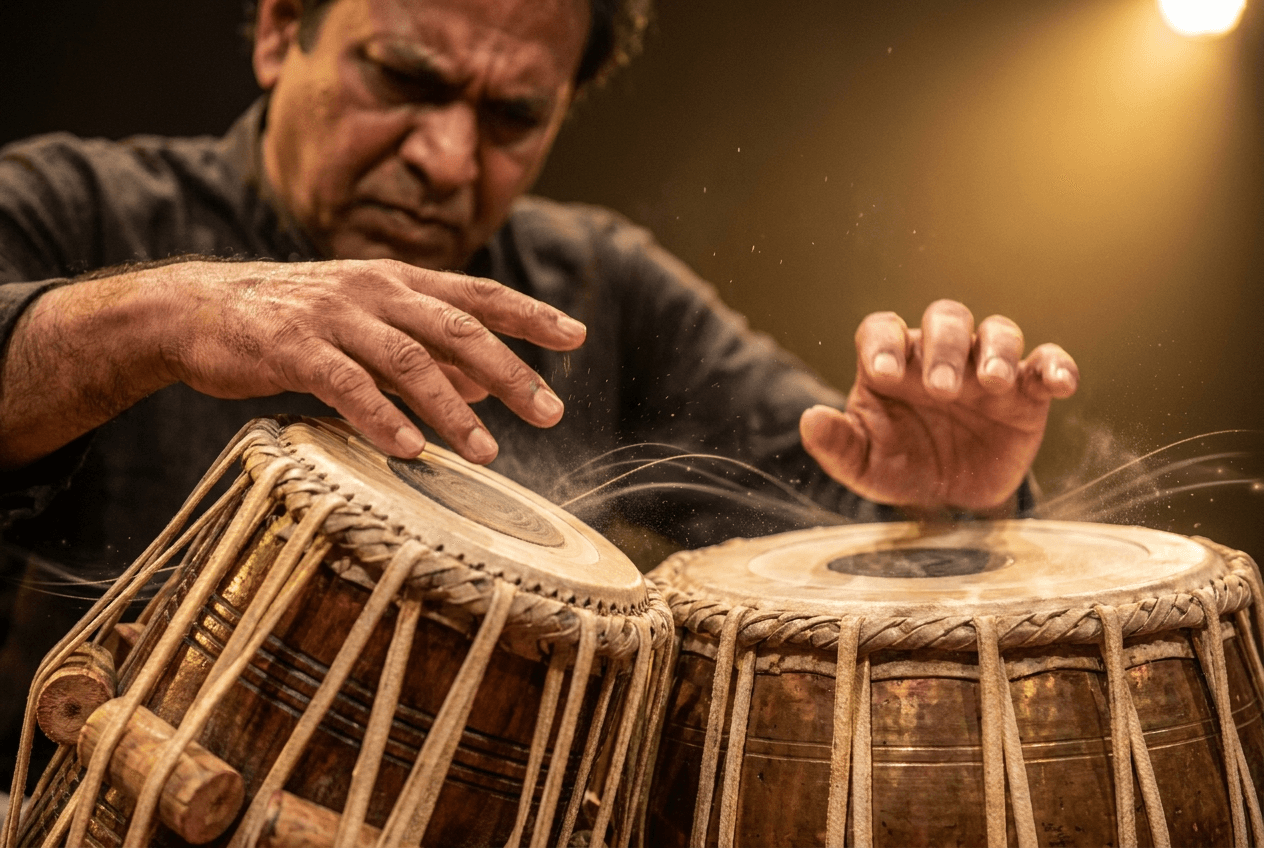
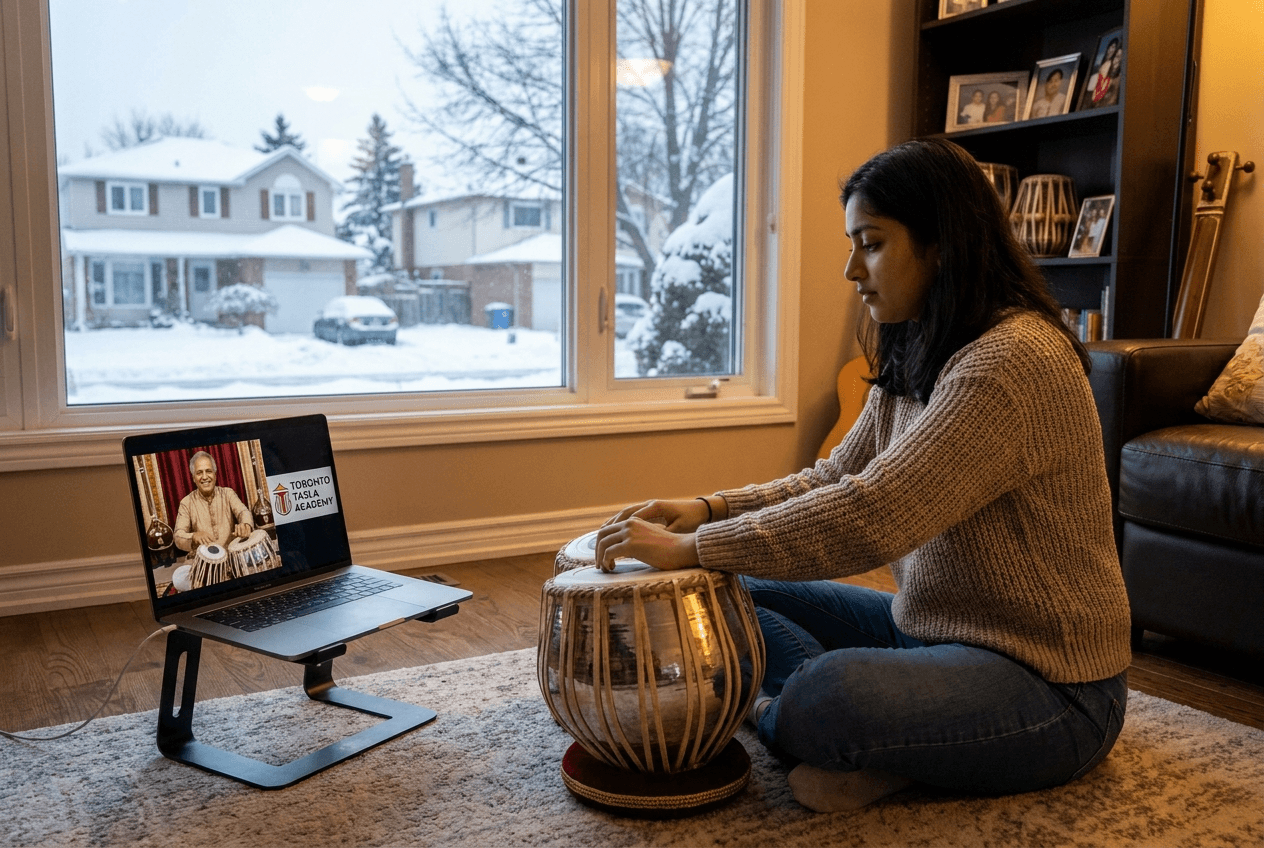 The tabla is a pair of hand drums, the dhayan and the bayan, that sits at the centre of Hindustani classical music. The dhayan, the smaller right-hand drum, produces the bright melodic tones that carry the rhythmic composition. The bayan, the larger left-hand drum, produces the deep bass tones and characteristic pressure sounds that give the tabla its unmistakable voice. Together, the two drums produce an extraordinary range of distinct tones, each called a bol, that form the musical vocabulary of tabla playing.
What makes the tabla exceptional is its dual role as both a rhythmic and a melodic instrument. The dhayan is tuned to the root note of the musical performance it accompanies, meaning that the tabla resonates harmonically with the vocalist or instrumentalist as well as providing rhythmic structure. This combination of rhythmic precision and melodic sensitivity makes tabla one of the most musically sophisticated percussion instruments in the world, and one of the most rewarding to study.
Tabla in Canada: The Indian-Canadian Rhythmic Tradition
Greater Toronto Area
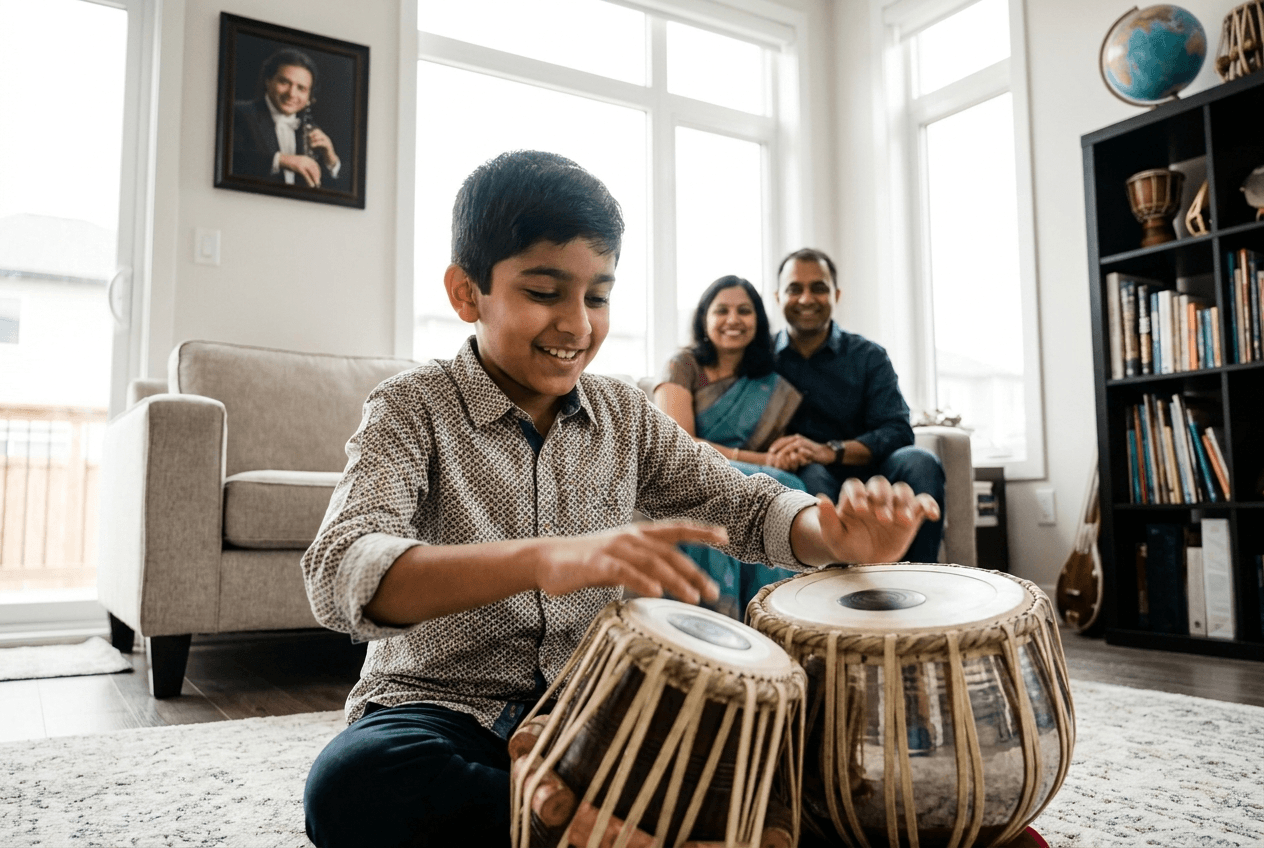
The GTA's North Indian community has the most established tabla culture in Canada. Temple bhajan groups, cultural organisations and informal music circles across Brampton, Mississauga, Scarborough and Markham all include tabla players, and the demand for quality tabla instruction for children is consistent and strong. However, the local provision of one-to-one tabla instruction for children, with certified classical training, is thin. Art Gharana's online programme fills this gap with live, personalised instruction in Eastern Time Zone scheduling.
Vancouver and the Punjabi Community
Vancouver's Punjabi community in Surrey, Abbotsford and the Lower Mainland has a deep relationship with Indian percussion through the bhangra tradition, and tabla training is increasingly sought as a complement to the bhangra percussion background that many families already have. Art Gharana's Pacific Time Zone scheduling serves the entire Lower Mainland with morning, evening and weekend slots.
Calgary, Edmonton and Nationwide
For Indian-Canadian families in Calgary, Edmonton, Ottawa, Winnipeg and across the Atlantic provinces, local tabla instruction with certified classical training is not consistently available. Art Gharana serves all of these families nationwide through live online classes in their local Canadian time zone.
Why Tabla Is an Outstanding Choice for Indian-Canadian Children
Mathematical Intelligence Through Rhythm
The tala structures of Hindustani music are among the world's most sophisticated systems of rhythmic mathematics. Learning to count, divide and improvise within tala cycles develops a form of mathematical pattern thinking that directly and measurably supports academic performance in numeracy, logic and problem solving. Canadian parents who want an extracurricular activity that develops both cultural connection and cognitive capability simultaneously will find few options as efficient as tabla.
Bilateral Coordination
Tabla requires the two hands to play completely independent rhythmic patterns simultaneously while remaining in perfect synchronisation. This bilateral demand challenges the nervous system to develop extraordinary bilateral coordination and fine motor precision. The benefits extend into every physical activity a child undertakes, from sports to writing to playing other instruments.
Cultural Heritage and Community Connection
For Indian-Canadian children, the sound of tabla carries the deepest cultural resonance. It is the sound of classical concerts, bhajan evenings, festive celebrations and the Bollywood films that have defined their cultural landscape. Learning to produce that sound with their own hands gives children an embodied connection to their heritage that is immediate, concrete and genuinely thrilling. Several Art Gharana tabla students in Canada describe their first successful bol as one of the most exciting moments of their childhood.
Academic and College Application Benefits
In the competitive Canadian and US college application landscape, serious training in a classical Indian instrument is genuinely distinctive. Most applicants list piano, violin or guitar. A student who lists several years of serious tabla training, with performance experience at cultural events and formal examinations, presents an extracurricular profile that stands out in ways that Western instrument training does not. Art Gharana's tabla curriculum prepares students for recognised certification examinations, and students who complete multiple levels have a formal credential that demonstrates sustained achievement in a rigorous classical arts tradition.
What Your Child Will Learn: The Tabla Curriculum
Beginner Stage, Ages 6 to 9
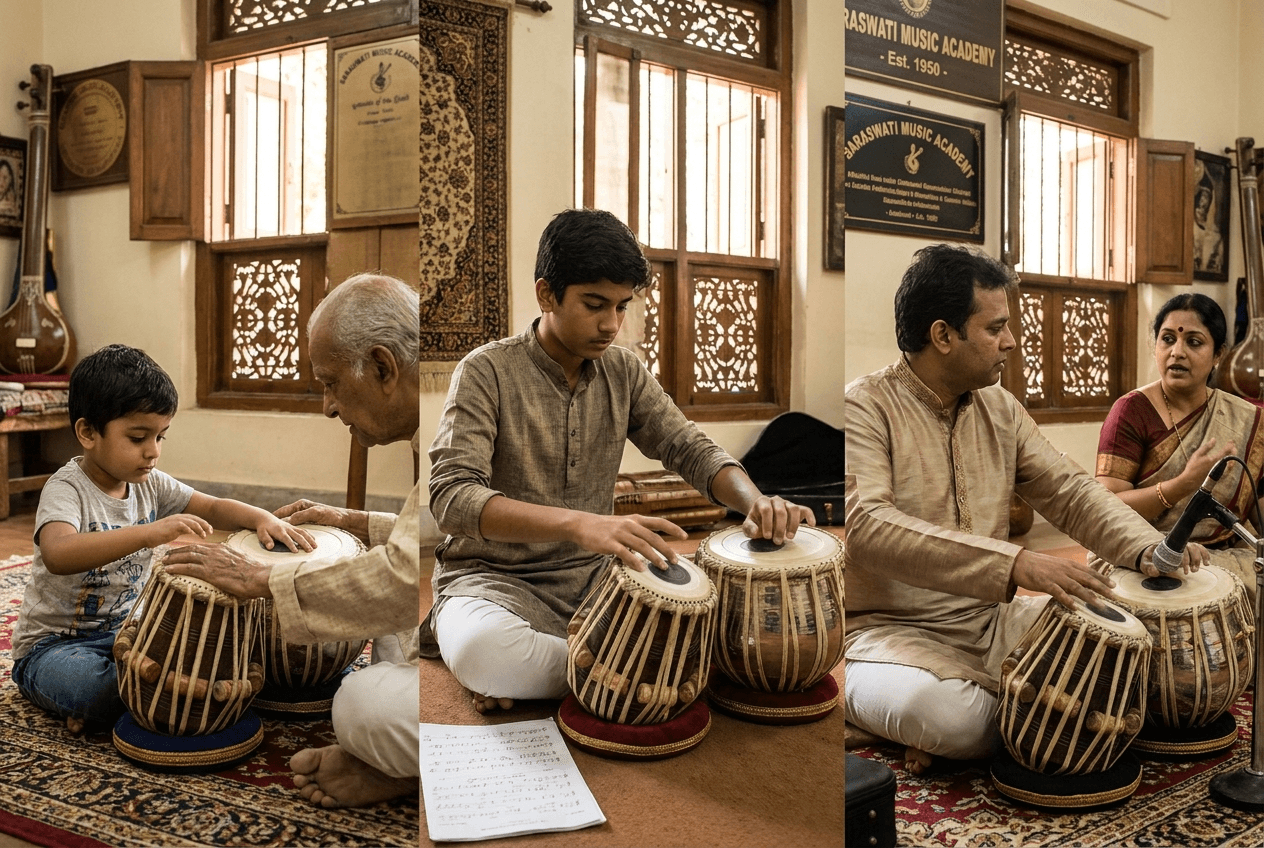
All tabla training begins with the basic strokes of the dhayan: Na, Tin, Te, Ti and Re, and the corresponding strokes of the bayan. Correct hand position, wrist technique and the balance of relaxation and engagement that produces a clean, resonant tone are the focus of the earliest lessons. Students learn the basics of Teen Taal, the sixteen-beat rhythmic cycle that forms the foundation of most early tabla study, and develop their ability to count accurately while playing.
Elementary Stage, Ages 9 to 12
Elementary students develop their bol vocabulary, begin working on kayda compositions and start learning rela, the fast flowing sequences that develop finger agility and rhythmic fluency. Students at this level work across multiple tala structures beyond Teen Taal and develop the ability to maintain consistent tempo across a range of speeds.
Intermediate Stage and Beyond
Intermediate students work on more complex talas, extended kayda and peshkar compositions, and the skill of tabla accompaniment, learning to support a vocalist or instrumentalist in live performance. This requires sophisticated musical awareness and responsiveness, and its development marks the transition from solo student to genuine musical collaborator.
Buying a Tabla in Canada
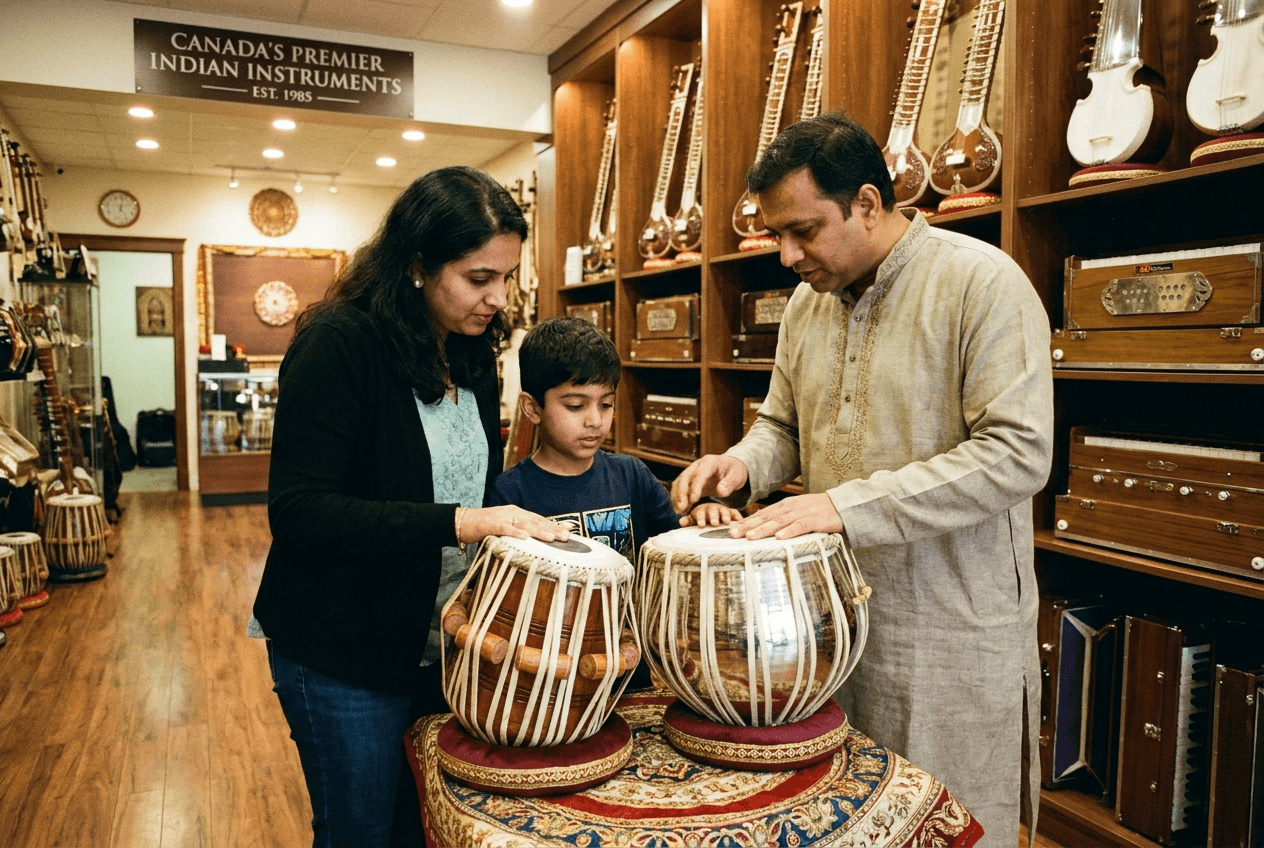
 One of the first practical questions parents ask is where to buy a tabla in Canada. We have a detailed tabla buying guide on the Art Gharana website. For Canadian families, quality student-grade tabla sets are available from Indian music suppliers in the GTA and Vancouver, as well as from online retailers shipping within Canada. Stores in the Indian commercial areas of Brampton's Dixie Road, Mississauga's Hurontario corridor and Vancouver's Surrey commercial areas typically carry or can order tabla sets. Your Art Gharana teacher will give specific recommendations at the first class based on your child's age, hand size and your budget.
How Art Gharana Compares
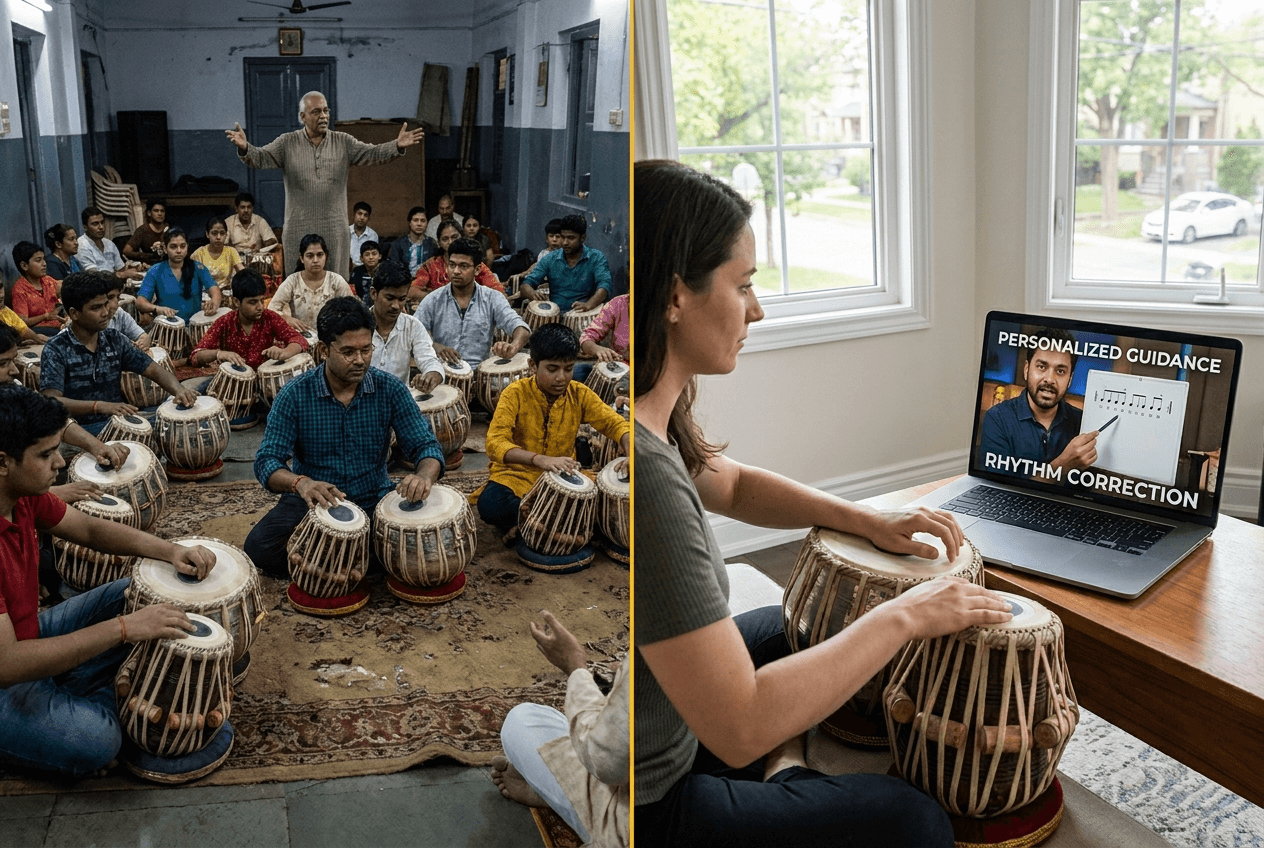
 Canadian families evaluating tabla options will find a landscape dominated by local community group classes and individual teachers with variable qualifications. Here is how Art Gharana compares.
Group community tabla classes in Canada operate on fixed schedules, at specific locations and with class sizes that limit individual teacher attention. The format works for community cohesion but produces slower individual progress than one-to-one instruction. Marketplace teacher listings offer varying quality with minimal credential verification. Art Gharana provides live, one-to-one instruction from formally trained Hindustani percussion teachers, with clear curriculum structure, certificate progression and full scheduling flexibility across all Canadian time zones.
Tabla Alongside Other Indian Arts
Tabla pairs naturally with Hindustani vocal and Kathak dance. Our Hindustani vocal classes develop the melodic and rhythmic intelligence that makes tabla students better musicians, and vice versa. The tabla-vocal dialogue is one of the most central features of classical Hindustani performance, and students who study both simultaneously consistently develop faster and more sophisticated musical intelligence than those who study only one.
For dance families, our Kathak classes pair directly with tabla training, as the rhythmic cycles of Kathak footwork are the same tala structures that tabla students master from the percussionist's perspective. Our flute classes are also a natural complement. Explore our full range of courses for all available options.
About Art Gharana
 Art Gharana is a specialist online Indian arts education platform with over 50 certified teachers across dance, music and vocal disciplines. Our tabla programme serves Indian-Canadian families across all provinces with live one-to-one instruction from formally trained Hindustani percussion teachers. Browse our teacher profiles and review our plans and pricing to get started.
Frequently Asked Questions
1. Where can I buy a tabla in Canada?
Student tabla sets are available from Indian music suppliers in the GTA and Vancouver commercial areas, and from online retailers shipping within Canada. Your Art Gharana teacher will give specific recommendations at your child's first class.
2. What age can children start tabla in Canada?
Children can begin tabla from around age 6, when their hands are large enough to work on the basic strokes effectively. Your teacher will assess your child's readiness at the trial class.
3. Can tabla be taught effectively online?
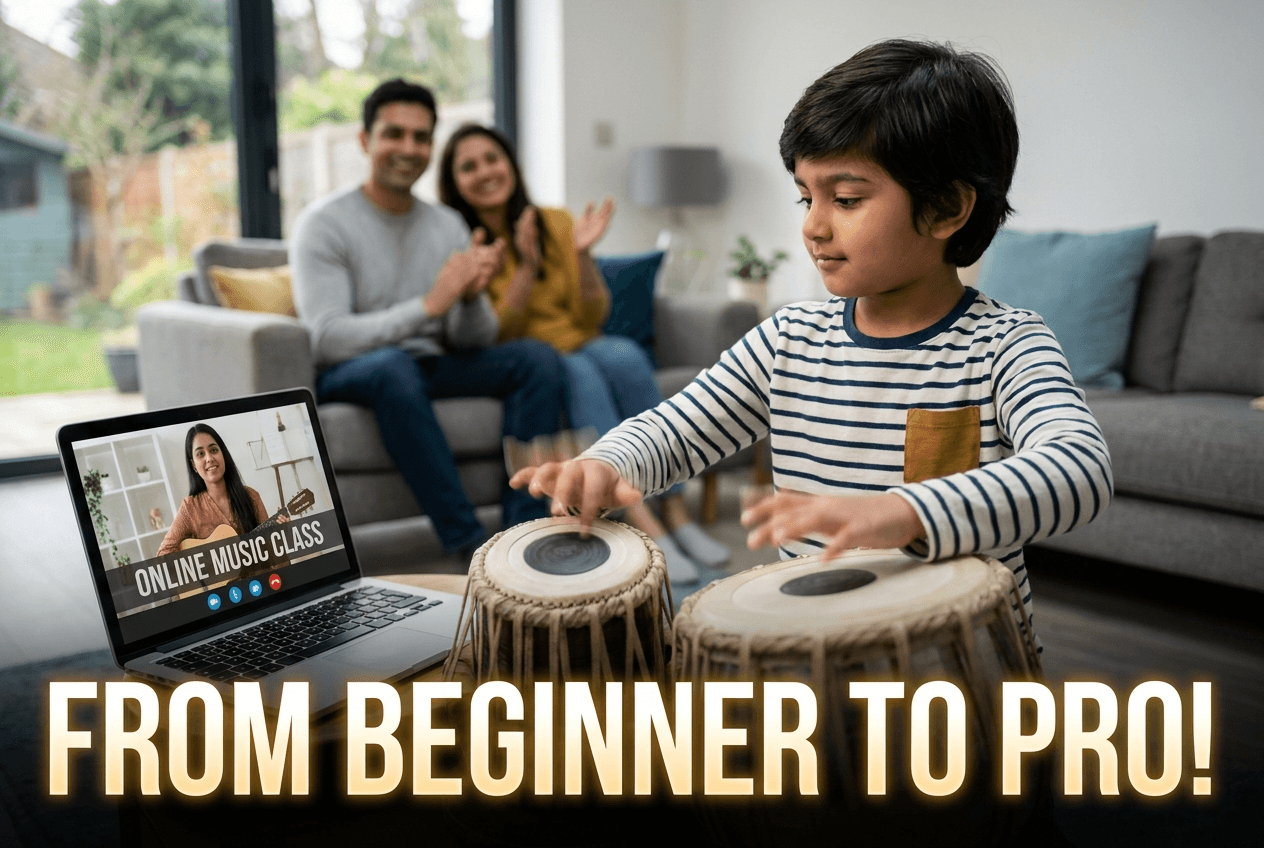
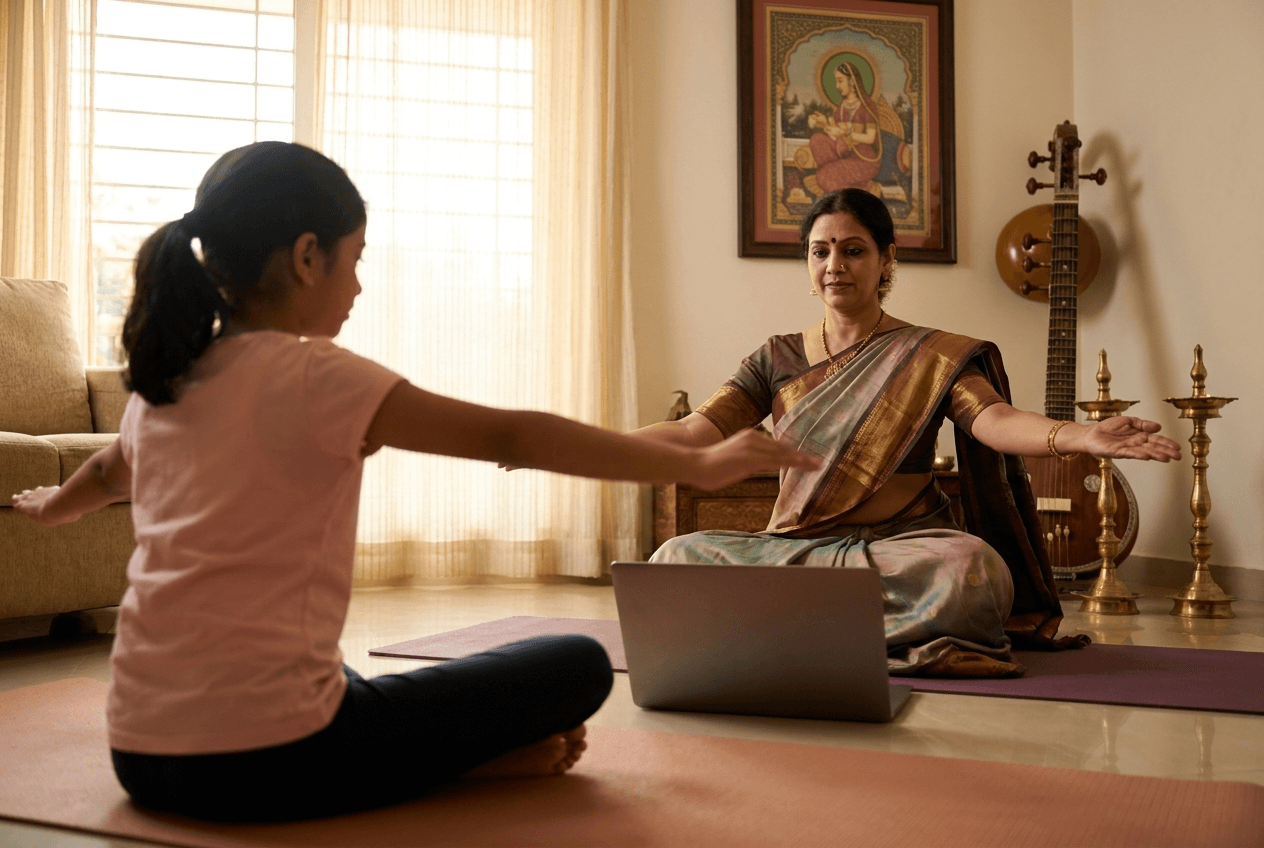
Yes. One-to-one online tabla instruction allows the teacher to see your child's hands clearly throughout the session and provide precise, real-time corrections to stroke technique and timing.
4. How long does it take to learn tabla?
Basic tabla proficiency typically takes one to two years of regular practice. An intermediate standard usually takes three to four years of consistent weekly lessons and daily home practice.
5. Are classes available across Canada, not just in the GTA?
Yes. Art Gharana's online programme serves families across all Canadian provinces in all time zones, including British Columbia, Alberta, Manitoba, Ontario, Quebec and Atlantic Canada.
Book Your Child's Free Tabla Trial Class Today
The tabla is one of the world's great musical instruments. With live one-to-one classes available across Canada, certified Hindustani percussion teachers, flexible Canadian time zone scheduling and a completely free first lesson, there is nothing standing between your child and the music. Head to our book a free trial class page and begin today.
The Sound of the Tabla and Why It Captivates
Many Canadian parents who did not grow up playing tabla themselves wonder why their children respond to the instrument with such immediate fascination. The answer lies in the tabla's extraordinary sonic character. It produces sounds unlike any instrument in Western music: the resonant, almost singing quality of the dhayan's Na stroke, the deep pressure-driven bass of the bayan's Ga stroke, the sharp bright crack of the Te, the rolling complexity of rela patterns played at high speed. These sounds connect to something fundamental in the human experience of rhythm and resonance.
Children who hear tabla played well at a community event, at a temple bhajan session or at a Diwali performance often come to their parents that evening and express a desire to learn. This desire arises from genuine sensory and aesthetic delight rather than from obligation or cultural duty. Intrinsic motivation of this kind is one of the best predictors of long-term success in any learning endeavour, and it makes the tabla a particularly compelling choice for musically inclined Indian-Canadian children who have not yet found their instrument.
A Typical Week for a Canadian Tabla Student
Understanding what a week of tabla training actually looks like helps Canadian parents assess whether the commitment is realistic for their family. For a beginner student, the weekly schedule involves one 45-minute live class with their Art Gharana teacher plus 20 to 30 minutes of daily home practice. The practice session follows the specific plan the teacher provides after each class: typically 10 minutes of individual stroke practice on the dhayan, 10 minutes working on the bayan strokes, and 10 minutes practicing the theka, the basic rhythmic framework of the tala cycle the student is working in.
Over time, as the student advances and the repertoire grows, practice sessions naturally lengthen. By the elementary level, most students practice for 30 to 45 minutes daily. Many Art Gharana tabla students in Canada describe the practice sessions themselves as one of the most enjoyable parts of their week. The experience of playing a well-tuned tabla cleanly and musically, feeling the resonance of the instrument through their hands and the rhythmic satisfaction of landing a complex bol sequence precisely, is genuinely pleasurable in a way that dry technical practice in many instruments is not. When practice becomes enjoyable rather than obligatory, progress accelerates dramatically.
Tabla and the Indian-Canadian Cultural Calendar
For Indian-Canadian children who have developed to an intermediate tabla level, the Canadian cultural calendar provides rich opportunities for public performance. Temple bhajan evenings, where a tabla student can accompany the devotional singing of their community, are among the most meaningful of these contexts. Cultural festival performances, multicultural school events, family celebrations and community Diwali shows all provide platforms where tabla skill is immediately appreciated and celebrated.
The experience of accompanying a vocalist or other instrumentalist in live performance, even at the informal level of a community bhajan session or family gathering, is one of the most valuable and transformative experiences available to a tabla student. The deep, responsive musical conversation between a tabla player and a vocalist, the way each musician responds to and influences the other's phrasing in real time, is one of the most profound experiences in all of Indian music. Art Gharana teachers prepare their Canadian students for these accompaniment contexts from the intermediate level, developing the musical listening and responsiveness skills that make a tabla player a genuine musical partner rather than merely a timekeeper.
Tabla as an Academic Advantage
In the competitive Canadian and US college application landscape, serious training in a classical Indian instrument is genuinely distinctive. Most applicants list piano, violin or guitar. A student who lists several years of serious tabla training, with performance experience at cultural events and formal certification examinations, presents an extracurricular profile that stands out in ways that Western instrument training simply cannot. Art Gharana's tabla curriculum is structured to prepare students for recognised certification examinations, providing students with a formal credential that demonstrates sustained achievement in a rigorous classical arts tradition. Many Art Gharana families in Canada have found that their children's tabla training has been a significant differentiator in the university application process, mentioned specifically by admissions readers as something genuinely distinctive and impressive.
Beyond college applications, the cognitive benefits of tabla training are documented and significant. The bilateral coordination demands, the rhythmic mathematics, the sustained practice discipline and the performance experience that tabla training develops are all directly transferable to academic performance. Several Art Gharana families in Canada have reported that beginning tabla training coincided with measurable improvements in their children's school performance, particularly in mathematics and concentration. The tabla is, in the most literal sense, a cognitive training tool as well as a musical and cultural one.
Home Practice for Canadian Tabla Students
The tabla develops through repetition, and repetition requires consistent daily practice between weekly classes. For beginner students in Canada, the daily practice commitment is modest: 20 to 30 minutes of focused work on the specific strokes and patterns the teacher has assigned. The most common mistake made by families in the early stages is treating the weekly class as the entirety of the learning experience. The class is where new material is introduced and corrections are made. The daily practice is where those corrections are internalised and where the physical habits of clean stroke production, accurate timing and relaxed technique are built into the hands.
Art Gharana tabla teachers provide specific, actionable practice plans after every class. Rather than a general instruction to practise, the plan specifies exactly which strokes to work on, which theka to practise, for how long and what to listen for in terms of tone quality. Following this plan consistently is the single most effective thing a Canadian tabla family can do to maximise the value of the programme. Families who build a regular daily practice session into the after-school routine, treating it with the same consistency as homework, report progress rates that are genuinely impressive to observe over the course of a year.
Canada offers Indian-Canadian families a remarkable range of contexts in which tabla skill becomes publicly valuable: temple bhajan sessions, cultural competitions, school multicultural events, community Diwali performances and family celebrations. For the child who has invested in consistent tabla training over several years, these contexts transform from passive attendance to active cultural participation. That transformation, from audience member to performer, from cultural observer to cultural practitioner, is one of the most valuable outcomes of Indian arts education in the Canadian diaspora context, and it is what Art Gharana works toward with every tabla student it teaches.
The tabla tradition is thousands of years old and has been carried to Canada by the South Asian diaspora with remarkable fidelity and care. Art Gharana is committed to continuing that transmission for the next generation of Indian-Canadian children, wherever in this vast country they happen to live. From the first Na stroke to the first public performance, from the first practice session to the first certification examination, Art Gharana's certified tabla teachers are with your family every step of the way. The free trial class is the beginning. Book one today.
Tabla is one of the world's great instruments. It is also one of the most powerful vehicles for Indian cultural transmission available to Canadian families, combining musical beauty, rhythmic complexity, cognitive development and community connection in a single practice that is uniquely suited to the Indian-Canadian experience. Art Gharana's certified tabla teachers are available to families in every province and territory in Canada, in every time zone, at every level from absolute beginner to advanced. The free trial class is the door. Walk through it and let your child's tabla journey begin.
Art Gharana serves tabla students in British Columbia, Alberta, Saskatchewan, Manitoba, Ontario, Quebec, New Brunswick, Nova Scotia, Prince Edward Island, Newfoundland and Labrador and across the territories. Canada is a vast country. The tabla tradition is vaster still. Art Gharana brings them together.
The tabla is ready. The teacher is ready. The tradition is ready. All that remains is for your family to take the first step. Book the free trial class today at artgharana.com and let your child's tabla journey begin in earnest. Families across Canada from Newfoundland to British Columbia have already taken that step and found it to be one of the best decisions of their children's upbringing.