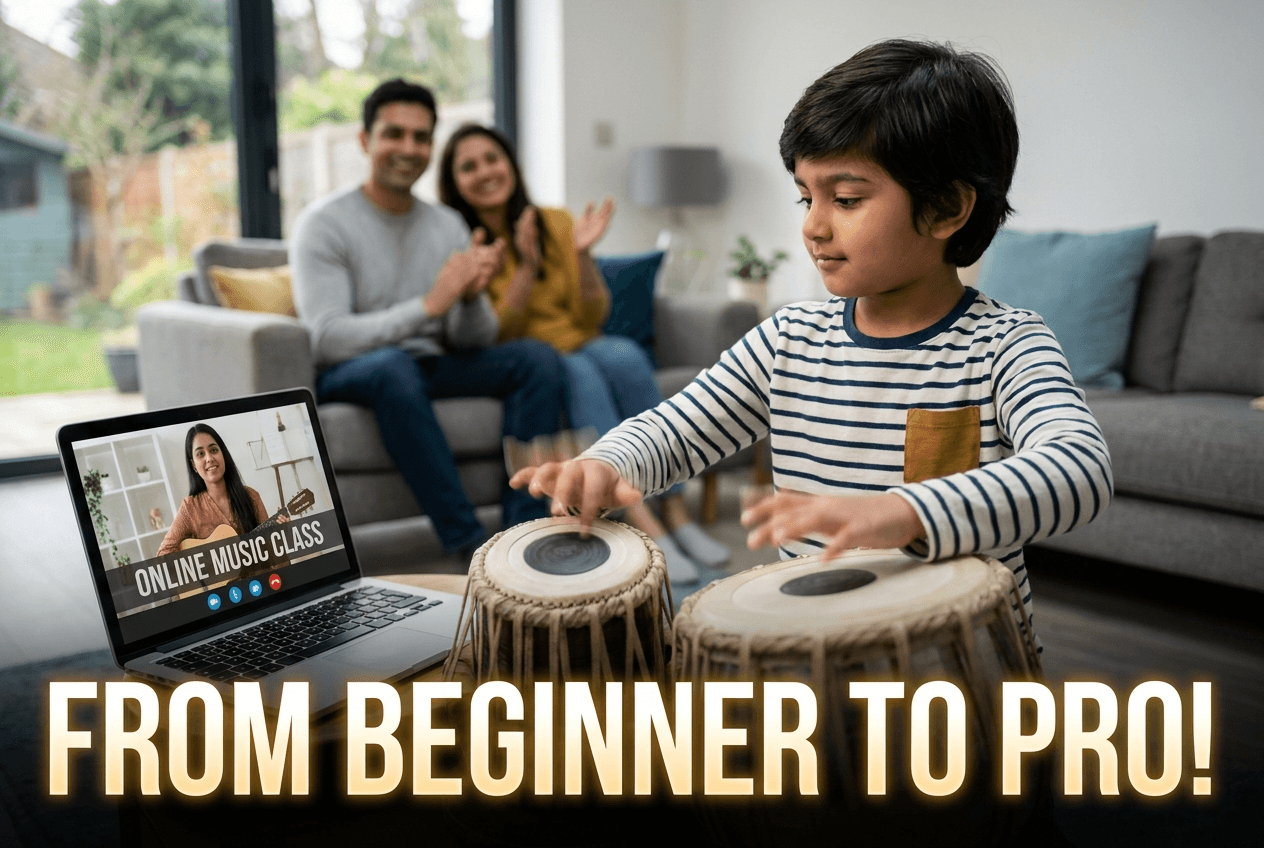
The tabla is one of the most iconic sounds in all of Indian music. Its complex rhythmic patterns, the satisfying resonance of its bols, and the way it sits at the heart of Hindustani classical performance make it one of the most rewarding instruments a child can learn. For Indian families across the United Kingdom, tabla lessons have long been a priority, but access to genuinely qualified teachers has historically been difficult and inconsistent.
The arrival of live online instruction has completely transformed this picture. Today, families in London, Leicester, Birmingham, Manchester, Glasgow, Edinburgh and every other corner of the UK can access certified tabla teachers with extensive classical training, learning one to one in real time from home. This guide covers everything you need to know about online tabla classes in the UK in 2026, from what the instrument involves and what your child will learn, to how to buy a tabla in the UK and what to look for in a teacher.
If you are already ready to explore, you can book a free first session directly on the Art Gharana website. If you want the full picture first, read on.
What Is the Tabla and Why Is It So Special?
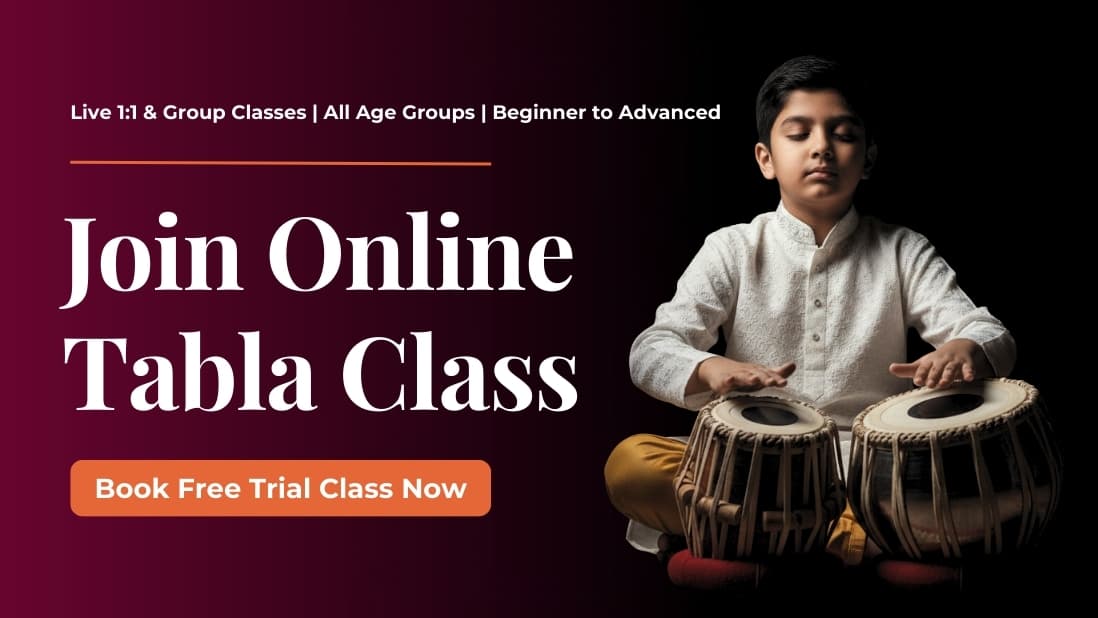
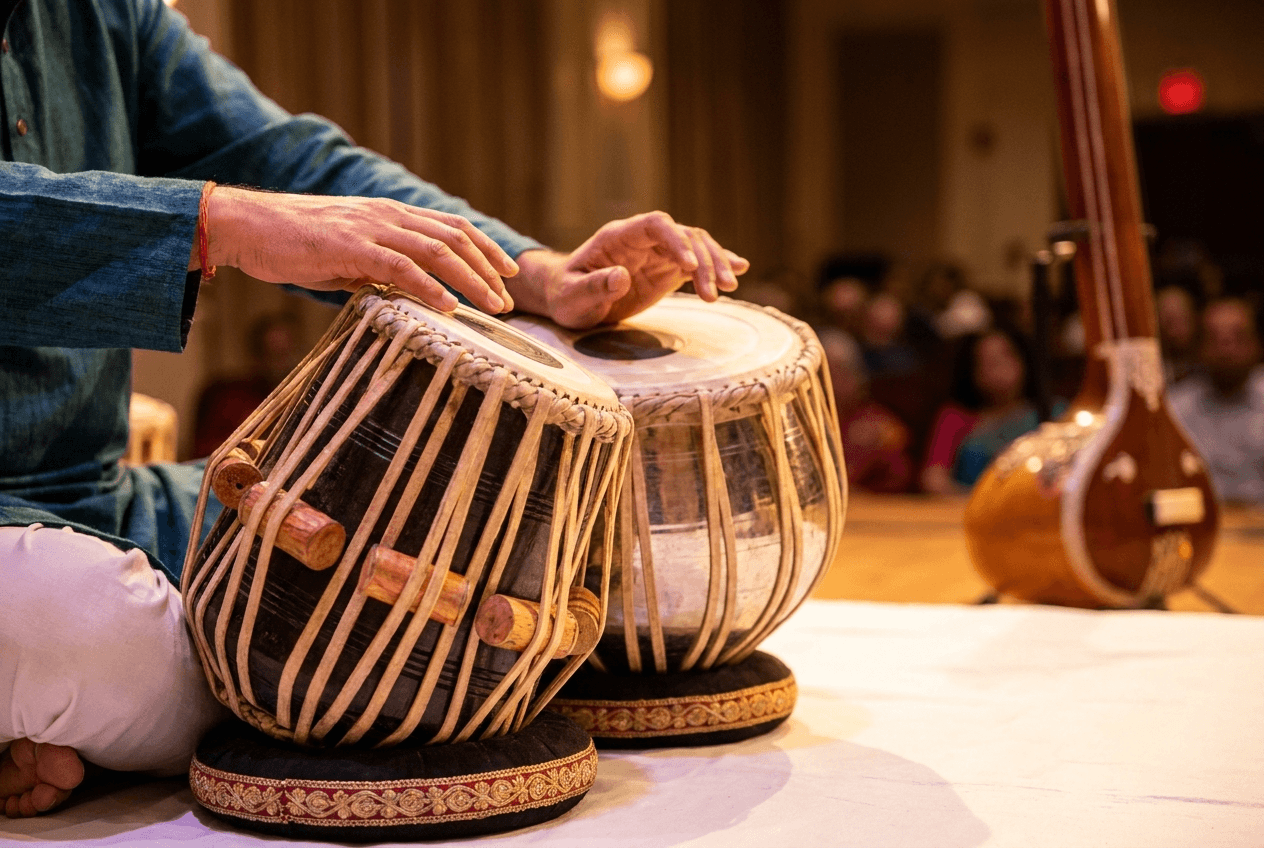
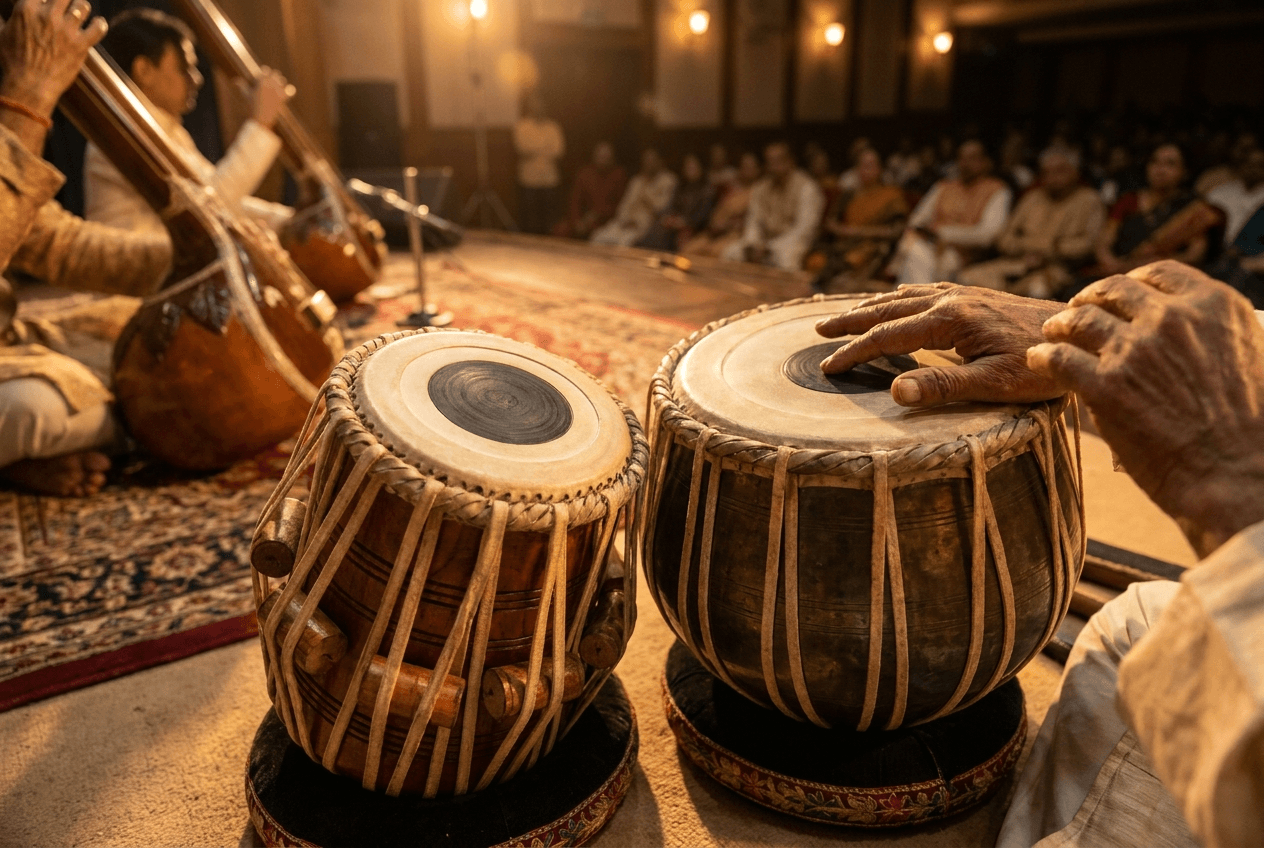 The tabla is a pair of hand drums that sits at the very heart of Hindustani classical music in North India. The pair consists of two drums that are always played together: the dhayan, a smaller cylindrical drum played with the right hand that produces a range of bright, melodic tones, and the bayan, a larger, bowl-shaped drum played with the left hand that produces the deep bass tones and the characteristic pressure sounds that give the tabla its unique voice.
What makes the tabla extraordinary among all the world's percussion instruments is its exceptional tonal range. Unlike a Western drum kit, which produces relatively fixed tones, the tabla can produce a remarkable variety of distinct sounds from a single drum head. Each sound, called a bol, is produced by a different combination of fingers, different areas of the drum head, and different amounts of pressure. The vocabulary of tabla bols is an entire language in itself, and learning to speak it fluently is the central work of tabla training.
The dhayan is tuned to a specific pitch, typically the root note of the musical performance it accompanies. This tuning process, using a hammer to tap the wooden pegs around the drum shell, is a skill that students learn in the early stages of training. The care that goes into keeping a tabla well-tuned is part of the respect and devotion that the instrument inspires in those who play it.
In the Hindustani classical tradition, rhythm is organised into cycles called talas. The most commonly taught tala for beginners is Teen Taal, a sixteen-beat cycle that forms the foundation of most early tabla study. As students advance, they encounter an extraordinary variety of tala structures, from the six-beat Dadra to the asymmetric rhythms of Jhaptaal and beyond, developing a rhythmic vocabulary that is among the most sophisticated in any musical culture in the world.
Why Tabla Is an Outstanding Choice for Children
Rhythmic Intelligence and Mathematical Thinking
Learning tabla develops what musicians call rhythmic intelligence, the ability to perceive, internalise and reproduce complex rhythmic structures with accuracy and expression. This capacity is directly linked to mathematical thinking. The counting, division and pattern recognition required to perform confidently within tala structures is essentially advanced arithmetic delivered through music. Children with strong rhythmic training consistently demonstrate better performance in numeracy and problem-solving tasks.
Bilateral Coordination
Because tabla requires the two hands to play completely independent patterns simultaneously while remaining in perfect rhythmic synchronisation, it develops bilateral coordination to an extraordinary degree. Each hand must work independently while staying locked to the other in time. This demand challenges and develops the nervous system in ways that few other childhood activities can match, with measurable benefits for fine motor skills, hand-eye coordination and overall physical control.
Concentration and Patient Practice
Mastering tabla requires genuine patience and sustained concentration. Progress comes from attentive, focused practice, and the discipline this demands builds habits of careful effort that serve children across every area of their education. In an age of short attention spans and constant digital distraction, the quiet, focused work of tabla practice is one of the most valuable counterbalances available to a child.
Cultural Connection and Heritage
For children from Indian families in the UK, the sound of the tabla carries deep cultural resonance. It is the sound of religious ceremony, classical concert, family celebration and Bollywood film. Learning to produce that sound, to step inside it and command it with their own hands, gives children a connection to their heritage that is physical, immediate and irreplaceable. Many parents describe hearing their child's first successful bol as a genuinely moving experience.
Musical Foundation
Tabla training builds a deep, structural understanding of rhythm that benefits any musician regardless of instrument. Children who learn tabla become better singers, better dancers and better players of every other instrument they encounter, because they understand rhythm from the inside out in a way that most musicians never develop.
What Your Child Will Learn: The Art Gharana Tabla Curriculum
Beginner Stage, Ages 6 to 9
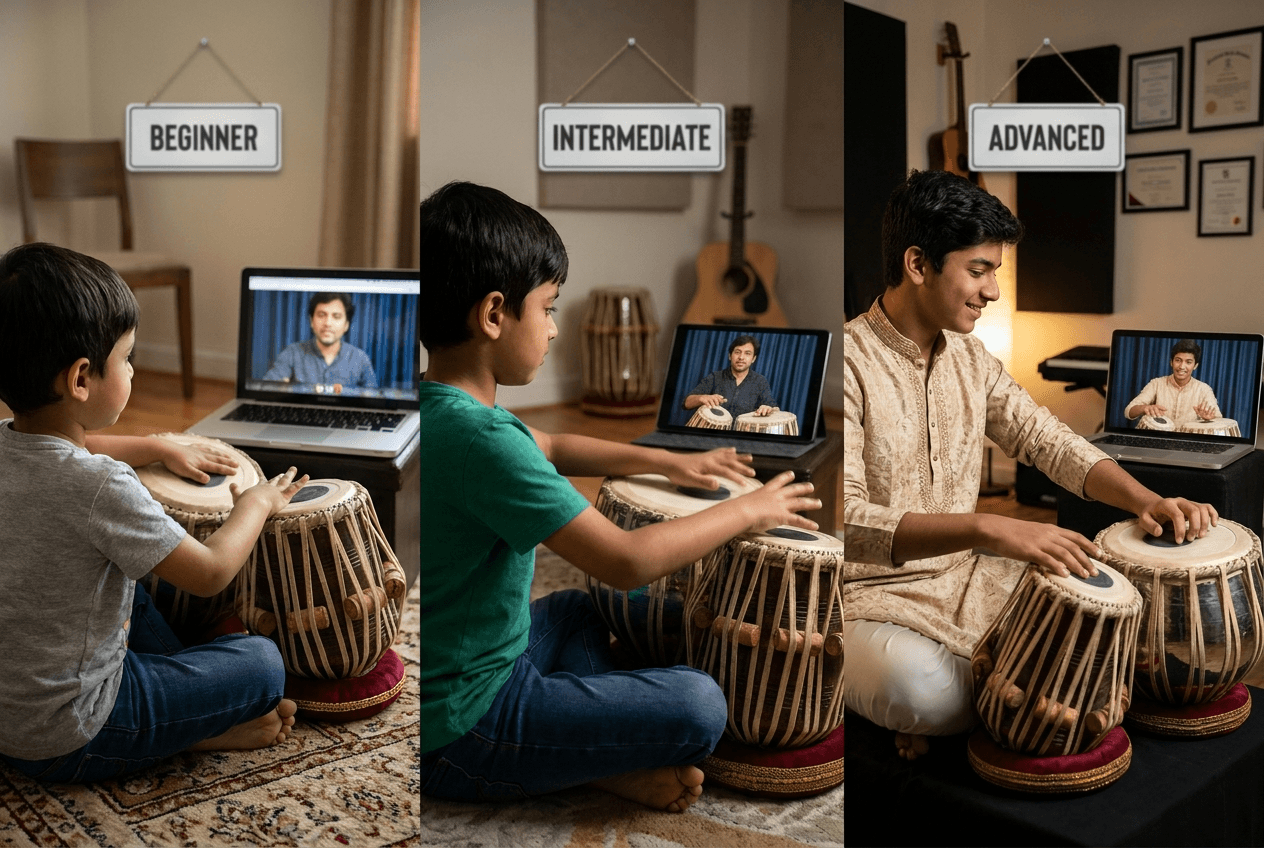
The beginner stage is entirely focused on building correct physical technique. Students learn the basic strokes of the dhayan, including Na, Tin, Te, Ti and Re, and the corresponding strokes of the bayan. Particular attention is paid to hand position, wrist movement and the correct balance of relaxation and engagement that produces a clear, resonant sound rather than a dull thud. Students learn the basics of Teen Taal, begin to play simple theka compositions within that cycle, and develop their ability to count accurately while playing.
Elementary Stage, Ages 9 to 12
At the elementary stage, students develop their bol vocabulary and begin working on kayda compositions, a form in which a short rhythmic phrase is taken through a systematic series of variations and elaborations. They also begin working on rela, the fast, flowing compositions played at high speed that develop finger agility and rhythmic fluency. Students at this level start developing their understanding of multiple tala structures beyond Teen Taal and learn to maintain accurate tempo across a range of different speeds.
Intermediate Stage, Ages 12 and Above
Intermediate students work on more complex talas, extended kayda and peshkar compositions, and the skill of tabla accompaniment. Learning to support a vocalist or instrumentalist in live performance, adjusting dynamically to the other musician's phrasing and improvisation, is one of the most sophisticated skills in Indian classical music, and its development is a major focus at this stage. Students also begin to develop their own improvisational vocabulary within the framework of a tala.
Buying a Tabla in the UK: A Practical Guide
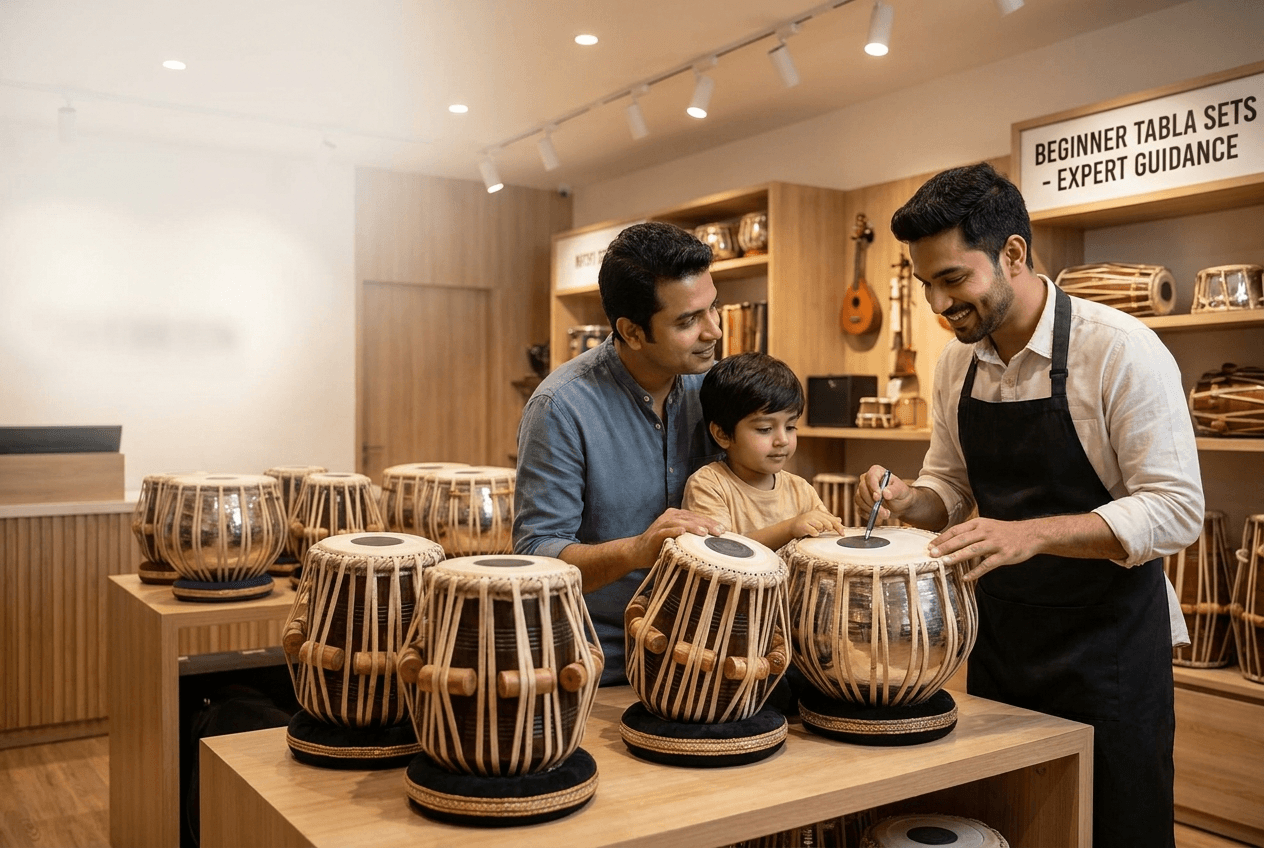 One of the first practical questions parents ask is where to buy a tabla in the UK. We have a detailed )[tabla buying guide](https://www.artgharana.com/blogs/musical-instruments/tabla-buying-guide on our website that covers everything in depth, but here is a concise overview to get you started.
What to Look for in a Beginner Tabla
For a child starting out, a good quality student-grade tabla set is entirely adequate. You do not need a professional instrument to begin learning. What matters most is that the drum heads, called pudi, are in good condition and produce a clear, resonant tone, and that the wooden tuning pegs, called gatta, are intact and functional. Student tabla sets are available from Indian music suppliers in the UK and through online retailers, and prices for a solid beginner set start from around forty to sixty pounds.
What to Avoid
Very cheap tabla sets, typically those priced under thirty pounds, often have drum heads of poor quality that produce an unclear sound and cannot be tuned properly. A student practising on a poorly sounding tabla will struggle to develop accurate tonal awareness and will find it much harder to progress. It is worth spending a little more to get a set that sounds clean and responds correctly to the basic strokes.
Your Teacher Will Advise
At your child's first class, your Art Gharana teacher will advise you on specific instrument recommendations based on your child's age, hand size and the budget you have available. Many teachers can point you to reliable UK-based suppliers who they have direct experience with. You do not need to purchase anything before the trial class.
How Art Gharana Compares to Other Online Tabla Providers
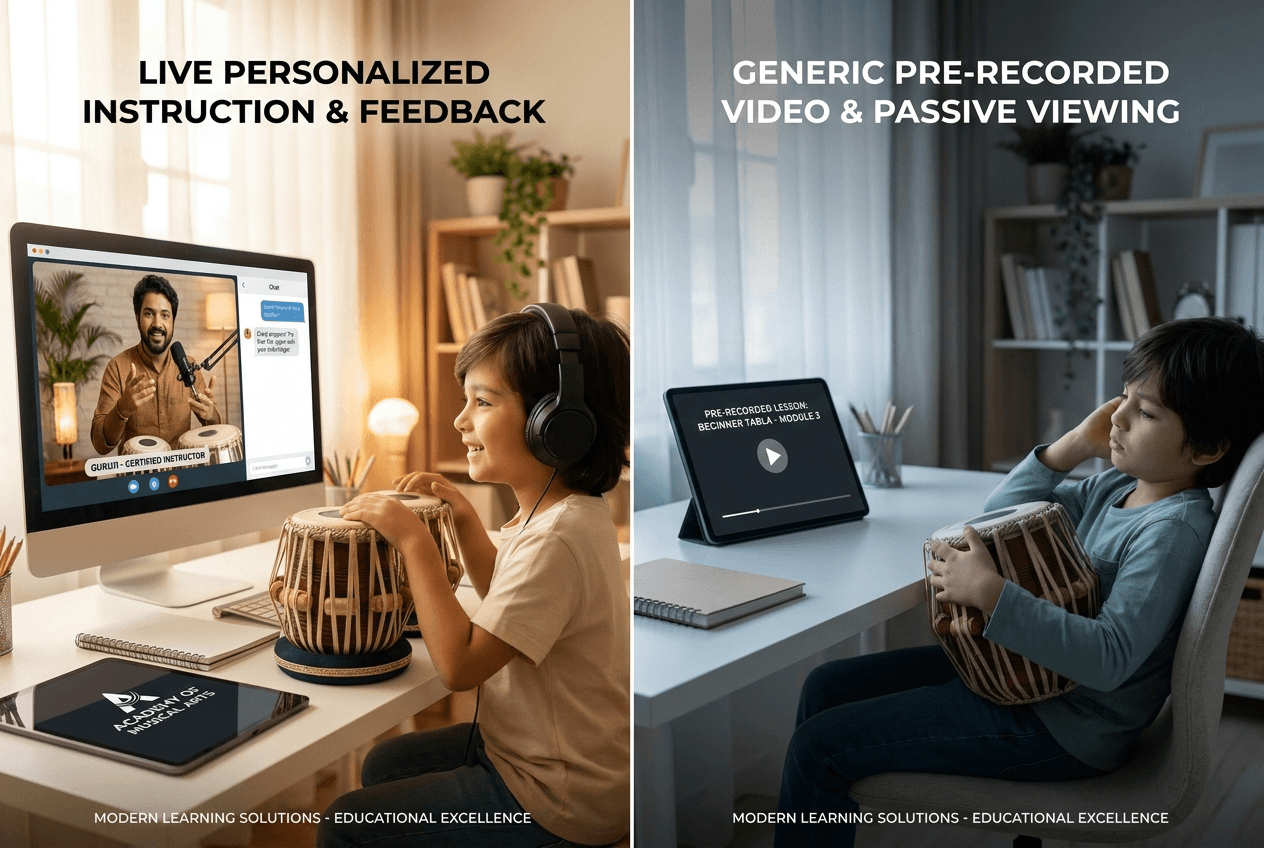 UK parents searching for online tabla classes for their children will encounter a range of options, from tutor marketplaces to pre-recorded video courses to group live classes. Here is a clear comparison of what is available and how Art Gharana is different.
The single most important distinction is between live one to one instruction and everything else. Pre-recorded videos cannot correct your child's hand position. Group classes cannot adapt to where your specific child is in their development on a given week. A teacher on a marketplace with no verified qualifications may not have the classical training needed to teach tabla correctly. Art Gharana provides live, one to one instruction from formally qualified teachers, in UK time zones, with a children-specific curriculum and a free trial so you can assess the quality before committing to anything.
How Live Online Tabla Classes Work at Art Gharana
All tabla classes at Art Gharana are delivered live, one to one, via video call. At the scheduled time, your child connects with their teacher and the class begins exactly as it would in a physical music room. The teacher demonstrates strokes and compositions, guides your child's practice, and provides real-time feedback on technique throughout the session.
The camera can be positioned to give the teacher a clear view of your child's hands and the tabla surface, enabling precise corrections to hand position, finger placement and stroke technique. Sessions are 45 minutes long and are scheduled in UK time zones. You can review our plans and pricing to see exactly what each plan includes and choose the option that works best for your family.
Between sessions, your child receives a structured practice plan from their teacher covering specific strokes and compositions to work on. Daily practice of even 20 to 30 minutes accelerates progress significantly. The teacher monitors what has been practised at each subsequent session and builds on it systematically.
Tabla Alongside Other Indian Arts
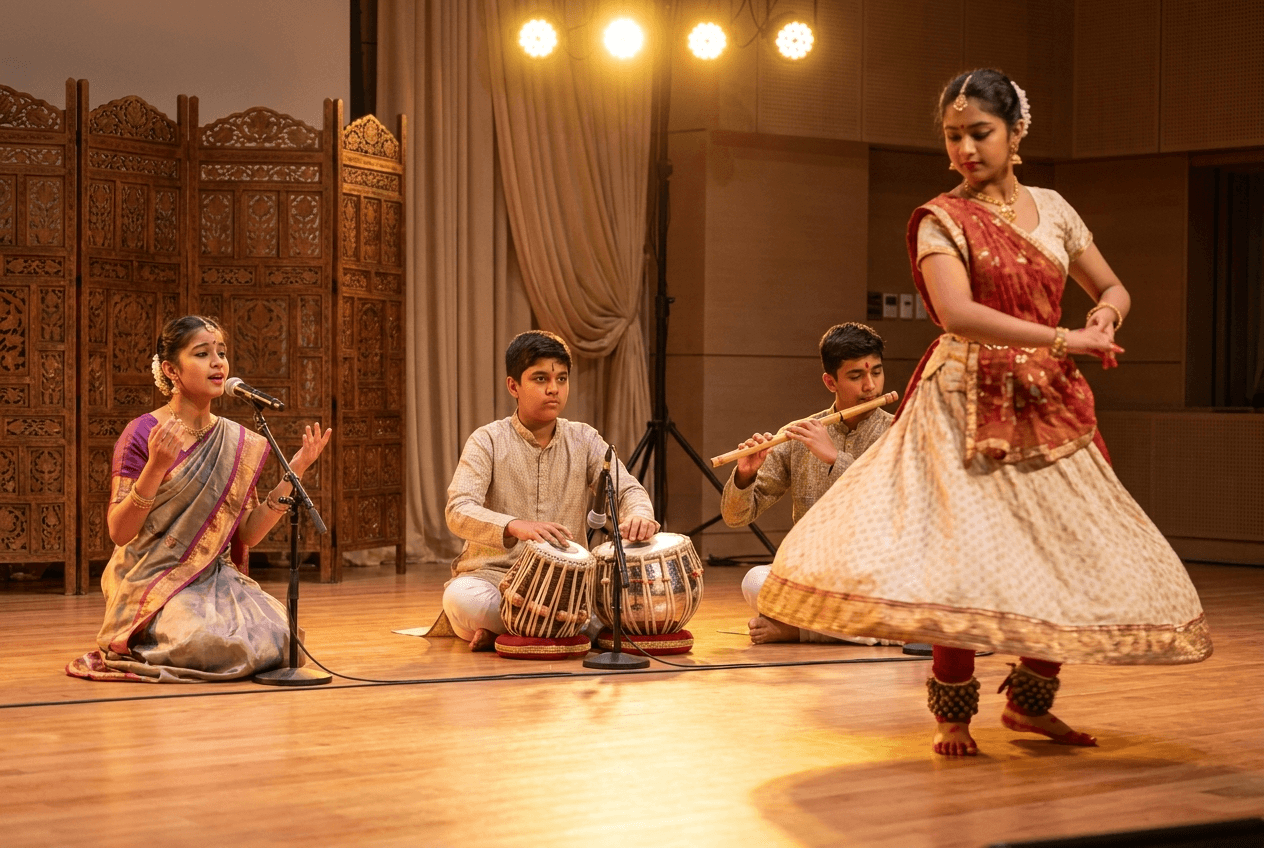 Tabla pairs exceptionally well with other Indian arts, and many Art Gharana families choose to combine tabla with a second discipline. Our Hindustani vocal classes are a natural complement to tabla training. Vocal students who study tabla develop a rhythmic awareness that dramatically enriches their singing, and tabla students who study vocal gain a melodic understanding that gives depth to their rhythmic improvisation. The two arts have grown alongside each other in the Hindustani classical tradition for centuries, and studying both simultaneously accelerates progress in each.
Students who are drawn to melody as well as rhythm often also explore our flute classes, where the deep rhythmic understanding that tabla training develops becomes an immediate asset in learning to phrase and breathe within musical cycles. For families interested in dance, our Kathak classes pair beautifully with tabla, as the footwork rhythms of Kathak are deeply connected to the tala structures that tabla students study. You can explore our full range of courses to find the right combination for your child.
Setting Up for Your Child's First Tabla Class
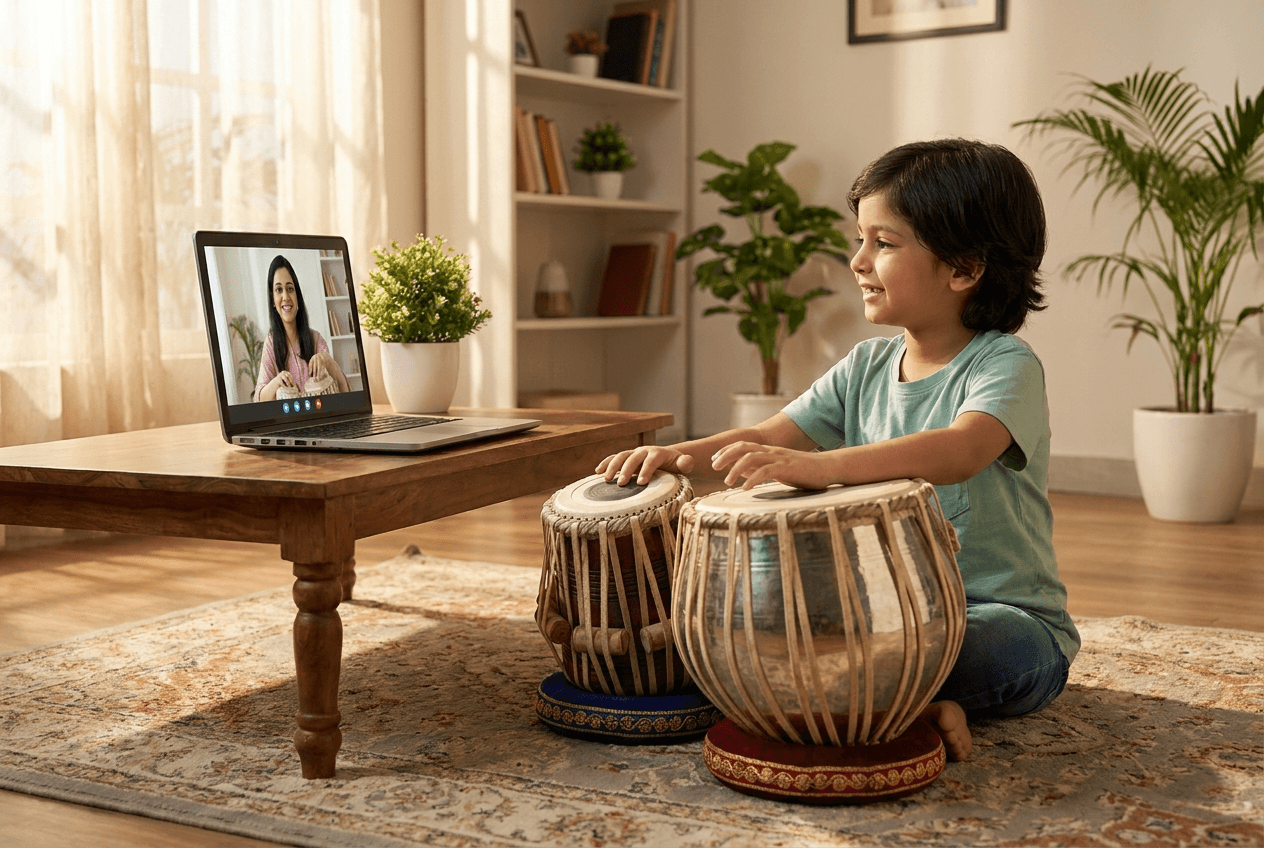 A little preparation before the first session makes a significant difference to how smoothly it goes. Here is what to have in place.
• Place the tabla set on a stable surface at a comfortable height for your child to sit with their arms relaxed. Traditional practice involves sitting cross-legged with the tabla resting on small cushions or rings. • Position your device so the camera gives the teacher a clear view of your child's hands and both drums. A slight angle from the side works better than directly front-on. • Make sure the room is reasonably quiet. The teacher needs to hear the quality of each stroke clearly to give accurate feedback. • Check your internet connection in advance. A stable connection is important for an instrument lesson where the teacher needs to hear subtle tonal differences. • Your child does not need to know anything before the first class. The teacher will start from the very beginning, showing how to sit with the tabla, how to position the hands and how to produce the first basic strokes. • Talk to your child about the instrument before the class. Look up a short video of professional tabla playing together and let them hear what they are working towards. Excitement about the destination is a powerful motivator.
Online Tabla Classes Across the UK
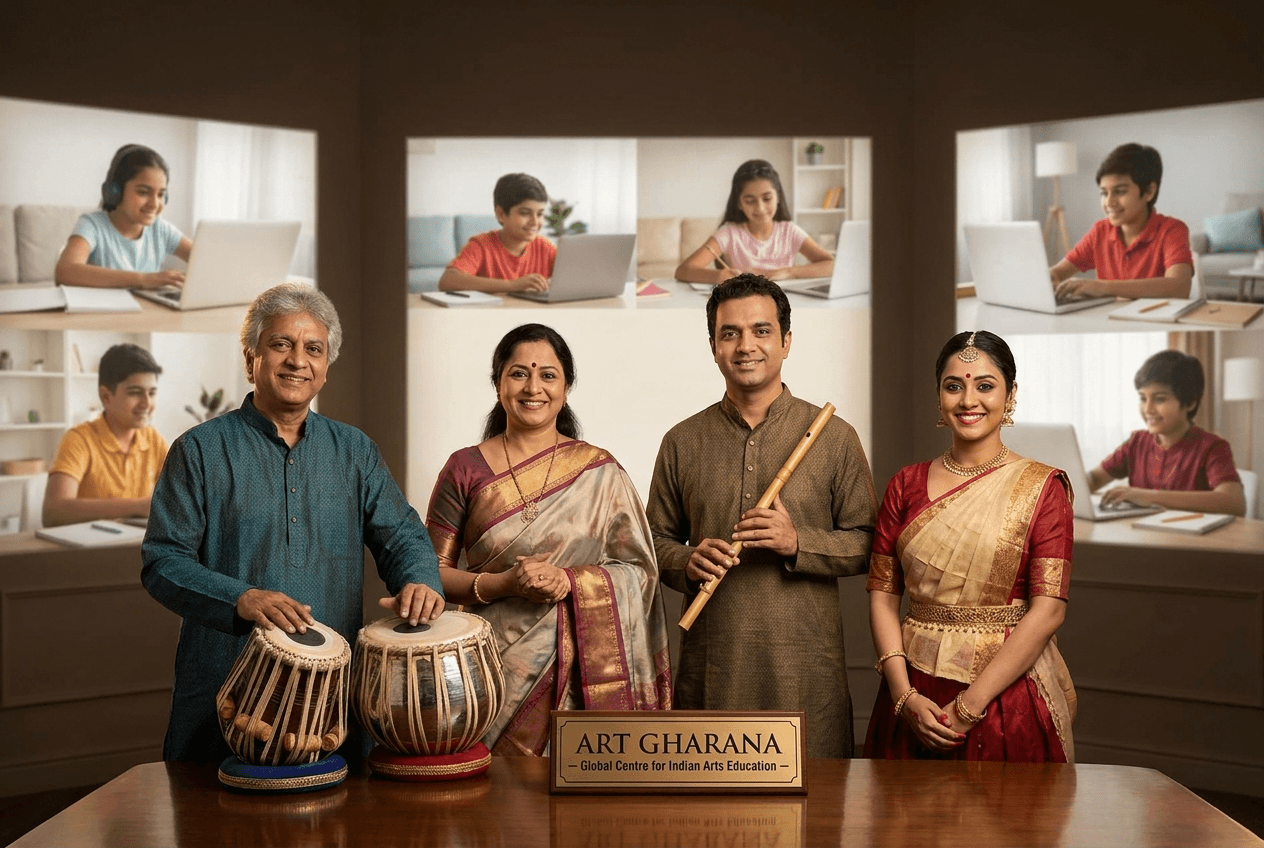 Art Gharana serves tabla students right across the United Kingdom. We have active students learning online from London, Leicester, Birmingham, Manchester, Bradford, Leeds, Sheffield, Glasgow, Edinburgh, Cardiff, Bristol, Coventry and many other cities. Because all instruction is live via video call, the quality of teaching is identical regardless of where in the UK you are based.
For families in cities with large Indian communities, particularly Leicester, Birmingham and the London boroughs of Harrow, Wembley and East Ham, tabla classes are a direct link to the musical traditions that form the backdrop to community celebrations, temple events and cultural gatherings throughout the year. For families in smaller towns and rural areas where no local Indian music teacher is available, Art Gharana's live online programme is often the only route to quality tabla instruction.
About Art Gharana
Art Gharana is a specialist online Indian arts education platform with over 50 certified teachers across dance, music and vocal disciplines. We serve Indian families across the UK, USA, Canada, Australia and India. Our tabla programme is delivered by formally qualified Hindustani percussion teachers who bring both performance experience and deep expertise in teaching children. You can browse teacher profiles and introductions on our teacher profiles page to find the right instructor for your child before booking.
Frequently Asked Questions
1. Do I need to buy a tabla before starting lessons?
Yes, you will need a tabla set to practise at home between sessions. Your teacher can advise on suitable beginner instruments available in the UK at your first class. You do not need to buy anything before the trial lesson.
2. What age can children start learning tabla?
Children can generally begin tabla from around age 6, when their hands are large enough to work on the basic strokes effectively. Your teacher will assess your child's hand size and readiness at the trial class and give an honest recommendation.
3. Is tabla difficult to learn?
Tabla has a reputation for being a demanding instrument at the advanced levels, and that reputation is well deserved. However, the early stages are genuinely accessible and satisfying. Most children produce their first recognisable strokes within the first two or three sessions, and the sense of progress is immediate and motivating.
4. Can tabla be taught effectively through online lessons?
Yes, very effectively. One to one online tabla instruction allows the teacher to see the student's hands clearly throughout the session and provide precise, real-time corrections to technique. Many Art Gharana students have progressed from complete beginner to intermediate level entirely through online lessons.
5. What is the difference between the dhayan and the bayan?
The dhayan is the smaller, higher-pitched drum played with the right hand, producing the bright melodic tones that carry the rhythmic composition. The bayan is the larger, lower-pitched drum played with the left hand, producing the deep bass tones and the sustained pressure sounds. Both drums are always played together as a pair.
6. How long does it take to learn tabla?
Basic tabla proficiency, including clean strokes and simple compositions in Teen Taal, typically takes one to two years of regular practice. Reaching an intermediate standard usually takes three to four years. Consistent daily practice of 20 to 30 minutes accelerates progress significantly.
7. How often should my child practise?
Daily practice of 20 to 30 minutes is ideal and produces the fastest results. Short, consistent sessions are far more effective than occasional longer sessions. Your teacher provides a structured practice plan after each class to guide exactly what your child should work on between sessions.
8. Is there a free trial class available?
Yes. Art Gharana offers a completely free trial class with no obligation. You can experience the quality of teaching first-hand before making any commitment.
Book Your Child's Free Tabla Trial Class Today
The tabla is an instrument that rewards patience, builds discipline and opens the door to one of the world's great musical traditions. With live one to one classes available across the UK, certified teachers, flexible UK-time scheduling and a completely free first lesson, the only thing left to do is take the first step. Head to our book a free trial class page and reserve your child's first session today. We look forward to introducing your family to the extraordinary world of Indian classical percussion.