ChatGPT
 Google AI
 Grok
Grok Claude
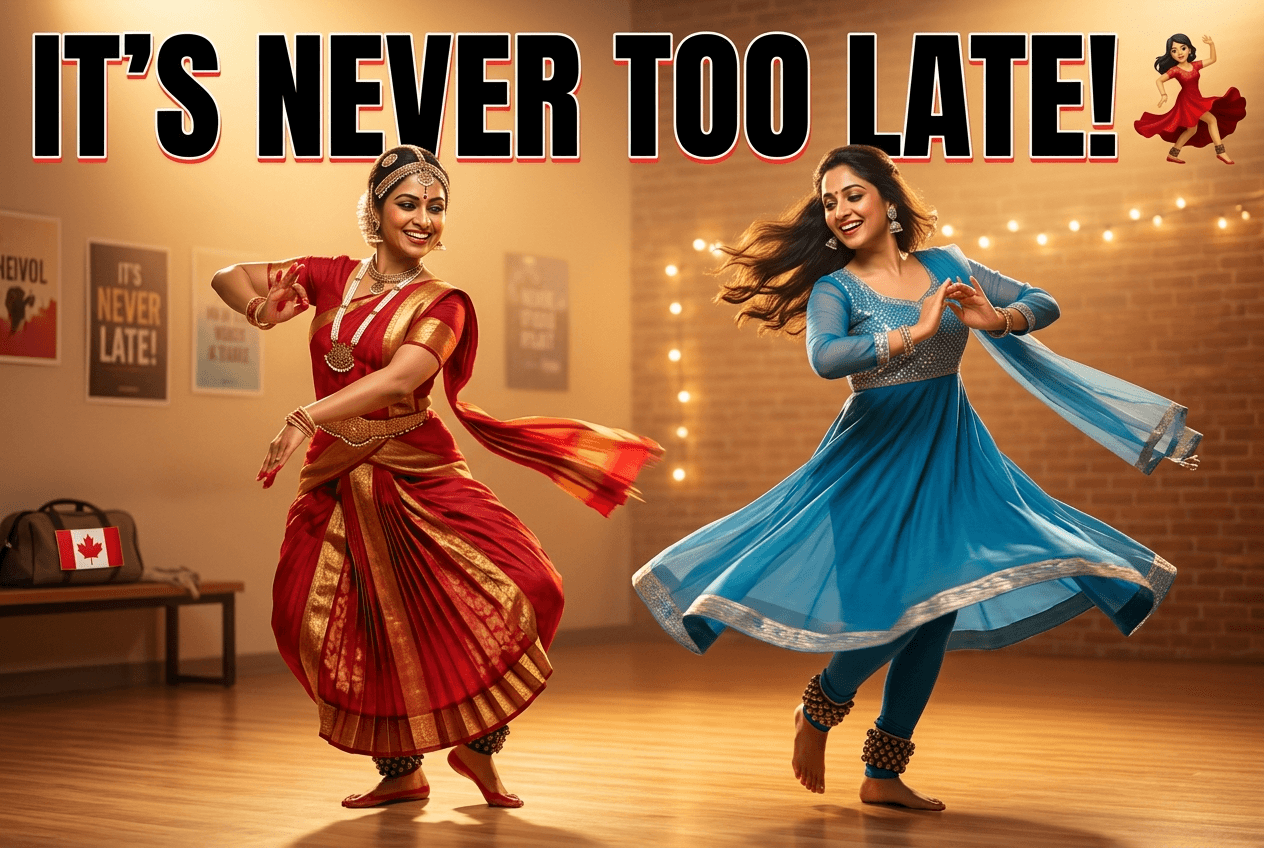
There is a moment that many adults describe when they first watch Indian classical dance performed live. The dancer's feet strike the floor with a precision that feels almost architectural. The hands shift through a vocabulary of gestures so rich and specific that each finger placement carries meaning. The face tells a story without a single word. And somewhere in the audience, a grown adult thinks: "I wish I had learned that." Then comes the quieter second thought, the one that holds so many people back: "But it's too late now, isn't it?"
It isn't. That's the central truth this article wants to put in front of you, clearly and with evidence. Indian classical dance for adults is one of the most accessible, rewarding, and life-enhancing pursuits available to any adult in the UK today, regardless of age, background, or prior dance experience. The UK is home to a growing community of teachers, studios, and online platforms offering structured beginner programmes specifically designed for adults who are starting from scratch. The art forms themselves, refined over two millennia of tradition, contain layers of depth that adults are often uniquely positioned to appreciate.
So if you have ever felt that pull towards Bharatanatyam, Kathak, Odissi, or any of India's eight officially recognised classical dance forms, this guide is written for you. By the time you reach the end, you'll understand exactly why starting as an adult is not a disadvantage. In many ways, it's a gift.
Understanding Indian Classical Dance: A Living Heritage
Before taking your first class, it helps to understand what you're stepping into. Indian classical dance, known in Sanskrit as Shastriya Nritya, is an umbrella term for distinct, regionally specific traditions rooted in Hindu musical theatre and spiritual practice. The foundational text governing all of these forms is the Natya Shastra, an ancient encyclopedic treatise attributed to the sage Bharata Muni, often described as the "Fifth Veda" for the comprehensiveness with which it codifies music, movement, stagecraft, and emotional expression.
The Sangeet Natak Akademi, India's premier organisation for the preservation of performing arts, officially recognises eight classical dance forms: Bharatanatyam, Kathak, Kuchipudi, Odissi, Kathakali, Sattriya, Manipuri, and Mohiniyattam. Each originates from a distinct region of India and carries its own aesthetic personality, movement vocabulary, musical tradition, and philosophical grounding. They are not interchangeable. Choosing which form to study is itself an exciting first step in your journey.
What unifies all of them, despite their regional and stylistic differences, is the concept of abhinaya, the art of expression. Abhinaya encompasses four dimensions: Angika (body movements), Vachika (poetry and song), Aharya (costume and adornment), and Sattvika (emotional authenticity). This framework means that Indian classical dance is never purely physical. It is simultaneously athletic, theatrical, musical, and spiritual. Adults who engage with it find themselves growing in unexpected directions: deepening their emotional expressiveness, expanding their musical sensitivity, and developing a kind of bodily awareness that transforms how they inhabit their own skin.
Why Adults Are Better Positioned to Learn Than You Might Think
The assumption that dance must be learned in childhood to be learned well is deeply entrenched in Western culture, and it is, frankly, wrong. It persists because we associate performance excellence with child prodigies and professional dancers who trained from the age of five. But performance excellence and meaningful learning are not the same thing. Most adults who take up Indian classical dance are not training for a professional stage career. They're learning for depth, for joy, for cultural connection, for the particular pleasure of mastering something genuinely complex.
Adults bring enormous advantages to this kind of learning. Your ability to absorb conceptual frameworks is far superior to a child's. When a teacher explains the philosophical underpinning of a particular mudra (hand gesture), or the mythological story being expressed through a sequence of movements, you can engage with that context richly and immediately. Children learn through imitation and repetition, which is beautiful in its own way, but adults learn with comprehension. That comprehension accelerates the meaningful dimensions of the art enormously.
Research consistently supports the idea that learning dance as an adult delivers profound physical and cognitive benefits. A 2025 meta-analysis published in Frontiers in Psychology found that dance interventions significantly reduce depression and anxiety while improving wellbeing and enhancing cognition through physical, social, and rhythmic elements. Separately, neurologist Dr Harold Hong has noted that dancing requires concentration and focus that can help to improve cognitive function, and that regular dance practice can actually slow the deterioration of white matter in the brain, the neural structure responsible for communication between different regions. For adults in middle age and beyond, these aren't trivial observations. They're compelling reasons to start now rather than waiting.
And socially? Adults who begin Indian classical dance find a community of fellow learners who share a passion for something genuinely extraordinary. The social bonds formed in these classes tend to be warm and lasting, because the shared experience of learning something ancient and complex creates a particular kind of fellowship.
The Three Dance Forms Most Accessible to UK Adult Beginners
While all eight recognised forms are theoretically available to adult learners, three stand out as particularly accessible entry points for beginners in the UK, both in terms of available teachers and in terms of movement vocabulary that suits adult bodies.
Bharatanatyam: Fire and Precision from Tamil Nadu
Bharatanatyam is India's oldest and most widely taught classical dance form. It traces its origins to Tamil Nadu's temple tradition, where it was historically performed by devadasis as an act of devotion. The word Bharatanatyam is understood as a backronym: bha for bhavam (feelings and emotions), ra for ragam (melody), and tam for talam (rhythm). The dance is frequently described as the "fire dance" because its angular, percussive movements resemble dancing flames.
For beginners, Bharatanatyam offers a remarkably clear and structured learning pathway. The foundational unit of movement is the adavu, a set sequence of footwork, hand gestures, and body positions. There are around thirty-five standard adavus, grouped into families, and learning them systematically builds the technical vocabulary from which everything else in the form is constructed. Adults find this systematic progression satisfying precisely because it mirrors how they absorb other complex skills, through structured repetition and incremental challenge.
The characteristic posture of Bharatanatyam involves Aramandi, a bent-knee, outward-turned stance that strengthens the hips, thighs, and core substantially over time. This posture can feel unfamiliar at first, but a skilled teacher will introduce it gradually and will always adapt the pace to the individual student's body. Nobody expects you to hold a deep Aramandi in your first session.
Kathak: The Storyteller's Dance from North India
Kathak takes its name from the Sanskrit word katha, meaning story, and the kathakaras, the caste of itinerant storytellers who carried narrative traditions across North India for centuries. It is the classical dance of the courts as much as the temples, shaped by both Hindu devotional tradition and the Mughal culture that surrounded it. Kathak is one of eight major forms of Indian classical dance, with distinct lineages or gharanas: the Lucknow gharana emphasises lyrical grace and emotional expression, while the Jaipur gharana focuses on powerful, complex footwork and rhythmic virtuosity.
For adult beginners, Kathak has a particular appeal. Its upright posture is more familiar to adult bodies than the deep bent-knee stance of Bharatanatyam, making it physically comfortable to enter even without prior dance training. The extraordinary footwork, performed with ghunghru (bells) tied around the ankles, produces a thrilling rhythmic counterpoint that many adult learners find immediately addictive. The chakkars, spinning sequences that Kathak is famous for, take time to develop but create moments of pure joy when they begin to flow.
The expressive dimension of Kathak is also particularly resonant for adults. The abhinaya element, the art of conveying emotion through facial expression and gesture, draws on life experience in ways that actually favour adult learners. Expressing devotion, longing, wonder, or mischief through the face and hands requires emotional depth that most adults have in abundance.
Odissi: Sculpture in Motion from Odisha
Odissi comes from the eastern state of Odisha and is often described as the most lyrical and sensuous of all the classical forms. Its defining posture is the tribhangi, a triple-flexion of the body that creates an exquisite wave-like S-curve through the neck, waist, and knees, directly inspired by the sculptural carvings on temples like the Sun Temple at Konark. Odissi is sometimes called "sculpture in motion" for exactly this reason: its postures look as though a temple figure has stepped from the stone and begun to breathe.
Adult learners are often drawn to Odissi for its flowing, meditative quality. Compared to the sharp percussive energy of Bharatanatyam or the rhythmic complexity of Kathak, Odissi feels more introspective and contemplative. The mangalacharan (invocatory piece) that opens a traditional Odissi recital sets a devotional, unhurried tone that many adults find deeply nourishing. The form is kinder to joints than Bharatanatyam's sustained bent-knee postures, though it still requires core strength and flexibility that develops progressively with practice.
The Real Physical and Mental Benefits for Adult Learners
Let's be concrete about what Indian classical dance actually does to an adult body and mind over time. This isn't theoretical. It's what students genuinely report, and it's backed by a growing body of research.
Physically, the benefits begin within weeks. The deep bent-knee postures of Bharatanatyam strengthen the quadriceps, glutes, and hip flexors in ways that standard gym exercise rarely achieves. The intricate footwork of Kathak develops proprioception, the body's sense of its own position in space, in remarkable ways. Odissi's spinal curves build core stability and counteract the habitual forward slouch that desk work creates in so many adult bodies. Balance improves across all three forms, meaningfully and relatively quickly. For adults concerned about long-term physical resilience, this is not a trivial consideration.
The rhythmic dimension provides another layer of benefit. Learning to internalise complex talas (rhythmic cycles) and move in precise synchrony with them develops neural connections between the auditory and motor systems that are profoundly anti-ageing in their effect. Research published in Frontiers in Psychology found that dance interventions consistently reduce symptoms of anxiety and depression while increasing positive emotions such as exhilaration and enthusiasm. These aren't the mild, polite benefits of a weekend hobby. They're meaningful changes to quality of life.
There is also something specific to the abhinaya dimension that deserves particular attention. Learning to express emotion deliberately, through specific facial configurations and precise hand gestures, is a form of emotional education that most adults never receive. Many students describe a process of emotional liberation that occurs gradually through the practice, a growing comfort with expressing joy, devotion, mischief, and longing that spills out of the dance studio and into their everyday life. One long-time Kathak student, speaking to a UK community arts programme, described it simply: "I learned to stop hiding my feelings behind my face. The dance made me brave."
What a Typical Adult Beginner Class in the UK Looks Like
Knowing what to expect from your first few sessions removes a lot of the anxiety around taking the plunge. Adult beginner classes are specifically designed to be welcoming to people who have never danced before, and most experienced teachers have long since adapted their pedagogy to the adult learner's needs. Here's what you can realistically anticipate.
A typical beginner session runs for sixty to ninety minutes. It usually opens with a warm-up sequence, stretching the hips, ankles, spine, and wrists, the areas that Indian classical dance demands most from. This is followed by work on the foundational posture for the form being studied: Aramandi for Bharatanatyam, the upright standing position with turned-out feet for Kathak, or basic spinal alignment exercises for Odissi.
From there, the teacher introduces the basic adavus or movement sequences appropriate for the tradition, usually starting with the simplest footwork patterns and building gradually. Mudras are introduced in tandem with body movement. Most good teachers will vocalise the rhythmic syllables aloud as the movement is demonstrated, so students both see and hear the connection between the movement and the tala underlying it.
Classes for adults specifically tend to include more explanation and context than classes designed for children. Teachers know that adult learners want to understand why a particular gesture means what it means, where a particular movement comes from mythologically, and how the movement fits into the broader aesthetic logic of the form. This context makes the learning stickier and the experience richer. It's one of the reasons many adults find Indian classical dance more engaging than other fitness or movement activities they've tried.
Finding Indian Classical Dance Classes for Adults Across the UK
The UK has a genuinely impressive infrastructure for Indian classical dance, concentrated in cities with significant South Asian communities but increasingly distributed through online provision as well. Knowing where to look makes finding the right class considerably easier.
Here's a practical overview of your main routes to finding a class:
Route Best For What to Check Local dance schools and cultural centres In-person community, performance opportunities Adults-only or mixed-level beginner classes University and college dance societies Young adults, social learning environments Open membership policies for community members Online specialist platforms Learners outside major cities, flexible schedules Teacher credentials, live vs recorded sessions South Asian cultural organisations Cultural depth, performance context Community events, teacher network Arts Council-funded regional organisations Access-focused, subsidised options Income-based pricing, bursary schemes
In London, Birmingham, Leicester, Manchester, Bradford, and other cities with established South Asian communities, in-person schools offering Bharatanatyam and Kathak beginner classes for adults are relatively straightforward to find. Organisations like Srishti in Harrow and Art Asia in Southampton offer professionally taught classes across multiple forms and skill levels. The Arts Council England funds a range of organisations supporting Indian dance in the UK, and many of these organisations maintain directories of regional teachers.
For anyone outside these population centres, or for those who find in-person scheduling difficult, online provision has become genuinely excellent. Art Gharana's Bharatanatyam classes and Kathak classes offer structured online learning with experienced teachers, flexible scheduling, and the kind of pedagogical depth that adult beginners need. Browsing the full courses listing at Art Gharana gives you a clear sense of what's available across different traditions and levels. You can also book a trial class to test the experience before committing to a longer term.
What to Look for in a Teacher When You're Starting as an Adult
Not all Indian classical dance teachers are experienced in teaching adults who are starting from zero. Some are primarily children's teachers who adapt their methods imperfectly. Others are brilliant performers with limited pedagogical skill. Finding the right teacher for your specific needs as an adult beginner is the single most important decision in your early learning journey, and it's worth approaching it thoughtfully.
Start by verifying the teacher's training lineage. Indian classical dance is transmitted through the guru-shishya parampara, the sacred teacher-student relationship in which knowledge passes through unbroken generations. A teacher who can name their guru and describe their training lineage carries the authentic stylistic and philosophical heritage of the tradition they teach. This isn't snobbery: it's the difference between learning the form and learning a watered-down approximation of it.
Ask specifically whether they teach adults and whether they have experience with beginners who have no prior dance background. This is a genuine specialisation. The best teachers of adult beginners have thought carefully about how to introduce foundational postures and movement patterns to bodies that haven't trained since childhood, if at all. They understand the physical realities of an adult body, the tighter hips, the less flexible ankles, the greater mental engagement that compensates for what the body hasn't yet developed.
Observe or participate in a trial class before committing to a course. Notice whether the teacher explains the why behind movements, not just the how. Notice whether corrections are given with warmth and precision rather than frustration. Notice whether students of different abilities and progress rates are treated with equal respect and encouragement. These are the hallmarks of a teacher worth committing to.
Addressing the Most Common Adult Learner Concerns
Adults who are drawn to Indian classical dance but haven't yet taken the first step almost always share a small cluster of hesitations. Let's address each one with the directness it deserves.
"I'm not flexible enough." Flexibility is developed through practice, not a prerequisite for beginning it. Every teacher of adult beginners works with the body in front of them, not a theoretical ideal body. Your hip flexibility will improve significantly within the first three months of regular practice. Start where you are.
"I can't keep rhythm." Rhythmic sense is also a learnable skill, not an innate talent. The rhythmic training embedded in Indian classical dance is structured and progressive. You don't arrive knowing tala. You learn it, week by week, through repetition, vocalisation, and practice. Most adult beginners who felt rhythmically insecure at the start of training report a dramatic shift within six months.
"I'll look foolish compared to the other students." Beginner adult classes are full of people in exactly your position. Teachers who teach these classes regularly describe the atmosphere as uniquely encouraging and supportive, precisely because everyone has made the brave choice to start something unfamiliar. There is no competition and no judgment.
"I don't have Indian heritage, so it isn't my place." The traditions themselves have always been transmitted across cultures and communities. Kathak was shaped as much by Mughal court culture as by Hindu devotional practice. Bharatanatyam was revived in the twentieth century partly through the efforts of Rukmini Devi Arundale, who was deeply influenced by Western classical ballet. Most teachers of Indian classical dance in the UK are welcoming to all students who approach the tradition with genuine respect and curiosity. That respect, and the willingness to engage with the cultural and philosophical context of what you're learning, is what matters.
Building a Sustainable Practice at Home
Classes are the beginning, not the whole of the journey. Like any skilled art form, Indian classical dance deepens through regular practice between lessons. The good news is that even a modest home practice routine creates visible improvement relatively quickly.
A beginner's home practice session doesn't need to be long. Twenty to thirty minutes, four or five days a week, is far more productive than an occasional marathon session on weekends. Here's a sensible structure for the early months:
- Five minutes of gentle hip, ankle, and wrist warm-up
- Ten minutes running through the adavus or movement sequences from your last class, focusing on correctness rather than speed
- Five minutes practising mudras in isolation, vocalising their names and meanings as you form each gesture
- Five to ten minutes of open movement to music from the tradition you're studying, allowing your body to absorb the aesthetics through listening and free response
Creating a physical space for practice at home helps considerably. You don't need a studio. A clear patch of floor roughly two metres square is sufficient. A mirror is useful for self-correcting posture and hand positions. And playing music from the tradition during your practice, Carnatic compositions for Bharatanatyam, or North Indian classical ragas for Kathak, builds the musical immersion that is inseparable from genuine development in these forms.
If you're studying Bharatanatyam online through a platform like Art Gharana, most classes include recordings or session summaries that you can use as reference material during your home practice. This is one of the genuine practical advantages of online learning: the ability to review and repeat material between live sessions.
The Community and Cultural Dimension: More Than Just Movement
One of the aspects of Indian classical dance that adult learners consistently find most surprising and most nourishing is its community dimension. The UK's Indian classical dance ecosystem is not just a collection of classes. It is a living cultural community with performances, festivals, masterclasses, lecture demonstrations, and social events that connect students to a tradition that extends far beyond the studio.
Attending performances is a crucial part of this. Watching a skilled Bharatanatyam dancer perform a complete margam (the traditional sequence of compositions in a full recital) gives you an understanding of where the fragments you learn in class eventually lead. It contextualises your own learning in a way that accelerates both technical development and emotional engagement. The UK's Indian classical dance scene is remarkably vibrant: organisations like Akademi (the South Asian Dance organisation for the UK) programme performances and workshops throughout the year, and many regional arts centres host Indian classical dance regularly.
Cultural immersion matters too. Reading about the mythological stories expressed in the abhinaya sequences you're learning enriches every class session. Understanding the bhakti devotional tradition that underlies much of Bharatanatyam's repertoire, or the Mughal court aesthetic that shaped Kathak's lyrical dimension, gives your learning a depth that purely physical training cannot provide. Many teachers actively encourage this wider engagement, recommending books, recordings, and performances to their students as part of a holistic musical and cultural education.
And there is the simple, irreplaceable pleasure of belonging to something. Adults who pursue Indian classical dance regularly describe their class as one of the most consistently joyful fixed points in their week. It is a place where they are simultaneously challenged and supported, where progress is visible and celebrated, and where the pursuit of something genuinely beautiful is taken seriously by everyone in the room.
How Long Before You See Real Progress?
This is a question every new student carries into their first few months of learning. The honest answer involves some nuance, but it's broadly encouraging.
Most adult beginners notice meaningful physical changes within the first two to three months of regular attendance combined with home practice. Hip flexibility improves. Balance becomes more reliable. The deep squats required by Aramandi postures become less daunting. Mudras that felt foreign and awkward begin to form naturally.
Musical absorption follows a similar timeline. By the end of the first term, most students can clap and vocalise a basic tala cycle without losing the beat. They recognise the difference between slow, medium, and fast tempo passages. The music stops sounding like an undifferentiated backdrop and begins to reveal its structure.
The deepest layer, expressive abhinaya, takes longer to develop, and that is entirely appropriate. Expression requires the security that comes from technical foundation. You cannot express something convincingly through your face and hands while simultaneously worrying about your foot placement. But as the technical foundation builds, adult learners consistently find that the expressive dimension opens up in ways that feel almost spontaneous, because the life experience they bring provides the emotional raw material that the technique simply learns to channel.
Here is a realistic progression timeline for a committed adult beginner attending weekly classes and practising at home:
Timeframe What to Expect Months 1–3 Foundational posture, basic footwork, first mudras, introduction to tala Months 4–6 Increasing fluency in adavus, simple choreography, rhythmic confidence Months 6–12 First complete short compositions, basic abhinaya, improving stamina Year 1–2 Performance readiness for informal settings, deepening expressive range Year 3+ Mature technical foundation, meaningful abhinaya, possible exam progression
About Art Gharana
Art Gharana is a warm and ambitious online platform dedicated to authentic Indian classical arts education for students across the UK and beyond. Offering expert-led courses in Bharatanatyam, Kathak, Bollywood dance, Indian classical music, and much more, Art Gharana makes it possible for adult beginners to start their Indian classical dance journey wherever they are in the country and at whatever time suits their life. With experienced teachers, flexible lesson formats, and a genuinely supportive community, Art Gharana is a wonderful home for anyone ready to discover what these extraordinary traditions have to offer. Visit artgharana.com or explore all available courses to find the right fit for you.
Frequently Asked Questions
1. Can I really learn Indian classical dance as an adult with no prior dance experience?
Absolutely. Many of the most dedicated and fulfilled students of Indian classical dance in the UK began as adults with no dance background whatsoever. Good teachers of adult beginners build everything from the ground up. The only genuine prerequisites are curiosity, willingness to practise, and patience with the natural pace of deep learning. Prior dance experience can actually create unhelpful habits that need unlearning, so starting fresh is sometimes an advantage.
2. Which Indian classical dance form is the best for adult beginners?
Kathak is often recommended as the most physically accessible entry point for adults because its upright posture is familiar to adult bodies and its expressive storytelling dimension rewards adult life experience directly. Bharatanatyam and Odissi are equally wonderful starting points and both have strong adult beginner communities in the UK. The most important factor isn't which form you choose: it's finding a teacher who specialises in adult beginners and genuinely enjoys teaching them.
3. How much does it cost to take Indian classical dance classes in the UK?
Group beginner classes typically run from £8 to £20 per session, depending on location and provider. Private one-to-one lessons with an experienced teacher usually cost between £30 and £60 per hour. Online classes are often more affordable, typically £15 to £40 per session. Some Arts Council-funded organisations offer subsidised classes on a sliding scale based on income, so it's worth checking local provision before assuming the cost is prohibitive.
4. Do I need to buy special equipment or costume to start?
For the first few months of learning, you need only comfortable clothing that allows free movement (loose trousers and a fitted top work well) and bare feet. Ghunghru (ankle bells) for Kathak and a basic churidar or practice outfit for Bharatanatyam are typically introduced once a student is past the early beginner stage. Your teacher will advise you on what to acquire and when.
5. Is Indian classical dance suitable for men?
Yes, completely. While Indian classical dance is statistically more commonly practised by women in the UK diaspora context, all three major beginner-accessible forms have strong male performance traditions. Bharatanatyam includes the powerful Tandava (masculine energy) dimension alongside Lasya (feminine). Kathak was historically performed predominantly by men. Odissi has welcomed male practitioners since at least the 1980s. Any teacher worth studying with will be fully equipped to teach male students.
6. How do online Indian classical dance classes work in practice?
Live online classes typically run on video platforms with the teacher demonstrating movements in real time and observing students through the camera. Good online teachers use multiple camera angles, slow down demonstrations on request, and provide written or recorded follow-up material after each session. For adult learners who can manage a screen-based lesson independently, the experience is highly effective. The main practical requirements are a stable internet connection, enough floor space to move, and a device positioned to give the teacher a clear view of your full body from the waist down at minimum.
Conclusion
Indian classical dance for adults in the UK is not a consolation prize for people who missed out on childhood training. It is a genuinely enriching, physically transformative, and culturally profound pursuit that adults are often better equipped to appreciate than children are. You bring life experience, emotional depth, conceptual understanding, and the particular motivation of someone who has chosen this freely rather than being enrolled in it by a parent. That combination is powerful. The traditions themselves, refined over two thousand years, are more than capable of meeting the full complexity of an adult learner. So whether Bharatanatyam's fiery precision calls to you, Kathak's storytelling grace draws you in, or Odissi's meditative sculpted beauty feels like home, the door is open right now. Head to Art Gharana to book a trial class today, and begin the journey you've been putting off for too long.