ChatGPT
 Google AI
 Grok
Grok Claude
Learning guitar as an adult in Canada has never been more accessible. Online lessons eliminate the need to find a local teacher, flexible scheduling accommodates busy professional and family lives, and the quality of live 1:1 online guitar instruction has been demonstrated to match in-person learning for most technical goals. This comprehensive guide covers the acoustic guitar specifically — the best starting instrument for most Canadian adult beginners — covering everything from choosing your first guitar and essential accessories to the complete beginner roadmap, the science of adult musical learning, common obstacles and how to overcome them, and what to look for in an online instructor.
Why the Acoustic Guitar Is the Best Starting Instrument for Most Canadian Adults
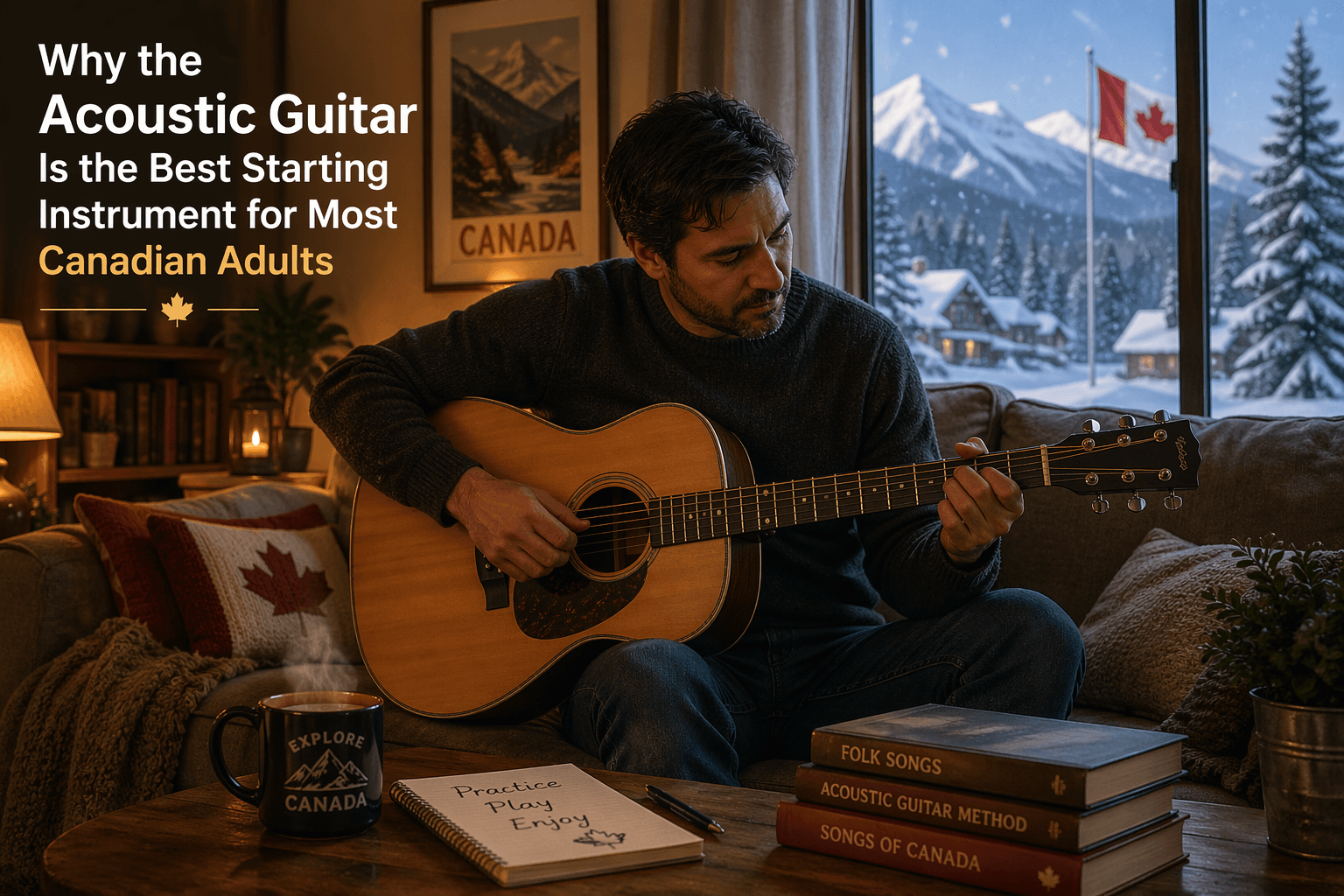
The Case for Starting on Acoustic
When Canadian adults decide to learn guitar, the first question is almost always acoustic versus electric. While both are valid starting points, acoustic guitar offers three specific advantages for adults:
Simplicity of Setup
An acoustic guitar requires no amplifier, no cables, no effects pedals, and no additional equipment. You pick it up and play. This simplicity dramatically reduces the friction between deciding to practise and actually playing. Adults with busy lives need every friction-reduction advantage they can get.
Developing Finger Strength Through Necessary Resistance
Acoustic guitar strings have slightly higher tension and sit at slightly higher action (distance from string to fretboard) than most electric guitars. This makes pressing down chords more physically demanding initially. While this causes some initial soreness, it systematically develops the finger strength and calluses that make all subsequent guitar playing easier.
Adult learners who begin on acoustic and then transition to electric find the electric guitar feels almost effortlessly easy by comparison. The reverse transition (electric to acoustic) is significantly harder.
The Sound Is Immediately Musical
Acoustic guitars produce a rich, resonant sound that most adults find intrinsically satisfying. Playing a G chord on a good acoustic guitar and hearing that full sound is immediately rewarding in a way that practising the same chord quietly on an unplugged electric guitar is not.
Understanding the Different Types of Acoustic Guitar
Steel-String Acoustic (Dreadnought)
The most common adult acoustic guitar. A full-size dreadnought body produces a loud, full sound ideal for strumming, folk, pop, country, Bollywood-style chord playing, and singer-songwriter repertoire. This is the right starting instrument for most Canadian adult beginners.
Classical Guitar (Nylon String)
Wider neck, softer nylon strings, quieter sound. Suitable for classical repertoire, Spanish guitar, and fingerstyle playing. Less ideal for pop and contemporary chord-based playing because the wider neck makes bar chords harder and the nylon strings don't project well for strumming styles.
Concert and Parlour Bodies
Smaller than a dreadnought, producing a quieter, more intimate sound. Better for players with smaller hands or shorter arms who find the full dreadnought body awkward to hold.
Choosing Your First Guitar in Canada

What to Look For
Playability Over Everything Else
The most important quality in a beginner guitar is playability: how easy it is to press down the strings and form chords without excessive effort or discomfort. Playability is primarily determined by the action (string height) and nut slot depth.
Many guitars in the under-$200 range have factory action that is higher than it needs to be. A professional setup by a guitar technician (typically CAD $60-$80 at any Canadian music store) can transform a mediocre-feeling guitar into a genuinely comfortable playing experience. This is one of the best investments any Canadian beginner can make.
Solid vs Laminate Top
At the under-$300 price point, most acoustic guitars have laminate tops (multiple thin wood layers pressed together). Laminate tops are stable, resistant to humidity changes (important in Canada's variable climate), and perfectly functional for learning.
Solid wood tops produce better tone and improve with age. Some guitars under $300, like the Yamaha FG800 and Fender CD-60S, feature solid spruce tops — exceptional value at their price points.
Recommended Acoustic Guitars for Canadian Adult Beginners
Under $300 CAD
Yamaha FG800: Consistently the most recommended beginner acoustic in Canada and worldwide. Solid spruce top, reliable tuning machines, excellent playability for the price. Available at Long and McQuade across Canada.
Fender CD-60S: Solid spruce top, comfortable neck profile, reliable hardware. Slightly different neck shape that suits some hands better than the Yamaha.
$300-$600 CAD
Seagull S6 Original: Made in Canada (Quebec) — always a meaningful consideration for Canadian buyers. Solid cedar top, excellent intonation, beautiful tone. Represents exceptional value and supports Canadian manufacturing.
Yamaha LL6 ARE: Solid spruce with Yamaha's ARE (Acoustic Resonance Enhancement) treatment. Noticeably warmer tone than the entry-level models.
$600+ CAD
At this price, you're looking at Taylor Academy 12e, Martin 000-15M, and entry-level Collings models. These are professional-level instruments that adult beginners who want to invest once and not outgrow their guitar should seriously consider.
Essential Accessories Every Canadian Beginner Needs
Clip-On Tuner
Always tune before every practice. The Snark SN5X ($15-20 CAD) and Peterson StroboClip HD ($55-65 CAD) are both excellent. A well-tuned guitar sounds beautiful and trains your ear; a poorly tuned guitar sounds discouraging and teaches bad sonic habits.
Capo
Allows you to play in different keys using the same chord shapes. Essential for playing along with songs. Any Dunlop spring capo ($15-25 CAD) works reliably.
Variety Pick Pack
Buy a sampler pack of different thicknesses. Most adults settle on medium (0.73mm) picks for strumming. Dunlop Tortex picks are the Canadian music store standard.
Spare Strings
Strings break. Keep a spare set. Elixir Nanoweb strings ($18-25 CAD) last significantly longer than plain strings due to their polymer coating.
Guitar Strap
Develops proper posture and prevents the guitar sliding from position during seated practice.
The Complete Adult Beginner Guitar Roadmap
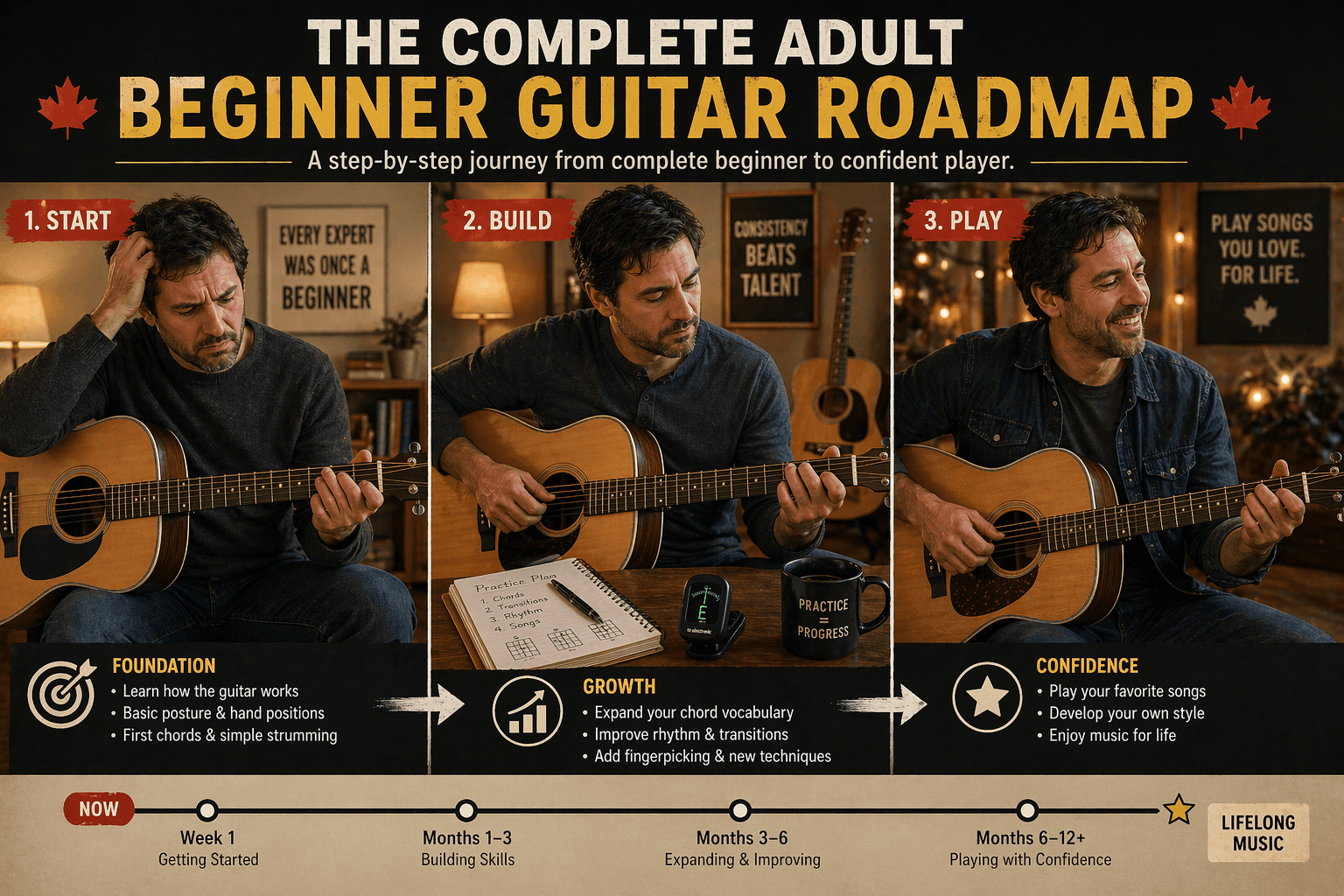
Month 1 - Foundation Building
The First Three Chords
The majority of popular music, folk songs, and simple Bollywood-inspired acoustic arrangements can be played with three basic chords. G, C, and D (or Em, C, and G) are the standard first-chord trio because they appear together constantly in Western popular music and their finger shapes develop essential left-hand technique.
Expect soreness in your fingertips for the first two to three weeks. This is normal and resolves as calluses form. Do not stop practising because of fingertip soreness — play for the same duration but rest if genuine pain develops.
Chord Transitions — The Real Foundation
Learning chord shapes is trivial compared to developing smooth, automatic transitions between them. This is where adult beginners actually spend most of their first month. The goal: hold down a chord, strum once cleanly, then move to the next chord in time without pausing, and strum once cleanly again. Repeat until the transition feels automatic. Then add rhythm.
Basic Strumming Pattern
Learning to strum rhythmically (rather than just strumming randomly) is the first rhythm skill. A simple down-down-up-down-up pattern in 4/4 time, applied consistently to chord transitions, produces the foundation of almost all acoustic strumming.
Months 2-4 - Building the Foundation
Expanding the Chord Vocabulary
Am, Dm, Em, A, E, and their variants are added progressively. Each new chord is connected to repertoire — songs that use it — so every new technical skill has immediate musical application.
Fingerpicking Introduction
Simple alternating bass fingerpicking patterns provide a different texture from strumming and develop right-hand finger independence. Travis picking (alternating thumb and finger patterns) is the most widely applicable fingerpicking technique for acoustic guitar.
Barre Chords — The Adult Beginner's Biggest Challenge
The F major chord (and by extension, all barre chord shapes) requires pressing all six strings simultaneously with the index finger. This requires more finger strength than most adults have in the first month of playing. It is the most commonly cited frustration in adult guitar learning.
The key: build up to barre chords gradually. Use the "spider" chromatic exercise to build index finger strength independently. Introduce partial barre shapes (mini-barre on two or three strings) before attempting the full six-string barre. Most adult beginners achieve clean barre chords within three to five months of consistent practice.
Months 5-12 — Developing Musical Expression
Learning Full Songs from Beginning to End
Complete songs become the primary vehicle for skill development. Playing a song from beginning to end without stopping, at the correct tempo, develops musical stamina and performance confidence that section-based practice doesn't.
Introduction to Basic Music Theory
Understanding keys, the major scale, basic chord progressions (I-IV-V-I, I-V-vi-IV), and simple transposition gives adult learners the conceptual tools to learn songs faster, understand why certain chords work together, and eventually write their own music.
Developing Personal Style
Adult learners who have been playing for six months to a year begin to develop instincts about what music they want to play and how they want to sound. This is the moment when guitar transitions from learning an instrument to developing a musical identity.
The Science of Adult Guitar Learning
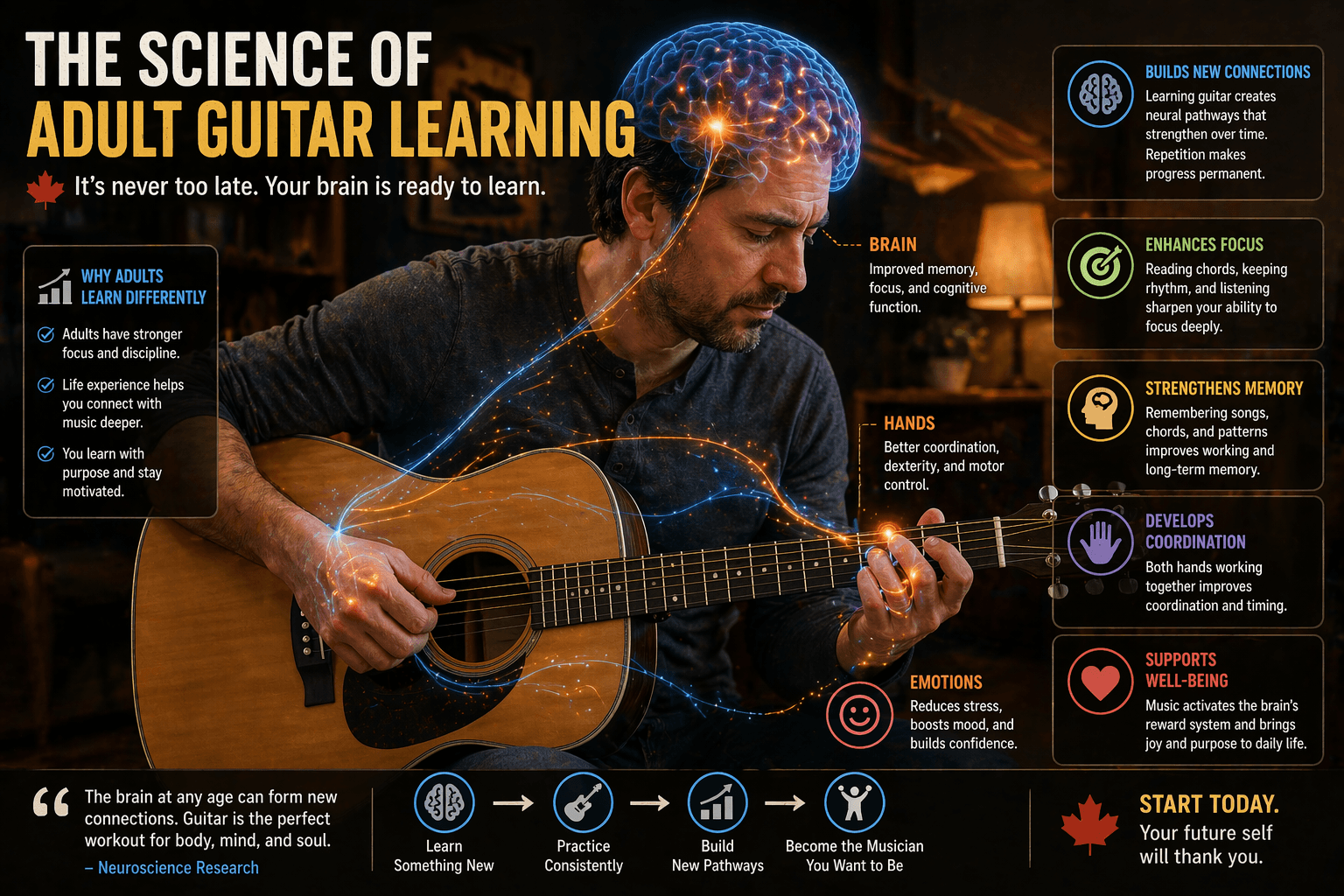
What Research Tells Us About Adults Learning Music
Adults learning music were historically underestimated by pedagogical theory, which often emphasised the advantages of childhood learning. More recent research offers a significantly more nuanced picture.
A study published in Nature Scientific Reports found that adult beginners who undertook just one hour of piano (keyboard instrument) practice per week for 11 weeks showed significant improvements in audio-visual processing and reductions in depression, stress, and anxiety. The researchers noted that musical learning couples visual cues with auditory feedback in ways that create genuine multisensory training — and this multisensory training benefit occurs at any age.
Adult Learning Advantages
Adults bring specific cognitive advantages to instrument learning:
Metacognitive awareness: Adults can hear what they're doing wrong and articulate it. This self-monitoring ability significantly accelerates the correction of technical issues when paired with good teacher feedback.
Autonomous practice management: Adults can structure their own practice sessions purposefully rather than needing parental supervision.
Emotional connection to repertoire: Adults who choose songs they genuinely love practise with greater consistency and emotional investment.
The Consistency Principle
The most important predictor of adult guitar progress is practice consistency, not session length. Research consistently shows that 20-30 minutes of daily focused practice produces faster progress than occasional longer sessions. The reason is neurological: musical motor skills are built through the repeated activation of specific neural pathways. Frequency of activation matters more than single-session duration.
How Online Guitar Lessons Work for Canadian Adults
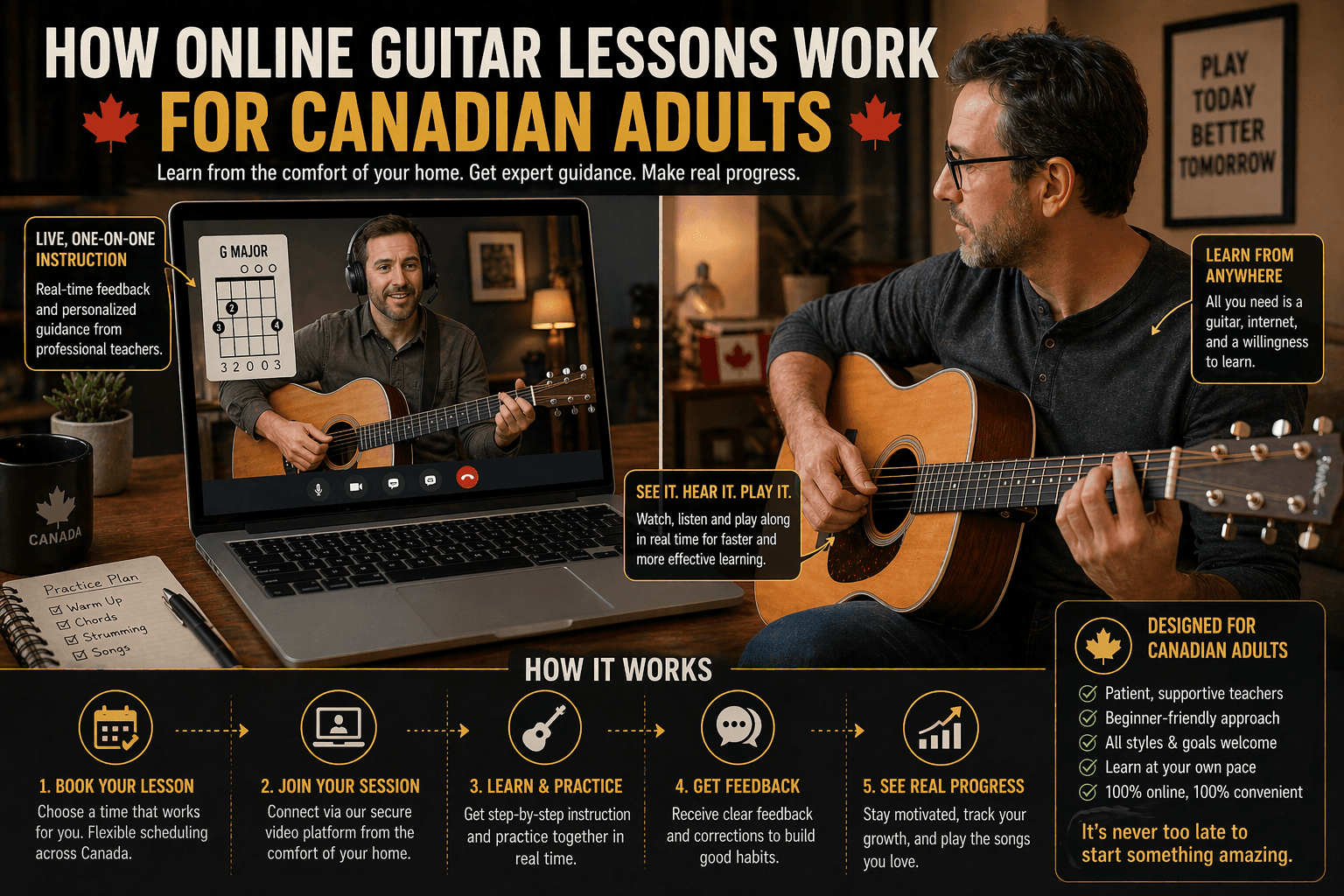
The Live 1:1 Online Format
Online guitar lessons are delivered through live video calls where the teacher can see the student's fretting hand, picking hand, posture, and hear the guitar clearly. Real-time corrections — "move your index finger slightly lower on that chord", "keep your elbow closer to your body when you strum" — are the primary value of live instruction.
Why Online Lessons Are Particularly Well-Suited to Canadian Adults
Canada's vast geography means that even in major cities, finding a truly excellent acoustic guitar teacher nearby is not always possible. Online lessons eliminate geography entirely.
Canada's variable and often harsh weather means that scheduled in-person lessons are frequently disrupted by weather conditions. Online lessons continue regardless of weather.
The working schedules of most Canadian adults favour flexibility that online lessons provide. Sessions can be scheduled for early mornings, lunch hours, or evenings without the travel time that in-person lessons require.
Setting Up for Online Guitar Lessons
The minimum setup for effective online guitar lessons:
A device with a camera positioned at roughly the same height as your guitar, angled to show both hands.
Good room lighting so the teacher can see your hand positions clearly.
A position that allows the teacher to hear your guitar clearly — sitting closer to the device's microphone or using a simple clip-on Lavalier microphone if your device's built-in microphone produces poor audio quality.
What to Look for in an Online Guitar Teacher for Canadian Adults
Musical Background and Repertoire Range
A teacher whose musical background spans multiple genres (folk, pop, classical, world music including Indian-influenced styles) can introduce adult learners to a richer repertoire than one whose background is exclusively one genre.
Adult Teaching Specialisation
Teaching adults requires different approaches from teaching children. Adults need explanations behind techniques, realistic timelines, and respectful engagement with their existing life priorities. Ask specifically about experience teaching adult beginners.
Structured Curriculum with Flexibility
A teacher who has a clear curriculum for beginner adults but adapts it to the specific songs and styles the student wants to learn provides the best of both worlds: a reliable learning structure and personally meaningful repertoire.
At Art Gharana, our guitar teachers offer live 1:1 online lessons for adult beginners across Canada. Explore our instrument courses for detailed information about our guitar programme.
Conclusion
Learning acoustic guitar as an adult in Canada is genuinely achievable, deeply rewarding, and with the right teacher and consistent practice, it produces real musical capability within months.
Three things to take away. First, invest in playability — get your guitar professionally set up. Second, practise daily for 20-30 minutes rather than longer occasional sessions. Third, choose songs you actually love. The emotional connection to your repertoire is the most powerful motivator in adult learning.
Book a free trial guitar lesson at Art Gharana today and start building real skills from your very first session.
Frequently Asked Questions
1. Is it too late for an adult to learn guitar?
No. Adults regularly develop genuine guitar playing ability with consistent practice and good instruction. The myth that adults cannot learn instruments is refuted by both research and the experience of thousands of Canadian adults who have learned guitar in their twenties, thirties, forties, and beyond.
2. How long does it take an adult beginner to play simple songs on guitar?
Most adult beginners can play simple three-chord songs with recognisable rhythm within four to eight weeks of daily practice. Playing them smoothly with good timing and tone typically takes three to five months.
3. What is the best online guitar lesson platform for Canadian adults?
Look for platforms offering live 1:1 instruction with qualified guitar teachers, structured curriculum that incorporates songs you want to learn, and a free trial class before financial commitment. Art Gharana offers all three.
4. Do I need to learn to read music notation to play guitar?
No. Most popular guitar playing uses tablature (TAB), a visual representation of string and fret positions, rather than standard music notation. Reading standard notation is valuable for classical guitar and certain professional contexts but is not necessary for most adult beginners' goals.
5. How much should I spend on my first acoustic guitar in Canada?
Most Canadian music educators recommend spending at least $200-$300 CAD on a first acoustic guitar to ensure it is genuinely playable. Below this price point, most guitars have quality control issues that create additional learning difficulties. The Yamaha FG800 ($250 CAD) and Seagull S6 ($450 CAD) represent excellent value at their respective price points.