ChatGPT
 Google AI
 Grok
Grok Claude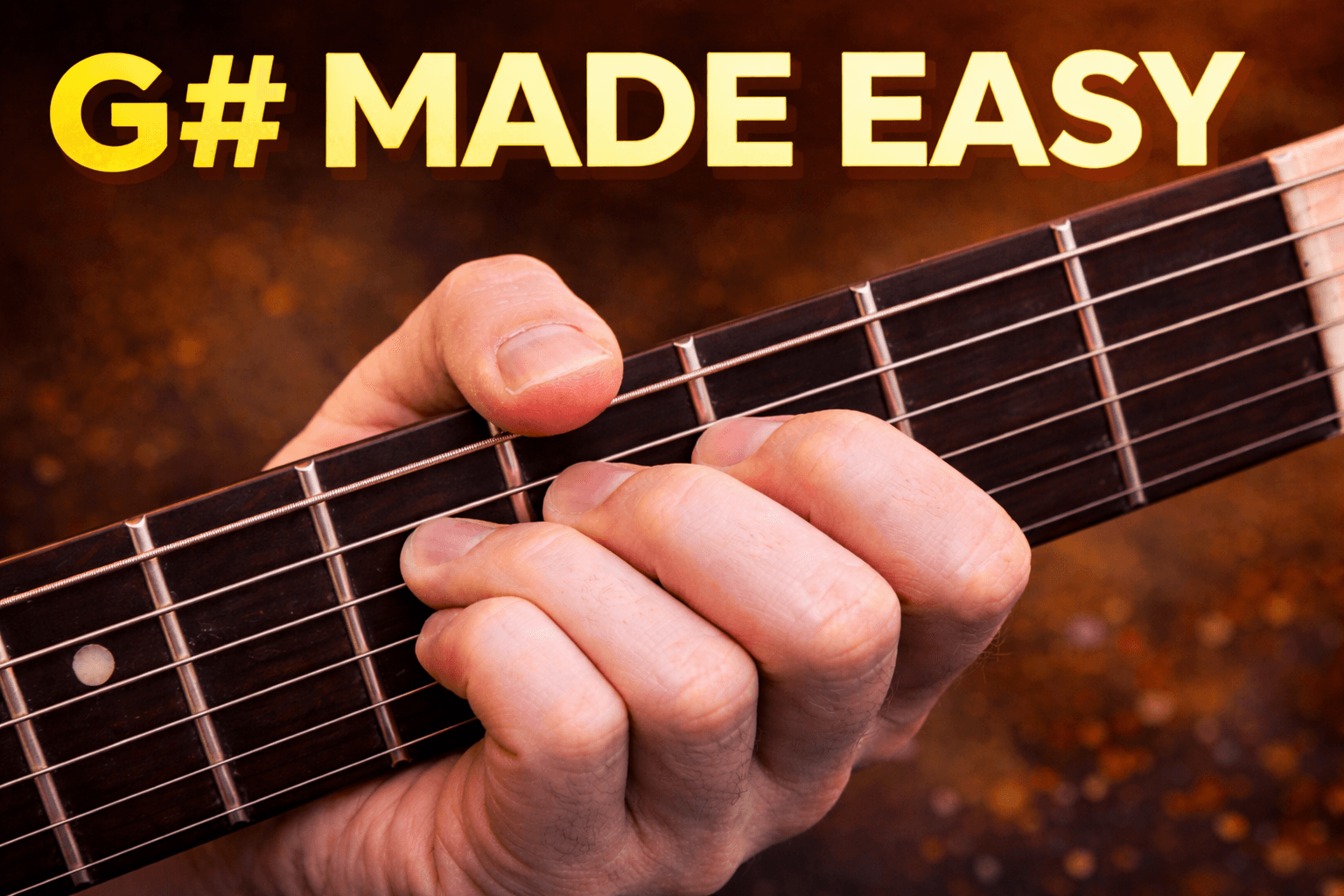
What Makes the G# Major Chord Special
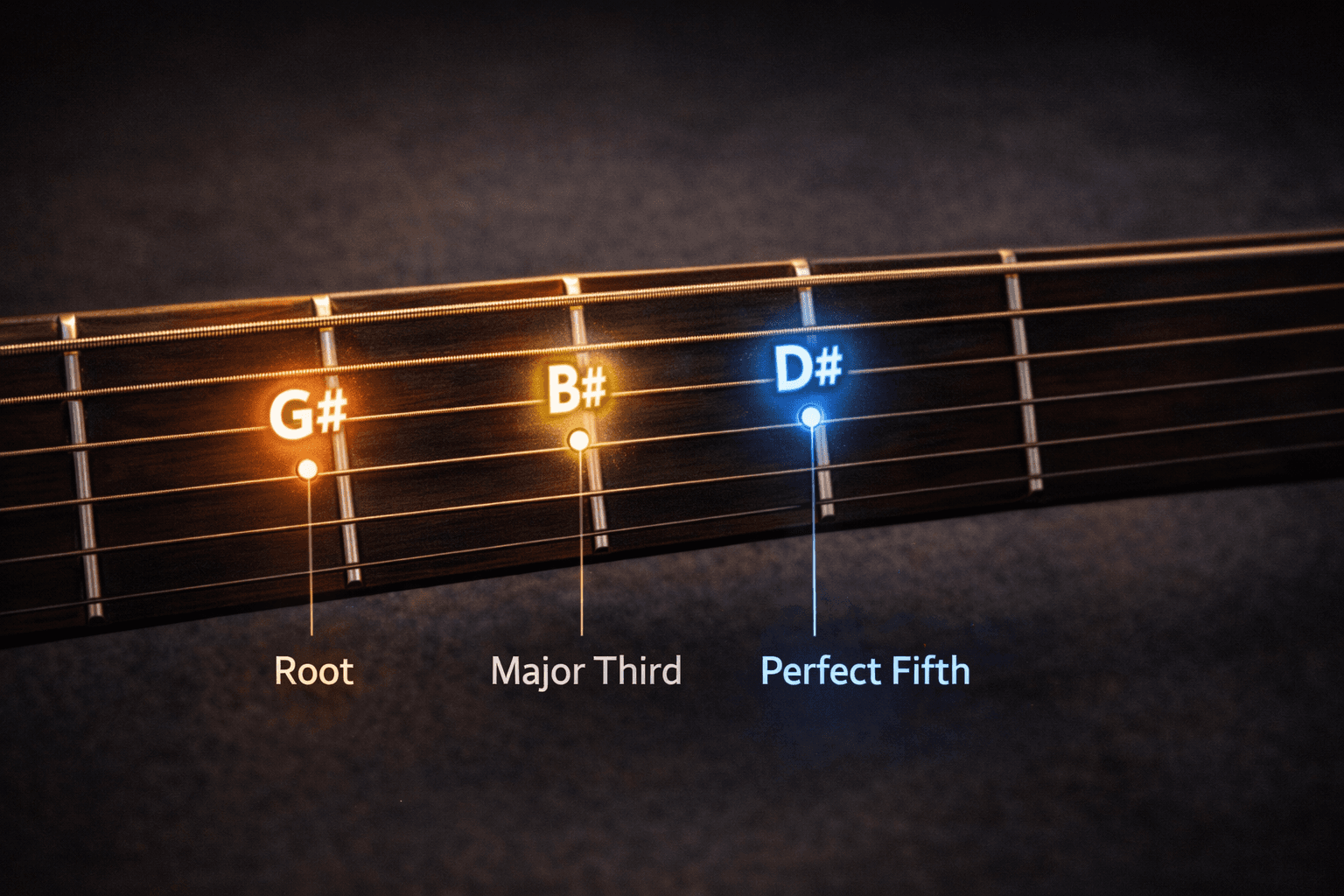 The G# major chord stands out because of its theoretical importance and tonal clarity. Built using the major chord formula of 1–3–5, it delivers a strong, uplifting sound that functions well as a tonic, dominant substitute, or modulation target in advanced progressions. Because G# major is enharmonically related to A♭ major, it often appears in music that modulates between sharp and flat keys, particularly in jazz, classical, and cinematic compositions.
Another defining characteristic of the G# major chord is that it cannot be played as a traditional open chord on standard tuning. This forces guitarists to rely on barre chords, movable shapes, and inversions. As a result, learning G# major significantly improves left-hand strength, barre chord accuracy, and fretboard visualization.
The chord is also valuable for understanding how theoretical spellings affect harmony. Seeing B# instead of C natural helps players recognize scale degrees and interval relationships rather than relying only on familiar note names. This awareness leads to more intentional chord choices and stronger harmonic control.
G# Major Chord Notes and Formula
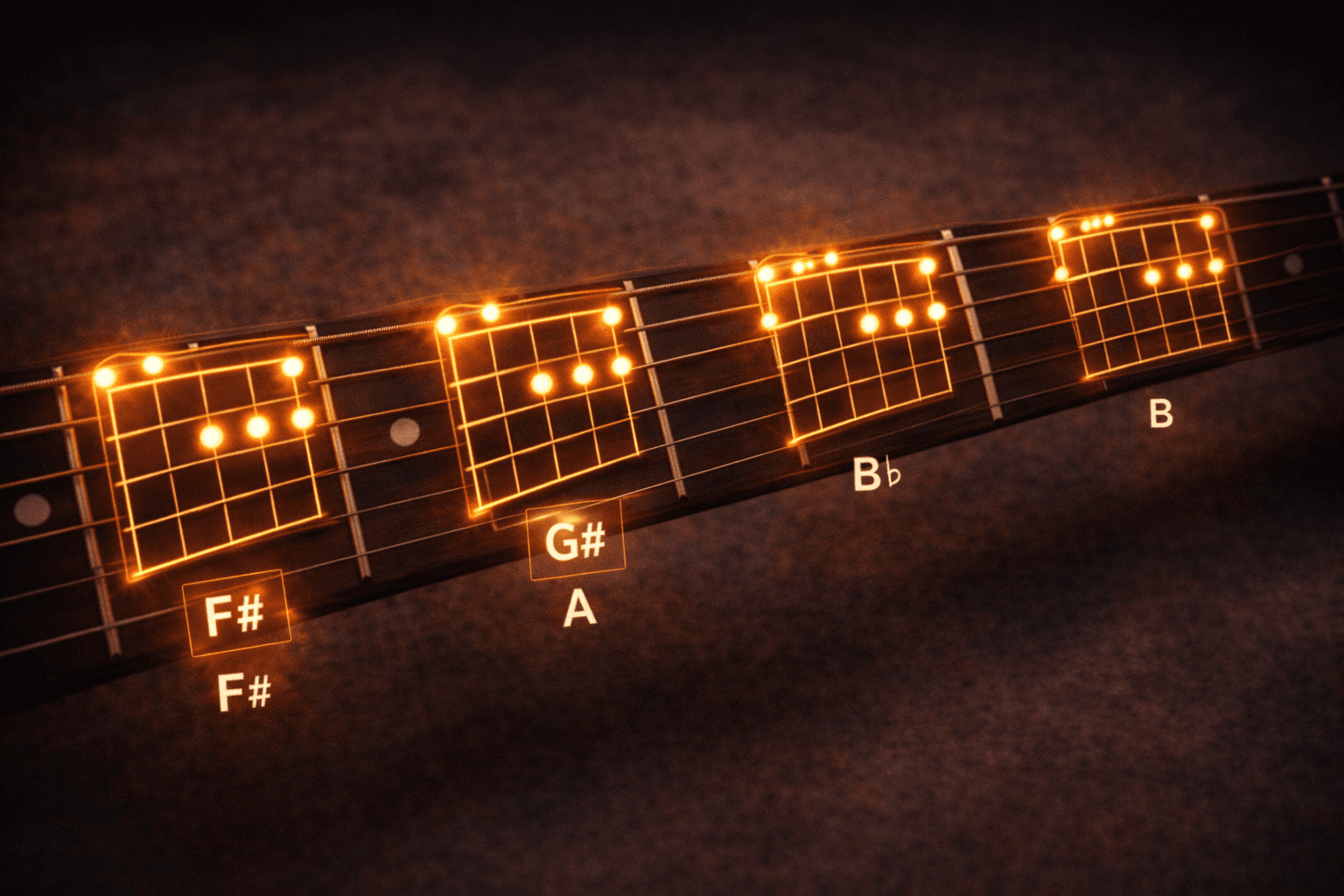 The G# major chord consists of the following notes.
G# is the root of the chord and defines its tonal center. B# functions as the major third and determines the chord’s bright quality. D# acts as the perfect fifth and provides harmonic stability.
These three notes form the G# major triad and follow the standard major chord formula of 1–3–5.
G# Major Chord Tone Breakdown
Note Interval G# Root B# Major Third D# Perfect Fifth
Understanding this structure allows guitarists to build G# major in multiple positions, identify chord tones during improvisation, and construct new voicings across the fretboard. It also reinforces the importance of correct enharmonic spelling when analyzing harmony and reading notation.
How the Major Chord Is Built
The G# major chord is derived from the G# major scale, which contains the notes G#, A#, B#, C#, D#, E#, and F𝄪. Selecting the first, third, and fifth notes from this scale produces the G# major triad: G#, B#, and D#.
This intervallic structure creates the characteristic brightness and stability associated with major chords. Learning how this formula applies to G# major helps guitarists transpose chord shapes, understand key construction, and recognize harmonic function within complex progressions. It also supports advanced techniques such as chord substitution, modulation, and reharmonization.
G# Major Chord on Guitar
The G# major chord is played exclusively using movable shapes on the guitar. These shapes are based on barre chord forms and CAGED system positions. Each voicing produces a different tonal color, allowing players to adapt the chord to rhythm, lead, or harmonic roles.
Because there is no open-position G# major chord in standard tuning, mastering these shapes improves technical control and musical flexibility. Understanding how the chord tones appear across strings also helps players connect theory to physical finger placement.
The Basic G# Major Barre Shape
The most common way to play G# major is by using an E-shape barre chord rooted on the sixth string. This shape places the root note on the fourth fret of the low E string. All strings are fretted or barred, creating a strong, full sound suitable for rhythm guitar.
This shape requires proper thumb placement behind the neck and even pressure across the barre to avoid muted notes. Practicing this position develops endurance and accuracy, which directly benefits other barre chords throughout the fretboard.
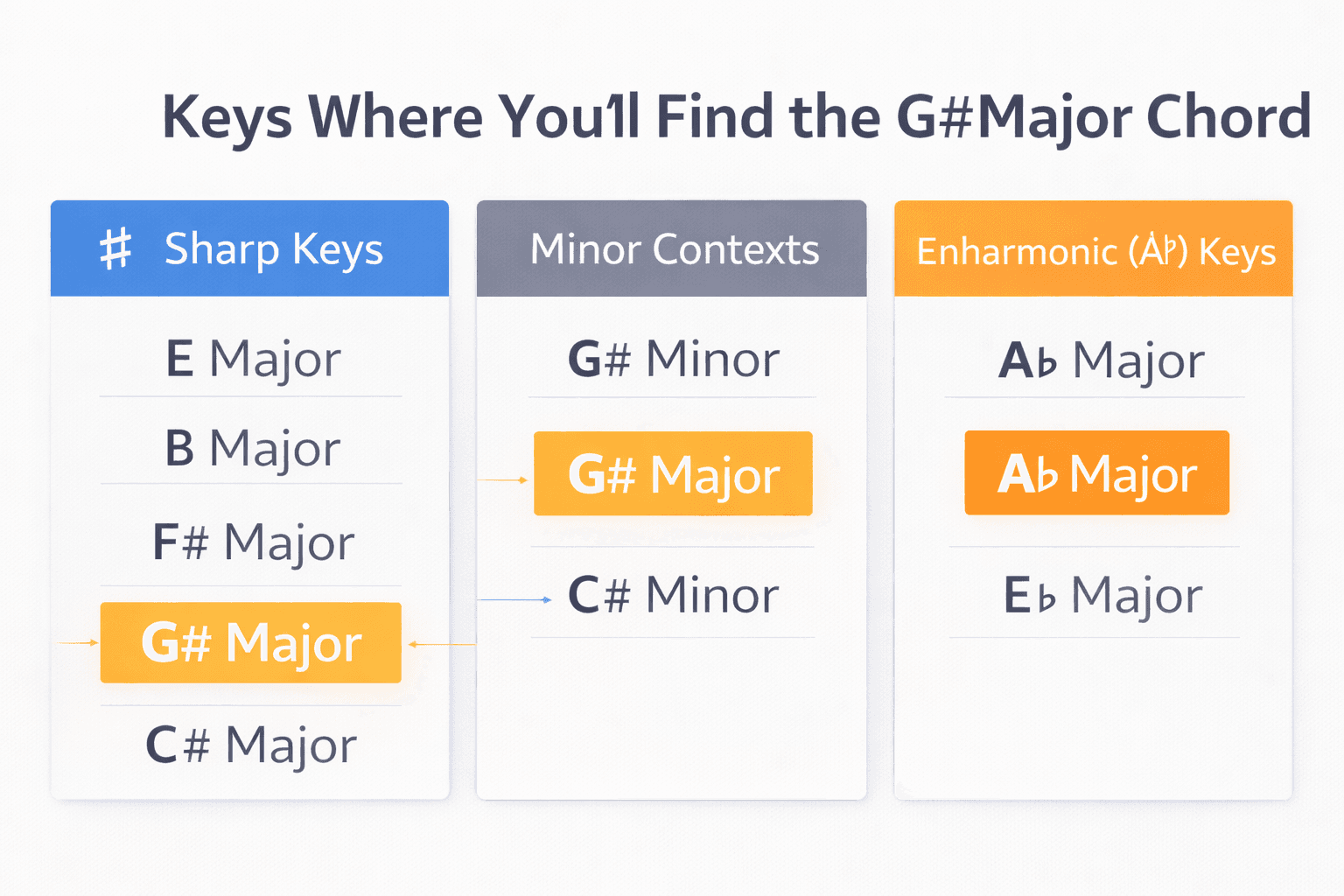
Keys Where You’ll Find the G# Major Chord
 The G# major chord appears in fewer keys than more common chords, but it plays a vital role in specific tonal contexts and modulations. It is most often encountered as a secondary dominant, borrowed chord, or enharmonic substitute.
Keys Containing G# Major
Key I ii iii IV V vi vii°
C# Major C# D#m E#m F# G# A#m B#dim
G# Minor (harmonic) G#m A#dim B C#m D# E F#dim
Enharmonic Ab Major Ab Bbm Cm Db Eb Fm Gdim
Recognizing these relationships helps guitarists understand where G# major fits harmonically and how it functions within both sharp and flat key systems.
Common Chord Progressions With G# Major
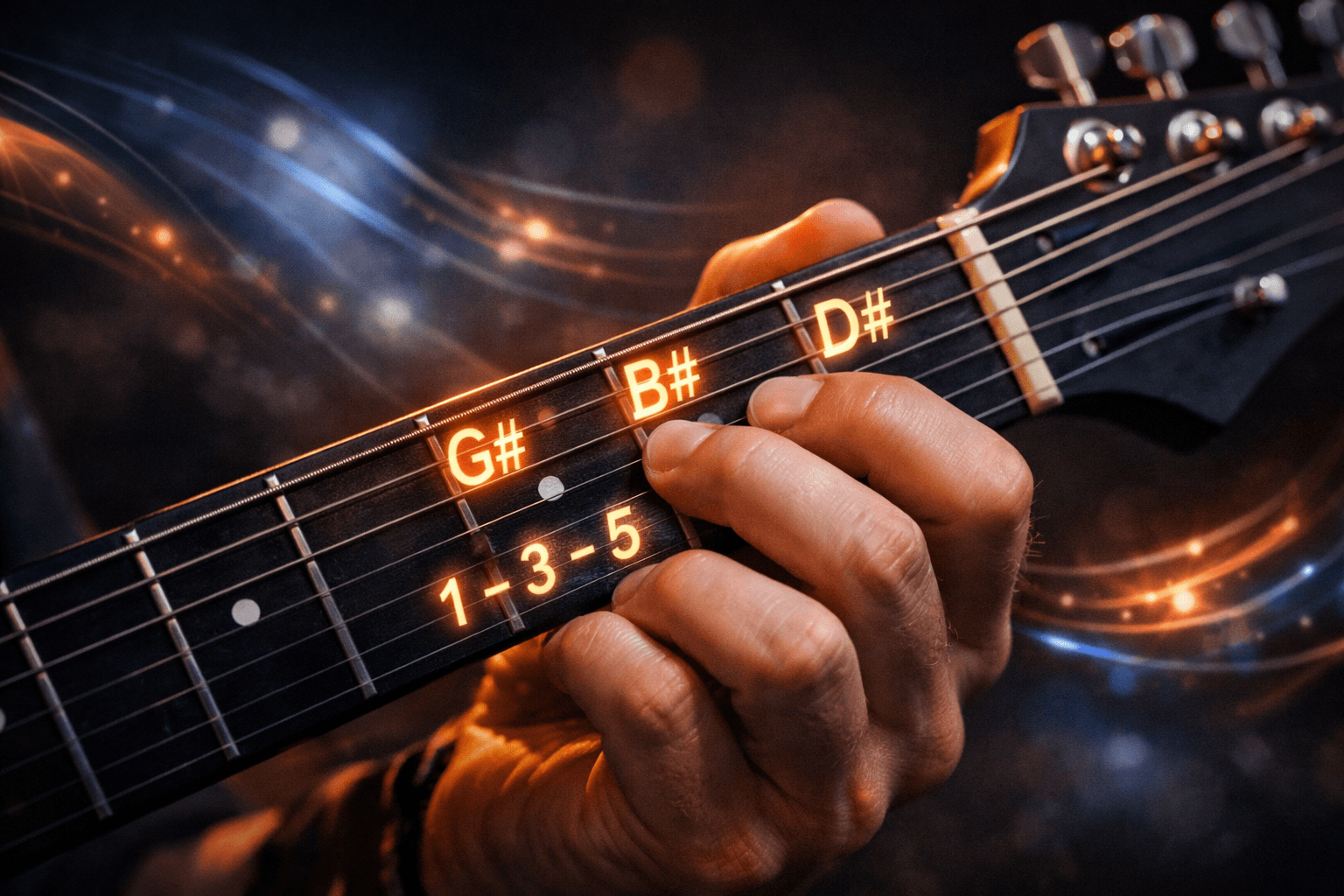 G# major often appears in sophisticated progressions rather than simple diatonic patterns. It is frequently used as a dominant chord leading to C# major or as an enharmonic substitute in A♭ major contexts.
Progressions involving G# major are common in jazz, film music, and advanced pop arrangements. Learning how this chord resolves strengthens harmonic awareness and improves a player’s ability to anticipate chord movement.
Scales to Play Over a G# Major Chord
Improvising over a G# major chord requires targeting its chord tones while choosing scales that reinforce its harmonic identity. Emphasizing G#, B#, and D# during solos creates strong melodic resolution.
Scales Compatible With G# Major
Scale Notes Mood
G# Major Scale G# A# B# C# D# E# F# Bright, resolved
E# Minor Scale E# F# G# A# B# C# D# Emotional
G# Major Pentatonic G# A# B# D# E# Clean, focused
G# Lydian G# A# B# C𝄪 D# E# F# Expansive
G# Mixolydian G# A# B# C# D# E# F# Tension-driven
These scales help players craft melodic lines that align naturally with the chord’s harmonic structure.
Popular Songs That Use the G# Major Chord
Direct use of G# major is rare in mainstream guitar music, but it appears in jazz standards, classical compositions, and film scores. Many modern recordings use its enharmonic equivalent, A♭ major, which functions identically on the guitar.
Studying these contexts helps guitarists understand how advanced harmony is applied in real musical settings and encourages experimentation beyond common open chords.
How to Play the G# Major Chord Across the Fretboard
 Using the CAGED system, guitarists can locate G# major in multiple connected positions. Each shape is movable and links to neighboring voicings, improving fluency and fretboard confidence.
G# Major Chord Positions
Position Root Note Location Shape Type
1 4th fret E string E-shape barre
2 11th fret A string A-shape barre
3 8th fret E string C-shape
4 13th fret D string G-shape
5 16th fret A string D-shape
Learning these positions allows guitarists to choose voicings that suit different musical textures and registers.
Alternate Voicings and Extensions
G# major can be expanded with additional tones to create richer harmonic colors. Common variations include G#maj7, G#sus2, G#sus4, G#6, and G#add9.
These extensions are widely used in jazz, fusion, and cinematic music. Exploring them adds emotional depth and sophistication to chord progressions and arrangements.
Playing G# Major With Other Roots
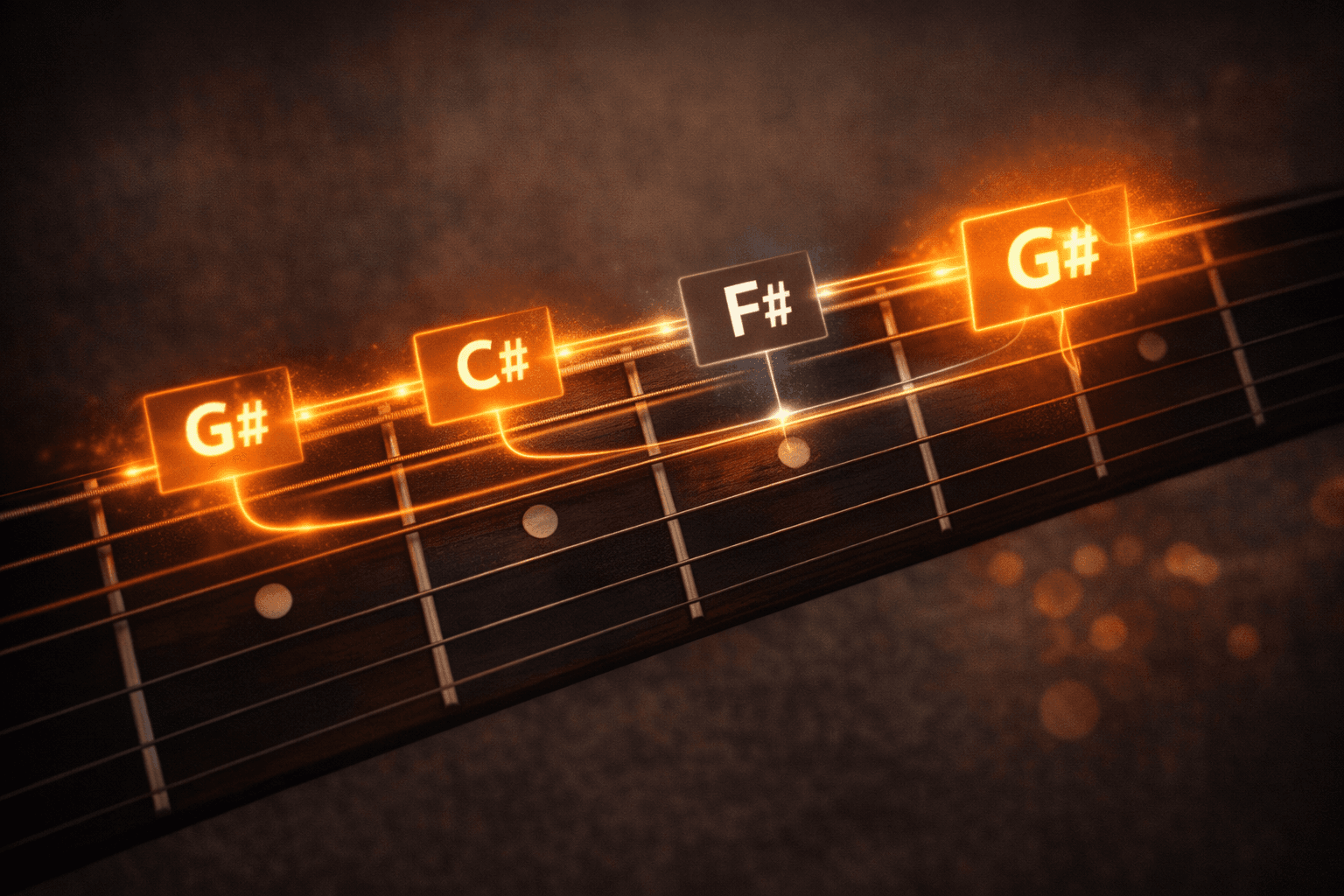 Because G# major is based on movable shapes, the same structure can be transposed to any key. Shifting the shape up or down the neck allows players to access all major chords using the same fingering logic.
This approach reinforces the CAGED system and builds a strong connection between theory and physical execution.
How to Build the G# Major Chord on Guitar
Building the G# major chord involves locating G#, B#, and D# across all six strings. Mapping these notes improves chord construction, triad recognition, and inversion creation.
This process strengthens overall fretboard literacy and supports advanced applications such as arpeggio-based soloing, chord melody playing, and harmonic analysis.
Tips to Master the G# Major Chord
 Clean execution of G# major requires controlled barre pressure, relaxed wrist alignment, and precise finger placement. Slow practice with a metronome helps maintain clarity and reduces tension.
G# Major Practice Routine
Exercise Duration Goal
Barre accuracy 5 mins Clean tone
Shape transitions 10 mins Smooth movement
Progressions 10 mins Harmonic flow
Consistent practice ensures steady improvement and confident performance.
Troubleshooting Common Problems
Common challenges include muted strings, hand fatigue, and inconsistent tone. These issues are usually caused by uneven barre pressure or excessive tension. Adjusting thumb position and practicing relaxed movements leads to rapid improvement.
Advanced Applications of the G# Major Chord
In advanced harmony, G# major is used for modulation, secondary dominants, and chromatic movement. In lead guitar, arpeggiating the chord creates strong melodic outlines.
Mastering G# major opens the door to sophisticated chord vocabulary and deeper musical expression across genres.
FAQ About the G# Major Guitar Chord
Is G# major hard to play on guitar? G# major is considered an intermediate to advanced chord because it relies entirely on barre shapes and precise finger control.
1 What are the notes in the G# major chord?
The chord consists of G#, B#, and D#.
2 Why is B# used instead of C?
B# is used to preserve correct scale degrees and interval relationships in music theory.
3 Which chords go well with G# major?
C# major, D# minor, E# minor, and A# minor commonly pair with G# major.
4 What is the difference between G# major and A♭ major?
They are enharmonically equivalent on the guitar but spelled differently in theory and notation.