ChatGPT
 Google AI
 Grok
Grok Claude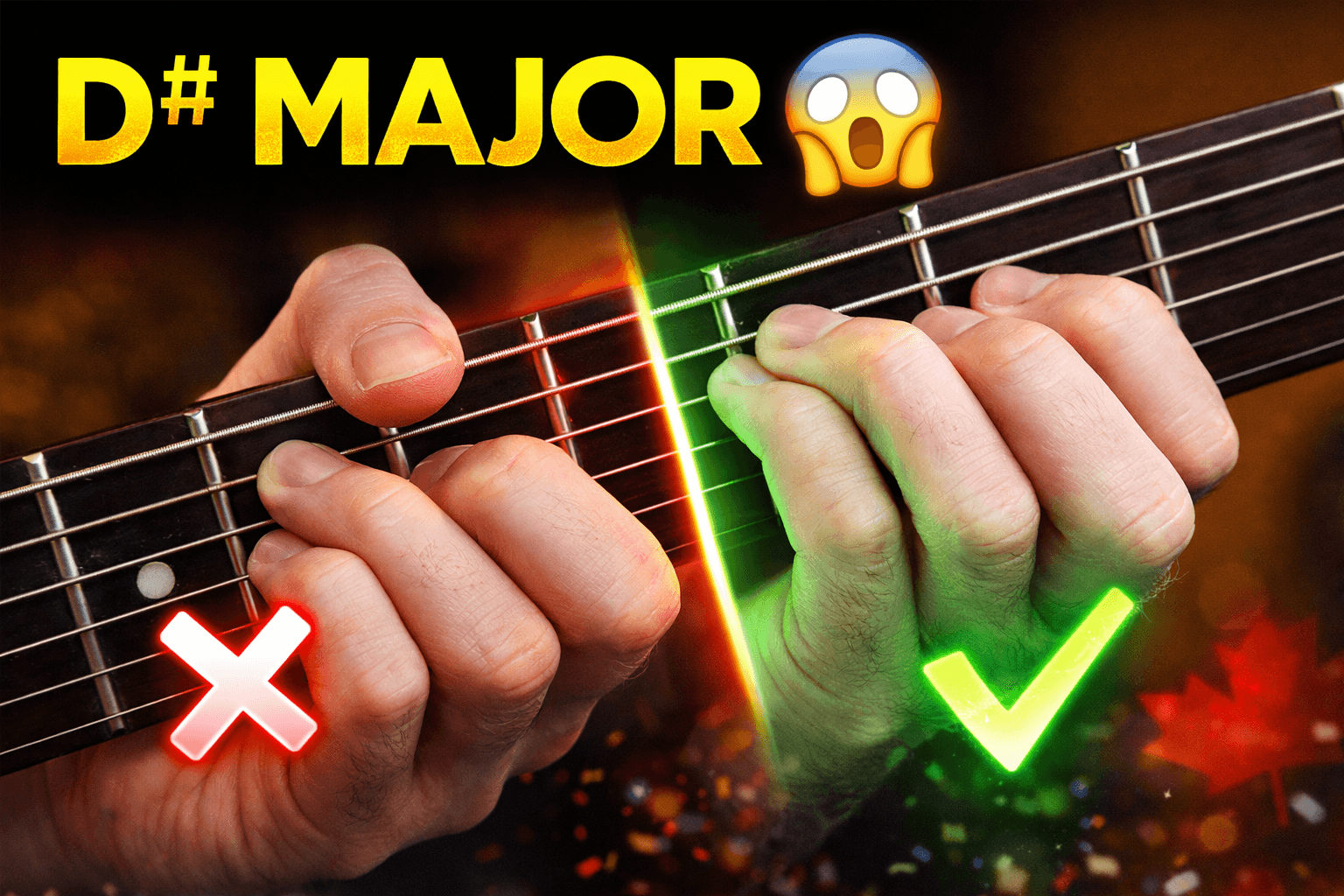
What Makes the D# Major Chord Special
 The D# major chord has a distinct tonal identity that stands out because of its bright harmonic structure and relative rarity in beginner guitar music. Built from the 1–3–5 formula, the chord produces a strong, uplifting sound that cuts through dense arrangements. It often appears in climactic sections of songs, key changes, or transitions that demand clarity and brilliance.
One reason the D# major chord is so important is that it forces guitarists to rely on theory rather than open-string familiarity. Since there is no standard open D# major chord, players must understand barre chords, movable shapes, and root-note mapping. This makes D# major a milestone chord that separates basic chord knowledge from true fretboard fluency.
In keys such as B major, G# minor, and D# major itself, this chord plays a crucial harmonic role as a tonic, dominant, or secondary dominant. Mastering its sound allows guitarists to write more sophisticated progressions, improvise with confidence, and understand how sharp keys function musically.
D# Major Chord Notes and Formula
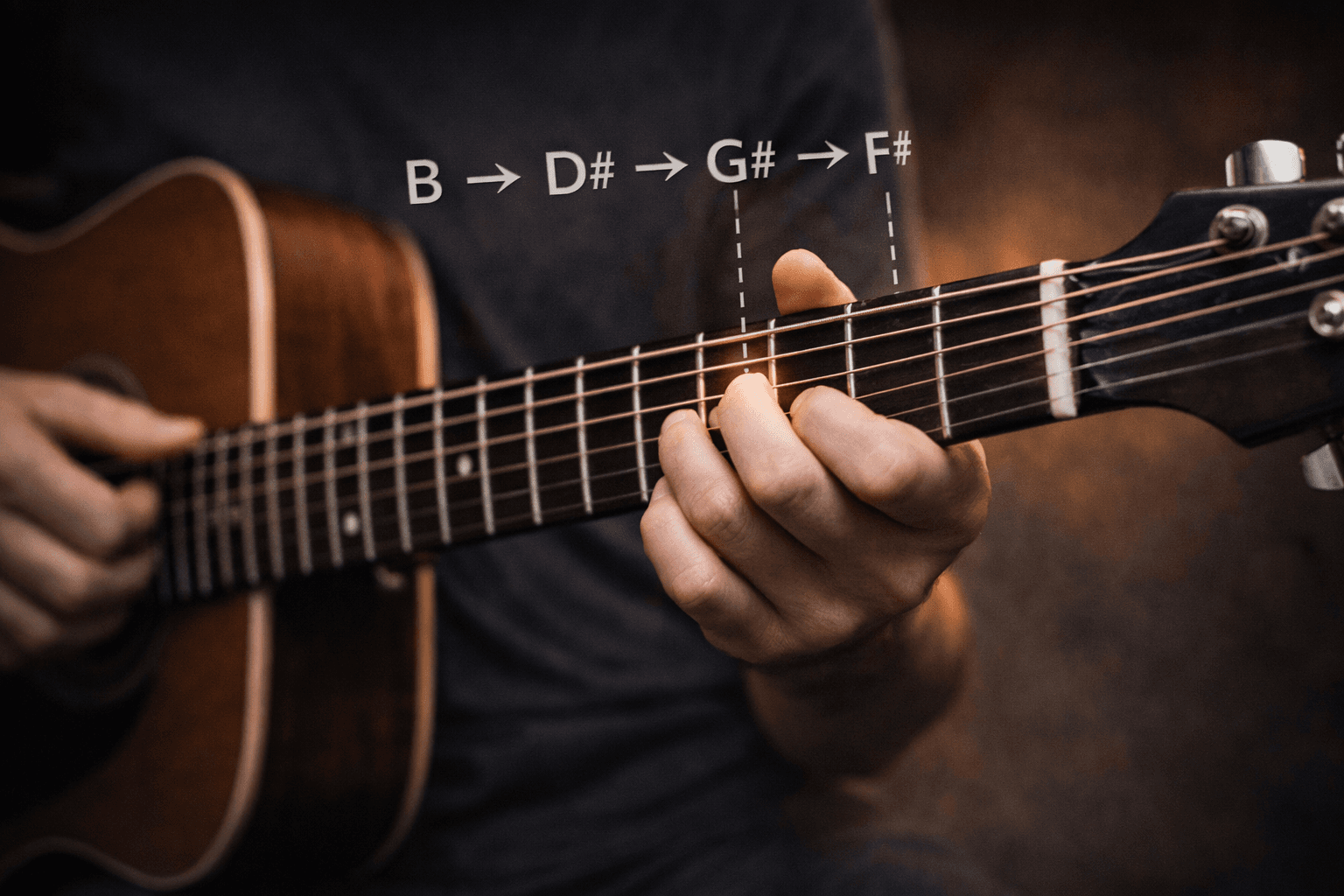 The D# major chord is built using the standard major chord formula of 1–3–5. These intervals are derived from the D# major scale and form the harmonic foundation of the chord.
The notes in the D# major chord are D# as the root, F## as the major third, and A# as the perfect fifth. Although F## may look complex on paper, it is enharmonically equivalent to G, which helps players relate the chord to familiar fretboard shapes.
D# Major Chord Tone Breakdown
Note Interval D# Root F## (G) Major Third A# Perfect Fifth
Understanding this structure is essential for building D# major chord shapes, identifying chord tones during solos, and creating new voicings. Once guitarists recognize how these notes appear across the strings, they can unlock triads, inversions, and arpeggios in any position.
How the Major Chord Is Built
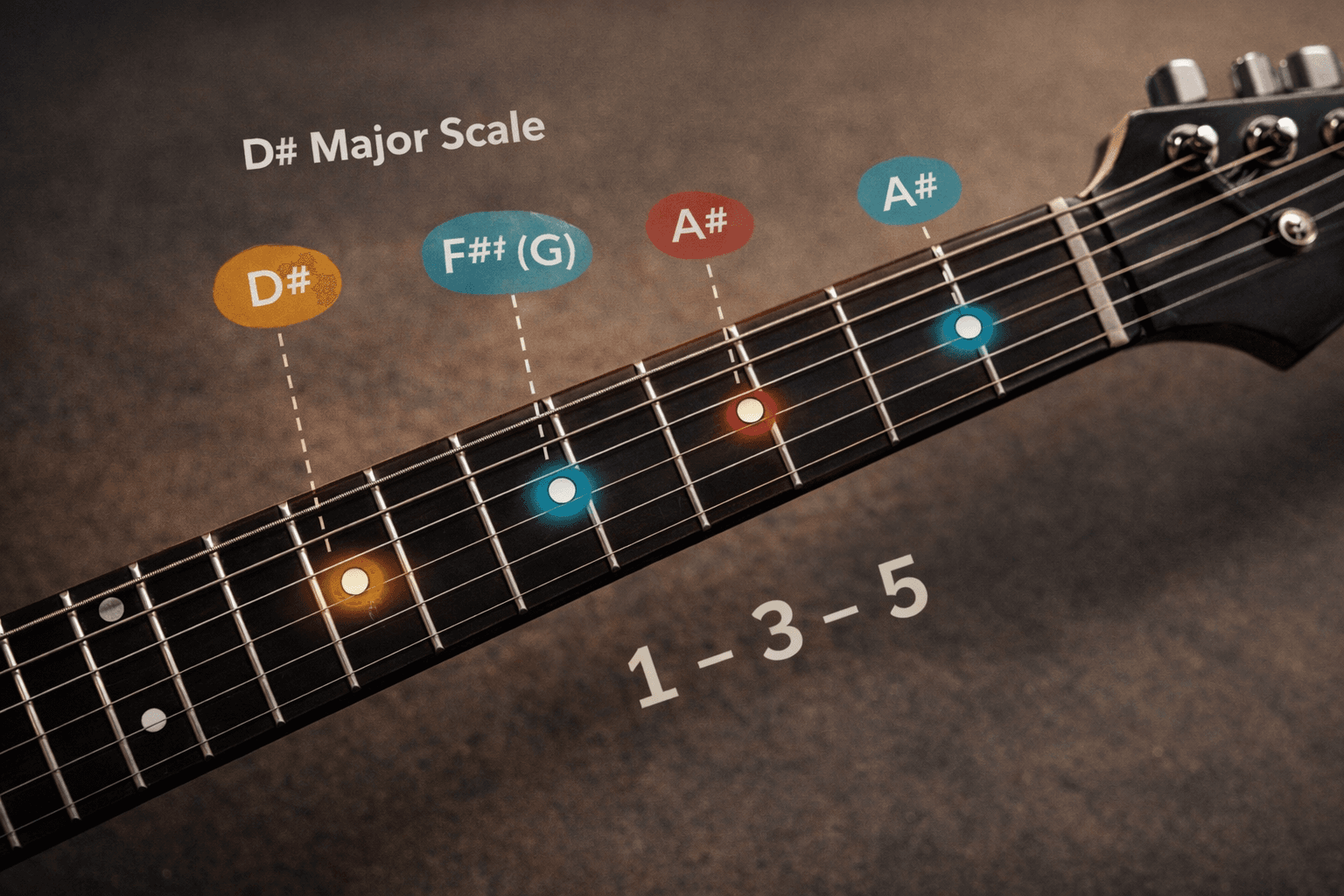 The D# major chord is constructed by stacking thirds from the D# major scale, which consists of the notes D#, E#, F##, G#, A#, B#, and C##. Selecting the first, third, and fifth notes from this scale produces the D# major triad: D#–F##–A#.
This interval relationship creates the bright and stable sound associated with major chords. By understanding how the major chord formula works, guitarists can construct the D# major chord anywhere on the fretboard without relying on memorized shapes alone.
This theoretical knowledge is especially important for advanced playing, as it allows musicians to form inversions, extended chords, and altered voicings that fit complex harmonic contexts.
D# Major Chord on Guitar
The D# major chord is played almost exclusively using barre chords and movable shapes. Because the guitar is tuned to favor natural keys, sharp chords like D# major demand strong fretting-hand technique and a clear understanding of root placement.
Each D# major position produces a slightly different tonal color depending on string choice, register, and voicing. Exploring these positions gives guitarists flexibility in rhythm playing, arrangement, and lead accompaniment.
The Most Common D# Major Shapes
The most widely used D# major chord is based on the E-shape barre chord rooted on the low E string. This shape places the root note on the sixth string at the eleventh fret, forming a full and balanced voicing that works well in rock, pop, and metal contexts.
Another important form is the A-shape barre chord rooted on the fifth string. This version offers a tighter, more focused sound and is commonly used in funk, rhythm guitar, and layered arrangements.
Mastering both shapes allows players to move freely between registers and adapt their chord voicings to different musical situations.
Keys Where You’ll Find the D# Major Chord
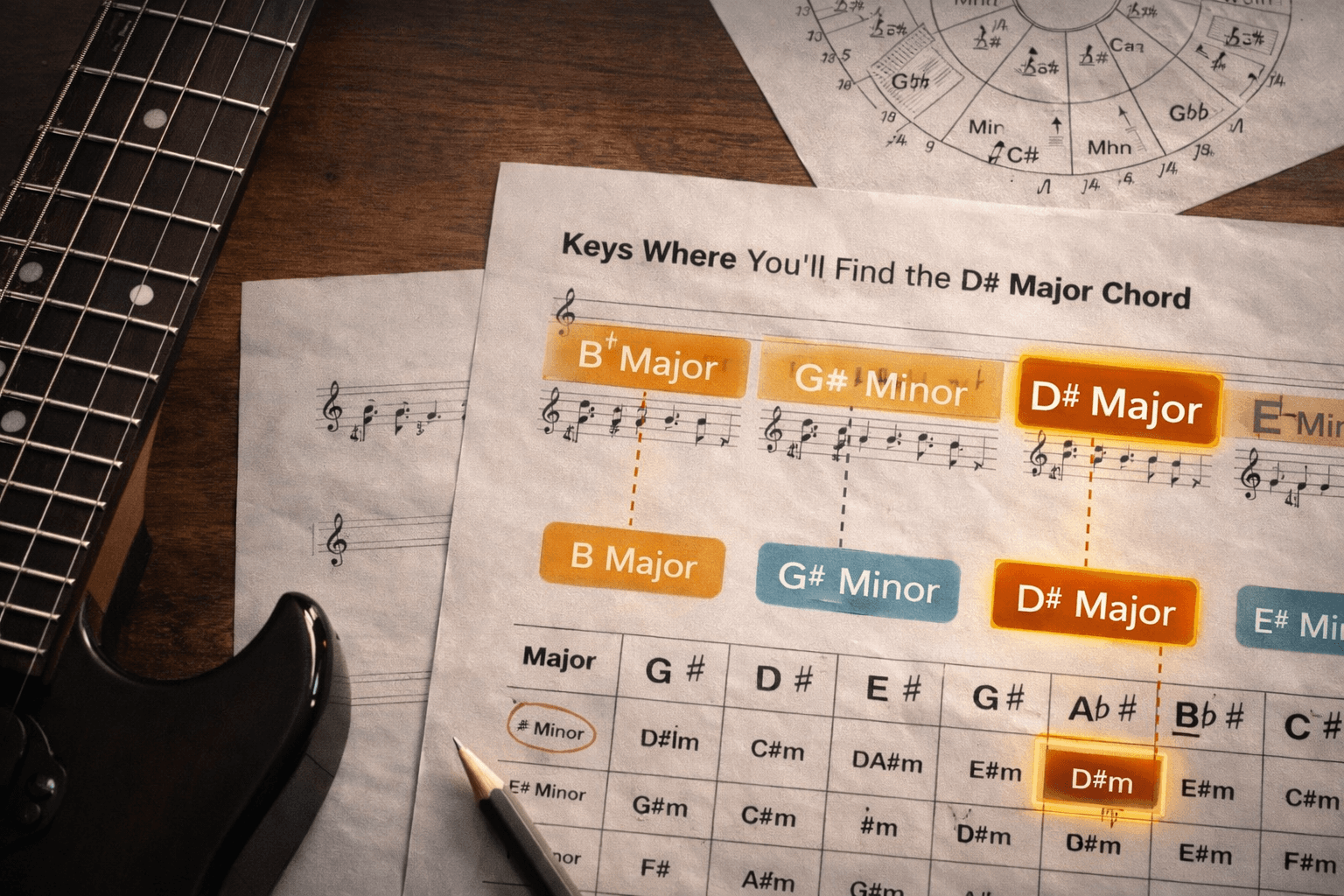
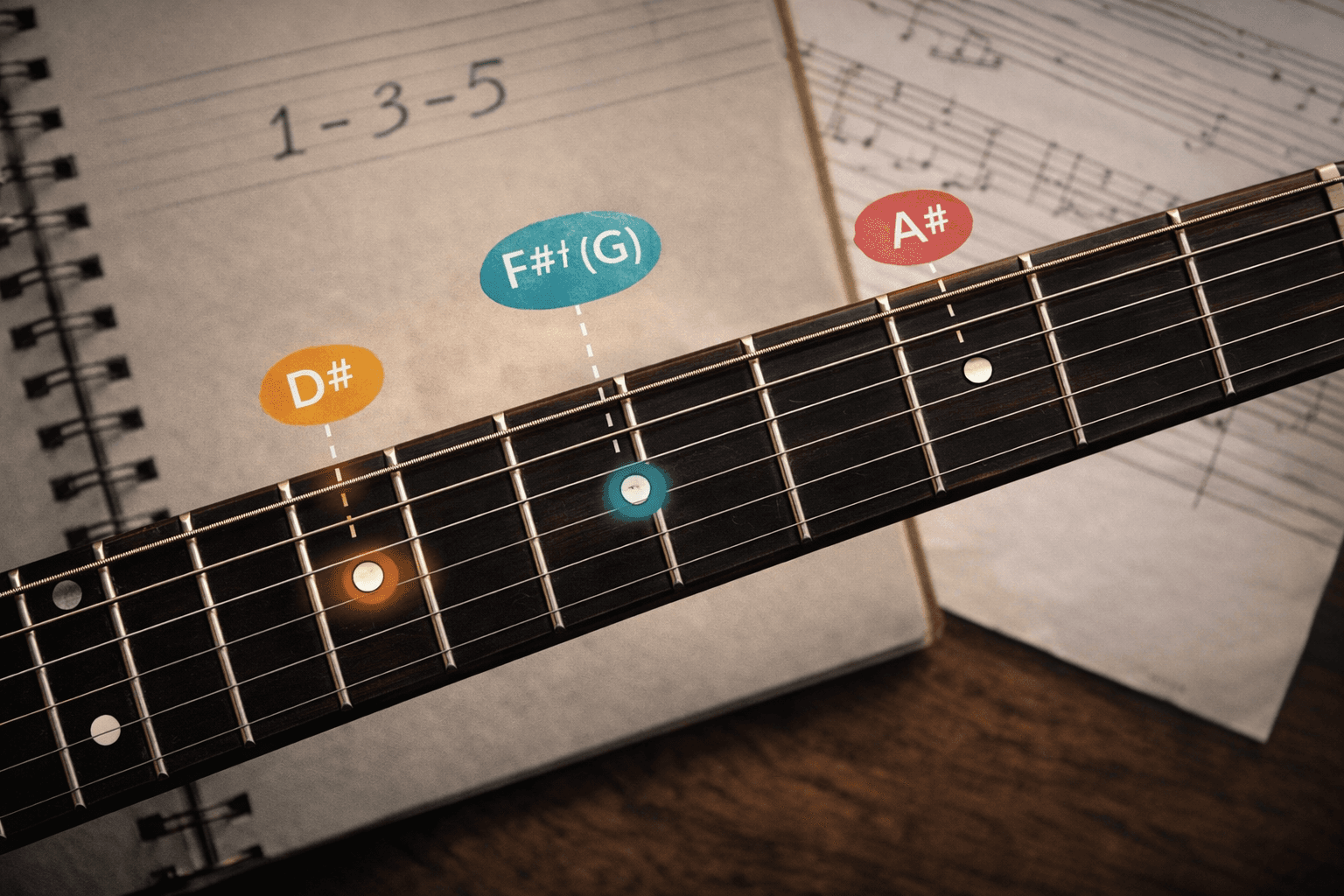 The D# major chord naturally appears in several sharp-based keys. Understanding these relationships helps guitarists analyze progressions, compose music, and improvise with accuracy.
Keys Containing D# Major
Key I ii iii IV V vi vii° D# Major D# E#m F##m G# A# B#m C##dim B Major B C#m D#m E F# G#m A#dim G# Minor G#m A#dim B C#m D# E F# A# Minor A#m B#dim C# D#m E# F# G#
Recognizing where D# major fits within these keys helps players anticipate chord movements and choose appropriate scales when improvising.
Common Chord Progressions With D# Major
 The D# major chord appears in many progressions that emphasize tension, brightness, and resolution. In modern pop and rock, it is often used as a dominant or a pivot chord during key changes.
Progressions built around D# major are especially common in keys like B major and G# minor, where the chord provides strong harmonic direction. Practicing these progressions improves timing, voice leading, and musical awareness.
Scales to Play Over a D# Major Chord
To improvise effectively over a D# major chord, guitarists must use scales that contain the chord tones D#, F##, and A#. Targeting these notes during solos creates melodic lines that sound intentional and harmonically grounded.
Scales Compatible With D# Major
Scale Notes Mood D# Major Scale D# E# F## G# A# B# C## Bright, resolved B Major Scale B C# D# E F# G# A# Smooth, stable G# Minor Scale G# A# B C# D# E F# Emotional D# Major Pentatonic D# F## G# A# C## Clean, focused D# Lydian D# E# F## G## A# B# C## Airy, modern
Using these scales helps guitarists build expressive solos, connect phrases across the neck, and maintain harmonic clarity.
Popular Songs That Use the D# Major Chord
The D# major chord appears frequently in songs that modulate into sharp keys or use barre-heavy progressions. While many songs refer to the chord as Eb major for notation simplicity, the sound and function remain the same.
Well-known artists across pop, rock, jazz, and worship music rely on this chord for its brilliance and strength. Studying these songs provides real-world context for how D# major is voiced and applied.
How to Play the D# Major Chord: Guitar Shapes and Positions
Using the CAGED system, guitarists can locate D# major across five connected positions. Each position highlights different inversions and string groupings, reinforcing fretboard awareness.
D# Major Chord Positions
| Position | Root Location | Shape Type |
|---|---|---|
| 1 | 11th fret E string | E-shape barre |
| 2 | 6th fret A string | A-shape barre |
| 3 | 11th fret D string | Triad-based |
| 4 | 15th fret A string | High voicing |
| 5 | 18th fret E string | Inversion |
Learning these positions allows players to choose voicings based on musical context rather than convenience.
Alternate Voicings and Extensions
 The D# major chord can be expanded using extensions and suspended tones to add color and emotional depth. Variations such as D#maj7, D#sus2, D#sus4, D#6, and D#add9 introduce subtle harmonic changes while retaining the chord’s major identity.
These voicings are especially useful in songwriting, jazz-influenced harmony, and ambient guitar styles.
Play This Chord With Other Roots
The shapes used for D# major can be moved to form other major chords across the fretboard. This transpositional ability is one of the most important skills for guitarists seeking fluency.
By shifting the same shape to different root notes, players can instantly access all twelve major keys, making the D# major chord a gateway to complete chord mastery.
How to Build the D# Major Chord on Guitar
Building the D# major chord involves locating D#, F##, and A# on each string and combining them into usable shapes. Mapping these notes across the fretboard enables guitarists to form custom voicings, partial chords, and melodic fragments.
This approach strengthens theoretical understanding and supports advanced techniques such as chord melody, arpeggios, and harmonic substitution.
Tips to Master the D# Major Chord
 Cleanly playing D# major requires proper thumb placement, relaxed wrist alignment, and even pressure across the barre. Slow practice with controlled strumming helps ensure clarity and endurance.
D# Major Practice Routine
| Exercise | Duration | Goal |
|---|---|---|
| Barre accuracy | 5 mins | Clean tone |
| Shape transitions | 10 mins | Smooth movement |
| Progression practice | 10 mins | Timing control |
Consistent, focused practice leads to noticeable improvement in tone and confidence.
Troubleshooting Common Problems
Common challenges include muted strings, buzzing due to uneven pressure, and hand fatigue. These issues are typically resolved by adjusting finger angle, reducing excess force, and practicing with slower tempos.
Small technical refinements result in significant improvements in sound quality.
Advanced Applications of the D# Major Chord
In advanced playing, D# major serves as a foundation for arpeggios, modal interchange, and complex progressions. Lead guitarists use D# major arpeggios to outline harmony, while rhythm players exploit multiple voicings to add texture and movement.
Understanding how D# major interacts with scales and neighboring chords allows guitarists to improvise seamlessly and compose with intention.
FAQ About the D# Major Guitar Chord
1. Is D# major hard to play on guitar?
D# major is more challenging than open chords because it relies on barre shapes, but it becomes comfortable with proper technique and practice.
2. What are the notes in the D# major chord?
The D# major chord consists of D#, F##, and A#.
3. Is D# major the same as Eb major?
Yes, D# major and Eb major are enharmonic equivalents, meaning they sound the same but are written differently.
4. Which chords go well with D# major?
Chords such as G# major, A# major, B major, and C# minor commonly pair with D# major.
5. How can I make D# major sound cleaner?
Focus on even barre pressure, relaxed hand posture, and slow practice to eliminate buzzing and muted notes.