ChatGPT
 Google AI
 Grok
Grok Claude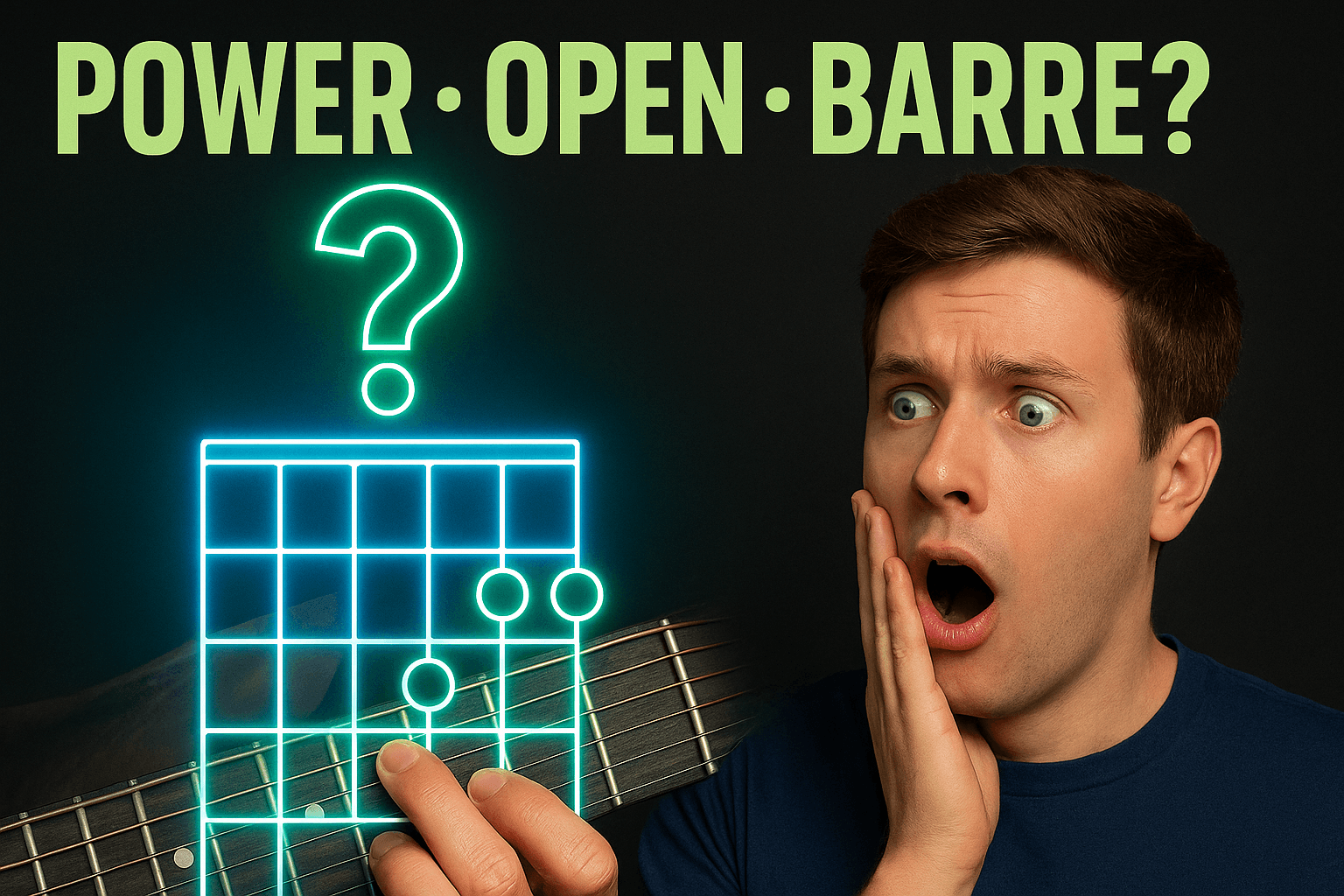
When you strum your guitar for the first time you might ask, “What do I play and where do I start?” Learning guitar chords for beginners gives you the building blocks of rhythm guitar and lead guitar. Chords create harmony and rhythm in music; without them songs would feel empty and incomplete. While drums and bass handle the beat and tempo, chords add that vital melodic depth. If you want structured learning from the basics, you can explore these online guitar classes designed specifically for beginners.
Beginners often find chords challenging because of finger strength, coordination, and learning how to read guitar tabs or chord diagrams. When you first try moving your fretting hand across guitar strings and guitar frets, it feels awkward. A good guitar practice routine will build finger strength, hand positioning for guitar, and comfort with strumming patterns. As you progress you’ll get a beginner guitar chord chart, start reading chord diagrams, and learn how to tune your guitar properly. Before diving into power chords, open chords, and barre chords, let’s glance at the three main chord types: Power chords, Open chords, and Barre chords.
Understanding the Basics of Guitar Chords
What Are Guitar Chords?
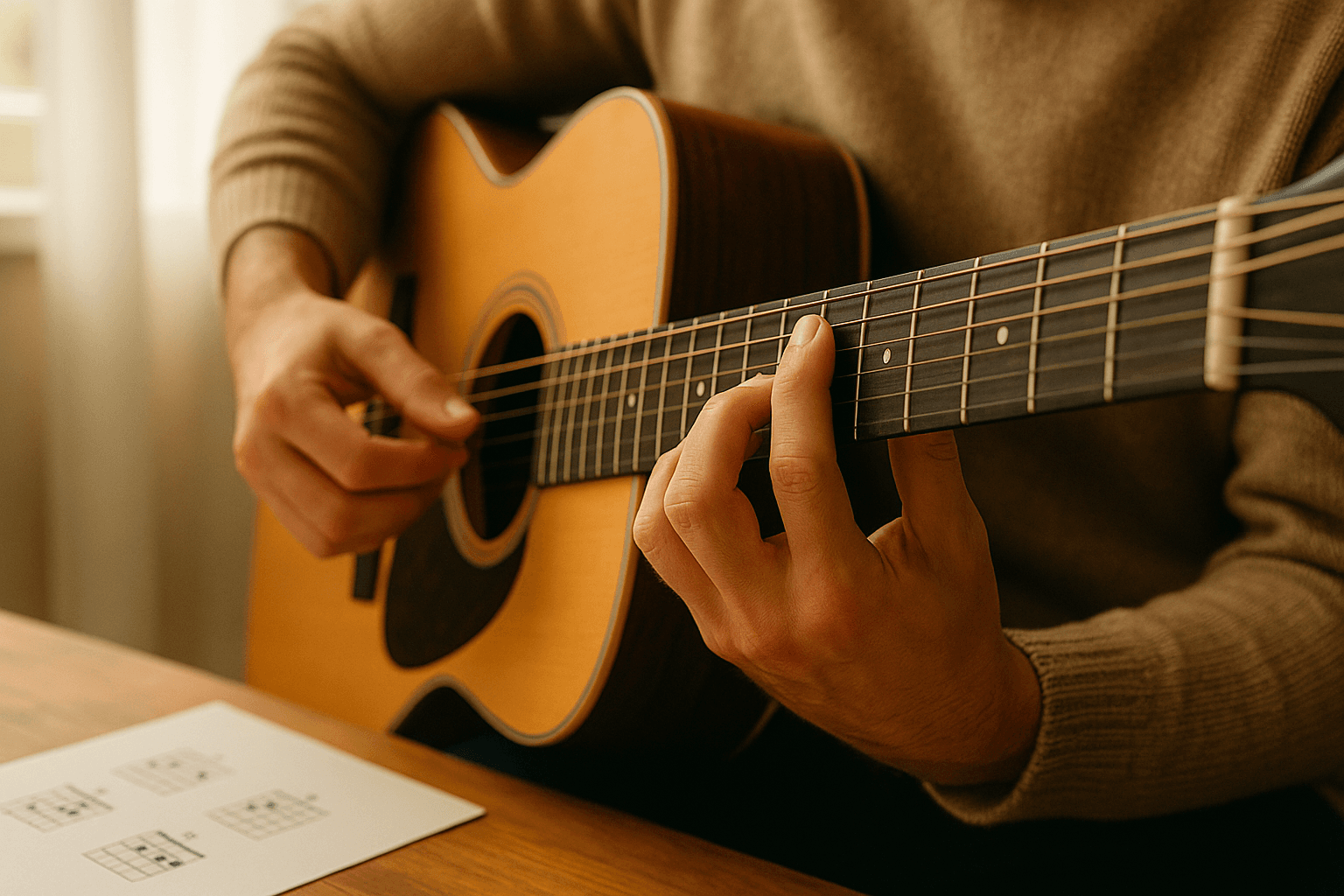
Guitar chords are formations of three or more notes (sometimes two in simpler forms) sounded together. They form the harmonic backdrop that supports melodies and riffs. In simple terms, a chord arises from a scale; you pick a root note, then add intervals (like the fifth note or the octave note) to build sound. The naming of chords depends on this structure — whether it’s major, minor, or a variant. For instance, major chords sound bright and “happy”, minor chords sound darker. Understanding chord progressions and how chord shapes fit into a key helps you to learn how to play guitar chords with purpose. To explore more music-learning tips and resources, you can visit Art Gharana.
The 3 Types of Guitar Chords
In your journey of guitar chords for beginners you’ll build through three core types: power chords, open chords, and barre chords. Power chords are simple two- or three-note shapes and work especially well in rock guitar, punk guitar, and metal guitar. Open chords ring freely using open strings and serve as the foundation of many acoustic songs. Barre chords, by contrast, involve using one finger to press multiple strings and moveable chord shapes become your secret weapon for versatility. Beginners should start simple — first power chords, then open chords, then barre chords — before tackling everything at once.
Power Chords — The Ultimate Beginner’s Tool
What Are Power Chords?
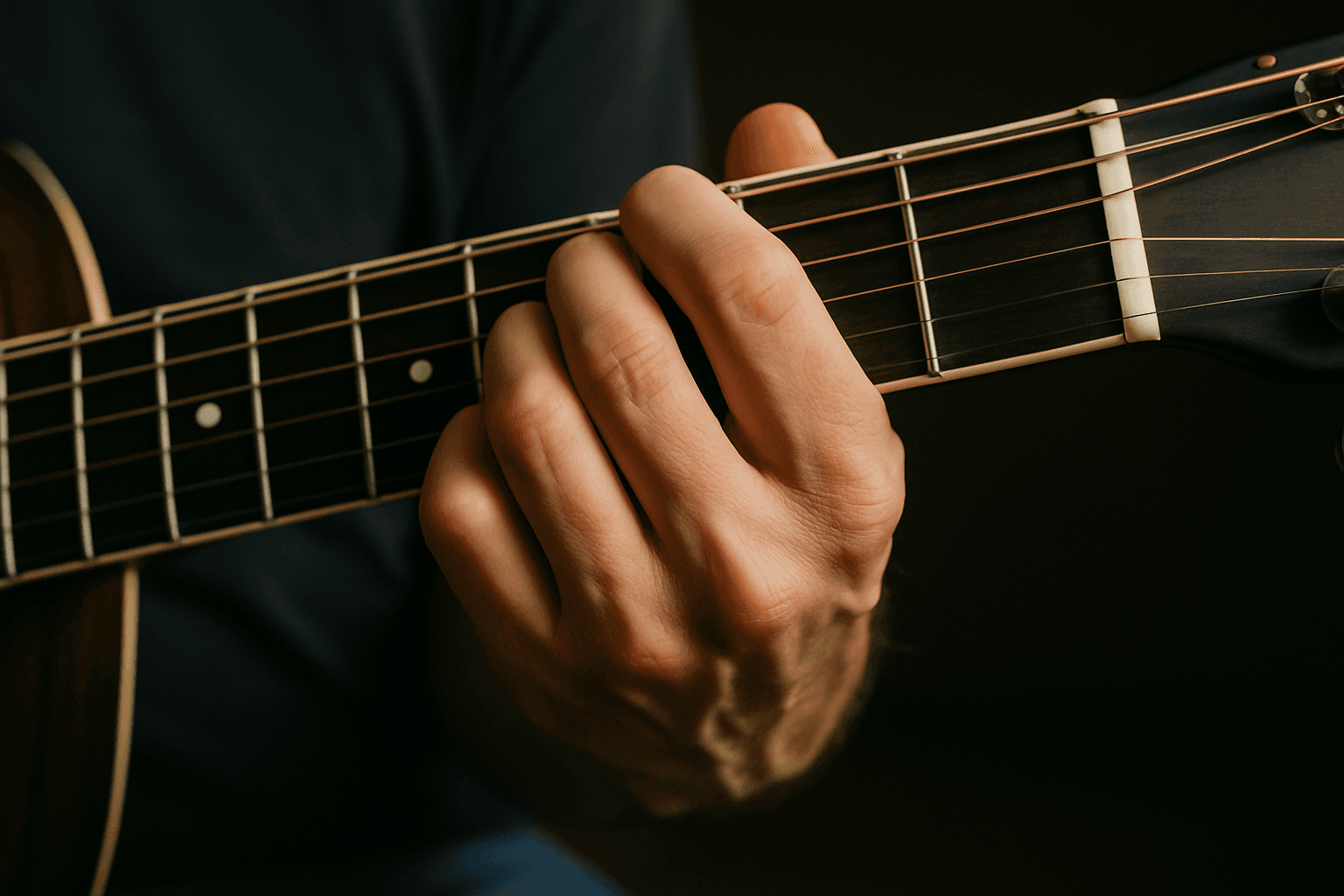
A power chord uses just the root note and fifth note — sometimes plus an octave note. Because it lacks a third, it is neither major nor minor. That neutrality gives power chords their punchy sound and makes them extremely versatile for rock guitar, punk guitar, and even modern pop guitar. Many songs you know rely heavily on these because they’re easy to grip and sound good with distortion.
Anatomy of a Power Chord
| Note | Description |
|---|---|
| Root | The starting note of the chord |
| Fifth | The second note, adding depth and strength |
| Octave | Reinforces the root for fuller tone (optional) |
Understanding this root-fifth chord structure helps you master moveable chord shapes quickly.
How to Play Power Chords Step-by-Step
- Place your index finger on the root note (for example 5th fret of the 6th string for A5).
- Then your ring or pinky finger lands on the 7th fret of the 5th string for the fifth.
- Only those two or three strings should ring; mute the others with the edge of your palm.
- Use the **palm muting technique** to clean up any stray strings.
- Practicing on both the 6th-string root and 5th-string root gives your fretting hand great versatility.
Moveable Power Chords and Patterns
Because the shape remains the same, you can slide that power-chord shape up or down the fretboard and instantly play a different chord. That’s what makes them moveable. Here’s a simple chart of common power chord shapes:
| Chord | Root Note | Fret | Strings Used |
|---|---|---|---|
| A5 | A | 5th fret | 6th + 5th |
| F5 | F | 1st fret | 6th + 5th |
| G5 | G | 3rd fret | 6th + 5th |
This table shows how quickly you can move chord shapes across the neck once you know the pattern.
Practice Techniques for Power Chords
- Start with slow tempo, focused strumming patterns, and a metronome.
- Listen for clear, clean tones — if strings ring incorrectly you’re not muting or placing fingers right.
- Backing tracks help simulate real-song context.
- Focus on **switching chords smoothly** between power-chord shapes like A5 to D5 to E5.
- This lays foundation for **beginner guitar exercises** that develop rhythm and muscle memory.
Songs to Practice Power Chords
- “Smoke on the Water”
- “Seven Nation Army”
- “Smells Like Teen Spirit”
These songs use power chords almost exclusively and help you apply the shapes in real musical contexts. By playing songs you love you’ll stay motivated, improve faster, and internalize how easy guitar chords for beginners to practice can actually sound great.
Open Chords — The Foundation of Rhythm Guitar

What Are Open Chords?
Open chords involve one or more guitar strings ringing without being pressed down. The resonance from open strings gives a rich full sound and makes these chord types ideal for beginner guitar songs. Using open strings reduces finger load and gives your fretting hand some relief. The CAGED system refers to common open chord shapes (C, A, G, E, D) that help you navigate the fretboard with ease.
Open Chord Finger Placements
| Chord | Fingering | Strings Played |
|---|---|---|
| C Major | x32010 | 5 strings |
| G Major | 320003 | 6 strings |
| D Major | xx0232 | 4 strings |
Using a beginner guitar chord chart you can map each shape and gradually memorize the finger placement chart for beginners.
Tips for Smooth Chord Transitions
- Practice hovering your fretting hand over the next shape while strumming a current chord — your fingers will learn where to go.
- Switch between open chords like G and C and power chord shapes like A5 to improve control.
- Build finger strength through repeated, targeted movements and include strumming and picking exercises.
- This improves timing, accuracy and confident tone.
- If you want guided feedback to speed up your progress, you can [book a trial class](https://www.artgharana.com/book-trial-class) with a professional instructor.
Easy Songs Using Open Chords
- “Wonderwall” (Oasis)
- “Knockin’ on Heaven’s Door” (Bob Dylan)
- “Horse with No Name” (America)
These songs use combinations of C, G, D, A, E and their minor forms. These songs reward you quickly with familiar melodies and make your practice feel purposeful and fun.
Barre Chords — Level Up Your Playing
What Are Barre Chords?
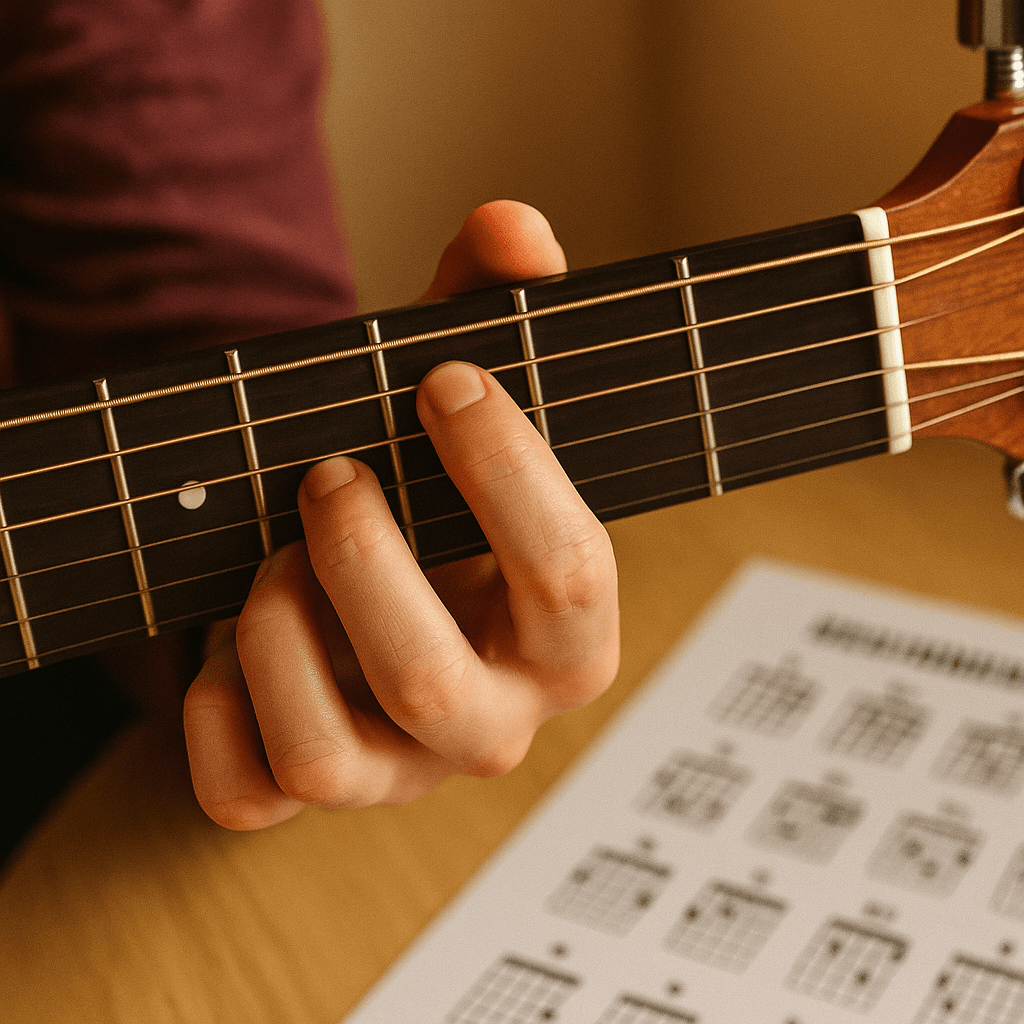
Barre chords apply the barre chord technique, which uses one finger to press down multiple strings across a fret. They are more advanced but open up the entire fretboard for you to play in any key. A major difficulty for beginners is keeping all strings clean sounding while your fretting finger acts like a movable capo. The concept of barre chord difficulty is real, but the payoff is huge.
How to Form a Barre Chord
- Place your index finger flat across all six strings at a given fret.
- Form the rest of the chord shape with your other fingers.
- An example is the F major barre chord at the first fret.
- Once you master that, you can slide the same shape up to G, A, B and so on — unlocking **moveable chord shapes** across the neck.
- This ability shifts your playing from just **open guitar chords** to full-neck freedom.
Exercises to Build Strength for Barre Chords
- Start with short sessions: press the barre shape, hold for ten seconds, release, and repeat.
- Practice **progression: open → power → barre** to build steadily rather than jumping in too hard.
- Stretch your fingers before playing.
- Use a metronome to tempo your drills.
- Over time your hand will adapt to the demand and your barre chords will sound clear, without buzz or muted strings.
Popular Songs Every Beginner Should Learn
Combining Chord Types in Real Songs
When you play real songs you’ll often merge open chords, power chords, and barre chords. The versatility of switching between an open G chord, then a moveable E5 power chord, then a barre B major chord, makes your playing dynamic. This approach engages both rhythm guitar and lead guitar parts, and helps you transition between chord types effortlessly.
Beginner Song List by Difficulty
| Level | Songs | Chord Types |
|---|---|---|
| Easy | “Smoke on the Water”, “Horse with No Name” | Power, Open |
| Medium | “Wonderwall”, “Knockin’ on Heaven’s Door” | Open, Barre |
| Harder | “Hotel California”, “Sweet Child O’ Mine” | Barre, Open |
Use this list as a roadmap. Start at Easy, move toward Medium and then Harder. Tackle the beginner guitar songs list intentionally because practice with real songs helps you lock in chord transitions and build rhythm.
Common Questions About Power Chords (FAQ)
What notes are in an A power chord?
An A power chord consists of the root note A and the fifth note E.
Is an A power chord a 5th?
Yes. In notation it’s often written as A5 because it includes root (A) and fifth (E).
What is the F power chord and how to play it?
Place your index finger on the 1st fret of the 6th string (F). Then ring finger on the 3rd fret of the 5th string (C). Strum those two strings cleanly.
Are power chords major or minor?
Neither. Because power chords omit the third interval they don’t have major or minor quality.
How many power chords exist?
There are at least twelve basic power chords — one for each semitone in an octave. As you move up or down the neck you get more variations.
Why are power chords easier than barre chords?
- They use fewer fingers and simpler shapes.
- Beginners find power chords more accessible because the fretting load is lighter.
Can you play songs with just power chords?
Yes. Many rock riffs and songs rely solely on power chords. It’s a great way to practice songs using A5, D5, and E5 power chords while still sounding like a full-on guitar track.
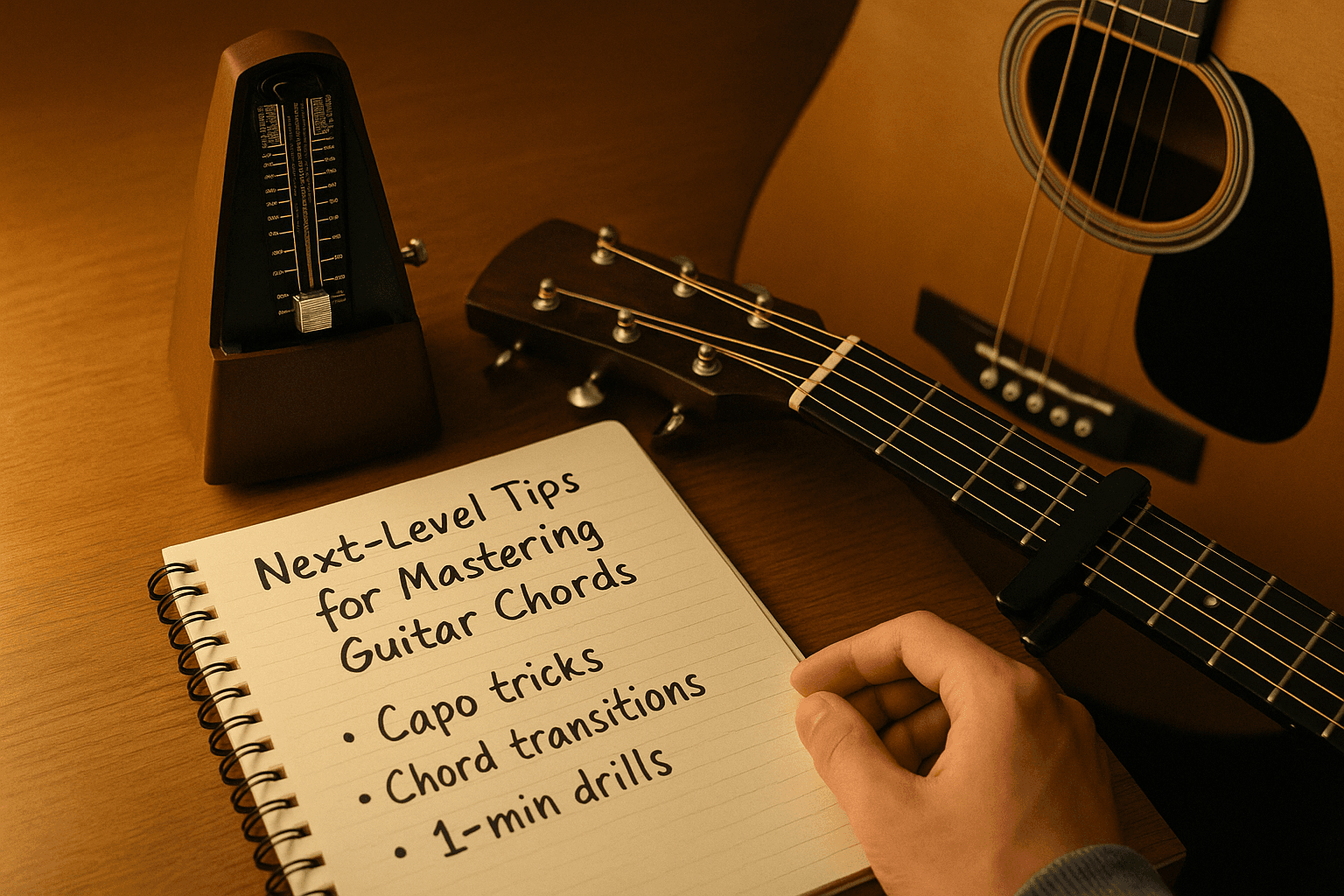
Next-Level Tips for Mastering Guitar Chords
Combining Power, Open, and Barre Chords in One Song
- Choose one song that uses open chords, one that uses power chords, and one that uses barre chords.
- Play them back to back in a **guitar practice routine**.
- You’ll become comfortable using all chord types and sharpen your control over different shapes and fretboard positions.
Using Capo for Easier Chords
A capo lets you play familiar chord shapes higher up the neck, changing the key without changing your finger shapes. It’s a smart trick when you want to play chords cleanly in a different key or avoid tricky barre transitions.
Practicing with a Metronome
One of the best ways to build rhythm is by using a metronome. Whether you’re working on a power-chord riff or an open-chord strum, keep your timing tight. Speed up slowly as you stay accurate. Timing and consistency matter as much as finger strength.
Building Strength and Speed
- Strength-building comes from repetition.
- Use short bursts of drills: one minute of power chord transitions, one minute of open chords, one minute of barre-chord holds.
- Tuck these into your daily schedule.
- Over weeks, your **finger placement, hand positioning for guitar**, and overall comfort will improve dramatically.