ChatGPT
 Google AI
 Grok
Grok Claude
Choosing your first guitar in the USA in 2026 doesn't have to be overwhelming. The biggest decision most beginners face is acoustic versus electric, but the right choice depends entirely on what music you want to play, your budget, and your lifestyle. This comprehensive guide covers the real differences between acoustic and electric guitars, which is genuinely easier to start on, the key quality indicators to look for in any beginner instrument, our recommended options at every price point, the essential accessories you'll need, and how to avoid the most common and expensive beginner buying mistakes in America.
Walk into a Guitar Center in the US. Open Amazon and type "beginner guitar." Within seconds, you're looking at hundreds of options, each one claiming to be the perfect first instrument. Reviews contradict each other. Price points range from forty dollars to four hundred. Marketing language is everywhere and meaningful information is scarce.
Here's the truth: the best guitar for beginners in the USA in 2026 isn't a specific model. It's the guitar that matches what you genuinely want to play, fits your budget honestly, and feels comfortable enough in your hands that you'll actually want to pick it up every single day.
Getting that choice right matters enormously. The right first guitar accelerates your learning and builds the habit of daily practice. The wrong first guitar sits in a corner, collecting guilt, and becomes proof that you "just aren't a guitar person."
Acoustic vs Electric Guitar: The Real Differences That Matter for Beginners

What Makes Acoustic Guitars Different
Acoustic guitars produce sound through the resonance of their hollow wooden body when the strings vibrate. No electricity required. No amplifier required. Pick it up, strum, sound comes out immediately.
This simplicity is the acoustic guitar's most powerful advantage for beginners. There is nothing to set up, nothing to plug in, and nothing to troubleshoot before you can practise. The guitar is always ready.
String action and tension: Acoustic guitars typically have slightly higher string action (the distance between the strings and the fretboard) and thicker strings than electric guitars. This means pressing down chords requires slightly more finger strength and causes more initial soreness. This is temporary. Within four to six weeks of regular practice, most beginners develop enough calluses and hand strength that acoustic guitar feels completely natural.
Sound production requirements: On an acoustic guitar, you need to strum and fret with sufficient force to produce a full, resonant sound. This naturally develops good technique habits in the right hand (picking/strumming) and left hand (fretting).
Types of acoustic guitars:
- Dreadnought: The classic full-sized acoustic guitar body. Loud, full-bodied sound. The standard recommendation for most beginners.
- Concert and parlour: Smaller body sizes. Quieter, more intimate sound. Comfortable for smaller players or those with shorter arms.
- Classical guitar (nylon string): Wider neck, nylon strings. Softer on fingers. Standard for classical music, flamenco, and often recommended for young children or those learning fingerstyle.
What Makes Electric Guitars Different
Electric guitars produce minimal sound acoustically. They require an amplifier to be heard properly. The electric guitar's body translates string vibrations into an electrical signal through pickups, which is then amplified and shaped by an amp.
Lower string action and lighter strings: Electric guitars typically have much lower string action and lighter gauge strings (as thin as 0.09 inches/0.23mm at the high E). This makes pressing down chords physically easier and causes significantly less initial finger soreness. Many beginners find the first month on electric guitar more physically comfortable than acoustic.
Amplifier requirement: The additional cost of a practice amp (entry-level starts around $50-60) and a cable is the main trade-off of electric guitar. The total beginner setup cost is higher.
Genre association: Electric guitars are the foundation of rock, blues, metal, funk, and much contemporary pop. If your musical heart lives in these genres, starting on electric is natural and appropriate.
The Question Most Beginners Are Really Asking
Most beginners who ask "acoustic or electric?" are really asking one of two things:
"Which is easier to learn?" Physically, electric strings are easier to press down. But the additional setup (amp, cable, interface) creates friction that reduces daily practice consistency. Acoustic's higher initial physical demand builds stronger foundational technique. Both arguments are legitimate.
"Which is better for the music I want to play?" This is the right question. If your musical vision involves strumming Bollywood-inspired folk songs, campfire classics, or singer-songwriter material, acoustic is natural. If your heart is in rock, blues, or contemporary pop with electric sounds, go electric.
The practical truth: Most guitar educators in the US agree that acoustic guitar provides an excellent foundation before moving to electric, but this is a guideline, not a rule. Choose based on what music excites you.
Classical Guitar: The Third Option Worth Knowing About

When a Classical Guitar Makes Sense for a Beginner
The classical guitar (nylon-string acoustic) deserves its own section because it's the most common recommendation for:
- Children under age 10 (smaller hands, softer fingertips)
- Adults learning fingerstyle or classical technique from the start/li>
- Indian-American families where one parent learned a stringed instrument and wants to complement that background
- Anyone with very sensitive fingertips who finds steel strings painful
Nylon strings are significantly gentler on fingertips than steel strings. The wider neck (typically 52mm at the nut vs 43-44mm for steel-string acoustics) makes individual string work easier for fingerstyle technique but slightly harder for chord grips that require the thumb to wrap around the neck.
If you're learning classical pieces, bossa nova, or fingerstyle arrangements of Indian classical or Bollywood music, the classical guitar is worth serious consideration.
What to Look for in Any Beginner Guitar: Quality Indicators

Playability - The Most Important Factor
Action: The distance between the strings and the fretboard. Lower action makes fretting easier. Most budget guitars ship with higher action than ideal. A basic professional setup by a guitar technician (typically $40-$60 at any music store) can dramatically improve the playability of an entry-level instrument.
Ask your music store to check and adjust the action before you take the guitar home. It's standard practice and many stores include it with purchase.
Neck profile and width: How the back of the neck feels in your fretting hand varies significantly between guitars. Rounder profiles feel comfortable to some, flatter C-shaped profiles to others. If possible, hold several guitars before buying and notice which feels most natural.
Nut and saddle quality: The nut (small piece at the top of the neck) and saddle (piece at the bridge) significantly affect tone and playability. Plastic nut and saddle are standard on budget guitars but can be upgraded inexpensively. Bone or synthetic bone alternatives improve tuning stability.
Intonation
Intonation refers to whether the guitar stays in tune as you play up the neck. A guitar with bad intonation sounds progressively more out of tune as you move to higher positions. Test this at the store: play an open E string, then play the same note at the 12th fret. They should be exactly an octave apart. If the 12th fret note is sharp or flat, the intonation needs adjustment.
Tuning Machine Quality
Budget guitars often have machine heads (tuning pegs) that don't hold tune reliably. Check reviews specifically for tuning stability. Grover and Gotoh are respected brands that appear on mid-range instruments. Sealed die-cast tuners hold tune better than vintage-style open gear tuners.
Solid Wood vs Laminate Top
A solid wood top produces better tone and improves acoustically with age. Laminate tops (multiple thin wood layers glued together) are stable but don't develop the same resonance over time.
In the under-$300 price range, most acoustic guitars have laminate tops. The Fender CD-60S and Yamaha FG800 are notable exceptions with solid spruce tops at under $200.
For beginners, a laminate guitar is completely fine. The tonal differences become relevant once you've been playing for a year or more.
Body Size for Children and Smaller Players
Full-size guitars are appropriate for players aged 12 and older. For younger children or smaller adults:
- 3/4 size: Appropriate for ages 7-11 or adults with shorter arms
- 1/2 size: For young children ages 5-7
- Mini or parlour: Some adults prefer smaller body sizes for comfort
A properly sized guitar is far more important than brand name for young learners. A child struggling to hold a full-size guitar will plateau quickly regardless of teacher quality.
Recommended Acoustic Guitars for US Beginners in 2026
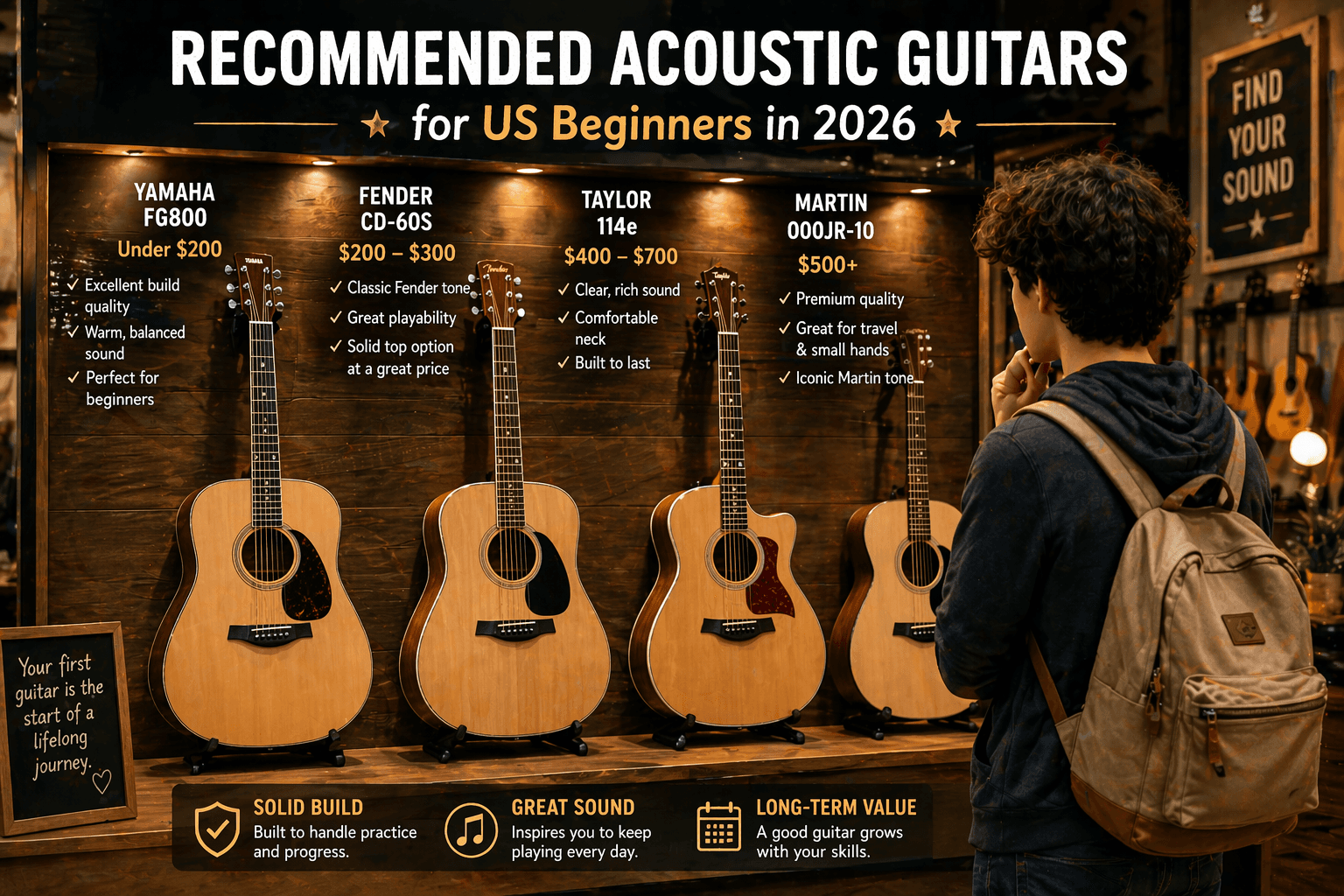
Under $200 - The Best Bang-for-Buck Options
Yamaha FG800 Consistently rated as one of the best acoustic guitars for beginners under $200, the FG800 features a solid Sitka spruce top (unusual at this price), nato back and sides, and Yamaha's scalloped bracing for improved resonance. It holds tune reliably, sets up well, and sounds genuinely good from day one. Available at Guitar Center, Sweetwater, and Amazon.
Fender CD-60S Another solid-top acoustic at under $200. The CD-60S features a solid spruce top and has the advantage of Fender's reputation for quality control at this price point. The neck profile suits most beginners well. A safe, proven choice.
Orangewood Sage A newer recommendation that has earned strong community praise. The Sage offers excellent playability, a solid cedar top, and a slightly wider body that produces impressive volume for its price.
$200-$400 - The Sweet Spot for Committed Beginners
Taylor Academy 10 The entry point to Taylor's Academy series brings Taylor's famously comfortable neck profile and excellent factory setup to the $300 price range. The forward-shifted X bracing improves the sound on smaller-bodied guitars. An excellent choice if you're committed to guitar from the start.
Seagull S6 Original Made in Canada with a solid cedar top and wild cherry back and sides, the Seagull S6 is one of the best-value acoustic guitars available in North America. Excellent intonation, beautiful tone, and a build quality that outperforms its price significantly.
Yamaha LL6 ARE At around $400, the LL6 ARE offers solid spruce top with Yamaha's ARE (Acoustic Resonance Enhancement) wood treatment that accelerates the tonal maturation process typically associated with aged wood. A genuinely excellent instrument.
$400+ - Investment Instruments for Serious Beginners
At this price point, you're looking at the Martin 000-15M (solid mahogany throughout), the Taylor Academy 12e (with electronics for amplification), and entry-level Martin Standard and Taylor Builder's Edition models. These are guitars you won't outgrow in years of serious playing.
Recommended Electric Guitars for US Beginners in 2026
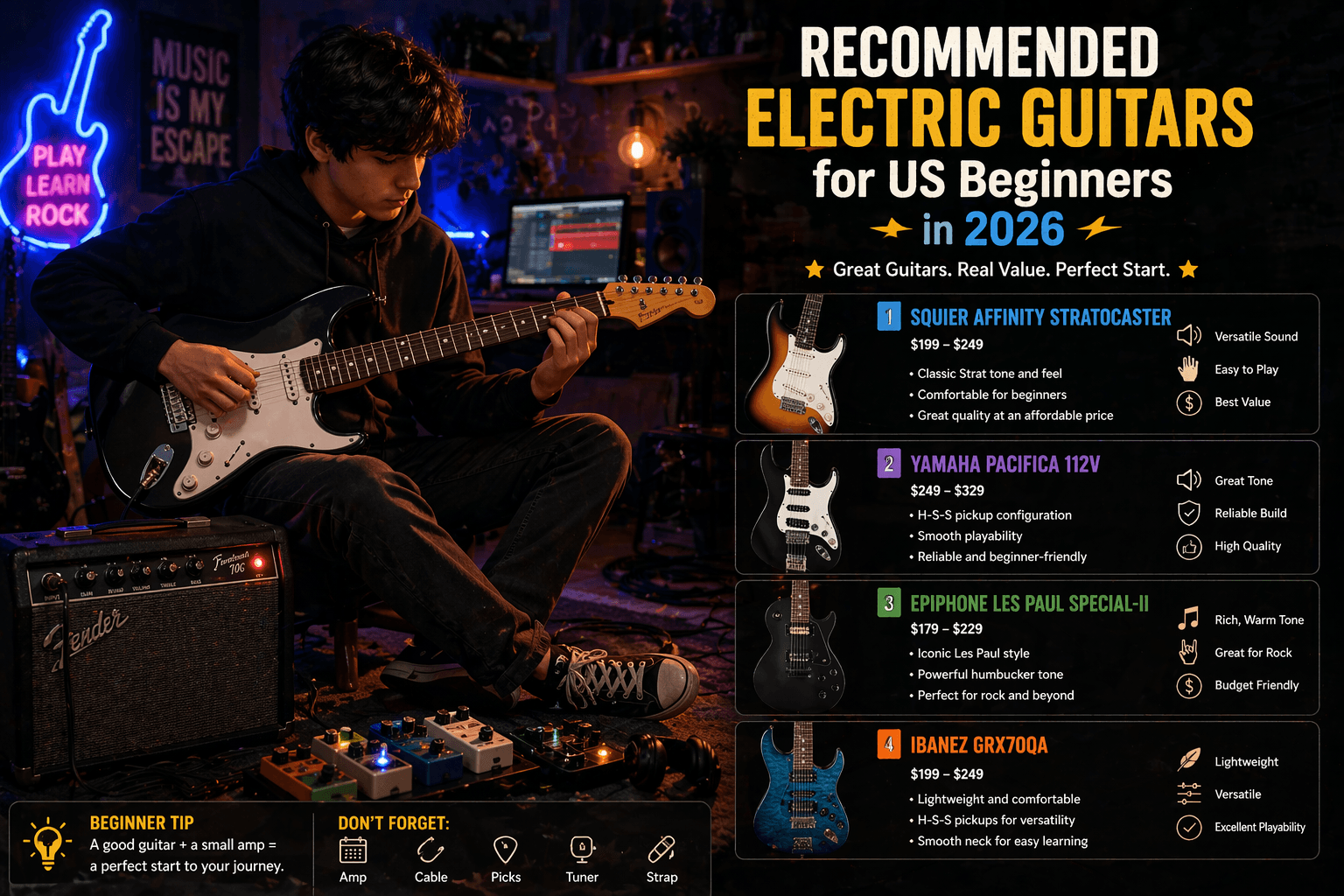
Under $300 - Entry Level Electric
Squier Classic Vibe Stratocaster The Squier Classic Vibe series is consistently praised as the finest entry-level electric guitar range available. Made by Fender's budget subsidiary, the Classic Vibe Stratocaster plays and sounds remarkably close to its significantly more expensive Fender counterparts. Available in the $400-$500 range for the new versions, with excellent used options under $300.
Epiphone Les Paul Standard Gibson's budget line produces Les Paul-style guitars that offer the warm, thick tone of the original at a fraction of the price. Solid mahogany body, good pickups, and reliable hardware make this a great entry point for rock and blues players.
$300-$600 - Mid-Range Electric Worth the Investment
Fender Player Stratocaster The Fender Player series is made in Mexico and represents a massive step up in hardware quality, playability, and tone from the Squier range. If you're committed to electric guitar from the start, stretching to the Player Strat is worth it.
PRS SE Standard 24 Paul Reed Smith's SE series offers excellent quality control and a versatile tonal range. The SE Standard 24 is particularly well-regarded for its clean, clear sound and excellent factory setup.
Practice Amps for Electric Guitar Beginners
Every electric guitar beginner in the USA needs a practice amp. Here are the most recommended options in 2026:
Boss Katana Mini (~$100): Best-in-class sound quality at low volume. Three voice channels (clean, crunch, lead), a built-in tape delay, and surprising headroom for such a compact unit. Highly recommended.
Fender Frontman 10G (~$60): The most affordable quality option. Clean and overdrive channels, single speaker, basic tone controls. Does exactly what a beginner needs.
Fender Champion 20 (~$120): Steps up to built-in effects (reverb, delay, chorus) and two channels. A significant quality jump from the 10G for a modest price increase.
Essential Accessories Every Beginner Needs From Day One
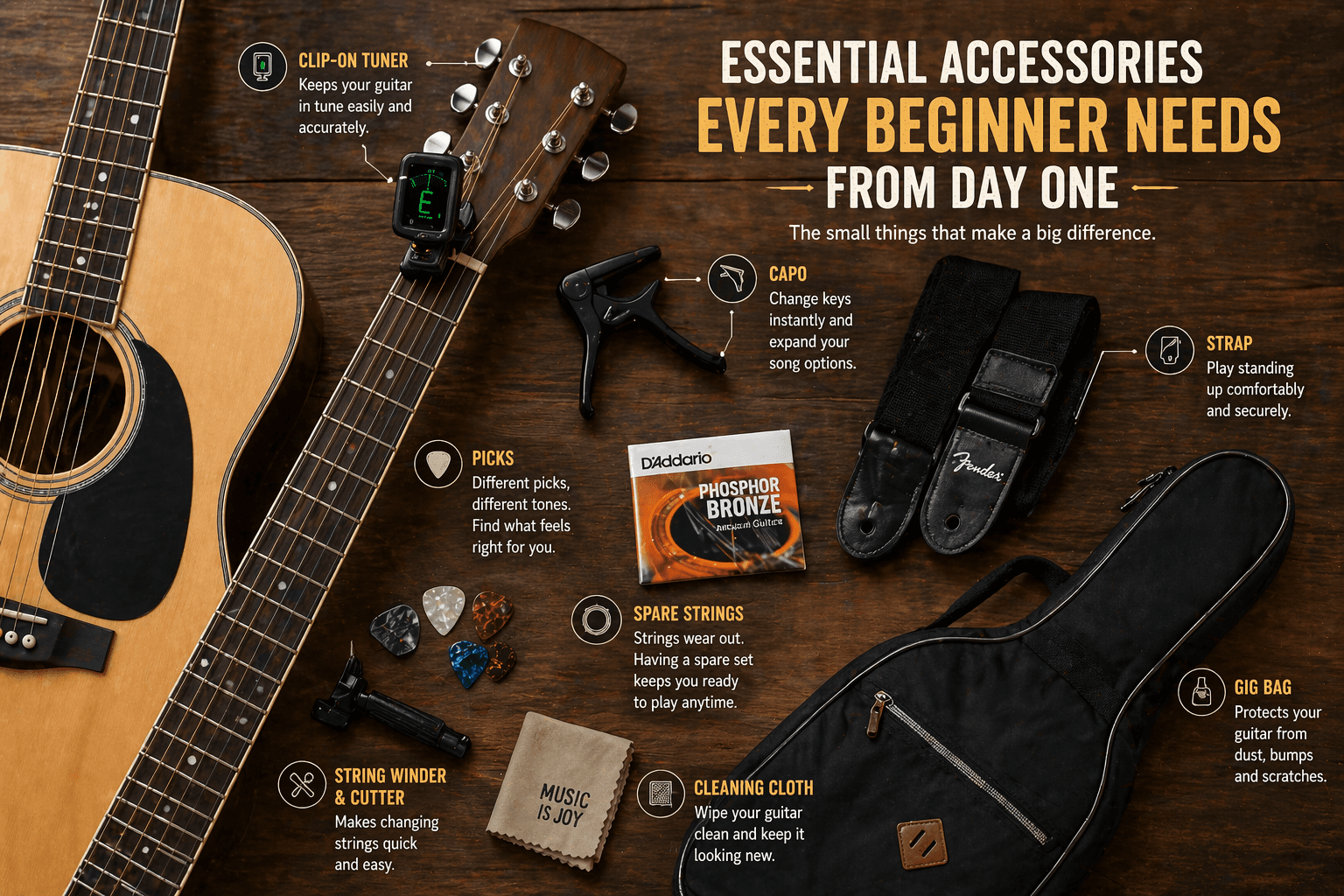
The Non-Negotiables
A quality clip-on tuner: Always tune before you practise. This builds ear training alongside technique. The Snark SN5X ($15) and Peterson StroboClip HD ($50) are both excellent. The Peterson is more accurate but the Snark is more than sufficient for beginners.
A capo: Allows you to play in different keys using the same chord shapes. Essential for most pop and folk repertoire. Any Dunlop spring capo works reliably.
A variety pack of picks: Buy a sampler pack of different thicknesses. Most beginners settle on medium (0.73mm) picks. Dunlop Tortex picks are the industry standard.
Spare strings: String breakage happens. Keep at least one spare set. Elixir Nanoweb strings have a polymer coating that significantly extends string life, making them worth the extra cost for beginners who don't want to restring frequently.
A strap: Develops proper posture and keeps the guitar stable during seated practice. Any leather or padded nylon strap at $15-25 is fine.
A gig bag or case: Protects your instrument. Most beginner guitars come with a basic gig bag. If yours doesn't, budget $25-$40 for one.
Optional But Recommended
A guitar stand: Keeps the guitar visible and accessible, which dramatically increases how often you pick it up. Instruments stored in cases get played less.
An acoustic-electric pickup (for acoustic guitarists who want to perform): Not for day one, but worth knowing about for later. Magnetic pickups like the LR Baggs M1 or aftermarket undersaddle systems are the standard choices.
The Most Common Beginner Guitar Buying Mistakes in the USA
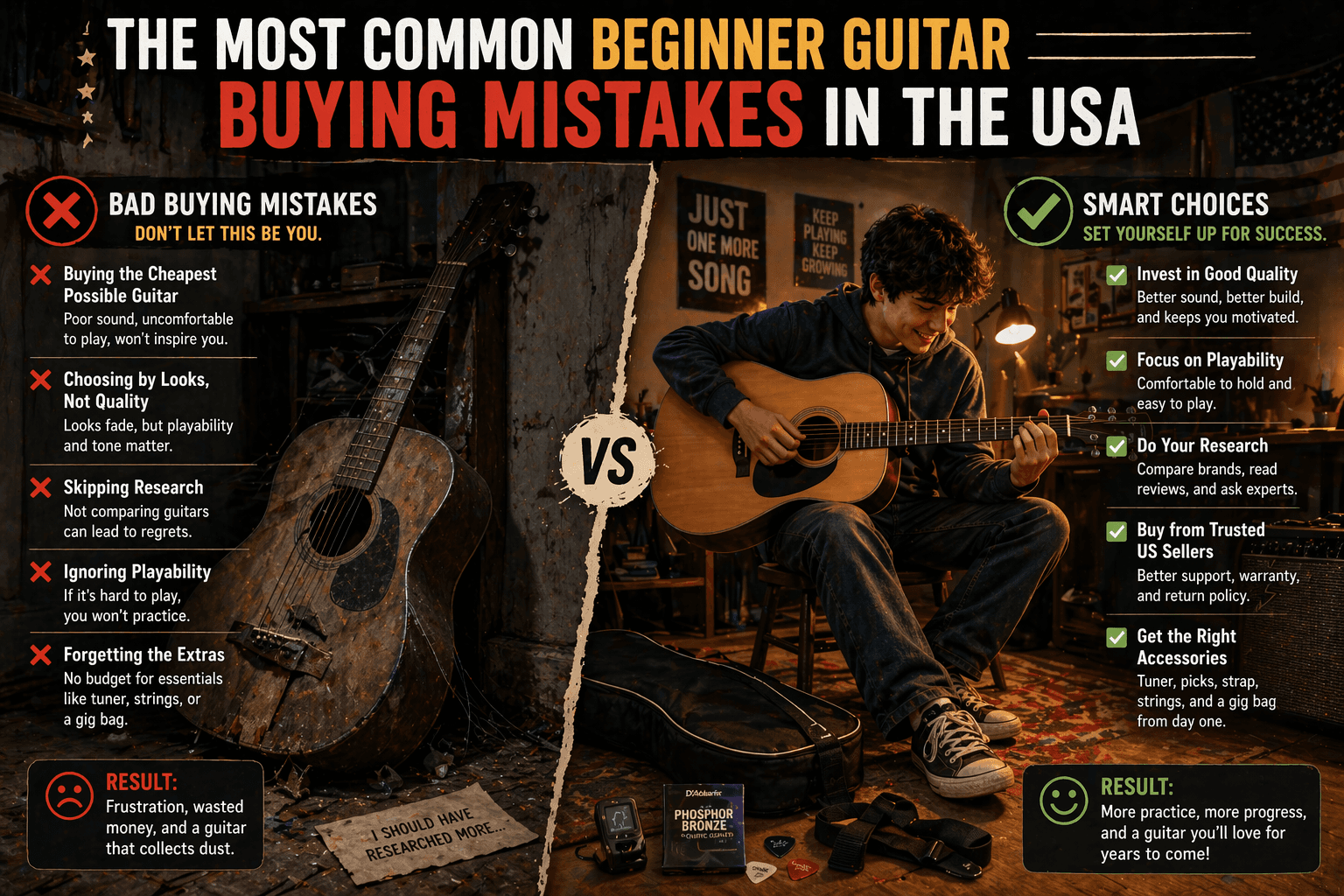
Mistake 1: Choosing Based on Looks
"That red one looks so cool" is not a guitar-buying criterion. A guitar that looks amazing but plays poorly will sit in a corner. Playability, comfort, and sound quality are the only meaningful factors. Looks are irrelevant.
Mistake 2: Buying Online Without Trying In Person
Guitars vary even within the same model and production run. Two Yamaha FG800s made on the same day can feel meaningfully different. If possible, visit a Guitar Center, Sam Ash, or local music shop and play five or six guitars in your target price range before buying.
Mistake 3: Buying the Cheapest Guitar Available
Sub-$80 guitars from unestablished brands typically have action so high and intonation so poor that learning on them is genuinely discouraging. The $50 savings is not worth the added difficulty. The Yamaha FG800 at around $200 is the lowest price point Art Gharana recommends for a beginner who wants a genuinely playable instrument.
Mistake 4: Skipping the Setup
A proper guitar setup (action adjustment, intonation check, nut slot filing) can make a $150 guitar play like a $400 guitar. Always ask the music store to set up the guitar before you take it home. It typically costs $40-$60 and is one of the best investments you can make.
Mistake 5: Learning Without a Teacher
Many American beginners spend months on YouTube tutorials and plateau because they've developed bad habits in posture, pick technique, or fretting hand position that become progressively harder to fix. A few lessons with a qualified teacher from the beginning is the single most efficient investment in your musical progress.
At Art Gharana, our guitar instructors offer live 1:1 online lessons that cover proper technique, chord progressions, music theory, and song application from week one. Explore our guitar and instrument courses or read our beginner's guide to Indian classical music if you're interested in integrating Indian musical traditions alongside your guitar learning.
Conclusion
The best guitar for beginners in the USA in 2026 is the one that matches your musical goals, feels good in your hands, and fits your honest budget. Acoustic is simpler and builds strong foundational technique. Electric is physically easier initially and directly suited to rock, blues, and contemporary music.
Three things to take away. First, prioritise playability above all else. Get the guitar professionally set up. Second, buy the right accessories from day one. A good tuner and a spare set of strings save you from avoidable frustration. Third, start working with a teacher early. Even four or five lessons in the first month builds habits that would take years to correct if allowed to develop incorrectly.
Book a free trial guitar lesson at Art Gharana today and start building real technique from your very first session.
Frequently Asked Questions
1. What is the best acoustic guitar under $200 for a beginner in the USA?
The Yamaha FG800 and Fender CD-60S are the most consistently recommended acoustic guitars under $200 in the US. Both feature solid spruce tops (unusual at this price), reliable tuning machines, and factory setups that are close to playable out of the box. The Yamaha FG800 has a slight edge in tonal warmth and has been a trusted recommendation for decades.
2. Should a child start on a full-size or smaller guitar?
Children aged 12 and older typically manage full-size (dreadnought) acoustic guitars comfortably. Children aged 7-11 are more comfortable on 3/4-size guitars. Children aged 5-7 benefit from 1/2-size instruments. The determining factor is whether the child can reach the frets comfortably without straining. A guitar that's too large inhibits proper technique development regardless of other qualities.
3. Do I need an amplifier to start learning electric guitar?
You can practise electric guitar unplugged, but the experience is thin and unmotivating. Even a budget practice amp dramatically improves the learning experience by giving you real acoustic feedback. The Boss Katana Mini ($100) and Fender Frontman 10G ($60) are both excellent starting options that won't disturb neighbours at low volume.
4. How long does it take to learn basic guitar chords?
Most beginners can produce recognisable, if imperfect, versions of the basic open chords (G, C, D, Em, Am) within two to four weeks of daily practice. Clean, smooth chord transitions take six to eight weeks for most people practising 20-30 minutes daily. The F barre chord, which requires pressing all six strings simultaneously with one finger, takes longer and should be introduced after the basic open chords are solid.
5. Is it worth buying a guitar from Amazon rather than a music store?
Amazon and online retailers often offer 10-20% lower prices than physical stores and have competitive return policies. The advantage of a physical store is being able to try before you buy. The best approach is to try guitars at a local store or Guitar Center to identify which model and feel you prefer, then purchase online if the price difference is significant. Always buy from a retailer with a clear, easy return policy.