ChatGPT
 Google AI
 Grok
Grok Claude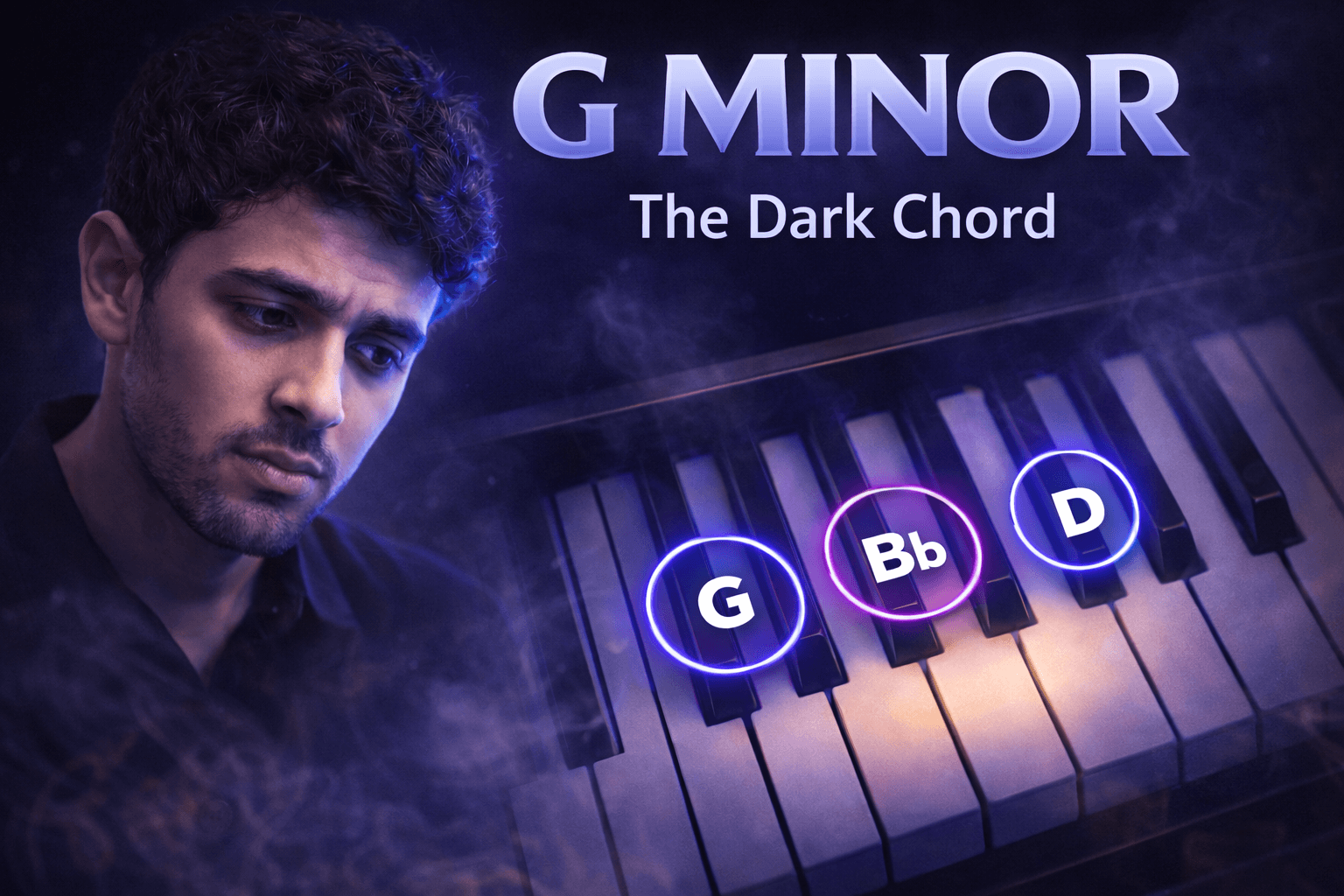
The G minor chord on piano is one of the most expressive, emotional, and widely used minor chords in music. Whether you are learning piano for the first time or expanding your understanding of harmony, the G minor triad is essential. Its rich, melancholic tone makes it a favorite in classical compositions, pop ballads, film scores, jazz improvisation, and contemporary music production. Understanding how to play the G minor chord on piano—along with its inversions, fingerings, progressions, and advanced variations—gives pianists the ability to add depth and emotional nuance to their performances.
The G minor chord is a simple triad composed of three notes: G, Bb, and D. These represent the root, minor third, and perfect fifth. Despite its simplicity, the chord provides powerful emotional expression, making it versatile for both beginning players and advanced composers. This comprehensive guide explains everything you need to know about playing and mastering the G minor chord on piano, from theory to practical application, ensuring that you fully understand how to integrate it into your musical journey.
Introduction to the G Minor Chord
 The G minor chord, often written as Gm or Gmin, is classified as a minor triad. Minor chords are known for their darker, more emotional qualities, often conveying sadness, mystery, introspection, or dramatic tension. In contrast to the bright, uplifting quality of major chords, minor chords like G minor evoke a deeper emotional resonance.
The emotional quality of the G minor triad has made it a staple in genres such as:
- Film soundtracks
- Classical symphonies
- Jazz ballads
- Rock and pop music
- EDM and electronic production
- Soul, R&B, and lo-fi music
For beginners, the G minor chord is a perfect introduction to learning black-key intervals, because it includes Bb, which requires hand flexibility and accurate finger placement. For intermediate and advanced players, the chord becomes a gateway to understanding more complex harmonic ideas such as modal interchange, minor keys, harmonic functions, and chord substitutions.
The triad itself is simple but deeply expressive, and as you progress through the inversions and related chord shapes, you will uncover a wide range of sounds and textures that can be created with this one chord.
Notes in the G Minor Chord
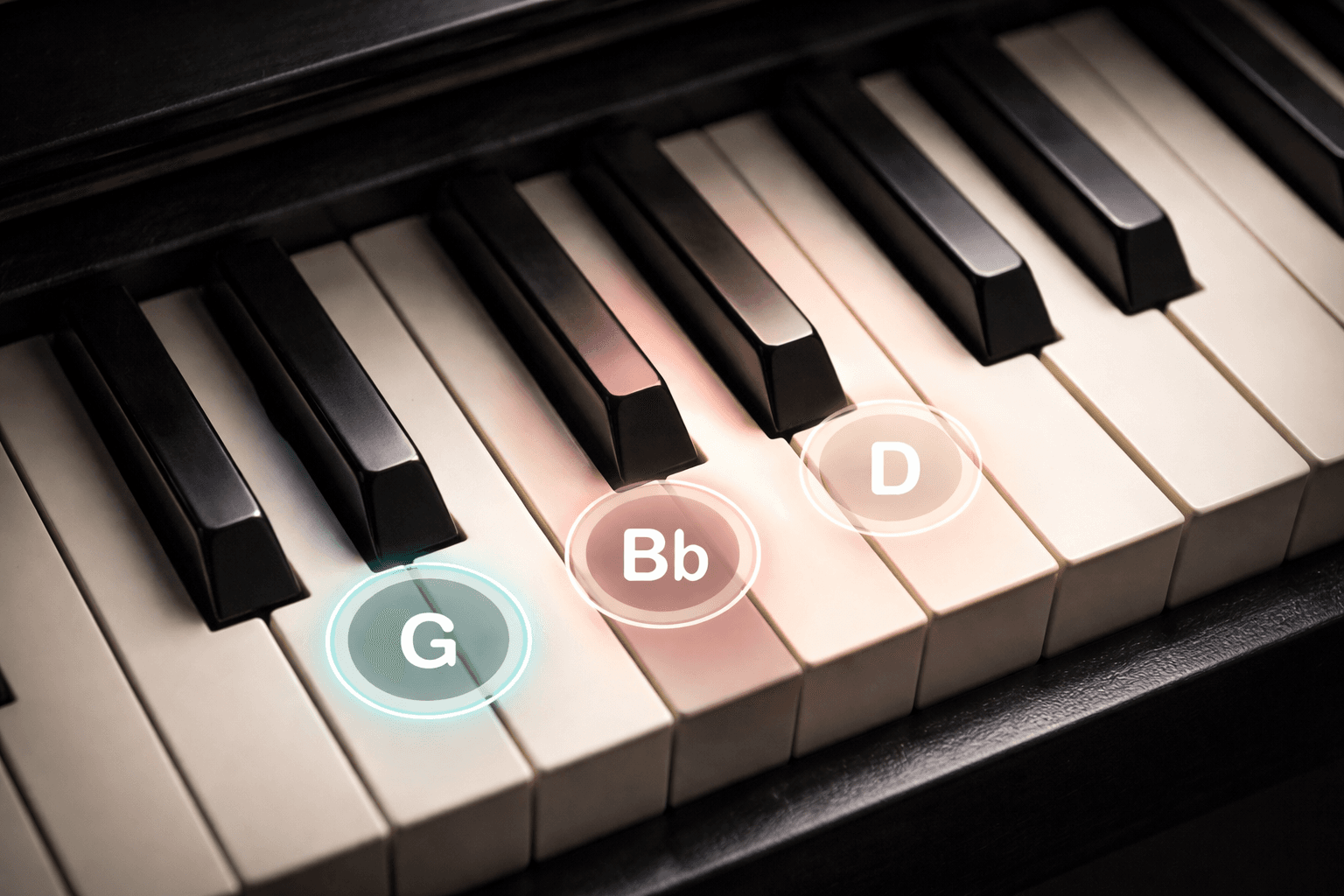 The G minor triad consists of three essential notes:
Note Function G Root Bb Minor Third D Perfect Fifth
The root (G) gives the chord its name. The minor third (Bb) establishes the minor quality of the chord. The perfect fifth (D) completes the triad and stabilizes the harmony. This 1–♭3–5 formula is the foundational structure for all minor chords. Learning it helps you identify and build minor chords anywhere on the piano.
How to Play the G Minor Chord in Root Position
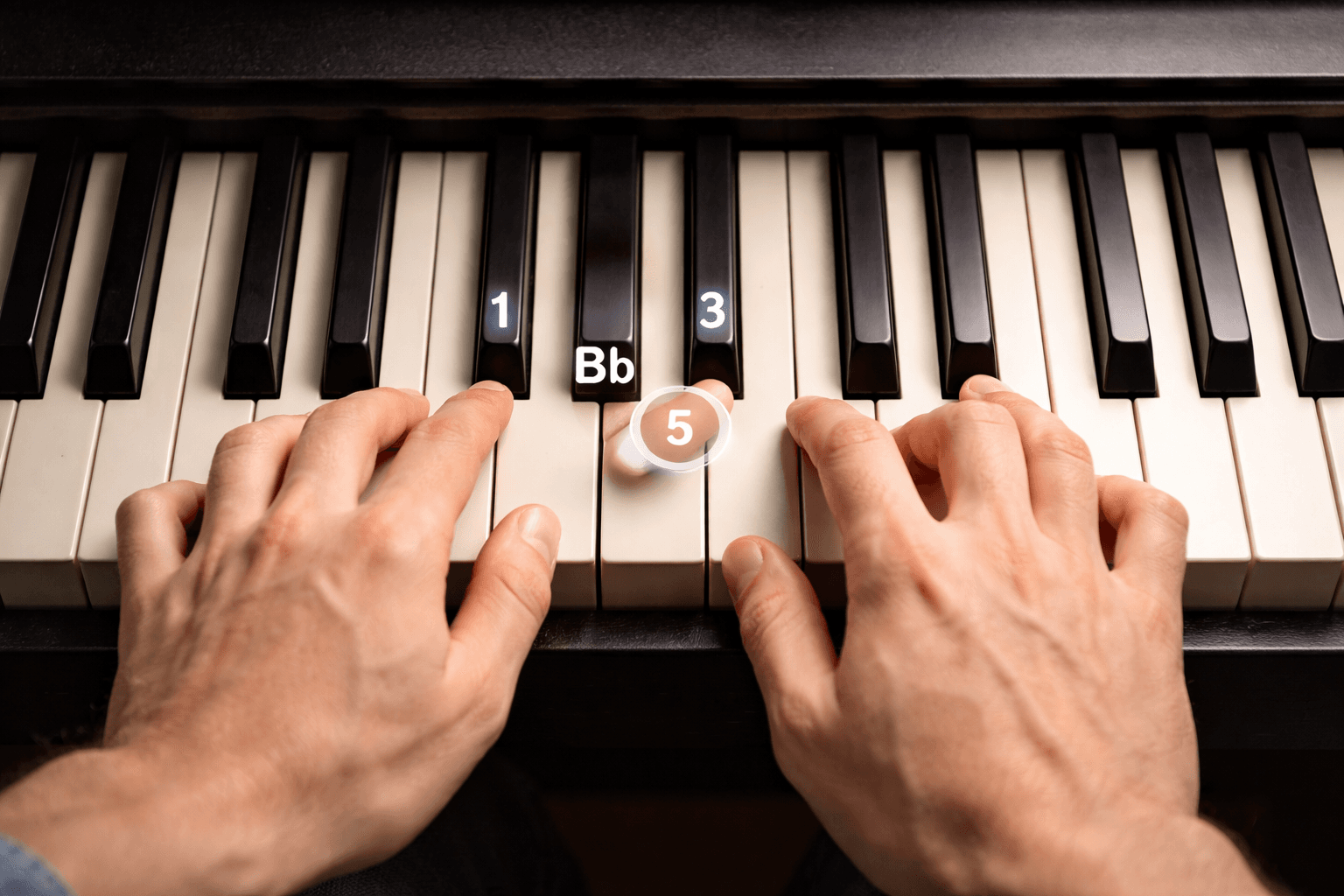 Root position is the starting point for learning any chord. In G minor root position, the chord is played with G as the lowest note, followed by Bb and D.
Right-Hand Fingering
- Thumb (1) on G
- Middle finger (3) on Bb
- Pinky (5) on D
Left-Hand Fingering
- Pinky (5) on G
- Middle finger (3) on Bb
- Thumb (1) on D
This formation ensures hand stability and even pressure across all keys. Beginners should play the chord slowly, ensuring each note rings clearly without tension or collapse of the knuckles.
Practicing the root position of G minor builds muscle memory and prepares you for learning inversions, arpeggios, and chord progressions that include the Gm chord.
Chord Structure and Intervals in G Minor
Minor chords are built using a formula of intervals:
- Minor third (3 semitones)
- Major third (4 semitones)
Stacking these intervals creates the minor triad.
Interval Breakdown
- G → Bb = Minor Third (3 semitones)
- Bb → D = Major Third (4 semitones)
Minor chords feel emotional because the minor third interval creates a sense of longing or tension that resolves when paired with harmonic or melodic movement. Understanding this interval structure helps pianists recognize minor chords by ear and build chords effortlessly.
Inversions of the G Minor Chord
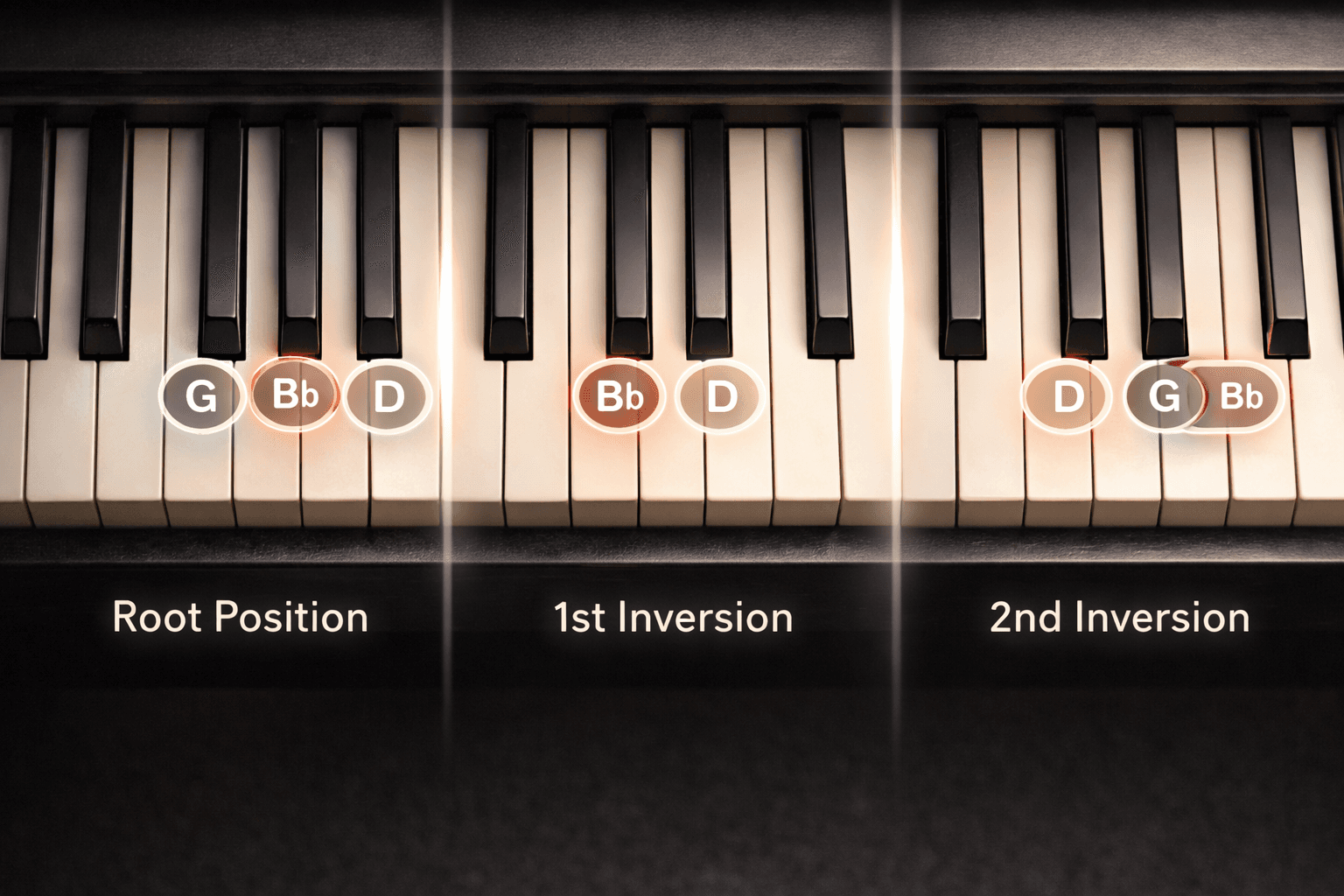 Chord inversions rearrange the order of the notes. Instead of keeping G as the lowest note, we can place Bb or D in the bass to create smoother transitions between chords. This is especially useful in progressions, accompaniment patterns, and lyrical piano playing.
G minor has two inversions:
1st Inversion (Bb – D – G)
In this inversion, Bb becomes the lowest note, giving the chord a lighter, more open quality.
Right-Hand Fingering:
- Thumb (1) on Bb
- Index or middle (2 or 3) on D
- Pinky (5) on G
Left-Hand Fingering:
- Pinky (5) on Bb
- Index (2) on D
- Thumb (1) on G
This shape is commonly used for smooth transitions to chords such as Eb, F, and D minor.
2nd Inversion (D – G – Bb)
Here, D is the lowest note, creating a brighter and more stable sound.
Right-Hand Fingering:
- Thumb (1) on D
- Middle (3) on G
- Pinky (5) on Bb
Left-Hand Fingering:
- Pinky (5) on D
- Middle (3) on G
- Thumb (1) on Bb
The second inversion works exceptionally well in progressions that move between D major or D minor, Bb major, and G minor.
Playing Arpeggios and Broken Chords
 Practicing arpeggios and broken chords helps develop hand independence, control, and fluidity. Arpeggios also appear frequently in music, especially in ballads, classical pieces, and improvisation.
G Minor Arpeggio Notes
-
G → Bb → D (ascending)
- D → Bb → G (descending)
Practice arpeggios hands separately, then together, at slow tempos before increasing speed.
Broken chords can be played in patterns such as:
- Root → Third → Fifth
- Root → Fifth → Third
- Alternating hand patterns
These exercises improve dexterity and prepare you for more advanced playing.
G Minor Scales (Natural, Harmonic, Melodic)
 Understanding the minor scales related to G minor helps with improvisation, melodic construction, and chord progression development.
Natural Minor Scale (G Natural Minor)
G – A – Bb – C – D – Eb – F – G
Harmonic Minor Scale (G Harmonic Minor)
G – A – Bb – C – D – Eb – F# – G
Melodic Minor Scale
Ascending: G – A – Bb – C – D – E – F# – G Descending: G – F – Eb – D – C – Bb – A – G
These scales introduce different harmonic possibilities, especially when playing over Gm, Gm6, Gm7, or progressions in the key of G minor.
Common Chord Progressions in G Minor
Below are some popular chord progressions used in ballads, pop songs, film scoring, and classical music.
Beginner Progressions
Progression Notes Gm – Bb – F – C G Bb D → Bb D F → F A C → C E G Gm – Eb – F G Bb D → Eb G Bb → F A C
Intermediate Progressions Progression Notes Gm – Dm – Bb – F G Bb D → D F A → Bb D F → F A C Gm – Eb – D – C G Bb D → Eb G Bb → D F# A → C E G
Advanced Progressions Progression Notes Gm – Bb – C – D G Bb D → Bb D F → C E G → D F# A Gm – D – Eb – F – Gm G Bb D → D F# A → Eb G Bb → F A C → G Bb D
These progressions are widely used in various genres, making the G minor chord highly adaptable.
Popular Songs That Use the G Minor Chord
The G minor chord appears in countless songs due to its emotional richness. Here are a few notable examples:
Classical Music
- Mozart – Symphony No. 40 in G minor
- Chopin – Nocturne in G minor
Pop & Contemporary
Rock
Film & TV Scores
Studying these songs helps pianists understand how G minor is used expressively across genres.
G Minor in Different Genres
Classical
G minor is one of the most dramatic keys in classical music. Composers like Mozart and Beethoven used it to express intensity and emotional struggle.
Jazz Jazz pianists often extend the G minor chord into:
- Gm7
- Gm6
- Gm9
- Gm11
These variations allow for rich voicings in improvisation.
Pop & Rock
G minor supports emotional depth in chord progressions and melodic hooks.
Film Scoring
G minor conveys suspense, longing, or epic emotional weight.
Tools to Learn the G Minor Chord
You can accelerate your learning using:
- Flowkey
- Simply Piano
- Piano Marvel
- Chord generator tools
- Digital keyboards with chord mode
- Interactive sheet music apps
These tools help visualize finger placement and practice transitions between G minor and related chords.
Tips and Tricks for Mastering G Minor
- Practice root position first, then move to inversions.
- Use slow tempo to ensure clean voice separation.
- Incorporate G minor into scales and arpeggio practice.
- Play common progressions daily to build fluidity.
- Explore G minor in different octaves for tonal variety.
- Use a metronome to stabilize rhythm and timing.
- Practice broken chord patterns to build finger independence.
Common Beginner Mistakes
- Pressing too hard on the Bb key
- Incorrect fingering during inversions
- Stiff wrists causing uneven sound
- Jumping between chords instead of sliding smoothly
- Avoiding black keys due to uncertainty
Correcting these issues early will ensure technical accuracy and musical expression.
Frequently Asked Questions (FAQs)
1. What notes make up the G minor chord?
G, Bb, and D form the G minor triad.
2. Is the G minor chord hard for beginners?
It requires accuracy on Bb, but with proper fingering, it is easy to learn.
3. What are the inversions of G minor?
- 1st inversion: Bb – D – G
- 2nd inversion: D – G – Bb
4. What scales can I use with G minor?
G natural minor, harmonic minor, and melodic minor scales.
5. Which chords work well with G minor?
Eb, Bb, F, Dm, C, and D are common companion chords.
6. What emotion does G minor create in music?
It conveys sadness, tension, drama, and introspection.
7. Can beginners use G minor in songs?
Yes. It appears in hundreds of simple pop and classical pieces.