ChatGPT
 Google AI
 Grok
Grok Claude
The G major chord guitar is one of the most fundamental and widely used chords in music. It consists of three notes: G, B, and D, forming a classic major triad. This chord creates a bright and uplifting sound, making it perfect for genres like pop, rock, folk, and blues. Understanding the G major chord structure helps guitarists transition between chords smoothly and improvise over songs with confidence. To learn these chords step-by-step, you can explore online guitar classes designed for beginners and intermediate players.
Learning the G chord guitar diagram is crucial for beginners and intermediate players alike. The chord appears in multiple keys containing G major chord, making it a versatile tool in music intervals on guitar. From open shapes to barre chords, mastering this chord builds a solid foundation for other major chord positions across the fretboard.
What Makes the G Chord Special

The G major chord stands out because of its bright and stable tone. Unlike minor chords, the G major triad has a clear, harmonious sound due to its root–major third–perfect fifth formula. This chord often functions as the tonic or dominant chord in many songs, providing a sense of resolution or drive. Its position in common chord progressions using G major makes it essential for rhythm and lead guitarists.
Its popularity is evident across decades of music. From folk classics to contemporary rock, the G major chord usage is nearly universal. Understanding the G major chord sound and how it fits within chord progressions allows players to create musical arrangements that are both rich and emotionally compelling.
G Major Chord Notes and Formula
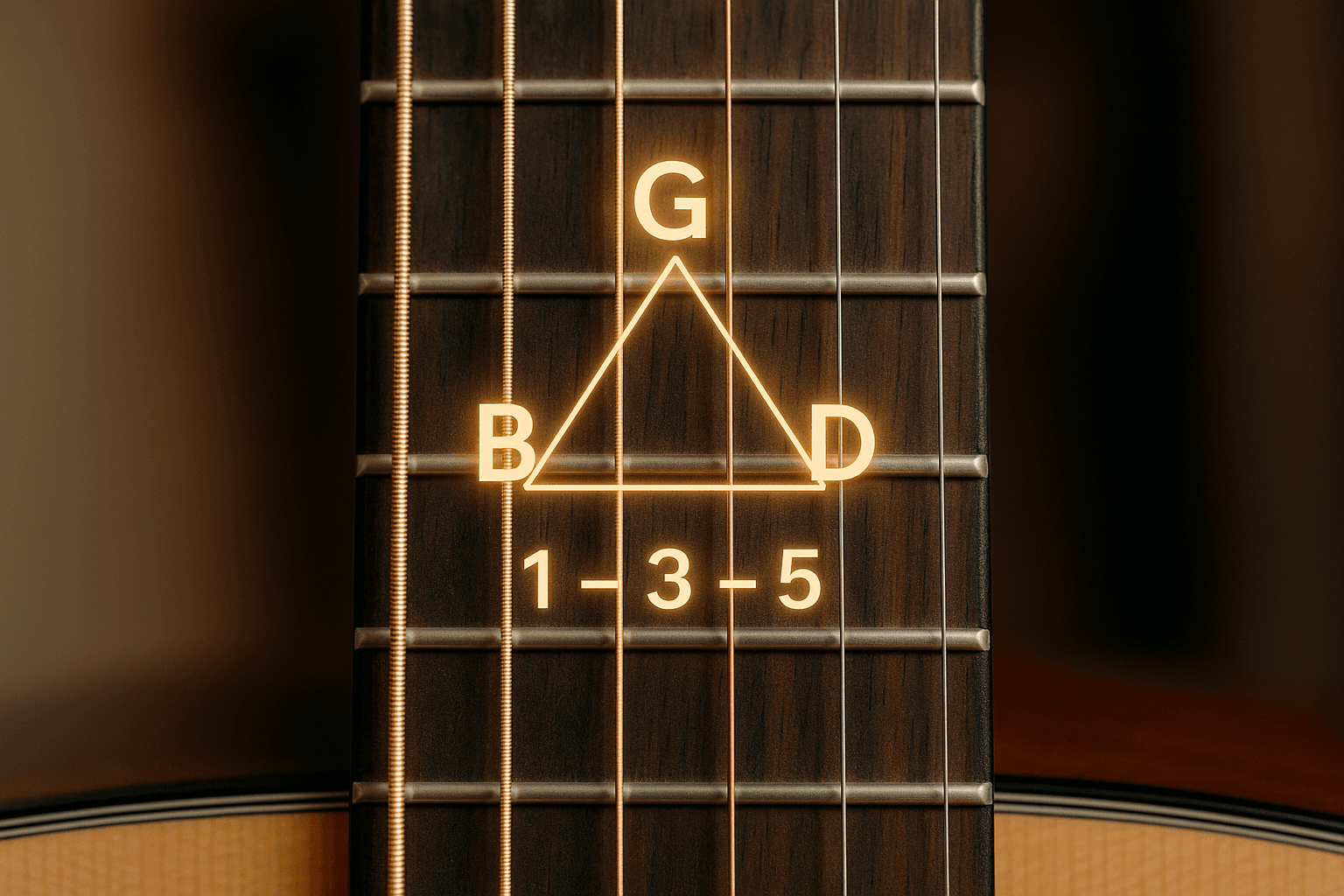
The G major chord notes are simple yet powerful: G (root), B (major third), and D (perfect fifth). These notes form a G major triad, adhering to the major chord formula of 1–3–5. Visualizing these tones across the fretboard is key to guitar chord construction and effective chord tone mapping.
| Note | Interval |
|---|---|
| G | Root |
| B | Major Third |
| D | Perfect Fifth |
By understanding the G major chord theory, players can identify the root, third, and fifth formula across strings. This enables the creation of new chord shapes on guitar, helping you explore triads on guitar and experiment with movable chord positions for greater versatility.
How the Major Chord Is Built
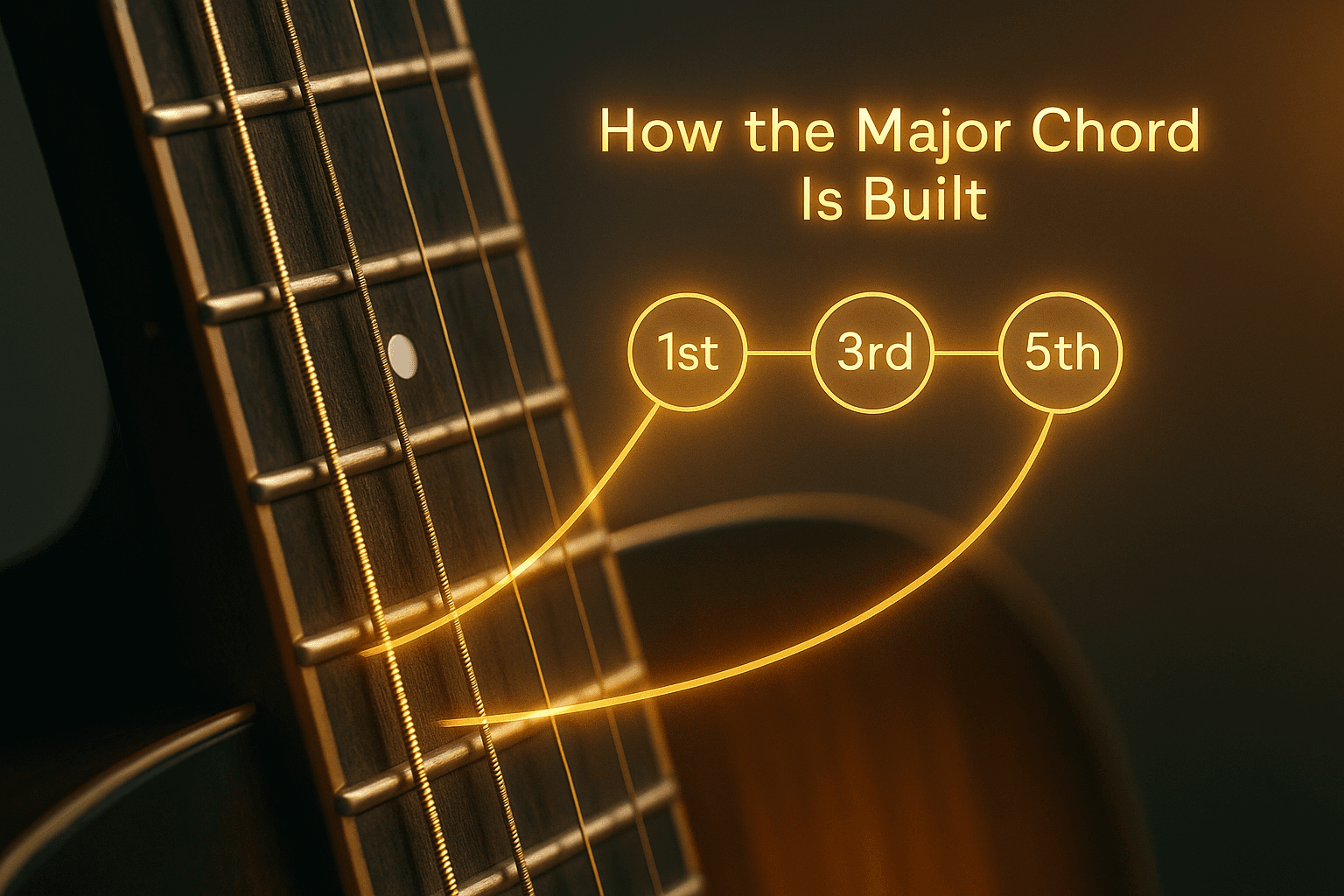
The G major chord is built by stacking thirds from the G major scale (G, A, B, C, D, E, F#). Selecting the 1st, 3rd, and 5th notes creates the G major triad (G–B–D). This construction explains why it has a bright, stable sound that contrasts with minor chords, which lower the third for a darker tone.
Understanding major chord intervals and the root third fifth formula allows guitarists to build chords anywhere on the fretboard. This knowledge also forms the foundation for creating G major chord variations, inversions, and extended chords, enhancing both rhythm and lead playing.
G Major Chord on Guitar
The Basic Open G Major Shape
The most familiar form is the open G guitar chord, played near the nut with some strings left open. This position provides a full, resonant tone ideal for rhythm and accompaniment. Common beginner mistakes include muted strings and incorrect guitar finger placement, which can result in uneven sound.
Standard G Major Fingering:
- 6th string (E): Play G with your ring finger on the 3rd fret
- 5th string (A): Play B with your middle finger on the 2nd fret
- 4th string (D): Play D (open string)
- 3rd string (G): Play G (open string)
- 2nd string (B): Play B (open string)
- 1st string (E): Play G with your pinky on the 3rd fret
Alternative G Chord Fingerings
There are multiple ways to finger the open G chord:
Variation 1 (Four-Finger):
- Index finger on 5th string, 2nd fret (B)
- Middle finger on 6th string, 3rd fret (G)
- Ring finger on 2nd string, 3rd fret (D)
- Pinky on 1st string, 3rd fret (G)
Variation 2 (Three-Finger):
- Middle finger on 5th string, 2nd fret (B)
- Ring finger on 6th string, 3rd fret (G)
- Pinky on 1st string, 3rd fret (G)
Experiment with different fingerings to find what feels most comfortable and allows smooth transitions to other chords.
Common Mistakes When Playing G Major
- Muted strings: Ensure your fingers aren't touching adjacent strings
- Buzzing notes: Press firmly behind the frets, not on top of them
- Uneven strumming: Practice hitting all six strings evenly
- Poor finger placement: Keep fingers arched and use fingertips
- Tension in the hand: Relax your grip and wrist
Other G Major Chord Positions

G Major Barre Chord (3rd Fret)
The G major barre chord at the 3rd fret follows the E major shape:
- Barre all strings at the 3rd fret with your index finger
- Middle finger on 3rd string, 4th fret
- Ring finger on 5th string, 5th fret
- Pinky on 4th string, 5th fret
This movable G chord can be shifted up or down the neck to play other major chords.
G Major Barre Chord (10th Fret)
Following the A major shape at the 10th fret:
- Barre at the 10th fret
- Ring finger barres 4th, 3rd, and 2nd strings at the 12th fret
This higher voicing creates a brighter, more treble-focused sound.
G Major Chord Progressions
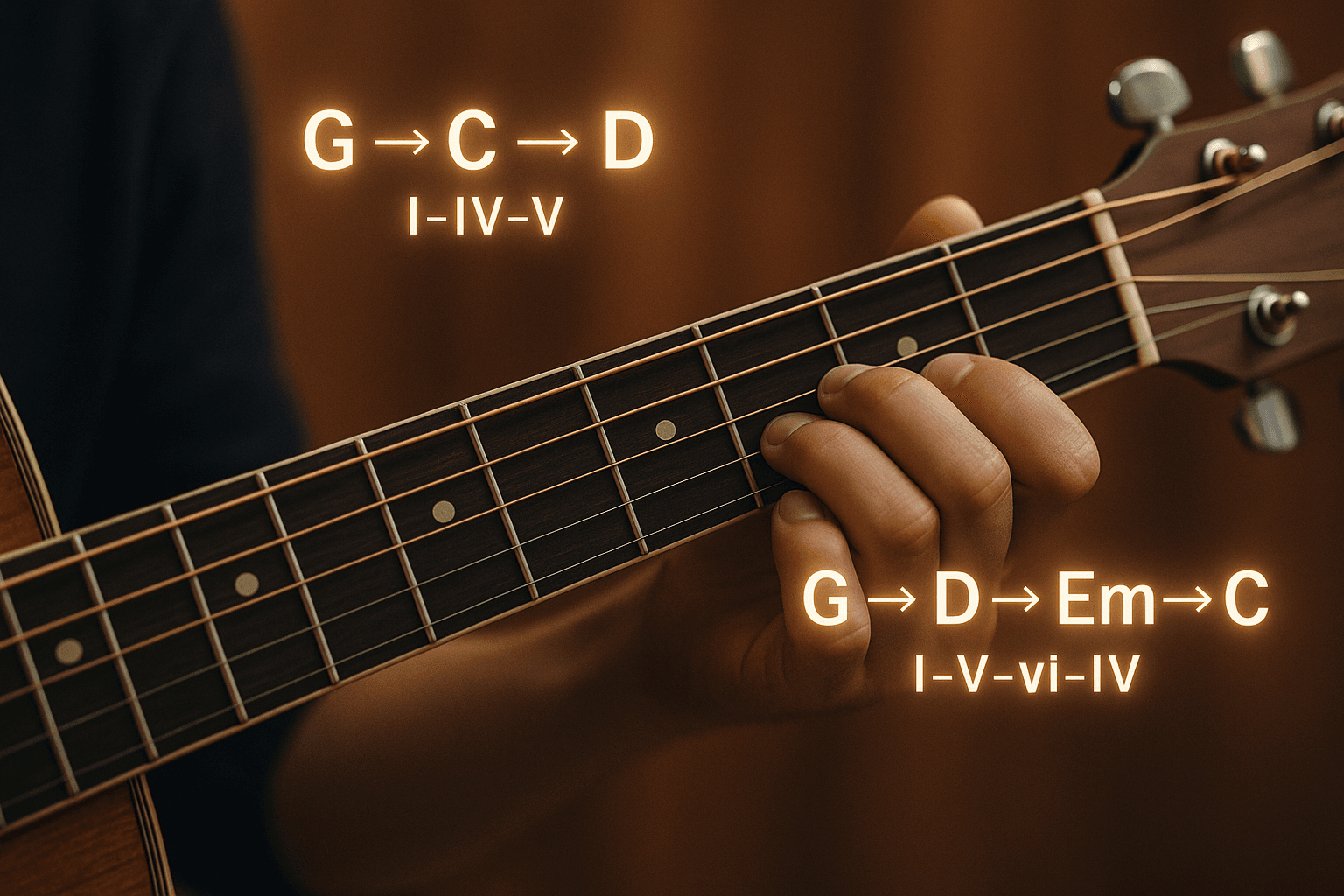
The G major chord is a cornerstone of countless progressions. Here are some of the most popular:
I - IV - V (G - C - D)
This is the most common progression in popular music:
- G major (I) - C major (IV) - D major (V)
Found in thousands of songs across rock, folk, country, and pop genres.
I - V - vi - IV (G - D - Em - C)
Known as the "pop progression":
- G major - D major - E minor - C major
Used in countless hit songs for its emotional and catchy quality.
I - vi - IV - V (G - Em - C - D)
The classic "50s progression":
- G major - E minor - C major - D major
Creates a nostalgic, timeless feel perfect for ballads.
12-Bar Blues in G
- G (4 bars) - C (2 bars) - G (2 bars) - D (1 bar) - C (1 bar) - G (2 bars)
The foundation of blues guitar in the key of G.
Songs That Use the G Major Chord
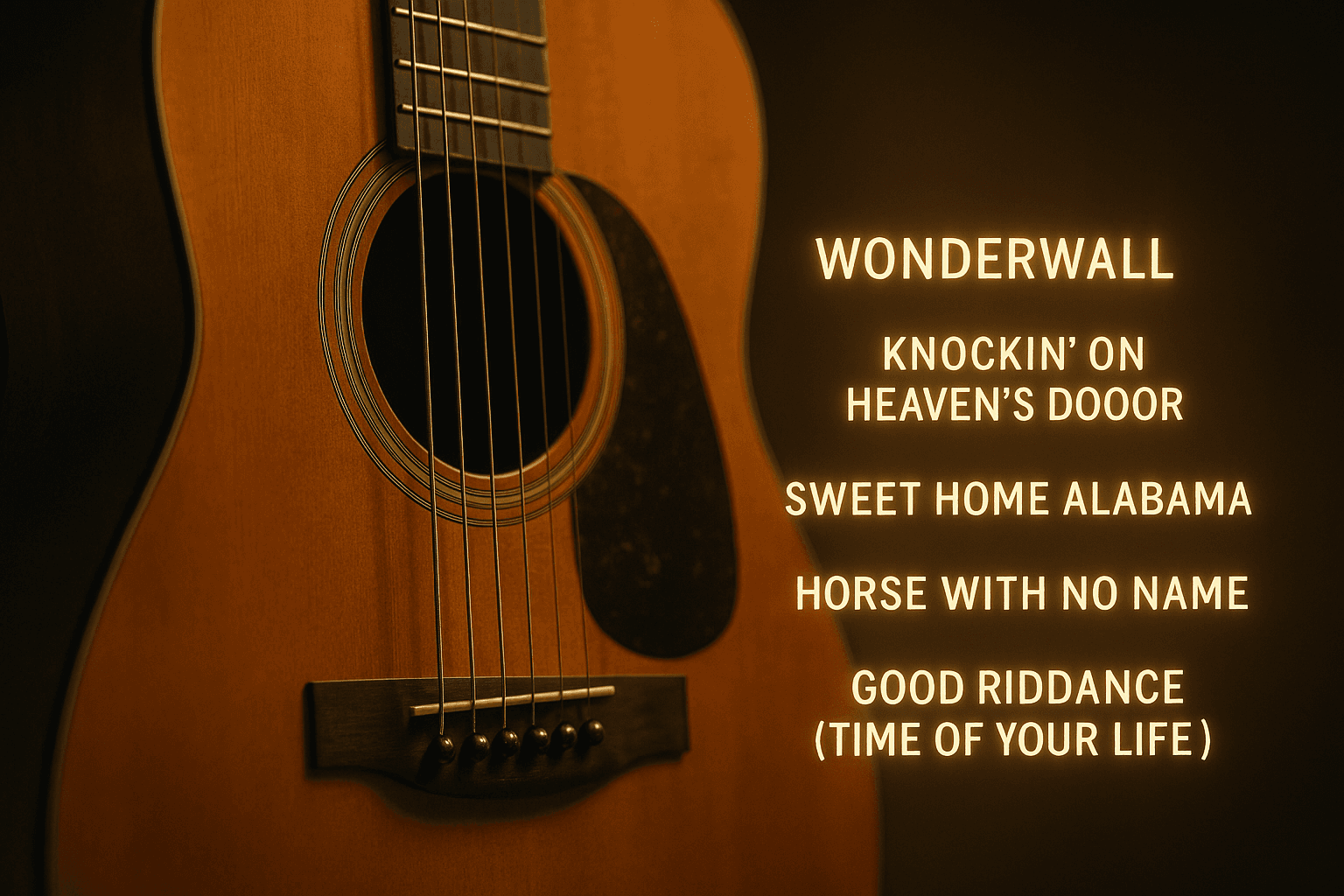
The G major chord appears in countless classic and modern songs:
- "Wonderwall" by Oasis - Features G major prominently in the main progression
- "Knockin' on Heaven's Door" by Bob Dylan - Simple G-D-Am-C progression
- "Sweet Home Alabama" by Lynyrd Skynyrd - Classic rock progression with G major
- "Horse with No Name" by America - Minimalist use of G major
- "Good Riddance (Time of Your Life)" by Green Day - Acoustic progression featuring G
Practicing these songs helps internalize how G major functions in real musical contexts.
Practice Tips and Exercises
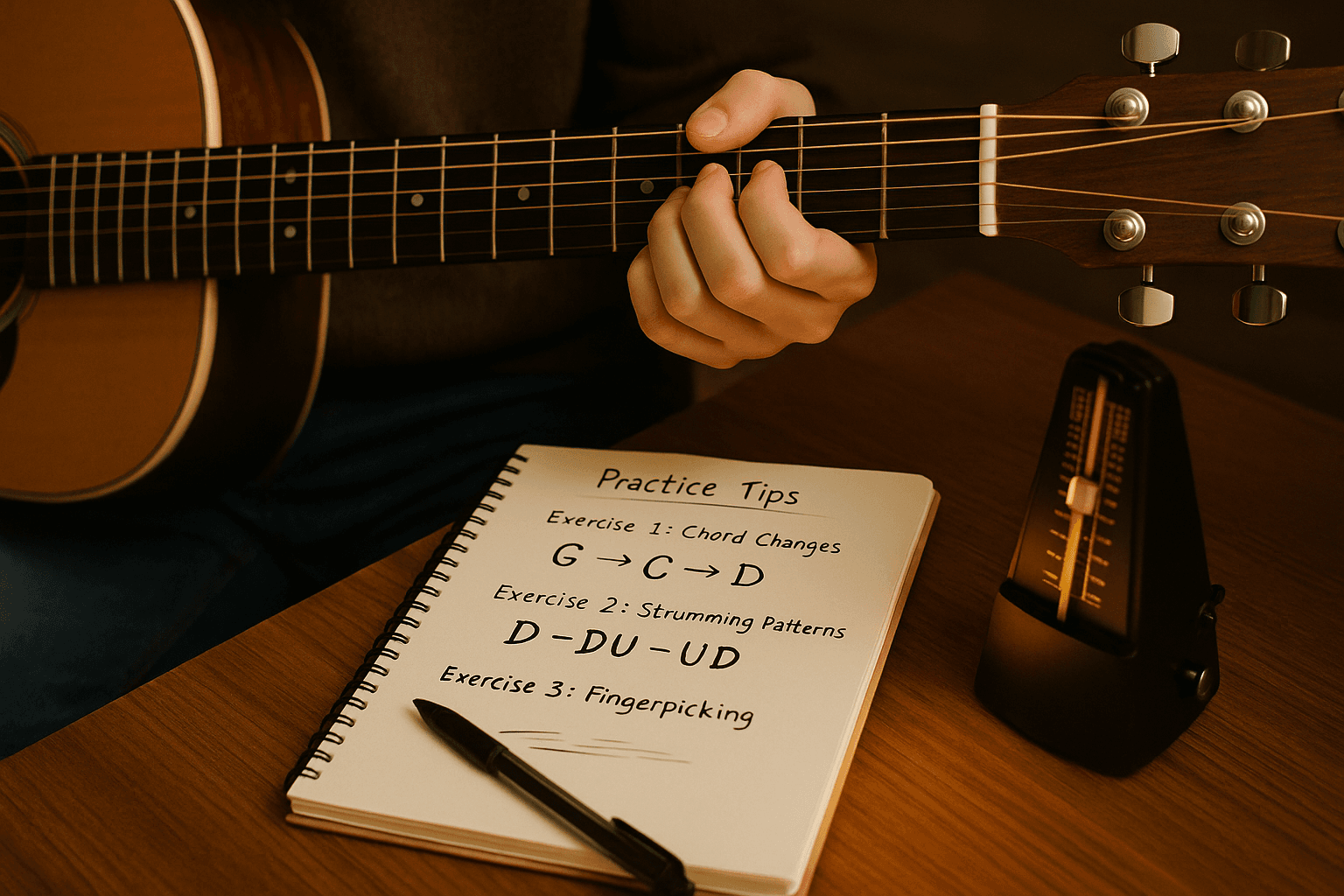
Exercise 1: Chord Changes
Practice transitioning between G and other common chords:
- G to C: 4 beats each, repeat 10 times
- G to D: 4 beats each, repeat 10 times
- G to Em: 4 beats each, repeat 10 times
- G to Am: 4 beats each, repeat 10 times
Use a metronome starting at 60 BPM and gradually increase speed.
Exercise 2: Strumming Patterns
Practice different strumming patterns on G major:
- Pattern 1: Down-Down-Up-Up-Down-Up
- Pattern 2: Down-Down-Up-Down-Up
- Pattern 3: Down-Up-Down-Up-Down-Up
Focus on keeping a steady rhythm and clean sound.
Exercise 3: Fingerpicking
Practice this basic fingerpicking pattern on G:
- Thumb: 6th string
- Index: 3rd string
- Middle: 2nd string
- Ring: 1st string
Play: Thumb-Index-Middle-Ring, repeat slowly and evenly.
Conclusion
Mastering the G major chord on guitar is essential for any guitarist. From understanding its chord structure (G-B-D) and chord formula (1-3-5) to exploring multiple positions and progressions, you now have a comprehensive foundation.
Remember:
- Practice the open G shape until it's second nature
- Learn barre chord variations for versatility
- Study common G major progressions to understand its musical context
- Play songs that feature G major to hear it in action
- Focus on clean technique and smooth transitions
Whether you're strumming folk songs, playing rock riffs, or improvising blues solos, the G major guitar chord will be one of your most reliable and expressive tools. Keep practicing, stay patient, and enjoy the journey of mastering this fundamental chord.