ChatGPT
 Google AI
 Grok
Grok Claude
What Makes the F# Major Chord Special
 The F# major chord stands out because of its tonal clarity and its role in less guitar-friendly keys. Built using the 1–3–5 formula of the F# major scale, it produces a clean, assertive, and uplifting sound. Compared to open-position chords like G or C, F# major feels tighter and more focused due to its barre-based structure, which gives it a consistent tone regardless of position.
In many compositions, F# major creates a sense of forward motion and emotional lift. It is often used in choruses, bridges, and key changes to raise energy and intensity. Because it is not available as a full open chord in standard tuning, guitarists must rely on barre chords, which makes F# major an excellent training ground for left-hand strength and precision.
Another reason the F# major chord is important is its versatility. Once learned, the same shape can be moved up or down the fretboard to create every other major chord. This makes F# major not just a chord, but a gateway to understanding the entire guitar neck and the logic behind chord transposition.
F# Major Chord Notes and Formula
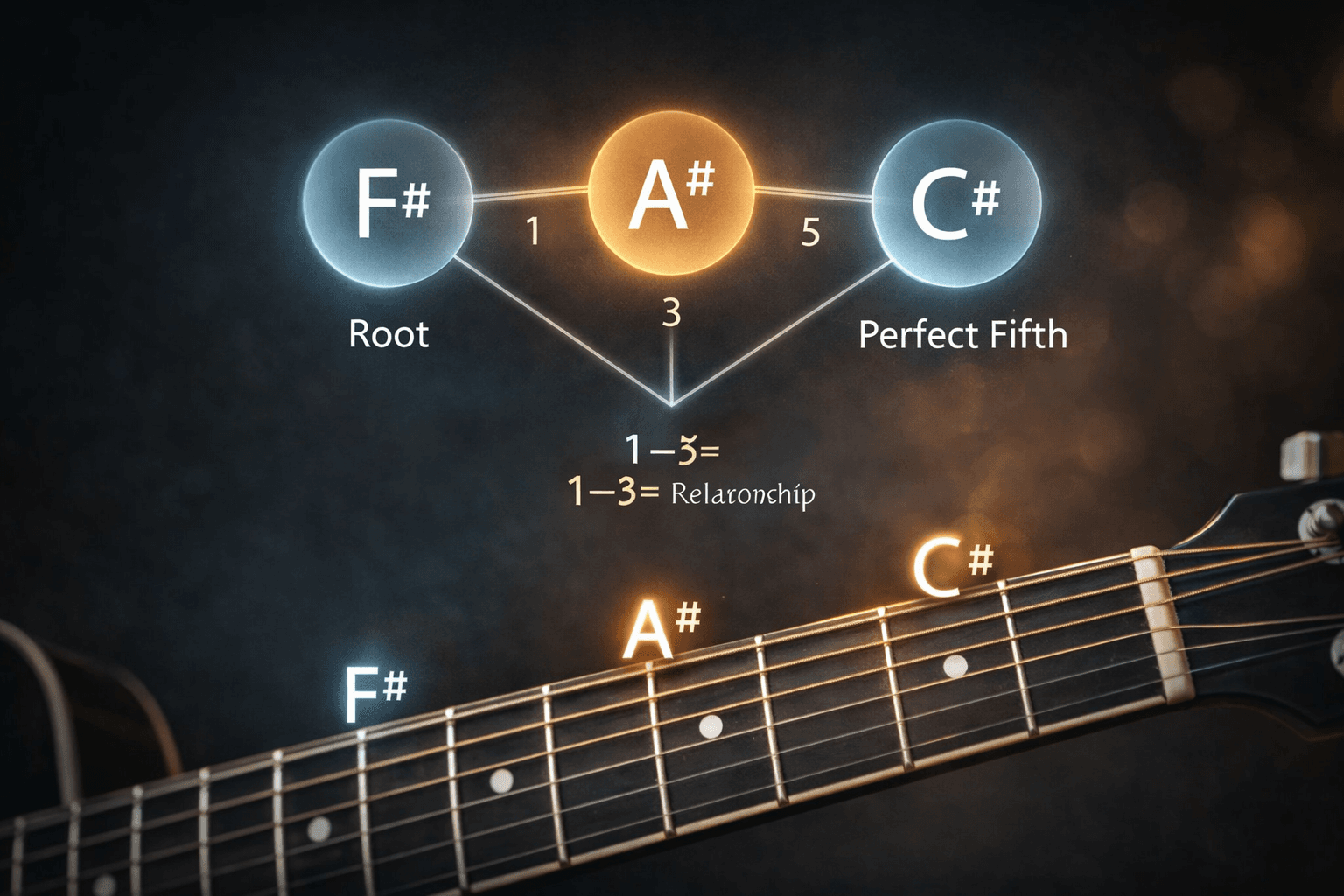
 The F# major chord is built from three essential notes that define its sound and function within music.
The notes in the F# major chord are F# as the root, A# as the major third, and C# as the perfect fifth. These notes form the basic F# major triad and follow the universal major chord formula of 1–3–5.
Note Interval F# Root A# Major Third C# Perfect Fifth
Understanding this structure is critical for guitarists who want to move beyond memorized shapes. By recognizing how F#, A#, and C# appear across different strings and frets, players can build new chord voicings, identify chord tones during solos, and develop a deeper understanding of harmony on the guitar.
How the Major Chord Is Built
The F# major chord is derived from the F# major scale, which contains the notes F#, G#, A#, B, C#, D#, and E#. Selecting the first, third, and fifth notes of this scale produces the F# major triad: F#–A#–C#.
This stacking of intervals, specifically a major third followed by a minor third, creates the characteristic bright and stable sound of a major chord. Understanding how this construction works allows guitarists to build F# major anywhere on the fretboard, regardless of position or tuning.
When players understand chord construction, they are no longer limited to fixed shapes. They can create inversions, partial voicings, and extended chords, all of which are essential for advanced rhythm playing, chord melody, and modern songwriting.
F# Major Chord on Guitar
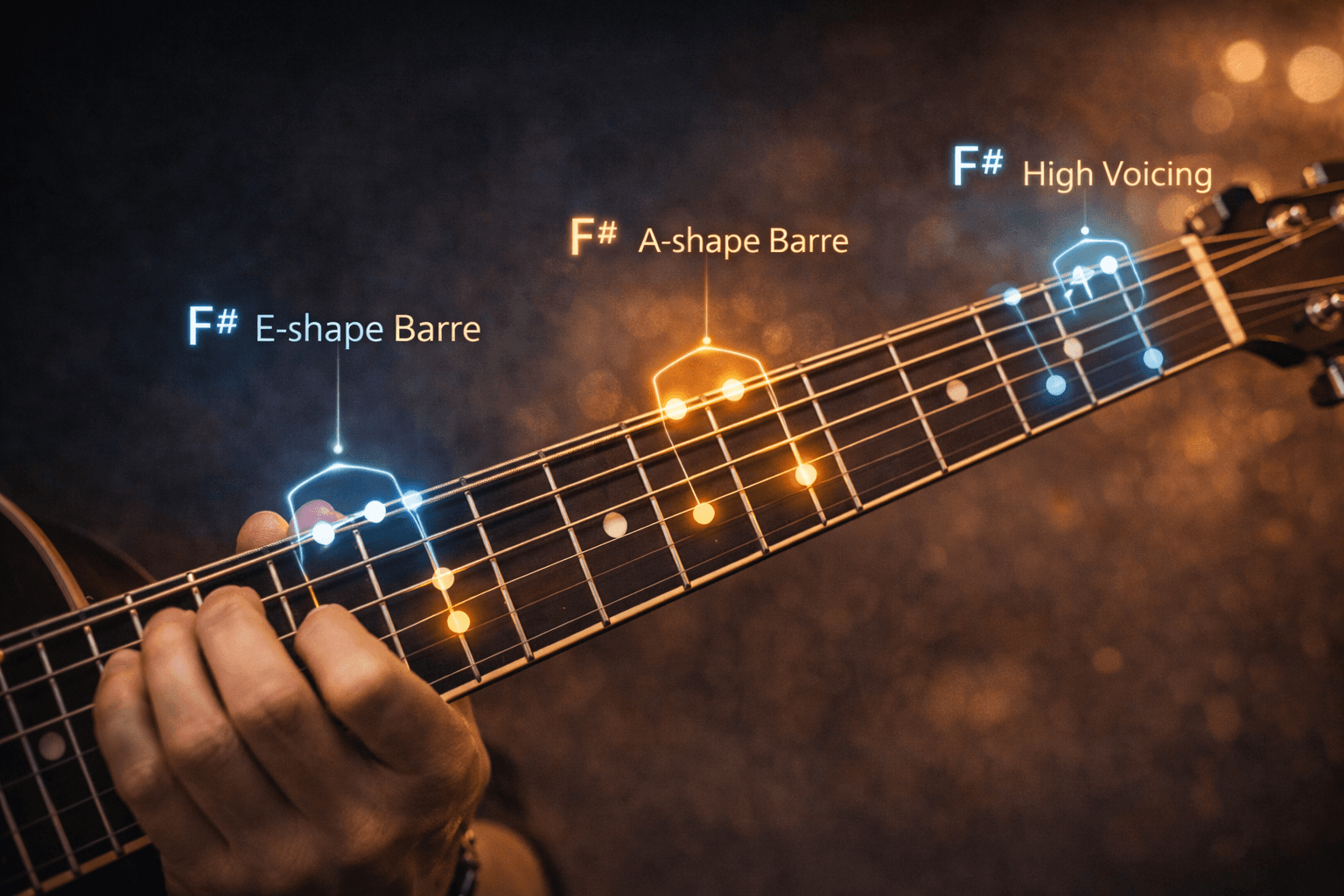
 The F# major chord can be played in multiple positions across the fretboard. While it does not have a standard full open shape in first position, it appears naturally as a barre chord and in higher voicings that offer tonal variety.
Each position of F# major has a distinct character. Lower-position barre chords sound thick and powerful, while higher voicings feel lighter and more expressive. Learning these shapes helps guitarists control dynamics, texture, and emotional impact in their playing.
The Basic F# Major Barre Shape
The most common way to play F# major is using the E-shape barre chord rooted on the low E string at the second fret. In this position, the index finger bars all six strings, while the remaining fingers form an E major shape two frets higher.
This chord produces a strong, balanced tone and is widely used in rock, pop, and worship music. Beginners often struggle with this shape because it requires consistent pressure across the strings. With proper thumb placement, relaxed wrist posture, and gradual practice, the F# barre chord becomes comfortable and reliable.
The importance of this shape cannot be overstated. Once mastered, it allows players to play major chords in every key simply by shifting position along the fretboard.
Keys Where You’ll Find the F# Major Chord
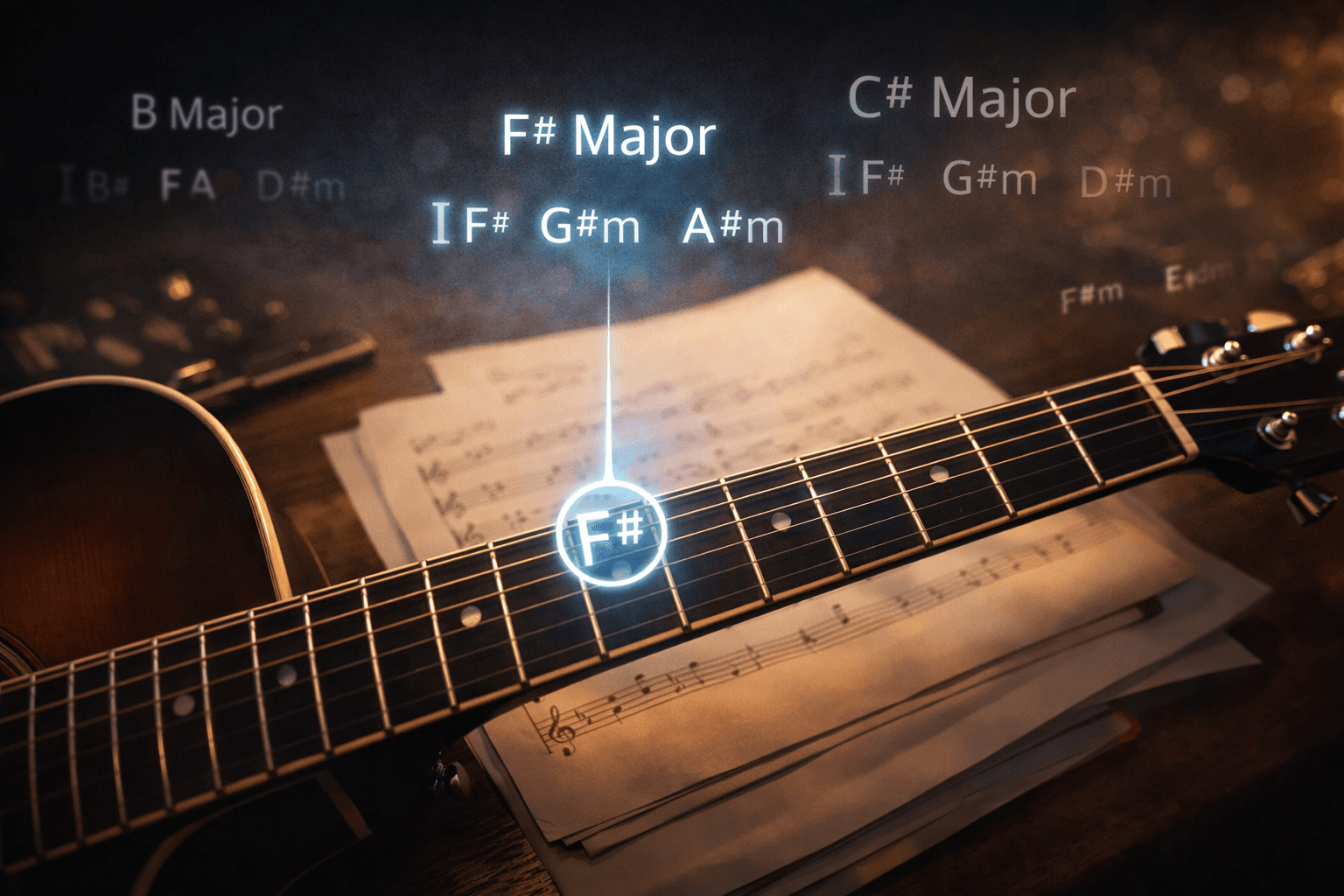
 The F# major chord naturally appears in several musical keys. Understanding its harmonic context helps guitarists recognize when and why it is used in progressions.
| Key | I | ii | iii | IV | V | vi | vii° |
|---|---|---|---|---|---|---|---|
| F# Major | F# | G#m | A#m | B | C# | D#m | E#dim |
| B Major | B | C#m | D#m | E | F# | G#m | A#dim |
| C# Major | C# | D#m | E#m | F# | G# | A#m | B#dim |
| D# Minor | D#m | E#dim | F# | G#m | A#m | B | C# |
Learning these relationships improves songwriting, improvisation, and the ability to predict chord changes by ear. It also helps players understand how F# major functions as a tonic, dominant, or subdominant chord depending on the key.
Common Chord Progressions With F# Major
F# major appears in many classic and modern chord progressions. In major keys, it often creates a sense of resolution or forward motion. In minor contexts, it adds brightness and contrast.
Progressions such as I–IV–V in F# major or vi–IV–I–V in related keys are common across genres. Practicing these progressions helps guitarists develop timing, rhythm, and musical intuition while reinforcing the sound of F# major in context.
Scales to Play Over an F# Major Chord
 Improvising over an F# major chord becomes much easier when players understand which scales contain its chord tones. Targeting F#, A#, and C# within scales creates melodies that sound connected and intentional.
| Scale | Notes | Mood |
|---|---|---|
| F# Major Scale | F# G# A# B C# D# E# | Bright, confident |
| D# Minor Scale | D# E# F# G# A# B C# | Emotional, smooth |
| F# Major Pentatonic | F# G# A# C# D# | Clean, melodic |
| F# Lydian | F# G# A# B# C# D# E# | Airy, modern |
| F# Mixolydian | F# G# A# B C# D# E | Bluesy, relaxed |
Understanding how these scales interact with F# major allows guitarists to craft expressive solos, melodic fills, and dynamic lead lines that complement the harmony.
Popular Songs That Use the F# Major Chord
The F# major chord appears in many well-known songs across different styles. It is often used in keys that favor brighter tonalities and uplifting emotional content.
Songs by artists such as Coldplay, U2, Hillsong, John Mayer, and modern pop writers frequently include F# major in choruses or bridges. Hearing the chord in real musical contexts helps players internalize its sound and recognize it by ear.
How to Play the F# Major Chord: Guitar Shapes and Positions
Using the CAGED system, guitarists can play the F# major chord in multiple connected positions across the neck. Each shape is derived from familiar open chord forms and moved to match the F# root.
| Position | Root Note Location | Shape Type |
|---|---|---|
| 1 | 2nd fret E string | E-shape barre |
| 2 | 9th fret A string | A-shape barre |
| 3 | 14th fret E string | High voicing |
| 4 | 11th fret D string | Triad-based |
| 5 | 6th fret B string | Inversion |
Learning these positions allows players to move fluidly across the fretboard, choose voicings that fit the song, and add variety to rhythm parts.
Alternate Voicings and Extensions
To expand the sound of F# major, guitarists can explore extended and altered voicings. Chords such as F#maj7, F#sus2, F#sus4, F#6, and F#add9 add color and emotional nuance.
These variations are widely used in pop, jazz, worship, and cinematic music. They help avoid repetitive harmony and allow guitarists to create richer arrangements without changing the underlying key.
Play This Chord With Other Roots
One of the most powerful aspects of the F# major chord is its movability. The barre shape used for F# major can be shifted to create any other major chord.
Moving the same shape down one fret produces F major, while moving it up two frets produces G# major. This concept reinforces the idea that the guitar is a pattern-based instrument, and mastering one shape unlocks dozens of chords instantly.
How to Build the F# Major Chord on Guitar
Building the F# major chord involves locating F#, A#, and C# across the fretboard. By identifying these notes on each string, players can create custom voicings, triads, and inversions.
This approach strengthens fretboard knowledge and supports advanced techniques such as arpeggios, chord melody, and harmonic substitution. Understanding how to build chords rather than memorize them is a defining skill of advanced guitarists.
Tips to Master the F# Major Chord
Playing F# major cleanly requires proper technique and patience. Keeping the thumb centered behind the neck, using arm weight instead of finger pressure, and maintaining relaxed hands all contribute to better tone and endurance.
Practicing transitions such as F#–B–C# or F#–D#m–B improves chord changes and musical flow. Slow, focused practice builds strength and accuracy more effectively than rushing through progressions.
| Exercise | Duration | Goal |
|---|---|---|
| Barre pressure control | 5 mins | Clean tone |
| F# to B transition | 10 mins | Smooth changes |
| F# progression practice | 10 mins | Timing and rhythm |
Troubleshooting Common Problems
Players often experience muted strings, buzzing, or hand fatigue when learning F# major. These issues usually come from uneven finger pressure, poor wrist angle, or excessive tension.
Small adjustments, such as rolling the index finger slightly or repositioning the thumb, can dramatically improve clarity. Consistent, relaxed practice leads to noticeable progress over time.
Advanced Applications of the F# Major Chord
In advanced rhythm playing, F# major can be voiced using partial chords, inversions, and high-register shapes to add texture and movement. In lead guitar, F# major arpeggios and chord-tone targeting create melodic solos that follow the harmony closely.
Understanding how F# major relates to scales, modes, and neighboring chords allows guitarists to improvise confidently and compose with intention. The chord becomes a central tool for expressive playing rather than just a technical challenge.
FAQ About the F# Major Guitar Chord
1 Is F# major hard to play on guitar?
F# major is challenging at first because it uses a barre chord, but with proper technique and regular practice, it becomes comfortable and reliable.
2 What are the notes in the F# major chord?
The F# major chord consists of F#, A#, and C#.
3 Which chords go well with F# major?
B major, C# major, D# minor, and G# minor pair naturally with F# major in common progressions.
4 How do I play F# major with less strain?
Focus on thumb placement, relaxed wrist position, and using arm weight instead of squeezing with the fingers.
5 What is the difference between F# major and F# minor?
F# major uses A# as the third, creating a bright sound. F# minor uses A natural, producing a darker, more emotional tone.