ChatGPT
 Google AI
 Grok
Grok Claude
The F minor chord on piano is one of those emotional piano chords that instantly creates a deep, moody, and cinematic feeling. Found in genres from classical to pop, the F minor piano chord carries a sound full of mystery and passion. When played softly, it feels melancholic, but when played with intensity, it builds power and depth that moves listeners.
Learning the F minor chord is essential because it’s not just about pressing three notes — it’s about understanding the relationship between sound, emotion, and technique. Every pianist, from beginner to advanced, uses the F minor chord formula as part of their foundation in chord theory. To enhance your understanding and discover practical tips, you can check out these piano note hacks.
What Is the F Minor Chord?

The F minor chord (also written as Fm chord) consists of three essential F minor chord notes: F, A♭, and C. These form what’s known as a minor triad — a chord built by stacking a minor third and a major third interval. If you look at any piano chord chart, you’ll find F minor labeled as Fm or Fmin, depending on the notation style.
The structure of this chord can be represented as:
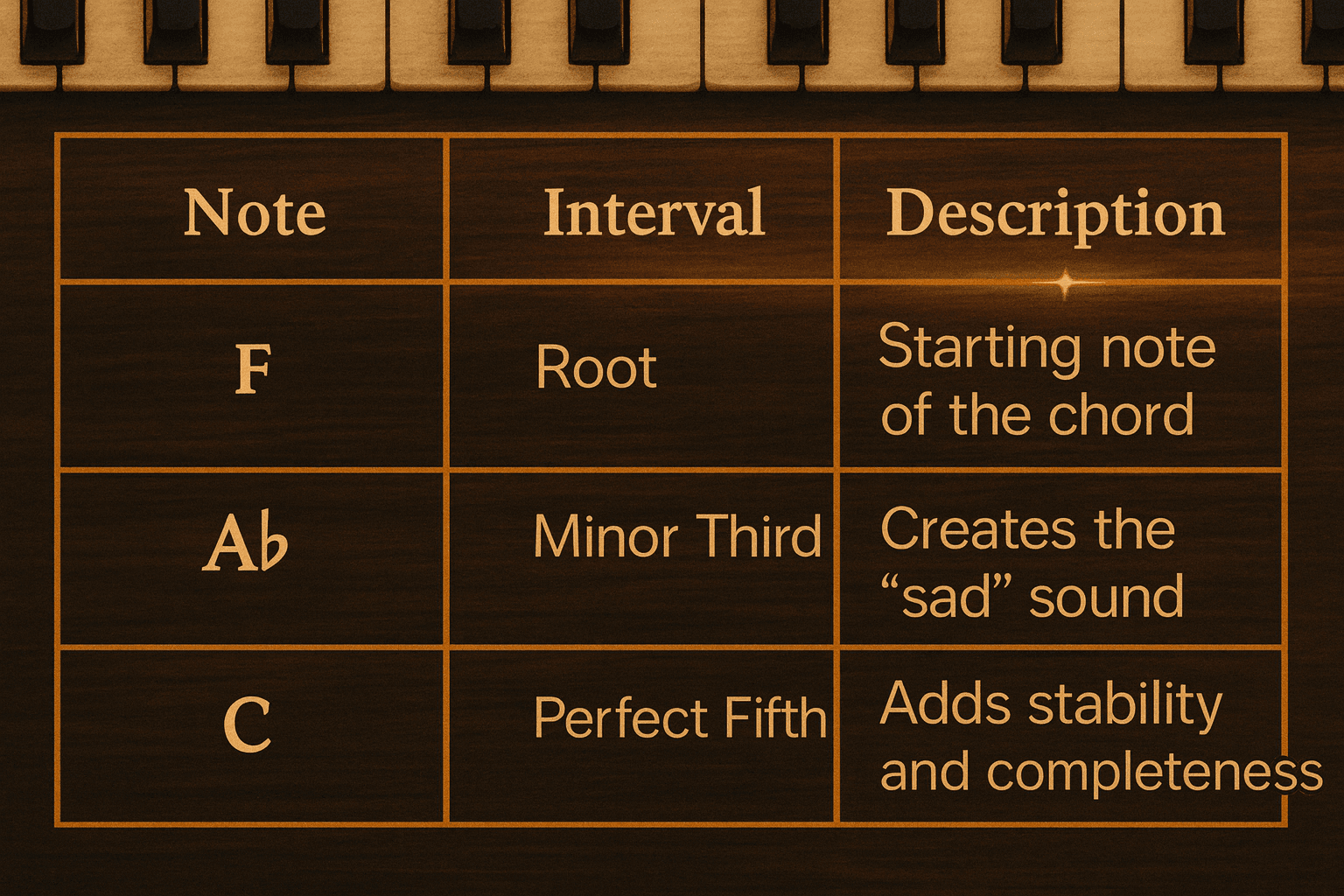
This Fm chord structure gives it a somber and expressive character, often used in ballads and emotional film music.
Notes That Make Up the F Minor Chord
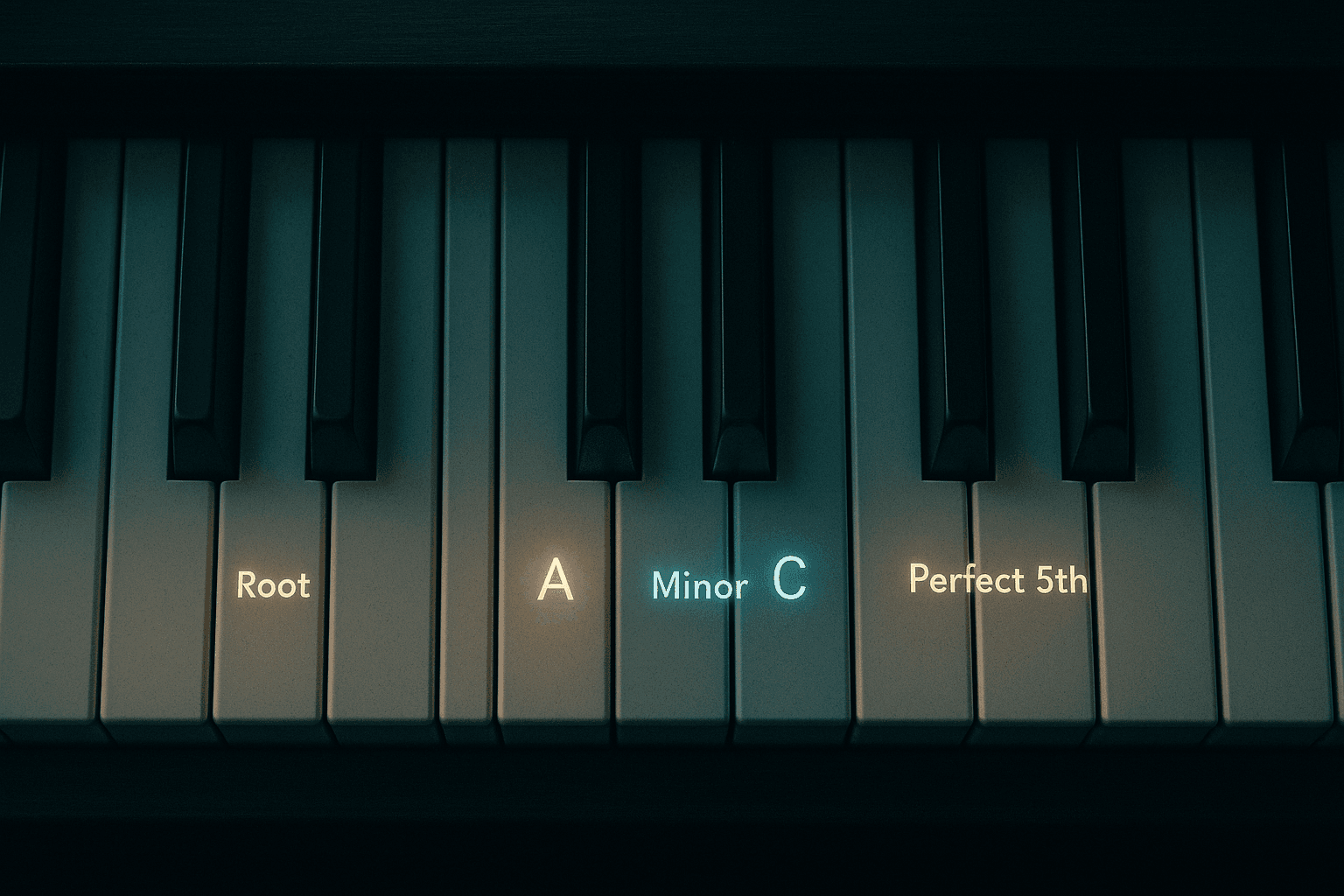
If you’re unsure how to find F on piano, it’s the white key immediately to the left of a group of three black keys. Once you locate F, move three half steps up to find A♭, and then four more half steps up to reach C.
These three notes — F, A♭, and C — together form the F minor chord piano sound. When visualized on a piano chord chart, this looks like a triangle pattern spread over the keys. Each note has a purpose: F acts as the root, A♭ gives the minor flavor, and C adds resolution.
When played cleanly, this F minor chord sound feels both warm and melancholic, giving your music a poetic touch.
F Minor Chord Formula and Music Theory Explained
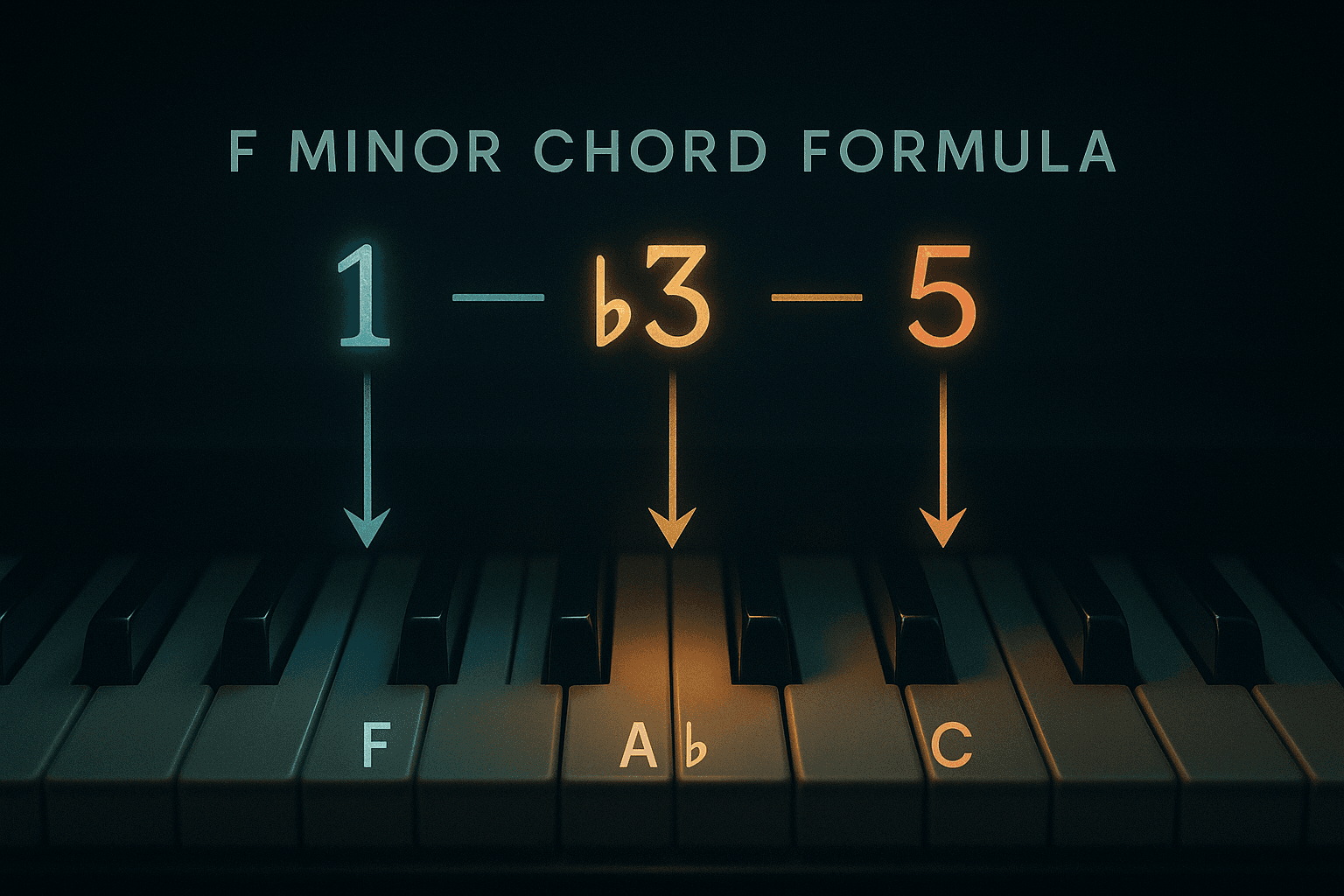
In music theory, the F minor chord formula follows the pattern 1 – ♭3 – 5, derived from the F natural minor scale (F, G, A♭, B♭, C, D♭, E♭). Using the first, third (flattened), and fifth notes of the scale, you form the F minor triad.
Understanding this formula helps you build any minor triads on piano easily. It’s a foundation in chord theory for beginners because every minor chord uses the same logic. If you can remember “root + minor third + perfect fifth,” you can construct any minor chord, including Fm, Gm, Am, and beyond.
When beginners learn how to play F minor chord on piano, they’re actually learning the building block of harmony — how tones blend to form emotions.
Sound, Emotion, and Feel of the F Minor Chord

The F minor chord sound is often described as dark, soulful, and hauntingly beautiful. It’s one of those somber piano chords that instantly transforms the mood of a song. You’ll hear it in cinematic scores, emotional pop songs, and even jazz improvisations.
Musicians often say the Fm chord feels like “melancholy with hope.” That’s because the flattened third note (A♭) lowers the brightness and introduces tension. In contrast, its relative major, A♭ major, feels more resolved and uplifting. This push and pull of emotion makes F minor ideal for expressing introspection and drama in music.
Why Learning F Minor Is Important for Pianists

Mastering the F minor piano chord goes beyond just pressing keys. It helps pianists understand minor key chord progressions and how harmonies interact across songs. Many beginner piano chords share this same formula, so once you get the F minor hand position right, you’ll find it easier to learn others like Gm or Am.
Moreover, knowing how to play F minor inversions, and its role in F minor chord progressions, opens creative doors. You’ll be able to accompany vocal lines, compose original tunes, or improvise over the F natural minor scale. With time, this knowledge shapes you into a more expressive player — one who understands the emotional language of music. To practice effectively with expert guidance, you can explore online piano and keyboard classes.
How to Play the F Minor Chord on Piano

The F minor chord on piano may look simple, but its power lies in correct technique. Playing this chord properly creates a clean and balanced tone — something every beginner should focus on early. The F minor triad is a vital building block that appears in hundreds of songs, making it one of the most essential beginner piano chords to master.
Before you begin, make sure your hand position feels relaxed. Curved fingers, supported wrists, and balanced weight are key. Good technique ensures the F minor chord sound stays smooth and expressive, rather than tense or harsh.
F Minor Chord in Root Position (F–A♭–C)
- Place your right-hand thumb on F, middle finger on A♭, and pinky on C.
- On your left hand, use the little finger for F, middle finger for A♭, and thumb for C.
- This shape is written as F–A♭–C, meaning you play the notes from the bottom up.
- It’s the simplest way to play how to play F minor chord on piano and helps you understand the core F minor chord structure.
- When played together, you’ll hear the dark and moody resonance typical of emotional piano chords.
- The F minor root position acts as a base for learning all F minor chord inversions on piano later.
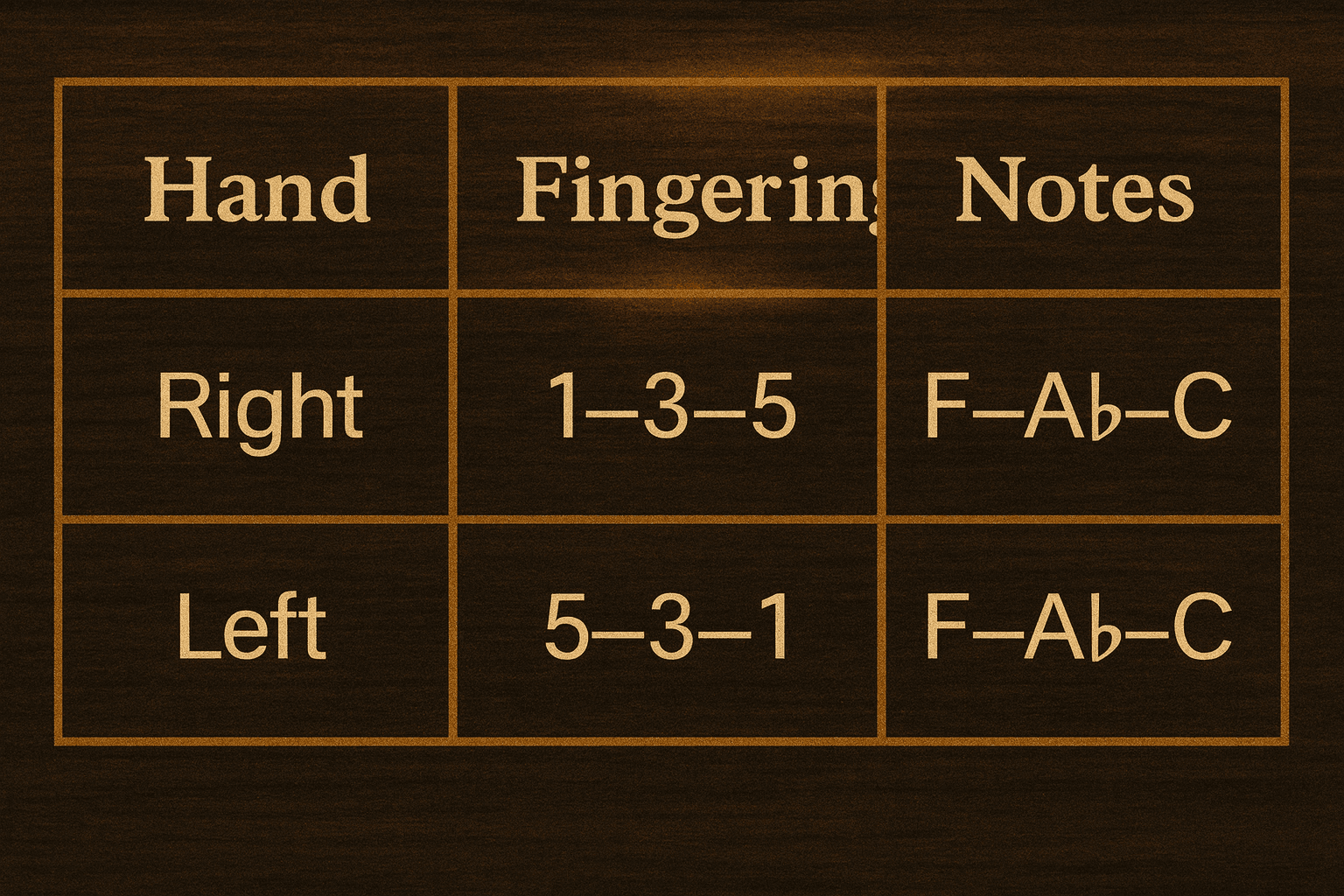
Correct Fingering for Both Hands
- Right hand: Thumb (1) on F, Middle finger (3) on A♭, Pinky (5) on C
- Left hand: Pinky (5) on F, Middle finger (3) on A♭, Thumb (1) on C
- This consistent approach helps when transitioning between chords like Fm–B♭m–C in piano chord progressions for beginners.
Common Mistakes Beginners Make
- Struggling with the F minor hand position because A♭ is a black key, forcing the hand to stretch.
- Pressing too hard or lifting fingers too high, causing uneven tone.
- Playing with flat fingers, which reduces control.
- Neglecting thumb position, letting it slip under other fingers.
- Proper posture, relaxed shoulders, and equal hand weight make a big difference when mastering the F minor chord piano shape.
- Listening ensures each note (F, A♭, and C) rings clearly, so your Fm chord sound resembles professional recordings.
Simple Exercises to Practice F Minor Smoothly
- Start slow, using a metronome to keep rhythm steady.
- Press F–A♭–C, hold for four beats, then release. Repeat ten times with each hand separately, then together.
- Try piano chord transitions like Fm–A♭–E♭ or Fm–C–B♭m.
- Break the chord into an arpeggio — play F, A♭, and C one by one to enhance control and flow.
- Consistency is key. Even five minutes of piano chord exercises daily can make your F minor chord sound richer and more dynamic.
Inversions of the F Minor Chord
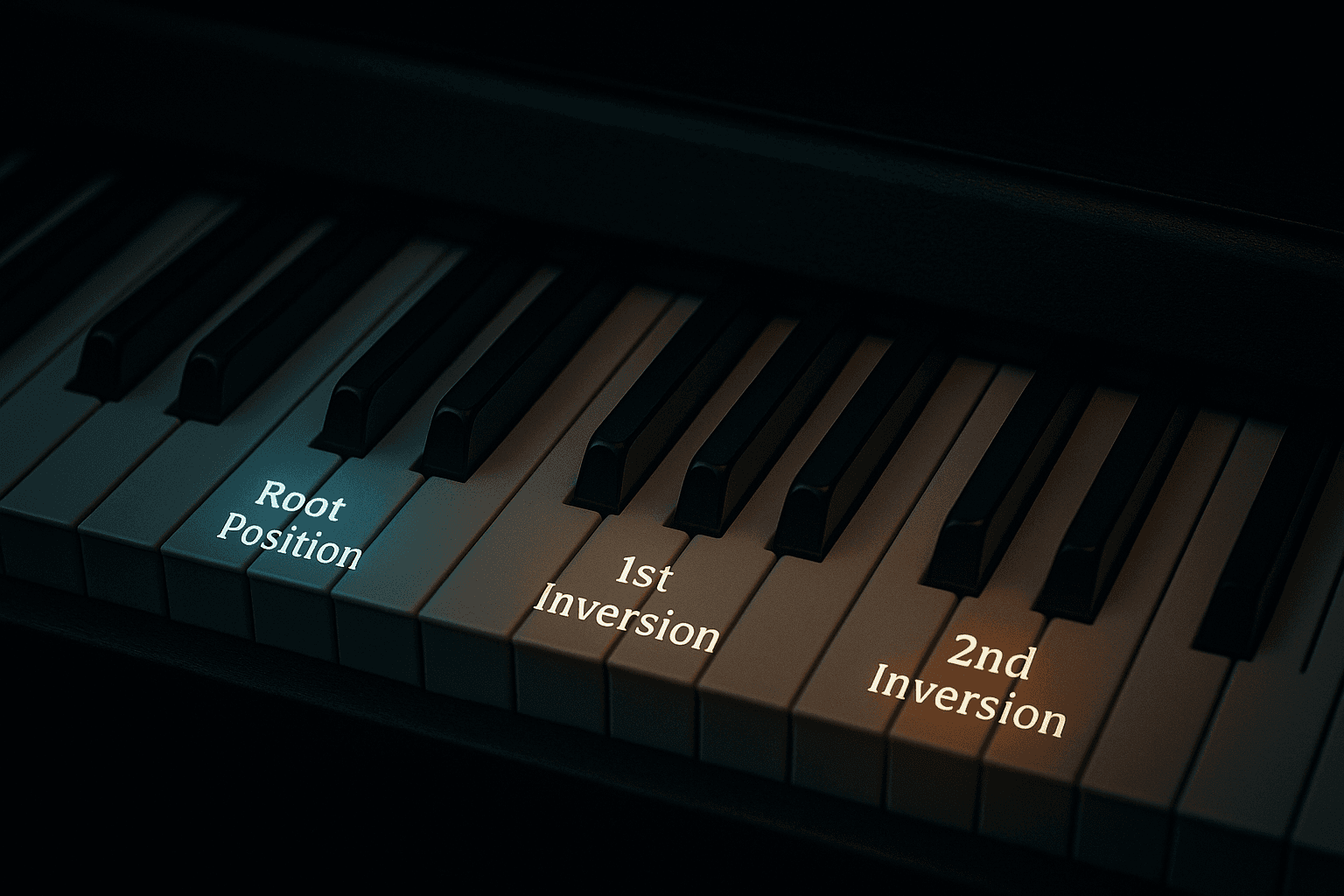
Learning the F minor chord inversions helps you move around the keyboard with confidence. Each inversion gives the same notes — F, A♭, and C — but in a different order. These changes may seem small, yet they completely transform the sound and emotional tone. Musicians use inversions to make piano chord transitions smoother and more expressive during songs.
When you switch between inversions, your hands travel shorter distances, which improves flow. Inversions are also crucial for understanding minor chord voicing and how chords connect in piano chord progressions for beginners.
What Are Chord Inversions and Why Use Them?
- A chord inversion means rearranging the order of notes in a chord.
- In the F minor triad, the root position has F at the bottom, A♭ in the middle, and C on top.
- When you move F to the top and let A♭ or C take its place at the bottom, you create the first or second inversion.
- Inversions let pianists play the same F minor chord notes in ways that fit melodies or accompany vocals more naturally.
- This technique also gives different F minor chord sound textures — one warm and soft, another bright and cutting.
- Understanding chord inversion examples helps you identify how pros shape harmony across genres like pop, jazz, and classical music.
How to Play the F Minor First Inversion (A♭–C–F)
- Start with A♭ as the lowest note, then C, and finally F on top.
- Right hand: Thumb on A♭, index or middle finger on C, pinky on F.
- Left hand: Pinky on A♭, middle finger on C, thumb on F.
- This F minor first inversion fingering helps you maintain balance and clarity.
- Practice slowly to ensure every note rings evenly.
- Alternating between F minor root position and first inversion develops smooth movement and adds different color to your playing.
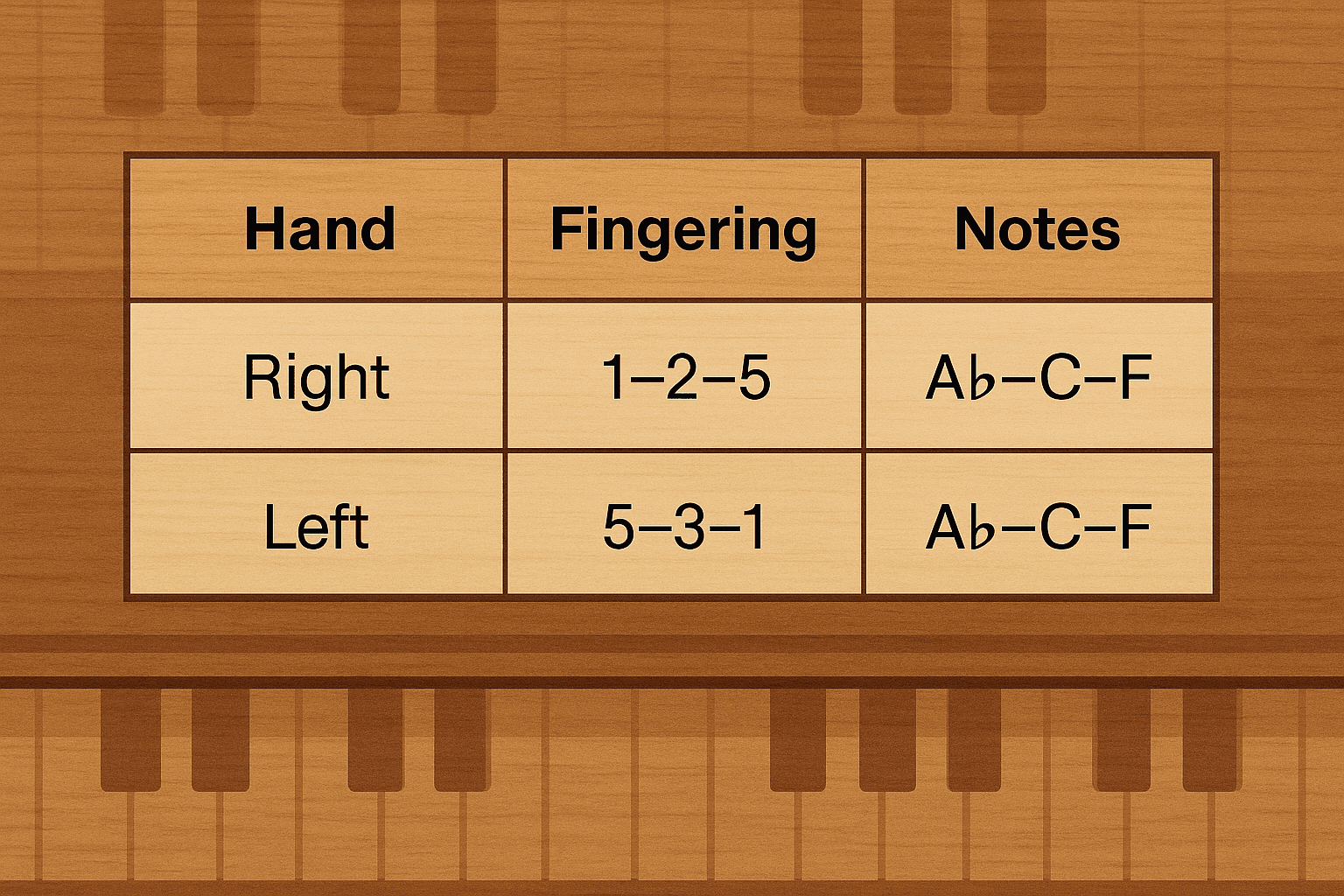
How to Play the F Minor Second Inversion (C–F–A♭)
- Start with C as the lowest note, followed by F, then A♭ on top.
- Right hand: Thumb on C, middle finger on F, pinky on A♭.
- Left hand: Pinky on C, index finger on F, thumb on A♭.
- This keeps your fingers positioned naturally without tension.
- Switching between all three shapes (root, first inversion, second inversion) lets you hear the different sounds of F minor chord inversions.
| Hand | Fingering | Notes |
|---|---|---|
| Right | 1–3–5 | C–F–A♭ |
| Left | 5–2–1 | C–F–A♭ |
Tips to Transition Between Inversions Easily
- Smooth transitions depend on muscle memory and hand stability.
- Hold each inversion for a few seconds, then shift to the next without lifting fingers too high.
- Visualize the next chord before moving — it trains your brain to react faster.
- A digital piano chord generator helps visualize how to play F minor inversions correctly.
- Keep your wrist loose, and avoid twisting your arm.
- Pair F minor with nearby chords like A♭ major or C minor to create realistic minor key chord progressions.
- Focus on accuracy and control, not speed — the hallmark of a good pianist.
Real Song Examples Using F Minor Inversions
- The haunting theme from The Godfather uses F minor chord progressions that rely heavily on inversions.
- Adele’s Someone Like You features emotional piano chords where F minor first inversion adds tension and release.
- In pop and jazz, chord variations built around Fm, Fm7, and Fm9 often use inversion-based movement.
- Practicing real-world examples trains your ear and helps you understand how different F minor chord inversions on piano influence melody and emotion.
F Minor Chord in Progressions
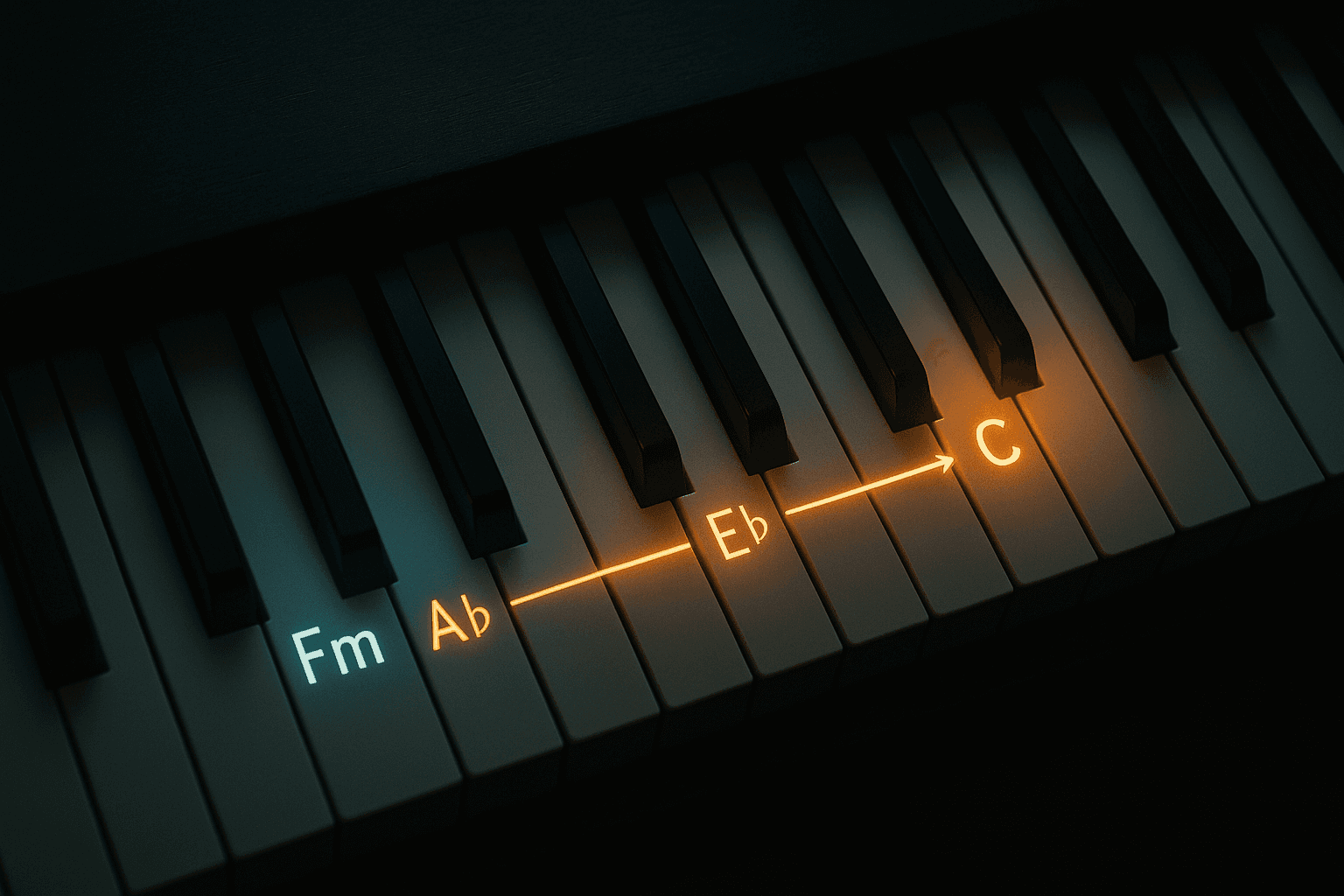
The F minor chord piano is not just a single chord; it is the backbone of many minor key chord progressions. Using F minor in sequences gives music a moody, emotional texture that works in ballads, jazz, and even pop songs. Understanding how to connect F minor with major and dominant chords is essential for smooth, expressive playing.
Chord progressions also teach you how to practice F minor on piano dynamically. By combining F minor with related chords, your fingers learn natural movement patterns. This develops your fluency in piano chord transitions and strengthens your understanding of chord theory for beginners.
Common Chord Progressions in the Key of F Minor
- Fm–C–B♭m–A♭: Classic minor sequence (Pop/rock ballads)
- Fm–A♭–E♭–C: Smooth emotional flow (Jazz & R&B)
- Fm–D♭–B♭m–C: Dramatic tension release (Film scores)
- Fm–C–B♭–C: Tension with resolution (Pop/ballad accompaniment)
These sequences let you explore piano chord progressions for beginners while creating expressive melodies. Practicing slowly, then increasing tempo, is key to mastering easy F minor chord progressions.
Emotional and Musical Contexts for F Minor
The F minor chord sound naturally conveys melancholy, introspection, and dramatic tension. When paired with a bright A♭ major chord, the contrast enhances the emotional impact. Jazz musicians often use Fm chord extensions like Fm7 or Fm9 to add richness, while pop artists rely on root and inversion movements for subtle tension.
This emotional versatility makes the F minor piano chord ideal for solo pieces, accompaniments, and improvisation. Knowing what chords go with F minor lets pianists compose fluid lines that feel professional, even in simple exercises or beginner piano chords practice.
How to Connect F Minor with Major and Dominant Chords
- Moving from Fm to C major creates resolution.
- Linking Fm to B♭ minor maintains emotional continuity.
- Using chord progression exercises that involve inversions further smooths transitions.
- Practicing sequences such as Fm–A♭–E♭ or Fm–C–B♭m helps hands naturally learn piano finger numbers and positioning.
- This method reinforces left hand and right hand piano technique, creating professional-sounding chord movement even for beginners.
Example Progressions (Fm–B♭m–C, Fm–A♭–E♭, etc.)
- Fm–B♭m–C: Root position Fm, B♭m, C — Beginner smooth flow
- Fm–A♭–E♭: Use first inversion Fm — Emotional dynamic control
- Fm–C–B♭: Mix inversions — Practice piano chord transitions
- Fm–D♭–B♭m–C: All inversions — Realistic minor key chord progressions
These exercises are ideal for integrating F minor chord inversions into actual musical contexts. Over time, your Fm chord sound examples will become rich and natural, preparing you for improvisation or song accompaniment. To get personalized guidance and structured practice, you can book a trial class.