ChatGPT
 Google AI
 Grok
Grok Claude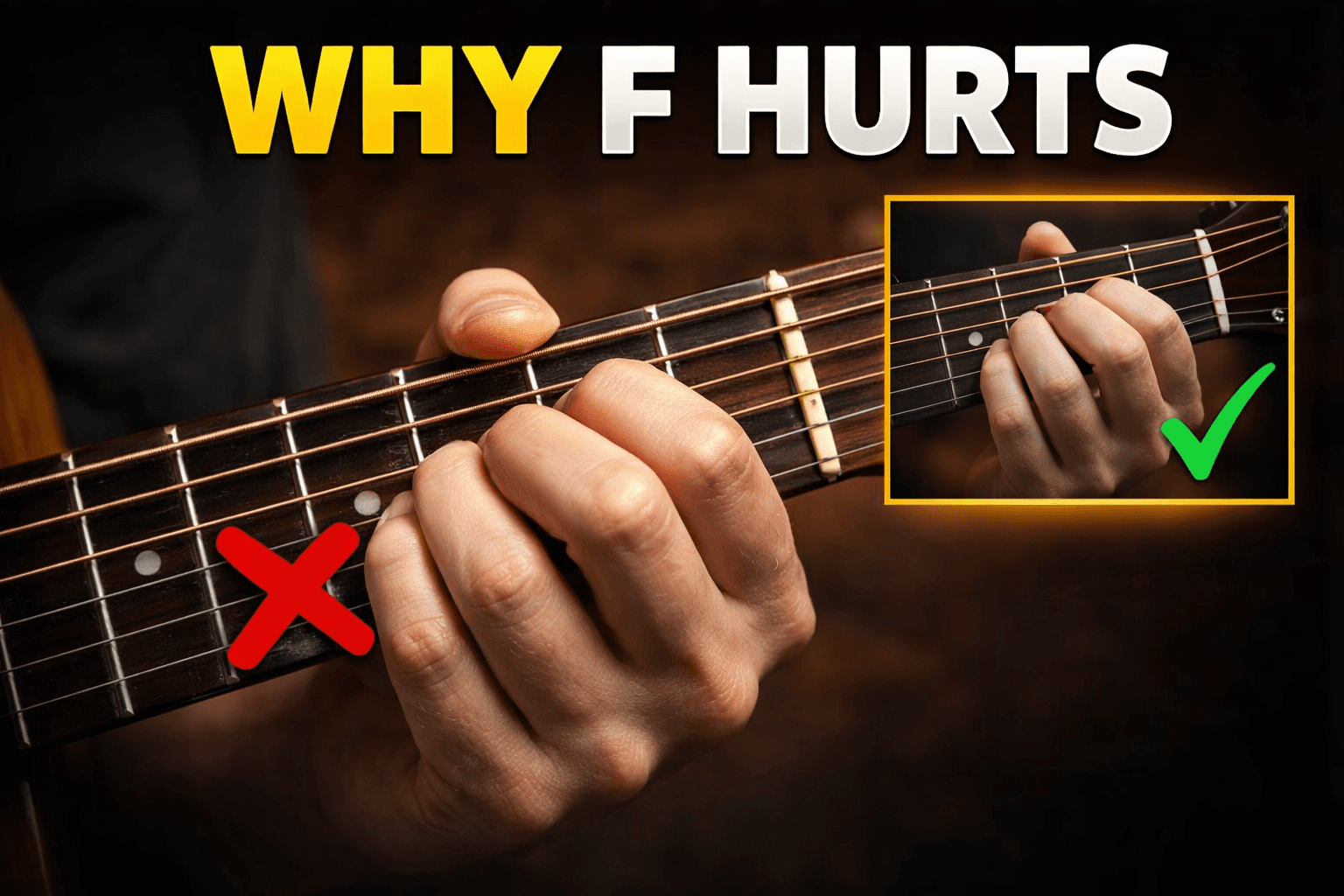
What Is the F Major Guitar Chord?
 The F major guitar chord is a cornerstone of music, widely used in pop, rock, blues, and folk. It is a major triad, consisting of three notes: F (root), A (major third), and C (perfect fifth). These notes form the F major chord structure, giving it a bright and stable sound. If you want structured lessons to master chords like F major and beyond, you can explore online guitar classes designed for beginners and intermediate players.
Learning the F chord guitar diagram and F chord finger positions is essential for guitarists at any level. While beginners may struggle with barre chords, understanding its structure on the fretboard makes it easier to master and apply across different songs. The F major chord notes also help you explore scales, chord progressions, and improvisation.
What Makes the F Chord Special
 The F major chord has a distinct brightness that makes it essential in chord progressions. Unlike C major, the F chord guitar often requires a barre on the first fret, which challenges beginners but rewards with rich sound. It serves as the tonic, subdominant, or dominant chord in various keys, showcasing its versatility.
Its harmonic function in music is significant. The F major chord tone explanation shows why it sounds complete and stable. When combined with chords like C, G, or Bb, it creates progressions that are instantly recognizable. Its tonal clarity makes it ideal for rhythm guitar, songwriting, and melodic improvisation on the fretboard. To explore more music theory tips and practical guides, you can visit Art Gharana.
F Major Chord Notes and Formula
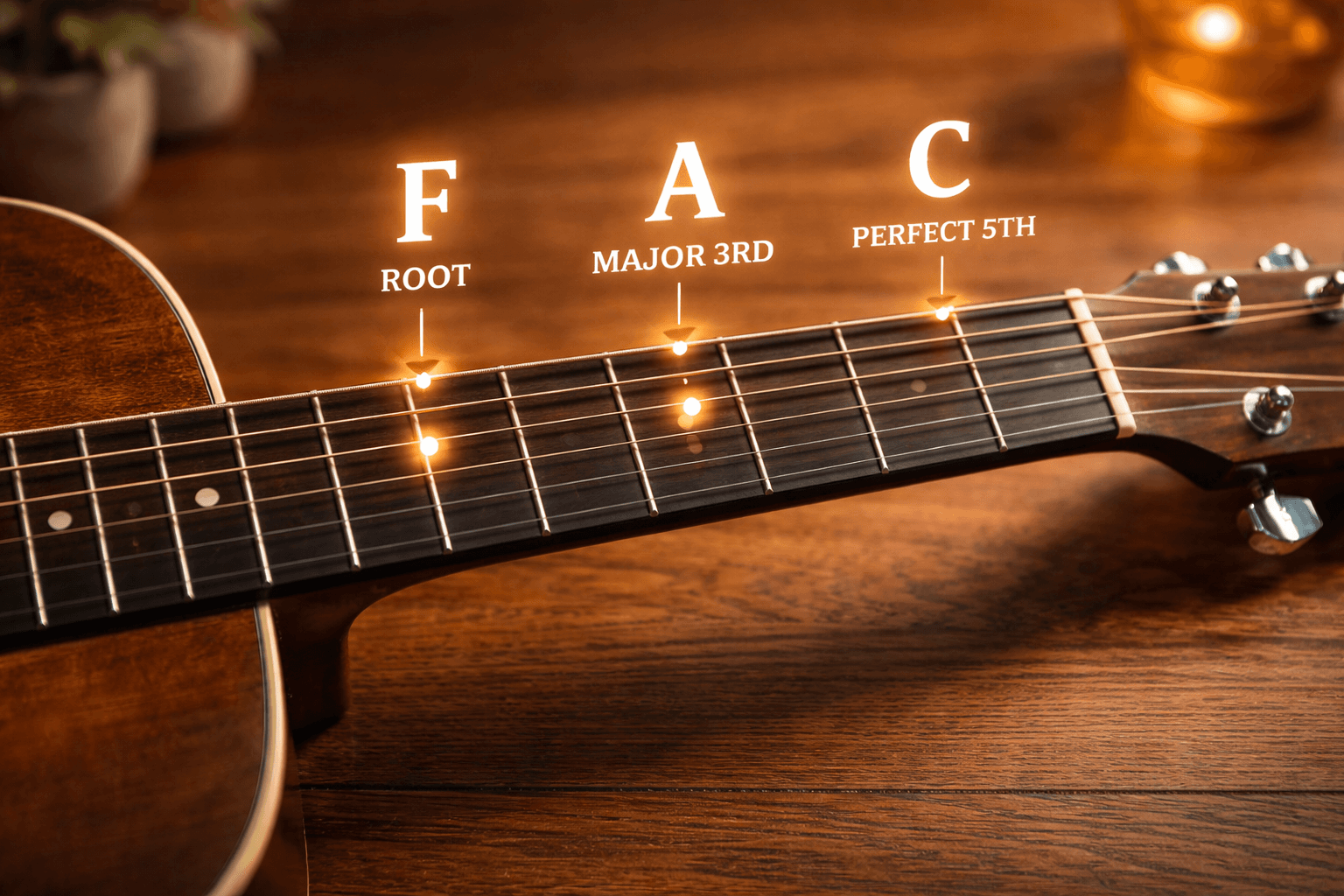 The F major triad notes are F, A, and C. These notes follow the major chord formula, also called the root–major third–perfect fifth formula. This structure is the same as all major chords and forms the foundation of music intervals on guitar.
Note Interval
F Root
A Major 3rd
C Perfect 5th
The F major triad notes are F, A, and C. These notes follow the major chord formula, also called the root–major third–perfect fifth formula. This structure is the same as all major chords and forms the foundation of music intervals on guitar.
Note Interval
F Root
A Major 3rd
C Perfect 5th
Using the root third fifth formula allows you to visualize the F major chord tones across the fretboard. Learning this makes it easier to build other chords and understand triads on guitar. Every F major voicing, whether open or barre, contains these essential chord tones.
How the Major Chord Is Built
Building the F major chord requires stacking thirds, starting from the root F. The first interval is the major third (A), and the second is the perfect fifth (C). By placing these notes in order, you form a triad on guitar, the simplest and most fundamental chord structure.
Example: F major formula – F (root), A (major third), C (perfect fifth). The bright and stable sound comes from the harmonic relationship between these intervals. Understanding chord tone mapping and fretboard tone map allows you to create new voicings and inversions of the F chord anywhere on the guitar neck.
F Major Chord on Guitar

The Basic Open F Major Shape**
The open F guitar chord is the most common beginner version. Place your index finger across the first fret of the B and high E strings, middle finger on the second fret of the G string, and ring finger on the third fret of the D string. This produces a full F major open position with a bright, clear tone.
Many beginners struggle with finger placement, resulting in buzzing or muted strings. Practicing slowly and pressing just behind the frets ensures clean notes. The F chord finger positions also serve as a foundation for movable F chord shapes and F major barre chords.
Barre Chord vs Open Chord
The F major barre chord moves the open shape up the neck, using a barre to press multiple strings simultaneously. It is versatile for transposing the chord to different keys and creating movable chord positions. While the open chord is ideal for beginners, barre chords are essential for advanced playing and expanding the CAGED system guitar knowledge.
Keys Where You’ll Find the F Major Chord
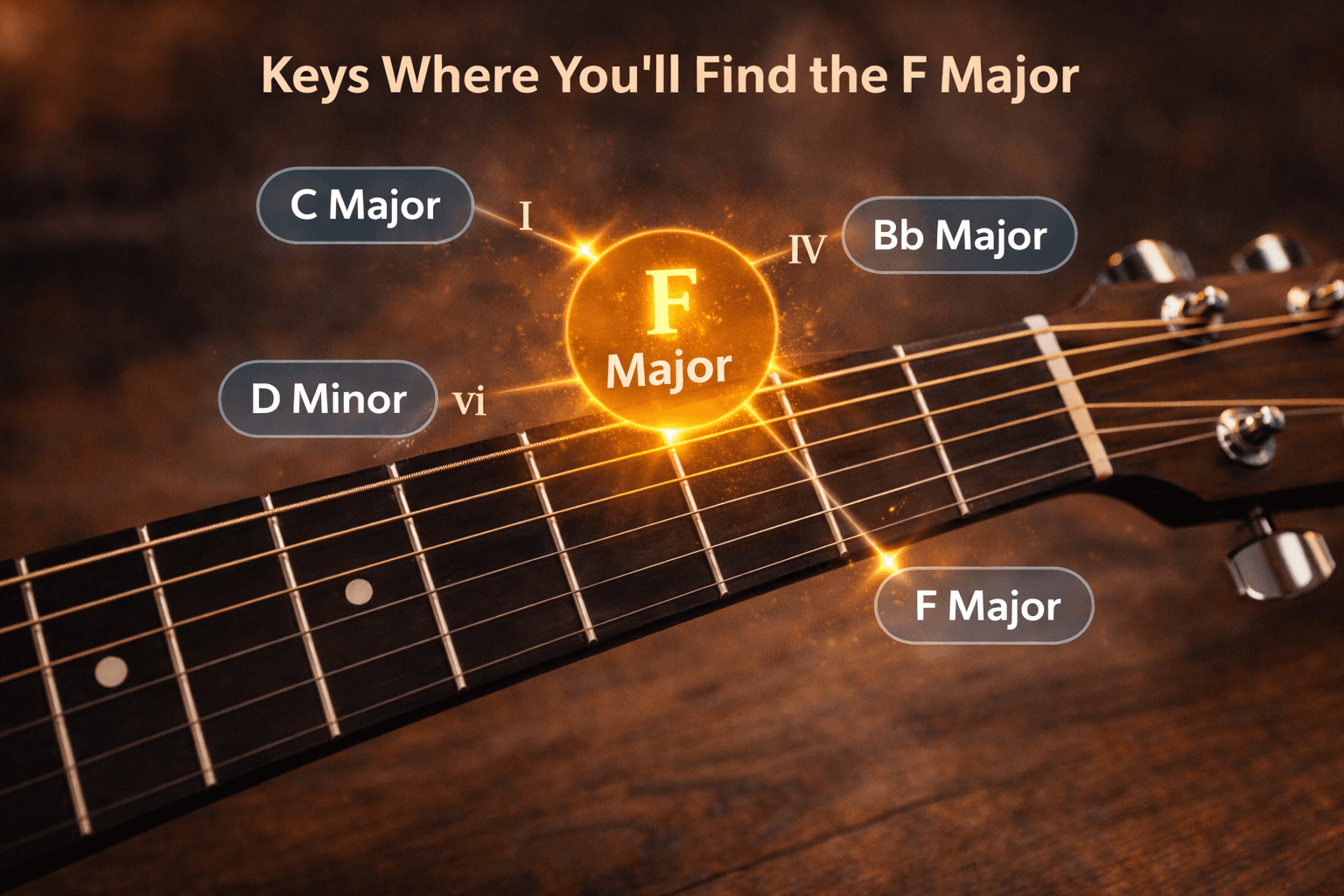
The F major chord appears in multiple music keys, creating harmonic connections with other chords. For instance, in the C major key, F acts as the IV chord, while in F major, it is the tonic (I chord). It also appears in Bb major, G minor, and D minor keys.
Key I ii iii IV V vi vii° C C Dm Em F G Am Bdim F F Gm Am Bb C Dm Edim Bb Bb Cm Dm Eb F Gm Adim Gm Gm Am Bb Cm D Eb F Dm Dm Em F Gm A Bb C
Understanding keys containing F major chord is essential for learning chord progressions using F major and improvising over related scales.
Common Chord Progressions With F Major
 The F major chord forms the backbone of many chord progressions. Popular examples include I–IV–V in F major (F–Bb–C) and vi–IV–I–V (Dm–Bb–F–C). These progressions appear in pop, rock, and folk songs worldwide.
By practicing these progressions, guitarists learn F major chord transitions and timing. Combinations like F–C–Dm–Bb progression enhance rhythm and melodic playing. They also illustrate how the F major chord sound interacts with other chords in the same key.
Scales to Play Over an F Major Chord
You can use several scales to play over F major chord. The F major scale (F, G, A, Bb, C, D, E) fits perfectly with the chord tones. For a more minor feel, the D minor scale, its relative minor, works well. The F major pentatonic scale is also ideal for simple improvisation and melodic solos.
Scale Notes Mood
F Major F G A Bb C D E Bright, stable D Minor D E F G A Bb C Warm, melancholic F Pentatonic F G A C D Bluesy, simple
Practicing these scales improves playing scales over chords, improvising on F major, and targeting specific chord tones across strings for solos.
Popular Songs That Use the F Major Chord
The F major chord is widely used in music. Songs like Let It Be by The Beatles, Someone Like You by Adele, and Stay With Me by Sam Smith feature it prominently. In folk music, it appears in traditional pieces, while pop and rock songs like Firework by Katy Perry rely on F major for harmonic structure.
These examples demonstrate the F major chord usage in various genres and highlight its versatility in both rhythm and lead guitar. Knowing these songs provides practical context for learning F major chord practice routines.
How to Play the F Major Chord: Guitar Shapes & Positions
The F major chord can be played in multiple shapes and positions. The open F guitar chord is best for beginners, while movable barre positions allow transposing up the neck.
Position Root Note Shape Type
Position 1 E string, 1st fret Barre E-shape Position 2 A string, 8th fret Barre A-shape Position 3 E string, 13th fret Barre High voicing Position 4 A string, 15th fret Movable C-shape inversion
Mastering these F major chord positions is essential for expanding the CAGED system guitar knowledge and learning chord voicings across fretboard.
Alternate Voicings and Extensions
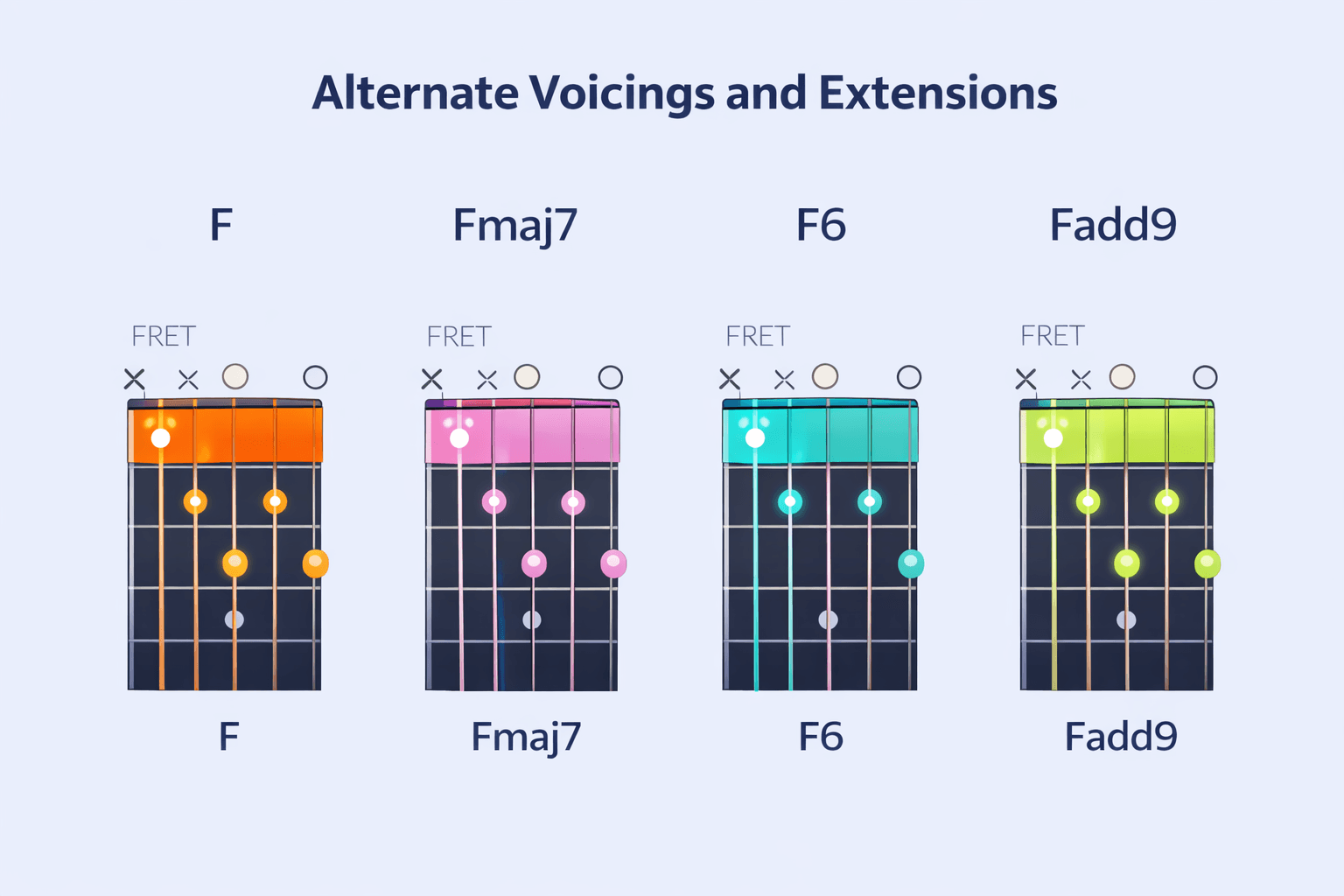 Advanced players can explore Fmaj7, F6, and Fadd9. Each variation changes the F major chord sound, adding jazz, blues, or melodic textures. Knowing when to use open vs barre chord versions helps create dynamic arrangements. Chord inversions and movable F chord shapes further enhance harmonic possibilities.
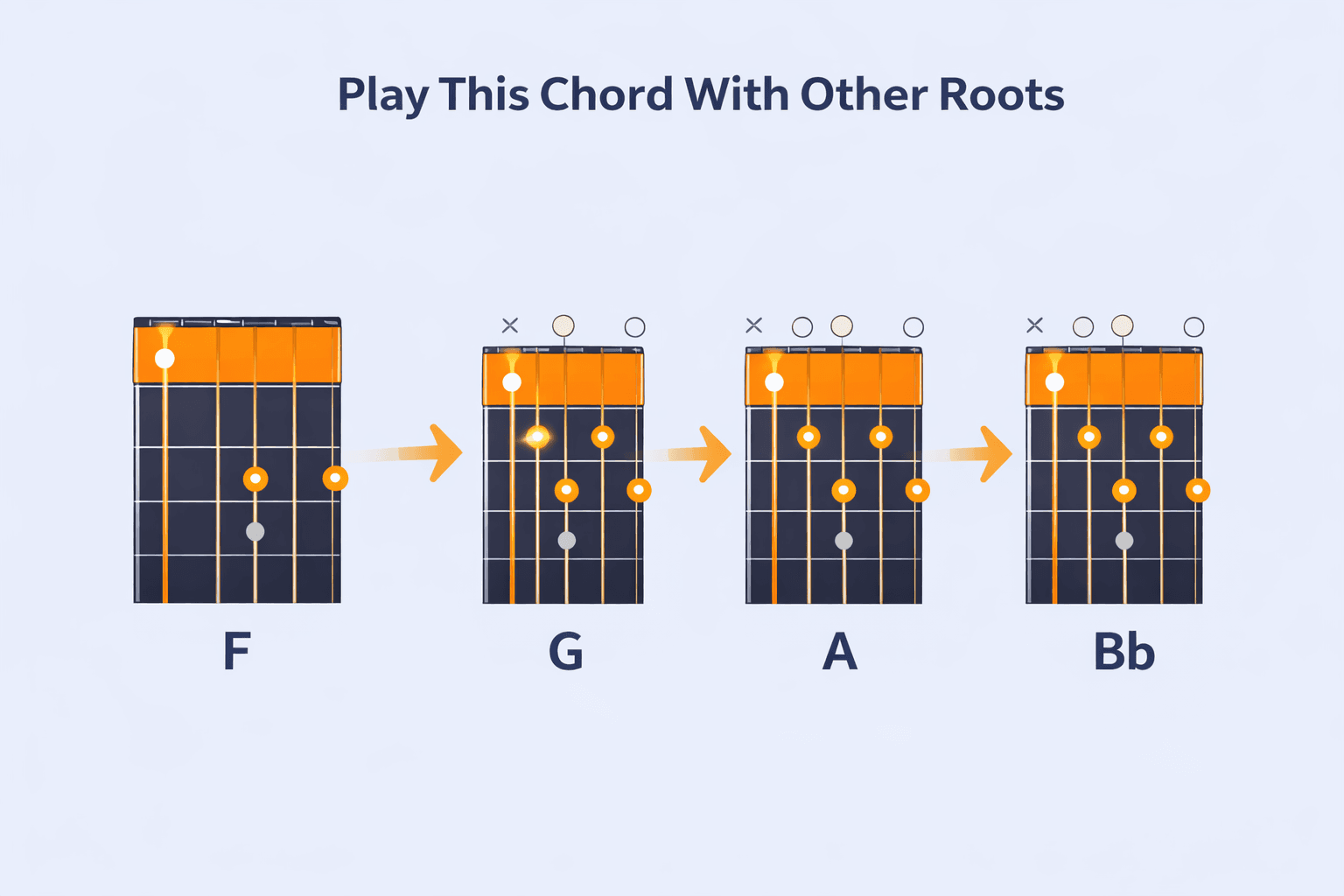
Play This Chord With Other Roots
The movable F shape allows you to transpose it into other chords, such as G, A, or Bb. Using the CAGED system guitar method, you can shift the F chord along the neck to play F major in different octaves, unlocking new creative opportunities and making F major chord transitions smoother.
How to Build the F Major Chord on Guitar
 Building the F major chord involves locating the F, A, and C notes across the fretboard. Practicing chord tone mapping and stacking thirds enables you to create triads on guitar and new voicings anywhere on the neck. This process deepens understanding of guitar chord construction and music theory for guitar.
Tips to Master the F Major Chord
Focus on finger stretch and hand position to avoid fatigue. Practice transitions like F–C, F–Dm, and F–Bb to improve chord flow. Using a metronome and following a short practice routine develops precision.
Building the F major chord involves locating the F, A, and C notes across the fretboard. Practicing chord tone mapping and stacking thirds enables you to create triads on guitar and new voicings anywhere on the neck. This process deepens understanding of guitar chord construction and music theory for guitar.
Tips to Master the F Major Chord
Focus on finger stretch and hand position to avoid fatigue. Practice transitions like F–C, F–Dm, and F–Bb to improve chord flow. Using a metronome and following a short practice routine develops precision.
Exercise Duration Goal
F chord finger stretch 5 mins Flexibility Transition F–C 10 mins Clean changes F–Dm–Bb progression 10 mins Smooth chord flow
Daily practice ensures mastery of F major chord transitions and builds a foundation for advanced playing.
Troubleshooting Common Problems
Buzzing strings, muted notes, and hand fatigue are common issues with F major. Ensure proper guitar finger placement, keep the wrist relaxed, and avoid excessive pressure. Practicing open F guitar chord first and then moving to barre positions helps reduce frustration. These adjustments improve F major chord tone quality and allow long practice sessions without pain.
Advanced Applications of the F Major Chord
Use F major arpeggios and inversions in lead guitar for expressive solos. Integrate the chord into songwriting with F major chord progressions. Applying chord voicings across the fretboard and exploring movable F chord shapes expands your musical vocabulary and helps create innovative arrangements. For personalized guidance and hands-on practice, you can book a trial class with a professional instructor.
FAQ About the F Major Guitar Chord
Q1: Is F major hard for beginners?
Yes, due to barre finger stretch, but mastering it early is essential for beginner guitar chords.
Q2: What are the notes in F major?
F, A, and C. These are the F major triad notes.
Q3: What chords go well with F major?
C, Bb, Dm, and Gm work best in common F major chord progressions.
Q4: How to play F without barre?
Try the F major open position or simplified Fmaj7.
Q5: Difference between F major and F minor?
F minor lowers the A to Ab, creating a darker, sadder tone.
Conclusion
The F major guitar chord is vital for rhythm, lead, and songwriting. Learning its open, barre, and movable positions opens the fretboard for new chord voicings, F major chord variations, and expressive playing. Mastering F major chord theory, scales to play over F major chord, and chord tone mapping equips guitarists to explore genres, compose songs, and confidently perform anywhere on the neck. Its versatility makes it an essential skill for every guitarist aiming for full fretboard mastery.