ChatGPT
 Google AI
 Grok
Grok Claude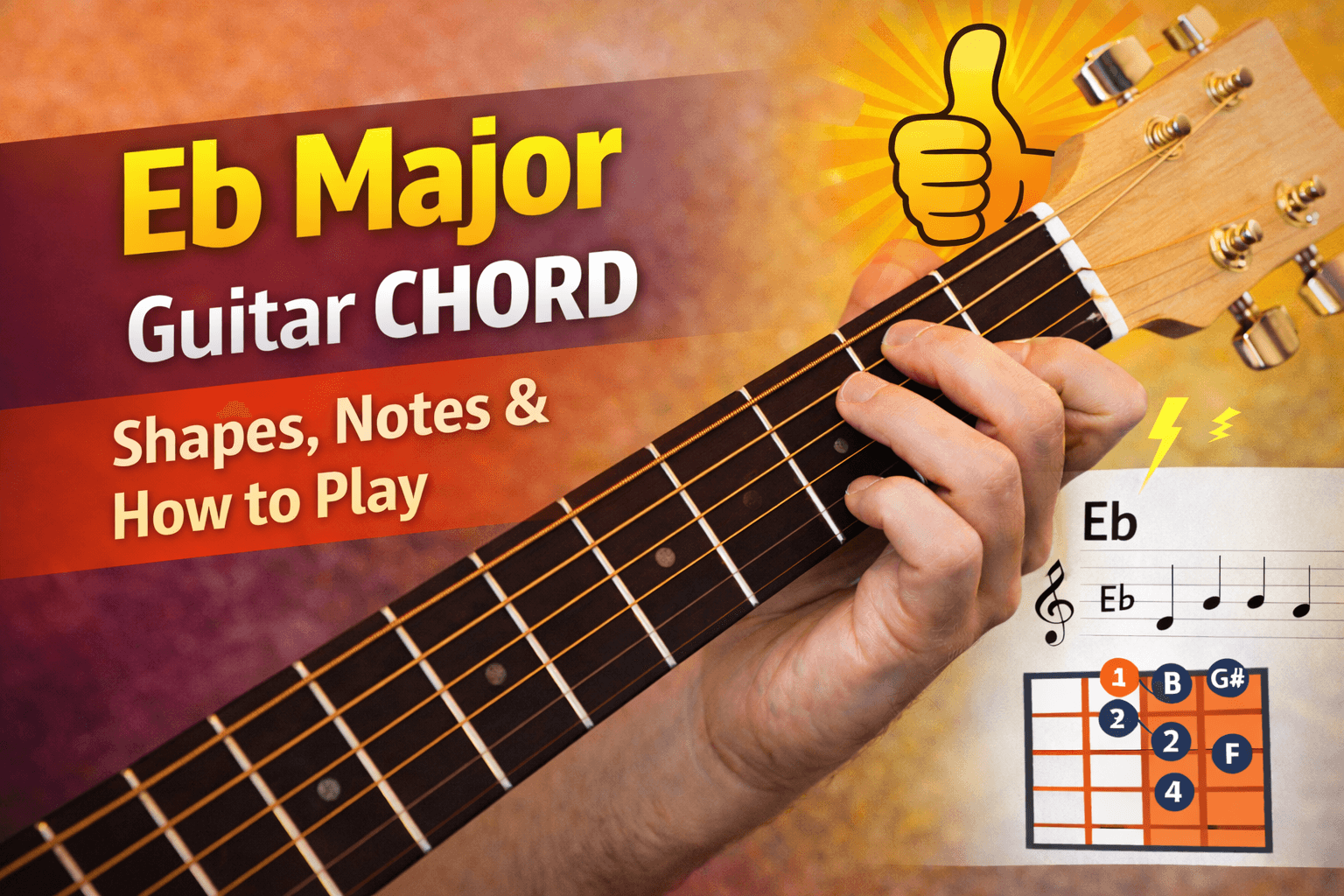
The Eb major guitar chord is a bright, resonant, and expressive chord built from the notes Eb–G–Bb, forming a classic major triad using the formula 1–3–5. Although it does not have an easy open-string shape in standard tuning, Eb major becomes one of the most important chords for guitarists who play pop, soul, R&B, funk, gospel, jazz, or modern acoustic music. Because this chord appears frequently in flat-major keys, learning the Eb major chord allows players to navigate many popular songs and harmonically rich compositions.
Since Eb is one half-step above D, the chord is usually played using movable barre shapes or triads on the upper strings. Understanding the Eb major chord diagram, notes, and finger placement helps players shift fluidly across the fretboard, improving chord knowledge and developing control over transitions in sharp- and flat-heavy keys. Eb major is also commonly found in modulations, transpositions, and horn-based arrangements where flat keys dominate.
From rhythm playing to melodic improvisation, the Eb major chord is essential for building a strong harmonic foundation. It also prepares guitarists for advanced concepts like the CAGED system, triad mapping, chord extensions, voice leading, and scale-to-chord relationships.
What Makes the Eb Major Chord Special?
 The Eb major chord stands out for its rich tonal character and its importance in genres influenced by jazz harmony, soul progressions, and pop ballads. Like all major chords, Eb major uses the structure root–major third–perfect fifth, giving it a stable and uplifting sound. What makes Eb major particularly noteworthy is its heavy presence in the keys of Eb Major, Bb Major, Ab Major, and C minor—keys used in countless classic and modern songs.
The Eb major chord is also central to the sound of brass arrangements, gospel compositions, orchestral transpositions, and R&B grooves. Many keyboard-based compositions, horn sections, and vocal-centric songs prefer flat keys, making Eb major one of the most frequently encountered chords outside of open-string guitar playing.
Because the chord relies primarily on barre shapes, it helps guitarists develop strength, control, and proper technique. This leads to better fretboard fluency and enhances the ability to visualize major triads across every string set. Understanding the harmonic function of Eb major gives players the ability to construct chord progressions, arrange voicings, and improvise with confidence.
Eb Major Chord Notes and Formula
The Eb major chord includes three essential notes:
Note Interval Eb Root G Major Third Bb Perfect Fifth
These notes form a pure major triad. The presence of the major third (G) gives the chord its bright and uplifting quality, while the perfect fifth (Bb) ensures stability and harmonic balance.
How the Major Chord Is Built
The Eb major chord comes from the Eb major scale:
Eb – F – G – Ab – Bb – C – D
Selecting the 1st, 3rd, and 5th notes forms the Eb major triad:
1 (Eb) → 3 (G) → 5 (Bb)
This structure, known as stacking thirds, is the basis for building any major chord. Understanding this formula helps players create triads across the fretboard, form inversions, construct new voicings, and explore deeper harmonic theory.
By learning how the chord is built, guitarists can identify Eb, G, and Bb across the neck and use them to craft compelling rhythm patterns, melodic lines, arpeggios, and chord tone-targeting techniques.
Eb Major Chord on Guitar
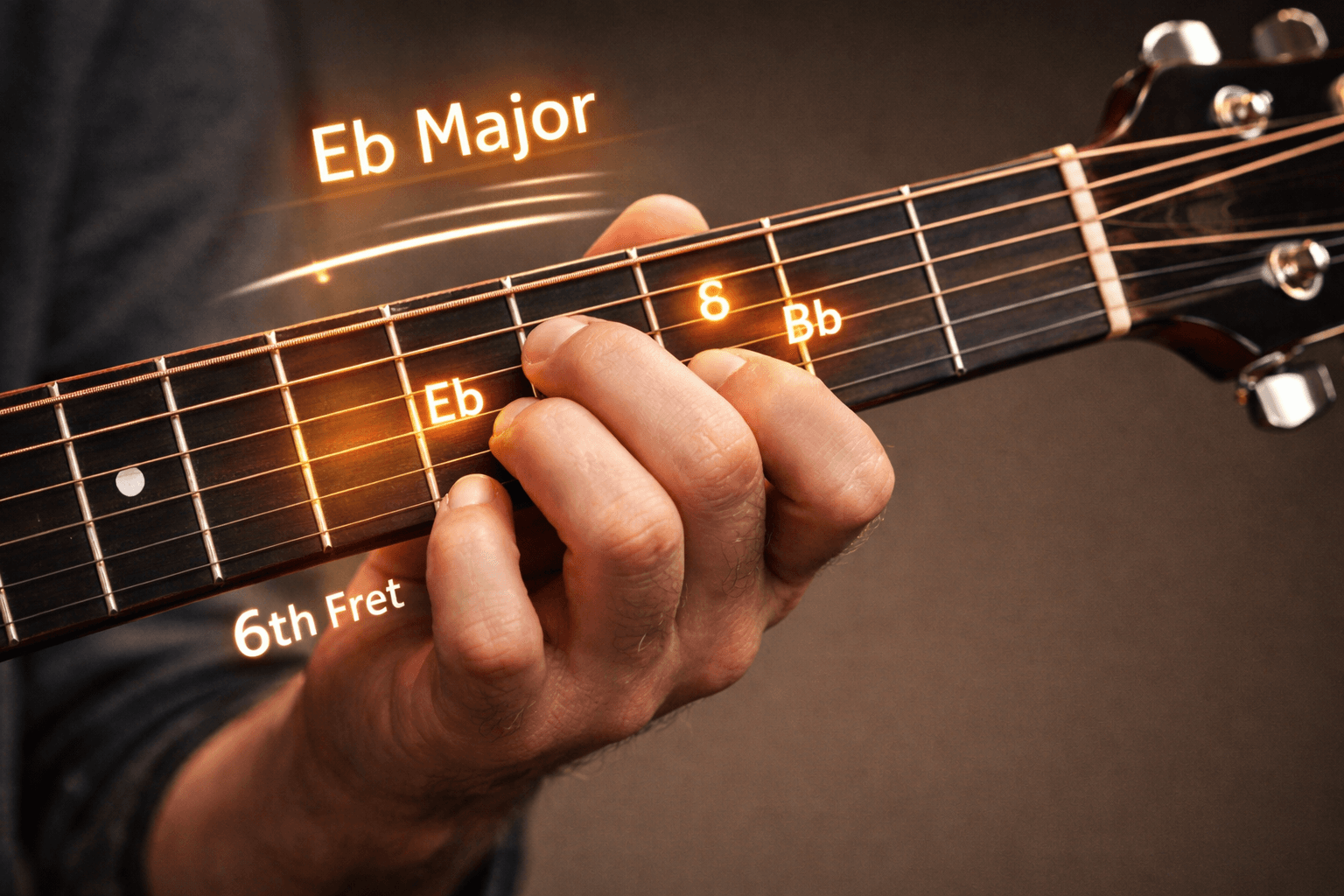 Because there are no easy open positions for Eb major in standard tuning, the chord is primarily played using:
- Barre chords
- Movable shapes
- CAGED system positions
- Triads on upper strings
- Higher-voicing fingerings
- Inconsistent pressure when forming the barre
- Muted or buzzing strings
- Difficulty shifting quickly into the shape
- Hand fatigue
-
I–IV–V (Eb – Ab – Bb) A classic progression used in pop and gospel.
-
I–V–vi–IV (Eb – Bb – Cm – Ab) One of the most popular emotional progressions in modern music.
- ii–V–I (Fm – Bb – Eb) A jazz and soul essential progression.
- Songs written in Eb Major, Bb Major, and Ab Major
- Gospel and R&B tracks using I–V–vi–IV progressions
- Pop ballads with piano-driven arrangement
- Motown classics in flat keys
- Modern pop transposed for vocal comfort
- Ebmaj7
- Eb6
- Ebsus2
- Ebsus4
- Ebadd9
- Ebmaj9
- Triads
- Inversions
- Arpeggios
- Movable chord shapes
- Fretboard mapping
- Keep your thumb placed behind the neck for strong leverage.
- Curve fingers to avoid muting adjacent strings.
- Avoid squeezing too hard; use arm weight to press the barre.
- Practice slowly before increasing BPM.
- Muted notes due to weak barre pressure
- Buzzing strings caused by incorrect angle
- Fatigue after repeated practice
- Difficulty controlling finger stretch
- Jazz comping using Ebmaj7, Eb6, and Eb9
- Gospel movements with IV–I resolutions in flat keys
- R&B embellishments using chord inversions
- Pop songwriting with expressive I–V–vi–IV patterns
- Lead improvisation using Eb major arpeggios and triads
Each shape offers a different texture, resonance, and tonal brightness. The most common Eb major shape is the A-shape barre chord at the 6th fret and the E-shape barre chord at the 11th fret.
Players often begin with the A-shape version due to its accessibility and warm tone. As they progress, they explore higher-voicing shapes that allow greater control over dynamics and articulation.
The Basic Barre Eb Major Shape
The most familiar form of the Eb major chord is the A-shape barre chord on the 6th fret. This voicing delivers a strong, punchy tone ideal for rhythm guitar, pop, rock, and funk.
Common beginner challenges include:
Practicing slow transitions and proper wrist alignment ensures a clear, resonant sound and builds essential muscle memory.
Keys Where You’ll Find the Eb Major Chord
Eb major appears in many flat-major and minor keys, making it essential for composing, improvising, and understanding harmonic flow. The chord’s role within each key is shown below:
Key I ii iii IV V vi vii°
Eb Major Eb Fm Gm Ab Bb Cm Ddim Bb Major Bb Cm Dm Eb F Gm Adim Ab Major Ab Bbm Cm Db Eb Fm Gdim C Minor Cm Ddim Eb Fm Gm Ab Bb
Understanding these positions allows guitarists to predict when Eb major will appear, analyze song structures, and build chord progressions with smoother transitions.
Common Chord Progressions With Eb Major
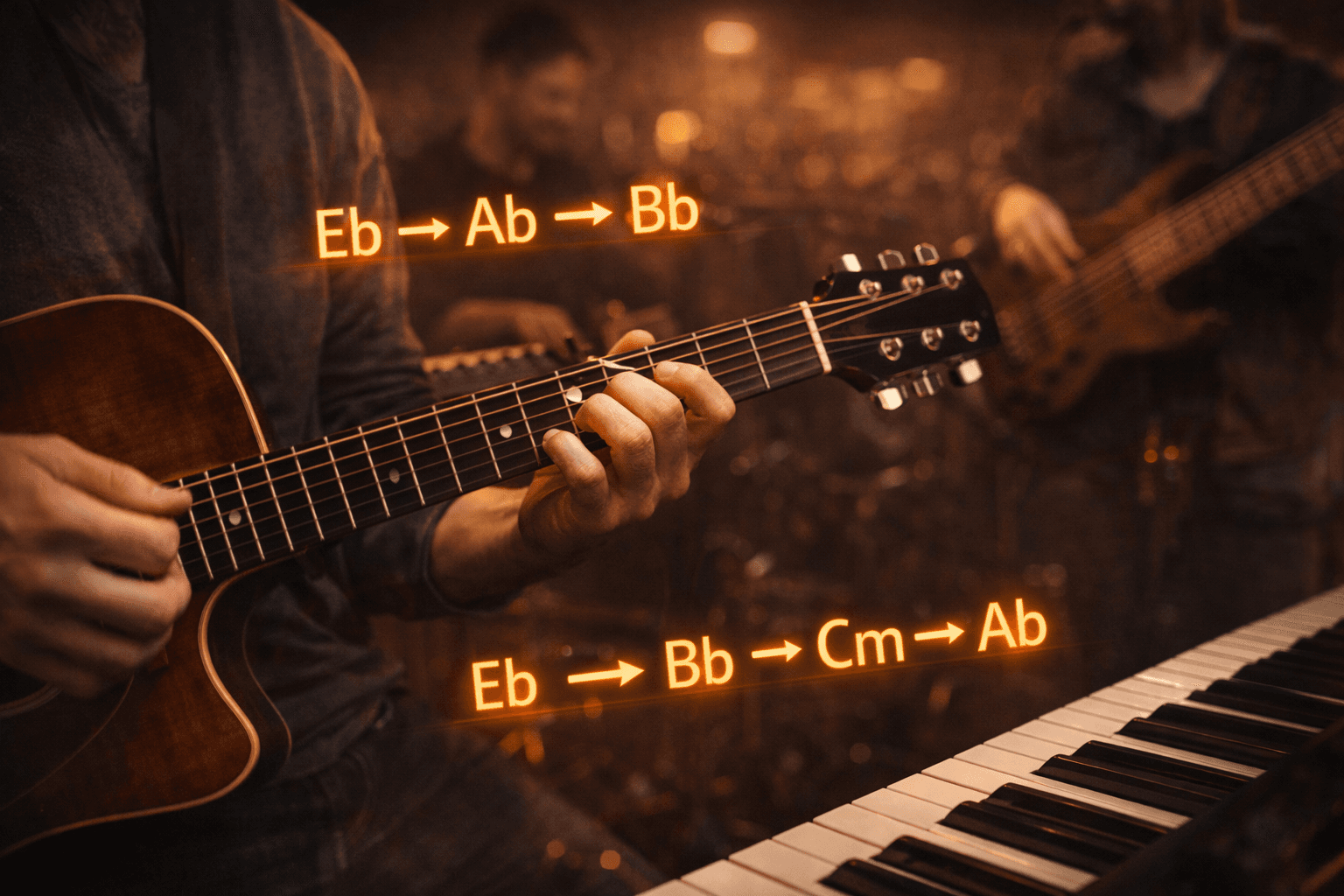 Eb major appears in many well-known progressions across genres like R&B, soul, pop, jazz, and gospel. Its rich harmonic presence makes it a favorite for expressive chord movement.
Popular Progressions
3 .vi–IV–I–V (Cm – Ab – Eb – Bb) Found in ballads, worship music, and contemporary pop.
These chord progressions using Eb major help illustrate how the chord interacts with others to form expressive harmonic patterns.
Scales to Play Over an Eb Major Chord
Improvising over an Eb major chord involves choosing scales that reinforce the chord’s tonal center while offering creative melodic possibilities.
Scale Notes Mood Eb Major Scale Eb F G Ab Bb C D Bright, uplifting C Minor Scale C D Eb F G Ab Bb Emotional, rich
Eb Major Pentatonic Eb F G Bb C Clean, melodic Eb Lydian Eb F G A Bb C D Airy, dreamy Eb Mixolydian Eb F G Ab Bb C Db Warm, bluesy
Practicing these scales enables expressive phrasing, chord-tone targeting, and creative improvisation.
Popular Songs That Use the Eb Major Chord
Eb major appears frequently in songs from pop, R&B, rock, soul, blues, and jazz. While guitars often require barre chords to play in Eb, the key itself is extremely common due to vocal and keyboard considerations.
Examples include:
The Eb major chord acts as a central harmonic anchor in these compositions, supporting melodies and driving emotional momentum.
How to Play the Eb Major Chord: Guitar Shapes & Positions
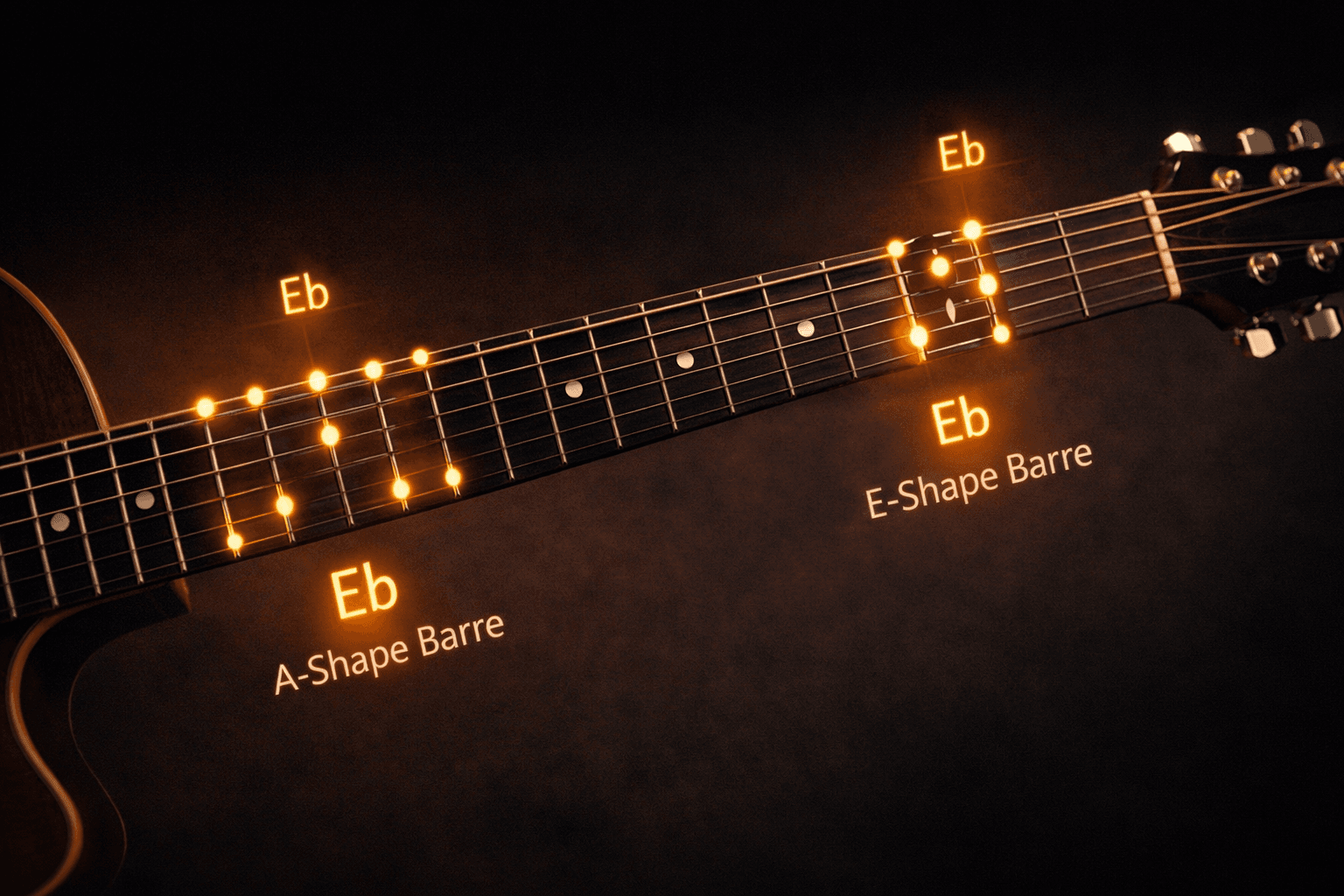 Eb major can be played across the neck using several shapes provided by the CAGED system.
Position Root Note Shape Type Position 1 6th fret A string Barre A-shape Position 2 11th fret E string Barre E-shape Position 3 8th fret G string Movable Triad Position 4 13th fret D string Movable Inversion Position 5 15th fret A string Movable High Voicing
Learning these chord positions improves fretboard awareness and builds harmonic versatility.
Alternate Voicings and Extensions
Advanced Eb major chord variations include:
Each variation alters the chord’s color, expanding its emotional depth and allowing players to craft unique textures in songwriting, arranging, and improvisation.
Play This Chord With Other Roots
Once you master the Eb major barre shape, you can slide the same form along the fretboard to create:
F major, G major, Ab major, Bb major, C major, D major, etc.
This skill is central to the CAGED system and allows guitarists to play in any key without memorizing hundreds of independent chord shapes.
How to Build the Eb Major Chord on Guitar
Building the Eb major chord involves locating every Eb, G, and Bb on the fretboard and arranging them into playable shapes. This leads to an understanding of:
Learning this process deepens harmonic knowledge and improves improvisation and songwriting skills.
Tips to Master the Eb Major Chord
Exercise Duration Goal Eb Barre Strength 5 mins Improve barre control Eb – Ab – Bb Transitions 10 mins Smooth chord changes Eb – Cm – Ab – Bb Progression 10 mins Improve rhythm flow
Additional Tips
Consistency builds confidence and accuracy.
Troubleshooting Common Problems
Guitarists often encounter:
Small adjustments in technique, posture, thumb alignment, and finger curvature resolve these issues gradually.
Advanced Applications of the Eb Major Chord
Eb major becomes especially exciting in advanced musical contexts:
These techniques expand your harmonic vocabulary and unlock deeper musical creativity.
FAQ About the Eb Major Guitar Chord
Is Eb major difficult to play on guitar?
Yes, because it requires barre chords. With practice, the chord becomes much easier to execute cleanly.
What notes make up the Eb major chord?
The Eb major chord uses Eb (root), G (major third), and Bb (perfect fifth).
Which chords sound good with Eb major?
Ab, Bb, Cm, Fm, and Gm complement Eb major in common progressions.
How can beginners simplify the Eb major chord?
Use three-note triads on the top strings or play the shape higher on the neck for reduced tension.
What is the difference between Eb major and Eb minor?
Eb major features Eb–G–Bb, while Eb minor uses Eb–Gb–Bb, giving it a darker emotional tone.