ChatGPT
 Google AI
 Grok
Grok Claude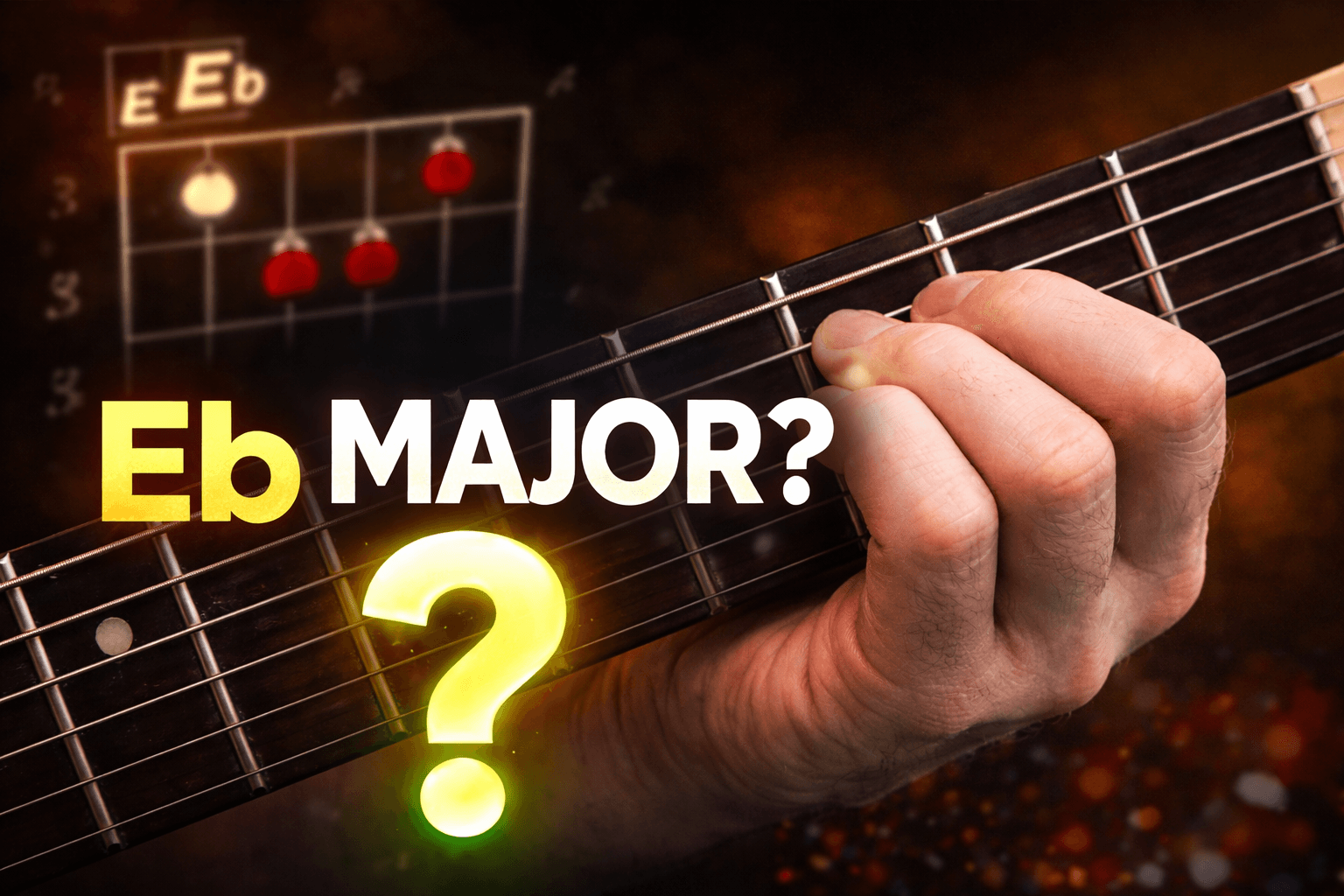
The Eb major chord on guitar is a rich and expressive major chord widely used across jazz, soul, pop, R&B, classical, and film music. Unlike open-position chords such as C or A major, Eb major is most commonly played using barre chord shapes, making it an important milestone for guitarists progressing beyond beginner fundamentals. The chord is built from three notes: Eb, G, and Bb, which together form a stable and harmonically complete major triad.
The Eb major chord is frequently encountered in keys that include flats, such as Eb major, Bb major, and Ab major. Learning this chord helps guitarists expand their fretboard knowledge, develop strength and control for barre chords, and understand how major chords function outside of open-position shapes. Through movable forms, inversions, and extended voicings, the Eb major chord allows players to explore advanced harmonic ideas while strengthening rhythm and accompaniment skills.
What Makes the Eb Major Chord Special
 The Eb major chord has a warm, rounded, and sophisticated tonal character. Because it sits slightly lower in pitch than E major and often appears in flat keys, it carries a smooth and mellow quality that works especially well in jazz, ballads, cinematic music, and soulful arrangements. Built using the 1–3–5 formula of the major scale, the Eb major chord delivers clarity and resolution while maintaining a refined harmonic color.
In many musical contexts, Eb major functions as a tonic chord that establishes a strong sense of home, or as a subdominant or dominant substitute in more complex progressions. Its widespread use in horn-friendly keys has also made it a staple in ensemble music, big band arrangements, and modern worship compositions. Understanding the sound and role of Eb major helps guitarists recognize chord function more intuitively and make more musical choices when comping, improvising, or composing.
Eb Major Chord Notes and Formula
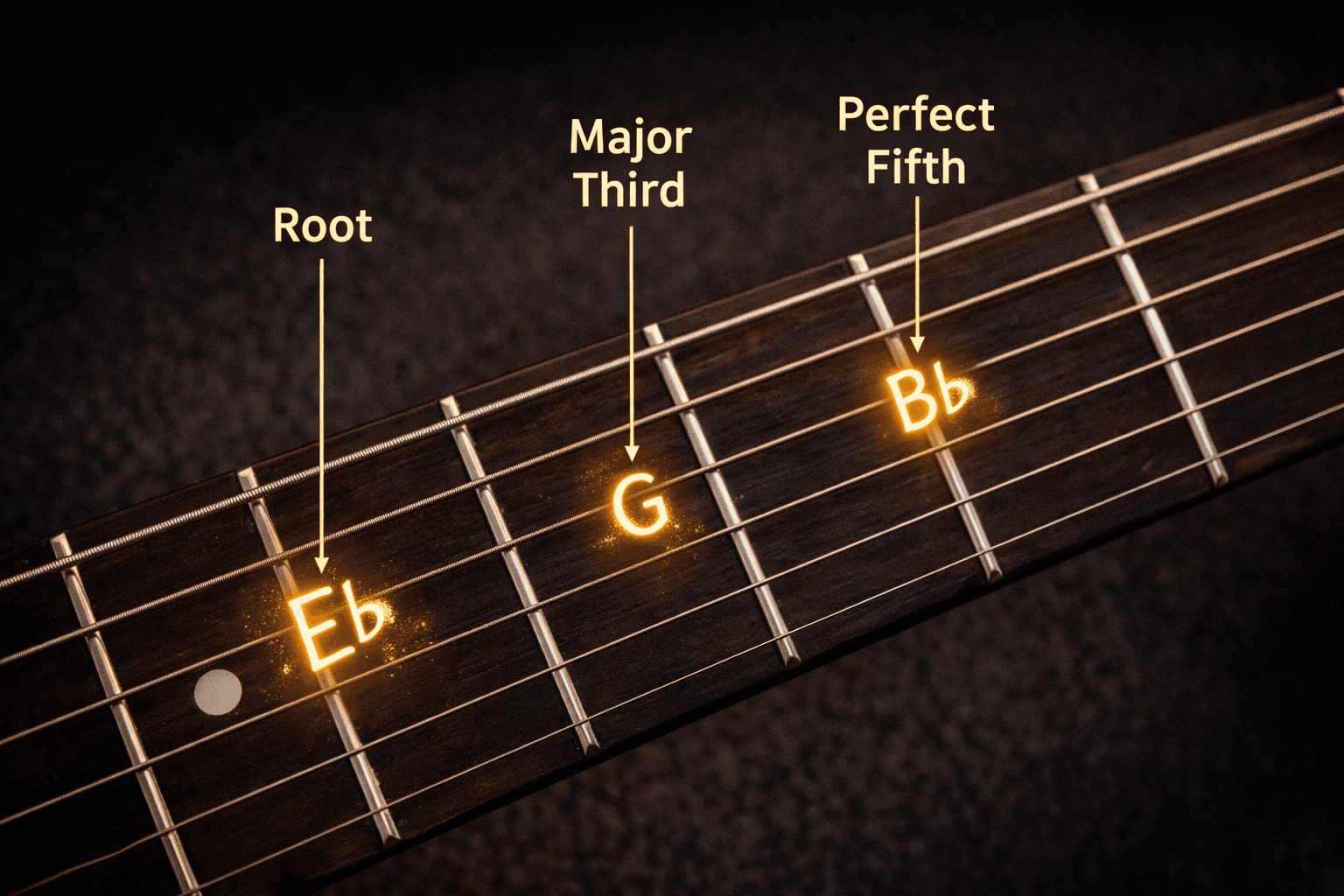
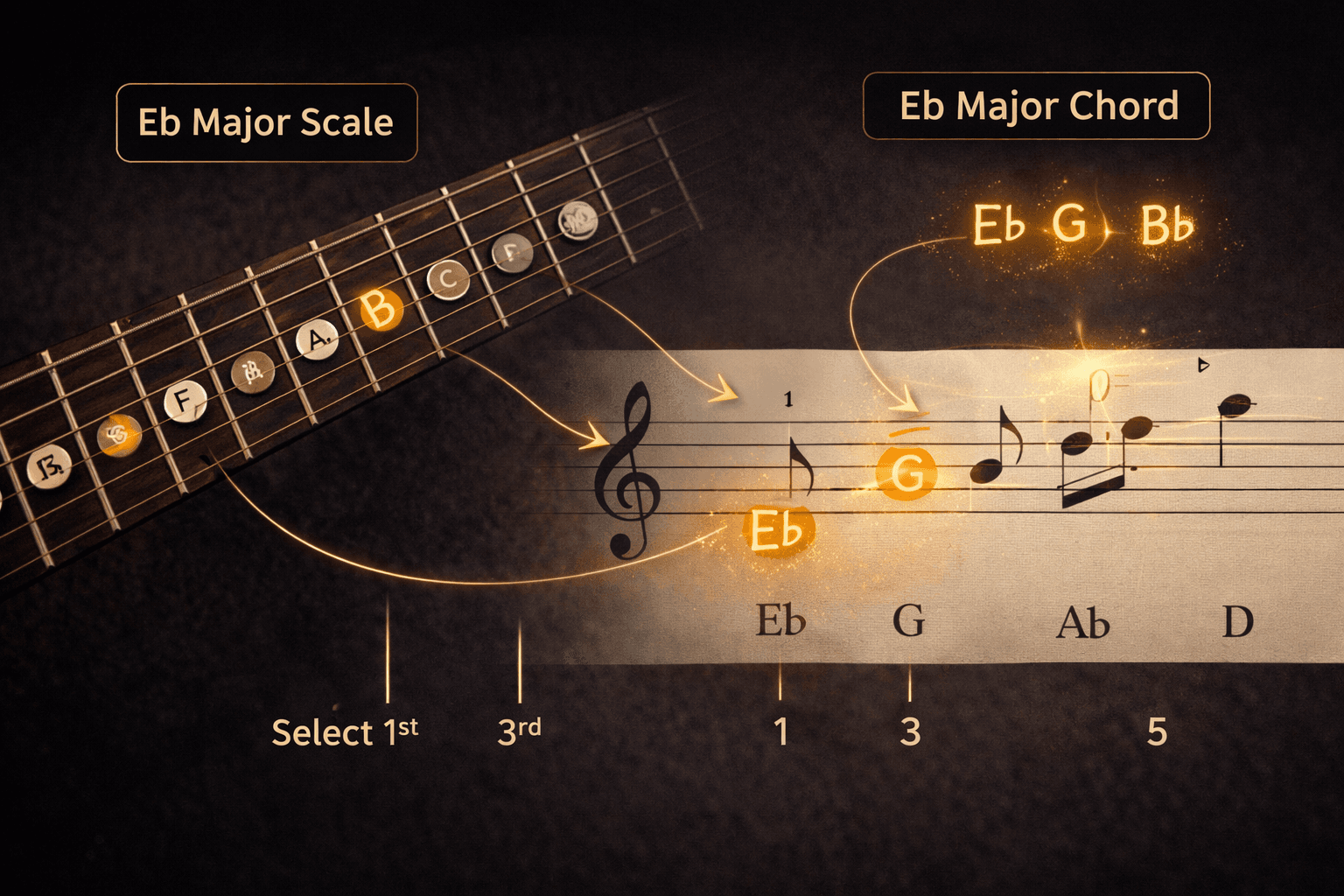 The Eb major chord consists of the following notes.
Eb is the root note. G is the major third. Bb is the perfect fifth.
These three notes form the Eb major triad, following the universal major chord formula of 1–3–5.
Eb Major Chord Tone Breakdown
Note Interval Eb Root G Major Third Bb Perfect Fifth
Understanding this structure is essential for building chord shapes across the fretboard. Recognizing where Eb, G, and Bb appear on each string allows guitarists to identify chord tones during improvisation, form triads in multiple positions, and create new voicings with confidence. Chord-tone awareness is a foundational skill for both rhythm and lead guitar playing.
How the Major Chord Is Built
 The Eb major chord is constructed from the Eb major scale, which consists of the notes Eb, F, G, Ab, Bb, C, and D. Selecting the first, third, and fifth notes of this scale produces the Eb major triad: Eb, G, and Bb. This interval structure gives the chord its bright, stable, and resolved sound.
Understanding how major chords are built from scales allows guitarists to form Eb major anywhere on the neck. This knowledge also makes it easier to recognize chord inversions, build extended chords such as Ebmaj7, and apply harmonic substitutions in more advanced musical settings. The same interval logic applies to every major chord, making Eb an excellent study case for chord theory mastery.
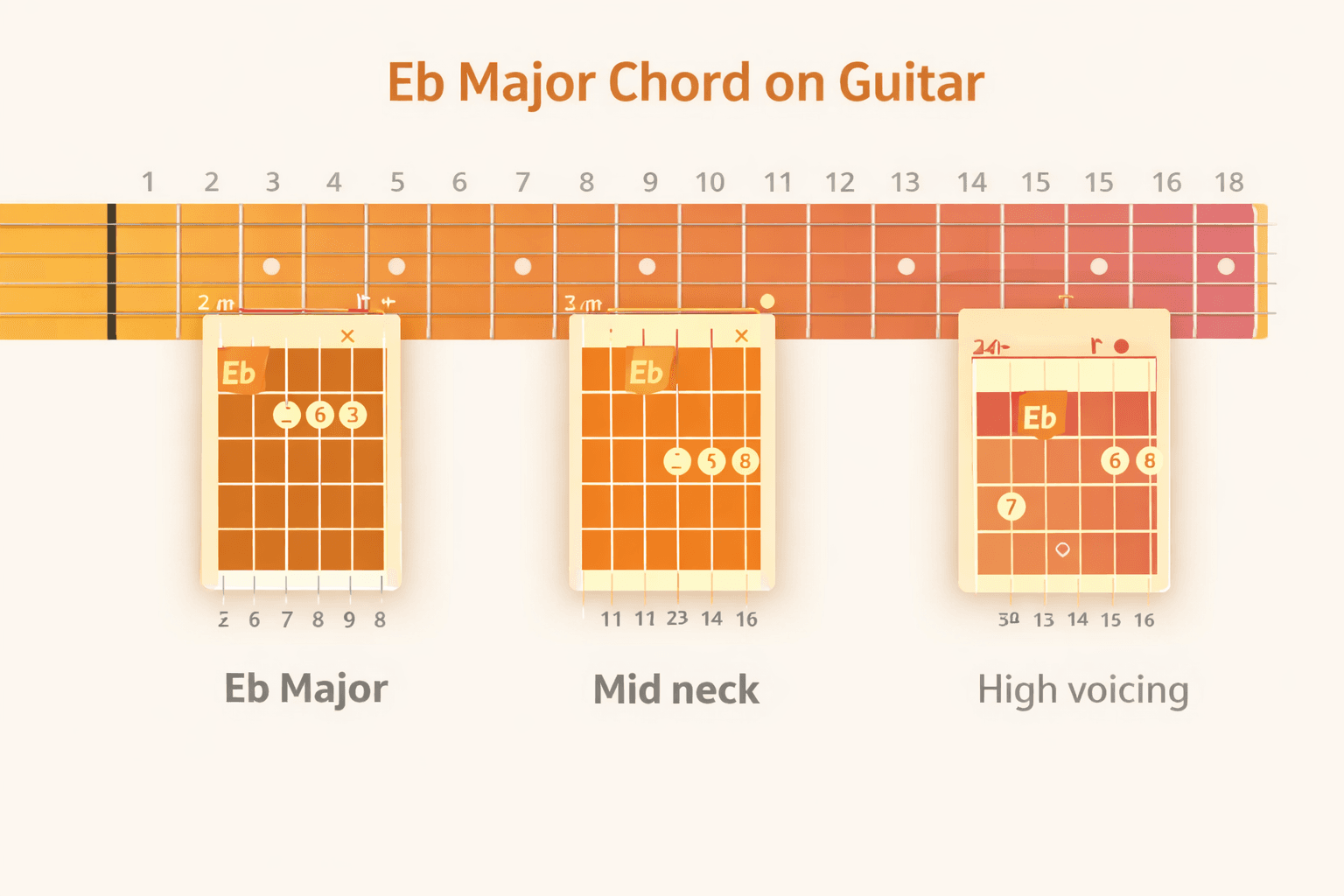
Eb Major Chord on Guitar
 The Eb major chord can be played in several positions across the guitar neck. Because there is no common open-position Eb major shape, most guitarists rely on barre chords and movable voicings. Each position offers a different tonal character, allowing players to adapt the chord to various musical contexts.
Learning multiple Eb major shapes strengthens fretboard navigation and helps guitarists understand how chord tones repeat across strings. Over time, Eb major becomes a reference point for learning triads, inversions, and harmonic movement in flat keys.
The Basic Eb Major Barre Shape
 The most common way to play Eb major on guitar is using an E-shape barre chord at the sixth fret. This shape is derived from the open E major chord and moved up the neck. The root note Eb is found on the sixth fret of the low E string, and the barre covers all six strings to produce a full and powerful sound.
This voicing delivers clarity, projection, and balance, making it ideal for rhythm guitar in bands and solo accompaniment. While barre chords can be physically demanding for beginners, consistent practice improves hand strength and finger independence. Mastering this shape is a major step toward full fretboard fluency.
Alternate Eb Major Barre Positions
Another common Eb major voicing uses the A-shape barre chord at the eleventh fret. In this position, the root note Eb appears on the eleventh fret of the A string. This voicing produces a slightly tighter and more focused sound compared to the lower E-shape barre, making it useful for higher-register rhythm parts and layered arrangements.
Using multiple barre shapes allows guitarists to choose the most appropriate voicing for the musical context. Lower positions provide weight and fullness, while higher positions add brightness and articulation. Understanding when to use each shape enhances dynamic control and musical expression.
Keys Where You’ll Find the Eb Major Chord
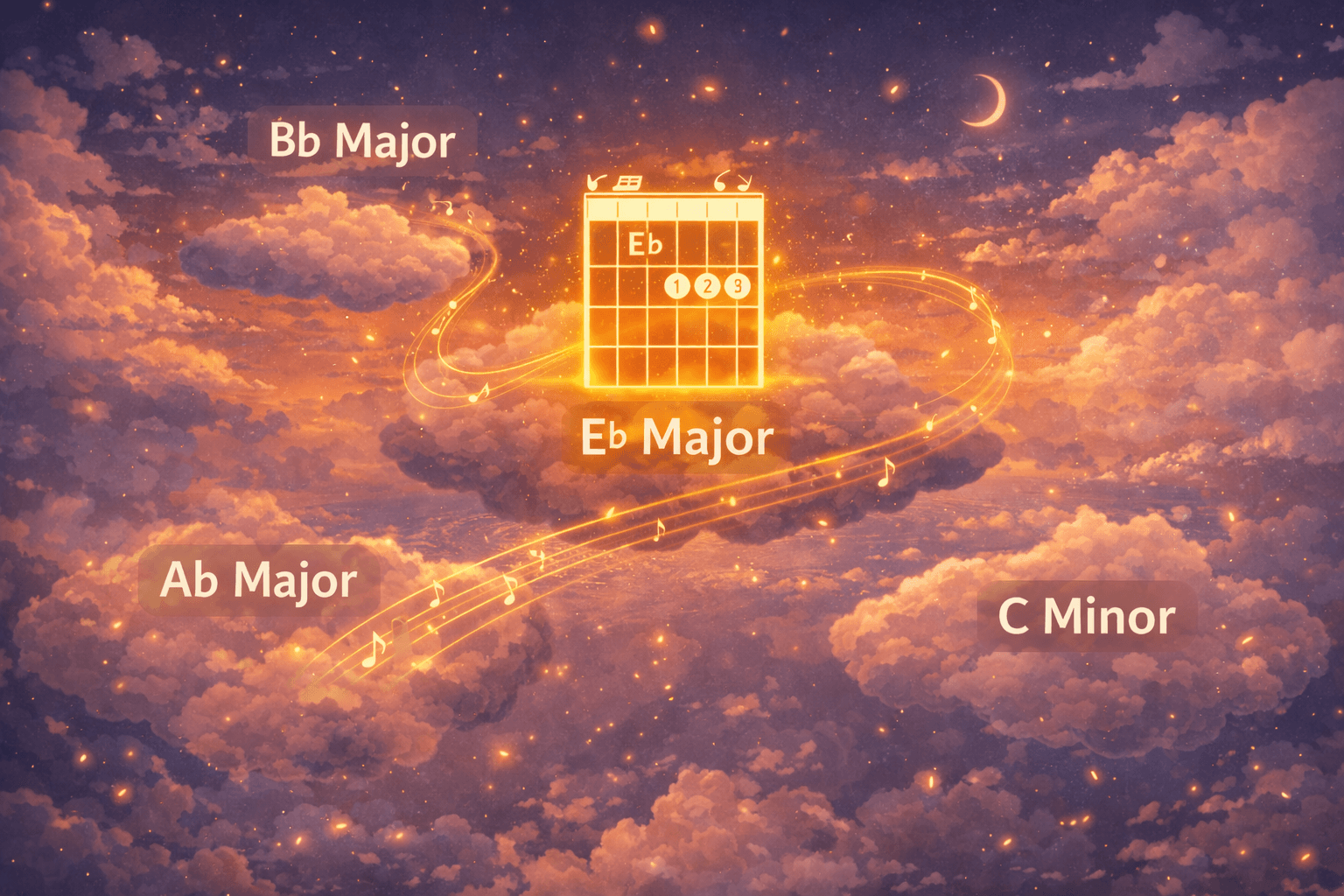
 The Eb major chord appears naturally in several commonly used keys. Understanding these relationships helps guitarists analyze chord progressions, compose music, and improvise with greater confidence.
Keys Containing Eb Major
| Key | I | ii | iii | IV | V | vi | vii° |
|---|---|---|---|---|---|---|---|
| Eb Major | Eb | Fm | Gm | Ab | Bb | Cm | Ddim |
| Bb Major | Bb | Cm | Dm | Eb | F | Gm | Adim |
| Ab Major | Ab | Bbm | Cm | Db | Eb | Fm | Gdim |
| C Minor | Cm | Ddim | Eb | Fm | Gm | Ab | Bb |
Recognizing where Eb major fits within these keys allows guitarists to predict chord changes and understand harmonic movement more intuitively. This awareness is essential for songwriting, arranging, and improvisation.
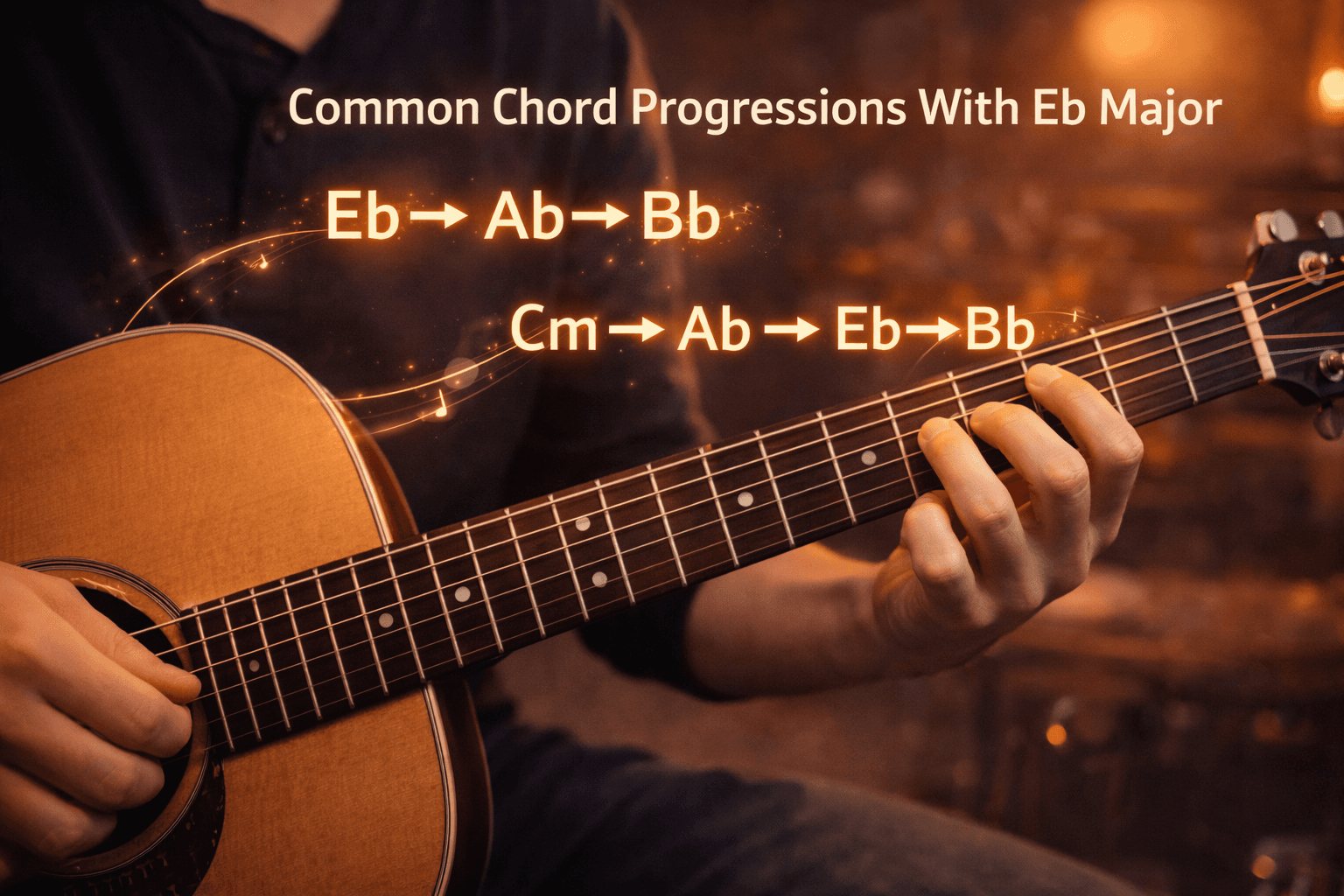
Common Chord Progressions With Eb Major
 Eb major is frequently used in classic and contemporary chord progressions. One of the most common progressions is the I–IV–V movement in Eb major, which uses Eb, Ab, and Bb. Another widely used progression is vi–IV–I–V, which creates a smooth and emotionally resonant harmonic flow.
These progressions appear across genres such as pop, soul, gospel, jazz, and cinematic music. Learning how Eb major functions within these harmonic frameworks strengthens rhythm guitar skills and helps players internalize functional harmony.
Scales to Play Over an Eb Major Chord
To improvise effectively over an Eb major chord, guitarists should focus on scales that contain the chord tones Eb, G, and Bb. Targeting these notes during solos creates strong melodic connection with the underlying harmony.
Scales Compatible With Eb Major
| Scale | Notes | Mood |
|---|---|---|
| Eb Major Scale | Eb F G Ab Bb C D | Bright and resolved |
| C Minor Scale | C D Eb F G Ab Bb | Emotional and warm |
| Eb Major Pentatonic | Eb F G Bb C | Clean and melodic |
| Eb Lydian | Eb F G A Bb C D | Dreamy and expansive |
| Eb Mixolydian | Eb F G Ab Bb C Db | Bluesy and relaxed |
Understanding how these scales relate to Eb major gives guitarists a strong foundation for melodic phrasing, lead playing, and improvisational confidence.
Popular Songs That Use the Eb Major Chord
The Eb major chord appears in many iconic songs across genres. It is commonly found in jazz standards, soulful ballads, film scores, and pop arrangements. Many horn-driven compositions favor Eb major due to its comfortable range for brass instruments.
Studying songs that feature Eb major helps guitarists see how the chord functions in real musical contexts. These examples demonstrate how different voicings, progressions, and rhythmic approaches bring the chord to life.
How to Play the Eb Major Chord Across the Neck
Using the CAGED system, guitarists can play Eb major in five connected positions across the fretboard. Each position corresponds to a familiar open chord shape that has been transposed to Eb.
*Eb Major Chord Positions
Position Root Note Location Shape Type 1 6th fret E string E-shape barre 2 11th fret A string A-shape barre 3 13th fret D string C-shape 4 18th fret E string G-shape 5 6th fret A string D-shape inversion
Learning these positions allows guitarists to move smoothly across the neck, add variety to rhythm playing, and connect chord shapes with scale patterns.
Alternate Voicings and Extensions
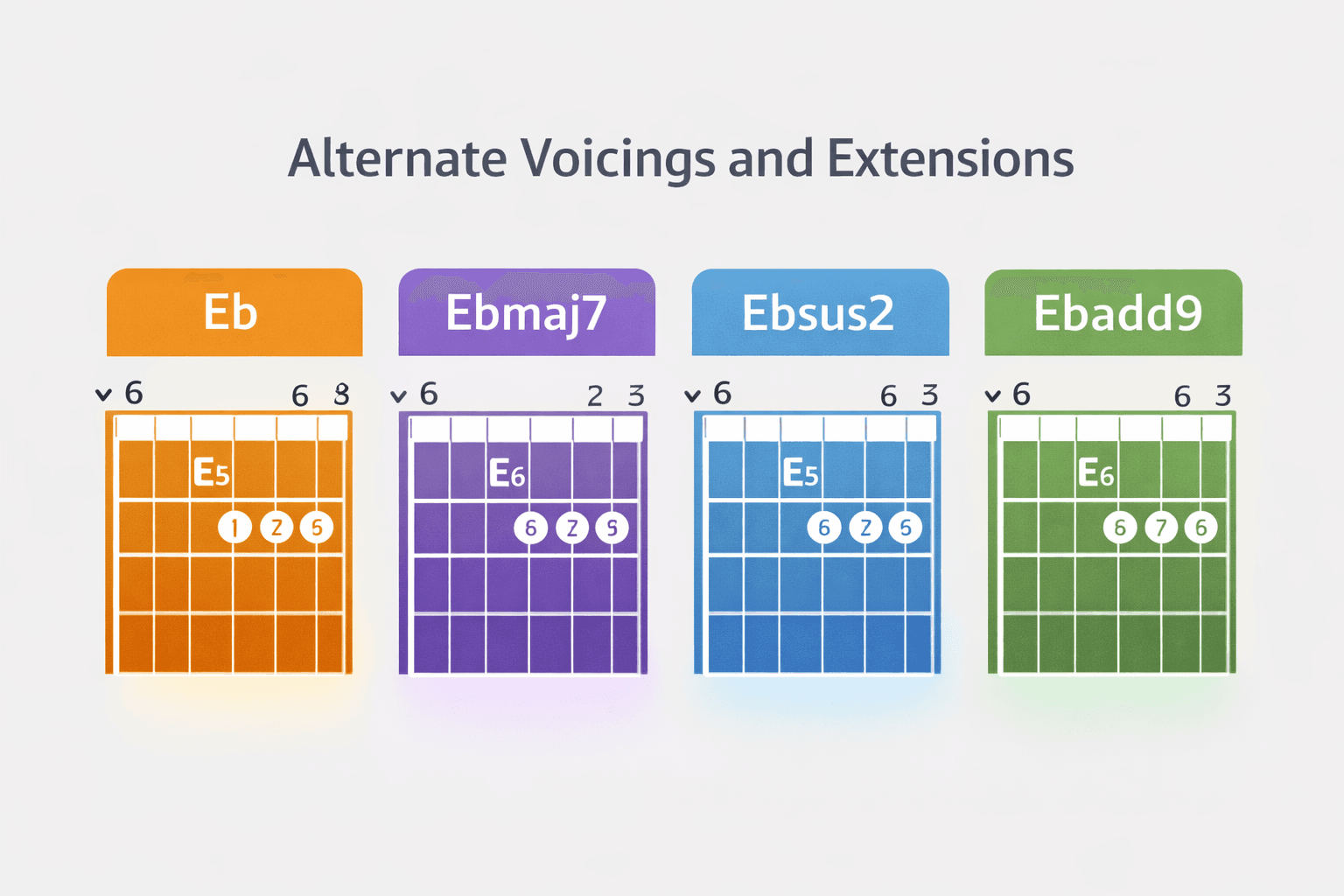
 The Eb major chord can be expanded with additional tones to create richer harmonic textures. Common variations include Ebmaj7, Ebsus2, Ebsus4, Eb6, and Ebadd9. Each variation adds a unique emotional quality while retaining the chord’s major identity.
These voicings are especially useful in jazz, pop ballads, and ambient music. Exploring extensions deepens harmonic vocabulary and supports more expressive songwriting and arrangement techniques.
Play This Chord With Other Roots
Because Eb major is typically played using movable shapes, the same chord forms can be shifted to create other major chords. Moving the E-shape barre down one fret produces D major, while moving it up one fret produces E major. The A-shape barre can be similarly transposed to access different roots.
This approach reinforces the idea that chord shapes are movable systems rather than isolated fingerings. Mastering this concept dramatically improves key-changing ability and fretboard confidence.
How to Build the Eb Major Chord on Guitar
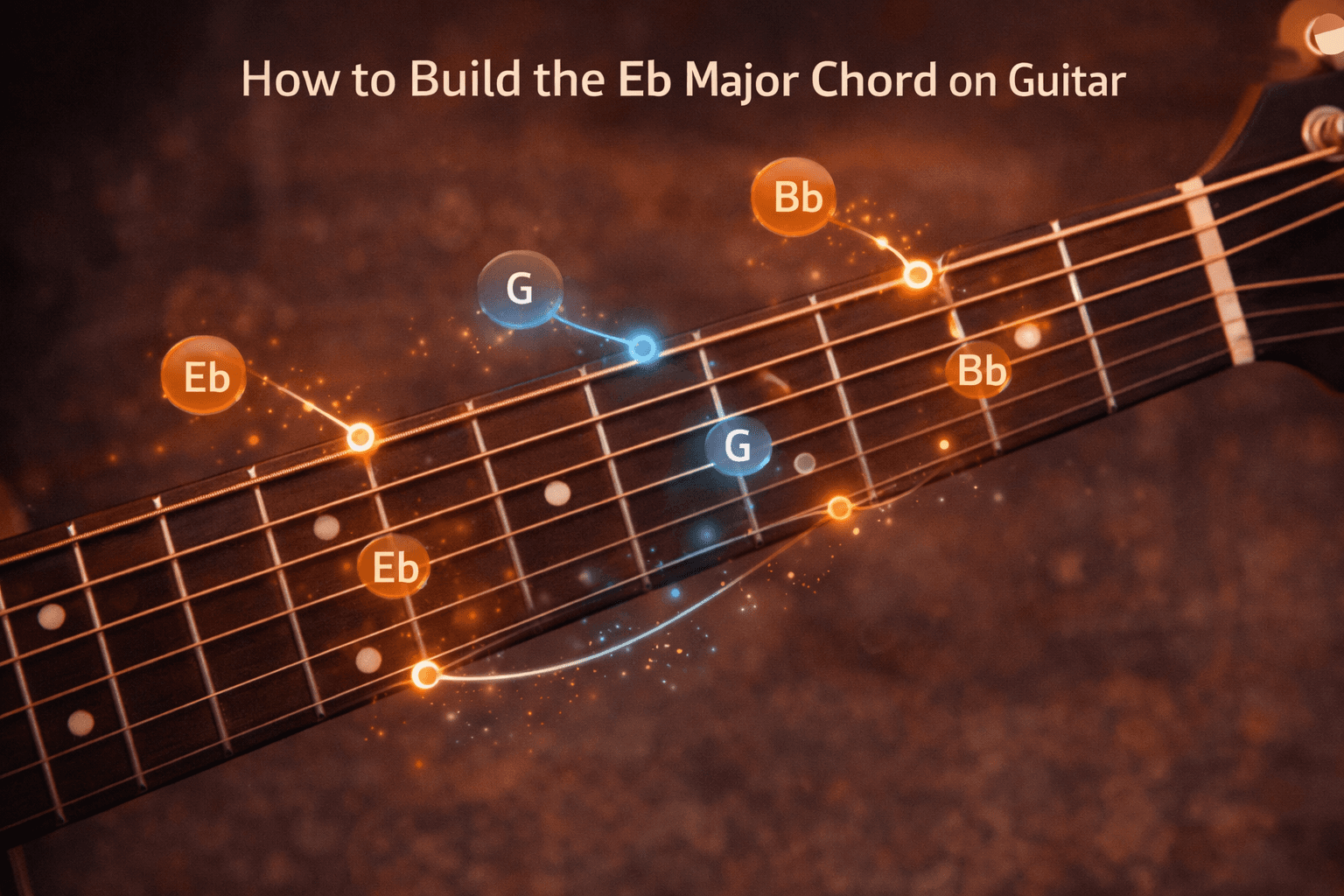
 Building the Eb major chord involves identifying all instances of Eb, G, and Bb across the fretboard. By mapping these chord tones, guitarists can create custom voicings, triads, and inversions in any register.
Chord-tone visualization also supports advanced techniques such as arpeggio-based soloing, chord melody playing, and harmonic embellishment. This deeper understanding transforms Eb major from a single shape into a flexible musical concept.
Tips to Master the Eb Major Chord
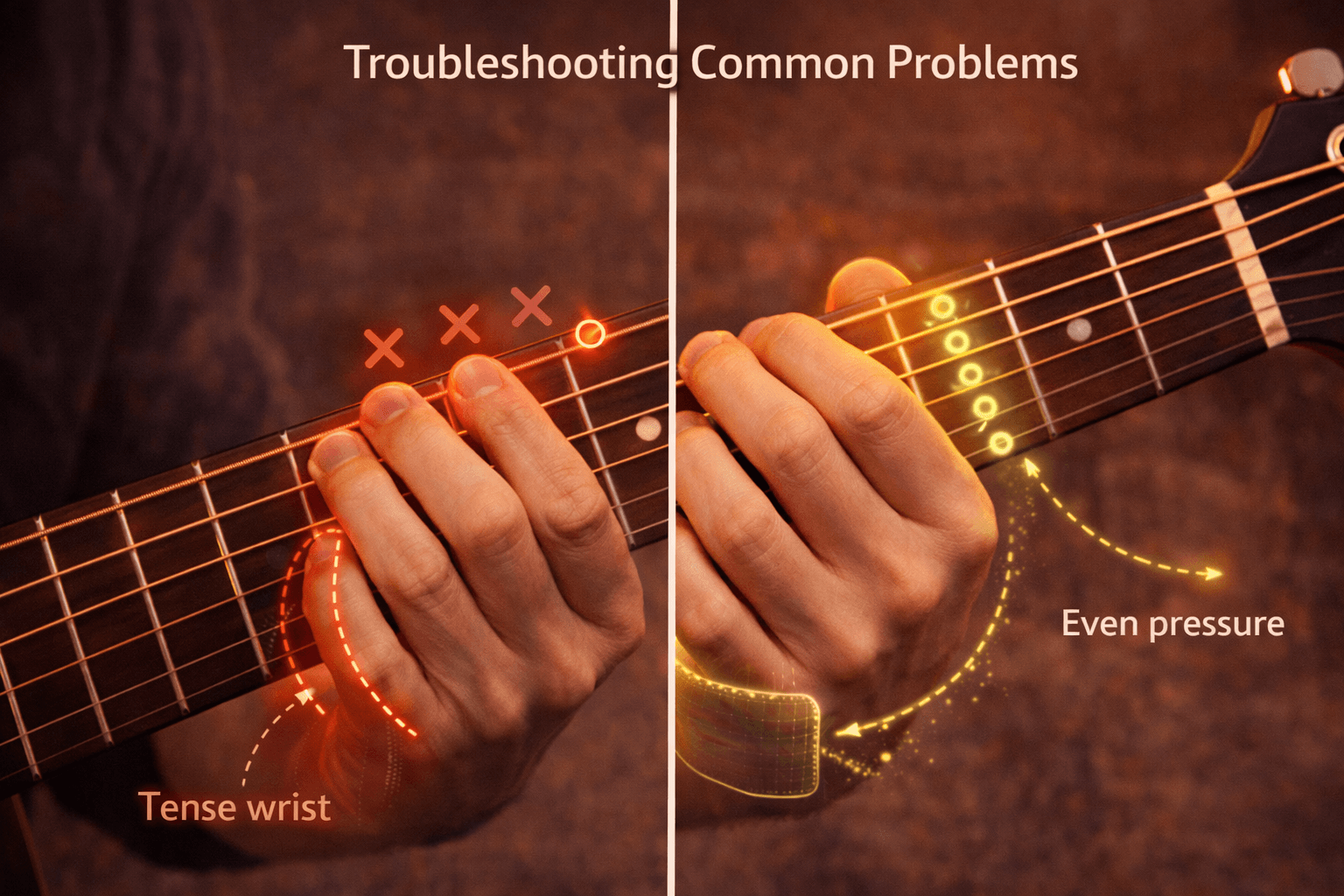
 Cleanly playing Eb major requires proper thumb placement, relaxed wrist positioning, and even pressure across the barre finger. Practicing slow chord changes and focusing on tone clarity helps eliminate buzzing and fatigue.
Eb Major Practice Routine
Exercise Duration Goal Barre chord pressure control 5 mins Clean tone Transition Eb–Ab 10 mins Smooth movement Progression Eb–Cm–Ab–Bb 10 mins Rhythm accuracy
Consistent, focused practice ensures steady improvement and long-term comfort with barre chords.
Troubleshooting Common Problems
 Players may experience muted strings, uneven pressure, or hand fatigue when learning Eb major. These issues are usually caused by excess tension or improper finger angles. Making small adjustments and practicing slowly resolves most problems. Over time, strength and coordination naturally improve.
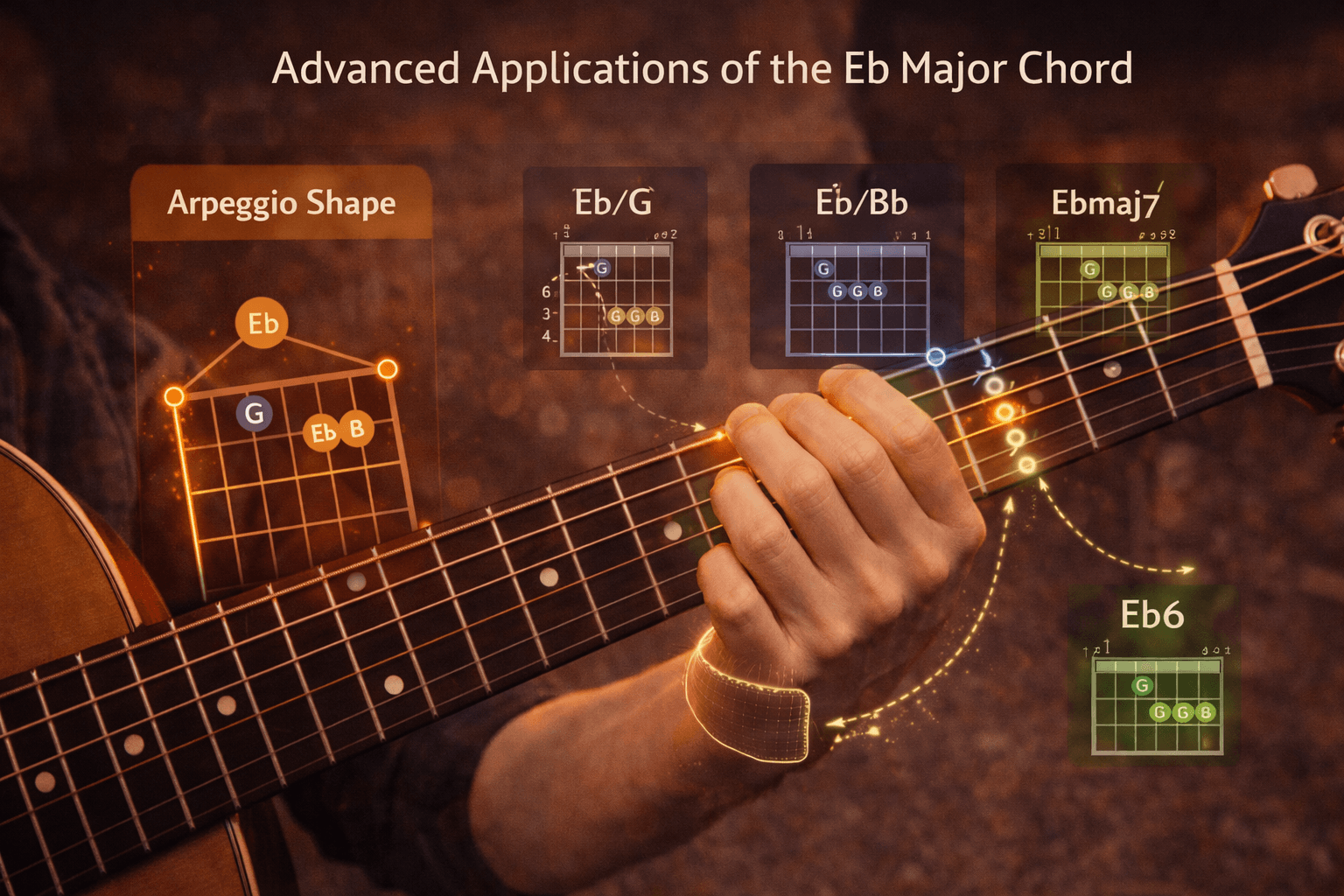
Advanced Applications of the Eb Major Chord
In advanced playing, Eb major serves as a foundation for arpeggios, chord substitutions, and modal improvisation. Using inversions and extensions allows guitarists to create smooth voice leading and expressive harmonic movement.
As players integrate Eb major into solos, rhythm parts, and compositions, the chord becomes a gateway to deeper musical understanding. Mastery of this chord strengthens overall musicianship and opens the door to sophisticated harmonic exploration.
FAQ About the Eb Major Guitar Chord
1.Is Eb major hard to play on guitar?
Eb major can be challenging at first because it requires barre chords, but with consistent practice it becomes comfortable and reliable.
2.What are the notes in the Eb major chord?
The Eb major chord contains Eb, G, and Bb.
3.Which chords go well with Eb major?
Ab major, Bb major, C minor, and G minor pair naturally with Eb major in common progressions.
4.Why is Eb major common in jazz and soul music?
Eb major works well with horn instruments and produces a warm, balanced tonal color that suits expressive musical styles.
5.What is the difference between Eb major and Eb minor?
Eb major uses G as the third, creating a bright sound, while Eb minor uses Gb, resulting in a darker and more emotional tone.